The Rust and the Reckoning: How a Century-Old Deed and a Worn Tractor Defied an Empire of Glass
CHAPTER 1: THE LINE IN THE DIRT
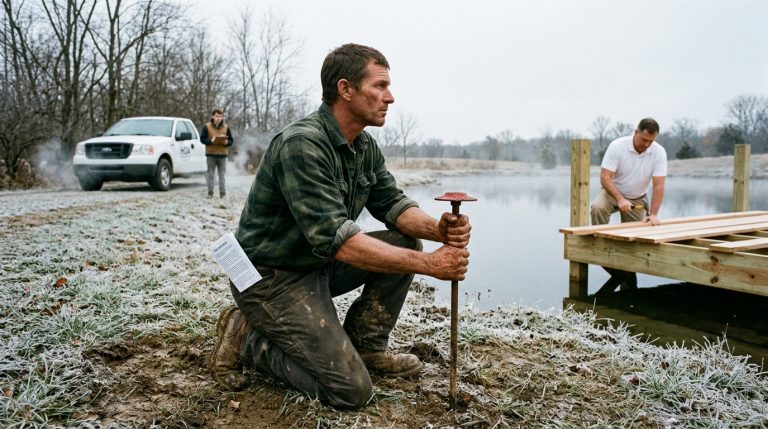
The soil of the rose garden did not yield easily; it was heavy with clay and packed with the stubborn root systems of old briars that had outlived two generations of McIntyres. John knelt in the damp gray earth, the knees of his dungarees dark and stiffened by years of moisture, his fingers wrapped around the handle of a three-tined hand cultivator that had belonged to his father.
To the east, the manicured emerald sweep of Whispering Pines Phase 4 rolled up to the very edge of his boundary like an artificial tide, held back only by the dry-stacked fieldstone wall his great-grandfather had laid stone by frost-heaved stone in the autumn of 1922.
“Your little patch of dirt is an eyesore, Major, and according to this bylaw, it’s now our patch of dirt.”
The voice cut through the steady hum of morning cicadas. John did not look up immediately. He finished working the earth away from a stubborn taproot, letting the dry crumbly soil settle between his knuckles, before slowly rising to his full height. His knees clicked with the familiar, dry snap of old timber, and a dull, grounding ache radiated outward from his lumbar—a permanent souvenir from a dirt runway in a province maps had long since forgotten.
At sixty-five, standing a head taller than the woman with the clipboard, John felt the weight of the air change.
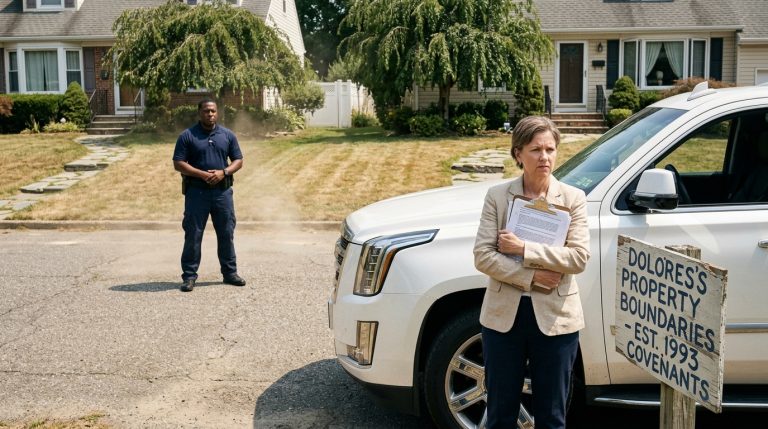
Karen Thompson stood on the opposite side of the moss-slick stones, her floral print dress a violent, synthetic splash against the muted cedar and pine of the five-acre homestead. Tucked against her chest like a parish hymnal was a heavy three-ring binder, its clear plastic cover bulging with color-coded tabs. Behind her, half-hidden by the manicured perfection of a neighbor’s hybrid tea roses, Gerald shifted his weight from one boat-shoed foot to the other, his eyes fixed firmly on the ground as if inspecting for ants.
“This patch of dirt,” John said, his voice dropping into the low, measured register he had once used to brief battalion commanders, “has been the McIntyre homestead for over a hundred years. It has never answered to a board of directors, and it never will.”
Karen let out a short, sharp bark of laughter—a sound remarkably like a startled poodle. “Oh, that’s charming, Major. Truly. But local ordinances don’t care about your family album. The developer who scraped together Phase 4 went belly-up during the municipal bond crunch three years ago. In the bankruptcy liquidation, the master covenants were assigned wholesale to our association. That includes every unincorporated pocket, unplotted lane, and orphaned lot within the original survey lines.” She tapped a crimson-lacquered fingernail against the binder’s plastic spine. “That means you.”
She smiled then, a small, predatory curving of the lips that lacked any trace of warmth.
“So here are your terms. You have twenty years of back dues, administrative late fees, and non-compliance penalties sitting at ninety-two thousand, four hundred and fifty dollars. You can write a check today, tear down that rusted-out eyesore of a tractor by your barn, and bring this property into aesthetic compliance. Or we place a structural lien against the deed by Friday noon.”
John looked past her shoulder toward the weathered cedar of the barn. Propped against the sliding door sat the stripped chassis of the 1953 Farmall, its gray iron frame coated in a fine layer of orange scale, waiting for the hands of a son who was currently three thousand miles away guarding a stretch of sand. The tractor was not an eyesore; it was an anchor.
“And if I do neither?” John asked softly.
“Then we foreclose,” Karen said, her voice dropping into a flat, bureaucratic finality. “And we bulldoze the roses.”
She turned on her heel, her floral hem swishing against the manicured turf as she gestured for Gerald to follow. John watched them go, his gaze tracking the precise line where his dry earth met their chemical green, his hand dropping automatically to the small, rusted iron latch of the garden gate, only to find the lower hinge pin missing—silently slipped from its socket during the night.
CHAPTER 2: THE ROLLTOP DESK AND THE IRON GALL INK
The air inside the hallway felt cooler, stripped of the heavy afternoon glare that beat down upon the neglected rose garden. John let the screen door latch itself with a dull, familiar click, his boots striking the wide-plank pine flooring with a rhythmic, measured cadence. The rage that Karen Thompson’s parting threat had sparked in his chest did not flare into wild heat; instead, it compressed into a dense, cold ballast sitting low in his ribs. Rage was a poor tool for construction, but it made an excellent anchor.
He walked past the framed photograph of his son in dress blues, pausing only long enough to adjust the frame back by a millimeter where the vibration of the slamming door had crooked it. Then he entered his study.
The room smelled of dry paper, aged walnut oil, and the faint, coppery scent of old iron. In the corner sat the massive rolltop desk that had belonged to his grandfather—a piece of furniture scarred by decades of dropped coffee mugs, ink splatters, and the deep, gouging scratch where a stubborn drawer had once been forced open with a screwdriver. John pulled out the oak captain’s chair, the wooden rollers protesting with a dry screech against the floorboards.
As he seated himself, his eyes drifted to the brass handle of the bottom-left drawer. The varnish there was worn completely through to the pale grain of the wood, polished smooth by the nervous friction of his father’s thumb during the municipal zoning fights back in the nineteen-seventies, and later by his own during the lean years following the mill closure.
V-2 Execution: A sudden, sharp memory flared behind his eyelids—the smell of damp wool and pipe tobacco, and his father’s voice echoing off the plaster walls during a similar twilight sixty years prior: “They won’t come with torches, Johnny. Men like that don’t need fire. They come with paper and ink, and they make you feel like the criminal for standing on your own porch.”
John blinked, clearing the phantom smoke from the room, and reached down. He pulled the deep drawer outward until it hit the internal stop, then tilted the front upward to release it from the runners, setting it carefully across his knees.
Reaching into the dark, empty cavity at the back of the desk housing, his fingertips brushed against cold, oiled metal. He hooked his index finger into the ring of a long, heavy aluminum canister, the kind used by artillery surveyors to protect topographical maps from monsoon mud. With a soft, pneumatic hiss of displaced air, the threaded brass cap broke loose, yielding to a faint puff of stale air preserved for half a century.
He tipped the canister forward. Into his palm slid a tightly rolled cylinder of heavy, cream-colored parchment, bound by a faded red ribbon that had turned the color of dried rust at the knots.
Laying the parchment across the polished walnut surface of the desk, John did not immediately untie the ribbon. Instead, he reached into his shirt pocket, pulled out a pair of wire-rimmed reading glasses, and hooked them over his ears. Only then did his calloused thumb slip beneath the ribbon, easing it free without tearing the brittle fibers.
The document unrolled with a dry, whispering rustle, the outer edges curling upward like autumn leaves seeking the sun. It was dated October 14, 1922. The script was rendered in permanent iron gall ink—an ink that had bitten deep into the rag paper, shifting over the decades from a rich blue-black to a stark, sepia-toned rust that matched the soil outside.
Be it known, the copperplate handwriting declared, sweeping across the page with nineteenth-century flourishes, that the five-acre parcel designated as the McIntyre homestead is hereby and in perpetuity excluded from any and all covenants, restrictions, or encumbrances…
John traced the familiar lines with the tip of his finger, feeling the microscopic ridges where the steel nib had pressed heavily into the damp paper a hundred years ago. His great-grandfather Angus had not been a learned lawyer; he was a stonemason who spoke English with a broad, flat Clydeside burr and trusted a handshake more than a magistrate. But Angus had understood the arithmetic of greed. He had seen the valley bottoms swallowed up by timber syndicates and railway barons. When Silas Blackwood came offering gold for the surrounding five hundred acres of scrub pine and rolling pasture, Angus had taken his payment, but he had insisted on a very specific, poisonous clause in the margins.
A clause that Karen Thompson and her three-ring binder had completely failed to uncover during their hurried, cost-cutting title search.
John leaned back in the creaking chair, the leather groaning under his weight, and looked past the desk lamp toward the darkened window. Out there, beyond the glass and the stone wall, the manicured lawns of Whispering Pines lay under the rising moon, completely unaware that they were built upon a fault line.
He reached for the telephone base sitting on the corner of the desk, his fingers hovering over the keypad before pressing the speed-dial button for his daughter. It was time to start laying down the first layer of gravel on the road back.
CHAPTER 3: THE PAPER SIEGE
The morning sun had barely crested the ridge of the eastern woodlot when the first pink notice manifested. John stepped off the back porch with a mug of black coffee, his eyes scanning the perimeter of his property line out of long-established habit. Nailed to the peeling white paint of the front screen door with a strip of cheap, amber-tinted packaging tape was a rectangle of garish, neon-magenta cardstock.
The tape had been pressed down hard enough to pucker the paper, leaving a sticky, chemical residue across the wood. John did not pull it down immediately. He stood on the top step, the steam from his mug curling lazily into the crisp morning air, studying the placard as if it were a marker left by surveyors in contested territory.
Violation Notice 7.4a, the black stencil read in block letters. Unmaintained landscape. Excessive overgrowth of localized weed flora (Taraxacum officinale) within forty feet of public right-of-way. Fine assessed: Fifty dollars ($50.00). Dues multiplier active.
John took a slow sip of the coffee, tasting the bitter chicory bite he preferred, and walked down the steps. The dandelions in question—a dozen small, golden heads pushing stubbornly through the dry, gravelly dirt near the shoulder of Old Mill Road—were little more than a momentary distraction for a bumblebee. Yet to the bureaucracy governing Whispering Pines, they were an assault on real estate values, a microscopic blemish on the engineered perfection of the suburban fringe.
V-3 Execution: A sudden gust of dry wind swept down from the hills, rattling the loose galvanized metal sheeting on the old tractor shed with a sharp, tinny clatter. The sound grated against his nerves, a reminder that the perimeter was constantly exposed, vulnerable to the incremental friction of petty authority.
He did not reach for a weeding tool or a trowel. Instead, he walked back inside the dim quiet of the house, fetched his digital camera from the top drawer of the sideboard, and returned to the porch. He spent twenty minutes documenting the infraction with the clinical precision of an ordnance inspector. He photographed the dandelions from ten feet back to show scale, from three inches away to capture the seed heads, and finally wide enough to include the weather-beaten grain of the barn wall in the background. Then he went to his desk, pulled out a fresh manila folder labeled HOA Correspondence: Phase One, and slipped the pink card inside next to a printed log sheet.
The second notice arrived four days later, slipping through the mail slot like an unexploded shell. This time, the grievance was architectural.
Violation 9.2c: Unapproved boundary containment material. The fine had doubled to one hundred dollars, citing the ancient, dry-stacked fieldstone wall that bordered the northern pasture. According to the board’s architectural guidelines, fencing within the development footprint required pre-approval, uniform height standards, and construction in vinyl, treated cedar, or wrought iron. A wall built by a Scottish stonemason using glacial drift rocks hauled out of the creek bed in nineteen-twenty-two apparently failed to meet municipal aesthetic standards.
John walked out to the wall that afternoon, his fingers tracing the cold, lichen-crusted surface of a granite boulder near the corner post. The stone was cold, damp with the residual mist of the night before, and anchored so deeply into the clay that centuries of frost heave had barely shifted its alignment.
“Unapproved material,” John muttered to the empty pasture, a dry, humorless sound escaping his throat.
He pulled out his notebook, jotted down the exact time, and took a fresh series of photographs, capturing the deep time-worn patina of the stone, the soft green moss nestled in the hairline fractures, and the absolute permanence of a structure that had outlived three generations of municipal planners.
By the end of the second month, the paper war had evolved into a predictable cadence. A pink slip arrived every Tuesday; a formal, polite rejection letter drafted on his own typewriter went out every Thursday via certified mail, carrying a return receipt card that cost him four dollars and sixty cents a pop. The stack of green postal slips grew inside his desk drawer, forming a neat, interleaved deck of cardboard bricks.
Sarah drove out every Saturday, her briefcase loaded with legal pads, municipal code printouts, and photocopies of county tax maps. They sat at the heavy oak dining table under the amber glow of the brass pendant lamp, mapping the enemy’s movements with cold, tactical detachment.
“She’s building toward a judicial foreclosure petition, Dad,” Sarah said, tapping the corner of a pink citation with the eraser end of a yellow pencil. Her eyes were sharp, ringed with the fatigue of a paralegal working seventy-hour weeks in the city, but her voice carried a hard, steady edge. “Every unpaid fine is logged as an accrued debt against the parcel tax ID. Once the total crosses a statutory threshold, she can petition the county court for a summary lien enforcement, arguing that you’re an abandoned or delinquent parcel endangering the community association’s financial charter.”
John poured two cups of coffee, sliding one across the polished wood toward his daughter. “Let her cross the threshold,” he said, his voice flat and level. “A structure built on bad math always collapses when you pull out the corner stone.”
“The math is solid on her end if we don’t present the deed,” Sarah cautioned, leaning back in her chair and crossing her arms. “Judges in these suburban districts hate unkempt lawns. If we just ignore her, she’ll get a default judgment signed by a sympathetic magistrate before we even reach trial.”
“We aren’t ignoring her,” John said, tapping the corner of the manila folder where the certified mail receipts were paperclipped. “We’re letting her overextend her supply lines. Every notice she mails is a signed confession of harassment. Every dollar she adds to that fictitious balance sheet is another brick in the wall she’s building around herself.”
He reached out and touched the corner of the protective plastic sheet covering the original 1922 master deed lying safely in the center of the table. The iron gall ink remained dark, silent, and patient under the light.
“She thinks she’s running an empire,” John added quietly, his gaze fixed on the faint, spidery script of his great-grandfather’s signature. “She doesn’t realize she’s standing in a minefield.”
CHAPTER 4: THE TOW TRUCK AT THE FENCE LINE
The morning air outside the screen door carried the sharp, dry tang of scorched August weeds and the heavy, sweet rot of fallen apples baking in the grass beneath the orchard trees. John stepped off the back porch just as the low, guttural rumble of a heavy-duty diesel engine shuddered through the upper pasture. It was not the familiar, rhythmic chug of a tractor or the hum of a passing delivery van; it was the deep-chested, pressurized growl of a commercial tow rig shifting down into a low gear.
He did not break into a run. Hurrying invited mistakes, and mistakes were the currency of a panicked opponent. Instead, he maintained his measured, deliberate stride across the hard-packed gravel of the drive, his boots crunching against the gray stone until he reached the open gap in the old cedar post fence where his dirt lane met the paved ribbon of Whispering Pines’ outer ring road.
A massive, dual-axle flatbed tow truck sat idling squarely across his property line, its tires biting deep into the soft, unpaved sod of his pasture and leaving fresh, black scars of churned earth in the green. Yellow emergency strobes mounted on the truck’s cab flashed in lazy, synchronized bursts against the bright morning glare.
Behind the wheel sat a man in a greasy blue jumpsuit, his forearm resting out the rolled-down window as he consulted a crumpled work order clipped to the visor. A few yards away, a heavy steel winch cable unspooled with a dry, metallic rattle, dragging across the grass toward the rusted, chassis of the 1953 Farmall resting by the barn doors.
“Hold it right there,” John said.
His voice was not loud, but it cut through the diesel exhaust note with the cold, flat authority of a plumb line.
The driver glanced up, his eyes meeting John’s over the hood of the flatbed. He was a man in his late thirties with a shaved head and a bored, transactional expression—the look of someone accustomed to hauling abandoned sedans out of apartment complexes and parking lots without asking questions. He shifted his chew from one cheek to the other before opening the door and stepping down onto the ruined turf.
“Got a work order right here, old man,” the driver said, tapping the paper in his hand. “Signed directive from the Whispering Pines Homeowners Association executive committee. Abandoned property, unpermitted storage in public view. My job is to winch it onto the flatbed and haul it to the impound lot off County Road Twelve.”
V-4 Execution: As the driver spoke, a sudden, erratic skip in the diesel engine’s idle caught John’s ear—a faint, rhythmic stutter in the fuel pump that mirrored the underlying instability of the man’s legal authority.
“That machine is not abandoned,” John replied, stepping forward until he planted his boots firmly across the boundary where the crushed gravel ended and the native pasture began. “And this is not association property. You are standing on private land without a warrant, attempting to remove a registered family asset. If that cable touches so much as an inch of paint on that tractor, I will name your employer, your insurance carrier, and yourself individually in a civil action that will strip every asset your company owns down to the chassis bolts.”
The driver stopped dead, a few feet from the boundary line. He looked down at the churned mud beneath his work boots, then across at the weathered face of the old soldier standing unyielding in the dust. The boredom in the man’s eyes flickered, replaced by the sudden, sharp calculation of a working man realizing his boss had lied to him about the liability.
“Look, man,” the driver muttered, raising his hands slightly palms out. “I just get a dispatch slip from the association management desk. They told me it was a standard public right-of-way clearance. They didn’t say nothing about private titles or court orders.”
“They lied to you,” John said quietly. “And if you drop that winch hook onto my tractor, you’ll be paying for the lawyers out of your own pocket when the sheriff’s deputies arrive.”
Before the driver could answer, a bright red electric golf cart rounded the bend of the paved road with a sharp squeal of turf tires. Karen Thompson sat at the steering wheel, her floral print dress taut across her chest, her jaw set into a hard, unyielding line. Gerald occupied the passenger seat, staring fixedly at the dashboard as if reading a prayer book.
The cart skidded to a halt on the gravel. Karen threw the selector into park and stood up before the cart had even finished rocking.
“What is the hold-up, Rick?” she demanded, her voice shrill and carrying across the pasture. She glared past the driver toward John, her eyes narrowing into bright, hard beads. “We didn’t pay for a consultation, we paid for a removal. Hook the chain up and haul that piece of junk out of here before I report your company for breach of contract.”
Rick looked from Karen to John, the choice between an angry suburban president and a stony-faced property owner becoming starkly clear. He took a slow step backward toward his truck cab, deliberately hooking his thumbs into his utility belt.
“Ma’am,” Rick said, his voice dropping flat. “My dispatcher didn’t mention nothing about private title disputes. Until you show me a judge’s signature on a writ of replevin, my winch stays on the spool. I’m not catching a grand theft charge for a neighborhood committee.”
Karen’s face mottled from pale peach to a deep, bruised crimson. “You are under contract with this association! You will do as you are told—”
John did not wait for her tirade to peak. He pulled his phone from his shirt pocket, his thumb moving with practiced, mechanical efficiency to dial three digits, his gaze never leaving the furious, trembling posture of the woman standing by the golf cart.
CHAPTER 5: THE BADGE AND THE BOUNDARY
The digits three-one-one registered on the small monochrome screen of John’s phone before he pressed it flat against his ear, his eyes remaining locked on the frantic, twitching motion of Karen Thompson’s fingers as she clawed at the steering wheel of the golf cart.
“County emergency dispatch,” a calm, flat voice answered on the line. “State your location and the nature of your emergency.”
“This is Major John MacIntyre, retired,” John said, his voice carrying clearly across the quiet space between the flatbed truck and the fence line. “I’m reporting an active trespassing violation and an attempted motor vehicle theft in progress at fifteen-twenty-two Old Mill Road. A commercial flatbed from Lakeside Towing, dispatched by the Whispering Pines Homeowners Association, is currently attempting to hook up and seize private property without a judicial warrant.”
Across the lane, the tow truck driver, Rick, let out a short, nervous scoff and backed another full step away from his own winch controls, his hands raised in defensive surrender. “Hey, look here, old man—I told you, I’m just following a service dispatch,” Rick called out, his voice cracking slightly as he glanced toward the road. “I ain’t touching nothing. You can call whoever you want, but keep me out of your civil squabbles.”
V-1 Execution: Down in the churned black mud near the rear tires of the flatbed, a small, iridescent bead of dark fluid gathered on the flattened blade of a dandelion—a slow, weeping leak from one of the truck’s high-pressure hydraulic fittings, poisoning the dirt drop by drop.
Karen threw herself out of the golf cart, the plastic chassis groaning under her sudden weight. She marched across the gravel boundary, her face mottled with furious, ugly color, her floral hem kicking up dust.
“You are making a catastrophic mistake, Major!” she shrieked, pointing a rigid, manicured finger straight at his chest. “We have absolute jurisdiction over every square inch of this valley! The county sheriff’s department already has our master plat on file; they know who owns this district! Put that phone down or I will personally file an emergency injunction against you for public nuisance and obstruction of municipal progress!”
John did not flinch, nor did he lower the phone. He simply repeated the address and the license plate number of the flatbed to the dispatcher, his gaze steady and cold as winter stone.
“They’ll be here in ten minutes, Karen,” John said into the receiver before ending the call with a sharp tap of his thumb. “And when they get here, they won’t be looking at your three-ring binder. They’ll be looking at your trespass order.”
The ten-minute wait stretched out like dry leather under a midday sun. Gerald sat frozen in the passenger seat of the golf cart, staring straight ahead at the dashboard with the vacant, shell-shocked expression of a man who realized too late he had enlisted in an army led by a fool. Rick leaned against the side of his diesel rig, arms crossed, staring down at his boots and chewing furiously on a piece of gum.
Then came the familiar, low-pitched rumble of a crown Victoria chassis navigating the washboard gravel of the outer lane.
A black-and-white county cruiser swung wide around the corner, its overhead light bar dark but authoritative in the morning glare. It rolled to a stop just short of the property line, crunching gravel under its front tires. The driver’s door pushed open with a heavy mechanical thud, and Sergeant Jim Miller swung his legs out, adjusting the heavy utility belt resting across his hips.
Miller was a man built like an old oak stump—weathered, grey-haired, and possessed of the deep, immovable patience of a country cop who had seen every variety of human stupidity and had long since run out of aspirin for it. He knew John from thirty years of community overlap and VFW fish fries, and he knew the subdivision boards even better.
Miller ambled slowly toward the group, his thumbs hooked casually into his belt loops, taking in the scene with one sweeping, practiced glance: the churned mud in the pasture, the massive flatbed truck trapped halfway across the property line, Karen’s trembling posture, and John standing motionless beside the rusted fender of the Farmall.
“All right, what’s all the commotion out here on the creek road?” Miller asked, his voice a low, gravelly drone as he stopped beside the golf cart. “Mac. Looks like you got uninvited guests tracking mud across your boundary again.”
Karen spun on the sergeant, her voice pitching up into an indignant wail before Miller could even draw a breath. “Sergeant Miller, thank heavens! This man is obstructing a legal association enforcement action! We have a signed operational covenant, a delinquent tax balance of nearly a hundred thousand dollars, and a municipal mandate to remove abandoned property from public view. Arrest him for interference!”
Miller did not look at Karen. He kept his eyes fixed entirely on John, raising one heavy, iron-grey eyebrow in silent inquiry.
“Private property, Jim,” John said quietly. “No warrant, no court order. Just a private citizen directing a tow truck operator to steal my tractor.”
Miller finally turned his head, shifting his gaze slowly from John down to Karen. His expression didn’t harden; it simply went completely flat, the professional mask of a lawman stepping back to examine the raw mechanics of an illegal act.
“Ma’am,” Miller said, his voice dropping into a register that made Gerald shrink back another inch into his seat. “You got a judge’s signature on a writ of replevin for this vehicle?”
Karen blinked, her mouth opening and closing like a landed fish. “We—we don’t need a judge’s signature for internal association covenant enforcements! Our bylaws supersede—”
“Ma’am,” Miller interrupted, cutting her off with the absolute finality of a dropped gate. “I enforce state statutes and county criminal code. I don’t give a damn about your clubhouse bylaws. You directed a commercial contractor to enter private property and hook up a registered asset without judicial process. In this county, that’s criminal trespass and attempted grand theft.”
He turned his gaze toward Rick, who immediately threw his hands up. “I told her, Sarge! I told her I needed a writ!”
“You did,” Miller agreed dryly. “And you’re smart enough to stop when you smelled trouble. Get that rig out of this man’s pasture before I impound your flatbed for property damage.”
Miller watched in silence as Rick scrambled back into the cab of the tow truck, the diesel engine roaring to life with a thick plume of black smoke as the heavy tires spun, tearing deeper into the sod before finally finding the gravel and hauling the rig back onto the public lane.
Karen stood frozen, her clipboard clutched to her chest like a shield against an oncoming tide, her face drained of every drop of color.
“You haven’t seen the end of this, Major,” she hissed, her voice shaking with impotent fury as she scrambled back into the golf cart and threw it into reverse, the small electric vehicle whining loudly as it bounced down the drive.
Miller watched them retreat down the lane until the dust settled, then turned back to John, leaning his weight onto one boot and letting out a long, slow breath that smelled faintly of black coffee and spearmint.
“She’s cornered now, Mac,” Miller muttered, shaking his head. “And folks like that don’t quit when they’re wrong. They just get louder.”
“Let her get as loud as she wants, Jim,” John replied, his hand resting calmly on the cold, rusted iron of the tractor’s hood. “We’re almost done setting the line.”
CHAPTER 6: THE MODERN STRATEGIST
The drive into town did not involve shortcuts. John kept the pickup truck at an exact, legal speed, his hands resting at ten and two on the cracked vinyl steering wheel as the asphalt wound through the scrub pine and rolling pastures of the county fringe. The sun climbed higher, baking the dry earth of the road shoulders and casting sharp, unyielding shadows across the hood of the truck.
He parked in the municipal lot behind a restored nineteenth-century brick building on Elm Street. The brass plaque beside the heavy oak door read Chen & Associates: Legal Counsel and Property Mediation. It was a minimalist, modern space carved out of an old grain merchant’s warehouse, where exposed iron beams met polished concrete floors and floor-to-ceiling glass panels.
John stepped inside, the blast of cool, dehumidified air hitting his face like a physical wall.
“Major MacIntyre,” a crisp, energetic voice called out from the far end of the open-plan office.
David Chen stood up from a large glass conference table, smoothing down the lapel of a tailored charcoal blazer. In his mid-thirties with a lean, runner’s physique and wire-rimmed glasses that caught the fluorescent glare, David possessed the sharp, restless intelligence of a former military JAG officer who had traded court-martials for complex land disputes. Behind him, Sarah sat amidst an array of stacked file folders, yellow legal pads, and a heavy brass-bound ledger.
“David. Sarah,” John said, walking across the polished concrete floor, his boots making a dull, rhythmic thud that contrasted with the sleek silence of the office.
“We got the dispatch transcript from the county sheriff’s office thirty minutes ago,” David said, stepping forward to offer a firm, dry handshake. His eyes were bright, lit with a quiet, professional intensity. “Miller’s report is clean. He logged it as an attempted illegal repossession and criminal trespass directed by the Whispering Pines HOA board. That gives us our factual foundation. But before we pull the pin, let’s look at the ordnance.”
V-2 Execution: John dropped his heavy canvas portfolio onto the glass surface, and as the leather bag hit the table, a brief, sharp memory surfaced—the smell of pipe tobacco and damp wool in a county courthouse thirty years prior, where his father had laid out similar blueprints before an old judge named Miller. He pushed the phantom scent aside and unzipped the flap.
Sarah leaned forward, her fingers sliding the original 1922 master deed out of its aluminum protective tube. She laid the brittle, cream-colored parchment carefully across the center of the glass table, anchoring the curling edges with small, polished river stones she had brought for the purpose.
“Dad, walk me through the physical timeline again,” Sarah asked, her pen poised over a yellow pad. “Karen’s tow truck stunt was the escalation we needed. It proves they aren’t just sending paper notices anymore; they’re committing overt acts of physical aggression against the homestead.”
“She’s backed herself into a corner,” John replied, pulling out a chair and sitting down, his forearms resting on the cool glass. “She thinks she can out-muscle a hundred-year title with a three-ring binder and a municipal development clause that was voided by the bankruptcy court two years ago.”
David leaned over the document, tracing the faded copperplate handwriting of the porcupine clause with the blunt tip of a silver pen. A slow, predatory grin spread across his face.
“Most homeowners association covenants are purely defensive,” David murmured, his voice dropping into an analytical hum. “They restrict what you can do with your land—paint colors, fence heights, grass length. But this… this is entirely offensive. Angus McIntyre didn’t just protect his own porch; he turned the surrounding five hundred acres into a financial hostage.”
“Explain it for the record, David,” John said, though he knew every word of the text by heart.
“The mechanics are absolute poetry,” David said, straightening up and pacing a slow circle around the table. “When Silas Blackwood bought the 500 surrounding acres from your great-grandfather in 1922, this clause was embedded directly into the master deed of sale. It states that any future governing body, homeowners association, or incorporated municipality that attempts to forcibly annex, lien, or compel the McIntyre homestead into compliance commits an immediate, material breach of the foundational title.”
“And the penalty?” Sarah prompted, her eyes gleaming.
“The reversionary clause,” David said, stopping his pacing and planting both hands flat on the glass table. “The moment they file a formal legal action—a lien, a foreclosure petition, or a certified demand letter backed by association authority—ownership of all common areas within the original five hundred acres reverts instantly to the McIntyre heirs. That means the subdivision roads, the community pool, the clubhouse, the greenbelts, and every square foot of common land.”
David looked from Sarah to John, his smile razor-thin.
“They don’t just lose the argument with you, Major. They lose the entire infrastructure of Whispering Pines. The title insurance companies would have mass heart attacks across the state.”
John reached out, his calloused fingertips resting gently on the margin of the brittle parchment. “So what is our operational window?”
“We wait,” David said, returning to his seat and pulling a clean legal pad toward him. “Karen is going to react to the sheriff’s report with a high-priced downtown law firm. She’ll send a formal, aggressive demand letter threatening immediate foreclosure to cover up her embarrassment over the tow truck fiasco. The moment that letter hits your mailbox, it constitutes an official legal and administrative action.”
“That’s our trigger,” John said.
“That’s our green light,” David corrected, clicking his ballpoint pen with a sharp, metallic snap. “When they fire that legal salvo, we don’t just duck. We drop the porcupine clause right on their heads.”
CHAPTER 7: THE HEAVY ENVELOPE
The wait did not manifest as a dramatic midnight knock or a shrieking siren. It arrived on a Tuesday afternoon with the dull, unceremonious thud of a postal carrier dropping a priority mailer through the brass slot of the front door.
John was in the mudroom, scraping dried clay from the treads of his work boots with an old flathead screwdriver, when the sound echoed through the hallway. He did not rush. He set the boots down side-by-side upon the rubber mat, wiped his hands on a greasy shop rag, and walked slowly down the pine-planked hall toward the foyer.
The envelope lay upon the braided wool rug—heavy, oversized, and manufactured from thick, cream-colored cardstock that reeked of expensive stationery and billable partner hours. In the top left corner, embossed in crisp, charcoal lettering, was the return address: Slate, Harding, and Finch: Attorneys at Law, Metropolitan Tower, Suite 1400.
John picked it up, feeling the substantial weight of the thick legal briefs enclosed within. He carried it back to the quiet dimness of the study, pulled out his pocketknife, and sliced cleanly through the top edge.
Inside lay a formal demand letter that spanned four tightly typed pages of dense, unyielding legalese. It was signed by Arthur Slate, a senior partner whose signature looked like a series of jagged iron spikes. The prose was dripping with the institutional arrogance of a firm that had never lost a summary judgment in a suburban zoning dispute.
Be advised, the text declared in stark black type, that your persistent refusal to submit to association governance, coupled with your aggressive obstruction of authorized municipal contractors on October fourteenth, constitutes an actionable default under Whispering Pines Master Covenants Section 4.2. Your accumulated balance of ninety-eight thousand, two hundred dollars ($98,200.00) in back dues, administrative penalties, and legal assessment fees is now immediately due in full.
The letter went on to state that if payment, accompanied by a signed accession agreement surrendering independent parcel jurisdiction, was not received at their downtown offices within thirty calendar days, the firm would file an immediate petition for judicial foreclosure in the county court, moving to sell the homestead at public auction to satisfy the debt.
V-3 Execution: As John read the final paragraph, a sudden, sharp gust of wind swept down from the northern hills, rattling the dry oak leaves outside against the windowpane with a dry, papery hiss that mirrored the urgency of the deadline stamped at the bottom of the page.
John didn’t flinch. He didn’t feel the hot surge of blind rage that had accompanied Karen Thompson’s initial trespass at the stone wall. Instead, a cold, crystalline clarity settled over his thoughts. The trap was no longer unbaited. The enemy had walked right into the kill zone and signed their name to the register.
He walked over to his desk, picked up the telephone receiver, and dialed David Chen’s direct line.
“David,” John said the moment the lawyer picked up. “The mail just arrived.”
On the other end of the line, David let out a sharp, genuine laugh—a sound full of bright, predatory amusement. “Let me guess, Major. Heavy paper, embossed letterhead, signed by Arthur Slate himself, giving you thirty days before they foreclose on the homestead?”
“Four pages of it,” John replied, scanning the signature line once more. “They’ve officially made their demand.”
“Then the trigger has been pulled,” David said, his tone shifting instantly from amusement to crisp, operational precision. “Arthur Slate just walked his entire firm into an ambush. Forward a high-resolution scan of that document to my office immediately. I’ll have our response drafted by sunrise tomorrow. We aren’t just going to answer their demand, John. We’re going to drop the porcupine clause right on their desk and watch their entire foundation crack.”
John set the receiver back down onto its cradle, the plastic click sharp and final in the silent room. He picked up the four-page legal demand, folded it neatly along its original creases, and slid it into the manila folder labeled HOA Correspondence, right beside the stack of green postal return receipts.
The paper war was over. The counter-strike was locked and loaded.
CHAPTER 8: THE TENPAGE COUNTERSTRIKE
The digital printer in David Chen’s downtown office did not hum; it shrieked. Sheet after heavy, cream-colored sheet slid out of the tray at high speed, the black toner biting into the paper with crisp, unyielding precision.
John stood beside the glass conference table, his hands resting flat against the cool surface, watching the stack grow. Sarah stood opposite him, her eyes scanning the final pages as they dropped into place, her thumb tracing the margin where the legal citations were lined up like soldiers in a trench.
“Ten pages,” Sarah murmured, a thin, satisfied smile touching the corners of her mouth. “Arthur Slate is going to choke on his morning coffee when his courier drops this on his desk.”
David walked over from his private office, holding a leather-bound folio containing the certified, county-stamped copy of the 1922 master deed. He tapped the folio against his palm, his expression entirely business.
“We aren’t just answering their threat,” David said, sliding the master deed securely into a transparent archival sleeve. “We’re dismantling their entire legal fiction. The first eight pages systematically dismantle their collection claims, entering every certified mail receipt, every ignored notification, and Sergeant Miller’s criminal trespass report into the formal record as evidence of bad-faith harassment.”
“And the last two pages?” John asked, his voice low and steady.
“The drop,” David replied, his eyes gleaming behind his wire-rimmed glasses. “That’s where we quote Angus McIntyre’s porcupine clause verbatim. We attach the certified registry number, point out that their formal demand letter constitutes the exact administrative breach specified in the original covenant, and formally notify them that our client is preparing a quiet title action to claim ownership of all subdivision common areas, including the roadways, the clubhouse, and the community pool.”
V-4 Execution: As David finished speaking, the office fax machine mounted on the far wall abruptly flared to life with a high-pitched, electronic squeal, spitting out a confirmation receipt from the county clerk’s office—a sharp, discordant interruption that underscored the mechanical finality of their move.
John did not smile. In a tactical engagement, you did not celebrate when the artillery fired; you watched the impact zone.
“Send it via priority courier,” John instructed, sliding his hands into the pockets of his jacket. “Ensure it lands on Arthur Slate’s desk before noon. I want no delays in transit.”
“It’s already booked,” David said, snapping the leather folio shut. “The courier is standing by in the lobby. By two o’clock this afternoon, the high-priced partners at Slate, Harding, and Finch are going to realize they’ve stepped on a landmine.”
The drive back to the homestead felt different. The air outside the truck window was crisp, carrying the dry, metallic scent of autumn frost clinging to the scrub pine along the roadside. John kept his eyes on the asphalt, his mind already turning to the next phase of the board’s inevitable collapse. Karen Thompson had built an empire on paper tigers and intimidation, but paper tigers burned down very quickly when real fire touched them.
CHAPTER 9: THE DESERTED FIELD
The telephone sat upon the corner of the heavy oak desk, its black plastic body catching the late afternoon light that filtered through the dusty windowpanes. It rang a second time—a sharp, demanding jolt that broke the heavy stillness of the room.
John did not rush. He walked across the pine-planked floor, his boots striking with a measured rhythm, and picked up the receiver on the third ring.
“Major MacIntyre,” a voice barked through the line. It was not David Chen’s calm cadence, nor was it the shrill, calculated sweetness of Karen Thompson. It was an older, gravel-worn voice, tight with the unmistakable panic of a senior partner who had just discovered an unexploded shell buried deep inside the corporate balance sheet. “My name is Arthur Slate. Senior partner at Slate, Harding, and Finch.”
John remained silent, letting the electronic hum of the long-distance line fill the gap. He leaned his hip against the edge of the desk, his gaze drifting out toward the weathered boards of the barn where the red fender of the Farmall caught the dying sun.
“I am calling,” Slate continued, his professional veneer cracking slightly under the strain of suppressed anger, “regarding the extraordinary document your counsel filed at our offices two hours ago. Specifically, the reference to the nineteen-twenty-two master deed and its so-called reversionary clause.”
V-1 Execution: As Slate spoke, John’s eyes dropped to the edge of a scratchpad on the desk, noticing a faint, unidentifiable smudge of black ink smeared across the margin—a minor, messy imperfection mirroring the chaotic undoing of the high-priced law firm’s due diligence.
“It isn’t a so-called clause, Mr. Slate,” John said, his voice level and entirely devoid of emotion. “It’s a matter of public record, filed in the county registry a century ago. Your firm’s junior associates simply forgot to check the historical tract books before you signed your name to a foreclosure threat.”
A heavy, muffled curse echoed on the other end of the line, followed by the frantic sound of paper shuffling—dozens of pages being flipped with desperate speed.
“Look, Major—let’s be entirely reasonable here,” Slate said, his tone shifting rapidly from corporate hauteur to defensive pragmatism. “A clerical oversight during the Phase Four bankruptcy liquidation does not invalidate the broader governing structure of a two-hundred-home residential community. If you pursue this quiet title action, you are looking at years of debilitating litigation that will tie up titles across the entire valley.”
“I am looking at a quiet evening on my front porch,” John replied quietly. “At least, I was, until your firm sent a four-page demand letter threatening to auction off my grandfather’s house for dandelions and a stone wall.”
“That was… that was an administrative error based on incomplete data provided by the association president,” Slate snapped, his voice rising in pitch as the panic broke through. “Mrs. Thompson assured us her jurisdiction was absolute. She failed to disclose the existence of pre-existing encumbrances.”
“Then I suggest you take it up with Mrs. Thompson,” John said. “Because my lawyer has instructions to file the lis pendens on the common areas first thing tomorrow morning unless your firm formally withdraws from representation and issues a complete, unconditional retraction of all association claims against this homestead.”
There was a long, suffocating silence on the line. The heavy clicking of a computer keyboard tapped frantically in the background, as if Slate were desperately running one last title search to find a loophole that didn’t exist.
The clicking stopped abruptly.
“My firm,” Slate said, his voice dropping into a cold, exhausted whisper, “cannot, in good professional conscience, maintain representation for a client whose gross negligence has exposed us to existential liability. We are formally withdrawing from our retainer with the Whispering Pines Estates Homeowners Association effective immediately.”
“A wise tactical decision,” John noted.
“You’ll receive our official notice of withdrawal by courier this afternoon,” Slate muttered, his professionalism entirely gone. “And for God’s sake… tell your lawyer to hold off on filing those papers until we’ve cleared the record.”
The line went dead with a sharp, robotic click.
John lowered the receiver back onto its cradle, the plastic locking into place with a definitive snap. He looked across the room at the rolltop desk, then turned and walked out the back door, stepping down into the cool autumn air of the pasture. The field was quiet, wrapped in the long shadows of the evening. The paper war was effectively won, but the real test—the human collision at the community clubhouse—was still waiting on the horizon.
CHAPTER 10: THE PAMPHLET WAR
The envelope containing Arthur Slate’s formal notice of withdrawal arrived by local courier less than two hours after the phone call, sliding through the brass mail slot with a soft, final rustle. John picked it up, skimmed the three dense paragraphs confirming the firm’s immediate severance from the Whispering Pines Estates Homeowners Association, and slid it into the manila folder.
The legal artillery had fallen silent. But the political battlefield across the ridge was about to reach its boiling point.
From the front porch, John could see the distant, steady stream of headlights turning off the main county highway and winding into the development’s primary boulevard. It was nearly seven o’clock—the designated hour for Karen Thompson’s emergency community-wide meeting at the central clubhouse. According to the copies of the flyer that had been stuffed into every mailbox from one end of the subdivision to the other, the session was billed as an urgent assembly to address a hostile legal threat to community property values and shared assets.
V-2 Execution: As he watched the headlights sweep across the treeline, a sharp, unbidden memory cut through his thoughts—his son standing beside the stripped iron chassis of the Farmall two years ago, wiping grease from his forehead and asking, “Dad, do you think they’ll ever understand that some things can’t be paved over?” John had told him no. Men who only see square footage rarely understand root systems.
He checked his pocket watch, buttoned the front of his service jacket, and stepped down off the porch. Sarah and David were waiting by the edge of the drive, their canvas bags laden with two hundred identical packets containing the chronological evidence logs, the sheriff’s trespass report, the withdrawn demand letters, and certified photocopies of the 1922 master deed.
The walk across the gravel boundary and onto the paved asphalt of Whispering Pines felt like crossing an administrative demilitarized zone. The manicured lawns on either side of the street glowed under the amber glare of automated carriage lamps, their hybrid turf clipped to an identical, sterile height.
As they approached the community clubhouse—a sprawling, colonial-style brick building with white pillars and a wide double-glass entryway—the low, angry murmur of a packed room spilled out through the open side windows. More than a hundred residents had turned out, their silhouettes crowding against the glass panes inside.
John did not hesitate. He walked up the concrete steps, his boots striking a sharp, rhythmic cadence against the stoop, and pulled the glass door open.
The collective chatter inside dropped instantly, as if a switch had been thrown. Every head turned toward the entryway. At the front of the hall, standing behind a polished mahogany podium with a small brass gavel clutched in her hand, Karen Thompson froze. Her floral print dress was immaculate, but her face—usually locked in a triumphant, predatory smile—was pale and rigid, framed by the sudden, suffocating silence of a room full of people who had just been handed a very different version of the truth.
CHAPTER 11: THE FLOOR OF THE CLUBHOUSE
The air inside the community hall was thick with the scent of floor wax and stale coffee, vibrating with a tense, collective stillness. John did not rush his steps as he walked down the central aisle, his service boots clicking against the linoleum floor. Sarah and David flanked him, their canvas portfolios held securely beneath their arms like field manuals.
Karen Thompson gripped the edges of the mahogany podium so tightly her knuckles had gone stark white. Her breath came in shallow, rapid hitches, her eyes darting across the sea of familiar faces in the rows of folding chairs—faces that no longer looked at her with compliant admiration, but with cold, hardening suspicion.
“Mrs. Thompson,” David Chen said, his voice cutting through the silence without raising a decibel, carrying effortlessly to the back corners of the hall. “Before you open the floor to discussion regarding hypothetical legal threats, perhaps the residents of Whispering Pines should see the actual correspondence your administration has been generating.”
A heavy murmur rippled through the front rows. Bill, the resident who had vocally supported Karen weeks prior, leaned forward in his seat, his eyes fixed on the manila packets Sarah began distributing down the rows.
“This is an unauthorized meeting!” Karen shrilled, her voice cracking slightly as she banged the small brass gavel down onto the wood, the tinny sound echoing in the rafters. “Security! Remove these intruders from the property immediately!”
No one moved. The men near the doors remained firmly planted, their arms crossed, watching the papers pass from hand to hand.
John stopped six feet from the base of the podium, his posture straight, his gaze locked steadily on the woman who had tried to auction off his grandfather’s porch. He did not shout; he spoke with the flat, unyielding cadence of an officer issuing an after-action report.
“There are no intruders here, Karen,” John said quietly. “Only neighbors who are finally seeing the bill for your mismanagement. You told them I was trying to steal their pool. You told them my family’s homestead was a blight endangering their property values. But you forgot to mention one critical detail.”
He reached into his inner pocket and pulled out the folded, certified copy of the 1922 master deed, letting it rest openly in his palm.
“You didn’t tell them that your own high-priced legal counsel, Slate, Harding, and Finch, resigned from your retainer yesterday afternoon,” John continued, his voice steady. “You didn’t tell them that their senior partner reviewed our defense, confirmed the validity of our century-old title, and formally advised you that your foreclosure campaign was legally suicidal.”
Karen’s face mottled into a deep, bruised crimson. “Lies! It’s an old, dusty piece of paper! It doesn’t mean anything—”
“It means everything,” David interrupted smoothly, stepping forward to lay a copy of Arthur Slate’s signed letter of withdrawal directly onto the mahogany podium, right beside her notes. “Here is the formal notice of withdrawal from your own attorneys. And attached to it is the porcupine clause recorded by Angus McIntyre in 1922. The moment your firm issued that formal foreclosure demand, your administration triggered a material breach of the foundational covenant.”
David leaned in, his voice dropping to a surgical whisper that carried across the silent room.
“A breach that legally transfers ownership of every square foot of common area—the roadways, the clubhouse, the greenbelts, and the pool—directly to Major MacIntyre. Your recklessness didn’t just fail to tax my client; it handed the keys of this entire subdivision over to him.”
The room erupted.
The murmurs fractured into a chaotic wave of shouting and overlapping disbelief. Neighbors stood up in their folding chairs, turning to look at one another with expressions of dawning, absolute horror.
“You did what?” a man in the third row shouted, glaring up at the podium. “You risked our titles over a personal feud?”
“Is the park even ours?” another voice demanded from the back. “What is this going to do to our property insurance?”
Karen opened her mouth, but no sound came out. The absolute collapse of her authority was complete. From the side of the room, Gerald—the nervous board member—slowly stood up, raised his hands in a gesture of total surrender, and reached across the podium to lift the brass gavel from beneath Karen’s trembling fingers.
“The board,” Gerald announced, his voice cracking slightly but holding firm, “moves for an immediate vote of no confidence in the presidency. Effective now.”
The vote wasn’t a show of hands; it was a roar of unanimous consensus that shook the drywall of the clubhouse. Karen stood frozen for three endless seconds, looking down at the empty podium where her gavel had just been taken, before she turned and fled through the side exit into the night.
John watched her go, felt no triumph, only the heavy, grounding realization that the perimeter was secure once more.
CHAPTER 12: THE RED FENDER AND THE CLEAN HORIZON
The murmurs in the clubhouse did not swell back into anger; they settled into a heavy, humbled quiet. Gerald stepped forward from the side of the dais, holding out a single, signed sheet of paper—the emergency board resolution rescinding all prior fines, expunging the fabricated tax liabilities, and acknowledging the absolute, permanent exemption of the McIntyre homestead from any and all subdivision covenants.
“Major,” Gerald said, his voice strained and exhausted as he handed over the document. “We’ve ratified the release. The board has voted to cover all legal fees incurred, and the municipal repair order for your lawn has already been settled. The association is dissolved in its current form, and we are rewriting our charter to permanently respect your boundary.”
John took the paper, folded it once with calloused fingers, and slipped it into his breast pocket. “A sensible adjustment, Gerald,” he said quietly. “A property line is only as strong as the respect behind it.”
He turned and walked back up the center aisle, Sarah and David following close behind. The double glass doors opened outward, releasing them from the warm, stale air of the hall into the crisp, clean breath of the autumn evening.
The transition back to the homestead was made in deliberate, unbroken silence. By the following Saturday morning, the physical repair of the lawn had been completed by a local crew sent by the association—the deep, ugly ruts left by the tow truck filled with rich topsoil, hand-raked, and re-seeded with hardy perennial rye.
John stood beside the barn, a small bristle brush in his hand, dipping it into a shallow can of bright, industrial enamel.
The 1953 Farmall tractor sat before him transformed. The rusted iron chassis had been scraped, primed, and coated in three layers of deep, brilliant implement red—the exact shade it had worn when it rolled off the assembly line seventy-three years ago. The chrome of the refurbished grille caught the midday sun, throwing a bright, steady glare across the dry gravel of the drive. Every bolt was torqued; every gasket was sealed.
He leaned down, carefully applying a final stroke of red paint to the lower edge of the left rear fender, covering a tiny pit in the metal that had survived half a century of farm work.
Down the road, a familiar rumbling sound broke the autumn quiet—a heavy-duty diesel engine shifting down as it pulled off the main highway and turned onto Old Mill Road. John paused, straightening his back and wiping a smudge of red paint from his thumb onto his jeans with a slow, deliberate motion.
A silver sedan rolled to a stop along the gravel apron. The passenger door pushed open, and a young man in crisp service dress uniform stepped out onto the dust, the gold bars of a lieutenant catching the light.
For a long moment, neither of them moved. They simply looked across the open space—past the restored red tractor, past the ancient fieldstone wall that traced the northern boundary, and out toward the wide, unbroken sweep of the valley pasture.
“You finished it,” his son said, a slow, quiet smile breaking across his face as he walked up the drive.
“We finished it,” John corrected, stepping forward to offer a hand, his grip firm and warm. “And the fence is holding.”
They stood together beside the tractor, the scent of fresh paint and damp earth lingering in the clean air, the homestead resting undisturbed under the wide, open sky.