The Architect of Silence: A Cold Calculation to Dismantle the Tyrant of Oakwood Bluffs
CHAPTER 1: THE ENCROACHMENT
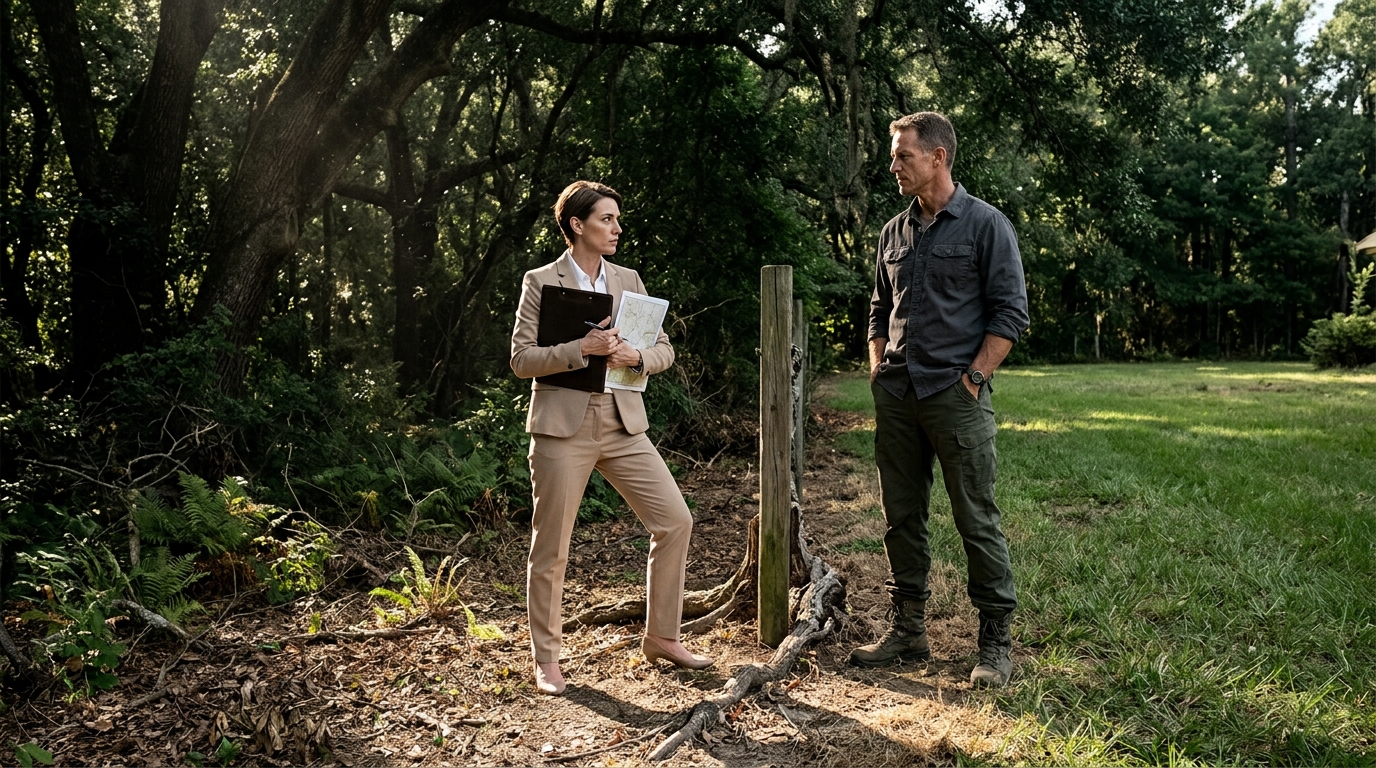
The air in Oakwood Bluffs was usually still enough to hear a lawnmower three streets over, but today, it felt thick, static-charged. Karen Miller stood on the precise edge of my property line, her beige pantsuit cutting a sharp, clinical silhouette against the deep green of my woods. She didn’t step onto the lawn. She hovered, the clipboard tucked under her arm like a shield, her face a mask of practiced, patronizing efficiency.
“This isn’t a request, Mr. Davies,” she said. Her voice didn’t carry warmth; it carried the weight of a gavel. “This is a notification of compulsory eminent domain for community improvement.”
I didn’t move. I didn’t breathe. I kept my hands buried deep in the pockets of my jeans, feeling the cool, solid weight of my keys. My mind had already detached, shifting into the rhythm I’d learned in the Corps: assess the structural integrity of the threat, identify the load-bearing weakness, and prepare the demolition.
The woods behind me were a five-acre cathedral of ancient oaks and shadows—my property, my silence, my buffer against the jagged edges of the world. Karen tapped the clipboard with a manicured finger. “We’ve labeled this area as the future site of the Oakwood Bluffs Recreational Complex. Your property value will see a significant—”
“My wood lot isn’t part of the HOA, Karen.” My voice came out flat, stripped of all color. I hadn’t raised it. I hadn’t moved a muscle. I just stood there, observing her, watching the way her posture flickered—a brief, microscopic twitch of irritation as she realized I wasn’t playing the part of the intimidated neighbor.
“It’s a procedural technicality,” she countered, her smile sharpening into a razor. “Our legal counsel has advised us we can overcome it. We are correcting an oversight.”
I looked at the clipboard. It was a crude map, a child’s drawing masquerading as a legal document. She wasn’t holding a court order; she was holding a wish list. She was trying to frame an invasion as a gift, a tactic as old as time. The sheer, naked arrogance of it was almost impressive.
“You should be thanking us,” she added, her eyes narrowing as she looked past me, toward the dark, silent heart of the trees.
The wind shifted, carrying the scent of pine and dry earth. I felt the knot in my stomach tighten, not with fear, but with the cold, precise clarity of a hunter who had just found the track. She thought she was building a tennis court. She didn’t realize she was handing me the detonator.
“I’ll review the documents,” I said, my tone as neutral as granite.
She paused, expecting a fight, a shout, a protest—anything to validate her authority. When I gave her nothing but silence, she looked unsettled. She turned on her heel, the fabric of her suit whispering in the quiet afternoon. As she walked away, her stride seemed a fraction less confident than when she’d arrived.
I stayed on the grass, watching her. I didn’t watch her reach her car. I watched the way she gripped the clipboard—white-knuckled, desperate. She was the one who had just walked into the trap. She just didn’t know it yet. A soft breeze brushed the oaks, and for a fleeting second, I saw a flash of movement in the brush—a squirrel, or maybe something else—but my focus remained on the empty space where she’d stood.
The real conflict hadn’t started with her arrival. It started the moment she underestimated the man who knew exactly how to dismantle a structure from the foundation up. I reached into my pocket, pulled out a small, metallic object, and pressed it into the soft, damp soil of the lawn—a marker for the start of a very long, very quiet war.
Everything was in place. The question was no longer what she would do, but how much of her world I would be forced to level before she understood the error she’d made. And as the shadows in the woods began to lengthen, I knew one thing for certain: she would never touch the trees.
CHAPTER 2: THE PAPER TRAIL OF TYRANNY
The house had settled back into its usual quiet, but the silence felt different now. It had a razor’s edge. I stood in my office, the evening light stretching long and thin across the hardwood, and looked down at the dining room table where I had begun to assemble the first of many binders.
I reached for a stack of violation notices Karen had sent over the last six months. They were neat, perfectly aligned, and utterly fraudulent. As I touched the textured cardstock of the first notice, a memory surfaced—not of the neighborhood, but of the Corps. I remembered a colonel, a man who believed that if you wrote a regulation down, it became physical law, regardless of the reality on the ground. He had lost a bridge project because he was so obsessed with the ink that he ignored the shifting soil beneath the foundation.
Karen Miller was that colonel in a beige pantsuit.
I opened the binder. Violation 1: Improper lawn height. I pulled out the timestamped photos I’d taken that day. The grass was three and a quarter inches—well within the realm of reasonable maintenance, and certainly not the catastrophe she had described in her flowery, passive-aggressive prose. I laid the HOA notice next to my own evidence. The contrast was striking: her claim was a work of fiction, mine was a record of the environment.
I worked with a mechanical, rhythmic precision. I didn’t just file these away; I created a master index. I cross-referenced the dates of the violations with my own calendar. Collection day incident: 8:00 p.m. deadline for garbage cans. I pulled the receipts from my son’s baseball game, the tickets, the team schedule. I wasn’t just documenting a fine; I was building an alibi, not for a crime, but for my existence. Every violation was a micro-aggression, a tiny, targeted cut meant to bleed my resources and my resolve.
My movements were deliberate, slow, and calculated. I didn’t want to feel the anger—the heat of it was a liability. I needed the cold, hard logic of a siege engine. The deeper I dove into the paperwork, the more the pattern emerged. This wasn’t random harassment. It was systematic. She wasn’t looking for compliance; she was looking for a pretext to drive me out.
The “Miller and Associates” consulting firm kept appearing in the budget summaries—a vague, recurring expense that felt like a shadow moving across the page. Every time I looked at those numbers, my skin prickled. It felt like walking through a house where the doors didn’t quite line up with the frames. Something was wrong with the architecture of her power.
I stopped for a moment, the silence of the house pressing against my ears. I thought about the survey crew, the way they looked at me with that mixture of confusion and apology. They were just instruments of her will, caught in the friction between her fantasy and the reality of the deed I held.
I reached for the next file, but my hand hovered. I felt a phantom sensation—the weight of a compass, the snap of a measuring tape. I saw the map of the neighborhood in my mind, the way the lines for Primrose Lane seemed to just… float, disconnected from the rest of the plat. It was a mental phantom, a nagging doubt that had been sitting in the back of my skull since the moment Karen first appeared on my lawn.
Why would a developer, a professional firm, leave a five-acre parcel and a road network un-dedicated? It didn’t make logistical sense. Unless the map wasn’t the final version. Unless there was another document, buried in the county archives, that showed the true boundaries.
I took a breath and forced the thought aside. I was getting ahead of the data. The first step wasn’t the archive; it was the dossier. I had to prove her malice before I could pull the threads of her authority. I recorded the last fine for the oil stain on the garage floor, the absurdity of it almost making me smile. She was watching my floor. She was watching my trash. She was watching me with the intensity of a predator who had forgotten how to look at the landscape she was hunting in.
I closed the binder and labeled the spine: HOA Harassment – Master Dossier. It looked small, but it felt heavy, a brick in the foundation of the case I was building. I stood up, my joints stiff from the hours of hunching over the table. The sun had dipped below the horizon, leaving the room bathed in a soft, grey twilight.
I walked to the window. The woods were a black wall against the purple sky. They were quiet, a sanctuary that felt more valuable tonight than it ever had before. I knew, with the kind of certainty that only comes from deep preparation, that she would come back. She would bring more surveyors, more threats, more paper.
And I would be ready. I had the files, I had the timeline, and now, I had the beginning of a map. I turned off the office light, leaving the room to the dark, and walked out into the hall. I needed to see Sarah. I needed to breathe the air of a house that was mine, on land that was mine, in a world that I was rapidly learning to navigate on my own terms. The siege had begun, and for the first time in years, I felt entirely, terrifyingly awake.
CHAPTER 3: THE LIBRARY SILENCE
The library conference room smelled of stale coffee and industrial carpet cleaner. It was a space designed to suppress personality, to enforce the hollow decorum of bureaucratic procedure. Karen Miller sat at the head of the long, faux-wood table, her clipboard occupying the space in front of her like a territorial marker. She was mid-sentence, lecturing a small group of homeowners about the virtues of “aesthetic cohesion,” her voice possessing the sterile, rhythmic quality of a metronome.
I slid into a chair near the back of the room, my movements quiet, deliberate. Sarah was beside me, her hand resting on my arm. She didn’t say anything, but the slight tension in her fingers told me she was as hyper-aware as I was.
Karen’s gaze flickered over the room, pausing on me for a fraction of a second—a brief, dismissive brush of her eyes—before she moved on. She was basking in the relative safety of a controlled environment. Here, there were no deeds to challenge her, no property lines to argue over. There was only the agenda, which she had authored, and the minutes, which she controlled.
“We have seen, in recent months, a troubling lack of attention to our community standards,” she was saying, her tone a perfect blend of faux-disappointment and stern authority. “But we are moving past that. The community vision initiative is about progress.”
I didn’t speak. I didn’t lean forward. I simply watched her. My focus was on the structure of her performance. She leaned on the table, her posture rigid, her hands never straying far from the clipboard. It was a classic display of control, but to my eyes—trained to look for the strain in a bridge, the weakness in a design—I saw the brittle geometry of her confidence. She was over-performing. She was convincing herself as much as she was trying to convince the room.
Mr. Henderson, the retired electrician, was sitting two rows ahead of me. He looked restless, his foot tapping a rhythmic, irregular beat against the floor. He glanced back at me, his eyes sharp with an unspoken question. I gave him a subtle, almost imperceptible nod. Now was not the time. We were not here to shout; we were here to document.
I pulled out my notebook—not the dossier, but a fresh, blank ledger. I began to record the meeting, noting the time, the people present, and the specific, sweeping declarations Karen was making about HOA authority. Every word she spoke was a brick in the wall she was building, and I was recording the blueprints.
“Does anyone have questions regarding the proposed landscaping budget?” Karen asked, scanning the room.
A woman from Oakwood Circle raised her hand. “The costs seem high, Karen. Three thousand for shrubs?”
Karen didn’t blink. “Quality requires investment, Susan. We are maintaining the property value of every single home in this subdivision. If we cut corners now, the long-term impact on our equity will be far greater than the cost of these improvements.”
It was a beautiful lie, delivered with the cadence of a truth. She used the word equity like a shield, knowing it was the one thing that made every homeowner in the room nervous. She was gambling that they were more afraid of losing money than they were interested in the integrity of the board.
I felt a cold, hard focus settle over me. I wasn’t just an observer; I was a counter-intelligence unit. I was tracking the movement of her authority, seeing where she stretched it and where it held firm. She was arrogant, yes, but her arrogance was a tactical error. She assumed that because she had the floor, she had the power. She didn’t realize that the power in this room was currently being measured, quantified, and logged.
As the meeting dragged on, I noticed Frank, the quiet board member, shifting in his seat. He looked tired. He was caught in the middle, and I could see the way his eyes occasionally darted toward the exit. He was the weak point in her perimeter. He knew more than he was saying, and he was beginning to feel the heat.
I stood up, not to speak, but to stretch, my chair scraping harshly against the floor. The sound drew the attention of a few neighbors. I caught Mrs. Gable’s eye. She offered a small, tentative smile, one that she quickly hid behind her hand. The air in the room was changing. It wasn’t the uniform, submissive silence Karen was used to; it was a pressurized, expectant tension.
Karen noticed it too. She faltered for a second, her rhythm stuttering. She took a sip of water, her hand hovering over the clipboard. For a moment, the mask slipped. I saw a flash of raw, unfiltered fear in her eyes—a look that had nothing to do with budgets and everything to do with the sudden realization that she was no longer in total control of the room.
She recovered quickly, smoothing her skirt and returning to the agenda, but the crack was there. I’d seen it. She was terrified of being questioned, not because she had something to hide—though she clearly did—but because she couldn’t handle the existence of a reality that didn’t confirm her own.
The meeting adjourned an hour later. I stayed in my seat until the room had mostly emptied, watching Karen pack her things. She didn’t look back. She walked out with her clipboard held high, but her stride lacked its earlier precision. She was walking like a woman who was starting to feel the structural vibrations of a collapse.
I waited until she was gone, then looked at my ledger. I had the notes. I had the witness record. I had the beginning of the end. I felt a surge of cold, steady resolve. I wasn’t going to fight her on her terms. I was going to let her continue to build her kingdom of paper, right up until the moment I pulled the map out from under it.
Sarah stood up, brushing off her coat. “She’s rattled, Jack.”
“She’s just beginning to see the cracks,” I said.
We walked out into the cool evening air. The library lights flickered behind us, casting long, distorted shadows on the pavement. I felt the familiar weight of the task ahead. There was more to do—the archive, the records, the final verification of the road titles. But for tonight, the library was closed, and I had everything I needed to keep the pressure on. The countdown had started, and the silence in Oakwood Bluffs was no longer mine alone.
CHAPTER 4: THE GHOST MAP
The county records building was a fortress of bureaucracy, its basement archive a labyrinth of steel shelves and the low, constant hum of dehumidifiers. The air here was different—it smelled of ozone, decaying cellulose, and the cold, unyielding weight of history. I walked down the narrow aisle, my footsteps echoing against the concrete floor, feeling the sudden, sharp drop in temperature as I moved deeper into the records vault.
I wasn’t here for the current HOA files. Those were smoke and mirrors, designed to lead a person in circles. I was here for the foundation.
“Mr. Davies?” The clerk, an older woman with sharp eyes and a sweater that looked like it had been knitted in another decade, pointed toward the back of the room. “The microfilm reader is serviced and ready. You’ve got the index number for the 1978 master plat?”
“I do,” I said, offering a tight, professional smile. I didn’t want to talk. I wanted to see the lines.
I sat at the machine, the screen glowing with a harsh, blue-white intensity. I fed the reel into the gate, the plastic ticking rhythmically as it unwound. When the image projected onto the glass, I didn’t rush. I adjusted the focus, the crispness of the lines appearing with a sudden, jolting clarity. There it was: Oakwood Bluffs, as it had been envisioned forty years ago.
I began to scroll. Lot by lot, street by street. My finger traced the route of Primrose Lane. The map was beautiful in its simplicity—a blueprint of order. But as I reached the eastern edge of the plat, where my property bordered the old remnants of the farmland, I felt the air in my lungs hitch.
I stopped. I scrolled back.
The boundary lines for my five-acre parcel were clear, marked with a surveyor’s precision. But the roads—the arteries of the neighborhood—had no accompanying stamp of dedication. No notary seal. No transfer of rights to the county, no handover to a homeowners association. They were lines on a paper, yes, but in the eyes of the law, they were phantom infrastructure.
I leaned in, my forehead almost touching the screen. The clerk had mentioned something about a microfilm error in the index, a “missing seal.” I scanned the bottom margin of the plat again. There was a smudge, a slight blurriness in the microfilm image where the legal dedication block should have been. It wasn’t just a misprint. It looked deliberate. As if someone, decades ago, had ensured that the legal transfer of these roads remained perpetually incomplete.
My pulse picked up, a steady, rhythmic thrumming in my ears. If the roads were never dedicated, then the HOA had been maintaining land they didn’t legally own for four decades. They were essentially caretakers of a ghost. Karen Miller hadn’t just misunderstood the rules; she was acting as the queen of a domain that didn’t exist in the eyes of the county.
I grabbed my pen and began to sketch the layout onto a notepad, my movements sharp and efficient. I needed to document this discrepancy, but more importantly, I needed to understand the legal vacuum it created. If the developer dissolved—which, given the age of these documents, was almost a certainty—the roads weren’t public property. They weren’t private common areas. They were legal orphans.
The hum of the machine felt like the sound of an approaching storm. I felt a surge of cold, analytical vindication. This was the leverage. It wasn’t just about my land anymore; it was about the entire foundation of Karen’s authority. Every fine she had issued for “common area” violations, every rule she had enforced on the street—it was all, legally speaking, a reach beyond her jurisdiction.
I stood up, the chair scraping sharply against the concrete. The sound startled the clerk, who looked over from her desk. I didn’t stop to explain. I packed my notes into my briefcase, the weight of the paper feeling heavier than it had ten minutes ago.
I climbed the stairs to the ground floor, the air getting progressively warmer, the light brighter. As I stepped out into the parking lot, the late afternoon sun hit me with a sudden, blinding force. It was a beautiful, clear day. The world looked exactly the same as it had when I arrived, but I knew the truth now. The neighborhood wasn’t a tight, managed community governed by bylaws. It was a legal sinkhole.
I got into my truck, the engine turning over with a familiar, mechanical roar. I didn’t drive home immediately. I sat there, looking at the building, thinking about the paper inside. Karen Miller thought she was playing a game of chess, maneuvering her pieces to seize my woods. She didn’t realize she was playing on a board that was currently being pulled out from under her.
I pulled out my phone and dialed Dave Sterling.
“Jack,” he answered on the second ring, his voice crisp. “What did you find?”
“I found the ghost in the machine, Dave,” I said, my voice low and steady. “The roads were never dedicated. The developer vanished, and the HOA is effectively squatting on land that doesn’t belong to anyone.”
There was a pause on the other end, then a sharp, low laugh. “Are you serious?”
“I’m looking at the plat right now. It’s not just an oversight. It’s a foundational flaw.”
“Don’t say a word to anyone,” Dave said, his tone turning instantly tactical. “If she finds out you’ve got this, she’ll try to bury the record. We need to move on this, but we need to do it with surgical precision.”
“I have the notes. I have the index numbers.”
“Good. Meet me tomorrow morning. We’re going to draft a motion that will make her wish she’d never heard the word ’eminent domain.'”
I hung up, the phone feeling solid and cool in my palm. The fight had escalated. It wasn’t just about my five acres anymore; it was about the legal legitimacy of her entire existence as the president of Oakwood Bluffs. The pressure was mounting, and for the first time, I could see the exit path. Karen Miller was going to have to answer for every single overreach, and she was going to have to do it in front of the people she’d spent months bullying.
I shifted the truck into gear and drove out of the lot, the tires crunching on the gravel. The neighborhood looked different now—more fragile, more temporary. I felt a cold, deep satisfaction. I had the map. The siege was no longer just a possibility; it was a scheduled event.
CHAPTER 5: THE JAGGED EDGE
The morning sun reflected off the glass facade of Dave’s office building with a blinding, clinical brightness. I gripped the handle of my briefcase, the leather familiar and firm against my palm. I was three steps from the main entrance when I saw it: a beige sedan, idling near the curb, its windshield partially obscured by a reflection that looked, for a heart-stopping second, like Karen Miller’s face.
I didn’t stop. To stop would be to acknowledge the threat, to telegraph that I was aware of being watched. I kept my stride steady, the rhythm of my boots on the pavement unchanging, even as my mind began to calculate the shift in the operational environment. If she was here, she wasn’t just guessing; she was tracking. She was terrified, and terrified people became dangerous because they stopped caring about the rules she had once so desperately used to hide behind.
I pushed through the revolving glass doors and into the cool, silent lobby. I didn’t glance back at the street. I headed straight for the elevator, my heart rate a calm, controlled hum. This was the friction of a siege—the moment the target realizes the wall is crumbling and starts looking for the breach.
Dave was waiting in his conference room, his desk already buried under a landscape of legal pads and open statute books. He looked up as I entered, the sharp, inquisitive lines around his eyes deepening.
“You’re early,” he said, then caught the look on my face. “What happened?”
“The beige sedan,” I said, setting the briefcase on the table and opening the latches with a decisive snap. “She’s not just watching the neighborhood anymore. She’s following the source.”
Dave stood up, his chair rolling back with a muted thud. He didn’t ask if I was sure. He trusted my observation. He walked to the window, peering down at the street through the blinds, his movements efficient and predatory. “If she’s shadowing you, she’s closer to the truth than we thought. That means we have to accelerate the schedule.”
“I have the plat map,” I said, pulling the rolled-up document from the briefcase. “But if she knows we’re here, she might be trying to get to the county records first to see if she can force a redaction or an ‘amendment’.”
“Let her,” Dave said, a dark, dangerous smile playing on his lips. “The record is already copied and filed with the attorney general’s office. If she tries to touch it now, it’ll be considered tampering. It’ll only deepen the hole she’s digging for herself.”
I looked at the map, then at Dave. The plan had been to wait, to let her commit in writing to her claims, but the presence of that sedan changed the calculus. We needed to hit the board before she could mobilize her remaining allies to “fix” the oversight.
“We need a motion,” I said. “Not a request. A motion to disclose all maintenance contracts and road ownership documentation, served directly to the board. If she refuses to disclose, we call for an immediate emergency meeting.”
“It’ll force her hand,” Dave agreed. “She’ll have to respond, and the moment she does, she’s either going to have to lie under oath or admit she’s been operating on phantom jurisdiction.”
I pulled the notes from the archive out and spread them across the table. We spent the next two hours working in a state of high-intensity focus. We weren’t just drafting a letter; we were writing a trap. Every word was chosen for its legal weight, its ability to pin her into a corner where her only options were self-incrimination or public surrender.
The office was quiet, the only sound the scratch of Dave’s fountain pen and the occasional drone of traffic from the street below. Every time a car went by, I found myself instinctively checking the street. It was a reflex, a part of the psychological burden of being the one she was hunting. But the frustration I had felt earlier was gone, replaced by the cold, clear focus of a strategist.
“Here,” Dave said, sliding a thick, stapled document across the table. “This is the ‘Demand for Disclosure.’ It’s aggressive, it’s legally airtight, and it gives her forty-eight hours to provide the requested documentation before we initiate the formal complaint process.”
I picked it up. The paper felt heavy, substantial. This was the first shot.
“What if she calls the police? Claims harassment?” I asked.
“Let her,” Dave said, his voice hard. “Harassment implies there’s no legitimate legal basis for our inquiries. Everything we’re asking for is a matter of public record and association law. If she calls the cops, she’s admitting she wants to suppress information that the residents have a legal right to access. She won’t do it. She’s too obsessed with keeping up the appearance of procedural legality.”
I nodded. He was right. Her weakness was her need to be the “correct” one. She couldn’t abandon the system, even if the system was currently turning against her.
I packed the document away. As I moved toward the door, I felt the familiar weight of the task ahead. The siege was no longer a matter of patience; it was a matter of momentum. I walked out of the office and back into the lobby, my grip on the briefcase firm. I didn’t care if the beige sedan was still there. I had the motion. And in two days, she was going to have to decide if she was going to be the president of a neighborhood, or the architect of her own destruction.
CHAPTER 6: THE STAKED LINE
The morning air was razor-sharp, a thin, biting cold that settled into my lungs with every breath. I stood at my back door, the glass cool against my forehead as I watched the white van from Apex Land Surveying roll slowly onto the cul-de-sac. It was exactly as I had feared. They weren’t just returning; they were acting with a new, aggressive intensity.
I didn’t rush. I didn’t shout. I moved through my house with a deliberate, haunting slowness, my mind already calculating the variables of the confrontation. My briefcase, containing the signed “Demand for Disclosure,” sat by the door. I picked it up, feeling the weight of the paper inside—my armor, my weapon.
As I stepped out onto the lawn, the grass was brittle with frost, crunching under my boots with a sound like shattering glass. The two men from the survey crew were already out of the van, unloading a tripod with practiced, clinical movements. They were ignoring the “No Trespassing” sign I’d driven into the oak tree days ago. It was a clear, tactical escalation—they had received instructions that superseded my warnings.
“Gentlemen,” I said, my voice carrying clearly across the frost-covered ground.
They stopped. The older man, the one I recognized from the last visit, looked up, his expression guarded, his hands still gripping the metal legs of the tripod.
“We’re just doing our jobs, Mr. Davies,” he said, his voice clipped. “We’ve been instructed that this area is designated for community enhancement. Our work order comes directly from the HOA board.”
I walked toward them, not stopping until I was within three feet of the line. I didn’t step over it. I stood there, a physical barrier, my posture rigid. I felt the sharp prickle of paranoia at the back of my neck—was Karen watching from the beige sedan? Was every neighbor currently looking out their window, gauging whether I was about to win or lose this round?
“Your work order is based on a false premise,” I said, holding his gaze. “The HOA has no authority over this parcel. I’ve already served them with a formal Demand for Disclosure regarding their jurisdictional claims. If you step onto this property, you aren’t just trespassing on my land; you’re complicit in an ongoing legal violation.”
The younger surveyor looked at his colleague, his eyes darting toward the woods. There was a flicker of hesitation in his movements, the uncertainty of a man who suddenly realized he was caught in the middle of a war he didn’t understand.
“Mr. Davies,” the older surveyor said, his tone turning hard. “We have our instructions. We were told to clear the boundary lines regardless of the protest.”
“Instructions are not laws,” I said, my voice dropping an octave. “And they certainly don’t override the deed I hold in my hand. If you plant one stake on this side of the line, I will not call the sheriff. I will call my attorney, and I will initiate a formal injunction against your firm for aiding and abetting the unlawful seizure of private property. Do you want to explain that to your insurance carrier?”
The older man tightened his grip on the tripod. He was clearly caught between his contract and the sudden, harsh reality of the legal liability I was presenting. The air felt heavy, charged with the static of the standoff. I watched his eyes move to the trees, then to the sign, then back to my face. I was looking for the crack—the moment the fear of the consequences outweighed the paycheck.
“We have to make the call,” the younger one muttered, stepping back toward the van.
“Call whoever you want,” I said. “But stay on the public easement.”
I turned my back on them. It was a calculated risk, a way of signaling that I was no longer afraid of their presence. As I walked back toward the house, I could hear them arguing, their voices muffled by the wind. My hands were shaking, a physical reaction to the adrenaline I’d been suppressing since I saw them arrive. I walked into my mudroom and locked the door behind me, the sound of the deadbolt echoing like a gunshot in the quiet house.
I moved to the front window and pulled the curtain back an inch. The sedan was parked two houses down. Through the glass, I could see someone sitting in the driver’s seat—a shadow behind the windshield.
My heart was a frantic, irregular drumbeat against my ribs. I had held them off, but the battle was moving from the legal realm back to the physical. Karen wasn’t going to wait for the forty-eight-hour deadline I’d served on the board. She was going to try to create a fait accompli—to stake out the ground, to build the foundations of her clubhouse before we could get the court order to stop her.
I picked up my phone and dialed Dave.
“They’re back, Dave,” I said, my voice tight. “They’re trying to force the survey.”
“I’m filing the emergency motion for an injunction now,” he replied, his voice calm, steady, and sharp. “It should be on the judge’s desk within the hour. Jack, listen to me—do not leave your property. If they step over that line, record it. Get it on video. If you do that, we’ll have everything we need to shut down their operation for good.”
I hung up, looking out the window at the woods. They were standing still, silent, indifferent to the chaos being fought at their edge. I felt a surge of cold, jagged anger, but I pushed it down, burying it under a layer of absolute, tactical necessity. I went to my office and set up the camera, the tripod steady and firm, the lens aimed directly at the tree line.
The siege was reaching its breaking point. Every moment was a calculation, every action a test of resolve. I sat in the dim light of the office, the camera blinking its small, red, recording eye at me, and waited for them to make the next move.
CHAPTER 7: THE PUBLIC TRIBUNAL
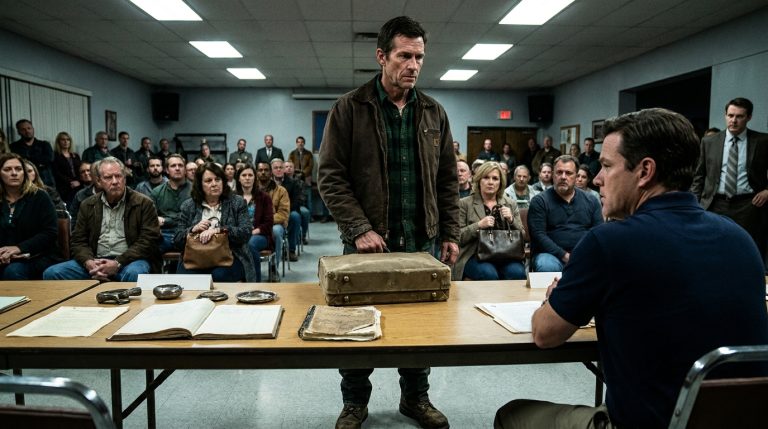
The community center room was saturated with a thick, suffocating tension. It wasn’t just the crowded rows of folding chairs or the low, anxious murmur of the residents; it was the feeling that we had reached the absolute edge of the plateau. Karen stood at the front, her floral print dress a jarring contrast to the grim, focused faces of the people she had spent months manipulating. She looked tired, a faint tremor in her hands as she shuffled her index cards, but she was still projecting that hollow, unearned authority.
“The meeting will come to order,” she said, her voice lacking its usual resonance.
I didn’t sit down. I stood in the back, near the door, my presence an intentional anomaly. I kept my hand on the handle of the briefcase, the hard edge of the motion within it a constant, grounding reality. Beside me, Dave Sterling stood perfectly still, his suit sharp, his gaze fixed on the back of Karen’s neck. He wasn’t here to participate; he was here to watch the trap snap shut.
Karen launched into her standard script—the “Community Vision Initiative,” the projected property values, the necessity of the clubhouse. She spoke about the “minor procedural hurdles” with a dismissive wave of her hand, but her voice faltered when she scanned the room and saw the expressions of her neighbors. They weren’t nodding anymore. They were waiting.
“Is there any new business?” she asked, her gaze sweeping past me, deliberately refusing to acknowledge my presence.
“There is,” I said, my voice cutting through the silence like a blade. I didn’t wait for her permission. I walked down the center aisle, the sound of my boots rhythmic and absolute. The room went dead silent. Every head turned. Even the board members, sitting in their sterile, high-backed chairs, seemed to shrink, sensing that the atmospheric pressure in the room had shifted.
I reached the front and stopped, a few feet from the podium. Karen stared at me, her face a mask of practiced contempt. “Mr. Davies, I believe I told you—”
“This isn’t an opinion, Karen,” I interrupted, placing the briefcase on the floor and opening it. “This is a legal motion regarding the foundational jurisdiction of this board.”
I pulled out the document Dave had prepared and laid it on the podium, right over her index cards. “This is a formal Demand for Disclosure. We have reason to believe that the Oakwood Bluffs Homeowners Association has been operating under a fraudulent claim of ownership over the community’s road network for over four decades. We are requesting immediate, verified documentation of title and road dedication.”
Karen looked down at the paper as if it were a poisonous insect. She didn’t touch it. She looked up at me, her eyes widening, the color draining from her face. “This is… this is a disruption. I will not have this meeting turned into a circus of baseless allegations.”
“It’s not an allegation,” Dave said, his voice quiet but carrying to every corner of the room. “It’s a request for transparency under the Property Owner Association Act. If the association owns the roads, you have the deed. If you don’t have the deed, then every fine you’ve issued for parking or traffic violations on those roads is an act of legal overreach. The choice is yours: provide the documentation or admit you’ve been acting under the color of authority you don’t possess.”
The room erupted. It wasn’t the uniform, submissive silence she was used to; it was a sudden, roaring wave of questions and demands. Mrs. Gable stood up, her hand shaking, pointing toward the screen where Mr. Miller had already begun to project the county plat map—the same map I’d found in the archive, the ghost map of an incomplete neighborhood.
Karen tried to shout over the noise, her face flushing a deep, frantic crimson. “It’s a technicality! The board has always maintained these streets! It’s common practice!”
But it was too late. The illusion of her control had been shredded. The neighbors weren’t listening to her anymore; they were looking at the map, at the lines that didn’t connect, at the absence of the seal that would have legitimized her power. She stood behind the podium, her hands clutching the edges until her knuckles turned white, realizing that the people she had bullied were no longer afraid.
She looked to her board members for support, but they were already distancing themselves, their chairs shifting away from her. She was isolated. The podium was no longer a platform of authority; it was a cage. I watched her, feeling not the heat of the anger, but the cold, clear focus of a strategist who had just watched a critical piece of the opponent’s line fall.
She tried to speak again, a desperate, high-pitched plea for order, but it was swallowed by the sound of the room. I didn’t need to say anything else. I stood my ground, my hands at my sides, watching the queen of Oakwood Bluffs lose her kingdom in real-time. The procedural facade was gone, and beneath it, there was nothing left but the truth.
CHAPTER 8: THE SETTLEMENT
The silence in the community center was heavy, textured by the cooling air and the shuffling of feet as neighbors began to disperse. Karen stood behind the podium, no longer the queen of a domain, but a woman trapped in a hollow space of her own making. The floral print of her dress looked muted under the harsh, flickering fluorescent lights. She didn’t move as the last of the board members walked past her, their heads down, their connection to her officially severed.
I walked toward her, the distance between us closing slowly. I didn’t feel the need to rush. The strategic exhaustion I had felt for months was bleeding away, replaced by a strange, hollow sense of clarity.
She looked at me as I reached the podium, her eyes darting toward the briefcase where the legal motion sat. “It doesn’t change anything,” she whispered, her voice brittle. “I did what I thought was best for the community. I had a vision.”
“You had a delusion, Karen,” I said. My voice wasn’t harsh; it was merely factual. “You built a system on an empty map and expected it to sustain the weight of your own ambition. You didn’t protect this community. You harvested it.”
She gripped the edges of the podium, her fingers trembling. She looked around the room, which was almost empty now, the chairs rearranged, the screen where the map had been still glowing with a faint, phantom light. For a moment, she looked small—not a villain, not a titan of industry, but someone who had lost the ability to distinguish her own ego from the landscape she occupied.
“The state will want to see the financial records,” I continued, stating the reality of what was to come. “The audit is already being arranged. If there’s a way to account for the misappropriated funds, it’s not going to be through your brother-in-law’s firm. It’s going to be through the court.”
She didn’t answer. She only stared at the floor, where a discarded flyer—one of the ones we had circulated—lay crumpled near her feet. It was a simple, stark summary of the road ownership issue. The irony of it seemed to finally settle on her.
I turned away, leaving her there in the empty, cooling room. As I pushed open the heavy double doors of the community center, the night air hit me with a clean, sharp intensity. It was autumn, and the wind carried the scent of dry leaves and cold earth.
Sarah was waiting by the truck, her silhouette clear against the glow of the streetlamp. She didn’t ask what happened. She saw it in my posture—the way my shoulders had finally dropped, the way my hands were no longer clenched.
We drove home in silence. The familiar route, the streets that had been the epicenter of our struggle, looked different now. They weren’t a battlefield. They were just streets. They belonged to the community now, not to a phantom corporation, and certainly not to a petty tyrant.
When we pulled into the driveway, I turned off the engine and sat for a moment, listening to the cooling metal of the truck. The silence of the neighborhood was total. There were no more surveillance cameras, no more fears of retaliatory fines, no more anxiety about the boundaries of our own home.
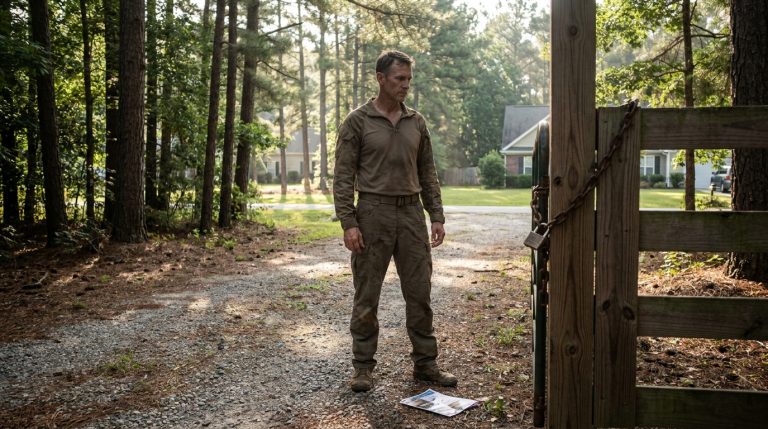
I got out and walked around to the back of the house. The woods were waiting, dark and absolute against the stars. I walked down the path toward the edge of the property, the ground crunching softly under my boots. I stopped at the oak tree where I had driven the “No Trespassing” sign weeks ago. The metal was cold under my hand.
I pulled the sign out, the wood yielding with a slow, grinding sound. I didn’t need it anymore. The border was no longer a disputed line; it was simply the edge of my world.
I walked back to the house and set the sign against the garden shed. Sarah was standing on the porch, a light in the kitchen window casting a warm, golden glow onto the grass. I looked at the house—the way it stood solid and grounded, the way the light played off the siding, the way the garden looked in the quiet, undisturbed dark.
I climbed the steps and took her hand. We didn’t need to speak of the victory. The closure was there, in the air, in the peace, in the fact that we were here, and we were home. I reached out and adjusted the light over the porch, the small, mechanical movement—a simple repair, a stabilization—giving me a final, quiet sense of order. The war was over. The map was complete. And for the first time in years, the world was exactly where it was supposed to be.