A Sanctuary Reclaimed: One Man’s Quiet Stand Against the Overbearing Silence of Harmony Creek
CHAPTER 1: The Weight of Steel
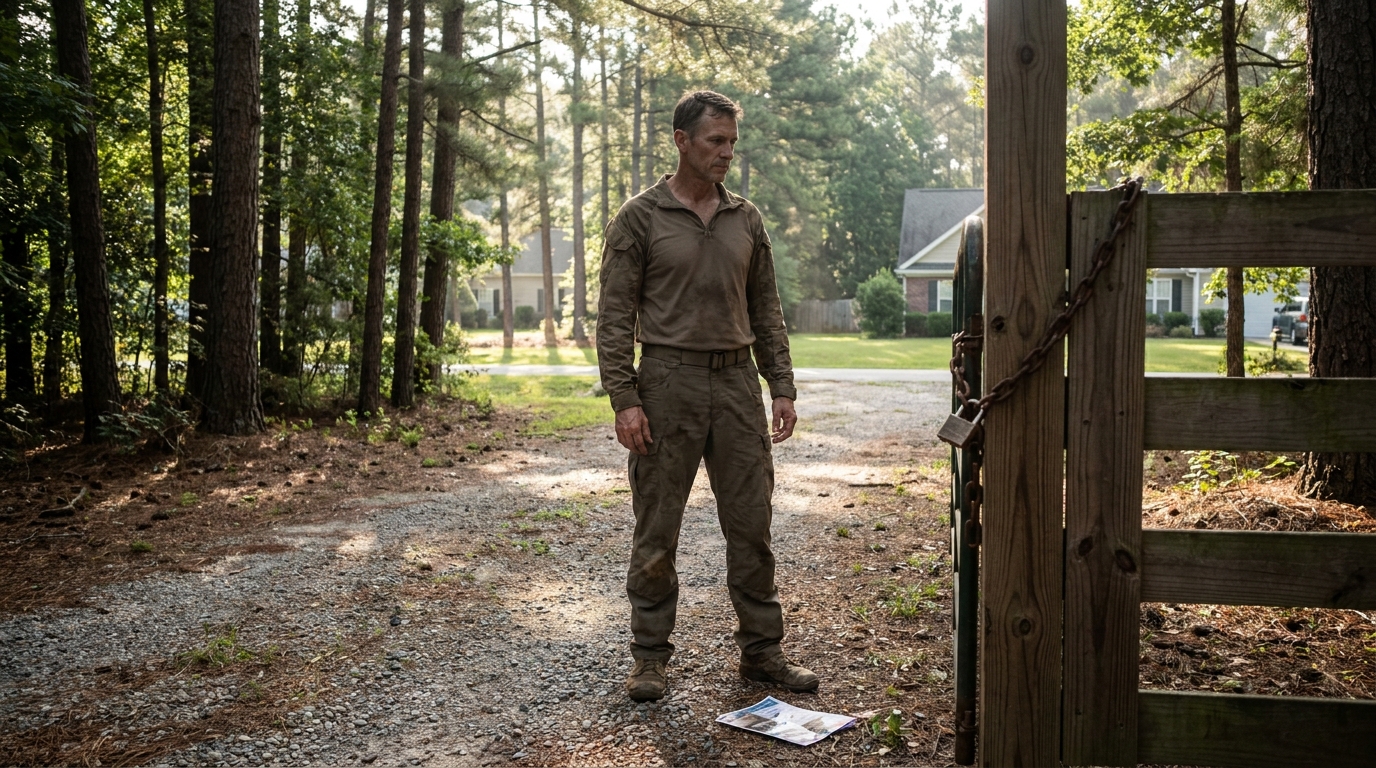
The sound of the padlock latching shut hung in the air long after Karen’s golf cart sputtered away. It was a cheap, rattling noise, the sound of a plastic soul attempting to manifest iron authority. I stared at the chain—a thick, rusted loop binding my gate to the fence post—and felt the familiar, cold pulse of adrenaline beginning to ebb, replaced by a dull, aching heat in my chest.
I was standing on the edge of my own five acres. The North Carolina morning was crisp, the light filtering through the canopy of pines in soft, honeyed shafts, but the view was ruined. My truck was on the other side of that steel. My wife, Sarah, was likely making coffee in a kitchen that was now, legally and physically, a cage.
I reached out, my fingers brushing the metal. It was cold. Beneath the rust, the surface felt rough, a fraying edge of the world I had fought so hard to find. For twenty years, I had navigated the wreckage of foreign deserts, built bridges where others saw only gaps, and learned that true strength was not in the force you applied, but in the patience you kept.
Karen had clearly never learned that. To her, this wasn’t a gate; it was a pedestal.
I didn’t reach for my phone to call the police. That would be an admission that I was a guest on my own land. Instead, I stood in the gravel, the silence of the woods amplifying the small, rhythmic sound of my own breathing. I looked at the padlock again. It was a standard, hardware-store-aisle-four model, gleaming mockingly in the rising sun. It was an intrusion, a foreign object in the ecosystem of my life.
My mind, once trained to scan for IEDs and structural weaknesses, now mapped the fence line. It wasn’t the lock that was the problem; it was the woman who thought she held the key to my peace. The anger in my gut wasn’t a fire anymore; it was a weight, a heavy, sinking stone. I thought of Sarah, waiting for me on the other side, her morning routine disrupted by the petty whims of a woman whose greatest struggle was the shade of paint on a mailbox.
I turned away from the gate and began to walk the perimeter of my property, my boots crunching rhythmically on the dirt. The air smelled of damp earth and pine needles, a scent that usually grounded me. Today, it felt fragile. I found myself focusing on the small things—a fallen branch, the way the sunlight hit the moss on an old oak—trying to anchor myself in the reality that this land was real, and that the chain was merely an illusion of power.
But as I reached the eastern boundary, I stopped. There, tucked behind a thicket of brush, was a small, discarded flyer, its edges frayed and dampened by the morning dew. It was an HOA notice, weeks old, listing “approved” landscaping standards. I picked it up. The paper was thin, cheap, and it felt like a ghost of the life Karen was trying to force upon us all.
I realized then that this wasn’t just a battle for a gate. If I tore that chain down, she would just put up another. If I filed a report, she would just file a fine. She was the infection in the air of Harmony Creek, and a simple cut wouldn’t heal the wound.
I looked back at the house through the trees. My kitchen light was flickering on. Sarah was there. She was looking for me. I took a deep breath, letting the tension in my shoulders drop. I wouldn’t rush this. I would be methodical, patient, and precise.
I turned back toward the gate, but this time, I didn’t see the chain as an obstacle. I saw it as a beginning. The war for my sanctuary hadn’t started today; it had been simmering for years, and now, finally, the lines were drawn in the gravel.
CHAPTER 2: The Geometry of Defiance
The chain felt colder than it looked. As I pulled my hand back, the jagged edge of a link left a thin, red smear of rust across my palm, a stark, arterial contrast to the pale, frayed edges of the surrounding woods. My truck sat just ten feet away, locked and idle behind the barrier, but that distance felt like miles.
I didn’t reach for the bolt cutters. Not yet. To move with blind speed was to play into the choreography Karen had laid out. I walked back toward the house, my pace measured. The crunch of gravel beneath my boots was the only sound in the morning, a rhythmic, abrasive percussion that forced me to focus.
My mind, however, wasn’t on the gravel. It was anchored to a memory I hadn’t summoned in years. I was back in a narrow valley, the air thick with the smell of diesel and dust, watching a group of locals wait for hours at a makeshift checkpoint. The weight of that metal—the same heavy, indifferent iron—had once signified a tactical necessity. Here, in the soft, green hills of North Carolina, it signified something far more corrosive.
Sarah was standing on the porch, her arms crossed over her chest, a mug of coffee steaming in her hand. Her face was a landscape of quiet, restrained anxiety. She didn’t call out; she knew better than to interrupt the silence of a man mapping a battlefield. When I reached the steps, I stopped, looking down at my palm. The rust had stained the skin, a stubborn, orange smudge.
“She wasn’t just being petty, Jack,” Sarah said, her voice barely rising above the rustle of the leaves. “She looked like she was performing a ritual. Like she actually believed she had the right.”
“She’s building a reality,” I replied, my voice steady, stripped of the morning’s initial spike of anger. “She thinks that if she can manifest the rules, she can control the outcome. It’s not about the HOA. It’s about the geography of her own insecurity.”
I went to the workshop, a space of order and deliberate precision. It was the only place where I could breathe. I didn’t reach for the heavy tools. I went to the workbench, pulling out a small, worn leather-bound journal—the one I kept for recording the mundane details of property maintenance. I opened to a clean page and began to map the site. Not a plan of attack, but a plan of record.
I pulled out my phone and accessed the cloud, opening the 360-degree footage I’d shot minutes ago. I scrubbed through the frames, freezing on the point where the HOA signpost stood, fifty feet from the gate. I zoomed in on the property markers. The data was there, silent and absolute. I didn’t need to break the law to prove she was violating it; I just needed the physics of the site to match the paperwork in my safe.
I picked up the camera again. I needed to document the exact positioning of that tape, the angle of the chain, the proximity to the county easement. I walked back to the gate, moving slowly, deliberately. Each step was a calibration. When I arrived, the gate felt different. It was no longer an obstruction; it was a physical argument, and I was the one holding the evidence.
I didn’t cut the chain. Instead, I carefully wrapped the chain in a thin layer of plastic film I’d brought from the shop, ensuring the integrity of any potential evidence of the tampering. It was a soldier’s habit—preserve the state of the obstacle, document the intent, neutralize the threat.
As I worked, the sound of a distant engine hummed through the trees. I froze, my eyes narrowing. It wasn’t the sputter of Karen’s golf cart. It was the deep, resonant drone of a delivery truck. It slowed as it approached the entrance, then stopped. I stood behind the fence, watching. A courier, likely looking for an address in the newer development, peered out the window at the chain. He saw the sign, hesitated, and then reversed, the screech of his tires fading as he turned back toward the main road.
I watched him go, a cold, sharp realization settling in my gut. This wasn’t just my property being inconvenienced. The gate was a bottleneck, a disruption of the local flow. It was a failure of the basic logic that kept a community functioning.
I finished my documentation, my hands steady. When I walked back to the porch, Sarah was still there, the coffee in her mug long forgotten. She watched me, sensing the shift in my posture.
“You’re not going to just take it off,” she observed.
“No,” I said, looking toward the sprawling, silent expanse of my land, then back at the iron gate. “I’m going to make sure that when it does come off, the entire foundation she’s standing on comes with it. We’re going to be thorough, Sarah. We’re going to be ghosts in her machine.”
I went inside and opened the safe. The documents inside—the deed, the plat maps, the original surveys—seemed to hum with potential energy. I pulled them out, spreading them across the desk in a meticulous, overlapping grid. I wasn’t fighting a person anymore; I was fighting an error in the system. And for the first time since the padlock clicked, I felt a calm, chilling focus.
The battle for Harmony Creek hadn’t just begun; it had been codified. I pulled a fresh sheet of paper, took out my pen, and began to draft a letter that would be the first tremor in a house of cards. The silence of the room was absolute, a perfect, pressurized space where every word counted. I didn’t know yet who I would need to bring into the light, or what the true cost of this campaign would be, but I knew one thing: Karen was about to find out that she hadn’t just blocked a gate. She had blocked a veteran, and I had nothing but time.
CHAPTER 3: The Architecture of Evidence
The ink on the draft was still wet, a dark, deliberate line that seemed to vibrate against the white paper. I sat at my desk for a long time, the house around me settling into the mid-morning heat. Outside, the world was oblivious to the shift in my intent. The trees rustled in a gentle breeze, and from the direction of the subdivision, the distant, muffled sound of a lawnmower droned on, a reminder of the standardized life Karen was so desperate to protect.
I stood up, the chair creaking under me, and carried the letter to the kitchen. Sarah was sitting at the table, a stack of bills before her, but her gaze was fixed on the window. She watched me approach, her eyes tracing the envelope I held as if it were a physical weight.
“Certified,” I said, setting it down. “It’s the first one. To the board members, individually. Not the general box.”
Sarah leaned forward, tracing the edge of the envelope. “You’re sure about this, Jack? Once this goes out, there is no dialing it back. She’s going to see it as a declaration.”
“It is,” I answered, my voice quiet but firm. “But she’s been declaring war on this community for years, one fine and one intimidation tactic at a time. She’s just never had anyone push back with the same level of discipline.”
I left her at the table and walked out to the garage, the space of order that had become my base of operations. The binder labeled “Karen” sat on the workbench, its spine cracked from use. I opened it, the pages filled with photos, dates, and the cold, hard geometry of my findings. I began to organize the supporting documents I had collected—a copy of the original plat map from 1988, a printout of the North Carolina statutes regarding rights-of-way, and the receipt for the bolt cutters I had purchased earlier. Everything was accounted for.
I spent the next hour preparing the supplementary materials. Each letter required a bespoke attachment—a copy of the local ordinance, a specific reference to their own bylaws regarding due process, and a detailed bill for the time and material spent correcting the “unapproved” structure she had tampered with. It was an exercise in bureaucracy, a weaponized application of the very rules she used to bludgeon her neighbors.
The weight of it all—the paper, the ink, the sheer volume of logic—gave me a strange sense of clarity. I wasn’t just defending my land; I was building a barricade of truth.
I took the envelope and walked to my truck. The drive to the local post office was short, the roads winding and lined with the manicured lawns of Harmony Creek. As I drove, I saw a familiar sight—a neighbor’s mailbox, painted a dull, uniform beige, the kind that made the entire street look like a set piece in a play. It was a small, sad detail, a testament to the quiet conformity that had been forced upon the neighborhood.
The post office was quiet. Brenda, the clerk who had processed my packages for years, looked up as I approached. She was a woman who saw everything—the birthday cards, the legal notices, the eviction papers. When she saw the five identical, certified envelopes, her eyebrows rose.
“Setting the neighborhood straight, Jack?” she asked, her voice low.
“Just asking for some clarification on the rules,” I replied, my expression neutral.
She nodded slowly, sliding the envelopes across the scale. “People around here are starting to talk. About your gate. About the way things are going. It’s been… stifling.”
“Things are going to change,” I said, the weight of the statement feeling final.
As I walked out of the post office, the air felt different. I had sent the first volley. The gears were turning, and there was nothing Karen could do to stop the mail from being delivered. I climbed into the truck, but before I started the engine, I looked toward the neighborhood. I felt the familiar pull of the, a memory of sitting in a briefing room, waiting for the order to move. The adrenaline was different here—slower, colder—but it was the same fundamental focus.
I headed back toward my property, but a mile from the entrance, I saw a familiar silhouette on the side of the road. Arthur Henderson. He was walking slowly, his hands clasped behind his back, his head bowed. I slowed the truck, rolling to a stop beside him.
“Arthur,” I called out.
He stopped, looking up. His face was etched with a lifetime of quiet resilience, his eyes tired but sharp. “Jack. I was just taking a walk. Trying to clear my head.”
“Hop in,” I said.
He climbed into the passenger seat, the smell of fresh earth following him. “You’ve been busy,” he said, nodding toward the stack of receipt copies on my console.
“The letters are in the mail,” I said. “Every board member has them now. They have to sign for them, and they have to address the content.”
Arthur looked at me, a small, sad smile playing on his lips. “It won’t be enough for her, you know. She doesn’t view this as a dispute to be settled. She views it as a challenge to her sovereignty. She’ll escalate.”
“Let her,” I said. “But she’ll be escalating into a trap of her own making. I’ve gone through their founding documents, Arthur. I’ve looked at every amendment, every bylaw change. There are inconsistencies, paths she took that she didn’t have the authority to take. She’s vulnerable.”
Arthur looked out the window as we pulled into the gravel drive of my property. “She’s built a kingdom out of paper,” he whispered. “And you’re the one who’s figured out how to set the fire.”
He stayed in the truck for a moment, looking up at the house. “You’re doing a good thing, Jack. But be careful. When you break someone’s reality, they often lash out with whatever is closest to them.”
“I know,” I said. “But my sanctuary is at stake. I don’t intend to lose it.”
I dropped him off at his own home, the forest green post of his mailbox a small, defiant beacon. As I pulled back into my own drive, the gate stood open, the chain—which I had kept, bagged in plastic—sitting on the workbench in the garage. I walked into the house, the silence welcoming me back. Sarah was still in the kitchen, but she had moved to the stove, the quiet hiss of a teapot filling the room.
“It’s done,” I said.
She nodded, not turning around. “Then we wait.”
I went to the office and sat down, the binder open before me. I didn’t feel relief, but I felt a sense of alignment. The pieces were moving, the board was set, and for the first time in a long time, I knew exactly what the next move would be. The architecture of evidence was complete; now, I just had to watch it stand.
CHAPTER 4: Echoes of the Excluded
Arthur’s house was a study in stillness, a place where time seemed to fold in on itself. The air inside held the faint, sweet scent of dried roses—a lingering perfume from a life that had ended, yet remained present in the meticulous arrangement of books and framed photographs. We sat at his kitchen table, the surface polished to a soft, matte sheen by decades of care. Between us, a heavy cardboard file box lay open, its contents a chaotic, chronological map of a neighborhood’s systematic erosion.
“You wanted to see the history,” Arthur said, his voice as dry as the paper he handled. He pushed a manila folder toward me. “These aren’t just complaints. They are the record of a slow-motion eviction.”
I opened the folder. The first page was a violation notice for a swing set—cedar, natural, beautiful. It had been dated three years ago. The fine was exorbitant, calculated to be just high enough to hurt, but not high enough to warrant a lawyer’s involvement. Beneath it, I found a handwritten letter from the Masons, a young couple who had once lived three doors down. Their tone wasn’t angry; it was defeated. They spoke of the exhaustion of trying to be “compliant” in a place where the definition of compliance shifted like sand.
“They were good people,” Arthur remarked, watching my face. “They left because they realized they were never going to be allowed to feel at home here. Karen didn’t want neighbors. She wanted subjects who paid dues to decorate her vanity.”
I pulled out another document—a record of a lien threatened against Mrs. Gable, the widow, for a satellite dish. My eyes caught a discrepancy. The HOA’s own bylaws, which I had spent the night reviewing, explicitly permitted such installations under federal protection. I pointed it out to Arthur, my finger tracing the text.
“She knew,” I said, a cold clarity washing over me. “She knew the rules, and she used the fear of them anyway. This isn’t just power-tripping, Arthur. This is predatory.”
As I sifted deeper, I found a slip of paper tucked into the back of the file. It was a note, scribbled on the back of an old grocery receipt—a list of names, crossed out one by one. Beside each name, a dollar amount. It didn’t look like a ledger; it looked like a tally. My heart slowed, the weight of the paper becoming tangible. These weren’t just violations. They were revenue streams.
“She’s been financing her personal stability through their displacement,” I murmured, the pieces beginning to form a pattern that went beyond simple bureaucracy.
Arthur sighed, a sound that seemed to come from the very floorboards of the house. “I’ve kept these because I couldn’t bear to let them be forgotten. When she comes for you, Jack, she’s not just coming for your gate. She’s coming for the equity you represent. She needs that territory.”
I looked at the note again. The physical discrepancy—the way the ink on the tally differed from the official HOA stationery—was a small, jagged detail. It suggested a secret, one that she kept away from the board members, away from the digital records.
“I need to talk to the others,” I said, looking up at Arthur. “If they know how much she’s taken, if they see the pattern, the fear might finally lose its grip.”
“They’re afraid, Jack,” Arthur warned, his gaze hardening. “They’ve been broken into quiet. You aren’t just asking them to speak up; you’re asking them to revisit the moment they decided it was easier to pay.”
“Then we start with David,” I replied. “He’s got the technical mind to see the gaps. If we combine your records with what I’ve found in the county office, we create a narrative she can’t edit.”
We spent the next two hours in a focused, hushed rhythm. We categorized, scanned, and digitized. My military experience had taught me how to triage trauma, and that was exactly what we were doing: documenting the wounds of the neighborhood so that they could eventually be presented as evidence. The atmosphere in the kitchen was heavy, but it was a productive weight. For the first time, Arthur seemed to shed some of his age, his movements gaining a new, steady precision.
When we finished, the sun was beginning to dip, casting long, thin shadows across the kitchen floor. I packed the files into my own bag, the weight of the cardboard square against my back. As I stood to leave, Arthur caught my arm. His grip was surprisingly firm.
“She’s already looking at the gate again, Jack. I saw her parked near the entrance this afternoon. She wasn’t driving. She was watching.”
“Let her watch,” I said, feeling the cool, hard resolve in my chest. “The more she fixates on the gate, the less she sees the foundation crumbling beneath her feet.”
I walked out into the cooling air, the smell of honeysuckle clinging to the evening. My truck was parked on the gravel, a dull, solid presence in the fading light. As I drove back toward my house, I caught a glimpse of Karen’s house—the perfect, beige-and-white structure that looked like a stage set. I didn’t slow down. I kept my eyes on the road, the truth of the file box sitting in the passenger seat like a silent, ticking witness.
The strategy was evolving. It was no longer a battle of wills over a patch of driveway; it was a campaign to strip away the mask. I was no longer an observer. I was the one holding the torch, and I knew that once the light hit those shadows, there was no going back for any of us.
CHAPTER 5: The Breaking Point
The sky did not darken gradually; it bruised, a deep, heavy purple that seemed to press down on the roof of the truck. By the time I reached the turnoff for David’s street, the rain was no longer falling—it was being driven, a horizontal sheet of grey that turned the world into a blurred, monochromatic sketch. I gripped the steering wheel, my knuckles white, the tires struggling for purchase on the slick, oil-stained asphalt of the Harmony Creek entrance.
I hadn’t planned for this. The timing of my meeting with David was precise, a tactical necessity to ensure we could compare his digital findings with the physical files from Arthur’s box before the board members could respond to my letters. But the storm was a living, breathing force of chaos.
As I rounded the corner near the community center, I saw a figure standing by the side of the road, huddled under a small, pathetic umbrella. It was Karen. She looked diminished, the pastel pink of her tracksuit soaked to a darker, wretched shade, the fabric clinging to her frame. She wasn’t walking; she was standing perfectly still, watching the traffic.
I slowed, my heart thumping a steady, martial beat. This wasn’t a coincidence. She was standing at the convergence of the community’s two main arteries. She was watching, gauging, perhaps waiting for someone to stop.
I should have kept driving. The logical move, the disciplined move, was to maintain momentum. But as I passed, I saw her head turn. Her eyes met mine through the rain-streaked glass. In that split second, I didn’t see the imperious, smug tyrant of the cul-de-sac. I saw someone who looked entirely undone. There was a hollow quality to her expression—a terrifying lack of focus that made the hair on the back of my neck stand up.
I didn’t stop, but the distraction cost me. A patch of standing water, hidden by the deluge, caught my front tires. The truck hydroplaned, the heavy mass of the vehicle sliding with sickening ease toward the curb. I fought the wheel, applying the counter-steer I had learned on the loose, sandy trails of a different world, but the physics were against me. The front bumper clipped a decorative planter, the impact jarring through the steering column with a sickening crunch.
I came to a stop, the engine coughing once before dying. The silence that followed was heavy, punctuated only by the relentless drumming of the rain on the roof.
I exhaled, the hot, stale air of the cab filling my lungs. I reached for the door handle, but then paused. Through the haze of the rain, I saw her. She was walking toward me. She didn’t look at the dent in the bumper or the smashed planter. She looked only at me, her face pale, the rain washing away the meticulously maintained mask she wore every day.
She reached the driver’s side and tapped on the glass. I rolled the window down just an inch. The smell of wet earth and ozone flooded the cab.
“You think you’ve won,” she said. Her voice was thin, devoid of the saccharine, bureaucratic poison she usually favored. It was simply tired—a voice that sounded like it had been screaming at a brick wall for a decade. “You think these papers, these letters… they make you the master of this place?”
“I don’t want to be the master of anything, Karen,” I replied, my voice hard, devoid of sympathy. “I just want to be left alone. You’re the one who turned a neighborhood into a prison.”
She let out a short, jagged laugh that sounded like dry leaves skittering across pavement. “You have no idea what it takes. You have no idea what it costs to keep order. They are all sheep, Jack. Without someone to force them, they’d let this whole place rot in months. You’re just accelerating the decay.”
“You’re not saving anything,” I said. “You’re just consuming it.”
She stared at me, her eyes unfocused, then looked down at the bag on the passenger seat—the one containing the file box. Her expression flickered. A flash of genuine terror, raw and visceral, crossed her features. She knew. She didn’t know the specifics of what Arthur and I had unearthed, but she knew the sanctity of her carefully curated reality was being breached.
“That,” she pointed a shaking finger at the bag. “That isn’t yours. That’s community property. I will have you charged with theft.”
“Then call the sheriff,” I said. “I’m sure he’d love to talk to you about the landscaping contracts while he’s at it.”
The mention of the contracts hit her like a physical blow. She staggered back, the umbrella slipping from her grip. She stood there, drenched, the rain soaking into her skin, her mouth opening and closing in an attempt to find words, but none came. She was cornered, not by me, but by the weight of her own actions, and the storm seemed to be washing away the last remnants of her posture.
She turned and began to walk away, a solitary, fading figure in the deluge. She wasn’t running. She was simply drifting, as if the gravity of her own life had finally failed.
I sat there for a long time, watching her until she vanished into the gloom of the storm. My hands were shaking, a delayed reaction to the near-accident and the intensity of the confrontation. I restarted the truck, the engine turning over with a reluctant roar. The bumper was bent, a piece of plastic trim dragging on the road, but the vehicle was functional.
I didn’t head home. I put the truck in gear and turned toward David’s. I had to get the files digitized, backed up, and protected. The collision hadn’t just been a physical failure; it had been a warning. The ground was getting soft. The conflict was becoming volatile, unpredictable. I was no longer playing a game of chess. I was navigating a collapse, and I had to move faster than the debris.
As I drove, the rain finally began to slacken, leaving the world slick and glistening in the streetlights. Every shadow looked like a threat, every turn in the road a potential hazard. I checked the mirror repeatedly, an old habit from a time when the road itself was the enemy. I wasn’t safe, and I wasn’t done. The fight had moved past the gate, past the binder, and into the very fabric of the neighborhood, and the frayed edges were beginning to tear wide open.
CHAPTER 6: The Unraveling
The community center smelled of floor wax and stale coffee, a scent that triggered a sharp, involuntary memory of standing in a drafty, concrete briefing room half a world away. I pushed the door open, the heavy glass frame swinging with a weight that felt disproportionate to the task at hand. The room was packed. People stood along the perimeter, their faces tight, their conversations hushed to a frantic buzz.
I looked for David. I saw him near the back, his laptop open on a folding table, his fingers flying across the keys with a frantic energy. Beside him was the folder we had compiled—a dense, annotated map of Karen’s financial overreach.
At the front of the room, behind a long, plastic-topped table, sat the five members of the HOA board. Karen was already there, positioned in the center, her spine as rigid as a steel rod. Her face was a mask of practiced, professional calm, but her hands—folded neatly in her lap—were clenched so tightly the knuckles had turned a waxy, translucent white. The other board members avoided her gaze, their focus intently on the agendas spread out before them.
I walked down the central aisle, the sound of my boots on the linoleum cutting through the murmur of the crowd. I didn’t head for a seat. I walked straight to the table. Karen’s eyes flickered toward me, then away, a deliberate dismissal.
“Mr. Davidson,” she said, her voice smooth, the practiced saccharine veneer firmly in place. “This meeting is for residents to discuss agenda items. Your personal disputes have been addressed through official channels.”
I didn’t stop until I was standing directly in front of the table. I felt the collective held breath of the room. “The agenda is a matter of record, Karen,” I said, my voice low, carrying easily in the sudden, absolute silence. “But transparency is a matter of law.”
I signaled to David. On the projector screen behind the board, the first slide illuminated—a stark, graphic representation of the landscaping budget versus the actual, documented work performed on the common areas. The room rippled with an audible gasp.
“What is this?” the treasurer, a man named Miller, stammered, leaning forward to squint at the screen.
“It’s a comparison,” I said, my gaze locked on Karen. “An analysis of where the association’s dues have gone over the last thirty-six months. It’s based on your own invoices and historical satellite imaging.”
Karen’s face remained composed, but the skin around her eyes pulled tight. “This is unauthorized. You are distorting data to harass this board.”
“I’m presenting data,” I countered, and David clicked to the next slide. This one was the photograph Arthur had taken—the Green Leaf truck sitting squarely in Karen’s driveway, the men in the background clearly installing the high-end water feature.
The tension in the room snapped. A woman near the front stood up, her chair clattering backward. “That’s my money,” she said, her voice trembling. “I’ve been paying fines for a dead shrub, and you’ve been building a fountain?”
The board members began to turn, their eyes landing on Karen. The unity of the “official channel” was fracturing in real-time. Miller, the treasurer, stood up, his face reddening. “Karen, I was told those invoices were for common area drainage. I never signed off on personal landscaping.”
“You were all kept informed!” Karen snapped, her control finally slipping. She stood up, her palms slamming onto the plastic table. “I have managed this community for eight years. I have kept the property values up, the streets clear, and the rules enforced. None of you would be here without my structure!”
She was shouting now, the mask completely gone. She looked less like a president and more like a cornered animal. She pointed at me, her finger trembling violently. “This is about his gate. He wants to tear down the rules so he can do whatever he wants, and you are all letting him poison you against me!”
“It isn’t about my gate, Karen,” I said, my voice steady, the cold fire in my gut now fully tempered into a weapon of surgical precision. “It’s about the fact that you’ve been using this community as your own personal bank, and you’ve been using the fear of fines to cover your tracks.”
I turned to the room, looking at the neighbors who had been bullied, fined, and shamed. “Look at the numbers on that screen. Look at the invoices. Ask yourselves why you were fined for a half-inch of grass when forty thousand dollars a year was disappearing into an account that only one person had access to.”
The room erupted. It wasn’t the sound of an angry mob, but of a dam breaking. People were shouting, pointing, demanding answers. The other board members were scrambling, the fragile, artificial architecture of their authority collapsing under the weight of the reality we had laid bare.
I watched Karen. She was shouting at them, her face a blotchy, uneven red, her eyes searching the room for an ally that no longer existed. She looked small. She looked isolated. For a brief, stinging second, I felt a flash of something—not empathy, but a deep, hollow recognition. She was a woman who had built her entire existence on a set of rules that didn’t exist in the real world, and now, the world was rushing back in to claim the territory.
She looked at me one final time, her eyes burning with a mixture of terror and white-hot hatred. She knew the game was over. She knew that the binder I had, the paper trail I had built, was not just a collection of grievances, but the end of her life as she knew it.
She didn’t wait for the vote. She didn’t wait for the apologies. She grabbed her bag from the chair, shoved her way through the murmuring, hostile crowd, and pushed out the door, into the cold, dark, rain-slicked night.
I didn’t follow her. I stood at the front of the room, the hum of the projector fan the only sound beneath the rising tide of the neighbors’ voices. The board sat in stunned, defeated silence, the plastic table between them suddenly feeling like a barrier to a future they didn’t know how to navigate.
I looked at David. He caught my eye and nodded, his hands moving to close the laptop. The evidence was secured. The truth was out. But as the room continued to churn, a cold, nagging thought crept into my mind: the victory was tactical, but the cost—the way we had torn apart our own community to find this truth—left a void in the air that wouldn’t be filled by audits or apologies. We had won the battle, but the landscape we were left with was irrevocably scarred.
CHAPTER 7: The Weight of Silence
The street outside the community center was a slick, reflective obsidian. The storm had passed, leaving behind a heavy, humid stillness that hung in the air like a shroud. I stood on the sidewalk, the fluorescent light from the center casting a long, jagged shadow that stretched toward the empty parking lot. My pulse was still hammering—a remnants of the confrontation, the adrenaline refusing to burn off even in the cool air.
I walked toward my truck. The bumper, still dented and dragging, made a dry, rhythmic scraping sound against the pavement—a persistent, annoying reminder of the evening’s near-catastrophe. I climbed into the cab and sat for a moment, the engine idling. I didn’t head straight home. The internal topography of the neighborhood felt changed, as if the physical structures had shifted under the pressure of the last hour.
I drove slowly, not because I was tired, but because the world felt distorted. The houses of Harmony Creek, usually so uniform and reassuring in their beige predictability, appeared to loom over the street like silent spectators. I turned onto Karen’s street. It was dark, save for a single, flickering porch light that pulsed with a dying, yellow intensity.
I stopped the truck a hundred yards away. My intention was to head to my own drive, but the proximity to her life—to the empty, ruined kingdom she had tried to build—pulled at me. This wasn’t curiosity; it was a need to understand the scale of the failure. I thought back to the way she had looked at me in the meeting, the hollow, desperate glare of a woman who had realized the architecture of her life was made of smoke.
Then, I saw it. A car turned onto the street, its headlights cutting through the damp darkness. It was a patrol vehicle, moving slowly, deliberately. I watched as it pulled into Karen’s driveway. A deputy stepped out, his silhouette backlit by the cruiser’s light. He didn’t approach the house with the urgency of a rescue; he moved with the steady, measured pace of an investigator.
I watched him walk to the door, knock, and then wait. No one answered. He waited again, his hand resting on his belt, then turned back toward his vehicle. He spent a few minutes speaking into his radio before turning the car around and heading back toward the main road.
I sat there, the engine’s vibration humming through the seat, and felt a strange, cold shiver. The investigation wasn’t waiting for the morning. It was already moving. The legal machinery I had helped set in motion wasn’t stopping at the community center; it was going to her front door.
I finally pulled away and headed toward the main road that led to my property. As I neared the entrance to my five acres, I saw the gate—the one she had chained, the one I had breached. It stood open, a simple, unadorned archway in the night. It felt smaller, less like the epic battleground it had been three days ago and more like a simple, functional piece of property.
I drove through the gateway, the tires hitting the gravel with a sound that felt like coming home. But even here, the silence felt different. It was heavy, laden with the residue of the day’s friction. I parked the truck, killed the engine, and stepped out. The air was cool and smelled of pine needles and damp earth—the same scent that had always grounded me. Tonight, it felt unfamiliar, as if the landscape itself were waiting for a resolution I wasn’t sure I could provide.
I walked to the workshop. Inside, the workspace was as I had left it—orderly, precise, prepared. I sat at the bench, the Karen binder sitting before me, now bloated with the digital scans David had provided. I opened it, the pages rustling in the quiet.
I needed to prepare the final submission for the district attorney. I had the records, the photos, the timeline of abuses, and the conclusive proof of the embezzlement. It was a complete package, a weaponized history of a petty tyrant’s collapse. But as I held the pen, I hesitated.
I thought of her standing in the rain, looking not like a villain, but like a woman who had run out of ground. I thought of her mother, the ambulance, the delayed response, and the crushing, systemic weight of the choices she had made.
“You’re doing what needs to be done,” I whispered to the empty room.
The words felt hollow. I wasn’t just exposing a crime; I was ensuring the end of a life. I knew the consequences. I knew the ruin that would follow. And yet, there was no alternative. A sanctuary could not be built on the back of someone else’s destruction, but neither could it exist alongside a predator.
I began to write. The ink flowed, sharp and black, the details pouring out with a cold, relentless clarity. Every invoice, every threat, every illegal fine was documented with surgical precision. I worked through the night, the world outside remaining perfectly, deceptively still. By the time the first light began to bruise the eastern horizon, the document was finished.
It was a total, absolute accounting. There was no more subtext, no more breathing room, no more ambiguity. The truth was laid bare on the paper, and with it, the final, inexorable conclusion of Karen’s reign. I stood up, my back aching, and looked out the window. The sun was rising over the pines, casting a pale, weak light over the driveway. The gate stood open. The war was over, but as I looked at the morning, I realized the peace I had craved was not a destination. It was a labor, and it was going to take a long time for the quiet to actually feel like peace again.
CHAPTER 8: The Architecture of Peace
The morning air held a crystalline clarity that made every detail of the property look sharper, as if the storm had scoured the world clean. I stood at the threshold of my workshop, the document tucked under my arm. It was done. The audit, the legal filings, the resignation of the board—everything that needed to be dismantled had been, and the pieces were now being swept away by the slow, inevitable motion of due process.
I walked toward the house, my pace slow. The scraping of the damaged bumper on my truck as I drove the final mile back home the previous night had been replaced by the soft, rhythmic crunch of gravel beneath my boots. Sarah was waiting on the porch, her posture less tense than it had been in weeks. She held a cup of coffee, the steam rising in the cool air, and as she saw me, her face softened into a smile that reached her eyes.
“It’s quiet today,” she said as I stepped onto the boards.
“It is,” I agreed.
I set the folder on the small patio table. It was over. The legal proceedings were underway, and the county had already moved to secure the assets Karen had tried to hide. It wasn’t a violent end, not the dramatic explosion she had feared, but a slow, legal evaporation of her control. She was no longer a person of influence in Harmony Creek; she was a cautionary tale, a ghost already fading from the community’s collective memory.
We sat in silence for a time, watching the sun climb higher, illuminating the tall, ancient pines that lined my five acres. The gate, still standing open, framed a view of the road—a path that was now truly public, truly free.
“You did what you had to do,” Sarah said, her hand finding mine. Her touch was warm, a grounding contrast to the cold, clinical nature of the paperwork that had consumed my life for the last few weeks. “But we’re done now, Jack. No more binders, no more reconnaissance.”
“I know,” I said.
I stood and walked down the steps to the yard. The physical evidence of my battle remained—the dented bumper, the broken planter at the entrance, the slight disturbance of the gravel where I had worked. I approached the gate. It was a sturdy, simple structure, its iron bars now clear of the jagged, industrial steel that had briefly claimed it.
I reached out, my fingers brushing the cool, smooth surface of the iron. I noticed a small, lingering patch of rust where the padlock had been fastened. I took a piece of sandpaper from my pocket—I had carried it with me, a small, final tool—and began to work. It was a quiet, repetitive motion, the abrasive grit removing the last, stubborn remnant of Karen’s intrusion.
It was a small, symbolic repair, but as the iron shone clean under my touch, I felt the tension finally bleed out of my muscles. I was a combat engineer; I knew that the true work was never in the destruction of an obstacle, but in the restoration of the path.
I looked back at the house. My daughter was running through the grass, her laughter light and unburdened, the sound cutting through the morning air like a clean, bright note. She was safe. The sanctuary was restored. The fears that had driven Karen—her desperate, trauma-fueled need to impose order on a world she felt slipping through her fingers—hadn’t been satisfied, and they never would be. That was her tragedy, not mine. I had protected my own, and in doing so, I had helped to set the neighborhood free.
I returned to the porch, sitting back down beside Sarah. The coffee was still warm. The world around us was alive with the simple, unpretentious beauty of a Saturday morning. There were no more threats, no more secret files, no more strategies to formulate. The “Karen” binder was a memory, a chapter of life closed and archived in the attic, gathering dust.
I closed my eyes, listening to the birds, the wind in the trees, and the distant, normal sounds of a community waking up to a day without a shadow hanging over it. The peace wasn’t perfect, and it wouldn’t remain undisturbed forever—life was too chaotic for that—but it was mine. It was real. And for the first time since the first padlock clicked, it was enough.