The Ghost of the Hangar: A Legacy of Intuition and the Art of Repairing Human Connection
CHAPTER 1: THE WEIGHT OF THE WRENCH
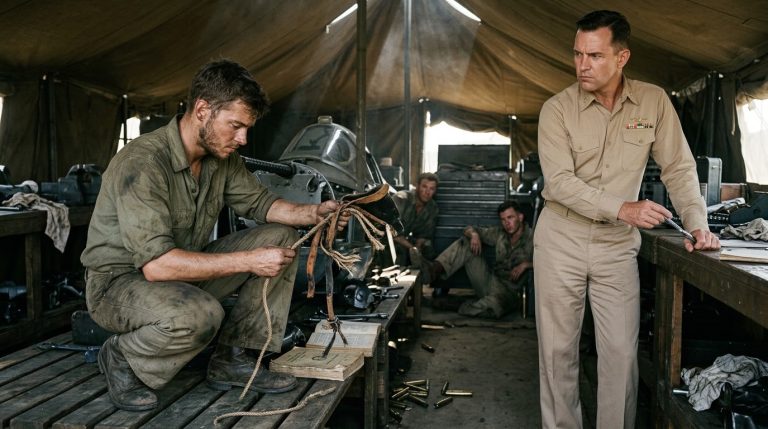
The fluorescent lights overhead hummed—a thin, reedy frequency that prickled at the back of Theodore’s neck. He stood in the shadow of the Apache, his hands buried deep in the pockets of his grease-stained coveralls. Beside him, Chief Warrant Officer Evans looked like a man drowning in dry air.
Evans was staring at the maintenance console, his finger hovering over a diagnostic tab that showed nothing but green bars. Perfection. According to the screen, the aircraft was ready for flight. According to the subtle, almost imperceptible tremor traveling through the concrete floor and into the soles of Theodore’s boots, the bird was dying.
“It’s not in the code, Chief,” Theodore said. His voice was gravelly, worn smooth by decades of shouting over rotor wash.
Evans didn’t look up. His jaw was clenched, a hard line of frustration. “The diagnostics have been run four times, Mr. Brewer. The system is reporting 100% operational status. Unless you want me to start ripping out wires based on ‘vibes,’ I suggest we trust the hardware.”
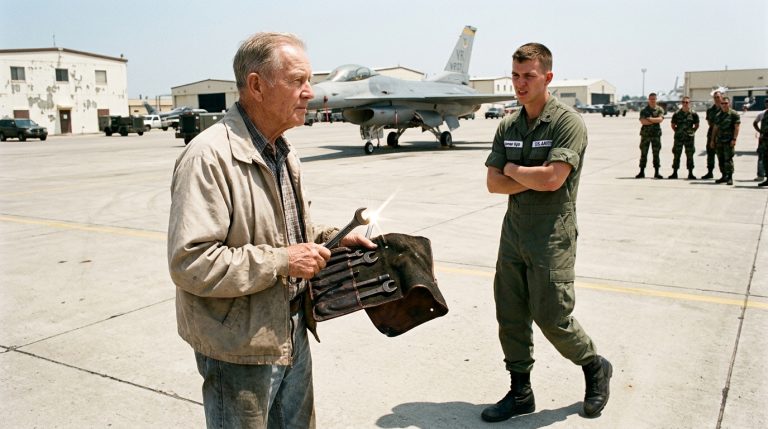
Theodore stepped toward the workbench. He didn’t reach for a computer. He reached for the leather roll. He untied the frayed twine, the sound of it scraping against the canvas like a dry branch snapping. He laid out the hand-forged tools. They caught the harsh hangar light, their surfaces dull and pitted, yet holding an edge that felt almost alive.
“The machine talks,” Theodore said, picking up a long, slender pick. “But it only knows the language you taught it. You taught it to be binary. Yes or no. Good or bad.”
“That’s how engineering works,” Evans snapped, finally turning around. His eyes were bloodshot, the exhaustion of the last few weeks etched into the dark hollows beneath them. “We deal in objective realities. We don’t have the luxury of superstition.”
Theodore tapped the side of the fuselage with the tip of the tool. The sound wasn’t a dull thud. It was a hollow, singing ring—a high-pitched whine that lingered in the air for a fraction of a second too long.
Evans stiffened. “What was that?”
“A hesitation,” Theodore replied. He closed his eyes, his hand resting flat against the composite skin of the bird. “The metal is stressed, not by the engine, but by the weight of the airframe itself. It’s a pressure leak in the hydraulic dampeners. It hasn’t triggered an alarm because the sensors are calibrated to look for catastrophic failure, not the slow, quiet decay of aging parts.”
Theodore looked at Evans. He didn’t see an adversary anymore; he saw a man trying to hold up the sky with a screen that wouldn’t show him the cracks.
“Put your hand there,” Theodore ordered, gesturing to the spot he had just struck.
Evans hesitated, his internal conflict visibly warring with his professional rigidness. He stepped forward, placing his palm against the cold metal. At first, there was only the ambient chill of the hangar. But then, as a distant heavy transport took off outside, the entire hangar vibrated.
Beneath Evans’s palm, the metal jumped. It wasn’t a mechanical shudder. It was a sharp, discordant pulse.
Evans pulled his hand back as if he’d been burned. He looked at the diagnostic terminal, then back at the ship. “The system… the system says nothing is happening.”
“The system is lying because you told it what to ignore,” Theodore said softly. He picked up his coffee mug, the steam rising in a thin, grey ribbon. “Now, are you going to keep staring at the screen, or are you going to show me how you strip a dampener without a manual?”
Evans stared at the tool—the razor-thin, ugly piece of steel—and for the first time, he didn’t reach for his tablet. He reached for the wrench.
CHAPTER 2: THE HANGARS GHOST
Evans stood frozen, his hand still vibrating from the phantom pulse of the dampener. He stared at the Apache, his breath hitching in his throat. The diagnostic screen remained a steady, mocking green. It was a digital lie, a pristine veneer stretched over a decaying skeleton.
Before he could articulate the dissonance between his touch and the data, the hangar’s overhead lights flickered. It wasn’t a standard brownout; the power grid surged, a low, guttural groan emanating from the massive industrial transformers bolted to the hangar’s rafters. The light shifted from clinical white to a jaundiced yellow, casting long, frantic shadows across the fuselage.
Brewer didn’t flinch. He didn’t even look up at the lights. He remained rooted to the concrete, his eyes fixed on the gap between the engine housing and the fuselage. He was listening to the hangar’s structure itself—the groan of the steel trusses, the imperceptible settling of a building that had seen too many decades of heavy vibrations.
“The bird isn’t the only thing with a fracture, Chief,” Brewer murmured. His voice was barely audible over the hum of the cooling fans.
“What is that?” Evans asked, his voice tight. He stepped back from the Apache, his professional training pulling him toward the terminal to check the power logs. “That surge—that shouldn’t happen. Not with the backup generators active.”
“It’s not the generators,” Brewer said, moving with that slow, shuffling grace toward the hangar’s support pillar. He pressed his ear against the cold, corrugated metal of the support beam. “It’s the resonance. The whole deck is shaking, and it’s feeding back into the flight line. You’re trying to diagnose an airplane in a cage that’s falling apart.”
Evans followed him, his boots clicking sharply on the polished floor. He felt a wave of irritation, a reflex to dismiss the old man’s mysticism, but the memory of the vibration in the dampener lingered in his palm like a brand. He was a man who lived by logic, and the logic of the diagnostic screen was currently collapsing under the weight of his own physical experience.
“If the building is vibrating, why aren’t the sensors picking it up?” Evans demanded, his finger tapping the tablet interface with unnecessary force. “The hangar is equipped with seismic dampeners.”
Brewer turned, a faint, sad smile touching the corners of his mouth. “The sensors look for earthquakes, son. They don’t look for the way a machine tries to breathe when it’s choked.”
The old man reached out and grabbed a loose bolt from the workbench. He didn’t use a wrench. He pressed it into the palm of his hand, closing his fingers, and then leaned against the support pillar. He stayed there for a long moment, eyes shut.
Evans watched, waiting for a lecture, for a sign of madness, or for the proof he desperately needed to justify the last seventy-two hours of frustration. He looked around the hangar—at the other technicians moving like ghosts, their eyes glued to their own tablets, their movements disconnected and robotic. They were trapped in a loop, slaves to the data stream.
Suddenly, the power surge died. The lights stabilized, the harsh, white fluorescent glow washing back over the floor. The hangar fell into an oppressive, heavy silence.
“You want to know why you can’t fix this bird?” Brewer asked, his eyes opening. They were clear, piercingly sharp in the sterile light. “It’s because you’re terrified of what happens if the data is wrong. You’ve built a world where you don’t have to be responsible for the machine—the screen is responsible. And when the screen fails, you’re just a man with a useless tool in your hand.”
Evans took a breath, the air tasting of ozone and machine oil. He looked at the Apache, then at his own trembling hands. He remembered the feeling—the sharp, discordant pulse in the dampener. It had been real. No computer had told him it was there; he had felt it through the skin, through the bone.
“I need to know,” Evans said, the admission tearing through his pride. “I need to know how you felt it. Before the surge. Before you touched the pillar.”
Brewer untied the leather roll again, pushing it toward Evans across the workbench. The tools inside looked like relics of a forgotten civilization, but as Evans looked at them, he didn’t see junk anymore. He saw a map of a different kind of reality.
“The first lesson isn’t in the hands,” Brewer said, walking toward the hangar door that opened onto the runway. He gestured for Evans to follow. “It’s in the quiet. You have to learn to shut off the noise. Not the engine noise—the noise in your own head.”
They stepped out into the humid heat of the flight line. The roar of a C-130 taxiing in the distance was a wall of sound, but Brewer walked into it as if he were stepping into a shallow stream. He stopped near the edge of the asphalt, where the heat haze shimmered off the landing gear of a parked Blackhawk.
“Look at the way the light catches the rivets,” Brewer commanded. “Don’t look for the color. Don’t look for the reflection. Look for the way the metal is weeping.”
Evans squinted. At first, he saw only the sunlight. But then, as he focused—as he forced his mind to quiet the analytical chatter that usually dominated his thoughts—he saw it. A tiny, oily stain trailing downward from a rivet on the gear housing. It was almost invisible, a ghost of a smear, but it was there.
“Hydraulic fluid,” Evans breathed, the realization cold and sudden.
“The machine is always talking, Chief,” Brewer said, his eyes scanning the horizon. “You just spent years learning how to stop listening.”
Evans looked back at the hangar. He realized with a sinking heart that he was now the only one who knew the truth about the Apache, and he still had no idea how to explain it to the Colonel without appearing insane. The gap between his knowledge and the reality of the base’s command structure felt like a chasm that would swallow him whole.
“We go back inside,” Evans said, his voice hardening into a new, quiet resolve. “We strip that dampener. And if the logs don’t show the error, I’ll force the diagnostic to run a stress test that will break the system if it’s lying.”
Brewer nodded, a spark of approval in his gaze. “That’s the spirit, son. But be careful. When you break the screen, you have to be ready to see what’s behind it.”
CHAPTER 3: THE HIDDEN FRACTURE
The transition from the blinding glare of the tarmac into the dim, cavernous interior of the hangar felt like descending into a subterranean vault. Evans squinted, his eyes struggling to adjust to the amber wash of the work lights. He carried the heavy toolkit as if it were a talisman, the metal handle biting into his palm. Every step on the concrete felt deliberate, stripped of the frantic, rapid-fire urgency he had cultivated over years of trying to outpace the base’s software.
Beside him, Brewer moved with the silent, rhythmic gait of a man who belonged to the machinery. He didn’t look at the other maintenance crews, who were huddled around their glowing terminals like moths around a dying flame. He walked straight toward the Apache, his path a direct, unhesitating line.
“The dampener,” Evans said, his voice sounding too loud in the stillness. He set the tools down on the workbench with a metallic clang that echoed into the rafters. “We start with the hydraulic line?”
Brewer reached into his coveralls, pulled out his mug, and took a slow, deliberate sip. “We start with the patience, Chief. You try to force a bolt that’s been sitting under stress for five years, you’ll shear the head off. Then you’ve got a real problem.”
Evans nodded, though his muscles were coiled tight. He approached the Apache. Up close, the composite skin looked different. He wasn’t seeing a high-end combat platform anymore; he was seeing an aging beast, its surface scarred by minor impacts and thermal expansion. He reached for the access panel. His hands, usually steady when guiding a mouse or a touchscreen, felt clumsy, unrefined. He had spent so long abstracting the machine—viewing it through the filter of data—that the physical reality of removing a bolt felt like an act of vandalism.
“Easy,” Brewer coached, his voice a low, steady rumble. “Don’t fight the resistance. Feel for the moment the metal yields.”
Evans placed the wrench on the bolt. He didn’t just twist. He closed his eyes, centering his focus on the friction between the steel of the tool and the steel of the bolt. He felt the initial resistance, the stubborn refusal of the part to move, and then, as he applied steady, calculated pressure, the microscopic give. It was a release. A faint, shuddering vibration traveled up the handle of the wrench, a tactile signal that the system was beginning to open.
He exhaled, the sound shaky. He had done this thousands of times, but never with this level of attention. It was as if he were listening to a conversation he had been ignoring for his entire career.
They worked in silence for ten minutes, the only sound the rhythmic rasp of tools and the occasional soft groan of the hangar’s metal framework. Evans felt a strange, quiet satisfaction in the labor. His back ached, and his hands were stained with grease—a mess he would have once considered a failure of protocol—but he didn’t care.
Then, he heard it.
It was a soft, rhythmic tink-tink-tink.
Evans stopped, his wrench hovering just above the panel. He frowned, turning his head. The sound wasn’t coming from their Apache. It was coming from the shadows of the adjacent bay, where a line of other helicopters sat draped in protective covers, dormant and cold.
“Do you hear that?” Evans whispered.
Brewer straightened up, his movements slow and fluid. He didn’t look at Evans. He tilted his head, his focus shifting toward the dark, silent aircraft sitting twenty yards away.
“I hear it,” Brewer said.
“It sounds like metal cooling,” Evans suggested, though he knew the sound was wrong. Cooling metal made a hollow, erratic popping. This was a mechanical rhythm—precise, intentional, and entirely out of place for a bird that hadn’t been spooled up in weeks.
“That’s not cooling,” Brewer said, his tone flat. He wiped his hands on a rag and began to walk toward the sound.
Evans hesitated, his gaze darting to the diagnostic terminal on their Apache. It was still showing a perfect, serene green. He looked at the bay where the ticking was coming from. It was a restricted area, reserved for long-term storage and sensitive electronics testing.
“Mr. Brewer, wait,” Evans called out, but the old man was already moving into the gloom.
Evans grabbed his light and followed. His heart hammered against his ribs—a drumbeat of anxiety. He reached the other helicopter, a newer model, sleek and imposing. He swept the light across its fuselage. Everything looked pristine. There were no oil leaks, no loose panels, no obvious signs of distress.
He stood near the rear rotor assembly. The ticking was louder here, vibrating faintly through the concrete floor.
“It’s in the tail,” Evans muttered. He moved closer, feeling the cold air radiating from the machine. He reached out, his hand trembling, and touched the tail rotor’s housing.
The vibration was subtle, but it was there—a tiny, rhythmic hammer hitting a hollow anvil. It was a heartbeat. A machine shouldn’t have a heartbeat.
Brewer stood behind him, his silhouette a dark, unmoving shadow. “You feel that, Chief?”
“It shouldn’t be possible,” Evans said, his voice rising in panic. “There is no power to this unit. The batteries are disconnected. The system is completely dead. How can it be… ticking?”
Brewer reached out and laid his hand beside Evans’s. He closed his eyes, a pained expression flitting across his face. “It’s not just ticking, son. It’s searching. It’s a ghost in the wiring, a feedback loop from the grid. And if it’s happening here, it’s happening everywhere.”
Evans looked at the silent hangar, the realization hitting him with the force of a physical blow. The systemic flaw wasn’t an isolated incident with their Apache. It was a contagion, hidden behind the green bars of a thousand diagnostic screens. The entire fleet was suffering from the same phantom ailment, a slow, metallic rot that the software was programmed to hide.
He looked at Brewer, his face pale. “We need to report this. We need to go to the Colonel.”
“And say what?” Brewer’s voice was sharp, cutting through the silence. “That you heard a sound? That you felt a vibration? You have no data, Chief. You have nothing but your hands and your ears. In this place, that’s not enough to be believed. It’s enough to be called a ghost.”
Evans gripped the cold metal of the helicopter, his knuckles white. The weight of what he had uncovered—or rather, what he had finally allowed himself to hear—was suffocating. He wasn’t just a mechanic anymore. He was a witness to a disaster that was waiting to happen, and he had no idea how to sound the alarm without being destroyed by the very system he was trying to save.
“Then we don’t report it,” Evans said, his voice dropping to a harsh whisper. “We fix it. One bird at a time.”
Brewer looked at him, and for the first time, a flicker of genuine respect warmed the old man’s eyes. “That,” Brewer said, “is going to be a very long, very loud, and very quiet war.”
CHAPTER 4: THE ARCHITECTURE OF TRUST
The walk back from the storage bay felt like a march toward a cliff’s edge. Every step Evans took on the industrial-grade concrete felt heavier, as if the floor beneath him were trying to pull him down into the subterranean infrastructure he now knew was screaming for help. Beside him, Brewer was a study in stillness, his hands tucked into the pockets of those grease-stained coveralls, his eyes tracking the movement of the mechanics like a predator assessing a herd.
Evans didn’t speak. He couldn’t. The magnitude of the realization—that the failure of the Apache wasn’t an anomaly, but a symptom—made every diagnostic terminal in the hangar look like a ticking bomb. He felt a sudden, sharp desire to stop, to turn around, to go back to the days when he simply trusted the green bars and the software logs. Ignorance, he realized, was the most efficient lubricant for his daily life.
They reached the edge of the Apache’s bay just as Colonel Davies emerged from the command office. The Colonel was reading a tablet, his brow furrowed in that familiar, harried line of perpetual crisis. When he saw them, he stopped, his gaze darting between Brewer’s impassive face and Evans’s disheveled, sweat-streaked appearance.
“Chief,” Davies said, his voice clipped, holding the authority of a man who didn’t have time for surprises. “The General is asking for a status update on the flight readiness. My engineers are reporting that the simulation software is showing no reason why that port engine shouldn’t be spooling up perfectly. Why is my bird still on the jacks?”
Evans felt his throat constrict. This was the moment. The path of least resistance was to blame the parts, to suggest a backorder delay, to feed the Colonel a lie that would keep the system quiet and the status quo intact. But then, he felt the memory of the vibration in his hand—the honest, physical reality of that rhythmic tink-tink-tink he had heard in the dark bay.
He glanced at Brewer. The old man didn’t look at him; he was busy inspecting the seam of the Apache’s engine cowling, his fingers tracing the metal with a gentle, almost reverent touch.
“The bird isn’t ready, sir,” Evans said, his voice steadying.
Davies sighed, a sharp, impatient sound. “Chief, I don’t have time for the ‘it needs more time’ routine. If there’s a hardware issue, identify it and replace it. If there’s a supply issue, I’ll leverage the procurement office. What is the specific obstruction?”
“It’s not a part, Colonel,” Evans said, stepping forward. He didn’t look at the tablet Davies was holding. He looked the Colonel directly in the eye. “It’s the environment. And it’s not just this aircraft.”
The Colonel froze, his expression shifting from annoyance to a cold, professional wariness. He looked around the hangar, ensuring no one was close enough to overhear. “Be very careful what you say next, Evans. We have the best engineers in the branch monitoring this fleet. You are suggesting a systemic failure.”
“I’m suggesting we’ve stopped listening to the airframe,” Evans replied, his voice rising just enough to carry the weight of his conviction. “Mr. Brewer found a pressure fracture that your digital scope missed. We’ve been running a check on the tail rotor housing in the storage bay, and there’s a resonance occurring that shouldn’t be possible—a feedback loop in the structural grounding.”
Davies took a step closer, his voice dropping to a whisper. “You’re talking about tearing apart the storage fleet. Do you know what that would mean for the operational timeline?”
“If we don’t, we’re going to lose a bird in flight,” Evans said. He reached into his pocket and pulled out the small, hand-forged pick Brewer had given him. He held it out, the metal dull and unrefined, yet unmistakably solid in the dim hangar light. “The computer is telling us everything is fine because the computer is calibrated to hear what we expect to hear. We need to do a manual, non-digital inspection of the grounding points on the entire row.”
Davies looked at the tool, then at Evans’s grease-stained hands. He was a creature of the system, a man who had climbed the ranks by mastering the bureaucracy of modern warfare. But he was also a soldier, and beneath the suit and the tablet, there was still a flickering spark of the man who had once understood that survival wasn’t a spreadsheet.
“You’re asking me to authorize an unauthorized maintenance protocol,” Davies said. It wasn’t a question.
“I’m asking you to let us find the ghosts before they bring one of your pilots down,” Evans replied.
The Colonel looked toward the main office, where the lights of the command center glowed with the cold, unblinking eyes of the servers. He stood there for a long moment, the silence of the hangar seemingly magnifying the distant, muffled hum of the base.
“The General arrives tomorrow for a final inspection,” Davies said, his gaze fixed on the floor. “He expects a flight-ready machine.”
“You’ll have a flight-ready machine,” Brewer spoke up, his voice soft but carrying across the metal floor. “But you’ll have one that doesn’t fall apart when the pilot pulls the collective.”
Davies looked at the old man. The tension in the Colonel’s shoulders didn’t leave, but his posture shifted. He turned back to Evans and gave a curt, almost imperceptible nod.
“You have six hours,” Davies said, his voice low. “If you find nothing, you’re back on standard diagnostics, and you’ll explain to the board why you wasted a cycle. If you find something… ensure you document it in a way that doesn’t trigger an automatic fleet-wide grounding until I have time to coordinate with Logistics.”
“Understood,” Evans said.
“And Evans?” Davies paused as he began to walk away. “Don’t break the bird.”
As the Colonel walked off toward the command office, Evans felt his legs go weak. He had crossed the line. He was no longer working within the system; he was working beneath it, in the cracks and the shadows. He looked at the Apache, then at the vast, darkened expanse of the hangar floor. The real work was just beginning.
CHAPTER 5: THE CRUCIBLE OF DOUBT
The hangar was a tomb of silence, or at least it had been until the Colonel departed. Now, the atmosphere felt charged, heavy with the weight of the clandestine work ahead. Evans stood by the Apache, the wrench feeling alien in his grip. His eyes traced the sleek, composite skin of the aircraft, but his mind kept drifting back to the command terminal. The green bars—the familiar, comforting, and utterly false indicators of system health—flickered in his memory like a persistent phantom.
“Stop,” Brewer’s voice cut through the air, low and steady. He was standing near the tail, his hands resting on a crate of spare parts. He didn’t look at Evans, but he sensed the hesitation. “You’re still looking at the ghost of the data, Chief.”
Evans blinked, shaking his head. “I was just thinking… if this is a systemic resonance, if it’s hitting the entire fleet, then the logs aren’t just wrong. They’re being rewritten by the firmware itself to hide the frequency shifts. That means every diagnostic check conducted in the last six months is suspect.”
“More than suspect,” Brewer said, walking toward him. “It’s a blindfold. You’re trying to navigate a minefield while someone else is holding the map and pointing you toward the craters.”
Evans turned away from the Apache, walking toward the storage bay where the ticking had started. The sound was rhythmic, persistent, a mechanical metronome of decay. As he drew closer, the V-2 sensation returned—the psychological phantom of the digital logs he had relied on. He could almost hear the ping of a system update, the chime of an ‘All Systems Green’ report, a chorus of technological approval that made the physical ticking feel like an intrusion. He stopped, closing his eyes.
“Chief?”
“I hear it,” Evans said, his voice strained. “But it’s getting louder. It’s not just in the tail rotor anymore. It’s in the chassis.”
He walked to the side of the dormant helicopter. He placed his hand against the fuselage, and the vibration was no longer subtle. It was a tremor, a high-frequency shivering that made his teeth ache. He pulled out the hand-forged pick Brewer had given him. The tool felt cold, the steel biting into his palm.
“If this resonance is active,” Evans said, “then the entire airframe is under load, even while standing still. The ground loop is fighting the dampeners.”
He moved to the access panel near the base of the rotor pylon. He hesitated. If he opened this panel and found the resonance was worse than he feared—if he found that the structural integrity had already been compromised beyond repair—the ‘official’ record would show he had meddled with an intact unit. He would be the one responsible for the failure.
The risk of the truth was becoming higher than the cost of the lie.
“Do it,” Brewer prompted.
Evans set the edge of the pick into the seam of the panel. He applied pressure, the metal of the ship feeling strangely soft under the tip of the tool, a sign of the microscopic fatigue that the scanners had been trained to overlook. With a sharp snap, the panel came free.
He swung it open.
Inside, the sight was a nightmare of mechanical degradation. The pneumatic lines were coiled with a fine, spider-webbing pattern of stress cracks, and the mounting brackets were visibly misaligned. The rhythmic ticking was coming from a loose connection on a sensor array that was physically beating against the mounting frame, acting as an unintended hammer.
“The sensor,” Evans whispered. “It’s not just reporting data; it’s literally shaking itself to pieces.”
He reached out, his hand hovering over the oscillating array. The speed of the vibration was incredible, a blur of motion that defied the cold, static environment of the hangar. It was a kinetic, violent energy.
“Don’t touch it with your skin,” Brewer warned. “It’ll take your finger off.”
Evans grabbed the small pair of insulated pliers from his kit. He carefully maneuvered toward the loose sensor mount. The heat radiating from the vibration was intense—a waste of energy that the digital logs insisted didn’t exist. He tightened the bolt. The ticking stopped instantly, replaced by a momentary, eerie stillness that felt even louder than the sound had been.
But the relief was short-lived.
As soon as the sensor ceased its hammering, the entire aircraft groaned. The structural tension shifted, the stress flowing from the sensor mount to the next weakest point in the chain. A high-pitched, metallic screech erupted from the pylon, and a hairline fracture opened in the main support spar, right before their eyes.
Evans recoiled, the sound vibrating in his chest. “I just moved the failure point,” he realized, his voice hollow. “I didn’t fix the resonance. I just forced the energy to go somewhere else.”
Brewer stepped forward, his face grim. He looked at the growing fracture in the spar. “Now you see, Chief. You aren’t just repairing a bird. You’re playing a game of physics against a machine that’s been allowed to decay for too long. If we don’t bleed off that resonance, the whole row is going to come down.”
Evans looked at the row of storage helicopters. The silence was back, but it felt precarious, a thin, taut wire stretched to the point of snapping. He realized then that he couldn’t just patch these aircraft one by one. The problem was the grid, the power, the way the hangar’s own grounding system was fueling the resonance.
“We have to kill the power to the storage row,” Evans said.
“The Colonel gave us authorization for maintenance,” Brewer said, “not for a base-wide shutdown.”
“If we don’t,” Evans replied, looking at the widening fracture in the spar, “there won’t be a fleet left for the General to inspect.”
He looked at the terminal at the end of the bay—the master control for the storage grid. It was encased in a security housing that he had no authorization to bypass. He turned back to Brewer, the wrench still gripped tight in his hand. The weight of his decision was absolute. He had started this as a repair; now, it was a tactical necessity. He would have to bypass the grid manually, a feat that would surely trigger an alert in the command center.
He was past the point of return. He walked toward the terminal, his boots echoing in the empty, silent hangar, the fracture in the spar still visible behind him, a dark, jagged scar on the future of the base.
CHAPTER 6: THE CRUCIBLE
The air in the storage bay turned frigid. It wasn’t the temperature of the room that shifted; it was the psychological weight of the alarm, a low-frequency hum that vibrated through the soles of Evans’s boots and into the marrow of his bones. He stood paralyzed before the control terminal. The screen, once dark, had flared into a deep, warning crimson, displaying a rapid-fire sequence of security protocols he hadn’t seen since his initial certification.
“Back away, Chief,” Brewer said. The old man was already at his side, his hands moving with a fluid, practiced efficiency. He didn’t look at the screen; he looked at the conduit leading from the terminal into the hangar’s main power trunk. “The system is sensing an unauthorized bridge. It’s going to initiate a hard lockout.”
“I can bypass the security handshake,” Evans argued, his voice brittle. “I just need to isolate the storage row’s power feed. If I can cut the resonance frequency, the spar fracture won’t propagate.”
“If you cut the feed while the system is in active conflict with the load,” Brewer countered, his voice sharp, “you’ll trigger an arc flash that will weld the control switches shut. You won’t just lock the grid; you’ll vaporize the interface.”
Evans looked at his hands. They were trembling. The doubt—the V-4 phantom—settled over him like a shroud. Was he really fixing the machines, or was he a relic-obsessed fool tearing apart a billion-dollar defense infrastructure because he didn’t understand the nuance of digital load-balancing? The flickering lights made the shadows in the hangar dance, and for a heartbeat, he saw his own reflection in the terminal glass: a man who looked older, exhausted, and hopelessly out of his depth.
“Trust the feel, not the math,” Brewer whispered, his hand resting briefly on Evans’s shoulder. The touch was firm, grounding. “The resonance isn’t just a number, Chief. It’s a physical push. You have to push back.”
Evans took a breath, the smell of hot, ionized air stinging his nostrils. He ignored the red warnings on the screen. He ignored the internal notification chimes that were now echoing throughout the hangar like a digital death knell. He focused on the conduit. He could feel the pulse of the power grid, a chaotic, thrashing rhythm that felt like a trapped animal behind the steel.
He gripped the manual override lever. It wasn’t a digital switch; it was a heavy, industrial-grade mechanical lever meant for emergency shutdown. It had probably never been pulled in the entire history of the base.
He braced his boots against the floor and pulled.
The resistance was incredible. The lever didn’t just fight him; it seemed to lock against the vibration of the hangar. Tink-tink-tink—the rhythmic ticking he had heard earlier returned, now echoing from every corner of the storage row as the grid struggled to keep the dead aircraft energized against the resonance.
“It’s too tight,” Evans grunted, his muscles screaming.
“The resonance is holding it,” Brewer shouted over the rising wail of the alarms. “You have to match the frequency of the pull to the frequency of the shift!”
Evans let his mind go blank. He let go of the idea of ‘power’ and ‘safety’ and ‘career.’ He focused entirely on the vibration in the lever—the push-pull of the grid’s struggle. He timed his effort, pulling only when the hangar’s metal groaned in sync with the pulse.
Now.
With a guttural roar, Evans threw his weight into the lever. There was a sound like a giant snapping a dry twig—the mechanical lock shattering under the torque—and the lever slammed downward.
A violent, blue-white flash illuminated the bay. The sound was deafening, a clap of thunder contained within the cold metal walls. The lights overhead surged one last time, turning a blinding, pure white, before vanishing entirely.
Silence rushed back into the room, heavy and absolute.
Evans fell back against the terminal, his chest heaving. His palms were blistered, the skin raw from the friction, but the ringing in his ears began to fade, replaced by a profound, eerie quiet. He clicked on his tactical light. The beam cut through the darkness, illuminating the control panel.
It was dead. No lights, no alarms, no warnings. The power to the entire storage row had been severed.
“Did we do it?” Evans breathed, his voice raw.
Brewer moved forward, his own light playing over the floor. He stopped near the storage row. The rhythmic ticking had ceased. The ominous, high-frequency shivering of the airframes was gone. The row of silent helicopters stood as still as statues, the unnatural kinetic energy drained from their hulls.
But as Evans walked toward the storage helicopter with the fractured spar, his light caught something that made his blood run cold.
The fracture hadn’t stopped growing.
Without the resonance holding the tension, the metal was settling—and as it settled, the gap in the support spar was widening. A steady, thin trickle of fluid was pooling on the floor, and the entire pylon was tilting by a fraction of a degree.
“The structural load was being supported by the resonance,” Evans whispered, the realization devastating. “We didn’t just shut off the power. We took away the only thing keeping the airframe together.”
He looked at the pylon, then back at the dark, silent terminal. He had solved the resonance, but he had accelerated the collapse. He had succeeded in his mission, only to realize that the ‘flaw’ was more deeply integrated into the machines than he had ever imagined.
He turned to look at Brewer, the old man’s face a mask of grim, sorrowful understanding.
“We have to brace it,” Brewer said, his voice quiet. “Before the gravity finishes what the electricity started.”
Evans looked at the massive, tilting aircraft. He realized then that the ‘war’ wasn’t against the machines. It was against the clock. They had hours, maybe less, before the pylon gave way, and they had no way to call for help without exposing everything they had done.
CHAPTER 7: THE SILENT DEPARTURE
The hangar’s atmospheric pressure shifted with a sickening pop, a sudden, sharp intake of air that made Evans’s ears ring. He stumbled, his hands skidding across the cold, damp fuselage of the storage helicopter. The air, usually stale and heavy with the scent of long-term preservation, now felt thin, almost brittle.
“The vent seal,” Brewer wheezed, his voice sounding distant in the suddenly rarified atmosphere. He was hunkered down near the base of the pylon, his hands expertly wedging a series of shims—forged from scrap metal—into the widening crack in the support spar. “The shutdown triggered a fail-safe in the climate control. We’re in a pressurized vacuum, Chief. Keep low. If the pressure stabilizes too fast, the airframe will snap like glass.”
Evans didn’t question the physics; he felt them. He pressed his chest against the cold, unyielding surface of the helicopter. The pylon, once a solid pillar of engineering, now felt like a living, groaning thing. He could feel the torsion working through the metal, a slow-motion torture that threatened to shatter the entire assembly. He maneuvered the heavy, manually operated support jack into place, his movements agonizingly slow. Every inch he turned the handle felt like lifting a mountain.
“Steady,” Brewer commanded, his voice a tether in the darkening bay. “Don’t fight the weight. Let the jack take the pressure, but keep the load centered. If you cant it even a fraction, the spar will shear.”
Evans adjusted his grip, his muscles burning. He was past the point of fatigue; he was operating on a primal, desperate instinct to preserve the machine. His thoughts drifted, unbidden, to the command center. Somewhere, deep within the base’s digital heart, a technician was probably staring at a screen, completely unaware that the storage row was literally holding its breath. The disconnect between their reality—this visceral, grinding fight for survival—and the antiseptic certainty of the data logs felt like a betrayal.
“They won’t know,” Evans muttered, the realization striking him with a bitter, hollow resonance. “Even if we fix this, even if we save the fleet, they’ll just look at the logs and call it a ‘transient software anomaly.’ They’ll never know how close this place came to falling down.”
Brewer, his back pressed against the pylon to provide additional tension, looked up. “That’s the secret, Chief. You don’t do this for the logs. You don’t do it for the commendations. You do it because the machine deserves to live, and because the men who fly them deserve to trust their gear.”
Evans didn’t reply. He focused on the jack. Click. The ratchet engaged, holding a fraction of the load. Click. Another fraction. He watched the crack in the spar. It stopped widening. The metal, under the sudden, corrective force of the jack, groaned, a long, high-pitched whine of agony that made Evans wince.
Then, the hanger’s internal lighting, still dead from the power cut, pulsed with a dim, emergency-red hue. A heavy, rhythmic thud echoed from the hangar’s main blast doors—the sound of security personnel, alerted by the sudden power fluctuation.
“They’re here,” Evans said, his voice tight.
“We have exactly two minutes,” Brewer said, his voice perfectly calm. “We need to finish the brace and get out of the bay. If they find us here, with the grid cut and the storage row compromised, they won’t ask questions. They’ll just lock us away for good.”
Evans pushed his body to the limit, his legs trembling as he cranked the jack. He wasn’t just lifting a pylon; he was lifting the weight of his entire career, of every assumption he’d ever held about technology and truth. He locked the jack in place. The pylon shifted, the spar settling into a new, stable alignment. He wiped the sweat from his eyes, his hands slick with a mixture of hydraulic fluid and blood.
They retreated into the shadows of the storage row, moving with the silent, practiced grace of men who had spent their lives navigating the dangerous corners of the world. As they reached the side door, Evans took one last look at the helicopter. It stood in the dim, red emergency light, a wounded, silent sentinel.
He didn’t feel like a hero. He felt like a man who had seen the foundation of his reality crumble and had tried, in his own small, clumsy way, to patch the cracks.
“Come on, Chief,” Brewer whispered, his hand on the door handle. “The real test is tomorrow. When the General sees what you’ve done, you won’t have a screen to hide behind. You’ll have to tell the truth. Are you ready for that?”
Evans looked at the wrench he still held—the handmade tool that had saved the Apache. He felt its weight, its history, its honest, brutal simplicity. “I’m ready,” he said, and for the first time in his life, the words were true.
CHAPTER 8: THE RESONANCE OF TRUTH
The hangar was waking up. In the distance, the first shift of the day was beginning—the clatter of metal tools, the distant, muffled shouting of logistics officers, and the high-pitched whine of ground power units being hooked up to the flight-line birds. Evans stood just inside the threshold of the storage bay, his lungs burning from the thin, pressurized air he’d been breathing, the transition to the normal, ambient temperature of the hangar feeling like a sudden, jarring displacement.
Brewer was right beside him, his movements fluid, his face a map of fatigue that somehow still held a quiet, iron-willed resolve. They had braced the spar, they had cut the grid, and now, they had to face the fallout.
“They’ll be here soon,” Brewer whispered. “The Colonel, the General, the whole parade.”
Evans looked down at his hands. They were covered in grease, grime, and the dry, white dust of the hangar floor. He looked at the tool in his hand—the hand-forged pick that had been his lifeline. It looked ugly, archaic, and entirely out of place in a hangar filled with multi-million-dollar surveillance equipment and digital diagnostics. But it was the only thing that had worked.
They walked back toward the Apache bay. As they rounded the corner, they saw them: Colonel Davies standing at rigid attention, his face a pale mask of anxiety, and beside him, the towering, imposing figure of General Peterson. The General was holding a tablet, his eyes scanning the data, but his expression was distant, as if he were waiting for something he knew was inevitable.
“Colonel,” Peterson said, his voice carrying easily across the expanse of the floor. “The logs are showing a power surge in the storage row. A significant one. Care to explain why the entire block just went dark?”
Davies swallowed hard. He looked at Evans and Brewer as they approached. The silence that followed was heavy, pressing in on the hangar like the pressure they had just fought to equalize.
Evans didn’t wait for Davies to speak. He stepped forward, his boots ringing on the concrete. He didn’t offer a salute. He simply reached into his pocket, pulled out the leather roll, and untied it. He laid the tools out on the workbench beside the Apache.
“The logs are blind, General,” Evans said, his voice clear, steady, and devoid of the deference he had once held for the rank. “The surge wasn’t a fault. It was a correction.”
The General’s eyes narrowed. He looked at the tools, then at Evans, his gaze icy. “You are the mechanic who tampered with the grid?”
“I’m the mechanic who fixed the fleet,” Evans corrected him. He pointed to the Apache’s engine cowling. “Your digital systems were telling you this bird was safe. It wasn’t. There is a systemic resonance in the airframe, a structural fatigue triggered by the grounding and power distribution of the hangar itself. The software is programmed to ignore the frequency, General. It doesn’t see the crack; it only sees the signal.”
The General looked at Davies, then back at the Apache. The room was deathly quiet. A dozen young mechanics had paused their work, their tablets forgotten, watching the tableau.
“You’re telling me,” the General said, his voice dangerously low, “that every diagnostic report from the last six months—the most advanced maintenance data we’ve ever deployed—is based on a flaw we’ve been programmatically ignoring?”
“I’m telling you that we’ve forgotten how to feel the machine,” Evans said. He picked up the pick. “The machine is screaming, and we’ve muted it because the screaming didn’t fit our data model.”
The General didn’t move for a long time. He looked at the Apache, the silent beast that had defied the brightest minds on the base. Then, slowly, he stepped forward. He stood next to Brewer, the man who had been his own lifeline in a war long forgotten. He looked at the old man, his eyes softening just for a second.
“Teddy,” the General murmured. “Is he right?”
Brewer stepped up to the Apache. He placed his hand on the fuselage—the same spot where Evans had felt the vibration hours ago. He didn’t speak. He just looked at the General.
“He’s right, Pete,” Brewer said. “We’ve built a world where the machine is an object, not a partner. We stopped listening, and now, the machines are breaking under the weight of our own silence.”
The General let out a long, shuddering breath. He looked at his tablet, the screen still glowing with the sanitized, perfect data, and then he simply pressed the power button. The screen went black.
“Ground the storage row,” the General ordered, his voice echoing through the hangar. “Davies, I want a full, manual inspection of the grounding points on every airframe in this bay. Not digital. Manual. With hand-tools and eyes. And I want Mr. Brewer to lead the team.”
Davies nodded, his relief so palpable it was almost a physical presence in the room.
The aftermath came in waves—the frantic, sudden reality of the work. But for Evans, it was a slow, quiet settling of the world. He moved back to the workbench, picking up his file, the simple, rhythmic motion of metal on metal a comfort he had never truly appreciated before.
Weeks later, the base had changed. The hangar was still loud, still busy, but the culture had shifted. There was more talk, more questioning, and for the first time in years, a mechanic could be seen walking the floor with a set of hand-tools, not a tablet.
Evans sat at the workbench, working on a new tool—a simple, elegant piece of steel he was shaping to fit his own hand. He felt a presence behind him. He didn’t look up, but he knew the steady, low-frequency hum of a mug of coffee being set down on the bench.
“You’re getting better at the bevel, Chief,” Brewer said, his voice a warm, familiar rumble.
Evans smiled, the sensation small and genuine. He picked up the tool, feeling the balance of it, the way it wanted to cut, the way it wanted to work. He looked out over the hangar, seeing not the data-stream, but the machines themselves—shining, imperfect, and finally, being listened to.
He had saved the fleet, but more importantly, he had saved the craft. He was a mechanic again. And for the first time in his life, he knew exactly what that meant.