The Silent Weight of Redemption: A Sniper’s Quiet Return to the Fray of Human Connection
CHAPTER 1: The Firing Line
Lieutenant Vasquez didn’t look at Marcus; he looked through him, as if Marcus were merely a smudge of grime on an otherwise polished afternoon. The sun glinted off the polished concrete of the outdoor range, turning the heat into a physical weight. Vasquez’s grin was sharp, practiced, a blade honed for the purpose of making others feel small.
“Five shots, five bullseyes,” Vasquez said, his voice carrying easily over the wind. “No blinking. Do that, and you get your plate of food, old man. Fail, and you go back to the bridge.”
Marcus stood still. The gravel beneath his boots felt uneven, a stark reminder of how long it had been since he stood on level ground. Around them, the crowd had grown—a circle of onlookers, some with children on their shoulders, their faces a mix of pity and morbid curiosity. The smell of grilled meat from the nearby event pulled at the hollow space in his stomach, a reminder of two days without a single crumb of sustenance.
He took the rifle Vasquez held out. It felt unnaturally light, a phantom limb he had buried deep beneath years of survival under the I95 bridge. His fingers traced the familiar texture of the grip. The metal was cool, indifferent to the mud-caked state of his hands.
“I’ll do it,” Marcus whispered. His voice sounded raspy, unused, but it held a steadiness that made Vasquez’s grin falter, just for a heartbeat.
He knelt. The movement was fluid, an unconscious return to the posture that had once defined his entire existence. He ignored the whispers behind him—the speculation about his legitimacy, the snickers of those who found his presence an affront to their curated afternoon. He focused instead on the target.
His breathing didn’t just slow; it leveled into the rhythm of the tides. In, out. The peripheral noise—the laughter, the shifting feet, the distant hum of traffic—began to bleach out, leaving only the sharp focus of the scope. He pressed his cheek to the stock. The leather of his jacket was stiff with age and filth, but for a moment, it provided the only stability he possessed.
He caught a scent—not the burning cordite of the range, but the faint, ghostly smell of dry, sun-baked earth from a ridge halfway across the world. It was a memory of silence, not of violence. He held his breath, the world narrowing down to a single, microscopic point of impact.
He didn’t blink. He didn’t even think. He simply let the moment happen.
The rifle kicked, a sharp, familiar jolt against his shoulder. The target fluttered. When the paper settled, the hole was dead center. The murmur from the crowd shifted; the pity wasn’t gone, but it was being replaced by something else, something far more volatile: surprise.
Marcus shifted his weight, his eyes locked on the next target. He was already calculating the wind, the drift, the pressure of his own heartbeat against the steel. He was no longer a homeless man begging for scraps; he was the instrument, the silence, and the truth, all at once. And he knew, with a sudden, painful clarity, that this shot would change everything.
CHAPTER 2: The Echo of the Shot
The silence that followed the fifth shot was heavy, the kind of silence that usually preceded an explosion or a funeral. Marcus remained knelt, his cheek still pressed against the cool, unforgiving polymer of the M4’s stock. His left eye remained open, scanning the periphery, but there was nothing to scan except for the stunned, slack-jawed expressions of the crowd.
Vasquez stood three feet away. The grin that had defined his face for the last twenty minutes was gone, replaced by a pale, twitching uncertainty. He looked at the paper target—five holes clustered so tightly they blurred into a single, jagged puncture—and then down at his own hands, which were clenched at his sides.
“Luck,” Vasquez breathed. The word lacked conviction; it was a desperate anchor he was casting into a sea that had already swallowed him. “Just dumb, blind luck. The wind died down. You got lucky.”
Marcus didn’t move to stand. His body felt anchored to the earth, the old ache in his knees radiating upward, a dull, familiar fire. As he shifted his weight, the movement of the rifle’s barrel across his field of vision acted like a strobe light in his mind.
Click.
The sound of the safety engaged, and for a fleeting second, the gravel at Camp Lejeune dissolved. He wasn’t on a pristine range in North Carolina. He was in a small, cramped kitchen in a forgotten village, the smell of burnt coffee and stale bread hanging in the air. He remembered the way the morning light had hit his mother’s apron—a faded, floral pattern that had been washed until the colors were ghost-like. It was a memory of peace, of a time before the rifles, before the long, shadow-drenched years of service. It was a texture he hadn’t touched in a decade: the soft, worn-out cotton of a life that didn’t involve keeping score.
The phantom scent vanished as quickly as it had arrived, replaced by the sharp, metallic tang of the range and the oppressive humidity of the afternoon.
Marcus slowly rose to his feet. His knees popped audibly, the sound cutting through the crowd’s hesitation. He handed the rifle back to Vasquez. The Lieutenant took it as if it were a live grenade, his fingers brushing against Marcus’s calloused, grime-stained palms. The contact was brief, but it seemed to shock Vasquez; he flinched, stepping back.
“The meal,” Marcus said, his voice flat. He didn’t ask for the $20. He didn’t care about the ego-driven wager anymore. The hunger in his stomach was still there, a gnawing, insistent void, but the tension in his chest had shifted. He was no longer the invisible man living under the I95 bridge; he was a relic unearthed, a living piece of history that these people didn’t know what to do with.
“Yeah,” Vasquez muttered, his eyes darting toward the crowd. He was looking for an escape, an audience member to validate his anger, but everyone was staring at Marcus. “Yeah, sure. Holder, get him the food.”
Sergeant Ray Holder didn’t move immediately. He was staring at Marcus’s forearm, where the sleeve of the torn jacket had ridden up during the rapid-fire sequence. The coordinates were faint, etched into skin that had seen too much sun and too little care. Holder’s face went white, his jaw working in a silent rhythm.
“Who are you?” Holder asked. It wasn’t a question of rank; it was a question of reality.
Marcus didn’t answer. He turned his gaze toward the food table under the aluminum foil. The smell of the ribs was intoxicating, but the surrounding atmosphere—the sudden, suffocating awe, the way the soldiers were pulling their phones out—made him want to retreat into the earth itself. He knew this shift. He knew that when the legend of ‘Deadshot’ became more real than the man holding the rifle, the man himself became a target.
“I’m just a veteran,” Marcus said, his voice barely rising above the wind. He turned his back on Vasquez, on the target, and on the expectation. “I just wanted to eat.”
He began to walk toward the food, but every step felt like he was walking through thick, drying cement. He felt the weight of the crowd’s eyes, a physical pressure that pushed against his shoulders. He was being redefined in real-time, translated from a homeless vagrant into a hero, and the transition felt like a betrayal of his hard-won anonymity. He had spent four years becoming nobody, and in thirty seconds, he had been forced back into the light.
As he reached the table, Captain Lisa Brennan stepped into his path. She wasn’t smiling. She looked at him with a piercing, analytical intensity, as if she were trying to reconcile the dirt-streaked man in front of her with the legendary files she had likely read years ago.
“You’re not just a veteran, Mr. Callahan,” she said, her voice quiet. “And you know that.”
Marcus looked at her, and for the first time, he let his guard drop just a millimeter. He saw the genuine concern beneath her professional rigidity. It wasn’t pity. It was recognition—the kind of look two people share when they both know the cost of the ground they’re standing on.
“I’m tired, Captain,” he replied, and for the first time, the fatigue wasn’t just in his legs. It was in his voice, in the way his shoulders slumped, in the way he looked at the plate of food as if it were a burden rather than a prize.
The air around them grew tight, vibrating with the unspoken history of the conflict, and as Marcus reached for the plate, he realized that the hardest part of the day wasn’t the shooting. It was the fact that he was finally being seen, and he had no idea how to hide again.
CHAPTER 3: The Exposure
The picnic table at the edge of the base was made of heavy, weathered oak, scarred by years of sun and service. It felt solid, yet as Marcus sat, he felt as if he were perched on the edge of a cliff. The food—the ribs, the corn, the potato salad—was still steaming, the aroma rich and sharp. But the air around him had curdled. It was no longer the air of a summer event; it was the air of a theater, and he was the unwilling lead performer.
He picked up the plastic fork. His hand, etched with the fine, white lines of a decade of hard living, trembled just enough to be noticeable. He kept his head down, focusing on the texture of the cornbread. It was dry, crumbly, and tasted like salt.
“Mr. Callahan.”
The voice was Captain Brennan’s, and it carried the weight of someone who knew how to command a room without raising her voice. She sat across from him, her posture impeccable. She hadn’t touched her own water. She was watching him, not with pity, but with a terrifying, professional curiosity.
“I’m eating, Captain,” Marcus said, his voice flat. He didn’t look up. He needed the silence. He needed the rhythm of the meal to anchor him, to stop the world from spinning.
“I know,” she replied. “And I’m watching you eat. You haven’t looked at the crowd once since you sat down. But they’re looking at you. They’re recording you, Marcus.”
Marcus stopped chewing. He slowly set the fork on the paper plate. The plastic clicked against the wood, a sound like a rifle bolt sliding home. He knew exactly what she meant. He could feel the heat of the phones—the digital eyes pointed at his back, tracking every movement, every slump of his shoulders, every tremor in his hands. The ‘Deadshot’ myth was currently being uploaded to a thousand different servers. By sunset, he wouldn’t be a man anymore; he would be content, a commodity, a ghost story made flesh.
A young woman in the crowd, perhaps a civilian spouse, moved closer, her phone held high. As she adjusted her angle, the sunlight caught the long, jagged burn mark on the right side of Marcus’s neck. It was a violent, ugly scar, a physical record of the day the grenade had decided he would be the one to walk away. The woman gasped, a sharp, audible sound that cut through the low-level chatter of the base event.
Marcus felt the woman’s gaze on the scar. He felt the ripple of realization pass through the small knot of people nearby. They weren’t looking at a hero anymore; they were looking at the damage. The mask of the legend was slipping, revealing the human cost underneath.
“They want a story, Marcus,” Brennan said, her voice dropping to a near whisper. “They think they want to see the hero who saved the recon team. They don’t know that they’re actually looking at a man who has been living under a bridge for four years. They aren’t prepared for the truth of what you did.”
“I didn’t ask to be seen,” Marcus said. He finally looked up. His eyes were bloodshot, the skin around them tight and bruised with exhaustion. He looked at Brennan, and for a moment, he saw a reflection of his own tactical awareness in her face. She was reading the room, assessing the threat of the crowd, the same way he used to assess a ridge before an insertion. “I asked for a plate of food. That was the deal.”
“The deal changed the moment you hit that fifth bullseye,” she said gently. “You can’t go back, Marcus. The database didn’t forget you, and neither did the world.”
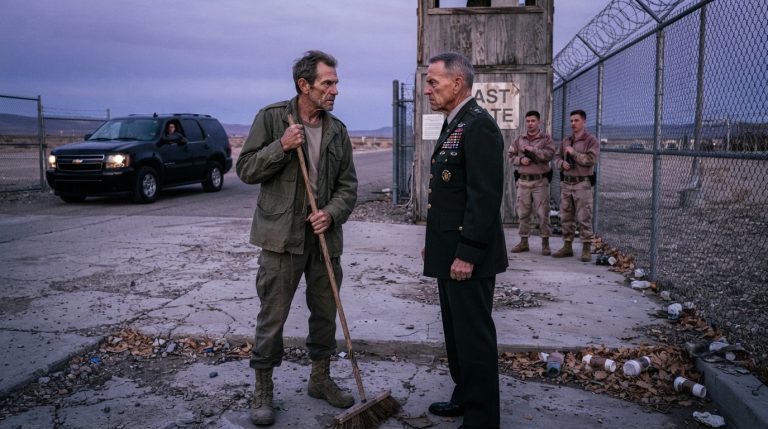
He looked past her, toward the maintenance building near the gate. He saw two men in dark suits—Apex Tactical, maybe, or something else entirely. They were lingering, watching him with that predatory, calculating patience he recognized all too well. They weren’t interested in his healing; they were interested in his utility. They saw a resource, a weapon that had been discarded and was now ripe for reclamation.
Marcus felt a coldness creep into his chest, the kind of chill that no sun-baked afternoon could touch. He took a long, slow breath, trying to steady the frantic beating of his heart. The ‘Kintsugi’ logic of his life—the idea that he was broken but could be pieced together—felt like a fragile lie. If he let them in, if he let the base and the contractors and the cameras take control, the pieces would be forced into a shape that wasn’t his.
He looked down at his forearm, at the place where the coordinates were etched into his skin. Five rounds, five souls. It was a ledger he was never supposed to balance, but here he was, still paying interest.
“I’m not a weapon, Captain,” Marcus said, his voice barely audible over the hum of the base’s activity.
“I know that,” she replied. “But you’re going to have to prove it to them. And more importantly, you’re going to have to prove it to yourself.”
Marcus didn’t answer. He turned his attention back to the plate, but the hunger had vanished, replaced by a dull, aching nausea. He was being pulled back into the fray, not by the enemy, but by the very people he had sacrificed everything to protect. He looked toward the exit, the path he had walked for four years, and for the first time, the bridge didn’t feel like a cage. It felt like a sanctuary—a place where he was truly, finally invisible.
The weight of the crowd was growing. He could hear them whispering, the name ‘Deadshot’ bouncing between them like a ricochet. It wasn’t praise anymore. It was a challenge. He took a final, forced bite of the cornbread, the dryness catching in his throat, and he realized with a sinking sense of dread that the hardest part of the day was only just beginning. He had survived the range, but he wasn’t sure he could survive the aftermath.
CHAPTER 4: The Retreat
The first drop of rain was heavy, hitting the wood of the picnic table with a sharp, percussive sound. Within seconds, the sky above Camp Lejeune tore open, releasing a deluge that transformed the dust of the firing range into a dark, clinging mire. Families scrambled, gathering coolers and children, their orderly retreat dissolving into a frantic, chaotic scramble for cover.
Marcus didn’t move. He sat under the partial overhang of a maintenance shed nearby, his hands resting on his knees. The rain was cold, a welcome contrast to the stifling, suffocating heat of the attention he had been under all afternoon. He watched the world blur through a curtain of gray, the manicured lawns of the base becoming a landscape of slick, muddy ruts.
“You should move, Mr. Callahan.”
Captain Brennan stood a few feet away, her arms folded, her uniform impeccably dry. She had clearly retreated to the shed before the worst of it began. She didn’t look at him; she looked out at the storm, her expression unreadable.
“I’m fine where I am,” Marcus replied, his voice low. The rain hammered against the corrugated metal roof, a relentless rhythm that helped drown out the memory of the cameras.
“You’re not invisible anymore,” she said, her voice cutting through the roar of the downpour. “The video has already crossed five million views. There are reporters at the gate. There are calls coming into the command center asking who ‘Deadshot’ is and why he’s living under a bridge. You’ve become a mirror for everyone’s own guilt and hope, Marcus. They aren’t going to let you just walk back to your overpass.”
Marcus looked down at his hands. They were steady, but he felt a tremor in his chest—a vibration of pure, unadulterated dread. He had wanted to disappear, to melt back into the anonymity of the city, but the ‘Butterfly Detour’ of the storm had trapped him. He was stuck here, in the heart of the machine, with the eyes of the public pressing in from all sides.
“I just wanted to eat,” he repeated, the words feeling brittle and useless.
“And you did,” she countered. “But you also reminded them of something they’d rather forget. That there are ghosts walking among them. And some of those ghosts have friends in high places.”
She pulled a thin, black folder from under her arm and held it out. Marcus didn’t take it. He looked at it as if it were a landmine.
“What is that?”
“Offers,” she said. “Contractors. Media companies. Private security firms. They aren’t asking nicely anymore. They’re starting to demand. My superiors are being pressured to ‘utilize’ you, to showcase you as a symbol of the Corps’ legacy. They want the legend. They don’t care about the man.”
Marcus felt a sharp, piercing flash of anger—a rare, hot spark that he hadn’t felt in years. He stood up, his boots sinking slightly into the mud that was creeping under the eaves of the shed. He was taller than Brennan, and in the dim, gray light of the storm, he looked like a silhouette carved out of the darkness itself.
“I gave them everything,” Marcus said, his voice rising, carrying a serrated edge that Brennan hadn’t heard before. “I gave them the best years of my life. I gave them the faces of the men I lost. And now they want to strip the rest of me away for a recruitment poster?”
The thunder rattled the metal roof, a rolling, guttural sound that seemed to mock the conversation. Brennan held her ground, her gaze fixed on him. She didn’t back down. She didn’t offer a platitude.
“The world doesn’t deal in fairness, Marcus. It deals in leverage. You’ve lost your leverage because you’ve stopped being a ghost. Now, you have to choose: you either let them define you, or you define yourself.”
“How?” Marcus asked, his voice cracking. “How do I define myself when I don’t even know who I am anymore?”
“Start by leaving,” she said, nodding toward the distant, obscured gate. “Before the press gets past the MPs. Take my truck. It’s behind the admin building. Go to the apartment I mentioned. It’s clean. It’s safe. It’s yours.”
Marcus looked at the rain. It was a deluge, a cleansing, blurring force. For the first time since the shooting, he felt a flicker of agency. He wasn’t a legend; he was a man in the rain, tired and cold, with a choice to make. He reached out and took the keys she held out, their fingers brushing for a second. The metal of the key was biting, cold, and real.
“Why are you doing this?” he asked.
“Because,” she said, turning away to look back out at the storm, “I’m tired of seeing good men get eaten by the system. And because, once upon a time, I believed in the same thing you did: that the job was worth the cost.”
Marcus stepped out into the rain. The water soaked through his jacket in seconds, chilling him to the bone, but it felt like a baptism. He began to walk, his stride purposeful, leaving the shelter of the base and the weight of the spectators behind. He wasn’t looking back. As he walked, he felt the heavy, suffocating mantle of the ‘Deadshot’ identity begin to tear at the edges, and for the first time in four years, he started to wonder what might be underneath. He wasn’t walking toward a career, or a contract, or a legacy. He was walking toward the only thing he had left: the possibility of being just Marcus, a man with a name, a past, and, perhaps, a future that didn’t involve a rifle.
He reached the truck, his movements fluid and precise, and as he climbed in, the silence of the cabin wrapped around him like a shroud. He didn’t start the engine. He just sat there, listening to the rain, waiting for the trembling in his hands to finally, mercifully, stop.
CHAPTER 5: The Threshold
The engine of the Ford Ranger idled with a rough, uneven cadence, a mechanical heartbeat that resonated through the steering wheel and into Marcus’s palms. Outside, the world was a smear of gray light and weeping sky. He stared through the windshield, watching the wipers carve pathetic, screeching arcs through the rain, but he didn’t put the truck in gear. The keys Brennan had given him felt heavy, a burden disguised as an opportunity.
He reached into his pocket and pulled out the business card he had kept since the firing range—the one with the handwritten note from Captain Brennan. He hadn’t realized until now, in the dim, flickering light of the dashboard, that there was a secondary set of coordinates printed in tiny, nearly invisible ink on the corner of the card. They weren’t Helmand coordinates. They were local.
A sudden, sharp suspicion spiked in his chest. Was the ‘transition program’ a genuine act of mercy, or was it just another layer of the grid? Was he being ‘helped,’ or was he being corralled into a facility where he could be monitored, analyzed, and eventually ‘utilized’ by the same entities that had been hovering near the gate? The thought was like a drop of ice water in his veins. He looked at the truck, the keys, the road ahead—it all seemed too neatly arranged, too perfectly offered.
He didn’t pull away. He sat there, his breath frosting against the cold glass, feeling the weight of the years spent under the I95 bridge. Down there, at least, he knew the rules of the terrain. He knew the vibration of the tires overhead, the rhythm of the city’s indifference. Here, in the clean, structured world of ‘support,’ he felt exposed.
He finally shifted the truck into gear. The movement was sluggish, the transmission clunking in protest. He didn’t head for the main gate. Instead, he drove in the opposite direction, toward the perimeter fence where the woods grew thick and the light failed entirely. He needed to think, to clear the static of ‘Deadshot’ from his brain. He needed to see if he could still navigate a path that hadn’t been laid out for him by someone else.
The truck tires crunched over wet gravel and pine needles as he navigated the narrow service road. The rain intensified, turning the dirt track into a slick, treacherous slide. He pushed the vehicle forward, relying on a muscle memory that had nothing to do with training and everything to do with instinct. Every bump in the road, every sway of the chassis, reminded him of convoys he had driven, of maneuvers he had executed, of a life that felt like a movie he had watched from a distance.
He stopped the truck near a clearing. The woods were dense here, the smell of damp earth and rotting cedar overpowering the sterile, metallic scent of the cab. He turned off the engine. The sudden silence was absolute, save for the patter of rain against the roof.
He sat there for a long time. The doubt that had been gnawing at him—the fear that he was being played—began to ebb, replaced by a deep, hollow fatigue. Was he really worried about a trap, or was he just terrified of actually being helped? Was he afraid that if he accepted the hand held out to him, he would finally have to acknowledge that he deserved to be alive?
He stepped out of the truck and walked into the rain. The water was freezing, but it felt good. It washed away the dust of the bridge, the grit of the firing range, and the heavy, metallic taste of the past few days. He stood in the clearing, letting the deluge soak him, and for the first time, he didn’t look for cover. He looked at the sky.
He thought about the boy, Jacob. He thought about the way the kid had looked at him, with a purity of belief that Marcus felt he had betrayed. He realized then that his suspicion wasn’t a tactical necessity; it was a psychological defense. He was sabotaging his own rescue because he felt he didn’t deserve it. The ‘Deadshot’ persona was a convenient cage, one that kept him isolated and justified his self-inflicted misery.
He reached into his pocket and pulled out the business card. The ink of the coordinates was starting to bleed in the rain. He watched the blue lines blur, the numbers becoming illegible. He didn’t care about the coordinates anymore. He didn’t care if the program was a trap or a sanctuary. He realized that the only trap was the one he had been building for himself for four years.
He turned back to the truck. His movements were no longer hesitant. He felt the cold in his marrow, a sharp, biting clarity that sharpened his perception. He climbed back into the cab and wiped the condensation from the side mirror. He saw himself—not as a legend, not as a target, not as a ghost—but as a man, aging, tired, and deeply, irrevocably human.
He started the engine. This time, he didn’t wait. He didn’t double-check the mirrors for imaginary pursuers. He didn’t plan for a tactical exit. He simply turned the truck around and began the slow, steady drive back toward the main gate, toward the transition program, toward the terrifying, messy, unpredictable prospect of living a life that belonged to him. The road ahead was dark, and the rain was still falling, but for the first time, he wasn’t looking at the past in the rearview. He was looking at the horizon.
CHAPTER 6: The Horizon
The gate to Camp Lejeune loomed ahead, a stark, metallic barrier against the bruised twilight. Marcus drove the truck toward the lights, his hands steady on the wheel. There was no hesitation now; the internal static that had clouded his vision for four years had finally gone silent. He wasn’t driving toward the accolades of the base or the predatory contracts of the private sector. He was driving toward the gate, toward the transition center, and toward the brutal, necessary work of unraveling the man he had been forced to become.
He stopped the truck at the guard shack. The MP on duty, a young marine with eyes that seemed too old for his face, stepped out into the rain. He looked at the truck, then at Marcus, and his posture shifted. He didn’t see a homeless veteran anymore. He saw the name that had been echoing across the base for days.
“Sir,” the MP said, his voice hesitant but respectful. He didn’t ask for ID. He simply stepped back and raised the gate.
Marcus nodded once, a brief, silent acknowledgement, and pulled through. He felt the boundary shift behind him. He wasn’t passing into a new life; he was passing out of a long, sustained holding pattern.
The transition center was a low, brick building bathed in the soft, fluorescent hum of late-evening activity. He parked the truck and stepped out. The rain had slowed to a drizzle, leaving the air smelling of wet asphalt and cooling pavement. Captain Brennan was waiting on the porch, her coat collar turned up against the chill. She didn’t say anything as he approached. She simply watched him, a quiet, steady presence that grounded the frantic energy of the day.
“I’m here,” Marcus said, his voice calm.
“I know,” Brennan replied. She reached into her pocket and pulled out the folder she had offered earlier, but this time, she didn’t offer it to him. Instead, she let it drop into the trash bin beside the door. “That’s the past, Marcus. The legends, the contracts, the expectations. None of that is coming inside with us.”
“And the future?” Marcus asked, looking at the door.
“That’s for the therapists to help you navigate,” she said with a faint, tired smile. “But for now, it’s just tonight. One night at a time.”
The interior of the center was warm, smelling faintly of coffee and floor wax—a mundane, comforting texture that Marcus hadn’t experienced in years. He walked to the front desk, his boots sounding hollow on the linoleum. He gave his name, and as he signed the paperwork, he felt the heavy weight of the ‘Deadshot’ call sign begin to evaporate. He was signing as Marcus Callahan. Just a man. No more, no less.
He was shown to a small, sparse room. It had a bed, a window looking out toward the dark line of the woods, and a small, wooden desk. It wasn’t much, but it was enough. He sat on the edge of the bed and looked out the window. The storm was breaking, the clouds parting to reveal a single, steady star.
The payoff was not in the status or the recognition; it was in the silence. He thought about the men he had lost in Helmand, but for the first time, he didn’t see the explosion. He saw their faces—not as ghosts, but as memories he could finally honor without letting them consume him. The poetic justice wasn’t in the defeat of his past demons, but in his own quiet refusal to let them win. He had survived the bridge, he had survived the range, and now he was surviving the return to himself.
He opened his bag—the green, military-style pack he had carried for four years—and took out the broken tactical binocular. It was a useless piece of junk, battered and cracked, but he didn’t toss it. He placed it carefully on the desk. This was his symbolic closure. It was the object he had clung to, the tool he used to watch a world he felt he no longer belonged to. He reached into his kit and pulled out a small piece of sandpaper, an old habit from his days in the field, and began to smooth the rough, jagged edge of the plastic frame.
It was a small, tedious task, but it felt right. He was repairing the remnants of his old life, not to restore them, but to make them fit into his new one.
His character arc, the long, painful curvature of his return, felt complete. He wasn’t the man who had left, and he wasn’t the man who had hidden under the bridge. He was something new, tempered by the fire of both war and hunger, and forged in the quiet resolve of choosing to stay.
He leaned back against the headboard and closed his eyes. The room was quiet. There were no sirens, no traffic vibrations, no echoes of shots fired. Just the low, steady sound of his own breathing. He thought of Jacob, the boy with the wide, trusting eyes. He thought of the simple, unpretentious hope of being ‘just a man.’ And as he drifted toward sleep, the darkness was no longer a threat. It was simply the end of a long, hard day.
He was Marcus. And tomorrow, he would begin the rest of his life.