The Silent Sentinel: A Soldier’s Unseen Return to the Light of Truth and Legacy
CHAPTER 1: THE RHYTHM OF THE FENCE
The Nevada morning was a bruised purple, the kind of light that turned the desert scrub into jagged charcoal sketches. Aaron Mitchell stood at the east gate, his back a straight line that ignored the biting cold. He did not mind the chill; he had grown accustomed to the way it sank into his bones, a constant reminder of the nights spent in the damp, claustrophobic silence of the jungle.
His push broom moved with a precision that bordered on religious. He knew the length of the perimeter by heart—eight hundred and twelve steps from the curb to the drainage ditch. He swept the stray leaves not out of necessity, but out of a need for order. If the base was a body, he was its immune system, clearing away the small, chaotic debris that threatened to mar its perfection.
To the young guards, he was a fixture, as inanimate as the chain-link fence he patrolled. They checked their watches, sipped coffee from plastic-lidded cups, and talked about things Aaron had never known: smart phones, digital flight logs, and the politics of the modern officer corps. They did not notice the way he timed his sweeping to the cadence of their radio chatter. They did not notice that he never turned his back on the base.
He reached the end of the line, his splintered wooden handle vibrating against his calloused palm. He stopped, his gaze lifting toward the flagpole in the center of the yard. It was early, the air thick with the metallic scent of morning dew on concrete. He took a breath, letting it out in a slow, controlled exhale that produced no mist in the thinning darkness.
A black government vehicle pulled off the main highway, its tires crunching the gravel with a sound like grinding teeth. It was a new car—sleek, dark, and utterly foreign to this stretch of road. It didn’t belong to the local patrol or the standard base supply route.
Aaron shifted, his fingers tightening around the rough grain of the broom handle. He felt it in the air, a subtle shift in atmospheric pressure, the way the silence suddenly seemed to thicken. He didn’t look at the car; he looked at the gate. The guards were bracing, pulling their shoulders back into an approximation of discipline.
He stepped back, retreating into the shadow of the fence line, just as the driver’s side door swung open. A man stepped out, his uniform pristine, his stature rigid with the kind of authority that commanded space even when he was still. This was not the standard shift change. The air felt heavy, charged with a purpose that felt too large for this quiet, forgotten perimeter.
Aaron lowered his eyes, his grip loosening on the broom, ready to vanish into the morning mist before the new arrivals could find reason to question his presence. But then, the man stopped. He didn’t head for the gate. He didn’t head for the guard post. He stopped, his gaze darting across the concrete lot, scanning the shadows with the intensity of a predator who had just caught a familiar scent.
The man’s eyes locked onto Aaron, and for a fleeting, terrifying moment, the general’s face changed. The stoic mask slipped, revealing a tremor in the jaw that suggested he was looking at a ghost. Aaron felt his heart skip a beat—a sensation he hadn’t experienced in thirty years. He tightened his hold on the broom, his knuckles white against the dark, worn wood, as he realized the man was walking straight toward him.
CHAPTER 2: THE PERIMETER OF ORDER
The General’s stride was measured, a rhythmic tap of leather on concrete that seemed to drown out the distant, early-morning hum of the base coming to life. He did not look at the guards, and he did not look at the idling SUV. His eyes remained fixed on Aaron, a steady, unwavering focus that felt like a spotlight on a stage where Aaron had spent decades perfecting his darkness.
Aaron remained still, his feet planted in the grit near the curb. The instinct to retreat—to turn and walk into the mist, to melt away as he always had—was a physical ache in his chest, a desperate, clawing pull. But he didn’t move. He felt the coarse, splintering wood of the broom handle against his palm, the familiar grain grounding him against the shifting reality of the moment. He stood his ground, not out of defiance, but out of a paralyzing sense of duty. If this was the end of his anonymity, then he would face it as he had faced everything else: with his back straight and his eyes forward.
“Captain.”
The word was not a question. It was a recognition. It hung in the cold, thin air, stripped of rank and protocol, carrying only the heavy, ragged weight of history.
Before Aaron could find his voice—before the air in his lungs could translate into a reply—a sharp, mechanical buzz cut through the silence. The security gate’s sensor, triggered by the proximity of the General’s vehicle, began a rhythmic, impatient beep. A younger MP, face flushed with the anxiety of a rookie caught in the crosshairs of command, hurried forward, his radio crackling with static.
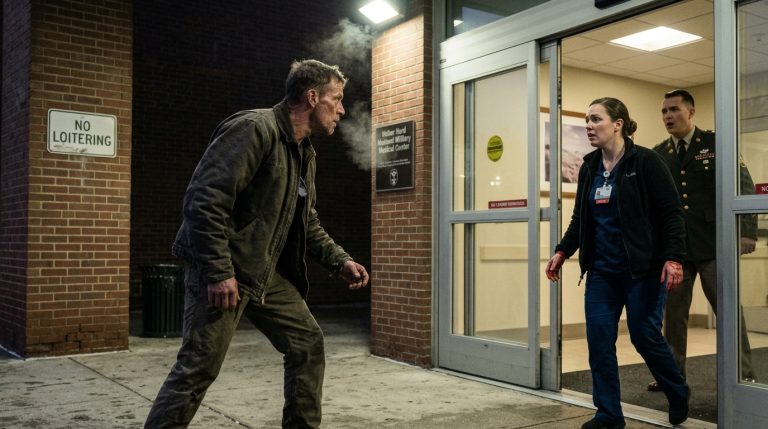
“General, sir,” the soldier stammered, his eyes darting between the commanding officer and the janitor. “Sir, we have strict orders regarding civilian loitering at the East Gate. I apologize for the interruption, but the protocol—the new security directive—requires that all unauthorized personnel be moved from the perimeter before the 0630 shift change.”
The General didn’t blink. He didn’t even turn his head. He kept his gaze locked on Aaron, as if the young soldier were nothing more than a passing shadow in the peripheral vision of a larger war.
“Stand down, Private,” the General said, his voice quiet, lacking the bite of a reprimand but possessing the weight of an anchor.
“Sir, the Colonel’s standing order—”
“I said stand down.” The General’s voice didn’t raise, yet the soldier stopped instantly, his heels clicking together with a jarring, hollow sound. The boy retreated, hovering at the edge of the guard post, his hand hovering near his sidearm out of pure, nervous habit.
The distraction, brief as it was, had cracked the tension. Aaron let out a slow, shallow breath. The mist was beginning to burn off, revealing the stark, clinical reality of the gate. He saw the way the General’s coat caught the first rays of the rising sun, the medals pinning him to the earth with the weight of unearned memory.
“General,” Aaron finally said, his own voice sounding foreign to his ears. It was rasping, unused, like a hinge that hadn’t seen oil in a generation. “You’re off course. This gate… it’s for maintenance. Not for commanders.”
The General stopped three paces away. Up close, the lines on his face were deep valleys, carved by a lifetime of command and the silence that followed it. He smelled of polished leather and a faint, lingering trace of antiseptic—the scent of a life lived in hospitals and high offices.
“I’ve spent forty years off course, Aaron,” the General replied, his gaze dropping to the broom, then back up to Aaron’s eyes. “Every time I looked at a map, I was looking for a ghost. Every time I heard a report, I was listening for a name that the brass told me didn’t exist.”
He gestured vaguely toward the sprawling base behind them. “I didn’t come here to inspect the perimeter. I came here because I saw a face in a training archival file this morning—a blurred, grain-heavy image from a forgotten recon mission. A face that hasn’t aged a day in forty years.”
Aaron looked past the General, his eyes tracing the jagged horizon where the desert met the sky. “The file should have stayed closed. Some things are better left under the dust.”
“That’s where you’re wrong,” the General said, taking a deliberate step forward, closing the distance until they were standing in the same, cold circle of shadow. “Dust is for things that have finished their work. You never finished yours.”
The sound of a radio suddenly blared from the guard post, a frantic, high-pitched inquiry about the General’s whereabouts. The General raised a hand, dismissing the world beyond the perimeter without taking his eyes off Aaron. The base was waking up, oblivious to the fact that the history they taught in their classrooms was currently standing on a sidewalk, clutching a splintered broom, trying to remember how to be a man who existed in the light.
Aaron felt the weight of the moment pressing in. He knew, with a sudden, sinking clarity, that there was no walking away from this one. The General hadn’t come for a reprimand or an inspection. He had come to reclaim a piece of himself, and in doing so, he was threatening to tear down the walls Aaron had spent four decades carefully building.
“I’m just a janitor, General,” Aaron whispered, though the lie felt lighter, more translucent than it ever had before.
The General’s eyes softened, a flicker of pain crossing his face that was gone as quickly as it had appeared. “A janitor who stands at attention when the flag is raised,” he countered. “A janitor who keeps the path clear for men who don’t know his name. That’s not a janitor, Captain. That’s a sentry. And I think it’s time the sentry was relieved.”
He reached out, his hand hovering for a second, hesitating as if he feared Aaron might shatter if touched. It was a moment of profound, painful intimacy—the intersection of two lives that had been ripped apart by the same fire, only to find each other in the gray, hollow light of a Nevada dawn. The base was coming alive around them, a hum of engines and voices, but inside the perimeter of the gate, there was only the wind and the silence between two men who had been waiting for this moment since 1977.
CHAPTER 3: THE CLATTER OF TRUTH
The sound of the metal box hitting the concrete was a sharp, final note that seemed to hang in the morning air, vibrating through the soles of Aaron’s boots. The lid had popped open upon impact, spilling its contents across the gray, dust-flecked ground like a secret being laid bare for inspection.
Aaron froze. For a heartbeat, his instinct was to drop the broom and cover the items with his body—to hide the Silver Star, the singed unit patch, and the photograph of the eight men in the flames. But he remained motionless, his fingers still curled around the handle of his broom, watching as the General’s gaze dropped to the items scattered at their feet.
The silence between them stretched, thick and suffocating. The rookie MP, who had been ordered to stand down, was still hovering nearby, his eyes wide as he stared at the contents of the box. He didn’t know the significance of the patch, but he knew the weight of a military decoration when he saw one. He took a hesitant half-step forward, his curiosity warring with his fear.
“General,” the soldier whispered, his voice trembling. “Sir, look at the… the insignia.”
The General didn’t acknowledge the soldier. He looked at the photograph first—that haunting, frozen moment of fire and smoke from Southeast Asia, 1977. He knelt, his knees hitting the cold ground with a dull thud that echoed his age and his pain. He reached out, not to touch the medal, but to brush the dust from the edges of the photo.
“I remember this chopper,” the General said, his voice barely audible over the distant, rising drone of the base’s morning shift change. “I was in the seat just behind the pilot. I remember the smoke filling the cabin, the way the heat felt against my skin, like the air itself was trying to boil us alive.”
He looked up at Aaron, his eyes glistening. “You were the one who held the door. You were the one who told us to stay low, that you’d hold the perimeter until the birds were clear.”
Aaron finally moved. He bent down, his joints stiff, and gathered the items. His hands were shaking—not from fear, but from the raw, exposed nerves of a memory he had spent forty years stitching shut. He placed the Silver Star back into the box. It felt heavier than it should have, a weight that had dragged him through every morning of his civilian life.
“That was a long time ago, General,” Aaron said, his voice flat. “The mission was a loss. The team… they didn’t make it. I just happened to be the one who didn’t die with them.”
“You weren’t supposed to survive?” The General stood up, his face hardening, the soft nostalgia replaced by a sharp, probing intensity. “That’s what you told yourself? That you failed because you came back?”
“I didn’t come back,” Aaron corrected, his tone biting. “I just didn’t finish the job. I left them in that ravine, and I’ve been trying to keep the path clear ever since, hoping it might count for something.”
The MP was still standing there, forgotten, his hand resting tentatively on his holster. He looked confused, his mind clearly struggling to reconcile the ‘janitor’ with the man being addressed as Captain. The realization was clearly dawning on him—this wasn’t just a security breach. This was a piece of the base’s own history, a living fragment of a war that had been filed away and forgotten in a cabinet somewhere in the Pentagon.
The General took a deep breath and looked toward the guard post. The command staff was beginning to notice the unusual gathering at the gate. A senior officer was already stepping out of the headquarters building, his brow furrowed, his eyes tracking the scene with professional concern.
“We need to move this, Aaron,” the General said, his tone shifting from emotional to tactical. “You can’t stay here. If they start asking questions, if they pull the logs and find out who you really are—and who you were supposed to be—they won’t let you leave. They’ll treat you like a case study, not a man.”
Aaron looked at the base. He saw the flag at the center of the yard, still limp in the early morning air. He saw the rows of barracks, the clean, orderly walkways, and the soldiers who went about their business without ever looking up. He had maintained this place. He had watched over it, cleaned its gutters, swept its sidewalks, and held his breath every time the flag touched the breeze.
“I’m not going anywhere,” Aaron said, his voice quiet. He picked up his broom. The wood felt right in his hand, a simple tool that didn’t demand explanations or justifications. “I have work to do. And if the Colonel wants me gone, he’ll have to tell me himself.”
The General sighed, a sound of profound frustration. He looked at the MP, who was still staring at the box. “Son,” the General said, turning his gaze on the young soldier. “Forget what you saw. This box doesn’t exist. This conversation didn’t happen. Do you understand?”
The soldier blinked, caught in the conflict between his duty to the base and the gravity of the man standing before him. “Sir… yes, sir. But—”
“That’s an order.” The General’s voice was like iron.
As the soldier hurried away, clearly rattled, the General turned back to Aaron. He didn’t offer to take the box. He didn’t offer to walk him to his apartment. He simply stood there, a man of power faced with a man of iron-willed silence. The base was waking up, the hum growing into a roar, and for the first time in four decades, Aaron felt the terrifying, electric pressure of being seen.
CHAPTER 4: THE GHOST IDENTIFIED
The black SUV pulled away with a low, predatory hum, leaving the dust to settle in the pale morning light. Aaron stood alone at the gate, the splintered handle of his broom vibrating in his hand. The quiet returned, but it was no longer the comfortable, familiar shroud he had worn for forty years. It was thin, porous—a veil that had been torn, and the air on the other side felt colder.
Private First Class Jason Miller did not retreat to his post. He lingered, his boots scuffing the gravel, his eyes fixed on Aaron with an intensity that made the old man’s skin crawl. Miller was a second-generation soldier; Aaron saw the type—clean-shaven, diligent, possessed of an earnest, dangerous curiosity. He was the kind of boy who believed that everything had a file, and every file had an answer.
“You’re him,” Miller said. The words were barely a whisper, carried on a sudden, restless gust of wind.
Aaron didn’t look at him. He set the metal box onto the ground, tucking it securely under his canvas jacket. He bent his back, resuming the rhythm. Left, right, step, pause. The broom hissed against the asphalt, a sound like a blade being sharpened. “You should be at your post, Private. The Colonel doesn’t like idle eyes.”
“I read the archive,” Miller persisted, stepping into Aaron’s path, forcing him to stop. “Last month, during the winter rotation. I was digging into the Operation Thunderline files. They were redacted, mostly—just fragments about an extraction that went wrong, a squad left behind, a commander who vanished.”
Aaron looked up. Miller’s face was earnest, lacking the cynical edge of the other guards. He wasn’t looking for a story; he was looking for a truth. The sunlight hit Miller’s visor, obscuring his eyes, but Aaron could see the tremor in his jaw.
“The archives are full of mistakes,” Aaron said, his voice as dry as the desert sand. He shifted his weight, trying to move around the boy, but Miller stepped in sync.
“The patch in that box,” Miller continued, his voice rising, thick with a sudden, frantic realization. “I saw the unit designation. I saw the date. Captain Aaron Mitchell. Presumed KIA, April 1977. My father—he served in the region that year. He told me stories about the men who stayed behind to hold the line so the others could lift off. He called them the ‘lost foundation.'”
Aaron felt a sharp, stabbing pressure behind his eyes. The gate seemed to blur; the sterile concrete of the perimeter wavered and, for a terrifying second, transformed into the damp, choking mud of a jungle clearing. He could smell the ozone of a burning chopper and hear the rhythmic, high-pitched whine of rotors struggling against the heavy air.
He gripped the broom handle so hard his knuckles ached, the physical sensation dragging him back to the present. He forced his breathing to slow, a technique he had refined over decades of practice.
“Your father was a good man, I’m sure,” Aaron said, his voice tight. “But men get things wrong. Memory is a flawed instrument. It adds color to things that were only ever gray.”
“It’s not just memory,” Miller insisted. He reached into his pocket and pulled out a small, worn field notebook, flipping through pages of neatly handwritten notes. “I’ve been cross-referencing. The patterns of the morning patrol, the way you stand when the flag goes up—you haven’t just been sweeping, have you? You’ve been monitoring the perimeter. You’ve been waiting for something.”
Aaron stopped the broom. He turned fully toward the young man. “I have been doing my job, Private. Nothing more.”
“But who gave you the order?” Miller’s voice was insistent, searching. “You aren’t under command, yet you act like you’re the last man on watch. Why?”
Aaron felt a cold sweat break out along his spine. He had played this game for forty years—the game of being invisible, of being a background detail in the life of the base. He had been a mascot, a nuisance, a shadow. He had been everything but a man with a history. And now, this boy was peeling back the layers with the blunt instrument of logic.
“I don’t serve,” Aaron said, his voice dropping to a low, dangerous register. “I watch. There’s a difference. You’re young, Miller. You believe that the truth is a prize you get to keep. But the truth is a fire. It burns the man who holds it, and it burns everyone he stands near.”
He pushed past the boy, his stride steady, refusing to look back. “Go back to the guard post. Forget the archives. Forget the names. If you keep digging, you aren’t going to find a hero. You’re going to find a man who left his team in the mud, and you’re going to find out that the guilt is the only thing that kept him breathing this long.”
Miller didn’t follow him, but Aaron could feel his gaze on his back—a heavy, burning sensation. As he walked toward the outer perimeter, his shadow stretched long and thin across the concrete, and for a moment, he thought he saw the shape of a helicopter pilot in the distortion of his own reflection. He realized then that the General hadn’t just come to reclaim a memory; he had opened the door, and the ghosts he had kept caged for forty years were beginning to spill out into the light of the Nevada sun. He had to finish this shift. He had to hold the line for just a few more hours. But the world was already changing around him, and he knew, with a sinking, heavy certainty, that he could no longer hide.
CHAPTER 5: THE GENERALS RETURN
The afternoon sun hung heavy over Fort Lincoln, casting long, bruised shadows across the compound. Aaron continued his work, though the rhythmic motion of the broom now felt labored. The air was thick with the scent of hot asphalt and the metallic tang of idling engines. Every jeep that passed, every soldier who glanced toward the gate, felt like an accusation. The equilibrium of his life—forty years of calibrated silence—was fracturing.
He was working near the side entrance, near the transit shed, when the low, rhythmic roar of an engine drew his gaze. It was the same black SUV. It cut through the base traffic with an unnatural authority, parting the stream of military transport like a stone in a fast-moving stream. Aaron tightened his grip on the broom, his knuckles white. He hadn’t expected the General back so soon. He hadn’t expected him back at all.
The vehicle slowed, the window rolling down just as it pulled alongside the curb where Aaron stood. General Hawthorne was in the passenger seat, his uniform still impeccably pressed, though his face was a shade paler than it had been that morning. The driver, an aide with eyes as cold and efficient as a computer, didn’t even look at Aaron.
“Get in,” the General said. His voice wasn’t a request; it was a command that bypassed decades of civilian life and tapped directly into a dormant, buried hierarchy.
“I have work to finish,” Aaron replied. He didn’t stop sweeping. He moved the debris of the day—dead leaves, discarded gum wrappers, gravel—into a neat, uniform line.
“The Colonel is holding a briefing in the main admin block,” Hawthorne said, ignoring the dismissal. “He’s pulled the classified logs from ’77. He knows there’s a discrepancy, Aaron. He doesn’t know who you are yet, but he knows something doesn’t align with the official record. He thinks there’s a security leak, and he’s authorized a full background sweep of all perimeter staff.”
The broom scraped against the concrete—a jagged, screeching sound. Aaron finally stopped. He looked at the General, seeing not just the man he had saved, but the man who had become the very system that had forgotten them both. “Then let him sweep. I’ve nothing to hide.”
“You have everything to hide,” Hawthorne retorted, his voice lowering until it was a harsh, private rasp. “You have your life, your identity, and the only peace you’ve managed to carve out for yourself in forty years. If they run your prints, if they dig into the VA records that were never meant to be linked to the Thunderline incident, they won’t just expose you. They’ll put you on a stage. They’ll make you a trophy. They’ll force you to recount every moment, every loss, every failure you’ve spent a lifetime trying to bury.”
The General leaned forward, the shadow of the roofline masking his eyes. “I can’t stop the inquiry. It’s too late for that. But I can give you a head start. I can get you off this base before the MPs reach your locker.”
“And go where?” Aaron asked. The question was quiet, devoid of hope. “I’ve spent half my life at this gate. It’s the only place where the ground feels solid.”
“Go to a place where you aren’t a ghost,” Hawthorne said. “I have a house near the coast—a place with no fences, no flags, no memories of that ravine. Just go. I’ll clear the transport, I’ll stall the investigation. I’ll make sure they think you walked out the main gate and vanished into the desert.”
Aaron looked toward the administration building. He could see the silhouettes of officers moving behind the glass—men who worked in climate-controlled offices, men who believed in protocols and procedures. He thought of Miller, the young soldier who had seen the patch, the boy who represented the future that the archive had nearly erased.
“It’s not just about me, is it?” Aaron asked, his eyes narrowing. “You’re worried about the mission report. You’re worried that if the truth of Thunderline comes out—if the real reason the team was left behind is unearthed—it’s going to stain more than just my name.”
The General’s jaw tightened. For a second, the mask of the decorated commander slipped, revealing the terrified twenty-three-year-old lieutenant who had scrambled into the belly of a burning helicopter. “It was a compromised mission, Aaron. There were political layers, high-level directives that went sour. If you talk, if they force you to testify, the fallout won’t just hit you. It will tear down the legacy of the men who didn’t come back. It will turn their sacrifice into a political scandal.”
Aaron felt a chill that had nothing to do with the desert wind. He realized then that the General hadn’t just come back to thank him. He had come to ensure the silence remained intact. The “Kintsugi” of his broken life wasn’t meant to be mended; it was meant to be sealed away, hidden in a display case where no one could ever touch the shards.
“You’re not saving me,” Aaron said, his voice cold and steady. “You’re saving the file.”
“I’m saving the memory of who we were before that ravine!” Hawthorne snapped, his hand gripping the edge of the door. “Choose, Aaron. Get in the car, or stay and watch them burn everything you’ve built.”
Aaron looked at his broom, then at the sprawling, sterile expanse of the base. He felt the weight of the metal box in his jacket—the Silver Star, the patch, the photograph. He had been a sentinel for forty years. He had stood guard over a reality that everyone else had abandoned. And now, he realized that he had been standing guard over a lie. He didn’t get into the car. He didn’t even flinch. He simply turned, his grip on the broom handle firm, and began to sweep again, moving toward the admin block, toward the heart of the storm.
CHAPTER 6: THE WEIGHT OF MEMORY
The administration building was a fortress of glass and brushed steel, a stark contrast to the grit and desert dust of the perimeter. Aaron walked through the sliding glass doors, his boots leaving faint, gray smudges on the polished tile. The temperature dropped abruptly, the hum of the climate control system replacing the desert wind. He still held the broom, its wooden handle feeling like a lifeline. He wasn’t a soldier; he was a janitor. That was the cover. That was the reality he had inhabited until five minutes ago.
The lobby was empty, save for a duty sergeant behind a desk of dark mahogany. The sergeant didn’t even look up at first, his fingers dancing across a keyboard, his focus entirely on the digital readout in front of him. Aaron stood before the desk, the silence stretching, thickening. He could hear the faint, rhythmic ticking of a wall clock, a sound that measured out the moments he had left before the world shifted forever.
“I need to see Colonel Ror,” Aaron said. His voice was steady, reclaimed from the desert.
The sergeant looked up, a flicker of annoyance crossing his features. “The Colonel is in a classified briefing, Mr. Mitchell. You know the protocols. Perimeter staff don’t have access to the admin wing without a work order.”
“I have a matter concerning the east gate,” Aaron said. He didn’t blink. He didn’t fidget. He stood with the effortless, dangerous composure of a man who had once been trained to command a room.
The sergeant paused, his hand hovering over his phone. He looked at the old man—the faded canvas jacket, the worn boots, the broom—and then he looked at the set of Aaron’s shoulders. He blinked, the irritation sliding away, replaced by a strange, instinctive deference that the soldier couldn’t quite name. “I’ll… I’ll check. But don’t expect him to take the call.”
As the sergeant spoke into the phone, Aaron drifted toward the closed double doors of the briefing room. He could hear the muffled, rapid-fire tone of an argument behind them. A chair scraped back. A voice—Colonel Ror’s—barked a command, and then, the sound of papers being shuffled with violent, impatient energy.
Aaron felt a phantom sensation—the weight of a rifle sling against his collarbone, the smell of cordite. He looked at his hands. They were spotted with age, the veins prominent and dark, but they were the same hands that had held a perimeter line for seven hours in the jungle rain, waiting for a helicopter that had almost missed them. He wasn’t afraid of the Colonel. He was afraid of the file. He was afraid of the way his own story would look when filtered through the clinical, sanitized lens of a military audit.
The sergeant put the phone down, his face pale. “He says he’s busy, but… he told me to let you into the conference room. He sounded like he was expecting you.”
Aaron didn’t thank him. He walked to the doors, pushed them open, and stepped into the room.
The air was stagnant, heavy with the scent of stale coffee and burnt electronics. Colonel Ror stood at the head of the table, his eyes locked on a stack of folders. General Hawthorne was there, too, standing by the window, his back turned to the door. He didn’t turn when Aaron entered.
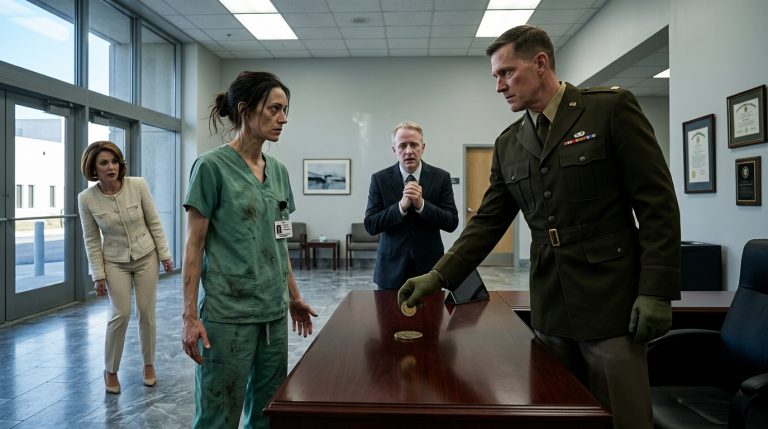
The Colonel looked up. He was younger than Aaron had expected, his face unlined, his eyes sharp and analytical. He didn’t look like a man who had fought a war; he looked like a man who managed the results of one. On the desk between them, open, was an old, yellowing folder with the label Operation Thunderline: After-Action Report. And next to it, the metal box Aaron had dropped at the gate.
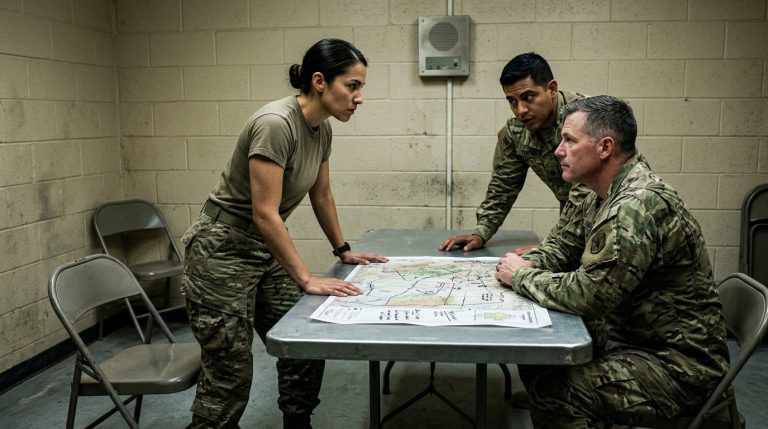
“General Hawthorne tells me you’re a ghost, Mr. Mitchell,” Ror said, his voice flat, devoid of any warmth. He gestured to the open folder. “I’ve spent the last hour reviewing these documents. There’s a discrepancy. A gap in the records. Seven survivors mentioned in the debrief, but the mission log lists only six who boarded the chopper. You were the seventh, weren’t you?”
Aaron leaned the broom against the wall. He moved toward the table, his steps measured. He didn’t look at the General. He looked at the Colonel. “I was the seventh. And I was the one who was left behind.”
“Left behind,” Ror repeated, his tone skeptical. “Or abandoned?”
“Does it matter?” Aaron asked, his gaze flickering toward the window where Hawthorne stood, his shoulders locked in a rigid, defensive posture. “The mission was a failure. The team was dead, or captured, or dying. The chopper had to lift. If they hadn’t, we all would have stayed in that ravine.”
“The logs show a sabotage report,” Ror continued, his finger tapping the yellowed page. “A report that suggests the mission wasn’t compromised by enemy fire alone. It suggests that someone on the ground had orders to ensure that the mission data didn’t make it back to the base. It suggests that you didn’t just stay behind to hold the line—you stayed behind because you were the only one who knew what was really in the compound.”
The silence in the room was absolute. Aaron felt the walls closing in. He saw the General shift slightly, his hand clenching into a fist at his side. He saw the Colonel watching him, a predator waiting for a mistake, waiting for the truth to slip out in a tremor or a glance. Aaron looked at the box—the Silver Star, the patch. He realized then that Layer 1 wasn’t just a decoy; it was a trap. The military didn’t want to honor him. They wanted to use him to bury the secret of what they had done in 1977.
“I stayed behind to save my men,” Aaron said, his voice echoing in the small room. “That is the only truth that exists in those files. If you want to find a scandal, you’re looking at the wrong man.”
“Then why have you stayed here for forty years?” Ror asked, stepping around the table, his eyes boring into Aaron’s. “Why watch the gate? Why clean the sidewalks? Why act like a guard, unless you were waiting for someone to come back and finish what you started?”
Aaron looked at the General, who finally turned. Hawthorne’s face was an open wound of regret and terror. Aaron understood it now. The General hadn’t come to get him out. He had come to make sure Aaron never left. He hadn’t come for a reunion; he had come to keep the silence of the grave, and the Colonel was the only one standing in the way of the final, lethal truth.
CHAPTER 7: THE CEREMONY OF HONOR
The room felt small, the walls pressing in with the force of forty years of buried history. Colonel Ror didn’t take his eyes off Aaron, but his hand moved toward a secure comms button on the desk. “If you’re telling the truth, Mitchell, then you have no reason to fear a formal inquiry. We’ll verify the service records, reinstate your status, and provide the honors that have been delayed for four decades. But if you’re hiding the reality of that mission—if you were involved in the loss of that unit—then this room is the last place you’ll be a free man.”
“Free?” Aaron laughed, a dry, rasping sound that seemed to surprise even him. He stepped forward, his hand dropping to the metal box. He didn’t open it this time; he simply rested his fingers on the lid. “I haven’t been free since 1977, Colonel. I’ve been serving a sentence I gave myself. Do you think a ceremony, a medal, or a press release changes the fact that my team is in a grave I dug with my own hands?”
General Hawthorne, still by the window, turned, his face etched with a desperate, frantic intensity. “Aaron, stop. You don’t understand the scope of what you’re saying. The mission reports were sealed by the Department of Defense. It wasn’t just about the unit. It was about the intel we brought back. If you open this up, you aren’t just questioning the records; you’re questioning the foundational command of this sector.”
“The foundation is rotting, General,” Aaron said, turning to look at him. “You’ve spent forty years building a monument on top of a lie. You want to give me my medals back? You want to bring me into the light? Then start by telling the truth about the extraction. Tell them why the chopper left without us. Tell them what happened to the cargo.”
Ror’s gaze snapped from Aaron to the General. “Cargo? What cargo, General? The mission debrief says it was a standard personnel extraction.”
Hawthorne didn’t answer. He froze, his gaze darting toward the Colonel, then back to Aaron. The silence was heavy, charged with the sudden, violent realization that the Colonel wasn’t part of the cover-up. He was a variable Hawthorne hadn’t accounted for.
“It wasn’t a personnel extraction,” Aaron said, his voice dropping into a rhythmic, terrifying calm. “We were sent to recover a cache of documents that exposed unauthorized tactical deployments in the region. We were the only ones who knew the origin of the orders. The helicopter wasn’t sent to save us, Colonel. It was sent to silence the team that held the proof.”
The Colonel pushed his chair back, the metal legs screeching against the floor. He leaned over the desk, his hands splayed wide. “That’s an accusation of high treason, Mitchell. Do you have proof?”
Aaron reached into the metal box. He pulled out the photograph—the one showing the eight men standing before the burning helicopter—and turned it over. Taped to the back, yellowed and brittle, was a small, micro-film strip. He held it up, the tiny piece of plastic catching the harsh fluorescent light.
“The General has spent forty years wondering why I survived,” Aaron said. “He thought it was luck. He thought it was because I was a good soldier. It was neither. I survived because I was the only one who didn’t trust the evac team. I stayed behind because I knew the chopper that was coming to save us was the same one that had been sent to finish the job.”
Hawthorne stepped forward, his hand reaching out in a pleading, desperate gesture. “Aaron, don’t. You’ll destroy everything. Not just the legacy—the stability of the entire chain of command. People will lose their lives. The chaos—”
“The chaos is already here, General,” Aaron cut him off. “It’s been here for forty years. It’s been sitting on this base, waiting for someone to sweep it away.”
He looked at the Colonel. “I’m not a hero. I’m not a janitor. I’m the only one left who knows what really happened in that ravine. And I’m tired of sweeping the mess under the rug.”
Ror stared at the microfilm, then at the General, his face hardening into a mask of cold, unyielding resolve. He reached for his phone, his thumb hovering over the line to the Pentagon command desk. The room felt like a bomb waiting to detonate, the air thin and electric. Aaron realized that the “decoy” of his stolen valor had finally been stripped away, and the core truth—the cold, hard reality of treason—was now sitting on the table.
He didn’t wait for the Colonel to make the call. He turned to the door, his heart hammering against his ribs, knowing that once he walked out of this room, he wouldn’t be walking back to the east gate. He would be walking out of the life he had built, moving into a reality that had no place for him, but which he had finally, irrevocably, set free. He left the microfilm and the photo on the desk, the weight of the past finally detached from his own hands, and stepped out into the hallway, the sound of the Colonel’s voice behind him beginning to initiate the chain of events that would pull the foundation out from under the entire base.
CHAPTER 8: THE ENDURING ECHO
The hallway of the administration building was narrow and oppressive, lined with framed photographs of generals who had come and gone, their faces stern and frozen in time. Aaron walked down the center of the tiles, his boots making a soft, rhythmic thud. Behind him, the double doors of the conference room remained shut, but the muffled sound of the Colonel’s voice—urgent, commanding—began to spill out into the corridor. The chain was moving. The truth he had clutched for four decades was finally being handed over to someone who had the power to process it.
He reached the front entrance. The sun was dipping toward the western horizon, painting the base in hues of amber and bruised gold. He walked out, his steps slowing as he descended the concrete stairs. He felt empty, a sensation that was not entirely unpleasant. The weight of the metal box—the Silver Star, the patch, the photograph—was gone. He had left it on the desk, a quiet resignation of the heavy, self-imposed burden he had carried until his back had begun to ache with the strain.
He walked past the guard post. The young MP, Miller, was standing there, staring out across the perimeter. When he saw Aaron, he straightened, his hand coming up in a crisp, instinctive salute. It wasn’t the salute of a soldier to a janitor; it was the salute of a student to a master. Aaron didn’t stop. He gave a single, slow nod, a gesture of quiet acknowledgement that bypassed rank and protocol.
He didn’t head for the gate. He didn’t head for his apartment. He turned toward the center of the base, toward the flagpole that stood tall and stark against the darkening sky.
The base was settling into the evening shift. The distant roar of engines was fading to a low, steady thrum. He reached the flagpole and stood there for a long time, watching the way the stars and stripes caught the final, lingering light of the day. He remembered the feeling of the rope in his hands—the coarse, familiar friction of the line, the way the flag would snap and shudder as it caught the wind.
He had raised it every morning for forty years. He had done it because he believed that someone had to ensure the symbol of their collective sacrifice didn’t go unheralded, even if the sacrifice itself had been betrayed. But as he watched the flag now, he saw it not as a monument to what had been lost, but as a promise to those who were yet to arrive.
The Colonel’s voice echoed in his mind, the realization dawning that the investigation would not just uncover the treason of ’77; it would reform the very structure of the military’s duty to its own. The “Mitchell Protocol” was no longer a hypothetical; it was becoming a necessity. He had not just revealed a secret; he had shifted the moral compass of the entire institution.
General Hawthorne walked out of the building behind him. He stopped a few paces away, his limp more pronounced in the cooling air. He didn’t say a word. He stood beside Aaron, watching the flag with the same distant, melancholic focus.
“They’re calling the Pentagon,” Hawthorne said eventually, his voice soft, purged of its previous desperation. “The Colonel is initiating the full audit. It’s over, Aaron. The wall is coming down.”
“It was never a wall,” Aaron replied. “It was just a grave.”
“And you?” Hawthorne asked. “Where will you go now? You have your back pay, your status, your life. You’re a free man.”
Aaron looked at his hands—calloused, scarred, and trembling only slightly. He realized then that freedom was not a destination; it was the quiet absence of a burden. He looked at the base, at the soldiers moving toward the mess hall, at the lights flickering on in the barracks. He felt a sudden, profound sense of peace.
“I don’t need a house,” Aaron said, a small, tired smile touching his lips. “I’ve had enough walls around me for one lifetime. I think I’ll take a walk.”
“The world is bigger than this base, Aaron.”
“I know,” Aaron replied.
He walked away from the flagpole, toward the gate. He didn’t look back. He didn’t search for a salute or a word of recognition. He simply walked, his pace steady, his head held with the quiet, unyielding grace of a man who had finally earned his silence. He reached the chain-link fence, the place where his journey had been confined for so long. He reached out and touched the cold, galvanized steel. It felt solid, real, and completely unremarkable.
The sun vanished behind the mountains, leaving the sky a deepening, velvet purple. A few stars began to prick through the darkness, steady and cold. Aaron pushed through the turnstile and stepped out onto the gravel road, the desert air clean and biting. He stopped at the roadside and reached into his jacket, pulling out a small, worn photograph he had kept tucked in his breast pocket—not the one from the burning helicopter, but a small, faded picture of his team in training, before the world had turned to fire.
He tore the photograph in half, and then into smaller, finer pieces, letting the wind carry them into the desert scrub. They weren’t ghosts anymore. They were just men, and he was finally, after forty long years, just a man, too. He turned and began to walk down the road, his silhouette shrinking against the vast, empty horizon. He didn’t have a destination, and he didn’t have a purpose, and for the first time in his life, that was more than enough. The silence behind him was no longer heavy; it was merely quiet, and he walked into it with the steady, rhythmic step of a soldier who had finally completed his march.