The Silent Tracker Who Cleaned a Forbidden Swamp When Standard Military Command Said It Was Impossible
CHAPTER 1: Stalled Advance
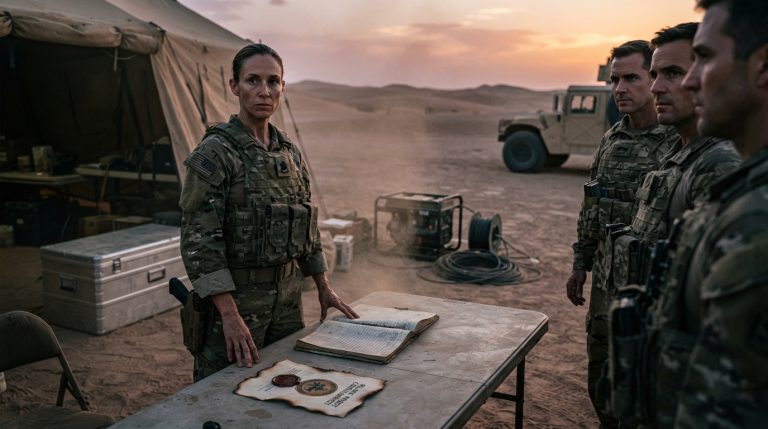
The map on the camp table was useless.
Captain Reynolds stared down at the grease-pencil markings while the humidity curled the edges of the heavy paper.
Outside the tent, two miles south of San Manuel, the engines of the stalled division idling in the distance hummed a heavy, frustrated vibration through the mud.
Two patrols had gone into that three-mile stretch of mangrove and stagnant water over the last forty-eight hours.
Neither had come back out.
Command had already written off the left flank as a dead zone, a natural barrier too choked with roots and rot to bother clearing.
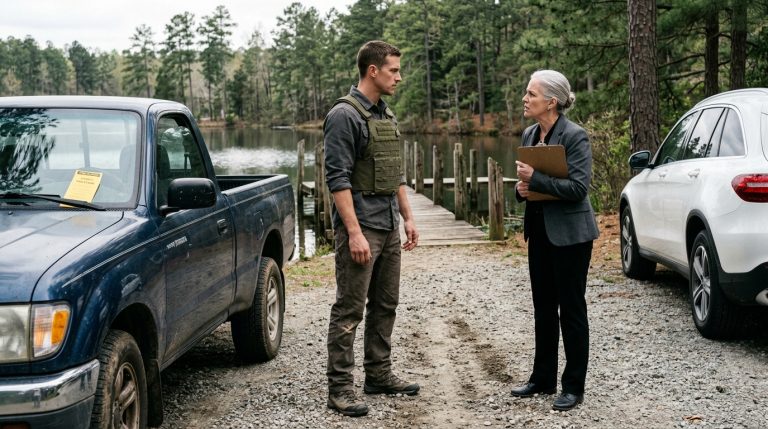
Corporal Roy Mason stood on the edge of the dry dirt line, his boots caked in gray clay, wiping a damp palm down the side of his trousers.
He didn’t look like a soldier primed for a standard infantry push.
He looked like a man who spent his life staring at murky water waiting for the surface to break.
At twenty-eight, with fourteen years of tracking predators through the Florida Everglades behind him, he knew the difference between a real barrier and an excuse.
Reynolds looked up from the map, his eyes bloodshot from a lack of sleep and the constant whine of mosquitoes.
He looked at Mason up and down, taking in the lean frame and the calm, weather-cracked face.
The lieutenant general had already dismissed Mason’s background that morning as backwoods nonsense, asking if he planned to wrestle alligators out in the Philippine brush.
Reynolds didn’t laugh, but he didn’t look convinced either.
He tapped a stubby finger against the blank green contour lines of the map.
The swamp stretched three miles along the left flank, packed with an estimated hundred and fifty enemy troops using the interior islands as a staging ground for raids.
Standard doctrine said bypass them and let the risk hang over the supply lines.
Mason didn’t say a word about doctrine.
He reached down, picked up a dry twig from the edge of the dirt line, and snapped it cleanly between calloused fingers.
The sharp crack cut through the distant hum of the idling trucks.
If you want to clear that water, Reynolds said, his voice dropping low, you don’t do it by shouting orders from dry ground.
Mason tossed the broken twig into the mud at the edge of the swamp.
Give me until fourteen hundred, Mason said.
Reynolds stared at him for a long, hard second, weighing the impossibility of the maps against the quiet certainty in the tracker’s voice.
He didn’t offer a radio.
He didn’t offer backup.
He just nodded once toward the dark, tangled wall of green and murky water.
CHAPTER 2: Into The Murk
The dry dirt line vanished behind a thick wall of hanging vines the moment Roy stepped off the solid bank.
The water temperature hovered around seventy-eight degrees, wrapping around his legs like a feverish blanket.
He didn’t rush his entry.
His boots sank into a layer of soft silt and hidden roots that tested the balance of every step.
The tactical radio that division command usually relied on stayed locked back at the supply tent, an impossible dead weight in these channels.
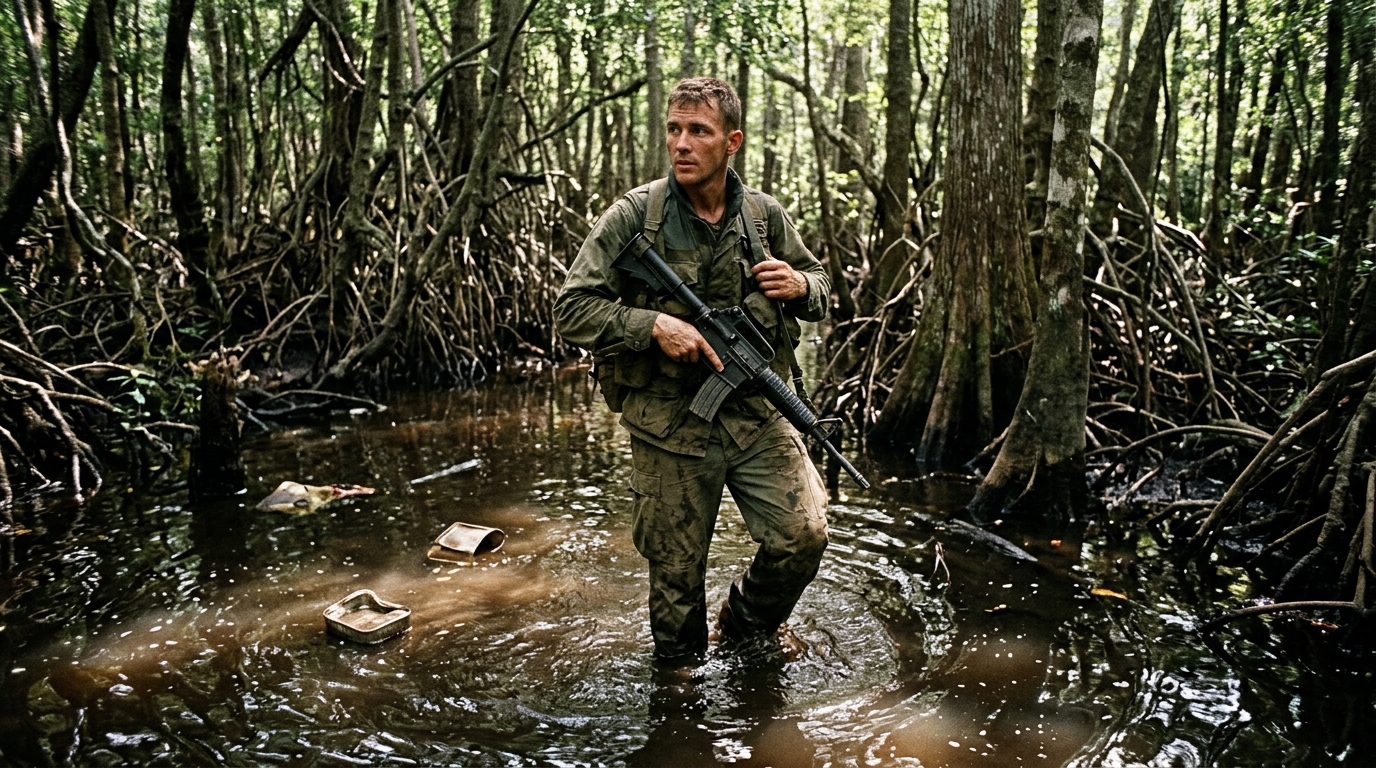
He moved forward entirely alone, his thumb resting lightly near the safety of the rifle while his eyes scanned the dark, winding avenues of the mangrove stands.
A faint, metallic glint caught his eye near a cluster of cypress roots to the left.
A standard-issue metal ration tin drifted lazily against the sluggish current, bobbing in a small eddy where no American patrol had any business being.
It wasn’t dropped by his own men.
The tin drifted from an unmapped upstream angle, a silent marker hinting at movement deeper in the interior.
Roy stopped dead in his tracks, letting his breathing slow until it matched the rhythmic dripping of water off the overhead leaves.
The absolute stillness of the swamp closed around him like a physical weight.
He reached down with his wooden-handled machete, testing the density of the submerged bottom before committing his next stride.
The mud shifted under his boot with a faint, greasy suction.
Voices echoed softly from somewhere ahead, muffled by the thick curtain of foliage and the humid air.
They weren’t shouting commands or moving with tactical urgency.
The enemy soldiers were talking in low tones, lulled into a false sense of security by the impenetrable reputation of the swamp.
Roy shifted his weight silently to his right foot, ensuring the water surface didn’t break into expanding ripples.
He kept his focus entirely on the space between the roots, calculating the distance to the voices while the damp air clung stubbornly to his skin.
CHAPTER 3: The First Island
Three men in faded uniforms sat on the center of the elevated earth, their backs turned completely toward the water’s edge.
They were sharing a meager meal of rice balls, completely unbothered by the heavy humidity or the stagnant green channels surrounding their makeshift shelter.
Their perimeter watch faced entirely east toward the distant dry ground where the main American forces were bottled up.
Not a single head turned toward the deep swamp behind them.
Roy adjusted his grip on the stock of his weapon, feeling the slick condensation slide across the wood.
The water around his knees remained dead calm, undisturbed by any sudden twitch of muscle or rushed footwork.
He didn’t rush the approach.
Every inch of forward movement required a calculated slide of his boot sole over submerged roots, feeling for firm mud before committing his weight.
One of the men on the island laughed softly, tossing a small wrapper into the brush without looking around.
The complacency of the enemy was thicker than the mud beneath the surface.
They believed the swamp was a barrier that protected their flank, failing to realize that water was just another kind of highway for someone who knew how to read it.
Roy crept closer until the distance closed to fifteen feet, keeping the dense mangrove stalks directly between his silhouette and the edge of the clearing.
He waited through a long, heavy beat of silence, watching the men shift their weight as they continued their casual conversation.
The moment to move arrived with the quiet drift of a surface ripple, and he stepped out of the water onto the dry dirt of the island without a sound.
CHAPTER 4: Expanding The Silence
The murky water closed over his shoulders, offering an immediate, suffocating refuge from the chaos that had just erupted on the dry dirt.
He didn’t look back toward the island.
His boots found the familiar suction of the submerged silt, guiding him blindly through the tangled maze of roots where standard infantry patrols lost their bearings within minutes.
The memory of past hunts flashed through his mind—a twelve-foot gator in thirty-eight that had tested his patience for three full days across the deep river grass.
The discipline was identical.
Panic was a luxury reserved for men who didn’t understand how water carried sound.
He moved north through chest-deep channels, keeping his rifle raised high above the waterline while the heavy humidity pressed down on the back of his neck.
A sharp rustle broke the regular rhythm of the dripping canopy twenty yards to his left.
At least five enemy soldiers were wading through the shallows, their boots splashing angrily against the surface as they rushed blindly toward the sound of the previous shots.
They were shouting back and forth, completely exposing their positions through sheer frustration and noise.
Roy stopped moving entirely, letting his body blend into the dense shadows cast by the overhanging mangrove branches.
He watched the shape of the closest soldier pass by through a gap in the roots, his rifle held in a sloppy, defensive grip.
They were looking for a conventional frontline enemy, not a tracker blending into the very medium they considered an impassable obstacle.
He waited until the splashing faded deeper into the interior before he resumed his silent crawl northward to map the next channel.
CHAPTER 5: Breaking The Morale
The shouts grew sharper as the search party thrashed through the deeper water, their frustration echoing off the hanging mangrove boughs.
They weren’t moving with tactical discipline anymore; they were driven by blind anger over the sudden disappearance of their comrades.
Roy kept his breathing shallow, pressing his shoulder blades tight against the damp wood while the muddy water lapped quietly at his shins.
He didn’t need to make a sound or force a confrontation to shift the balance.
The invisible threat of the silent tracker was already doing the work for him.
Across the stagnant interior, another scattered group of enemy soldiers could be heard shouting back and forth across the hidden islands, abandoning their forward watch posts to cluster on drier ground.
They were pulling back from the edges, trading their tactical advantage for the false comfort of numbers.
The rigid confidence of their command structure was cracking under the weight of an enemy they couldn’t see or predict.
He waited until the heavy splashing drifted toward the eastern perimeter, away from the mapping channels he still needed to clear.
Slowly, without a ripple disturbing the surface film, he eased out from behind the cypress stump and stepped deeper into the gray murk.
CHAPTER 6: Final Sweep
The remaining figures wading through the shallow southern exit didn’t have anywhere left to run.
They scrambled blindly against the sucking mud, refusing to accept that the water channels they thought belonged to them had completely collapsed under a simple, relentless push.
Roy rested his thumb against the safety catch, his breathing steady despite the heavy heat rising off the stagnant pool.
He didn’t shout a warning or demand a surrender.
He watched them stumble through the knee-deep mire until the last of the resistance broke entirely under the weight of their own panic.
The left flank was completely clear.
Captain Reynolds was waiting back at the dry dirt line when Roy stepped out of the water, his boots dripping gray clay onto the hard earth.
Reynolds didn’t ask about radios or standard infantry doctrine anymore.
He just looked at the empty expanse of the three-mile swamp, quiet and secured at last, and handed over the signed clearance papers without a word.
Roy wiped his damp palm down his trousers, turned away from the camp table, and walked back toward the quiet perimeter where the morning sun finally hit dry ground.