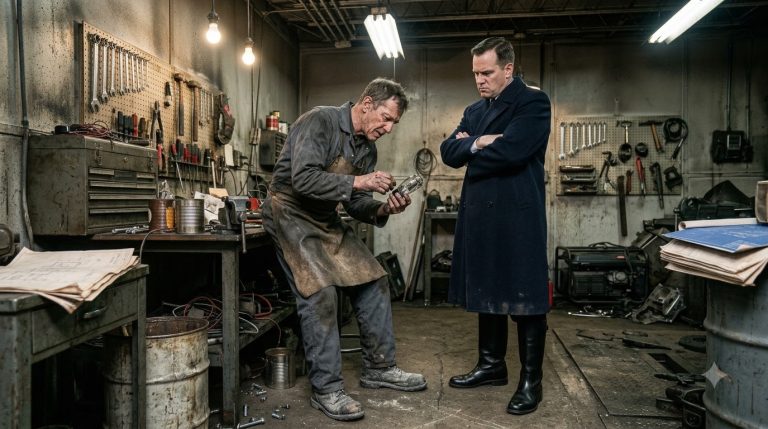
The Iron Anchor: A Century of Torque, Humility, and the Quiet Strength of Iowa Soil
CHAPTER 1: THE SINKING
The Caterpillar 375 didn’t go down with a roar. It went down with a sickening, wet squelch, the kind of sound a boot makes in deep, hungry clay.
Frank stood on the ridge, the September wind cutting through his heavy canvas jacket. Below him, the machine—the pride of his fleet, the $600,000 promise of his firm’s future—tilted. It wasn’t a fast slide. It was a slow, agonizing surrender to gravity. He watched the massive hydraulic arm, meant to tear through solid bedrock, claw at the air like a drowning man before sinking another six inches into the muck.
“Get out!” Frank barked into his handheld radio, though the operator was already scrambling over the edge of the cab, mud already staining his high-visibility vest.
Frank didn’t move. He felt the cold iron of his own ambition chilling him from the inside out. He had personally overseen the surveying for this stretch of Highway 52. He had looked at the reports, signed the permits, and pushed his crews to move faster, always faster. They were behind schedule, and the bank was breathing down his neck. The surveyors had promised solid ground.
Now, that ground was proving to be a deception.
He watched the yellow paint—so vibrant, so artificial—become streaked with the bruised, black earth of the swamp. It wasn’t just a machine losing its footing; it was a career, a reputation, and a mountain of debt vanishing in real-time. The silence that followed the initial thud was worse than the noise. It was a heavy, suffocating weight that pressed against his chest.
He took a step forward, his boots catching on the dry, cracked surface of the verge. He was a man of steel and diesel, a man who believed that if you threw enough horsepower at a problem, it would eventually yield. But as he stared at the excavator, he realized the mud didn’t care about horsepower. It didn’t care about deadlines or bottom lines. It was a chaotic, ancient force that didn’t follow the laws of his spreadsheets.
His foreman, Miller, crested the hill behind him, breathless. “The winch truck is three miles out, Frank. But if the ground won’t hold the tracks, it won’t hold the winch anchor either.”
Frank didn’t turn around. He focused on the way the swamp water was beginning to swirl around the cab door. He felt a sudden, sharp tremor in his own hands—a physical manifestation of his own lack of control. “Keep the crew back,” Frank said, his voice flat. “If that thing tips, I don’t want anyone caught in the drag.”
He looked toward the treeline on the eastern boundary of the site. A small, familiar silhouette was parked near the fence, a lone John Deere tractor. Walter Brennan was sitting there, just watching. He hadn’t moved for an hour.
Frank felt a surge of irrational irritation. What is he looking at? he thought. Is he waiting for me to fail?
The excavator shifted again, a low, metallic groan echoing across the site. The rear track was completely gone now. The machine was balanced on a knife’s edge, leaning further into the dark, silent hunger of the earth. Frank reached for his radio again, but his fingers slipped. He looked down and saw a smear of black, wet silt on his palm.
He wasn’t just losing his equipment. He was being pulled into the mud himself, and he had no idea how to stop the slide.
CHAPTER 2: THE SNAP OF STEEL
The sound wasn’t a crack; it was a shriek of tortured molecules, a metallic protest that vibrated through the soles of Frank’s boots.
Twenty yards away, the recovery truck from Des Moines was anchored into a concrete foundation the crew had poured in a desperate rush, but the ground beneath that foundation was just as treacherous as the swamp itself. Frank watched, his breath caught in his throat, as the winch cable pulled taut. It wasn’t the slow, steady pull of a machine designed for work—it was a frantic, high-tension scream of a cable stretched beyond its yield point.
The truck’s chassis buckled, tires digging into the gravel until they hit the soft, wet underbelly of the site. Then, the sound happened again—a violent, air-splitting pop—followed by the erratic, serpentine whip of the cable. It sliced through the air, dragging a spray of mud and silt with it, before burying itself deep into the brush.
Silence rushed back in, heavy and thick. The excavator, having been pulled at an impossible angle for a heartbeat, settled back into the muck with a wet, final-sounding thud. It had sunk another six inches.
Frank felt the heat rising in his neck, a prickly sensation that had nothing to do with the September sun. He looked at Miller, whose face was a mask of gray defeat.
“The anchor’s out,” Miller said, his voice barely a whisper. “The concrete just… it pulled right out of the mud. Frank, the ground won’t hold the weight. We’re just digging a grave for the equipment.”
Frank looked at the excavator. It sat at a steeper angle now, the cabin door half-submerged in black, stagnant water. He could smell it—a mixture of stagnant marsh water, rotting vegetation, and the sharp, metallic tang of hydraulic fluid leaking from a ruptured line. It was the smell of failure.
He didn’t answer Miller. Instead, his eyes were drawn back to the eastern fence line. Walter Brennan hadn’t left. He was still standing there, leaning against his John Deere, his hands tucked into the pockets of his worn overalls. He wasn’t watching the recovery truck; he was watching Frank. There was no mockery in the old man’s posture, only a patient, almost weary observation.
“Frank?” Miller prompted. “We need to call the home office. Tell them we need a specialized team. Maybe a helicopter from Minnesota, even if the cost is astronomical.”
“A sky crane won’t work, Miller,” Frank said, his voice finally finding its edge. He walked away from the edge of the swamp, his boots crunching on the gravel. He kept his head down, focusing on the texture of the ground—how the gravel shifted, how the mud threatened to reclaim every inch of the project site. “The wind speeds on the ridge are too high for a lift of that mass, and if we wait for a storm to break, we’re looking at another month of rain. That machine will be at the bottom of the aquifer by then.”
He stopped, staring at his own mud-caked hands. The realization hit him with a cold, hollow force: he had built his reputation on the idea that every problem had a technological solution, provided you had the capital to deploy it. He had spent his life treating the land as something to be flattened, paved, and conquered. Now, the land was refusing the conqueror.
“What do we do?” Miller asked, trailing him.
“We stop,” Frank said. It was the hardest thing he had ever said. “Clear the site. Secure the perimeter. Get the crew out of the danger zone. I need to think.”
“You want us to just leave it?”
“We aren’t leaving it,” Frank snapped, the irritation finally boiling over. “But we are done breaking things. Every time we pull, we’re just making the hole deeper. We need a different approach.”
He walked toward his truck, his gait stiff, his mind racing through every structural diagram and soil survey he’d ever reviewed. Nothing worked. The ground beneath them was a lie, a thin, deceiving crust hiding a bottomless, saturated reality. He sat in the cab of his truck and stared out at the construction site.
The wind shifted, carrying the scent of damp earth and something else—a faint, lingering smell of coal smoke from the direction of the Brennan farm. Frank rested his head against the steering wheel, his eyes closed. He was tired, a deep, bone-aching exhaustion that he hadn’t felt since he was driving a backhoe for twelve dollars an hour.
He thought about his grandfather, who had worked in the foundries, and his father, who had believed in the steady, rhythmic grind of manual labor. He had traded all of that for high-speed, high-precision, high-failure technology.
He looked up. Walter Brennan was climbing back onto his tractor. The engine sputtered to life, a low, guttural chug that sounded nothing like the refined whine of the diesel equipment currently surrounding him. Walter began the slow, rhythmic drive back toward his farm, the tractor’s tires leaving deep, steady tracks in the mud.
Frank watched the old man go, a strange, persistent knot of curiosity forming in his chest. It wasn’t hope—he didn’t believe in miracles—but it was the first time in his career he realized he might be looking at the world through the wrong end of the telescope.
He started his truck, the engine roaring to life with a synthetic, computer-managed precision that suddenly felt entirely useless. He needed to get home, to sit in the quiet, and to admit to himself that the experts were wrong.
The excavator groaned one last time in the distance, a long, drawn-out sound of settling metal, as if the swamp were finally closing its mouth. Frank put the truck in gear and turned away, but his eyes caught one last glimpse of the mud-streaked yellow machine in his rearview mirror.
It was already sinking, slow and steady, into the dark, indifferent earth.
CHAPTER 3: THE WATCHER ON THE HILL
The drive home felt less like a commute and more like a retreat. Frank’s truck, a vehicle designed for precision and power, felt bloated and unresponsive under his hands as he navigated the narrow, winding backroads of Clayton County. Every bump in the road, every rattle of the suspension, felt like a personal critique of his judgment.
When he finally pulled into his driveway, the house was dark, the windows reflecting the dying orange light of the sunset. He didn’t go inside immediately. Instead, he killed the engine and sat in the profound, heavy silence of the Iowa twilight. The only sound was the ticking of the cooling engine—a metal-on-metal contraction that sounded far too much like the groaning of the excavator he had left behind in the mud.
He thought about Walter Brennan. The image of the old man on his John Deere persisted in Frank’s mind—not as an enemy, and not as an annoyance, but as a persistent, quiet question. Why had the old man stayed? Why had he spent three days watching a disaster unfold, only to step in when the experts had failed?
Frank climbed out of the truck, his boots dragging on the gravel. He walked to the edge of his property, looking out over the rolling hills toward the construction site. Somewhere in that darkness, his machine was still sinking. The realization that he was entirely powerless to stop it felt like a cold stone in his gut. For thirty years, he had operated under the assumption that if he possessed the right tools, he possessed the truth. If he had the best excavator, he had the best answer. If he had the fastest computer, he had the most accurate data.
He leaned against a cedar fence post, the wood rough and weathered under his palms. He realized he didn’t know the soil in that swamp. He knew the data the surveyors had given him, but he didn’t know the land. He hadn’t bothered to walk it, to touch it, to understand its hidden, saturated history. He had looked at the surface and assumed he knew what lay beneath.
A light flickered on in the distance. It was the farmhouse on the other side of the treeline—Walter Brennan’s home.
Frank felt a sudden, sharp impulse to drive over there. He needed to know. Not about the steam engine—he could read a manual for that—but about the man. He wanted to know what it felt like to look at a machine that cost more than your life’s work and see not a tragedy, but a problem with a mechanical solution. He wanted to understand the perspective of someone who didn’t measure their value in horsepower or market share.
He turned toward his truck, then hesitated. To go there now would be an admission of defeat. It would be a gesture of weakness, a plea for help that his pride was still fighting to suppress. He gripped the fence post tighter, his knuckles white in the fading light. He was the boss. He was Frank Donnelly. He didn’t ask for help from farmers in stained overalls.
But then he remembered the sound of the cable snapping—that violent, final pop that had signaled the end of his competence.
He didn’t get back into the truck. Instead, he walked toward the back door of his house, his movements slow and deliberate. Inside, the air was still, smelling faintly of the coffee he’d made that morning and the dust of a house he rarely occupied. He went to his study, a room filled with blueprints, budget reports, and maps of the site. He spread the site survey out on the desk, the lines of elevation and soil density markers staring back at him like a foreign language.
He grabbed a red pencil and circled the area of the swamp. He looked at the historical data he’d ignored, the old geological surveys he’d dismissed as outdated. Buried in the margins of a 1950s report, he found a small, hand-written note: Underground spring activity. Subject to seasonal saturation.
He hadn’t ignored it out of malice; he had ignored it because it didn’t fit the narrative of his efficiency. He had chosen the data that validated his speed, not the data that questioned his safety.
Frank stared at the red circle for a long time. The house was settling, the wooden frame shifting in the cooling air. Outside, the wind had picked up, rustling the corn husks in the field. He felt a profound sense of isolation. He had built a life on the premise of being the man in charge, the one with the answers, the one who navigated the world through the application of overwhelming force. Now, he was just a man in an empty house, looking at a map of his own failure.
He reached out and tapped the red circle. The swamp wasn’t just a physical trap; it was a mirror. It had exposed the rot in his own decision-making process. He thought about the machine again—the $600,000 Caterpillar—and for the first time, he didn’t see the price tag. He saw the waste.
He went to the kitchen and poured a glass of water, the sound of the faucet echoing in the quiet. He didn’t drink it. He just held the glass, watching the light catch the movement of the water. He was going to have to do something tomorrow. He couldn’t just walk away. And the only person who seemed to know the terrain—the only person who hadn’t walked away when things got difficult—was the man he’d laughed at.
Frank put the glass down on the counter with a sharp clack. He wouldn’t go to the farm tonight. But he would be there at sunrise. He needed to see the engine. He needed to see the man. He needed to understand how a piece of iron and steel could command a force that his modern, computerized behemoths couldn’t even comprehend.
He walked back to the study and turned off the lamp, plunging the room into darkness. He stood there for a moment, looking out the window at the distant, steady light of the Brennan farm, his jaw set in a line of cold, hard resolve. He wasn’t going to apologize for his failure; he was going to learn how to fix it.
CHAPTER 4: THE THRESHOLD OF HUMILITY
The morning air was sharp, smelling of wet clover and the faint, acrid bite of coal smoke. Frank parked his truck at the very edge of the Brennan property, his engine clicking as it cooled—a sound that felt uncomfortably loud in the quiet expanse of the Iowa countryside. He didn’t step out immediately. He sat, watching the silhouette of the barn against a bruised, purple dawn, trying to steady the frantic, unproductive energy that had been driving him since midnight.
He finally opened the door. The gravel crunched under his boots, a sound that seemed to carry for miles. He wasn’t wearing his usual site gear; he’d swapped his clean, high-visibility vest for a heavy, dark canvas jacket. He wanted to blend, to be less of a target, though he knew he looked every bit the intruder he felt.
As he neared the barn, he saw Walter. The old man was already awake, hunched over a worktable littered with brass fittings and rusted tools. He was cleaning a spark plug with a rag, his movements methodical and agonizingly slow. He didn’t look up, but his voice was clear, cutting through the morning stillness like a blade.
“You’re early, Mr. Donnelly. The sun hasn’t even cleared the fence line.”
Frank stopped a few paces away, his hands shoved deep into his pockets to hide the slight tremor. “I didn’t come to talk about schedules, Walter.”
Walter paused, the rag held mid-motion. He finally lifted his head, his eyes bright and piercing beneath the brim of a faded cap. He took in Frank’s posture, the way he held his shoulders, the shadow of exhaustion beneath his eyes. “You came because the excavator is still sinking, and the realization of what that means is starting to take root.”
Frank stepped closer, his gaze drifting past Walter toward the center of the barn. There it sat. The 1912 Case steam engine. In the dim, dusty light of the barn, it was less a machine and more a monument. It was black iron, immense and imposing, with brass gauges that caught the stray beams of dawn like eyes watching him.
“I saw the survey notes,” Frank said, his voice dropping. “The underground springs. I knew they were there.”
“Knowing and understanding are two very different things,” Walter replied, returning to the spark plug. “You knew the water was there, but you didn’t respect it. You thought you could pave over it with enough concrete and power. But the swamp doesn’t care about your payroll, Frank.”
Frank walked toward the engine, his boots tracing a path through the dust. He reached out, hesitating, before running a hand along the cold, massive rear drive wheel. The metal was pitted, worn smooth by decades of friction and hard labor. It felt solid, anchored to the very earth beneath the concrete floor.
“It’s not just a machine, is it?” Frank asked, his fingers tracing the deep, jagged indentations of the steel cleats.
“It’s an education,” Walter said, standing up and wiping his hands on his overalls. He moved toward Frank, his gait steady despite the years. He pointed to the frame, to the thick, riveted steel that had clearly been hammered into shape by hand. “Look at the rivets. Each one set by a man who knew that if he did it poorly, the whole thing would fail. That’s the difference. You build things that are meant to be replaced. This was built to be inherited.”
Frank looked down at his own hands, then back at the engine. He noticed a patch of mud on the floor near the rear wheel—a dark, sticky residue that hadn’t been there yesterday. He knelt, pressing a finger into it. It was thick, heavy clay, mixed with the fine, almost silty sand of the swamp’s base. It was the same mud that was currently swallowing his $600,000 excavator.
“It’s the same soil,” Frank whispered.
“The earth doesn’t change, Frank,” Walter said, his tone softening just a fraction. “We do. You think you’ve improved on the past, but all you’ve done is build a bridge that doesn’t reach the other side. You forgot that before you build, you have to listen to what the ground is willing to let you do.”
Frank stood up. The tension in his chest hadn’t vanished, but it had shifted. It was no longer the frantic, ego-driven stress of a man losing money; it was the heavy, sobering weight of a man realizing he had been a fool. He looked at the boiler, at the way the pipes were coiled like the muscles of a giant, and then at the small, brass pressure gauge mounted near the throttle.
“I need to get it out,” Frank said, his voice hard, focused. “Not for the company. Not for the insurance. I need to get it out because I can’t leave it there like that. It’s a mark of my own arrogance.”
Walter stared at him for a long, silent moment. The only sound in the barn was the distant cawing of a crow in the fields and the rhythmic, soft wheezing of the old man’s breath.
“You’re finally starting to see it,” Walter said. He walked past Frank toward the back of the barn, toward a stack of long, heavy timber beams—thick, square-cut oak. “If you want to move that excavator, you don’t pull it harder. You pull it smarter. You use the timber to create a road, and you use the torque to climb the hill, not fight the mud. Are you ready to get your hands dirty, Frank? Not the kind of dirty you get in a boardroom, but the kind that stays under your fingernails for a week?”
Frank felt a strange, quiet hum in his blood—a sense of purpose he hadn’t felt in years. He walked over to the stack of oak beams and gripped the end of one. It was impossibly heavy, dense with years of curing, rough against his palms.
“I’m ready,” Frank said.
“Good,” Walter replied, handing him a rusted, heavy-duty crowbar. “Because the swamp isn’t going to wait for us to find our pride.”
CHAPTER 5: THE FIRING OF THE BOILER
Walter didn’t just walk to the engine; he approached it like a priest approaching an altar. The barn was silent, save for the rhythmic drip of condensation from the roof, but in the center of that silence, the 1912 Case steam traction engine waited. To Frank, it looked less like a machine and more like a sleeping beast made of cast iron and suppressed potential.
“Building steam isn’t like turning a key,” Walter said, his voice low, respectful. He began gathering wood and coal from a nearby pile. “It’s a conversation. You have to listen to the boiler, feel the expansion of the metal, and watch the pressure. You push it too hard, too fast, and the plates stress. You don’t push it enough, and you’re just standing still in the mud.”
Frank stood by, feeling oddly useless, his hands still raw from gripping the heavy oak beams. He watched as Walter carefully laid a foundation of dry, brittle pine kindling into the firebox. There was a rhythm to the old man’s movements—a grace born of fifty years of intimacy with the machine.
“I spent my life trying to force results, Walter,” Frank murmured, his eyes fixed on the flicker of the match Walter struck. The flame leaped, catching the pine, and the first wisps of grey smoke began to curl up through the stack. “I thought if I didn’t see progress, I wasn’t working. I thought speed was the only metric that mattered.”
Walter didn’t look up. “Speed is just a way of hiding your mistakes. You move fast, you don’t have to look at the cracks in the foundation. But out there, in that swamp? The swamp doesn’t care how fast you are. It only cares about the weight you’re putting on it and whether or not you have the grit to stay on top.”
As the fire grew, Frank felt a strange, cold shiver. The image of the fire flickering in the dark iron chamber triggered a jagged memory—a flash of a failed loan meeting twenty years ago, his first backhoe repossessed in a pouring rainstorm. The helplessness of that day, the feeling of the earth beneath his feet being pulled away, hit him with the force of a physical blow. He braced himself against the side of the engine, the metal cool and unyielding against his palm.
“It’s not just a machine,” Frank whispered, almost to himself. “It’s the patience I never had.”
“It’s the debt we owe,” Walter corrected. He began shoveling coal into the firebox, the rhythmic clink-clatter of the shovel against the metal echoing against the barn walls. “Every one of these machines that survived the scrapyard represents a man who couldn’t bear to let his history vanish. My grandfather didn’t keep this because it was useful. He kept it because it was honest.”
The boiler began to groan—a low, deep-seated vibration that traveled up through the floorboards and into Frank’s bones. The pressure gauge needle moved, twitching upward as the water inside the boiler began to heat. It was a slow, deliberate movement, a stark contrast to the jittery, digital readouts on his company’s modern fleet.
Frank reached out and adjusted a valve, his touch tentative. He could feel the resistance, the heavy, pressurized defiance of the steam waiting to be unleashed. For the first time, he realized that managing this machine wasn’t about controlling it; it was about yielding to its requirements.
“We’re going to need more wood,” Walter said, gesturing to the corner. “The kindling is just to wake her up. Now we need the heart of the fire.”
Frank moved with a new urgency. He lugged the heavy oak scraps to the barn floor, his muscles aching with a familiar, grounding fatigue. He worked alongside Walter, the two of them moving in a syncopated, wordless dance of labor. There was no mention of the construction site, no talk of the $600,000 lost in the mud, no discussion of the corporate fallout waiting for him in the city.
There was only the fire, the water, and the slow, inevitable buildup of power.
As the steam pressure continued to climb, the engine began to sing—a high, whistling whine from the relief valves that made the air in the barn vibrate. It was a hungry, demanding sound. Frank stood back, wiping sweat from his forehead with the back of his mud-stained hand. He felt stripped down, raw, his identity as a construction magnate peeling away in the heat of the fire.
“She’s almost ready,” Walter said, his face illuminated by the orange glow of the firebox. He looked at Frank, his gaze searching. “When you take the throttle, you have to remember: you aren’t just pulling a machine out of the mud. You’re proving that what we built matters. You ready to shoulder that?”
Frank looked at the pressure gauge—deep in the red, right where it needed to be. He looked at the massive, iron-cleated wheels that hadn’t turned in a month. He felt the weight of the hammer he’d used, the grit of the swamp mud on his boots, and the quiet, steady strength of the man standing next to him.
“I am,” Frank said.
The steam hissed, a sharp, powerful burst that filled the barn with the scent of ozone and ancient, boiling water. The engine was alive, a dormant titan waking up to finish a job that the modern world had abandoned. Frank walked toward the platform, his heart steady, his resolve forged in the heat of the fire.
CHAPTER 6: THE IRON PROCESSION
The transition from the barn to the open road was not a launch; it was a slow, agonizing birth. As Walter eased the throttle forward, the steam engine didn’t lurch or roar like the modern machines Frank was used to. Instead, it groaned—a deep, resonant metallic sigh that seemed to originate from the very center of the iron boiler. The drive wheels, six feet of cast iron studded with steel cleats, began to bite into the soft earth of the yard.
Frank walked beside the engine, one hand resting on the warm, vibrating brass of the side rail. He could feel the pulse of the pistons, a heavy, rhythmic heartbeat that dictated the pace of the world. With every rotation, the wheels ground the gravel into dust, leaving deep, permanent scars in the ground.
“Keep your eyes on the pressure,” Walter called down from the operator’s platform. His voice was strained, competing with the constant, rhythmic hiss of steam escaping the valves. “We’re entering the road now. The surface is different. It’s hard-packed gravel, and she’s going to want to slide.”
Frank nodded, though he knew Walter couldn’t see him. He felt an intense, focused alertness. The air had shifted—the late afternoon sun was being swallowed by a wall of thick, rolling fog that spilled out from the marshland, cooling the air and turning the world into a series of blurred, grey textures.
As they crested the small hill leading onto the county road, Frank saw the construction site in the distance. Even in the gloom of the fog, the yellow silhouette of the stuck excavator stood out like a beacon of failure. A few of the crew members were still there, milling about the perimeter, their bright orange vests looking like neon smears against the darkening landscape.
“They’re watching,” Frank said, his voice tight.
“Let them watch,” Walter replied, his hand steady on the throttle. “Most of them have never seen a machine that isn’t running on a microchip. They’re used to machines that tell them what they can and can’t do. They don’t know what it’s like to work with something that simply… does.”
The engine hit the county road, and the sound changed. The soft, damp thud of the yard gravel gave way to the sharp, metallic crunch of steel cleats biting into the hardened surface of the road. It was a loud, aggressive noise—a machine built in 1912 asserting its dominance over the tarmac of the 1990s.
Frank watched the front wheels—large, heavy iron discs—wobble slightly as they navigated the ruts of the road. He felt a sudden spike of anxiety. If a tie rod snapped here, if a gear slipped, the entire weight of the machine would be uncontrolled. But Walter’s hands never wavered. He steered with a calm, almost meditative focus, his eyes tracking the road ahead, anticipating the dips and the crown of the pavement.
As they rolled past a farmhouse, an old truck pulled over. The driver—a local farmer—stepped out, leaning against his door. He wasn’t staring at Frank, and he wasn’t staring at the excavator. He was staring at the engine. His face was filled with a look of profound, quiet recognition, the way a person looks at an old photograph they haven’t seen in decades.
“We’re moving too slow,” Frank muttered, checking his watch. “The mud is setting, Walter. The longer we wait, the more suction the swamp creates.”
“If we move faster, we risk the boiler,” Walter shot back, his voice brooking no argument. “You want to get there? Then you accept the pace. The pace is the point, Frank. You can’t rush physics. You can’t rush the weight of the world.”
The fog thickened, wrapping the steam engine in a shroud of white mist. The whistle suddenly let out a low, mournful wail—not a signal, but a command that reverberated off the trees and rattled the windows of the passing homes. It was a sound that belonged to a different time, a time when machines were made of iron and sweat, not plastic and software.
Frank felt the cold of the fog seeping through his jacket, but he didn’t care. He was entirely caught up in the motion. He watched the drive wheels turn, their massive, six-foot diameter churning with a slow, hypnotic grace. He realized then that he had spent his entire life trying to exist above the friction of the world, trying to minimize resistance, trying to make everything move as quickly and effortlessly as possible.
But this engine… this engine loved the friction. It required it. It needed the resistance of the road and the weight of the load to prove it existed.
“We’re almost there,” Walter said, his voice barely audible over the chuffing of the pistons.
Ahead, the construction site lights flickered on, piercing through the fog like jaundiced, dying stars. Frank saw the excavator, its yellow paint dull and grey in the mist, looking smaller than he remembered. He felt a surge of cold dread. It was deeper than before, the mud having crept up to the base of the cab.
He gripped the side rail tighter, the heat of the boiler burning against his palm. He wasn’t afraid of the cost anymore. He wasn’t afraid of the bankruptcy. He was afraid that even with the power of this ancient, iron titan, the swamp might prove to be stronger.
“Steady, Frank,” Walter warned, his eyes fixed on the muddy edge of the road. “Here is where the real work begins.”
The engine hit the soft shoulder, the ground beneath them vibrating as the heavy, iron wheels began to sink. Walter opened the throttle, and the engine’s song deepened, becoming a guttural, earth-shaking rumble that signaled they were no longer on the road. They were on the battlefield.
CHAPTER 7: THE PULL
The swamp didn’t just smell; it felt like a living thing, a cold, wet hand gripping the heavy iron wheels of the 1912 Case. As Walter eased the throttle forward, the steam engine didn’t simply move. It shuddered, the entire chassis vibrating as the pistons fought the static friction of a month’s worth of settling mud. The engine’s chuffing became a guttural roar, a deep, rhythmic, iron-lunged labor that drowned out the nervous murmurs of the construction crew standing at the edge of the clearing.
Frank stood on the muddy bank, the chain stretched out between them like a taut, silver artery. His hands were braced against his knees, his eyes locked on the connection point at the excavator’s frame. He felt a sudden, sharp, and terrifyingly irrational thought—that the iron of the chain was going to shatter like glass. He blinked, shaking his head. The chain was heavy, forged by men who knew what it meant to hold the weight of a farm. It was solid. It was real.
“She’s biting!” Walter shouted from the platform, his voice cracking with exertion.
The drive wheels, six feet of iron teeth, tore through the soft surface layer. They didn’t spin; they chewed. Frank watched, mesmerized, as the steam engine dug down, finding the hidden, compacted substrate of the swamp floor—the solid earth the surveyors had insisted didn’t exist. The machine began to crawl forward, an inch at a time, each movement accompanied by a wet, sucking sound from the mud that felt like the swamp refusing to let go.
Frank moved with the machine, his boots sinking into the muck, his muscles burning. He wasn’t thinking about the timeline. He wasn’t thinking about the budget. He was thinking about the physics—the raw, brutal, beautiful trade-off of torque for distance.
“More pressure, Walter!” Frank yelled, though he knew the old man was already pushing the boiler to its limit.
The steam engine let out a piercing, long-drawn-out shriek of steam from the safety valve, a warning that the pressure was nearing the red line. For a second, the excavator didn’t move. It sat there, a $600,000 monument to failure, balanced on the knife-edge of the swamp’s appetite. Frank felt a wave of dizziness—an intrusive, haunting memory of every time his company had failed, every time he had overpromised and under-delivered, every time he had seen his own work being dismantled or repossessed. He blinked, the image of his childhood backhoe being loaded onto a flatbed superimposed over the excavator in the mud. He gripped the chain, the cold, rusted steel biting into his palms, grounding him in the present.
“It’s moving, Frank! Look!”
The excavator tilted. A foot of track emerged from the black slime, dripping with thick, oily sediment. Then another. The massive, yellow frame groaned—the sound of metal being stretched, of hydraulic lines shifting, of a machine being reborn from the earth.
Frank let out a shout, his voice raw. He threw his weight against the chain, not because it helped the engine, but because he needed to feel the struggle. He was part of the machine now. He was the anchor. He was the force that wouldn’t let the past be swallowed.
The swamp fought back. The suction, a powerful, vacuum-like force created by the shifting mud, pulled against the excavator’s underside with incredible power. The steam engine’s rhythm faltered for a heartbeat—a misfire in the pistons—and Frank’s heart hammered against his ribs. He watched the drive wheels spin, kicking up a spray of mud that coated his clothes in a thick, dark film.
“Don’t you dare,” Frank whispered to the engine, to the swamp, to the ghost of his own ambition. “Don’t you dare.”
Walter surged the throttle, the engine letting out a roar that seemed to vibrate the very air. The steam pressure hit the absolute peak of the gauge, the needle quivering in the red zone. The engine lunged. The chain snapped taut with a force that sent a tremor back through the ground.
With a final, gargantuan slurp, the excavator broke free. It didn’t just slide out; it rose, the tracks clearing the hole with a sudden, kinetic release that almost threw Frank off his feet.
He stumbled back, his breath coming in ragged gasps, as the excavator continued to roll forward, dragged by the relentless, slow-motion pull of the steam engine. Walter kept the pressure steady, the wheels biting, the cleats tearing through the mud until the machine sat safe, grounded, and solid on the firm earth of the site entrance.
The silence that returned to the swamp was sudden and absolute. The steam engine hissed as the pressure began to bleed off, a long, sighing sound of a giant finally resting. Frank fell to his knees in the mud, his hands shaking, his entire body soaked, shivering with a mixture of adrenaline and profound, soul-deep relief. He looked at the excavator, then at the steam engine—a machine from a century ago, sitting there in the fog, black, steaming, and perfect.
He hadn’t just saved his business. He had found something he hadn’t realized was lost—the understanding that there was a kind of strength that didn’t need to be fast, and a kind of legacy that didn’t need to be modern.
He didn’t stand up. He just sat there, in the cold, wet mud of the construction site, watching the fog swirl around the iron wheels of the engine, listening to the cooling metal click and sigh in the quiet.
CHAPTER 8: THE ECHO OF THE WHISTLE
The silence that settled over the construction site was profound, broken only by the rhythmic, metallic ping-ping-ping of the steam engine’s boiler contracting in the cool evening air. Frank remained on his knees in the mud, his breathing slowing to match the rhythm of the cooling metal. The excavator sat just a few feet away, a muddy, battered monument to the limits of his own world.
He looked at his hands. They were caked in the same black silt that had nearly cost him his business. He rubbed his palms together, feeling the grit of the swamp soil—a texture that now felt like a permanent part of his own history. It wasn’t just dirt; it was the reality he had spent thirty years trying to engineer his way out of.
Walter stepped off the operator’s platform, his movements slower than before, his face lined with the deep, honest exhaustion of a man who had done exactly what he promised. He didn’t offer a hand to help Frank up. He simply walked to the front of the steam engine and laid a hand on the massive iron wheel, letting the warmth of the boiler bleed into his skin.
“She held,” Walter said. His voice was soft, devoid of triumph. It was the simple statement of a fact. “She always holds, if you treat her with respect.”
Frank stood up, his legs shaking. He wiped his face with a rag, smearing the mud until his skin burned, but he didn’t care. He walked over to the excavator and placed a hand on the cold steel of the track. It was solid. It was stable. And for the first time, he realized it was entirely incidental. The machine itself—the hydraulic complexity, the million-dollar price tag—meant nothing compared to the ground it stood upon.
“I thought I was smarter than the land,” Frank said, his voice quiet in the vast, darkening field. “I thought if I had enough power, the land would have to obey. But you didn’t force it, Walter. You asked it.”
“I understood it,” Walter corrected, turning to look at him. The firelight from the engine’s firebox cast long, flickering shadows across his weathered features. “You don’t fight the earth, Frank. You negotiate with it. You provide the traction, you respect the load, and you accept that some things simply require time. You’ve been living your whole life like you’re trying to outrun tomorrow. You might want to try living in today for a change.”
The construction crew was gathered in the distance, a group of tired, mud-stained men who had spent three days convinced they were witnessing a miracle. They weren’t cheering anymore. They were watching, as if they were seeing the world for the first time. They were witnessing the moment the myth of modern inevitability broke, replaced by something slower, heavier, and infinitely more durable.
Frank walked toward the edge of the site, where the road waited. He thought about the check he would write tomorrow—the donation to the historical society—and realized it was the most important document he’d ever signed. It wasn’t a payout for a service rendered; it was a down payment on a new way of seeing.
“I’m going to change how we work, Walter,” Frank said, looking back at the old man. “Not just because of this. But because I finally see what we’ve been throwing away.”
Walter nodded once, a gesture of quiet, final acknowledgement. He climbed back onto the platform of the steam engine, his hands moving with practiced ease to check the valves. “That’s all anyone can ask, Frank. To see.”
As Walter pulled the throttle, the engine gave a soft, rhythmic chuff, the great iron wheels beginning their slow, deliberate rotation. The sound of the steam whistle didn’t come this time. Instead, there was just the deep, mechanical purr of the pistons, a heartbeat that sounded like the very rhythm of the Iowa landscape.
Frank watched the engine retreat into the thickening fog, its form slowly dissolving until it was nothing more than a shadow against the horizon. He walked to his truck, the mud of the swamp clinging to his boots, and sat inside. He didn’t start the engine. He just sat there, listening to the silence of the night, feeling the heavy, grounded weight of the truth he had uncovered.
He hadn’t solved a problem. He had been corrected by the past. And as he finally turned the ignition, the synthetic hum of the modern truck felt thin and fragile compared to the memory of the deep, iron rhythm he had just left behind.
He drove away, the road stretching out before him—not a challenge to be conquered, but a path to be traveled, with the slow, steady patience of a man who had finally learned how to listen to the earth beneath his feet.