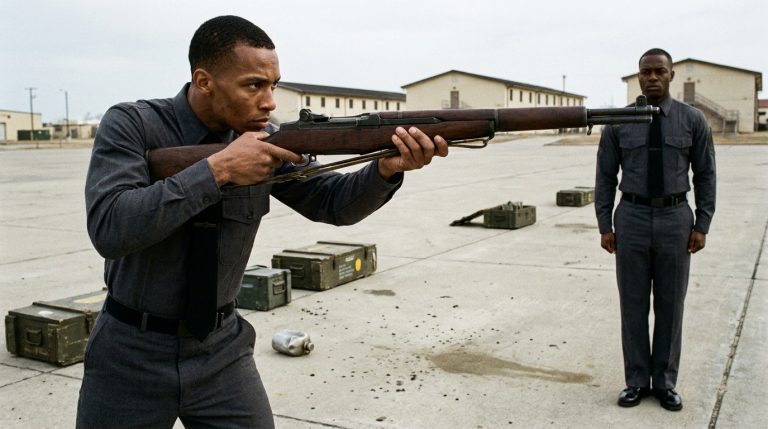
A Marine’s Final Directive: How One Decorated Veteran Engineered a Masterpiece of Calculated, Cold-Blooded Justice
CHAPTER 1: THE WEIGHT OF THE BLUE PLASTIC
The kitchen smelled of burnt coffee and synthetic air freshener. I stared at the blue plastic pill organizer on the granite countertop. It was a cheap, flimsy thing Era had bought from a dollar store in 2019, its seven compartments snapped shut with a sound like a rifle bolt locking home.
Harry leaned against the island, his thumbs hooked into the pockets of his designer jeans. He was watching me. He always watched me, especially when I reached for the sertraline.
“Pops, you’re shaking again,” he said. His voice was too smooth, too practiced. It was the tone of a man who had already spent the money he hadn’t yet stolen.
I didn’t look up. I forced my hand to remain steady, focusing on the mechanical precision of the lid. Click. One, two, three. The pills rattled against the plastic—a sharp, rhythmic sound that cut through the silence of the room. I took them with a glass of tap water, the cold glass biting into my palm.
“I’m fine, Harry,” I said, my voice as flat and hard as a slab of cured leather.
“You’re not fine. You’re jumpy. The neighbor’s lawnmower goes off and you look like you’re diving for a foxhole.” Lisa stepped into the room, her iPhone held at an angle that made my neck prickle. She was recording. She was always recording. “We’re worried, Sam. It’s getting harder to justify keeping you here when you’re clearly not capable of managing your own… existence.”
I set the organizer down. I didn’t reach for the paper plates. I didn’t apologize for my presence. I looked at the kitchen window, watching a shadow move across the lawn.
“Is that right?” I asked.
“The deed, Dad,” Harry said, his patience wearing thin. “Just sign the transfer. We’ll refinance, move you into the facility in Pinehurst. They have medical staff, people who know how to handle your specific… type.”
I felt the weight of the digital recorder in my shirt pocket, a small, black sliver of truth pressed against my ribs. It was recording now. Every word. Every threat. Every lie.
“I need time to think,” I lied.
Harry let out a sharp, jagged laugh. He turned to Lisa, his eyes glinting with a predator’s certainty. “He’s confused. Look at him, Lisa. He doesn’t even know what year it is.”
I didn’t blink. I didn’t reach for the excuses. I just watched the way Harry’s hands trembled when he thought I wasn’t looking. He was terrified of me, even if he didn’t know why yet. He thought he was the hunter, but he had already walked into the trap.
“I know exactly what year it is,” I said, the quiet iron in my voice causing him to step back. “I know exactly who is in this house. And I know exactly what comes next.”
I didn’t wait for his reply. I turned and walked toward the basement stairs, leaving them standing in the kitchen, surrounded by the shadows of their own arrogance.
CHAPTER 2: THE WAR CHEST
The basement was a tomb of forgotten things, smelling of damp concrete and the faint, metallic tang of oxidized iron. I didn’t turn on the light. I didn’t need it. My hands knew the geography of this room as well as they knew the firing mechanism of an M16. I navigated the shadows, my boots silent on the cold floor, the darkness serving as a blanket against the artificiality of the life being constructed for me upstairs.
Up there, Harry and Lisa were likely still standing in the kitchen, dissecting my reaction like pathologists. They were probably already crafting the narrative for the next “episode.” I could almost hear the cadence of their voices—the feigned concern, the subtle emphasis on words like decline and incompetent. They were weaving a net, strand by strand, believing I was the fly already caught in the mesh.
I reached the corner beneath the stairs where the floorboards were loose. A sharp, piercing memory caught me in the chest—a humid night in ’69, the smell of cordite mixing with the rot of a flooded rice paddy, and the sound of a patrol sergeant whispering that the only way to survive the perimeter was to be the thing the enemy feared most: invisible.
The weight of that memory—the cold, hard reality of survival—tempered the adrenaline in my blood. I pried the board up with the steady, practiced grace of a man who had spent decades maintaining aircraft engines.
The lockbox sat where I had placed it three years ago. Steel, fireproof, heavy. I didn’t open it yet. I stood there, listening to the muffled thuds of footsteps above. They were moving, likely checking the hallway, perhaps even listening at the top of the stairs. They wanted to see if I was pacing, if I was talking to myself, if I was acting “the part.”
I sat on a wooden crate and pulled the box into my lap. The combination—a sequence of numbers that meant nothing to anyone but Era and me—clicked over with the soft, deliberate precision of a safe. Inside, the documents lay undisturbed. The Lockheed Martin statements, the real deed, the medical evaluations. They were clean, white, and lethal.
I traced the edge of the VA medical report. Dr. Patricia Hayes had been an anchor for me, her notes a steady, scientific refutation of every lie Harry intended to spin. Patient exhibits mild anxiety disorder… symptoms well controlled… fully functional. I looked at the digital recorder. It was a small, unassuming black brick, but in this light, it looked like a detonator.
If I walked upstairs now and played it, I’d win the argument, but I’d lose the war. A single spark would only burn the edges of their plan. I needed the whole house to collapse. I needed them to stand in the wreckage of their own choosing, believing they had finally reached the ceiling of their ambition, only to have the floor vanish beneath them.
I pulled out a blank notebook and a pen. I didn’t write notes; I wrote a timeline.
February 2024. The consultation with the ‘specialist’ lawyer.
I mapped out the move. Harry’s arrogance was his primary vulnerability. He viewed me as a broken instrument, a relic of a war he only understood through films. He would never suspect that the “shaking hands” he mocked were the same hands that had documented every unauthorized dollar, every transactional cruelty, and every violation of my sovereignty.
I sat there for an hour, the basement air chilling my bones. I wasn’t just a father being fleeced; I was a strategist re-evaluating the battlefield. I accounted for the neighbor’s perceptions—the curated “episodes,” the staged grocery store conversations. I checked my phone’s voice memo app once more. The data was backed up, encrypted, and safe.
A sudden floorboard creak above me signaled Harry’s movement. He was heading for the basement door.
I snapped the lockbox shut, slid it into the hollow, and replaced the board. I wiped the dust from my knees and stood up, my posture correcting itself into the rigid, disciplined line of a man who had earned his place in the world.
I didn’t move toward the stairs yet. I waited. I needed him to think I was brooding, that I was “agitated.” I needed the performance to be perfect.
The basement door clicked open. A sliver of kitchen light sliced across the floor, illuminating the dust motes dancing in the air.
“Dad?” Harry’s voice was too loud, a forced joviality that didn’t reach his eyes. “You okay down there? You’ve been quiet. Usually, you’re… well, you know. Talking to Mom.”
I stepped into the sliver of light, my face a mask of weary, muted confusion. I let my shoulders slump, just a fraction.
“I’m just tired, Harry,” I said, my voice heavy.
“Yeah, I bet,” he said, stepping down onto the first tread, his gaze sweeping the room, searching for—what? A conversation with a ghost? A frantic display of “crazy”?
He wouldn’t find it. He would find only the man he expected to see, the man he thought he could discard.
“Come on up,” he urged, his hand hovering near his pocket where I knew the iPhone sat, recording. “Lisa made dinner. We need to talk about that appointment again. The lawyer needs to know you’re… cooperative.”
“I’ll be up in a minute,” I said, turning away so he wouldn’t see the cold, clear sharpness in my eyes. “Just need a moment to collect myself.”
“Take your time, Dad,” he said, and I heard the faint, triumphant smile in his tone.
He climbed back up, and I stood in the dark, counting his footsteps. One. Two. Three. He was walking directly into the trap, and he was doing it with a smile on his face.
CHAPTER 3: THE PRICE OF COMFORT
The transition from the cool, damp silence of the basement to the bright, artificial heat of the kitchen was a sensory assault. The air was thick with the scent of roasted rosemary and garlic—a culinary performance intended to soothe me, to lull me into a state of docile compliance. Harry was already at the table, pouring wine with a flourish that felt choreographed.
“Sit, Dad,” he said, pulling out a chair. “Lisa’s making a special meal tonight. We’re going to have a real talk. No distractions.”
I sat. The wood of the chair was polished, smooth, and utterly foreign under my calloused hands. Lisa was at the stove, her back to me, the iPhone 15 Pro resting strategically on the counter near the spice rack. It was recording. It was always recording. I watched the lens, a small, dark eye that monitored my every breath, waiting for a twitch of the hand or a stutter in my speech to validate their narrative of my decay.
“You’re quiet tonight,” Lisa remarked, stirring the pot with an efficiency that bordered on clinical. “Thinking about something?”
“Just tired,” I repeated, my voice tight. I looked down at the table. The good China Era had chosen—the delicate, white porcelain with the gold rim—glinted under the recessed lights. It felt heavy, a burden of memory that Harry and Lisa treated like a piece of leverage. They hadn’t touched this china in years. To see it on the table now was a blunt, tactical move: a reminder that they were the masters of this domain, the curators of what remained of my life.
“We talked to the lawyer today,” Harry said, his voice lowering into that patronizing, syrupy pitch he reserved for the insurance office. “He’s concerned, Dad. He says that if we don’t start the guardianship process soon, the court might view your hesitation as evidence of lack of capacity.”
I looked up, meeting his gaze. He expected a flare-up. He expected a shake of my hands or an outburst about my rights. I gave him nothing. I maintained a steady, chilling neutrality.
“The lawyer,” I said, my voice barely above a whisper. “Does he know about the mortgage applications?”
Harry’s hand froze mid-pour. The wine swirled in the glass, a deep, bruised crimson. He didn’t look away, but the muscle in his jaw tightened. “What applications?”
“The ones I found on your laptop,” I said. It was a lie, of course—I’d found the copies in the emails I’d accessed months ago—but the ambiguity was a weapon. “The ones for the refinance.”
Lisa stopped stirring. The kitchen went deathly quiet. I could hear the hum of the refrigerator, the distant, muffled sound of a neighbor’s car driving down the street. Harry’s face went through a rapid series of shifts: shock, followed by a sharp, defensive dismissal.
“You’re hallucinating, Dad,” Harry said, setting the bottle down with a soft, controlled thud. “You’re misremembering things again. Stress can do that. It makes you see threats where there are only efforts to help.”
“Stress,” I echoed.
“Exactly,” Lisa interjected, turning to face me, her expression a mask of manufactured empathy. She looked at the phone on the counter, then back at me. “We want to take the burden off you. The finances, the house maintenance—it’s too much for you to manage. You’re confused, Sam. It’s okay to admit it.”
I leaned forward, placing my hands flat on the table. My grip was iron-steady. I noticed a detail I hadn’t seen before: the small, leather-bound envelope that usually sat in the study was missing. It was a minor thing, perhaps a bank statement or an insurance update, but it was out of place. Harry and Lisa were moving, searching for the evidence that would seal my fate, unaware that the real evidence was already beyond their reach.
“If I’m so confused,” I said, watching Harry’s eyes dart toward the phone, “why are you so interested in where I keep my records?”
Harry stood up, his face reddening. The performance of the “devoted son” was starting to fracture under the weight of his own irritation. “We’re interested because we have to be! Because you’re wasting assets and endangering the future of this family!”
“This family,” I said, a cold, dry humor touching my tone. “Is that what we’re calling it?”
“Don’t do this, Dad,” Lisa warned, her voice dropping to a sharp, transactional edge. “Don’t force us to show the records to Dr. Hayes. If we bring her the footage of you acting like this—the paranoia, the accusations—she won’t have a choice but to sign the competency referral.”
They thought they had me. They thought this was the kill shot: the threat of the doctor, the threat of the state. They didn’t understand that I had already talked to Dr. Hayes. I had already cleared the ground.
“I’m not the one acting,” I said, standing up slowly. I didn’t raise my voice. I didn’t reach for the paper plates they’d left on the counter. I just looked at them—really looked at them—seeing the fear beneath the greed. They were running out of time, and they knew it. Every day I stayed here was a day of friction, a day of mounting risk for them.
“I think I’ve lost my appetite,” I said, turning away from the table.
“Dad, sit down!” Harry barked, his control snapping. “We aren’t finished!”
“I am,” I said. I walked toward the hallway, my gait measured, deliberate. I could feel their eyes on my back—a mixture of anger and confusion. They were calculating, trying to figure out if this was a genuine episode or something else. I left them there, surrounded by the smell of their rosemary chicken and the silence of their own failures.
I went to my room and closed the door. I sat on the edge of the bed and waited. The house felt smaller tonight, the walls pressing in with the accumulated weight of their lies. But as I sat there, I listened to the house—the way the pipes groaned, the settling of the foundation, the soft, rhythmic clicking of the smart-home thermostat. Every mechanical sound was a clock, and I was the one holding the key to the mainspring.
They thought they were the ones managing the house. They didn’t realize that in a building this old, the secrets weren’t in the rooms. They were in the bones. And I knew exactly how to make them break.
CHAPTER 4: THE RECONNAISSANCE
The door handle turned—a slow, agonizingly deliberate rotation. Harry didn’t knock. He pushed the door open just wide enough to let the hallway light slice across the floorboards. I didn’t look up from the bed. I kept my breathing shallow, rhythmic, the kind of stillness that Marines learn when they’re hiding in the tall grass, waiting for the patrol to pass.
“Dad?” Harry’s voice was softer now, devoid of the earlier bravado. He was switching tactics, trying the ‘concerned son’ routine again. “We’re going out for a bit. Lisa needs to pick up some things for the house. We’ll be back in an hour. Please… just try to stay calm while we’re gone.”
I didn’t answer. I kept my eyes fixed on the shadows in the corner, where the wall met the ceiling.
“I left some tea in the kitchen,” he added, his voice trailing off as if he were trying to gauge my pulse from the doorway. He lingered for a moment, waiting for me to break, to beg, to scream—anything that would validate the recordings he and Lisa were so obsessed with. When I remained silent, he sighed, a sound of exaggerated frustration, and pulled the door shut.
The lock clicked—a heavy, mechanical sound. He’d locked me in.
I waited for the rumble of the BMW’s engine to fade into the distance before I moved. I didn’t reach for the door. I didn’t try the handle. I reached instead for the underside of my nightstand, where I had taped a small, flat-head screwdriver months ago. My movements were fluid, devoid of the tremor they all expected me to have.
The hallway light flickered as I exited the room, the dying bulb casting long, jagged shadows that danced across the wallpaper. For a split second, the visual shift—the strobe-like rhythm of the light—pulled at my consciousness. My heart spiked, the old familiar warning of a flashback, but I clamped down on it. I forced my focus to the physical world: the cold bite of the screwdriver in my hand, the rough texture of the wall, the scent of dust. I was in Fayetteville, not the rice paddies. I was in control of the perimeter.
I headed straight for the study.
The house felt different when they were gone. The oppressive, performative air dissipated, leaving behind the true, quiet hum of the building. I moved through the hallway like a ghost. This was my home—the house Era and I had bought with the money that cost me three Purple Hearts. Every squeak of the floorboards was a familiar note in a song I’d memorized over thirty years.
I entered the study and went straight to the desk. The leather-bound envelope was gone, as I’d suspected, but they had been reckless in their haste. Papers were scattered across the mahogany surface, folders left half-open, drawers pulled out just enough to reveal their contents. They were searching for the Lockheed pension records, or perhaps the original deed, but they were looking in the wrong places. They were looking for evidence of my incompetence, not realizing they were looking for evidence of my survival.
I didn’t look for the documents. I looked for the holes in their story.
I found a scrap of paper in the trash bin near the desk—a scribbled note with a time and a name: Dr. Henderson, 2:00 PM, Thursday. That wasn’t Dr. Hayes. That was a new name. A new, contracted medical expert, no doubt someone paid to overlook the facts and provide the “expert testimony” required to strip me of my rights.
The strategy was simple, and it was brutal. They weren’t just going to bully me into signing; they were going to manufacture a medical record that would make my protest irrelevant.
I took a photo of the note with my burner phone, the shutter silent.
As I worked, the house felt like it was breathing with me. I moved through the rooms with a sense of clarity that I hadn’t felt in years. Every piece of furniture, every frame on the wall, seemed to sharpen in focus. They thought they were building a cage for a broken man, but they were actually clearing the stage for a performance they hadn’t invited.
I made my way back to the kitchen. I didn’t touch the tea Harry had left. I went to the pantry and opened the small, hidden compartment behind the flour sacks where I kept the copies of the real property tax receipts and the legal correspondence from Jimmy Miller.
Everything was in order.
I heard the sound of tires on the gravel driveway. They were back early.
My heart didn’t race. My hands didn’t shake. I put the compartment back in place, smoothed the flour sack, and walked back to the hallway, catching my reflection in the hall mirror. The man looking back wasn’t the “broken old veteran” they described to the neighbors. He was something else entirely—someone they hadn’t even begun to understand.
I reached the front door just as the key turned in the lock. I stepped into the living room, adjusted my collar, and assumed the posture of a man waiting for his visitors. When the door swung open, revealing Harry’s expectant, slightly anxious face, I didn’t say a word. I just waited for him to make the first move, knowing that every step he took was one he couldn’t take back.
He saw me standing there and hesitated, his hand still on the door frame. The silence between us stretched, thin and taut as a wire.
“Everything okay, Dad?” he asked, his voice probing.
“Fine,” I said. “Just wondering when you’d be back.”
He looked at me, scanning my face for a sign of a breakdown, for the confusion he so desperately needed to see. He found nothing but the quiet, impenetrable surface of a man who had already won.
CHAPTER 5: THE UNEXPECTED VISITOR
The doorbell wasn’t just a sound; it was an interruption of the vacuum Harry and Lisa were trying to create. Harry’s head snapped toward the door, his eyes wide with a frantic, animal-like irritation. He had spent the last hour trying to regain control of the narrative, trying to corner me with questions about the “lawyer” and the “financial concerns,” but the bell—a simple, aggressive mechanical chime—rendered his efforts moot.
“Don’t move,” Harry hissed, pointing a finger at me as if I were a dog he’d commanded to stay.
He didn’t wait for my response. He strode to the door, smoothing his shirt and plastering that practiced, oily smile onto his face. I didn’t move. I remained on the armchair, my hands resting on my knees, watching the door from the periphery of my vision.
When it opened, the figure on the porch was unmistakable: Mrs. Gable, the president of the neighborhood association. She was a woman who dealt in HOA violations and manicured lawns, a woman who treated a blade of grass more than two inches high as a declaration of war.
“Harry,” she said, her voice piercing the heavy, artificial warmth of the house. “I know it’s late, but we’re finalizing the plans for the annual neighborhood cleanup this Saturday. I wanted to see if Cadell would like to sign the volunteer sheet. It’s important to have our veterans participate.”
Harry’s shoulder blocked the view of the living room, but he couldn’t block the sound. He was sweating now, the thin sheen of moisture on his brow betraying the stress he was trying to hide.
“Mrs. Gable,” Harry said, his voice a pitch too high. “Now isn’t really a good time. Dad’s… well, he’s not feeling very social. He’s had a difficult day.”
“Oh, it will only take a moment,” she persisted, stepping onto the threshold. She was a woman who didn’t take no for an answer, especially when it came to neighborhood initiatives. “And I wanted to ask him about the property maintenance. There have been… reports of some neglect on the side of the house.”
That was the hook. Property maintenance. The subtext of the conversation wasn’t about grass; it was about the appearance of order. If Mrs. Gable, the neighborhood’s moral arbiter, started asking questions about the “neglect” of the house, the narrative of “caring for the father” would begin to fray.
I stood up. I didn’t wait to be invited. I moved past Harry, my steps heavy and deliberate, and stood in the doorway.
“Mrs. Gable,” I said, offering a stiff, polite nod.
“Cadell!” she exclaimed, her eyes widening as she took in my appearance. She looked at Harry, then back at me. I was clean, shaved, and wearing a crisp button-down shirt—the antithesis of the “feeble, disheveled” man Harry had described to her over coffee three weeks ago. “It’s so good to see you. I’ve been hearing such worrying things.”
Harry tried to jump in, his hand gripping the doorframe so tightly his knuckles turned white. “Dad, we talked about this—”
“I’m doing just fine, Mrs. Gable,” I interrupted, my voice steady, cutting across his protest with the precision of a scalpel. “In fact, I’d be happy to discuss the cleanup. I’ve been looking forward to getting back out into the neighborhood.”
I saw the shift in her eyes—the sudden, sharp curiosity as she measured my confidence against Harry’s blatant agitation. The discrepancy was impossible to ignore. Harry was the one looking unsteady, the one looking like he was hiding something. I was the one standing in the doorway, projecting the calm, weary authority of a man who had seen worse than a messy lawn.
“I’m sure Harry would be happy to help me look over the volunteer forms,” I said, turning to look at my son. His jaw was locked, his eyes darting from the street to the interior of the house, looking for an exit strategy that didn’t exist. “Wouldn’t you, Harry?”
He had no choice. To refuse would be to expose the cracks. He was forced to play along, to perform the role of the dutiful, smiling son while the woman who held the social keys to the neighborhood watched him like a hawk.
“Of course,” Harry managed, the smile on his face looking like it was stretched over bone. “Come in, Mrs. Gable. Let’s sit.”
As they moved toward the kitchen, I remained on the porch for a heartbeat, breathing in the cool, evening air. The interaction was a minor detail in the grand scheme, but it was a rupture in their containment field. They had spent three years trying to convince the neighbors that I was a ghost, a fading memory of a man.
Tonight, the ghost had walked out the front door, and it was the man who had been controlling everything who was starting to tremble.
The strategy was working. By forcing them to maintain the facade in front of a third party, I was causing them to exert more energy, to make more mistakes, to be more reckless.
I turned and walked into the house, my pace slow and measured. The trap was set, the components were aligned, and I was exactly where I needed to be. The end wasn’t coming quickly—it was coming with the inevitability of the tide, and there was nothing Harry could do to stop it.
CHAPTER 6: THE NOTARYS VERDICT
The drive to Jimmy Miller’s office was not a journey; it was an extraction. I had navigated the house’s internal pressures, managed the intruder in the form of Mrs. Gable, and now I had to move the battlefield into the light of the law. I drove my old Honda Civic—a reliable, unassuming machine—with a focus that made the streetlights blur into streaks of amber.
Behind me, in the rearview mirror, I didn’t look for Harry. I looked for the distance. Every mile between me and that house felt like a layer of armor being reinforced.
Jimmy’s office, located in a brick building on the edge of the business district, was a sanctuary of stale coffee, old law books, and the distinct, dry scent of paper. When I walked in, he was already standing, his jacket off, his sleeves rolled up to reveal forearms mapped with the veins of a man who had done his time in the furnace.
“Sam,” he said, his voice dropping the professional veneer. “You look like you’ve been through a meat grinder.”
“I’m still standing, Jimmy. That’s more than they can say.”
I laid the burner phone on his desk, showing him the photo of the note. Jimmy stared at it, his expression hardening into something tectonic. He didn’t ask how I got it. He didn’t ask why I hadn’t come to him sooner. He simply pulled a legal pad toward him and started writing.
“Dr. Henderson,” he muttered. “I know the name. He’s a mercenary, Sam. He doesn’t treat patients; he treats court cases. He’ll sign whatever invoice the firm puts in front of him.”
“Then we strike before he can finalize the report,” I said, my voice cutting through the quiet of the room. “If he thinks he’s walking into an interview with a confused old man, he’s going to be disappointed.”
“You’re going to be ready?” Jimmy asked, looking me in the eye.
“I’ve been ready for three years.”
Suddenly, the room seemed to tilt. A sound—sharp, crystalline, and impossibly familiar—pierced the silence. The ring of a rotary phone. It wasn’t the digital trill of the office equipment; it was the analog brrr-ing of a telephone from a different life, a different time, a different war. I froze. The sensation of a heavy receiver in my hand, the sweat on my brow, the smell of damp earth—it crashed over me in a wave.
It was a phantom, a memory of a call that had never happened, a command I’d never heard. I gripped the edge of the desk until my knuckles ached, anchoring myself to the reality of the mahogany wood and the legal briefs.
“Sam?” Jimmy’s voice was urgent. “You with me?”
I closed my eyes, took a breath, and felt the flashback recede, leaving behind a cold, sharp clarity. “I’m here,” I said. “Just… a momentary drift.”
Jimmy didn’t push. He respected the silence of a man who carried ghosts. “We’re going to file the injunction tomorrow morning. If they try to force a meeting with Henderson, we serve them with the notice of pending litigation. We freeze the accounts, we initiate a formal review of the property titles, and we turn the pressure until the house of cards comes down.”
“And the records?”
“I have them,” Jimmy said, tapping his briefcase. “The VA medical evaluations, the pension records, the transcripts you provided. It’s enough to put them in the position of defending their ‘care’ in front of a judge. They’ll try to argue you’re irrational, but the paper trail says you’re the most rational man in the room.”
I nodded. The plan was sound, the logic was ironclad, and the stakes were existential.
As I stood to leave, the office door creaked. A secretary peered in, then retreated, but the interruption had broken the atmosphere. I looked at Jimmy—my friend, my colleague, my brother in the fraternity of the forgotten.
“They think this is a game of checkers, Jimmy. They think I’m playing for the house.”
“And what are you playing for?”
“Everything,” I said.
I walked out of the office into the cool night air. The street was empty, the town silent save for the occasional distant hum of a car. I felt lighter now, the burden of the last three years shifting into a tactical weight I could handle. Harry would wake up tomorrow morning, probably expecting me to be still trapped in the room he’d locked me in, expecting me to be the broken man who would crumble at the sight of a new doctor.
He would be surprised.
I got into the Civic, the engine turning over with a steady, reliable hum. I didn’t head straight back to the house. I drove to the park, parked under the heavy canopy of an oak tree, and watched the streetlights. I needed the quiet. I needed to let the phantom ring of that phone settle into the silence of the night, to acknowledge it for what it was: a ghost, not a warning.
The strategy was set. The trap was sprung, and by the time Harry realized he was fighting a war, I would have already occupied the high ground.
CHAPTER 7: THE MEMORIAL DAY RECKONING
The house was dark, the kind of heavy, oppressive silence that follows a sudden storm. I pushed the front door open, the hinges resisting for a fraction of a second before giving way. The air inside smelled of stale coffee and the cloying, sweet perfume Lisa insisted on wearing. I didn’t reach for the light switch. I didn’t need to see the house to know exactly where everything was.
Harry’s briefcase sat on the foyer table, abandoned in his haste. It was a careless mistake, the kind a man makes when he’s convinced the game is already won. I didn’t touch it. I walked past it, the floorboards sighing under my boots, and moved toward the kitchen. The moonlight filtered through the blinds, casting long, barred shadows across the floor, turning the kitchen into a cage of silver and gray.
My heart was steady, a rhythmic beat of pure, tactical intent. Every piece of the machine was in place. The legal injunction was prepared, the evidence of their fraud was consolidated in Jimmy’s office, and the neighborhood—led by Mrs. Gable—was already whispering about the “devoted son” who looked a lot more like a man on the run.
I stood in the center of the kitchen and listened. Silence.
Harry and Lisa were upstairs. I could hear the faint, rhythmic sound of their breathing through the vents, the soft rustle of blankets. They were sleeping, or trying to, blissfully unaware that the ground had been cut from beneath them. They thought tomorrow would be just another day of staging my decline, another day of chipping away at my life until there was nothing left but the shell.
They had no idea that tomorrow was the parade.
I turned to the kitchen counter and picked up the blue pill organizer. I opened the lid—the snap sounded like a gunshot in the quiet room—and looked at the empty compartments. It was a hollow vessel, a prop that had served its purpose. I felt a strange, detached satisfaction as I placed it back on the counter, leaving it slightly askew. It was a small, intentional displacement, a psychological signal that the environment had changed.
I went to the basement door and listened. The scent of damp concrete drifted up, a stark contrast to the sterile, staged interior of the house. I had everything I needed. The recorder was in my pocket, the truth contained within its digital core. The Lockheed papers were safe. The house was, for one more night, legally mine.
I sat at Era’s kitchen table, the wood cool against my palms. I thought about the parade, about the medals in the living room, and the weight of the bronze and the ribbon. They weren’t just metal; they were anchors to a reality where duty mattered, where loyalty was the currency of survival. Harry had tried to commodify that currency, to trade in the dignity of a man he didn’t understand, and in doing so, he had invited the very force he thought he had successfully buried.
The clock on the wall ticked—a persistent, mechanical countdown.
A floorboard creaked upstairs. I didn’t move. I didn’t tense. I simply watched the shadows. A sliver of light from the hallway grew, then vanished, as a bedroom door opened. Harry. He was walking toward the bathroom, his steps heavy with the exhaustion of a man who was living a lie. He stopped, perhaps noticing the shift in the air, the subtle change in the rhythm of the house.
He stayed there for a long time, listening. He was hunting for the “agitated veteran,” the “confused father.” He wanted to hear the mutterings, the signs of the dementia he’d spent three years fabricating.
I gave him nothing but the absolute, crushing weight of silence.
He didn’t come downstairs. After a moment, he retreated, the door closing with a soft, final thud.
I remained at the table until the first gray light of dawn began to bleed through the blinds. Tomorrow, the town would gather. The band would strike up the anthem, the flags would unfurl, and the people would line the streets, waiting to honor those who had given everything. And in the lead car, the man they had dismissed as a ghost would finally show them that some battles are never truly finished, and some soldiers never truly surrender.
The machine was fully wound now. All that remained was to let it run.
CHAPTER 8: THE FINAL RECKONING
The sun was high now, a relentless, bright eye staring down at Hay Street. The crowd was a sea of shifting color and noise—the brassy, triumphant blare of the high school band, the rhythmic thud of the marching boots, the murmur of the onlookers who had come to celebrate a history they barely understood. I sat in the back of the red Mustang, my hands resting on my knees, every muscle in my body dialed to a state of calm, predatory readiness.
Harry and Lisa were already at the reviewing stand, positioned at the front like a pair of bookends. Harry was beaming, waving to the crowd with a practiced, politician’s grace. He looked like the picture of the devoted son, the man who had supposedly rescued his aging, broken father from the brink. He saw me approaching in the lead car and gave a vigorous, enthusiastic wave, his mouth moving in a silent, exaggerated cheer.
He didn’t know yet. He didn’t know that the briefcase he had left in the foyer—the one I had walked past in the dark—was no longer just his; it was the catalyst for his undoing. Jimmy Miller was standing near the microphone, a leather folder under his arm that held not just the legal documents, but the end of everything Harry had built on the foundation of my life.
The car slowed as it reached the platform. I stepped out, my boots striking the asphalt with a solid, resonant authority. The crowd went quiet, the sudden shift in the ambient noise acting like a physical force. I walked toward the stand, the weight of the medals—the Bronze Star, the Purple Hearts—feeling like heavy iron against my uniform.
Harry stepped down to meet me, his smile wavering just for a fraction of a second when he saw the look in my eyes. “Dad, you look fantastic,” he whispered, stepping into my personal space to maintain the facade. “Everyone’s watching. Keep it together.”
“I am,” I said, my voice cutting through the festive noise. “The question is whether you are.”
I walked past him, ascending the steps to the reviewing stand. Jimmy met me at the top. He didn’t smile. He simply handed me the microphone and stepped aside.
I looked out at the sea of faces—eight hundred people, neighbors, friends, veterans who had fought in wars that spanned decades. I saw Tony Rodriguez in the crowd, his gaze locked onto mine with a silent, iron-clad solidarity. I saw Mrs. Gable, her expression one of growing, sharp-edged realization.
“Thank you for this honor,” I began, my voice clear, carried by the speakers across the entire stretch of Hay Street.
I didn’t rush. I took my time, the pacing of my speech deliberate, each word a step on a flight of stairs. I dismantled their narrative not with anger, but with the cold, precise language of a report. I detailed the months of gaslighting, the forged property papers, the financial theft—the systematic, clinical abuse of a man they had mistakenly deemed “broken.”
Harry tried to reach the microphone, his face a mottled, terrified red. “Dad, stop! You’re sick! You don’t know what you’re saying!”
“I know exactly what I’m saying,” I replied, not even turning to look at him. I held up the digital recorder, then gestured toward Jimmy.
Jimmy moved forward, unfolding the injunction. The crowd surged as he read the legal charges, the word fraud ringing out like a bell. Lisa had collapsed into a chair on the platform, her phone forgotten on the floor, the screen dark. The “devoted couple” was now exposed for exactly what they were: parasites who had mistaken silence for weakness.
The downfall was not sudden; it was a slow, agonizing dissolution. I watched as the color drained from Harry’s face, as the people around him—the ones who had cheered for him minutes before—slowly pulled away, creating a physical circle of isolation around him. He looked for support, for a justification, for a way to turn the crowd, but there was nothing left. His own methods—his focus on optics, his reliance on public performance—had trapped him on the very stage he had used to broadcast his deception.
He was defeated by his own tools.
As the authorities moved onto the platform, the air seemed to thin, the tension breaking with a collective, jagged sigh from the crowd. I turned away from the scene, the spectacle no longer relevant. My task was complete.
I walked down the steps, my movements fluid and unburdened. Tony Rodriguez stepped forward, his hand steady on my shoulder. “Need a ride home, Sam?”
“Yes,” I said. “Home.”
The drive back was quiet, the noise of the parade fading behind us. When we pulled into the driveway, the house stood silent in the afternoon sun. It was just a house—wood, brick, and history—but it felt different. The weight that had held me down for three years was gone.
I walked to the front door, the key turning in the lock with a sound of absolute, final resolution. I stepped inside, the house greeting me with its familiar, comfortable silence. I walked into the living room and stopped in front of the framed medals Era had prepared. I reached out and touched the glass, a small, physical act of connection.
I sat in my chair by the window. I felt the pulse of the room, the way the light played against the walls. For the first time in three years, I wasn’t waiting for a movement, a sound, or a lie. I was simply here. The ghosts had been exorcised, not with a ritual, but with the truth.
I looked out the window at the yard, where the grass was long, untamed, and waiting to be mowed. It was a chore, but it was mine. A simple, honest task in a life that was finally, unequivocally, my own. I closed my eyes and listened to the house—a solid, breathing entity that had held onto my life even when I couldn’t. I was home, and the silence was no longer a cage; it was the sound of a future that had no room for anything but the truth.