The Silent Depth: A Journey into the Quiet Strength of Those Who Hold the Line
CHAPTER 1: The Weight of the Blue Shirt
The logistics supply tent was a cavern of olive-drab canvas, smelling of dry heat and industrial solvent. It was the kind of place where the silence usually hummed with the steady vibration of distant generators, but today, the sound was brittle, ready to shatter.
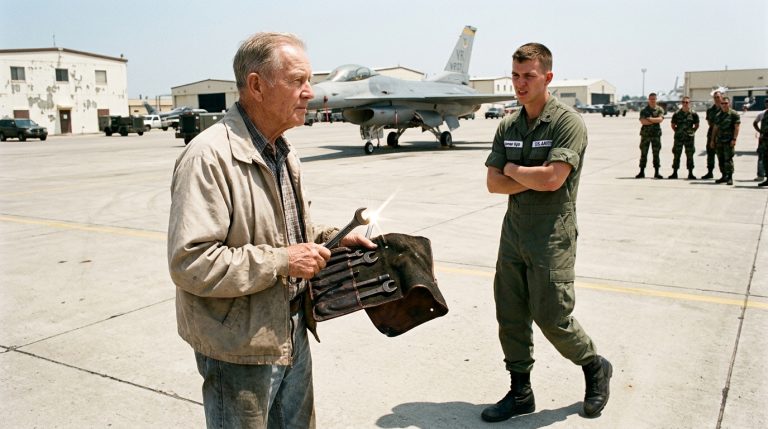
Lieutenant Marcus Miller stood with his hip cocked against a stack of reinforced crates, his arms folded. He was the apex of his unit, a man who measured his life in performance metrics and ribbon racks. Before him stood an intruder—at least, that was how Miller’s brain categorized him. The man was eighty-two, a slight figure clad in a simple royal blue polo shirt that looked like a faded echo of a much brighter day. His slacks were beige, his skin the texture of dry parchment, and he held a weathered baseball cap in his hands, his thumbs tracing the brim in a rhythm as steady as a ticking clock.
“Did you get lost on the way to the bingo hall, old-timer?” Miller asked. His voice was a casual, jagged blade, designed to slice through the man’s composure.
The man didn’t flinch. He didn’t even look up. He remained still, his eyes fixed on the empty intake counter where a clerk had vanished moments before. The silence that followed was not the silence of submission; it was the silence of a deep pool that refused to be disturbed by a stone.
Miller pushed off the crate, his combat boots heavy on the packed dirt. He stepped into the man’s personal space—a territory governed by military discipline and unspoken threats. “I asked you a question. You’re in a restricted zone. You don’t belong here.”
The man finally looked up. Behind thick, round glasses, his eyes were a pale, watery blue, reflecting the harsh fluorescent light of the tent without absorbing it. There was no fear there, no flicker of annoyance. Just a profound, bottomless patience. It was the kind of gaze that had likely stared down the horizon of a storm and refused to blink.
“I am waiting for the quartermaster,” the man said. His voice was raspy, a dry whisper that scraped against the humid air like leaves on concrete, yet it traveled perfectly, undiluted by the surrounding tension.
Miller let out a sharp, dismissive bark of laughter, glancing back at his squadmates. A few of them chuckled—a nervous, compliant sound—but the atmosphere was beginning to curdle. “Chief Henderson is busy with operators. He’s not here for museum tours.”
The man turned his attention back to the counter, entirely unfazed. He placed a small, folded piece of paper on the metal surface. The dismissiveness stung Miller more than a direct insult would have. It felt like being ghosted by a ghost. He stepped closer, leaning an elbow on the counter to block the man’s line of sight, his morale patch—a skull and crossbones—staring back at the old man.
“I’m trying to help you, Pop,” Miller said, his voice dropping to a low, cold warning. “Before the MPs come and haul you off for trespassing. Which war were you even in? Korea? Did you lose your tour bus?”
The man remained frozen. His gaze drifted to the skull patch on Miller’s shoulder, lingered for a fraction of a second, and then shifted back to the empty space behind the counter.
“I was in the one that let you stand here and talk like that,” the man said softly.
The laughter in the room died instantly. It was not a boast. It was as plain as the fact that water is wet. Miller felt his jaw tighten, a flash of red heat blooming beneath his skin. He stood to his full height, towering over the stranger.
“Watch your tone,” Miller growled, reaching out to grip the man’s bicep. “You might have served in the past, but you’re talking to a Navy SEAL. You show respect.”
As Miller’s hand tightened, he felt the man’s muscles—surprising, dense, and unnervingly still. And then, he saw it. The man reached into his breast pocket with agonizing slowness, pulling out a worn, leather wallet. Inside lay a single, laminated card, typed on an old machine. As the man slid it onto the metal surface, his eyes flickered toward the back of the tent, where the petty officer had finally emerged—his face white, his hands trembling as he stared at the red, blinking screen of the supply terminal.
“Lieutenant,” the clerk whispered, his voice cracking. “Stop. You don’t understand what you’re doing.”
CHAPTER 2: The Red Light Lockdown
The petty officer’s finger hovered over the supply terminal, his knuckle white against the dull gray plastic. The monitor didn’t just display text; it cast a rhythmic, hypnotic red glow over the workstation, painting the clerk’s face in the colors of an emergency.
“Lieutenant,” the clerk repeated, his voice thin, stretched to the breaking point by the absurdity of the situation. “You don’t understand. The system—it’s locked.”
Miller didn’t move. His hand was still on Philip’s arm, his grip tightened by the sheer, stubborn refusal of his own ego to acknowledge the glitch. He was a Navy SEAL. He commanded terrain, people, and outcomes. He did not take orders from a flickering piece of junk hardware or a frightened junior enlistee. “It’s a system error, Petty Officer. Reset the terminal. Now.”
“I can’t,” the clerk breathed, his eyes darting from the screen to Miller, and finally to the old man in the royal blue polo. “It’s a legacy flag, sir. The Z4 protocol. It’s hard-coded at the command level. It’s not just an error—it’s a containment notification.”
The tent had gone unnaturally quiet. The industrial fans continued their low-frequency hum, but the ambient chatter of the other SEALs had vanished. Miller felt the weight of twenty pairs of eyes drilling into his back. His authority, once a solid, comforting armor, felt suddenly porous, like it was being eaten away by the silent patience of the man he was holding.
Philip Weston hadn’t moved. He didn’t look at the screen. He didn’t look at the clerk. He simply stood there, his gaze fixed on the small, wax-wrapped box the clerk had been holding before the panic erupted. It was a curious, tender expression—the look of a man reuniting with a part of himself that had been buried in the mud decades ago.
“Containment?” Miller scoffed, though the word felt heavy, like lead in his mouth. He looked down at Philip, trying to find a tremor of fear, a tell, a drop of sweat. He found nothing. “What are you hiding, old man? Who are you?”
Philip shifted his weight, his old joints clicking with a sharp, dry sound that seemed to cut through the hum of the tent. He looked at Miller, not with defiance, but with a weary, profound pity. “I am just a man who came for his property, Lieutenant. You’ve turned this into a tragedy of your own making.”
Miller’s grip on the old man’s arm faltered. It wasn’t a conscious decision; it was the realization that he was applying force to something that wasn’t there. Philip was as immovable as a mountain, not because he was physically superior, but because he was entirely untethered from the petty reality Miller occupied.
“I’m calling the Master-at-Arms,” Miller said, reaching for his radio, his voice bordering on a shout to mask the rising tide of doubt. “Security, this is Miller, logistics tent 4. We have a—”
“Lieutenant, stop,” the clerk interrupted, his voice dropping to a desperate hiss. He was looking at his own monitor, his fingers flying across the keys in a frantic, uncoordinated rhythm. “The alert just escalated. It’s not just the watch commander anymore. The signal has reached command headquarters. It’s logged as a Priority One event.”
Miller froze, his hand half-submerged in his tactical vest, hovering over his comms unit. Priority One. That was a designation for structural failures, terrorist incursions, or the arrival of dignitaries who had the power to make careers vanish with a single phone call. He looked at the clerk, really looked at him, and saw the absolute, unvarnished terror in the boy’s eyes. This wasn’t a game.
“Who,” Miller whispered, the question meant only for himself, “is this?”
Philip reached out, his hand moving with a grace that felt ancient and practiced. He adjusted his royal blue collar, his movements slow, deliberate, and entirely unbothered by the chaos he had inadvertently sparked.
“The clerk is right, Lieutenant,” Philip said, his raspy voice cutting through the tension. “You really should put that radio down. You’re about to have a very uncomfortable conversation, and I’d hate for you to be holding a piece of plastic when it happens.”
Miller’s pulse thrummed in his ears, a frantic, rhythmic beat that synchronized with the blinking red light of the terminal. He looked at the wax-wrapped box sitting on the counter. It was just a box. Just paper. But in the silence of the tent, it seemed to vibrate with a history he didn’t understand.
He was standing on the precipice of a revelation, and for the first time in his career, he realized he wasn’t the one in control of the fall. He looked at the door of the tent. The base, which had been a familiar, manageable world just ten minutes ago, now felt alien. And in the center of that uncertainty, the man in the blue shirt remained the only fixed point in the universe, waiting for the storm he knew was coming.
CHAPTER 3: The Arrival of the Storm
The crash of the double flaps sounded like a gunshot in the confined space of the logistics tent. The sound brought the entire room into a singular, agonizing alignment. Lieutenant Marcus Miller, his hand still frozen near his comms unit, felt the blood drain from his face as the heavy, steady tread of leather-soled shoes approached.
It was not the sound of the Shore Patrol. It was the rhythm of a man who commanded the very ground he walked upon.
Behind the sergeant major, whose face was a mask of rigid, professional stone, walked Admiral Vance. The two-star rank on his collar glinted in the harsh, flickering fluorescent lights, turning the metallic stars into sharp, piercing points. The air in the tent seemed to drop ten degrees, the heat of the humid afternoon replaced by the thin, glacial chill of absolute discipline.
Miller felt his breath hitch. He turned, his movements jerky and mechanical, and began the process of snapping to attention. His eyes flickered to the petty officer, who was currently pressed into the corner of the workstation as if trying to merge with the cold metal of the equipment racks. The terminal screen was still pulsing that damning, rhythmic red.
The Admiral didn’t look at Miller. He didn’t look at the sergeant major, or the stunned, motionless SEALs who had been laughing just moments ago. Vance’s entire focus was directed toward the center of the room, toward the man in the faded royal blue polo shirt.
“Unhand that man immediately.”
The Admiral’s voice was not a shout. It was a low, resonant command that carried the weight of a freight train. It was the voice of a man who dealt in the currency of command, and it was currently being spent with absolute, terrifying precision.
Miller’s hand, still gripping Philip’s bicep, went numb. He released the old man as if he had touched a live high-voltage wire. He spun to face the Admiral, his hand whipping up into a salute so rigid it bordered on painful. “Admiral, sir! This civilian was trespassing—he refused to identify!”
Vance didn’t answer. He didn’t even acknowledge the salute. He moved past Miller with the focused intent of a predator, his stride long and deliberate. The silence that followed was total. Even the industrial fans seemed to hold their breath.
Philip stood in the center of the tent, his posture entirely unchanged. He didn’t hunch, he didn’t apologize, and he didn’t look for an exit. He simply stood, his thumbs hooked casually over his thumbs, looking at the Admiral with a familiarity that was fundamentally incomprehensible to the younger men in the room.
Vance stopped three paces from Philip. The Admiral, a man known for his booming presence and sharp, uncompromising temper, suddenly softened. He brought his heels together, his back straightening into a line of perfection. He raised his hand in a salute.
It was not the salute given to a superior officer. It was the slow, profound gesture of a man paying homage to a monument.
“Master Chief,” Vance said, his voice thick, stripped of all official pretense. “I apologize for the delay. And for the circumstances.”
Miller, still standing at a rigid, trembling salute, felt his reality fracture. Master Chief? He looked at the old man, desperately trying to map the title onto the faded polo shirt and the beige slacks. The pieces didn’t fit. Nothing fit. The man was a ghost of a different era, and yet, here he was, being treated with a reverence that Miller—with all his ribbons, his training, and his lethal expertise—had never received in his entire life.
“At ease, Admiral,” Philip said. The raspy, dry-leaf voice had taken on a new authority, one that didn’t need to be loud to dominate the space.
Vance dropped his salute and turned, his face slowly hardening as his gaze landed on Miller. The transition was so abrupt it was dizzying. The warmth he had shown Philip was extinguished, replaced by a cold, clinical disdain that made Miller feel like he was being dissected by a scalpel.
“Lieutenant Miller,” Vance said, his voice dropping an octave, turning into the sound of grinding stones. “Do you know who this is?”
Miller’s throat felt as dry as sand. He tried to speak, but the words caught. “No, sir. He had an expired ID. I—I was just following the standard security protocol for unauthorized personnel in a restricted zone.”
Vance took a single step toward Miller, closing the distance until their faces were inches apart. The Admiral’s eyes were narrow, icy, and devoid of mercy. “You don’t know who this is, and yet you presumed to judge him? You saw an old man in a blue shirt, and you saw a target for your own insecurities. You took a man who has operated in the darkest corners of this world—a man whose very existence was a classified necessity—and you tried to bully him.”
Miller’s head bowed, not by choice, but because the weight of the moment was simply too heavy to remain upright. He could hear the shallow, terrified breathing of the petty officer behind him. He could feel the eyes of his own men, the ones he was supposed to lead, watching his disintegration in real-time.
“Master Chief Philip Weston,” Vance announced, his voice carrying to every corner of the tent, ensuring that no one would ever forget the name. “He didn’t tell you where he served because the places he served didn’t have names on the maps when he was there. He founded the very selection course you think makes you a god.”
Vance pointed toward the wax-wrapped box on the counter. “He is here for a replacement. A simple, mechanical tool. And because of your ignorance, your arrogance, and your complete lack of the most basic tenet of our brotherhood, you have turned his visit into a spectacle of your own shame.”
Miller stood in the center of the storm, stripped bare. The silence was no longer heavy; it was suffocating. He realized then that he had spent his entire career climbing a ladder of his own design, never realizing that men like Philip Weston had built the structure he was standing on.
CHAPTER 4: The Weight of the Aftermath
Lieutenant Marcus Miller walked down the long, industrial corridor of the command headquarters. The air here was different—chilled, filtered, and devoid of the chaotic, dusty energy of the supply tent. It smelled of floor wax and ozone. Every footfall felt unnaturally loud, a rhythmic clack-clack-clack that measured the distance between his old identity and the hollowed-out shell he felt like now.
His hand drifted toward his chest, fingers brushing the fabric where his trident pin sat. It felt foreign, a piece of metal he hadn’t truly earned today. He had spent his career polishing the armor of his status, ensuring every detail was sharp, every move calculated, every interaction a display of dominance. But in the quiet reflection of the polished corridor windows, he saw a man who looked like an imposter.
He remembered his own promotion ceremony—the bright sun, the clapping of his peers, the feeling of invincibility as the pin was pressed into his skin. He had thought that was the apex. Today, he realized it was only the beginning of a long, slow decay of the self. The arrogance he had wielded like a weapon had been shattered not by violence, but by a simple, quiet observation from an eighty-two-year-old man in a royal blue polo.
“The uniform fits. The training is there. But the man inside, the man needs work.”
The words were an intrusive thought, a phantom whispering in the back of his mind. He tried to suppress it, to return to the tactical focus that usually guided him, but the internal logic of the day had been fundamentally altered. Every shadow in the corridor seemed to hold the weight of Master Chief Weston’s gaze.
Miller reached the hatch leading to the outer admin block. He paused, his hand hovering over the lever. He didn’t want to go back out there, back into the world where his team was waiting—the men who looked up to him, who trusted his judgment, who mirrored his aggression because they thought it was the hallmark of a leader. How could he look them in the eye, knowing he had been stripped of his status by a man who didn’t even bother to raise his voice?
He forced himself through the hatch, stepping out into the late afternoon heat. The base was in full swing, the sound of machinery and distant laughter floating on the breeze. He walked past the supply tent—the scene of the crime. It looked ordinary now. No red lights. No standoff. Just a canvas tent housing inventory.
He stopped, his gaze lingering on the spot where Philip had stood. It felt like he was looking at the site of an impact, a crater left by something immense that had passed through the earth and moved on, leaving only the displaced dirt behind. The petty officer was there, moving crates with a rhythmic, somber efficiency, his face set in a mask of grim duty. Miller could have approached him, could have offered a word of apology, but he knew the clerk wouldn’t understand. The clerk wasn’t looking at Miller; he was looking at the floor, lost in the same silence that had consumed the room earlier.
Miller continued walking, his pace measured. He had nowhere to go, no mission to fulfill, no door to kick down. For the first time in years, he was simply existing, stripped of the mission-oriented tunnel vision that had fueled his ascent.
He reached the barracks but bypassed the front entrance, finding himself on a secluded bench near the edge of the training grounds. The grass was scorched and dry, the smell of dust and sun-baked earth filling his lungs. It was a place of preparation, a place where he had spent hundreds of hours honing the edge of his team’s lethality.
He sat down, his hands resting on his knees. He looked out over the obstacle course, a collection of rusted steel and weathered timber. It looked archaic. He thought of Philip, the man who had written the manual on this kind of endurance, and he realized with a sudden, sinking dread that he hadn’t been fighting a war at all. He had been playing at one, a performance piece designed to satisfy his own need to be the hero of the story.
The sun began to dip toward the horizon, casting long, sharp shadows across the training grounds. Miller sat until the light turned the world into a series of stark contrasts—gold and gray. He thought about the Admiral’s office, the 0800 meeting, the disciplinary review. He should be rehearsing his excuses, planning his defense, preparing to save his reputation.
But as he stared into the gathering dark, he realized he didn’t care about the reputation anymore. He cared about the silence. He cared about the weight of the blue shirt. He cared about the fact that there were people like Philip Weston who lived their lives in the shadows, unacknowledged and unconcerned with the glory that Miller had chased with such blind intensity.
He stood up, his legs feeling heavy, and began the slow walk back toward his quarters. He was no longer a predator on the prowl. He was a man with a long night of reflection ahead, and for the first time in his life, he didn’t know what the mission was.