When Three Abandoned Boys Returned Twenty Years Later As Billionaires, They Didn’t Just Save Their Foster Mother, They Humbled An Entire Town
CHAPTER 1: THE GARDEN GATE
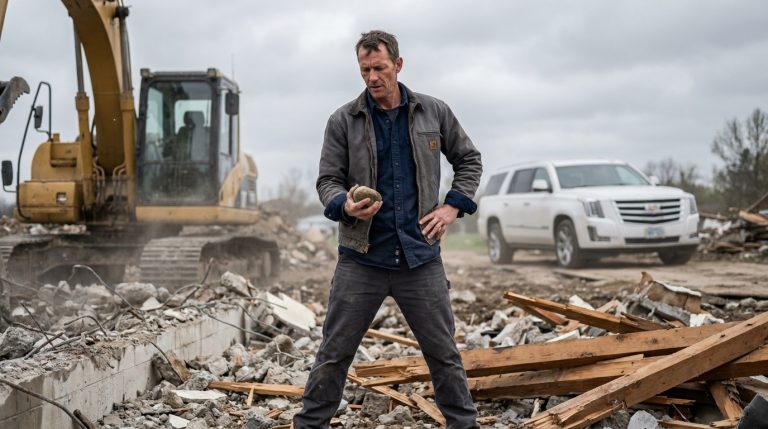
Beatrice’s fingers were caked in dry Georgia dirt around the stem of a prize tomato plant.
The vibration through the floorboards of the truck tires on gravel did not match the local mail carrier or the high school pickup trucks.
She did not wipe her hands on her apron.
She simply stood up, her knees popping with the sharp, familiar ache of sixty-five years of hard floors and heavy lifting.
The three black SUVs idled in a tight, disciplined formation right where her front gate used to hang before the hinges rusted through.
The middle vehicle’s door swung open with a muffled, expensive thud.
A man stepped out into the bright spring sunlight, broad-shouldered and sharp-suited, wearing the exact same stubborn set of the jaw she had stared down across a courtroom two decades ago.
James did not look like a boy anymore.
Behind him, two more doors clicked open, revealing the heavy, military posture of Daniel and the quiet, observant gaze of Thomas behind thin wire-rimmed glasses.
The watering hose slipped from Beatrice’s numb fingers, spilling cold water across the dry soil between her boots.
Her breath caught, tight and shallow in her throat, refusing to move past the sudden lump of raw disbelief.
James didn’t wait for permission or protocol.
He crossed the weed-strewn lawn in long, measured strides, his eyes locked entirely on hers with an intensity that burned right through the years of exhaustion.
When he reached the garden edge, he stopped, his chest rising once beneath his grey wool vest.
“Mama B,” James whispered, his voice cracking flatly across the quiet yard.
Beatrice tried to speak, but her vocal cords felt rusted shut, choked by twenty years of nighttime prayers whispered into an empty house.
She took one stumbling step forward through the tomato vines.
Daniel was already moving, his heavy shoulders shaking as he closed the distance, while Thomas followed close behind with slow, deliberate steps, clutching his hands tight at his sides.
James reached her first, his arms coming around her shoulders with a crushing, fierce grip that drove the remaining air straight out of her lungs.
He buried his face against her neck, trembling with the exact same raw desperation he had carried the day the state van took him away.
Beatrice’s hands flew up to clutch the fabric of his expensive jacket, her fingernails digging deep into the wool as the tears finally broke free, hot and blinding down her weathered cheeks.
“You came back,” she gasped out against his collar, the words tearing through her throat.
“We promised,” James answered, his voice thick and breaking against her ear. “We always kept our promises.”
Daniel wrapped his arms around both of them from the side, his face pressed heavily into Beatrice’s shoulder, sobbing without a single ounce of shame or pride.
Thomas stepped in close, his hand reaching out to touch the sleeve of her faded cotton dress just to make sure she was real.
The afternoon wind swept through the old oak tree above them, dropping dry leaves onto their heads while the rest of Hadley Springs watched from behind closed curtains.
CHAPTER 2: THE EMPTY KITCHEN
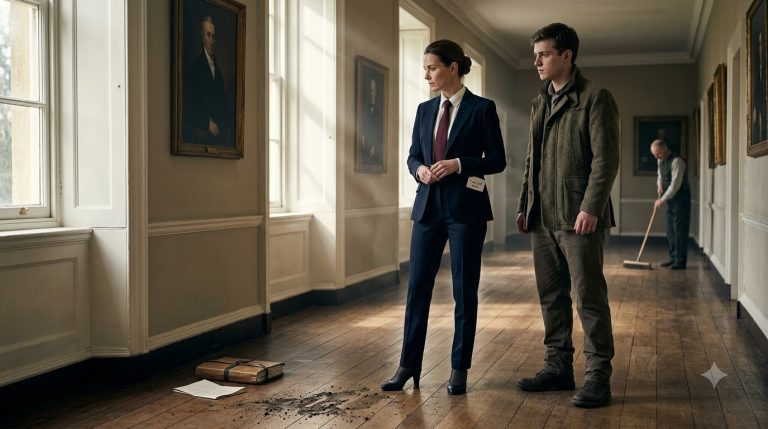
James stepped across the threshold first, his heavy boots echoing against the warped pine floorboards that had not seen a coat of varnish in a decade.
The three men moved through the cramped living room not with the swagger of strangers, but with the quiet, haunted reverence of ghosts returning to a grave.
Daniel stopped beside the mantelpiece, his hand hovering just inches from the small wooden plaque carved by Beatrice’s grandmother.
The carved letters read the same as they had twenty years ago, worn smooth by dust and time.
“You still have the table,” Daniel muttered, his gaze dropping to the scarred wooden surface in the kitchen where they used to shovel down green beans and fried chicken.
“I never threw anything away that mattered,” Beatrice answered, her voice trembling slightly as she closed the front door to shut out the curious gaze of the neighborhood.
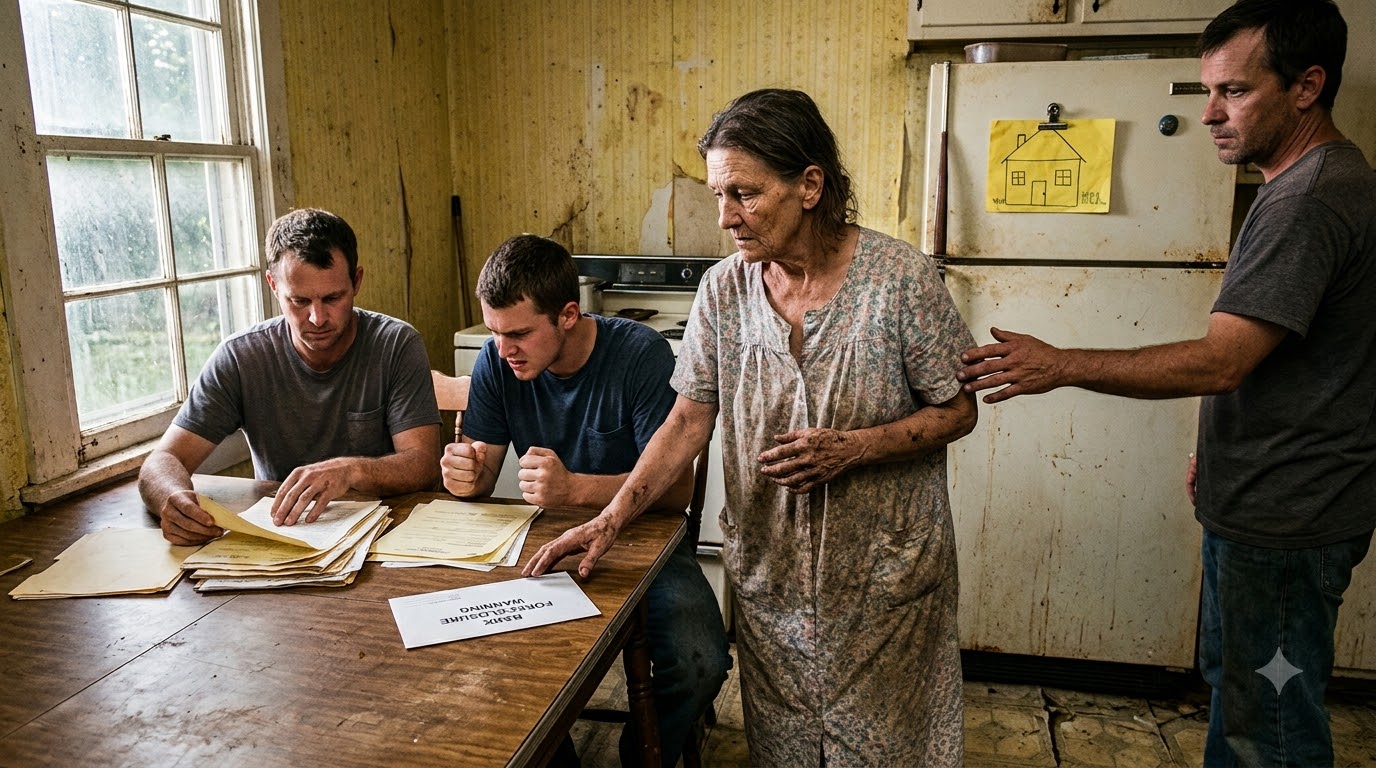
Thomas walked straight to the refrigerator, his fingers brushing against the faded, yellowed drawing of a house with a yellow roof held up by a single magnetized clip.
His chest hitched once, a silent, sharp intake of air that he swallowed down with a hard swallow.
“You left it right where I put it,” Thomas said, his voice dropping to a low, rough murmur.
“Every single day,” Beatrice replied, stepping into the kitchen to stand beside him. “Even when the walls started leaking and the county sent the notices.”
James turned sharply from the window, his eyes narrowing as he spotted a white legal envelope sitting face down near the flour canister.
He didn’t ask what it was.
He didn’t need to.
The bold red lettering of the bank’s final foreclosure warning was visible even upside down.
“Thirty days,” James said, his jaw tightening into a hard, rigid line that mirrored the expression he wore the day Harold Whitfield’s limousine pulled away.
“Seven days,” Beatrice corrected gently, her hand reaching out to touch his arm. “The bank gave me until next Friday before the sheriff posts the notice.”
Daniel spun around from the mantel, his fists clenching so hard the knuckles turned stark white under the kitchen light.
“They waited until you were alone,” Daniel growled, his voice dropping an octave as the old anger surged back up behind his ribs. “They sat back and watched you lose everything we built here.”
“They didn’t just watch, Daniel,” Thomas said quietly, lifting the white envelope off the counter without asking permission. “They signed off on it. Every single tax lien, every delayed grant, every denied permit for twenty years.”
Beatrice froze, her breath catching in her throat as she looked from Thomas to James.
“What are you talking about?” she asked.
James stepped forward, pulling a folded stack of yellowed municipal records from inside his jacket pocket and laying them flat on the kitchen table.
“We didn’t just spend four years finding you, Mama B,” James said, his eyes burning with a cold, terrifying clarity. “We spent four years investigating the people who broke this town.”
CHAPTER 3: THE TOWN SQUARE
James pressed a broad, calloused thumb against the edge of a yellowed zoning map dated from the winter of twenty years ago.
“They didn’t just misplace your grant applications, Mama B,” James said, his voice dropping into a cold, flat cadence. “They logged them into a rejected queue and flagged your parcel for expedited tax seizure the week after we were taken.”
Beatrice stared down at the black-and-ink signatures stamped at the bottom of the county file.
The name at the bottom of the clearance order belonged to the town clerk, backed by the initial approval of the municipal oversight board.
“Edna Cartwright,” Beatrice murmured, recognizing the familiar loop of the handwriting instantly.
“And Sheriff Dawson signed off on the code enforcement citations for your leaking roof while the county roads stayed frozen over,” Daniel added, his jaw ticking as he leaned over the table.
Beatrice’s chest tightened, a familiar wave of exhaustion washing over her tired frame.
She had spent twenty years blaming bad luck, poor timing, and her own empty pockets for the slow strangulation of her home.
“They wanted this land cleared,” Thomas said, adjusting his glasses with a sharp click against the bridge of his nose. “And they used the system to do it piece by piece.”
James folded the municipal documents back into a precise square and slid them off the table.
“Pack a light bag, Mama B,” James said, his eyes locking onto hers with absolute, immovable resolve. “We’re going down to the town square.”
Within twenty minutes, the black SUVs rolled out of the driveway and parked directly in front of the Hadley Springs municipal building.
The town square was already buzzing with curious neighbors peering out from shop windows and bakery counters.
Eighty-odd people had gathered around the wooden bandstand where local notices were traditionally posted on Friday afternoons.
Beatrice walked up the wooden steps of the stage with her head held high, supported gently by James on her left and Daniel on her right.
The murmurs rippled through the crowd instantly, shifting from low whispers to stunned, uncomfortable silence.
James stepped up to the rusted metal microphone stand, his broad shoulders blocking out the spring sun.
“Twenty years ago,” James’s voice boomed across the square, steady and uncompromising, “three orphaned boys stood on this exact street with nowhere to go and nobody willing to look us in the eye.”
The crowd shifted uneasily, several older residents instinctively looking down at their shoes.
“This town turned its back on the only person who opened her door,” James continued, his gaze sweeping slowly over the gathered faces. “And for twenty years, you watched her struggle, you listened to the rumors, and you helped the county write the rules to push her out.”
CHAPTER 4: KNEELING IN THE DUST
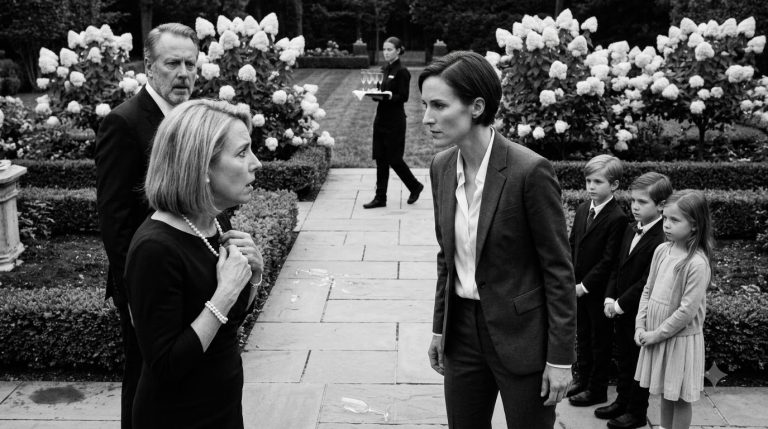
Edna Cartwright shifted her weight against the front edge of the grocery store porch across the square, her knuckles whitening where she gripped her walking cane.
The afternoon air felt heavy, stripped of the casual gossip that usually filled the lunch hour in Hadley Springs.
James did not lower his gaze from the front row where the town council members stood shoulder to shoulder.
“For twenty years, this community chose convenience over conscience,” James said, his voice cutting through the open air like a dry wind. “You let the paperwork pile up on her desk while you closed your eyes to the truth.”
Beatrice stood quietly beside Daniel on the wooden platform, her hands folded over the simple cotton fabric of her skirt.
She felt no surge of triumph, only a deep, weary ache as she watched the faces of neighbors she had baked for, cleaned for, and prayed for through decades of quiet isolation.
From the edge of the assembly, Edna pushed her way forward through the crowd, her breath coming in shallow, ragged gasps.
The eighty-eight-year-old woman leaned heavily on her polished wood cane, her frail frame trembling under the collective stare of eight hundred residents.
Edna reached the base of the wooden stage stairs and stopped, her wrinkled chin quivering as she looked directly up at Beatrice.
“Beatrice,” Edna’s voice cracked, thin and brittle against the quiet afternoon. “I was wrong.”
Nobody moved.
The town council members behind Edna shifted uncomfortably, avoiding eye contact as the old woman let go of her cane entirely.
Edna dropped straight to her knees in the dusty gravel at the foot of the stairs, her hands pressing flat against the earth.
“Everything I said,” Edna sobbed, her shoulders shaking beneath her floral cardigan. “Everything I signed to push you out… I was wrong. Can you ever forgive me?”
Beatrice looked down at the woman who had orchestrated her firing, spread rumors during her cancer treatments, and signed every code enforcement lien meant to break her home.
The silence stretched long and tense across the square, every eye locked on the platform waiting for the verdict.
Beatrice didn’t hesitate or look to her sons for permission.
She stepped down the wooden stairs one slow, deliberate step at a time until she stood right beside the kneeling woman.
“I forgave you a long time ago, Edna,” Beatrice said softly, her voice carrying clear and steady across the clearing. “Holding on to anger only hurts the one holding it.”
Beatrice reached down with both hands, grabbed Edna’s trembling forearms, and hoisted the old woman straight up to her feet.
Edna buried her face against Beatrice’s shoulder, weeping openly as the rigid wall of community pride finally cracked open.
Across the square, a single neighbor started clapping, hesitant at first, before the sound swelled into a roaring wave that filled the entire valley.
CHAPTER 5: THE NEW FOUNDATION
James stepped back from the microphone as the wave of public reconciliation finally crested and settled into a heavy, contemplative stillness across the asphalt.
The county commissioners standing near the back row did not look at one another; they kept their eyes fixed straight ahead on the wooden platform where the past twenty years of local history had just been rewritten.
Thomas opened his leather briefcase on the podium, pulling out a thick set of legal charters bearing the embossed seal of the state.
“The Beatrice Owens Foundation is officially chartered as of this morning,” Thomas announced, his voice carrying a calm, unshakeable authority that demanded absolute attention.
“We are allocating twenty million to rebuild fifty homes in this county—starting with the families who need new roofs and plumbing the most.”
Daniel stepped up beside his younger brother, resting his hands casually on the edge of the wood.
“That includes the people who spent decades trying to push our mother out,” Daniel added, his tone hard around the edges but stripped of malice. “Because in this house, nobody gets left behind in the cold.”
Beatrice stood quietly near the center of the stage, her fingers tracing the worn edge of the leather notebook tucked safely beneath her arm.
She looked out over the sea of familiar faces—the grocers, the mechanics, the churchgoers—all staring back with the humbled realization of what true community actually cost.
The foundation offices would break ground on the empty lot beside the courthouse by Monday morning, replacing decades of closed doors with open doors and permanent resources.
James caught her eye from across the platform and offered a quiet, reassuring nod that told her everything was locked into place.
They weren’t just fixing a house or paying off a bank debt; they were permanently rewriting the conscience of Hadley Springs.
CHAPTER 6: THE FINAL KNOCK
Beatrice stood on her wrap-around porch, her fingers resting lightly on the varnished wood of the rocking chair her grandmother built.
The sound of gravel crunching under a car tire drifted up from the lane, steady and slow, unlike the heavy roar of the black SUVs that had arrived a year ago.
James pushed baby B on the porch swing just around the corner, his laughter blending softly with the afternoon bird song.
Daniel was firing up the grill down in the yard, while Thomas sat on the lower steps with his notebook open across his knees, drafting a new bill for the state legislature.
The old blue sedan pulled up beside the fence and stopped.
Carolyn Mitchell stepped out from the driver’s side, her retired caseworker jacket zipped against the crisp air, holding the hand of a seven-year-old girl with wide, frightened eyes and a torn canvas backpack.
Beatrice didn’t wait for Carolyn to call out or climb the steps.
She walked straight down the weathered wooden stairs, her knees feeling strong and steady beneath her cotton skirt, and knelt right there in the fresh green grass.
“Hey, sweetheart,” Beatrice said softly, her voice warm and clear as she met the child’s gaze levelly. “I’m Miss B. And this is your home now.”
The little girl stared at her for a long, quiet second, searching the lines of Beatrice’s face for any sign of hesitation or doubt.
Finding none, the child’s small fingers uncurled from her backpack strap and slipped entirely into Beatrice’s palm.
Beatrice stood up, holding the little girl’s hand securely in hers, and turned back toward the house where her family waited on the porch.
The roof overhead was solid, the debt was gone, and the empty rooms were filled with life.
Some things never change, and some things never should.