The Architect’s Vengeance: How a Governor Dismantled a Tyrant and Rebuilt a Legacy from the Rubble
CHAPTER 1: THE HOUR OF DUST
The crunch of gravel beneath my boots was the only sound for miles. It was a rhythmic, biting noise—the sound of destruction being ground into the earth. I stopped near the edge of what used to be the master bedroom. A single beam of reclaimed cedar lay shattered across the foundation, the wood splintered in a way that exposed the raw, pale interior. I reached down, my fingers brushing the grain. It still smelled of Montana summers, a faint, ghost-like trace of the woman who had spent months hunting for this specific texture.
Now, it was just debris.
The excavator sat idling at the gate, a yellow monster painted with grease and apathy. Its operator didn’t look at me. He didn’t have to. He was just a tool in Vivien Pritchard’s hand, a mechanical extension of a woman who measured life in square footage and paint codes. I stood in the shadow of the structure’s remaining frame, the wind catching the jagged edges of a broken glass panel. It sang a high, mournful note—a funeral dirge for a life she had tried to build.
My pocket hummed. The phone was hot against my leg, an anchor of electronic reality in a place that felt like a crime scene. I didn’t look at the screen. I knew who it was. The lawyers, the staff, the panicked voice of a chief of staff who still hadn’t realized that the rules of the game had fundamentally shifted.
I looked down at the ground. There, half-buried in the churned earth of the driveway, was a small, smooth stone. It was a river rock—one of the thousands I had personally placed in the fireplace hearth six years ago. It was cool, damp, and perfectly solid.
I picked it up. The weight of it was grounding.
I didn’t feel the sudden surge of rage that people expected from a grieving widower. I felt a cold, crystalline focus. Vivien had been playing with the arrogance of someone who thought she was the only one with leverage. She thought she was correcting a neighborhood nuisance. She didn’t realize that by destroying the house, she had cleared the landscape of every barrier between me and the truth.
I turned back to the ruins. I needed to see the safe. If Elaine had left the plans, she would have left the records. Vivien had taken the wood and the glass, but she hadn’t taken the paper. And in this world, paper was the only currency that mattered.
A movement caught my eye at the gate. A white Cadillac Escalade, polished to a mirror finish, glinted in the morning sun. It didn’t pull into the driveway. It simply hovered there, watching. I didn’t wave. I just tightened my grip on the river rock, feeling the sharp edges of my resolve solidify.
The game had started. And for the first time in six years, I wasn’t just a judge, and I wasn’t just a widower. I was the architect of the endgame.
CHAPTER 2: THE PAPER VAULT
The Escalade didn’t move. It sat at the edge of the access road like a vulture waiting for the carcass to stop twitching. I didn’t give it the satisfaction of a glance. Instead, I turned back toward the house—or what was left of it. The master bedroom had been the first to fall, the exterior wall peeled back like the skin of a fruit to expose the contents of the walk-in closet.
Vivien’s bulldozer had been efficient, but it lacked the nuance to search for secrets.
I waded through the pulverized drywall, my boots kicking up clouds of chalky dust that tasted like old mortar and failed promises. I moved toward the center of the debris field. Elaine had been an architect; she understood that every foundation needs a core, and every core needs a vault. We hadn’t buried the safe in the floorboards; we’d encased it in a reinforced concrete pillar that had been designed to survive everything from seismic shifts to direct impacts.
The pillar was still there, jagged and lonely, stripped of its cedar cladding.
I set the river rock down and knelt, pulling a small, folding shovel from my tool belt—a habit of utility I’d never been able to break. The ground around the base was soft, turned over by the heavy treads of the demolition equipment. It took twenty minutes of rhythmic, agonizing digging before my shovel clanged against cold, fireproof steel.
My breath hitched. The metallic ring vibrated up my arm, a sharp contrast to the soft, heavy silence of the mountain morning. I cleared the remaining debris, revealing the dial.
12-08-19.
The day we’d signed the final plans. I spun the dial. The tumblers fell into place with a mechanical precision that felt like a heartbeat in the silence. The bolt slid back with a heavy, satisfying thud.
I opened the door. Inside, shielded from the crushing weight of the house above, lay the life we had planned. A portfolio of blueprints, crisp and white, sat beneath a stack of leather-bound journals. But beneath those, secured in a waterproof pouch, were the files I had hidden away during the final months of my judgeship—the receipts for every fine, the canceled checks, and the scathing, bureaucratic emails where the architectural committee had signed off on the very things Vivien later claimed were violations.
As I touched the edge of the paper, a memory flooded back—unbidden and intrusive. I saw Elaine’s hand, thin and tremulous, moving a graphite pencil across a sheet of vellum. She hadn’t been drawing a house; she’d been drawing a cage for her dreams. She had known, in those final weeks, that the world would try to tear this down. She hadn’t built a mansion; she’d built an archive.
I felt a phantom pressure in my chest, a sharpness that matched the jagged rebar looming above me. It wasn’t grief. It was the sudden, cold realization that she had suspected Vivien’s nature long before the first fine was even issued. She had been protecting me from the start.
I tucked the documents into my internal jacket pocket, zipping it tight against the elements. The safe was a shell now, empty and useless.
I stood, the blood rushing to my head. When I looked toward the gate, the Cadillac was gone. It hadn’t left because the job was done; it had left because it had seen what it needed to see: a man standing in the wreckage of his own life, silent, still, and entirely focused.
I didn’t head for the road. I headed for the tree line where my truck was parked. I had a three-hour drive to the capital, and a list of names to call. I didn’t need a courtroom to win this. I needed a mirror, and I was going to force Vivien Pritchard to look at the reflection of her own theft until she couldn’t stand the sight of it anymore.
The air on the mountain was turning, the breeze picking up, carrying the scent of impending rain. The dust on my clothes felt heavy, like a shroud. I stepped into my truck, the engine turning over with a steady, deep rumble that promised motion. Every mile back to the city was a mile closer to the dismantling. I wouldn’t rush it. I wouldn’t skip a step. I would build the case against her exactly the way I built this house—stone by stone, beam by beam, until the structure she’d built for herself—her reputation, her safety, her entire world—had nowhere left to stand.
CHAPTER 3: THE COUNTERSTRIKE
The engine of the truck died with a final, shuddering gasp, leaving me in the sudden, ringing silence of the government building’s parking garage. I sat there for a long moment, my hands still gripped at ten and two on the steering wheel. The leather was cold, slick with the dust of the construction site I had just left. I could still smell the wet pine and the sharp, metallic tang of the shattered rebar, but here, the air was filtered, recycled, and utterly devoid of history.
I stepped out onto the concrete. The sound of my heels echoed—a sharp, percussive rhythm that felt like a challenge.
Tobias Kendrick, Governor of the State. But as I walked toward the elevators, I didn’t feel like a politician. I felt like a judge preparing a final, irrevocable verdict. My jacket felt heavy against my ribs where the documents from the safe were tucked, a dense weight of paper that possessed more force than any executive order.
Upstairs, the office was already humming with the kind of forced, frenetic energy that characterized a staff in crisis. I bypassed the receptionist’s desk and pushed directly into the conference room. Tobias—my chief of staff—was there, staring at a wall of monitors. He looked up, his eyes widening as he took in my state: the dust-streaked jacket, the dirt under my fingernails, the grim, unreadable set of my jaw.
“Sir,” he started, his voice a tight knot of concern. “The news cycle is already pivoting. They’re spinning the demolition as a routine enforcement of HOA standards. They’ve got a PR firm from Denver on record saying you were a non-compliant homeowner. They’re framing this as a ‘clash of egos’ between you and the HOA president.”
I walked to the head of the table and laid the leather-bound portfolio down. It landed with a dull, heavy thud that silenced the room.
“I don’t care about their spin,” I said, my voice steady, stripped of the fatigue that clawed at my limbs. “I care about the record. Vivien Pritchard didn’t demolish my house because of a paint color, and she didn’t do it because of a driveway light. She did it because she’s been running a private treasury out of the community’s reserve funds for years.”
I opened the portfolio. The documents were stained with a bit of dust, but the ink was clear. I spread them out: the canceled checks, the architectural committee approvals, and the dated, signed overrides.
“I need you to contact Kurt Bellamy,” I said, pointing to the land-use attorney’s name on a sticky note. “And Mariana Soto. Don’t frame it as a Governor’s request. Frame it as a citizen’s demand for discovery. I want every bank statement, every vendor invoice, and every board meeting minute from Ridgemont Estates for the last decade.”
Tobias leaned in, his eyes scanning the documents. “This is… this is a mountain of evidence, sir. If this is accurate, this isn’t just an HOA dispute. This is fraud.”
“Exactly,” I replied. “And we are going to treat it as such. We aren’t going to go through the legislature, and we aren’t going to go through the media. We are going to go through the discovery process. We’re going to force them to answer these questions under oath in a civil court, where their ‘PR spin’ carries the weight of perjury.”
I looked at my hands. They were still trembling slightly from the adrenaline of the morning, but as I smoothed out the pages, the shaking stopped. I was no longer the man standing in the rubble, mourning a ghost. I was the man systematically dismantling the architecture of a lie.
“Vivien Pritchard thinks she’s protected by the walls of a community association,” I said, catching Tobias’s gaze. “She’s wrong. She’s just living in a house of cards. And today, we start the draft.”
The room was still silent, save for the low, rhythmic hum of the HVAC system. There was a shift in the air, a movement from the chaotic panic of the morning into something sharper, colder, and far more dangerous. They saw it in my eyes—the realization that I wasn’t here to plead my case. I was here to prosecute theirs. I stood there, watching them scramble, feeling the cold weight of the evidence in my hand. The mountain air was gone, replaced by the sterile smell of progress, but for the first time in years, the future felt as solid as a foundation.
CHAPTER 4: THE FALSE BOTTOM
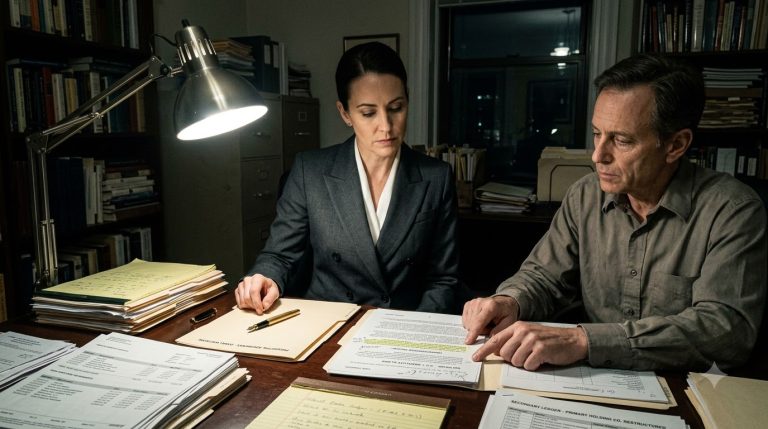
The box landed on the mahogany table with a heavy, final thud. It was dense—packed tight with years of bank statements, deposit slips, and vendor contracts. Kurt Bellamy stood opposite me, his sleeves rolled up, his eyes already tracing the familiar lines of forensic accounting. He didn’t say a word. He didn’t have to. The silence in the office was electric, filled with the promise of the first real crack in Vivien’s armor.
I reached for my letter opener, the metal cold and sharp against my palm. I slit the tape, the sound jarringly loud in the quiet room. Inside, the documents were organized with a terrifying, bureaucratic tidiness. Vivien was a tyrant, but she was a meticulous one. Or so she thought.
“Everything here is dated back eight years,” Kurt said, his voice low. He began lifting folders, stacking them in chronological order. “She’s been the president for nine, but the real rot seems to have set in around the third year. Right when she consolidated the architectural committee.”
I pulled out a stack of ledger sheets, my eyes skimming over the entries. They were boring—rows of numbers, service fees, maintenance costs. It was the kind of data that made most people’s eyes glaze over. But as I flipped to the second year of her presidency, something caught my eye. A line item for ‘Road Resurfacing—Phase 1.’
It was a staggering figure. Too high for a community of three hundred homes, even with premium materials. I pulled the corresponding invoice from the vendor folder. It was a local paving outfit I didn’t recognize.
“Kurt,” I said, my voice tight. “Look at this. The HOA paid this contractor in full, upfront. That’s not standard practice. Usually, you pay in thirds—start, progress, completion.”
Kurt moved around the table, his bifocals magnifying his sharp, appraising stare. He traced the numbers, his finger stopping on the signature line. “The invoice was signed by Vivien, but there’s no counter-signature from a board treasurer. And look at the bank routing number.”
He grabbed a magnifying glass from his briefcase, his movements efficient and practiced. “That’s not the company’s primary account. I’ve seen this before. It’s an intermediary holding account.”
My pulse quickened. The “false bottom” I’d suspected was starting to take shape. This wasn’t just mismanagement. This was a sophisticated, multi-layered siphon. She was using legitimate community maintenance projects as a funnel, redirecting the money into a secondary entity before it ever reached the actual contractors.
I set the document down and looked out the window. The city skyline was beginning to darken, the buildings turning into silhouettes against the bruising purple of the twilight sky. Vivien had played this game for years, shielded by the anonymity of homeowners who were too tired to fight and a legal system that treated HOAs as harmless little fiefdoms.
“She wasn’t just stealing the money,” I murmured, the pieces clicking together with a sickening clarity. “She was creating a debt. By paying the contractors from a holding account that she controlled, she could claim the work was funded while never actually transferring the full amount to the vendors. Then, when the contractors started coming for their money, she’d hit the homeowners with ‘special assessments’ to cover the shortfall.”
“She’s been double-dipping,” Kurt whispered, looking up. “She took the dues, then she took the assessments, and she laundered the difference through that Nevada LLC Rex identified.”
I felt a cold prickle of realization at the base of my neck. This was more than just greed. It was a strategy for survival. By keeping the HOA on the brink of financial insolvency, she kept the board in a perpetual state of fear, making them easier to manipulate. It was the perfect ecosystem for a tyrant.
“We need to find the paving contractor,” I said, my voice hardening. “If they never got paid the full amount, they’ll have a lean on the property. And if they have a lean, they’re the ones who hold the key to the clubhouse.”
I reached for my phone, my fingers hovering over the screen. I needed to move fast. If she realized I had the ledger, she’d wipe the accounts. I looked at the box of paper, the dry, sterile records of a crime that had ruined lives and destroyed dreams. I had the truth in my hands, but it wasn’t enough to just have it. I had to make sure it was bulletproof.
“Kurt,” I said, not looking away from the ledger. “Find me the head of that paving company. I don’t care if they’re retired or in hiding. I need to know exactly how much they were actually paid, and I need a statement that she personally directed them to send the invoices to the shell company.”
I stood up, the chair scraping against the floorboards. The office felt suddenly small, the air thick with the weight of what we were about to unleash. Vivien Pritchard was going to fight—that was a certainty. But she was fighting for a lie, and I was fighting for the foundation. And for the first time, I knew exactly where the first strike would land.
CHAPTER 5: THE BREACH
The drive to the mountains was a blur of high-beam lights and the relentless, driving cadence of a rainstorm that felt more like a cleansing agent than a weather event. I didn’t bother with the radio. The only sound in the cab was the rhythmic thrum of the tires on the slick pavement and the occasional ping of my phone—a continuous stream of updates from Rex Dunaway.
The construction trailer sat on a lonely stretch of land where the pines gave way to the jagged granite of the foothills. When I pulled up, the sight was jarring. The door was hanging open, swaying on a single, bent hinge that shrieked in the gale. The lock—a heavy-duty steel shackle I’d installed myself—lay on the ground, cut with surgical precision.
I didn’t wait for Rex. I stepped out, the rain instantly soaking through my blazer. The smell hit me before I reached the threshold: a sharp, aggressive, chemical stink of fresh spray paint that cut right through the earthy scent of the storm.
Inside, the work lights I’d left on were still flickering, casting long, unstable shadows across the interior. The shelving where I kept the blueprints was bare. The tool chest—Elaine’s father’s, a heavy, oak-and-steel artifact from the fifties—was gone. And on the back wall, in a shade of red that looked uncomfortably like dried blood, was the message.
“GO BACK TO THE CAPITAL.”
The paint was still wet. It dripped, running down the corrugated metal wall in slow, uneven rivulets. I stood frozen in the center of the room, my boots crunching on something gritty. I looked down. Glass. The skylight had been smashed in, the jagged shards littering the floor like diamonds in the mud.
This wasn’t a robbery. It was a message. And it was personal.
I turned around, the movement feeling sluggish, heavy. Every instinct I’d honed as a judge, every calculation I’d made as a governor, was screaming the same thing: I had pushed too hard, and the reaction had been immediate. Vivien wasn’t just hiding behind her lawyers anymore; she was lashing out. She was terrified.
“Governor?”
Rex Dunaway appeared in the doorway, his silhouette framed by the harsh, strobing light of the storm. He didn’t come in. He just stood there, his eyes scanning the space with the professional detachment of a man who’d seen this kind of desperation a dozen times before.
“They took the journal,” I said, my voice sounding flat, hollow. “The blueprints, the notes… they took the only physical record of the construction process.”
Rex stepped inside, his boots making a soft, squelching sound on the damp floor. He didn’t look at the graffiti. He looked at the floor, crouching near the spot where the tool chest had sat. “They were looking for something specific, sir. If they just wanted to vandalize the place, they would’ve smashed everything. They took the chest and the papers. They’re erasing the trail.”
“They can’t erase the records at the county assessor’s office,” I replied, though the thought offered little comfort. “Or the bank statements.”
“No,” Rex agreed, rising to his feet. “But they’re hoping to slow you down. They’re hoping you’ll see this, get angry, and make a mistake. They want you to move out of your comfort zone, to stop being the ‘Governor’ and start being the ‘victim’.”
I looked at the red paint, the drips slowing as the air cooled. The anger I’d been suppressing since the demolition suddenly flared, hot and sharp. It wasn’t the blind, destructive rage of a man who’d lost his home. It was the cold, calculated fury of a man who was now being hunted by the very people he was trying to bring to justice.
“They think they’re erasing the past,” I said, my voice barely a whisper. “They don’t realize they’ve just provided me with a motive. If they wanted me to stop, they should have left the chest alone.”
I walked toward the doorway, passing Rex. I didn’t look back at the wall. I stepped out into the rain, the cold water washing the grit of the crime scene from my hands. I had come here to retrieve the evidence of a crime, and instead, I had been handed the evidence of a confession. Vivien was panicking. And when someone like Vivien panics, they make mistakes. I just had to make sure I was close enough to catch them when they fell.
CHAPTER 6: THE DEPOSITION
The conference room was a monument to clinical, high-stakes combat. The air was pressurized, smelling of expensive air freshener and the metallic tang of printer toner. A court reporter sat in the corner, her fingers hovering over a stenotype machine like a spider on a web. Opposite me, Vivien Pritchard sat with her hands folded on the table—a terrifying study in composed, lacquered stillness. Her blonde hair was pulled back into a knot so tight it looked like it might pull her skin taut.
“Governor Kendrick,” her attorney, a man whose smile didn’t reach his eyes, offered as a greeting that felt more like a warning. “I trust we can keep this focused on the matter of the property disputes.”
“We’ll focus on the truth,” I said, my voice cutting through the sterile room like a blade. I didn’t take off my coat. I sat down, the damp fabric sticking to my shoulders, and placed the folder I’d been working on since the trailer break-in right in the center of the table.
Vivien’s gaze flickered to the folder, then snapped back to my face. She didn’t look like a terrified homeowner. She looked like a predator who had spent her entire life deciding who to eat. “You’re making a mistake, Tobias,” she said. Her voice was thin, brittle—the sound of glass about to shatter. “You’re letting a little bit of bad luck destroy a perfectly functional community.”
“Bad luck didn’t cut the lock on my trailer, Vivien,” I said, leaning forward. “And bad luck didn’t paint a threat on my wall. Let’s start with the vote.”
I opened the folder. The board minutes from last year were there, pristine and typed. “You stated for the record that the decision to demolish the property was unanimous. But I have affidavits from two board members who were out of state at the time. They were never notified. How can three people constitute a unanimous vote among five?”
Vivien didn’t blink. “They were notified. They simply chose not to participate. If they failed to check their emails, that is a failure of their diligence, not mine.”
“And the demolition company?” I pressed, sliding a new document forward. It was the invoice I’d pulled from the box—the one signed by her and paid to the holding account. “Why was the payment routed through Ridgemont Management Services instead of the contractor’s primary business account?”
The lawyer’s hand shot up. “Objection. This is outside the scope of the current—”
“It’s about the financial health of the HOA,” I interrupted, my eyes locked on Vivien’s. “If the money was diverted, the HOA is currently in breach of contract. That makes this entirely relevant.”
Vivien shifted. For the first time, the facade cracked. Her fingers drummed against the table—a rhythmic, agitated motion that betrayed the calm she was trying to project. “The management service was a temporary holding measure. We needed to ensure that funds were reserved for the project before the contractor met our strict performance standards.”
“Performance standards,” I repeated, a cold, humorless laugh escaping me. “Is that why the contractor never received the funds, and why the HOA is now facing a one-hundred-and-twenty-seven-thousand-dollar lien from a paving company that claims they were never paid?”
The room went completely silent. The court reporter’s fingers stopped moving.
Vivien looked at her attorney, then back at me. Her expression changed—the predator replaced by the trapped animal. She opened her mouth to speak, but the words were caught in her throat. She realized, in that split second, that I wasn’t just asking questions to catch her in a lie. I was asking them because I already knew the answers. I knew about the holding account, the fake invoices, and the deliberate erosion of the community’s assets to keep the board in a state of controlled panic.
“We followed the procedures,” she said, her voice rising in a sharp, defensive spike. “You people… you think you can just march in here with your judge’s robes and your government titles and decide what’s ‘fair’. You don’t have a clue what it takes to keep a community like this from falling into chaos.”
“Is that what you call it?” I asked, my voice deadly quiet. “Chaos? Or is that what you call the moment your fraud stopped being profitable?”
I leaned back, the victory tasting like copper in my mouth. She had revealed herself. She had admitted to the ‘you people’ mentality that defined her crusade against anyone who didn’t fit her narrow, tyrannical vision of order. I looked at the reporter. “Record that,” I said. “And make sure it’s transcribed exactly as she said it.”
Vivien gripped the edge of the table, her knuckles white. She looked like she wanted to stand up, to reach across the table and tear the documents apart, but she was frozen by the reality that she was no longer in control. The deposition continued, but the air in the room had fundamentally shifted. She was unraveling, every answer becoming a tighter knot, every defensive remark a admission of guilt. I didn’t need to shout. I didn’t need to threaten. I just had to keep asking, keep digging, and watch her dismantle the rest of her world by herself.
CHAPTER 7: THE TOWN HALL TRIAL
The clubhouse was suffocating. Every seat was filled, and the overflow crowd spilled out onto the patio, their faces pale and flickering in the harsh, strobe-like light of the news cameras. It smelled of wet wool and nervous sweat, a heavy, organic atmosphere that seemed to press against the glass walls. At the center of the room, Vivien Pritchard sat behind a raised podium, her knuckles white as she gripped the sides. She looked like a captain holding onto the helm of a sinking ship, staring out into a sea of people who had finally, decisively, stopped fearing her.
I walked down the center aisle, the floorboards creaking under my weight. I didn’t rush. I carried the binder like a weapon, the heavy-stock paper inside acting as the ballast for my resolve. When I reached the front, the room went dead quiet. The air was so thin it felt like I was back at seventy-two hundred feet, the pressure building in my ears.
Vivien looked at me, her eyes darting toward the camera lenses. “This is an HOA meeting, Tobias,” she said, her voice strained, a jagged vibration that scraped against the silence. “You don’t have the floor. Your residency status is… currently under review.”
“My residency is irrelevant to the truth, Vivien,” I said, my voice projecting clearly into the microphone. I didn’t look at her. I looked at the homeowners—at Iris, the elderly widow sitting in the front row, her hands tucked neatly in her lap; at the young couple who had been fined for the ‘commercial’ look of their car; at the quiet, exhausted faces of people who had been bullied into submission for nearly a decade.
“I’m not here as a governor,” I continued, opening the binder to the ledger page I had discovered in the office. “I’m here as a neighbor. And I’m here to show you exactly why your road taxes never seemed to fix the potholes, and why your clubhouse furniture is three years out of date.”
I signaled to Dale, who was standing by the projector. A spreadsheet illuminated the wall behind Vivien, the numbers stark and unforgiving in black and white. A collective gasp rippled through the room—a sound like the intake of breath before a cliff dive.
“You were told there was a budget shortfall,” I said, my eyes finally locking onto Vivien. “You were told that the resurfacing project was over-budget because of material costs. But the reality is much simpler.”
I read the bank transfer data, every transaction mapped against the dates of the ‘special assessments’ they had been forced to pay. I didn’t shout. I didn’t need to. The numbers were screaming on their own. I watched as the faces of the homeowners shifted from confusion to a cold, hard, burgeoning rage.
Vivien stood up, the chair behind her clattering to the floor. “This is a fabrication! He’s trying to destroy the board to save his own reputation!”
“I’m not trying to save anything,” I replied, and for the first time, I felt the phantom weight of Elaine’s absence lift, replaced by the sharp, stinging clarity of the present. “I’m cleaning up the wreckage you made of our home.”
The room erupted. It wasn’t the chaotic roar of a riot; it was the sudden, disciplined surge of a crowd that had found its target. People began standing, shouting questions that had been silenced for years. Phyllis, a board member who had been Vivien’s staunchest ally, stood up and walked to the front, her face a mask of bitter realization as she read the documents being passed down the rows.
Vivien tried to speak, her voice lost in the swell of anger, but then she did the one thing that finalized her destruction. She reached for the gavel to try and regain control, and in her panicked, clumsy movement, she knocked over the glass of water on her podium. It shattered, the sound sharp and final, cutting through the shouting. She stared at the puddle spreading across the surface of the mahogany, her breath hitching, her eyes wide and glassy.
She looked small. She looked like a woman who had spent so long building a fortress that she hadn’t realized she’d trapped herself inside.
“The vote, Phyllis,” I said, my voice cutting through the noise. “Call the vote.”
Phyllis looked at Vivien, then at the room. She turned to the crowd, her voice trembling but resolute. “All in favor of the immediate removal of Vivien Pritchard as President of Ridgemont Estates?”
The response was instantaneous—a wall of voices, deep and absolute. Vivien didn’t wait to hear the opposition. She turned, her face pale, and pushed past the news cameras, her husband, Garrett, hovering at her shoulder like a ghost of her former authority. They didn’t look back. They walked out of the clubhouse and into the darkness of the mountain night, their departure marked only by the frantic squeal of tires on the gravel.
I stood there, the silence returning to the room, not as a weight, but as a space for something new to grow. I looked down at the binder. The evidence was presented, the truth was laid bare, and the tyrant was gone. The room was still vibrating with the energy of the collapse, but I felt a strange, quiet calm. I walked over to the chair where Iris sat. She was looking at me, her eyes wet, but there was a flicker of something in them I hadn’t seen before. Hope. I had reached the end of the roadmap, but for the first time in years, the path forward felt like something I could actually build upon.
CHAPTER 8: THE FINAL FOUNDATION
The federal courthouse was a place of muted colors—charcoal carpets, polished walnut, and the gray, diffused light of a city morning. There was no theatricality here, no flashing cameras or shouting neighbors. Just the steady, rhythmic ticking of the wall clock and the rustle of robes as the judge took the bench.
Vivien sat at the defense table. She looked smaller than she had at the clubhouse, her shoulders hunched under the weight of a charcoal suit that looked two sizes too big. Garrett sat beside her, his face a mask of dull, defeated indifference. They weren’t fighting anymore. The evidence—the ledger, the shell company transfers, the sworn statements from the paving contractors—had stripped away every layer of their defense.
“The court has reviewed the sentencing memoranda,” the judge said, his voice deep and resonant, bouncing off the high ceiling. “The scale of the fraud here is not merely a matter of financial mismanagement. It is a systematic betrayal of trust that left families vulnerable, seniors exposed, and a community hollowed out from within.”
He paused, his eyes moving from the prosecutor to Vivien. “Eight years, federal custody. No parole.”
The words landed with the weight of granite. Vivien didn’t cry out. She didn’t protest. She just closed her eyes, her head bowing as if the ceiling were suddenly pressing down on her. It was the absolute, hollow defeat I had worked for, but sitting in the back of the room, I found that the fire in my gut had cooled into something steady and manageable.
I left the courthouse before the bailiffs led them out. The air outside was bright, cutting, and alive. My phone buzzed in my pocket—a message from the young architect I’d hired. Foundation set. Ready for the first beams.
I drove back to the property. It was different now. The site of the old mansion was still scarred, but the new house—smaller, tighter, built to Elaine’s specifications using the salvaged cedar—was beginning to take its final shape. I parked and walked to the edge of the slope.
I took the river rock I had pulled from the rubble on that first morning and walked to the center of the living room space. I knelt, pushing aside a loose board to find the spot where the pillar had been. I didn’t hide the stone in a vault this time. I placed it into the wet concrete of the new foundation, a silent, permanent mark of the struggle that had led here.
Lucia was on the porch, waiting with a thermos of coffee. She didn’t say anything, just watched as I stood up and wiped the concrete from my hands. She didn’t need to ask if it was over. The peace of the mountain, once disrupted by diesel engines and the heavy tread of bulldozers, had returned. It was a quieter peace, tempered by the knowledge of what it had cost to regain it.
“It’s a good house, Tobias,” she said softly.
“It’s a home,” I corrected.
I looked out toward the Continental Divide. The glass panels had been installed in the main atrium, and they caught the sun, casting long, sharp-edged shadows across the floorboards. It was the “mountain’s breath”—the design Elaine had sketched on that hospital napkin, the one that caught the wind and made it sing. I sat on the porch, the wood cool against my palms.
The reform bill had passed. The state was changing. Across the region, homeowners were filing their own records requests, standing up to boards that had operated in the dark for decades. The movement had legs. It had strength. And most importantly, it had a precedent.
I reached into my pocket and pulled out the small, framed sketch the scholarship recipient had sent me. A house with big windows, built to catch the light. I had done my part. I had taken the wreckage of a lie and used it to build something that would hold. I hadn’t destroyed Vivien out of malice; I had removed an obstruction, allowing the law to do what it was meant to do.
The wind picked up, flowing through the atrium. It hit the steel bracing and produced a low, harmonic hum—the song of the house. I closed my eyes and listened. It wasn’t the sound of sorrow anymore. It was the sound of something built to last, something that had been tested by fire and found to be solid. I was home.