The Silent Perimeter: A Veteran’s Calculated Dismantling of a Suburban Saboteur’s Web of Deceit
CHAPTER 1: THE DRIVEWAY SIEGE
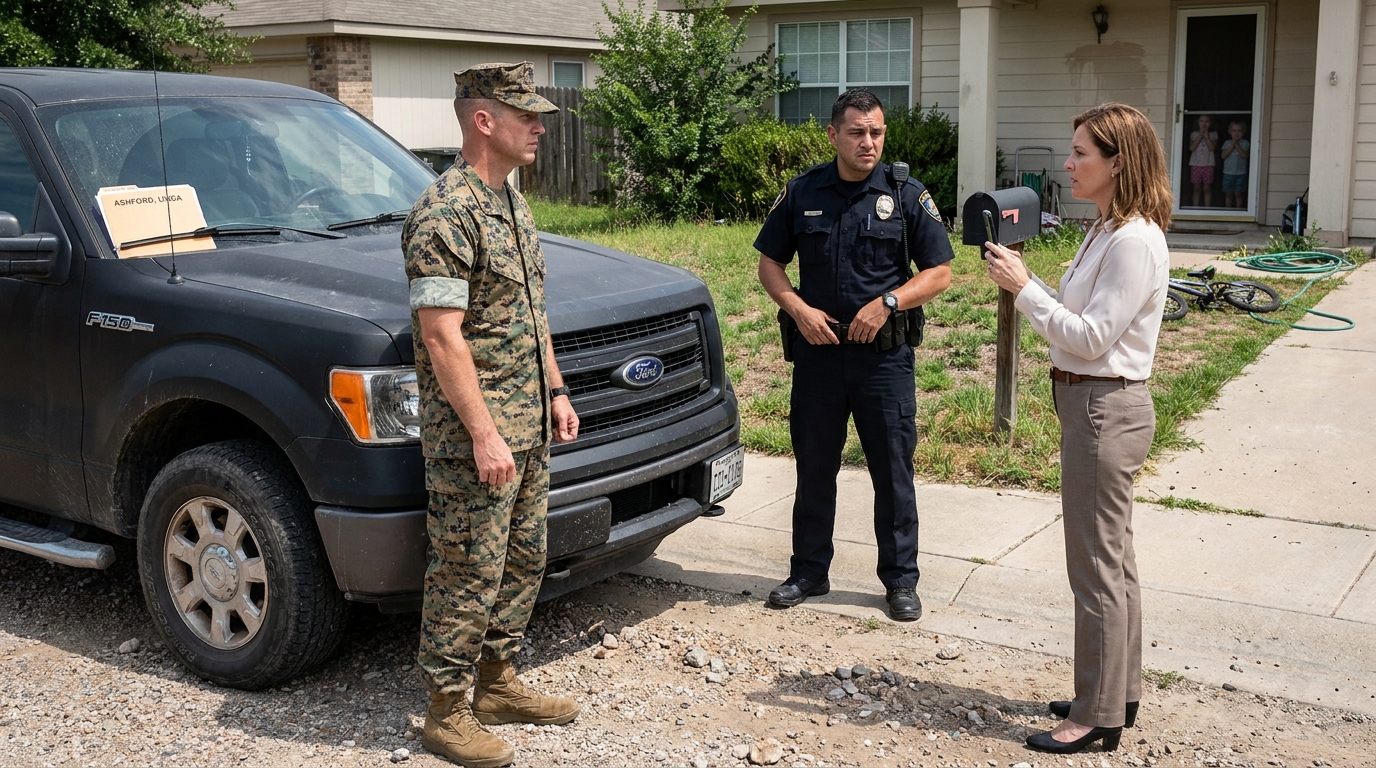
The crunch of gravel beneath the officers’ boots was the only sound louder than the throbbing of my own temple. Officer Martinez approached first, his hand hovering near his belt in a gesture that was half-habit and half-performance for the woman watching from the sidewalk. I didn’t move. I didn’t reach for my registration. I simply stood by the open driver’s side door of my F-150, watching the way his eyes darted toward Linda, then back to me, searching for the “threatening behavior” she had promised the dispatcher.
“Sir,” Martinez said, his voice stripped of his usual warmth. He was a good man, a local who respected the base, but he was trapped in the machinery of protocol. “We received a call regarding intimidation tactics. A complaint about blocking emergency sight lines.”
I looked past his shoulder. Linda was there, the picture of aggrieved suburban sanctity. She held the phone steady, her posture a masterpiece of practiced fragility. She wasn’t just reporting an HOA violation; she was harvesting data. She was recording the officers’ demeanor, their tone, and the exact position of my vehicle, likely to be used as evidence for a board hearing I hadn’t even been notified about.
“Officer,” I said, my voice dropping into that specific, low-register frequency that commanded attention without escalating tone. It was the voice I used to debrief squads after a mortar strike. “You can see my wheels are clear of the curb. You can see the driveway width. You know as well as I do that this vehicle has been parked in this exact orientation for six months.”
Martinez glanced at the truck, then back at me. A flicker of something—fatigue, perhaps—passed over his face. He knew the geography of this street. He knew the petty, festering grievances that fueled the complaints.
“I have to document the report, Colonel,” he said quietly, dropping the formality for a fleeting second. “She’s claiming you used a ‘military presence’ to block her access to the street.”
I didn’t blink. Behind me, I heard the screen door creak. The twins were there, pressed against the mesh, their small faces pale in the porch light. That was the line. That was the moment where the irritation turned into something else, something sharper and much more dangerous.
“Document it,” I replied, moving back to close my door. “But before you finish, make sure your body camera catches the reflection in her window.”
Martinez paused, his brow furrowing. “Sir?”
“Look at her window,” I repeated, not pointing, not accusing. “She isn’t just filming. She’s running a live feed. She’s not recording this for the police record, Martinez. She’s recording this for someone else.”
I saw the shift in his posture. The professional curiosity of a patrolman superseded the rigidity of the call. He looked toward the Ashford house, then back to me, the confusion finally giving way to a nascent suspicion. As I walked past him to reach my children, I felt the cold, hard weight of a plan crystallizing. She wanted a military confrontation? I would give her a tactical one. I reached the porch, my hand resting briefly on my son’s shoulder, a silent promise of resolution. When I turned back to look at the street, Linda had moved. She was no longer filming the officers. She was filming me, and for the first time, she looked afraid.
CHAPTER 2: THE INTELLIGENCE LOG
The house felt smaller when I stepped inside. The air was thick with the scent of coffee and the faint, metallic tang of the humid Colorado night, but as I locked the deadbolt, it wasn’t the smell of the home I was focused on—it was the phantom rhythm of a briefing room three thousand miles away. For a split second, the polished mahogany of my home office desk transformed into a scorched folding table in a dusty tent outside Kandahar, the weight of a tactical report replacing the stack of HOA violation notices. My hands didn’t shake, but the muscle memory of the battlefield returned: the need for a paper trail, the need for a secure perimeter, the need to categorize the threat before it could compromise the soft targets inside these walls.
I didn’t head for the kitchen or the recliner where my father sat, his eyes glazed over with the evening fog of his condition. Instead, I bypassed the living room, my combat boots rhythmic and controlled against the hardwood. I entered my office, closed the door, and engaged the latch.
This was the war room now.
I sat at the desk and pulled the manila folder from the top drawer—the one labeled Ashford, Linda. The documentation inside was more than just a list of grievances; it was a digital manifest of someone who had spent months conducting reconnaissance. I spread the papers out. I needed a baseline. I needed to separate the noise—the petty neighborhood squabbles—from the signals—the calculated, surgical strikes against military personnel.
I opened my laptop. The screen glowed, bathing the room in a clinical, white light that sharpened every edge of the furniture. My fingers tapped a steady, staccato beat against the keys as I navigated the public HOA record database. Most people viewed these documents as mundane chores, public filings meant to govern curb appeal and fence heights. But to someone trained in intelligence gathering, they were open-source intelligence gold mines.
I cross-referenced the dates of every violation notice filed against my neighbors with the dates of base maintenance announcements. The correlation wasn’t just significant; it was damning. Every time a new base contract was listed for bidding, the volume of complaints in the Maplewood subdivision spiked. It was a pattern, a heartbeat of activity that Linda Ashford couldn’t see because she was too deep in the execution of the move.
The silence of the room was suddenly broken by the soft, rhythmic thud of the old man’s cane in the hallway. I paused, my hand hovering over the mouse. My father, even in his diminished state, possessed a radar for tension. He stood outside the door for a long moment, the fabric of his robe rustling against the doorframe. I didn’t breathe. I waited for the knock, but it didn’t come. Eventually, the thudding receded, moving back toward the living room, leaving me alone with the screen and the mounting evidence.
I went deeper. I searched the tax assessment records for her address, then cross-referenced them with the property values of the surrounding houses. Her movements were erratic, desperate. She had filed an injunction against a neighbor’s tree trimming three months ago, citing “encroachment of private airspace”—a laughably obscure clause. Why? Because the tree partially obscured the view of the property line from her upper window. She wasn’t protecting her property value; she was protecting a line of sight.
My monitor reflected back at me—the face of a man who had seen this before. It was the same behavior as local informants who were trying to keep their own heads above water by pointing fingers at those they perceived as “the others.” She wasn’t acting out of hatred; hatred was too volatile. This was transactional. She was documenting “transient” behavior to keep the neighborhood demographics shifting in a way that suited a very specific, very narrow agenda.
I took a sip of the cold coffee from my mug, the bitterness grounding me. My eyes scanned the lines of data, turning the information into a mental map of her vulnerabilities. She had left a trail of breadcrumbs, and she had assumed that no one in this subdivision would know how to read them. She had made a fundamental error in threat assessment: she had underestimated the man she was trying to displace.
I created a new file: Case File: Alpha.
I began to input the data. Date of incident. Nature of complaint. Witness present. Outcome. The spreadsheet grew, a digital ledger of harassment that was, piece by piece, building a foundation for her total institutional removal. I didn’t need to yell. I didn’t need to file a counter-complaint that would just be discarded in the noise of the system. I needed to build a narrative that was so airtight, so logically undeniable, that when it was finally presented to the authorities, it would function like a scalpel.
A sudden flash of memory hit me—a debriefing in the dark of a secure bunker. The voice of my commanding officer: Intelligence is only as good as the time you take to verify the sources. I looked at the screen again. The HOA document cited a witness I didn’t recognize: a “Robert H. Miller.” I searched the name. There was no resident by that name in Maplewood.
The hair on the back of my neck stood up. The silence of the house suddenly felt heavy, predatory. If she was citing a witness who didn’t exist, she wasn’t just gaming the HOA—she was fabricating evidence. The petty nuisance had just become a criminal matter. I didn’t close the laptop. I didn’t stand up. I simply leaned back, staring into the glow, feeling the sharp, cold edge of resolve carve through the fatigue. She had opened the door to the shadows; now, I would be the one to map what lived inside them.
CHAPTER 3: THE SCHOOLYARD POISON
I left the office not long after, the silence of the house still pressing against my ears. I walked into the kitchen, the linoleum cold beneath my socks. I didn’t turn on the overhead lights. Instead, I stood by the counter, my fingers tracing the edge of a stack of mail, listening to the house breathe. Dad was still asleep in the living room; I could hear his labored, rhythmic breathing, a sound that usually comforted me but now felt like a ticking clock. My children were tucked away upstairs, their innocence currently being eroded by a slow-drip campaign of social isolation that I had only just begun to quantify.
The next morning, the ritual of the school drop-off was no longer a routine; it was a deployment. I watched from the driver’s seat of my F-150 as the twins exited the vehicle. I didn’t rush them. I watched the yard, the cluster of parents near the entrance, and the way the group seemed to fracture and reform like mercury as my kids approached.
I saw it then—the subtle, coordinated recoil. It wasn’t overt. It was a slight shift in stance, a sudden pivot of conversation away from the kids as they walked past, a deliberate turning of backs. It was a masterclass in social exile. Emma’s shoulders were hunched, a small, involuntary contraction of her posture that turned my stomach. Jake, usually the more stoic of the two, walked with his hands jammed deep into his pockets, his gaze fixed on the pavement.
I didn’t pull away. I kept the engine idling, the diesel rumble a low vibration against the floorboards, and pulled out my phone. I didn’t call the school. I didn’t call the board. I opened the encrypted folder on my drive and started recording my own observations, dictating the time, the names of the parents involved, and the specific physical behaviors of the group.
“Observation 0815,” I whispered into the phone, my voice low and devoid of emotion. “Subject group interaction confirms systematic ostracization. Parents involved: Morrison, Hayes, and a third unidentified party. The reaction is uniform, suggesting prior instruction.”
As I spoke, a white BMW SUV pulled into the fire lane near the school entrance. Linda Ashford. She didn’t get out of the car. She simply sat there, the window down just enough to maintain a clear sightline of the entrance. She wasn’t just watching; she was waiting for the report. She was monitoring the efficacy of the contagion she had released.
The sensation of being watched was a familiar weight, one I had felt in crowded bazaars and lonely border crossings, but here, in a suburban school zone, it felt like a violation of the laws of nature. I watched her hand move—the subtle, rhythmic tap of her manicured finger against the steering wheel. It was the movement of a conductor. She wasn’t leading the harassment; she was managing it, ensuring the “protocol” of social exclusion was being adhered to by every parent in her sphere of influence.
My initial assessment had been that she was an isolated actor, a woman with a grievance. But watching her sit there, cool and detached, I began to see the deeper architecture of her plan. If she could make the environment hostile enough, she didn’t need to do the dirty work of forcing us out. She would simply make the air in this neighborhood so toxic that leaving would be the only logical choice for my family’s mental health.
I checked the dashboard clock. I had to get to work, but the compulsion to stay, to document, was overwhelming. My hands gripped the wheel, the leather biting into my palms. I felt the sharp, jagged edge of a memory—a briefing on psychological operations, the way a population is conditioned to view an “outsider” as a threat. Linda was using those same tactics. She was turning my own neighbors into the intelligence-gathering arm of her campaign.
I looked at the school doors, then back at the BMW. I had to change the variables. I couldn’t just play defense; I had to force an error. I needed them to see me not as a “transient” threat, but as a superior strategist who had been watching their every move.
I reached out and shifted the truck into gear. Instead of pulling away, I maneuvered the F-150 into the spot directly behind Linda’s vehicle. I killed the engine. The silence that followed was absolute. I saw her rearview mirror adjust—a frantic, jerky movement—as she realized I was no longer a moving target, but a stationary presence in her immediate vicinity.
She didn’t turn around. She didn’t flee. She sat there, her hands frozen on the wheel, her posture rigid. She knew I was there. She knew I had seen the connection between the schoolyard treatment of my children and her presence in the fire lane. I sat in the truck, my eyes fixed on the back of her head, not saying a word, just holding the space.
It was a small, tactical victory, but as I sat there, I felt a tremor of doubt. Was it really that coordinated? Or was my own exhaustion, the weight of the last few months, turning simple neighborhood cliquishness into a grand conspiracy? The thought tasted like bile. I dismissed it, but the doubt lingered, a phantom itch in the back of my mind. No, the data was too clean, the patterns too precise. I forced myself to reset, my focus sharpening again. I wasn’t here to be paranoid; I was here to win.
I watched her through the glass. She looked small, almost fragile, in the driver’s seat. It was a brilliant mask, one that had worked for months. But as she finally pulled away, her movements were no longer the precise, conductor-like taps of before. She was driving away with a jerky, erratic speed, and for a split second, I saw her hand go to her face—a frantic, wiping motion, as if she were trying to rub away a sudden, unexpected panic. I had made her move. It was time to push harder.
CHAPTER 4: THE NETWORK EXPOSED
The server hub was a nondescript brick building tucked behind the city’s maintenance yard, a place where rusted dump trucks and piles of gravel sat like monuments to suburban decay. I parked the truck two streets over, blending into the morning flow of commuters. The air was dry, smelling of pulverized concrete and old oil. My pulse was rhythmic, a low-frequency hum that had served me since my first tour—the calm before the breach.
If Linda was funneling data, she wasn’t doing it through a home router. She was using a compromised access point within the municipal network to pull base maintenance schedules and personnel locations, disguising the traffic as routine property tax queries. It was brilliant, in a sick, twisted way—using the city’s own bureaucracy to hide the digital fingerprints of her espionage.
I walked the perimeter. The chain-link fence was topped with razor wire that had been cut and bent back weeks ago, a gap someone—likely the same contractors she was collaborating with—had been using for a while. I slipped through the opening, the metal snagging my jacket, a sharp, tearing sound that seemed deafening in the stillness of the yard. I kept low, my boots finding purchase on the cracked asphalt, moving with the measured, rolling gait of a man trained to avoid tripwires.
The door to the hub was electronic, a simple key-card entry. I didn’t have a card, but I had something better: the knowledge of how these outdated systems were installed. I bypassed the terminal box on the exterior wall, my hands moving with muscle memory that felt like a reflex. Two wires, a short-circuit, and the lock clicked with a heavy, final sound.
Inside, the room was freezing, the air dominated by the whine of cooling fans and the smell of ozone. I reached the main terminal, my laptop pulled from my pack, and connected to the internal port. The download started, a progress bar ticking across the screen.
Then, the floorboards outside creaked.
I didn’t move. I stayed hunched over the terminal, my peripheral vision locked on the reflection in the server rack’s glass door. A shadow lengthened across the floor—not the hurried, clumsy movement of a maintenance worker, but the measured, deliberate step of someone who knew exactly where they were going.
I disconnected the drive, the data bar hitting 98 percent, and stepped into the blind spot behind a row of server racks just as the door opened.
A man walked in. He wore the high-visibility vest of a city contractor, but his hands were empty, his posture tactical. He wasn’t checking the equipment; he was scanning the room, his eyes sharp, searching. My hand drifted to the small, weighted light I carried in my kit. I didn’t want a confrontation—a physical fight here would leave traces—but the way he reached for his waistband suggested he wasn’t interested in conversation, either.
He stopped three feet from the terminal. He frowned, seeing the cable still dangling from the port. He knew.
“You’re not supposed to be here, friend,” he said, his voice hard, lacking the cadence of a local worker. It was the voice of a man who dealt in shadows.
I stepped out, not into a rush, but into a position of advantage. I kept my posture relaxed, a deceptive frame of unconcern. “Neither are you, considering the maintenance schedule for this hub is set for next Tuesday.”
He tensed, his fingers hovering. “You’re the one from the Maplewood subdivision.”
“And you’re the one who’s been using the Ashford contract to mask the traffic,” I said, my voice steady, cutting through the whine of the fans. I didn’t wait for him to initiate. I threw the heavy, industrial-grade flashlight—not at him, but at the main electrical relay panel on the wall behind him. The impact was deafening, a shower of sparks and a violent pop as the room plunged into absolute, suffocating darkness.
I didn’t run. I moved. I shifted to the side, my boots silent on the floor, and exited the door as the man scrambled in the dark, his voice a curse of frustration. I didn’t look back. I reached the fence and vaulted it, the razor wire missing my skin by millimeters, and hit the pavement running.
The data was on the drive. I had the connection between Linda, the fake witness Robert Miller, and the construction firm that was actively bidding on the Fort Carson maintenance contracts. The decoy secret—the idea that this was just neighborhood gossip—was dead. I was holding the ledger of a conspiracy, and I wasn’t just a neighbor anymore. I was the one who had finally caught the signal in the noise.
As I reached my truck, the cold Colorado wind bit into my face, but I barely felt it. My mind was already racing, categorizing the evidence, preparing the file for the federal investigators I knew would have to be involved. This wasn’t a game for HOA boards anymore. This was federal territory, and I had just dropped the first bomb.
CHAPTER 5: THE TRAP CLOSES
I didn’t head home. I drove the long way around, circling the perimeter of the Maplewood subdivision to watch the neighborhood from the vantage point of the access road. Everything looked the same—the manicured lawns, the pristine white fences, the quiet, orderly streets—but to my eyes, it was a grid of vulnerabilities. I turned onto Linda’s street. Her BMW was back in its designated, angle-perfect position, but the house itself seemed different. The curtains in the front room were drawn tight, a subtle shift in the neighborhood’s routine that didn’t escape me.
I pulled into my own driveway and sat in the dark for a moment, the engine ticking as it cooled. I needed to know why. The contractor connection was the tactical objective, but the why—the driving force behind a woman who would risk federal investigation for a base contract—still eluded me. I needed one more piece of evidence, something that pointed to the personal desperation behind the professional aggression.
I waited until 2300 hours. The neighborhood was dead silent, the only sound the distant rustle of cottonwood leaves. I slipped out the back door, moving through the shadows of my backyard, my tactical gear replaced by dark, nondescript clothing. I didn’t approach the front; I went through the alleyway, the path of least resistance.
Linda’s trash cans were out for the morning collection. I approached them with the clinical detachment of a man checking for explosive residue. I didn’t rummage; I systematically isolated the bags that appeared to have been added last—the ones that would contain the remnants of her day. I pulled out a heavy black bag, the plastic crinkling loudly in the quiet night, and carried it to the shadow of a neighbor’s shed.
I sorted through the contents by the glow of a red-filtered penlight. Takeout boxes, receipts, the usual detritus of a suburban life. Then, I found it: a thick envelope, torn open and discarded, bearing the logo of a commercial real estate firm and a date from three weeks ago.
It wasn’t a contract offer. It was a final notice of foreclosure on a commercial property she and her husband had clearly over-leveraged. The document was brutal, detailing a timeline of missed payments, mounting penalties, and an imminent date for an auction of the assets.
The weight of it hit me like a physical blow. She wasn’t just a bitter neighbor; she was a woman staring into the abyss of total financial ruin. The contract she was trying to sabotage—and the one she was trying to steer toward her cohorts—wasn’t just a lucrative job; it was a lifeline, a multi-million-dollar gamble meant to save them from bankruptcy.
I took a photo of the document, the flash of the camera a momentary flicker in the dark alley, and replaced the trash, ensuring the bag was perfectly aligned. I retreated back to my yard, my breath hitching as I realized the scale of her desperation. She had turned the neighborhood into a battlefield because she had no other play left. She was cornered, and that made her more dangerous than any insurgent I had ever faced.
I entered my office, the familiar hum of the computer welcoming me back. I uploaded the photo of the foreclosure notice. I had the contractor conspiracy linked to the espionage effort, and now I had the motive—a desperate, clawing need to survive the collapse of their private empire.
I sat back in my chair, the screen’s white light reflecting in my eyes. I didn’t feel triumph. I felt a cold, hard clarity. This wasn’t about neighbors anymore. This was about a woman who had bet her entire life on a scheme, and I was the one who had finally held up the mirror. I opened the encrypted email window and attached the entire dossier. My finger hovered over the ‘Send’ button, addressed to the federal agent I had been coordinating with.
I glanced at the screen, then at the house, the quiet, sleeping form of my family upstairs. This would end her. It would end everything she had built. But there was no other way. She had chosen to make my family the target of her sinking ship, and now, the ship was going down. I clicked the button. The status bar climbed, reached 100 percent, and the file was gone. The trap wasn’t just set; it had been triggered.
CHAPTER 6: THE FINAL CLEARANCE
The summons had been issued through the proper channels, but the weight of it in my hands felt like an ultimatum. Major Stevens from base legal sat opposite me in the garrison command office, her expression neutral but her posture coiled, like a spring ready to release. We were ready. The dossiers, the timeline analyses, the financial records—everything was laid out on the mahogany table in precise, military order.
When Linda Ashford was escorted into the room, she looked like a woman who had spent the last twenty-four hours unspooling. Her hair, usually an architectural achievement of suburban control, was flat. Her clothes were wrinkled. She walked in with a remnant of her usual defensive posture, but the moment her eyes met the evidence wall—the stark, undeniable charts connecting her to the corrupt contractor firm—the mask fractured.
She didn’t speak. She didn’t offer a denial. She sat down, her hands trembling in her lap, and stared at the foreclosure notice I had retrieved from her trash. It was the centerpiece of the collapse.
“Mrs. Ashford,” I said, my voice intentionally low, devoid of any triumph. “We have the connection to the municipal server, the coordination with the contractors, and the motive. You didn’t just harass your neighbors. You attempted to interfere with base operations, and you used information gathered through illegal reconnaissance to do it.”
She looked up at me, her eyes red-rimmed and hollow. “You have no idea,” she whispered, the veneer of the “concerned neighbor” finally stripped away, revealing the raw, jagged panic of someone who had lost everything. “You think this is about you? You think I care about your parking or your lawn? We were drowning. That contract—that money—was the only thing left. We lost the commercial properties. We lost the equity. We were going to lose the house by the end of the month.”
The truth wasn’t a complex web of malice; it was a desperate, grasping reach for a lifeline that didn’t exist. She hadn’t been fighting to preserve the neighborhood; she had been trying to build a moat around her own sinking ship.
“The desperation is noted,” Stevens said, her voice clinical, “but the criminal liability is absolute. You conspired to defraud the government and you engaged in a coordinated campaign of intimidation against military personnel and their families.”
Linda slumped. The fight had drained out of her, not in a grand concession, but in a quiet, devastating realization of the consequences. She wasn’t the strategist I had imagined; she was a victim of her own unchecked ambition and the inevitable failure that follows a life built on an illusion of stability.
The next hour was a systematic dismantling. We walked her through the charges—the conspiracy, the civil rights violations, the intelligence gathering. She didn’t protest. She simply nodded, a slow, mechanical movement that signaled the end of her operation.
When she was finally led out of the office, the room felt impossibly quiet. The tension that had defined the last eight months—the constant scanning, the documentation, the defensive posture of my own home—began to bleed away. I walked to the window and looked out toward the base gates. The flag was fluttering, a sharp, crisp movement against the blue sky.
I went home that evening, the air in the house feeling cleaner, lighter. I found my father in the garden. He was carefully pruning the tomatoes, his hands steady, his movements precise. He looked up as I approached, his eyes catching mine with a moment of crystalline clarity. He didn’t say anything, just gave a slow, deliberate nod—an acknowledgment of a mission completed.
I walked to the backyard and picked up a loose board on the fence—the same one that had started this entire conflict. I took the hammer from the shed, the metal heavy and cool in my hand, and drove the nail back into the wood with a single, clean strike. It was a small thing, a minor repair, but as I stood there, I felt a deep, resonant calm.
Inside, the house was filled with the sound of the twins’ laughter from the kitchen and Sarah’s voice, a steady, grounding anchor. I walked to the kitchen and stood in the doorway for a long moment, watching them. The conflict hadn’t just been about a neighbor; it had been about the boundaries of our own sanity. I had protected that, and in the process, I had found a way to bridge the gap back to the quiet, atmospheric peace that was the true definition of home.
The case was closed, the records archived, and the neighborhood—now beginning to heal—would continue to be a place where service meant something, where we stood for the values that defined us. I felt the weight of the last year settle, not as a burden, but as a scar—a testament to a fight that had been won, not with fire, but with the quiet, relentless application of truth.