A Patch of Wet Earth: How One Engineer’s Resolve Healed the Fractured Soul of Oakidge Meadows
CHAPTER 1: THE LETTER AND THE SOIL
The envelope was thick, the cardstock heavy and cream-colored, exuding the kind of artificial authority that had become the hallmark of the Oakidge Meadows Homeowners Association. Mark Henderson stood on his front porch, the morning air still clinging to the moisture of the recent biblical deluge. He read the line twice. The fine was for the accumulation of debris on his driveway—a brown, ugly smear across the gravel that had been birthed by the storm’s fury.
Twelve hundred dollars. The amount was a sharp, clinical instrument, designed to cut.
He looked down at the driveway. It wasn’t just dirt; it was the story of the last twelve hours. The storm had turned the county into a swamp, and his property—a five-acre stretch he had spent years meticulously balancing—had become a vessel for the water’s redirected path. But as his engineer’s eyes scanned the sediment, the burn in his gut shifted from simple anger to a quiet, crystalline focus.
The pattern was wrong.
He knelt, his waterproof boots sinking into the saturated fringe of his lawn. He brushed his fingers through the silt. It wasn’t the erratic, chaotic spread of general storm runoff. It was a fanned, rhythmic deposit, perfectly angled away from the back boundary line he shared with the HOA common area. Someone hadn’t just allowed the storm to take its course; they had built a machine, however crude, to aim the violence of the creek at his front door.
A shadow flickered at the edge of his vision. He thought of Karen Bishop, the HOA president, who prowled the neighborhood in her golf cart like a queen presiding over a graveyard of garden gnomes and trash cans. She had never been a neighbor; she had been a landlord of the spirit, measuring the worth of a family by the shade of their mailbox paint.
Mark stood, the paper crumpling slightly in his grip. The money didn’t matter. The money was merely a receipt for an act of malice that had traveled through the water. He walked toward the back of the property, his boots leaving deep, heavy impressions in the spongier soil. Each step was a measurement, a mental calculation of gradient, velocity, and the sheer, staggering incompetence of someone who thought they could leash a seasonal creek for the sake of a picnic bench.
He reached the creek’s bank and stopped. The air here was colder, heavy with the scent of pine and disturbed earth. The banks, once reinforced with local stone and native roots, were raw, red clay gashes. The creek had been straightened, forced into a narrow, vicious chute that surged with an intensity he had only ever seen in tactical drainage simulations.
He looked back at the house, then toward the neighborhood common land beyond the fence. The realization settled over him not with a roar, but with the weight of a rising tide. This wasn’t an act of God. It was a design. And the architect had made a fatal mistake—they had left the evidence of their tampering in the very mud they now sought to fine him for.
He pulled his phone from his pocket, the screen brightening in the dim, gray light. He didn’t dial a lawyer; he didn’t call the police. He simply began to record, his voice steady, dispassionate, and as cold as the water soaking into the soles of his boots. He was an engineer, and for the first time in a long time, he saw a system that needed to be repaired. But as he turned to walk back toward the house, he noticed a scrap of something caught in a splintered tree root—a bright, synthetic blue ribbon, the kind used by landscape surveyors. It was tangled deep, as if placed there to mark a boundary.
His heart hitched. The ribbon wasn’t just a survey marker; it was tied with a specific, tight double-hitch knot he had seen on a golf cart’s steering column just two days before the storm hit.
CHAPTER 2: THE ANATOMY OF A SYSTEM FAILURE
The blue ribbon was a pathetic thing, really—a thin, synthetic strip of arrogance snagged on a root. It snapped softly in the damp breeze, a rhythmic tick that felt like a mockery of his patience. Mark pulled it free, the fibers resisting, and coiled it around his index finger. It wasn’t a standard marker. It was the same industrial-grade polyester he’d seen dangling from the storage rack in the back of Kevin Gable’s truck, the one that had been idling in the common area just days before the sky opened up.
He didn’t walk back to the house. Instead, he crouched low, his knees sinking into the soft, yielding mud. He began to trace the path of the diversion. The water had been pushed, coerced by a crude but effective berm of packed clay and ripped-up sod. He ran his hand along the top of it. The soil here was different—darker, more compacted than the surrounding landscape. It had been brought in from elsewhere, layered, and tamped down with heavy machinery.
His mind was a blur of cross-sections and flow coefficients. The damage to his property wasn’t just a result of a storm; it was the result of a hydraulic shortcut. By straightening the creek, they hadn’t just rerouted the water; they had increased its kinetic energy, turning a gentle seasonal stream into a scalpel. And his land—his five acres of carefully managed order—was the autopsy table.
He followed the berm’s curve. It led directly into the heart of the “Patriots Perch” project. He stood, his boots heavy with the clay, and looked toward the picnic area. It sat on a raised mound of fresh, still-bare dirt, looking like a fresh wound in the landscape. It was dry. Perfectly, infuriatingly dry. He turned back to his own yard, where the grass was matted and brown, suffocated by the silt. The math was cruel: to keep the picnic bench feet dry, they had chosen to drown his front driveway.
The anger didn’t burn now; it cooled, hardening into something solid and utilitarian. He walked back toward the Polaris, the soft, squelching sound of the mud underfoot the only rhythm in the woods. He needed to verify the grade. He needed to prove, with the cold, unassailable language of surveying, that the common area’s elevation had been altered to shunt runoff into the natural depression that fed his property.
When he reached the Polaris, he didn’t head for the garage. He circled his property, taking the long way, walking the perimeter where the vegetation was thick and overgrown. He needed to look at the culvert under the main road, the one he had mentioned to himself earlier. If the HOA had blocked that, they had created a bottleneck, a pressure point that forced the water to seek the path of least resistance: his land.
The walk took nearly an hour, a deliberate trek through terrain that fought him at every turn. Briars caught at his jeans, and the ground was a treacherous, shifting mess of saturated topsoil. He didn’t rush. Rushing was for those who didn’t understand the physics of a site. He moved with the measured gait of a man inspecting a bridge foundation, stopping to note the water line on the trees, the way the debris had piled up against the fencing.
He found the culvert. It was partially obstructed by a poorly constructed retaining wall made of stacked landscape timbers—the kind of quick-fix, low-budget landscaping he’d seen Kevin Gable promote in flyers around the neighborhood. It was choked with dead grass and sediment. It was a dam, plain and simple.
He stood over it, the cold wind whipping his hair, and felt the first tremor of a deeper realization. This wasn’t just a landscaping project. This was a systematic reallocation of environmental hazards. The HOA had looked at the neighborhood’s topography and decided that his property was the most convenient sponge.
He didn’t need to shout. He didn’t need to break anything. He just needed to document the specific, quantifiable failure. He reached into his pocket and pulled out his phone again, but this time, he didn’t just record video. He opened the topographic app he used for his own site maintenance. He paced the area, marking the coordinates, recording the elevation differentials. The data began to populate, a digital skeleton of the crime scene.
As he worked, a familiar sound drifted through the trees: the low, electric hum of a golf cart. It was distant, but unmistakably approaching. Karen Bishop’s domain was just over the rise. He stepped behind the dense trunk of an old oak, his movements instinctual and silent.
The cart crested the hill. Karen was behind the wheel, her face set in that perpetually pinched, righteous expression. Beside her sat a man he recognized as Gary, the board member, holding a clipboard that looked like a shield. They stopped near the picnic area.
“The drainage seems to be holding,” Karen said, her voice carrying clearly on the crisp air. She was pointing at the picnic area, her hand sweeping over the very berm he had just been analyzing.
“I don’t know, Karen,” Gary replied, his voice tinny with anxiety. “Henderson is a civil engineer. He’s been out on his property all morning. If he looks into the permits…”
“He won’t look,” she snapped, cutting him off with a flick of her hand. “He’s a retired soldier. He knows how to follow orders. And our order is to keep the common area dry. If his driveway gets a little muddy, that’s the price of living in a restricted community. It’s in the bylaws.”
Mark leaned his back against the rough, damp bark of the oak. The “bylaws” weren’t just the rules of the neighborhood; they were her religion. She used them like a shroud, covering her sins and her nepotism in a layer of beige-tinted authority. He watched them for a moment longer, watched as she stepped off the cart and adjusted a decorative stone near the newly dug channel, her movements possessing a strange, predatory pride.
He didn’t move. He didn’t confront them. He simply waited for them to drive away, his eyes locked on the way she stood—the way she looked at the landscape not as something to steward, but as something to command. He had the physical evidence now. He had the surveyor’s ribbon, the data on the elevation, and now, the written intent of his antagonist.
The weight of the blue ribbon in his pocket felt heavy, like a key. He realized then that the war wouldn’t be won by proving the water was wrong; it would be won by proving that the woman behind the wheel of that cart was, in every sense that mattered, a broken part of a system that was about to experience a total collapse.
He waited until the hum of the cart faded into the distance before moving. He walked back to his house, not to his driveway, but to his office. He had a lot of work to do, and for the first time in a decade, he found himself looking forward to the precision of the planning phase. The soil was damp, the air was cold, but the path forward was becoming increasingly clear.
CHAPTER 3: THE CLUBHOUSE CONFRONTATION
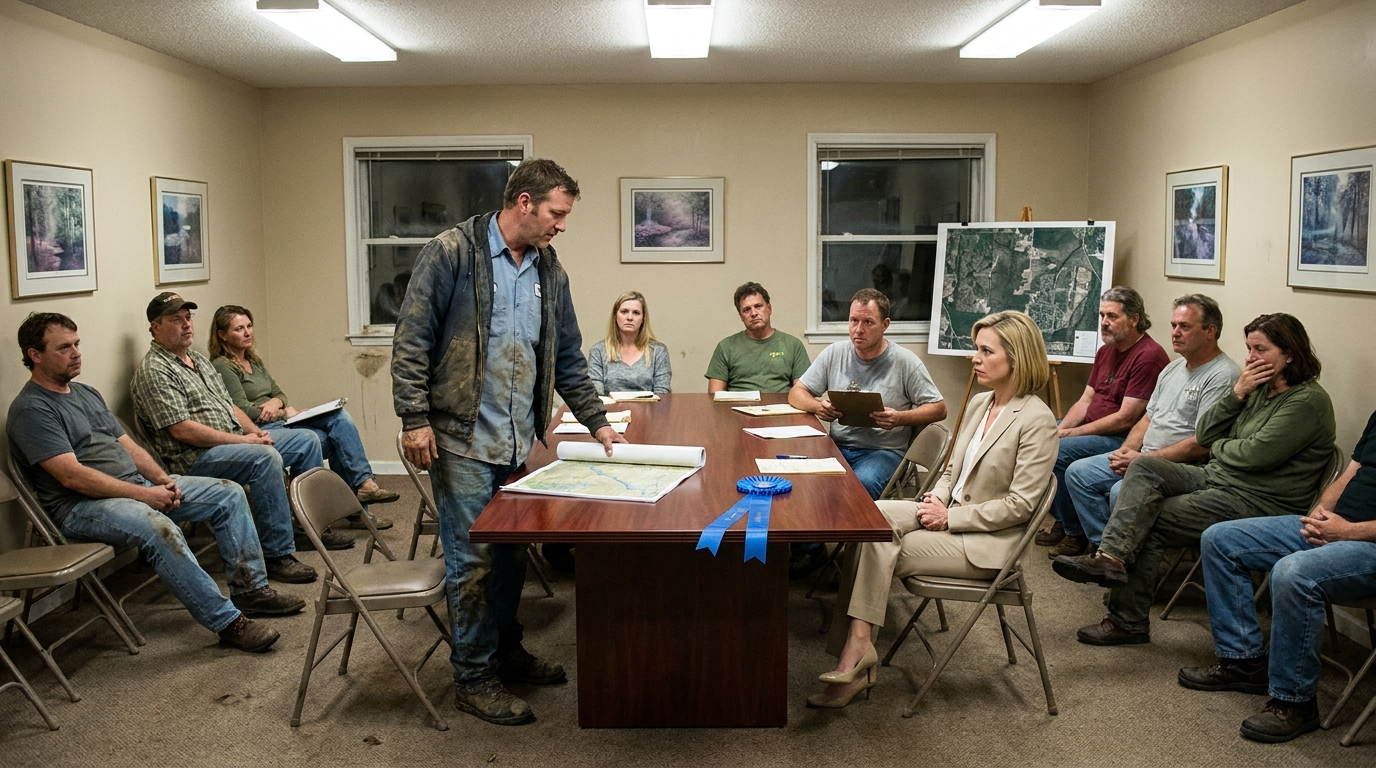
The transition from the quiet focus of his desk to the front doors of the clubhouse felt like walking from a vacuum into a pressure chamber. Mark pushed through the glass doors, the scent of industrial lemon cleaner hitting him first—a sharp, sterile odor that did nothing to mask the underlying sense of decay. Inside, the Oakidge Meadows clubhouse was a desert of beige carpet and mismatched seating.
Karen Bishop was already at the long, polished mahogany table at the front of the room. She looked crisp, her movements precise as she arranged a stack of folders. Beside her sat Gary, who was sweating despite the cool air-conditioning, and Brenda, who stared blankly at the wall as if waiting for a signal that wasn’t coming.
Mark didn’t rush. He walked down the center aisle, his footsteps muted by the carpet, carrying his leather portfolio like a shield. He chose a seat in the front row, directly in Karen’s line of sight. He placed the portfolio on his lap, the weight of the documents inside—the GPS logs, the elevation charts, and the survey ribbon—tethering him to reality.
Karen’s gaze flickered to him, a subtle contraction of her eyes, before she turned her attention back to her paperwork. She began the meeting with a practiced ease, her voice smooth and performative. She touched upon the usual litany of grievances: the height of the hedges on Elm Street, the misplaced recycling bins, the ongoing debate regarding the “appropriate” mailbox shades. The other homeowners sat in a stupor of boredom, their eyes glazed, their posture slumped in the uncomfortable metal chairs.
Then, she reached the agenda item that mattered: “Outstanding Covenant Violations.”
She leaned forward, her fingers interlaced on the tabletop. “We have several matters to resolve tonight,” she said, her smile not quite reaching her eyes. “Mr. Henderson, if you’re present, I believe we have an outstanding matter regarding the fine for your driveway’s state of disrepair.”
Mark stood. He didn’t rise quickly; he rose with the slow, deliberate motion of someone who had done the math and knew the answer. The room went still. The air felt thin.
“I’m here, Karen,” he said, his voice level. It didn’t boom, but it carried to every corner of the sterile room.
She offered a look of practiced annoyance. “This is a procedural meeting, Mr. Henderson. If you have an appeal, it needs to be filed through the proper channels. We don’t have time for a personal airing of grievances.”
“I’m not here to appeal,” Mark said, walking toward the front of the room. He didn’t ask for permission. He stepped up to the table, his presence displacing the air of authority she had cultivated. He opened his portfolio. He didn’t pull out the fine; he pulled out the satellite map of the creek’s historical path, printed in high-resolution, the blue of the original waterway standing out against the muted tones of the neighborhood map.
“I’m here to discuss the landscape improvement that caused the mud you’re trying to fine me for,” he said. He laid the map flat on the table, right under her hand.
Karen didn’t look at it. She looked at him. Her face tightened, the skin around her eyes pulling thin. “The creek diversion was a necessary measure for the common area, approved by the board for the benefit of the community. It has nothing to do with your property, which you have failed to maintain.”
“It has everything to do with it,” Mark replied, sliding a second photograph over—the close-up of the eroded bank, the red clay exposed like raw muscle. “Straightening a natural waterway without an engineering study increases velocity. It turns runoff into a projectile. My driveway is the delta for your ‘improvement’.”
Gary shifted in his seat, the sound of his chair scraping against the floor sounding like a gunshot. Brenda finally looked over, her gaze darting from the map to Mark’s face, then to the closed expression on Karen’s.
“We are not here to debate engineering, Mr. Henderson,” Karen said, her voice rising an octave, becoming sharper, more brittle. “We are here to maintain the standards of Oakidge Meadows. The fine stands. If you refuse to pay, the board will initiate the standard collections process.”
Mark looked at her, searching for a trace of the neighbor who lived three streets over. There was only the administrator, the woman who mistook rules for reality. He took the small, blue survey ribbon from his pocket and set it down on the table. It looked absurdly small against the mahogany, a bright, garish streak of evidence.
“This was found snagged on the bank near your ‘improvement’,” he said. He watched her eyes track the object. “It matches the material in your brother-in-law’s truck, Karen. The one that was parked at the Patriots Perch site two days before the storm.”
The silence in the room was absolute. A neighbor in the back row shifted, the sound of her breath sharp in the stillness. Karen’s hand moved to pull back, but her gaze stayed fixed on the ribbon, her control fraying at the edges.
“That is a baseless accusation,” she hissed, her voice barely a whisper now, but the confidence had leaked out of it like air from a punctured tire.
“I’m not accusing anyone yet,” Mark said, his tone remaining clinical, professional, and entirely devoid of the heat she was currently radiating. “I’m simply stating the facts as I’ve observed them. The fine is a formal acknowledgment of a condition that your board created. If you want to push for collections, feel free. But I suggest you look at the map once more before you do. Because the next time we have this conversation, the board won’t be the only ones present.”
He didn’t wait for her to respond. He closed his portfolio, the snap of the metal fastener sounding like a gavel in the quiet room, and turned his back on them. He walked back to his chair, his heart hammering against his ribs, but his outward demeanor remained as still as a stone. He had planted the seed; he had shown them the ribbon of evidence, and he had made it clear that the tide was coming in.
He sat down, leaving Karen to stare at the small, blue scrap of synthetic fabric, her world of beige rules and iron-clad authority beginning to show its first real, visible cracks.
CHAPTER 4: THE ALLIANCE OF THE DISENFRANCHISED
The walk from the clubhouse doors to his Polaris felt longer than it should have. The air outside was damp and cool, biting into the sweat that had gathered at the small of his back during the meeting. Mark reached his vehicle and sat in the driver’s seat, his hands resting on the wheel. They weren’t shaking, but he felt a strange, humming fatigue beneath his skin.
He pulled his phone out. It was already vibrating. A flurry of notifications—messages from neighbors he had barely spoken to, emails from the Millers and the Youngs. They weren’t just curious anymore; they were scared, and their fear had sharpened into a demand for direction.
As he looked at the screen, a memory surfaced—a jagged, unwelcome intrusive thought. He saw a bridge in a forward operating base, a structure he had helped design that buckled under a monsoon because of a single, ignored miscalculation in the soil compaction data. The smell of wet, churning earth in that memory was identical to the scent of the mud on his driveway tonight. He gripped the steering wheel, his knuckles turning white, the sensation of failure in that distant past momentarily clouding his present resolve. He had to suppress it; he was the engineer, not the failure.
The silence of the parking lot was broken by the sound of approaching footsteps. It was Maria, the single mother he had visited earlier in the week. She looked small against the backdrop of the massive oaks that bordered the community.
“Mark?” she called out, her voice barely audible over the wind.
He stepped out of the Polaris. “I’m here, Maria.”
“They’re terrified,” she said, pulling her sweater tighter around her. “Karen already sent out a message to the board’s private mailing list—I saw it because my sister works for the management company. She’s calling for an emergency session to force a vote on a ‘security initiative.’ She’s going to try to ban us from meeting on common land.”
Mark leaned against the hood of the vehicle. The frustration pulsed in his temples. “She’s cornered. That’s what cornered animals do—they lash out at the boundaries.”
“People want to know what to do next,” Maria continued, her eyes searching his. “The Millers, the Youngs—they’re all waiting. They don’t want to just talk about the creek anymore. They want to know how we stop her from putting a lien on their homes before the month is out.”
Mark pulled a notepad from his inner jacket pocket, the paper damp with the night air. He began to scribble, his pen strokes firm and decisive. “We don’t meet on common land. We meet at my place. We create a legal firewall—not just an informal committee, but a formal petition to recall the entire board based on the evidence we have. We need sixty percent of the residents, Maria. Can we get them?”
“After tonight?” she offered a thin, tired smile. “I think people are done with being quiet, Mark.”
They stood there for a few minutes, the weight of their alliance hardening into something that could survive the coming pressure. But as they spoke, a set of headlights cut through the darkness of the parking lot. A car—an SUV he recognized as Karen’s—slowed to a crawl near the clubhouse entrance, its engine idling. It didn’t pull into a spot. It just sat there, a watchful, metallic predator.
“She’s watching us,” Maria whispered.
Mark looked toward the SUV. He could see the silhouette of a head—Karen, or perhaps someone she had hired to track their movements. It didn’t matter. The intimidation tactic was predictable, a desperate reach for control.
“Let her watch,” Mark said, his voice dropping to a low, steady pitch. “The more she watches, the less she’s doing to actually fix the damage. She’s losing time, and time is the one thing she can’t manufacture.”
He climbed back into the Polaris and started the engine. The engine’s growl felt like a challenge. He gestured for Maria to follow him. They drove in tandem, a slow procession back toward his property, aware of the SUV’s lights trailing them like a pair of judgmental eyes.
When he reached his home, he didn’t head inside to rest. He went straight to his office, where the topographical maps still covered every surface. The room was a sanctuary of logic. He laid out the new evidence—the recent communication from the management company, the notes from the clubhouse meeting. He needed to coordinate the next steps with David, his legal contact, but he also needed to prepare for the inevitable blowback.
He looked at the maps, his eyes tracing the line of the creek once more. He wasn’t just defending his driveway anymore; he was defending the legitimacy of the neighborhood itself. Every time Karen acted, she made a mistake—a paper trail, a witness, a signed check. She was building the scaffold for her own exit.
He turned off the desk lamp, the room plunging into the cool blue of the moonlight. He could hear the faint, trickling sound of the creek through the open window—a sound that used to be peaceful but now acted as a constant reminder of the work that remained. Tomorrow would bring a new, sharper escalation. He felt the weight of it, the grinding, slow-motion friction of two opposing forces colliding. He wasn’t afraid of the collision. He was simply waiting for the moment when the physical reality of the damage would finally, undeniably, outweigh the fragile veneer of the HOA’s authority.
He lay back in his chair, the fatigue settling deep into his bones, and closed his eyes. The battle was no longer a matter of opinion or petty grievance. It was a matter of math, and the numbers, he knew, were finally starting to tilt in the right direction.
CHAPTER 5: THE PAPER TRAIL
The office was quiet, save for the rhythmic humming of the computer fans. Mark sat motionless, the light from the monitor casting deep, elongated shadows against the walls covered in maps and timelines. He reached out and touched the spine of a thick, blue binder—the compilation of every FOIA request, every financial discrepancy, and the damning proposal from K&G Landscaping. It was heavy, a physical manifestation of the neighborhood’s fraying integrity, now stitched together by his own methodical hand.
The screen flickered. A new email from David Miller arrived. It was brief, containing the final draft of the legal petition that would be submitted to the county court the following morning. The language was sharp, devoid of emotion, and entirely devastating. It didn’t just target the illegal diversion of the creek; it dismantled the board’s entire fiscal structure.
Mark leaned back, his chair creaking in the stillness. He thought back to the clubhouse meeting, the way the silence had felt—a physical weight hanging over the room when he’d set the blue ribbon on the table. That had been the beginning of the end for Karen’s absolute rule. Since then, the neighborhood had shifted. He’d seen it in the small ways: the way Gary, the nervous board member, now avoided eye contact in the parking lot; the way Brenda had stopped participating in the active policing of the neighborhood’s “aesthetic standards.”
They were deserting the sinking ship, leaving Karen alone on the bridge.
He stood and walked to the window. Outside, the neighborhood was bathed in the pale, indifferent light of the moon. He could see the faint outline of the creek, currently held in a fragile state of imbalance, waiting for the restoration that the legal petition would force. He knew Karen was still out there, lurking in the shadows of her own panic, trying to find a loophole in the bylaws to save her position. But she was fighting against a reality he had already mapped out.
He walked to the printer, the machine groaning to life, spitting out the final pages of the petition. The rhythmic thwack-thwack-thwack of the printer was the only sound in the house. He gathered the papers, his touch light, respectful of the documentation. These weren’t just sheets of paper; they were the tools of an engineer. They were the precise, measured response to a chaotic, irrational force.
He returned to the desk and began to organize the final package. He needed to be absolutely certain of the sequence—the evidence of the conflict of interest at the top, the environmental impact analysis in the center, and the testimonials from the thirty-four affected homeowners as the foundation.
His phone buzzed. A message from Maria: They’ve called a secret meeting for 6:00 AM at the management office. She’s trying to authorize an emergency expenditure for ‘legal defense’ before anyone can intervene.
Mark didn’t hesitate. He pulled on his jacket, his movements fluid, conditioned by years of field assessments. He didn’t rush out the door; he moved with the steady, calibrated pace of a man who knew exactly where he was going. He grabbed his keys and the heavy blue binder.
The drive to the management office was uneventful, the streets of Oakidge Meadows silent and deserted. He arrived just as the first hint of gray light touched the horizon. The office, a small, nondescript building near the edge of the development, was already illuminated. Through the window, he could see Karen standing at a table, gesturing wildly, her face twisted in that same, pinched expression he had seen at the clubhouse. Gary and Brenda were there too, sitting slumped in chairs, looking like statues of resignation.
Mark parked his Polaris in the lot. He didn’t go inside immediately. He stood by the vehicle, watching them through the glass. He could feel the cold dampness of the morning air, a sharp contrast to the stuffy, climate-controlled silence of the office inside.
He waited until the door opened—until Karen emerged, her face pale as she checked her watch, her eyes darting toward the parking lot. She saw him. She stopped dead, her hand clutching her clipboard like a frantic, desperate talisman.
He didn’t speak. He simply stood there, the blue binder held firmly at his side, a silent, immovable obstruction to her final attempt at evasion. The look of pure, unadulterated shock on her face was not a victory, but a data point—an acknowledgment that the logic he had spent weeks building was finally, completely, unavoidable.
He began to walk toward her, the sound of his boots on the asphalt crisp and steady, each step a closing of the distance between the world she had tried to build and the reality she had finally been forced to confront.
CHAPTER 6: THE HEALING CREEK
Karen didn’t run. She stood there, frozen, the clipboard she held vibrating slightly in her grip. The morning sun was just beginning to crest the horizon, casting long, sharp shadows across the pavement. She looked small, stripped of the manicured perfection she had wielded for years. Behind her, the door to the office opened, and Gary stumbled out, his face pale, his eyes darting toward the binder in Mark’s hand. He didn’t even look at Karen; he simply walked toward his own car, his shoulders hunched in retreat.
Mark stopped five feet from her. He didn’t need to tower over her to diminish her; the truth was doing that for him. “The meeting’s over, Karen,” he said, his voice flat, stripped of malice. “The county has the files. The state has the investigation reports. And the neighborhood has the evidence.”
Karen’s lip trembled. She tried to find a defense—some remnant of a bylaw, some shred of procedural jargon—but her mind was a blank slate. “I did what I thought was best,” she whispered, the defiance finally collapsing into a hollow, jagged grief. “The picnic area… it was for everyone. It was supposed to be a place where we could all be proud of this community.”
“You built it on a foundation of lies and broken trust,” Mark replied. He gestured toward the creek bed, visible in the distance, still jagged and torn. “You didn’t build a community. You built a theater, and you forced everyone else to play the roles you assigned.”
She looked at him then, and for a fleeting second, the armor of the HOA president shattered completely. She wasn’t a tyrant; she was a woman terrified of the very chaos she had spent her life trying to micromanage. She had feared the wildness of the water, the irregularity of the seasons, and the unpredictability of her neighbors. She had tried to master it all, and in doing so, she had become the most chaotic force in the neighborhood.
“I just wanted things to be right,” she said, her voice cracking.
“You wanted things to be yours,” Mark corrected gently. He set the binder down on the hood of her SUV. “Go home, Karen. Pack your things. When you come back to the clubhouse, you’ll be doing it as a resident, not a president.”
She didn’t argue. She turned and walked to her car, her movements listless, her sense of purpose entirely evaporated. As she drove away, the silence of the morning returned, thick and profound.
The restoration began a week later. It was a slow, deliberate process. The heavy machinery that had once scarred the land was now an instrument of recovery. Mark stood on his back deck, his morning coffee warm against his palms, watching the engineers. They worked with a precision that mirrored his own, placing stones back into the creek’s natural curve, meticulously layering the soil to support the native grasses.
There was no rush, no frantic push for a deadline. They understood the land. Day by day, the raw, red clay was covered by the soft, green fuzz of new growth. The creek began to meander again, finding its old path, the water clearer and calmer, freed from the artificial pressure of the channel.
The clubhouse meetings became different things entirely. They were no longer trials; they were conversations. Under the leadership of Mr. Miller, the new board operated in the light of day. There were no hidden agendas, no secret expenditures, and, most importantly, no petty grievances masquerading as policy. Mark attended one, sitting in the back, listening as a neighbor discussed the community garden project near the creek. It was a simple, beautiful thing—the very thing Karen had once dismissed as “agricultural.”
He felt a deep, quiet resonance in his chest. He hadn’t just saved his driveway; he had helped save the spirit of the place.
On a particularly clear Tuesday, he went down to the creek. He carried a small, flat stone he’d found in the brush months ago, back when the water was still being weaponized against him. He walked to the edge of the bank, where the ground was firm and smelling of damp pine and rich, revitalized earth. He placed the stone into the bank, reinforcing a small, weak spot where the water still seemed to pull a little too hard.
He stood up, brushing the dirt from his hands. The work was never truly finished—the land required constant care, and community was an act of perpetual maintenance—but for the first time in years, it was stable. He looked toward the house. Sarah was on the porch, watching him with a soft, knowing smile. He walked toward her, the tension that had lived in his shoulders for months finally, and completely, beginning to dissolve.
The path he had fought to uncover was finally clear. The water flowed naturally, the garden grew, and the neighbors—the real neighbors—were talking. The theater of power had burned down, leaving behind something much more durable, and much more essential: a foundation built not on the rigidity of rules, but on the quiet, resilient truth of living alongside one another.