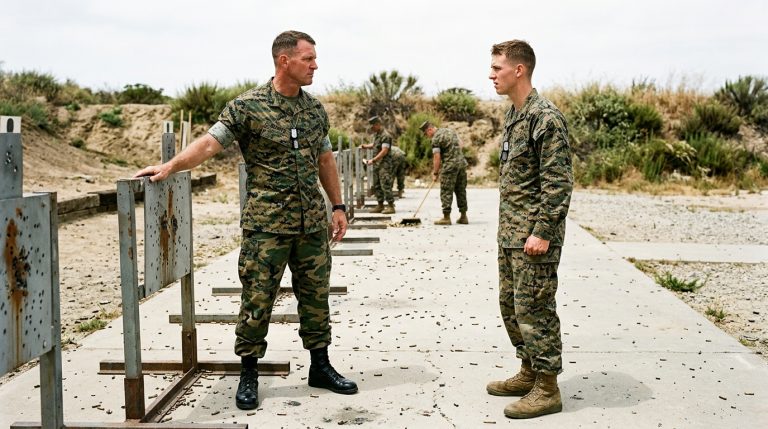
Shadows of Obsidian: Five Seals Navigate a Fragile Peace While the Erasure Protocol Refuses to Die
CHAPTER 1: THE PERIMETER SHIFT
The wind off the port tasted like metallic salt and engine oil. Dempsey stood in the lee of a rusted shipping container, his hand tight around the base of his radio. He didn’t speak. He watched the mother, watching her daughter, as she scanned the perimeter with the same predatory stillness he’d seen years ago in the bush.
She wasn’t a civilian. She hadn’t been one for a long time.
Wells moved up beside him, his movements fluid, calculated. He didn’t look at the mother; he looked at the dock’s entry gate, where the taillights of the Agency’s sedan were still bleeding red into the darkness. “They didn’t just come to talk, Chief,” Wells whispered. His voice was a flat, jagged edge. “Those men were carrying civilian-issue sidearms, not standard field pieces. They weren’t here to detain her. They were here to sanitize the site.”
Dempsey nodded once, his jaw tight. “Check the perimeter,” he ordered, the command barely a ripple in the cold air. “If they sent a two-man sweep, there’s a support vehicle within five klicks. Keep the eyes on the road. Nothing gets in without a trigger pull.”
The team scattered. They didn’t run; they transitioned, melting into the shadows of the stacked containers like ghosts returning to their element. Dempsey turned his attention back to the woman. She was holding a small, weathered leather bag, her knuckles white. She looked at him, not with gratitude, but with the cold, measured assessment of a tactical commander analyzing a new variable.
“You brought a lot of heat to this dock, Dempsey,” she said. Her voice was steady, void of fear, stripped down to the bone. “When you walked into that admin wing, you didn’t just clear my file. You flagged every burner account linked to the unit.”
Dempsey stepped closer, his boots crunching softly on the gravel. He didn’t try to soften the reality. “The file was already active, Chief. They were hunting you the second you pulled that exit.”
“They’re hunting the data,” she corrected, stepping into the dim light of a flickering streetlamp. The circle-and-slash tattoo on her arm looked like a brand, a permanent mark of a war that had never officially ended. She reached into her jacket and pulled out the phone she had seized—the one Dempsey had thought was just a tool for leverage.
She tapped the screen, and the device emitted a sharp, rhythmic hum—a pulse that didn’t show up on any standard radio frequency. It was a beacon.
“They didn’t lose me,” she said, her eyes tracking the dark horizon. “They were waiting for me to touch this.”
Dempsey felt the hair on his arms stand up. The silence of the dock suddenly felt heavy, suffocating. He realized then that they hadn’t just saved a ghost—they had walked directly into the center of a target zone. Behind him, Morales whistled, a low, sharp sound that hit the cold air like a gunshot.
“Chief,” Morales called out, his voice barely audible over the wind. “We’ve got movement at the north gate. Three vehicles. High-speed approach. And they aren’t slowing down for the barrier.”
Dempsey looked at the woman. She didn’t flinch. She simply tucked the phone away and looked at her daughter, who was standing perfectly still behind a rusted pylon. “Keep her down,” the woman said, then turned to Dempsey. “You wanted to correct history, Chief? This is the opening act.”
The distant hum of engines grew into a roar, the vibration humming through the soles of his boots, and Dempsey knew the game had changed.
CHAPTER 2: THE GHOSTS LEDGER
Dempsey didn’t look at the vehicles. He looked at the woman. The incoming roar wasn’t the sloppy, uncoordinated sound of a localized threat; it was rhythmic, disciplined, and too fast for a standard patrol. Whoever was in those cars had been tracking the phone’s signal long before it hit the port.
“Get them behind the container,” Dempsey barked, his voice sharp enough to cut through the rising wind. He didn’t wait for a response. He moved with a practiced, predatory economy, sliding behind a stack of weathered steel crates. Wells was already there, his hands moving over his kit with the tactile grace of a man who didn’t need to look at his gear to know exactly where the pressure points were.
“They’re tight,” Wells muttered, his eyes locked on the space between two rusted shipping containers. “Three vehicles. Four men per car. They aren’t looking for a conversation, Chief.”
Dempsey felt the familiar, bitter pull of a memory he had spent years trying to suppress. It was the same rhythm he had heard back in that deniable territory, the night the air turned sour and the mission dissolved into static. For a split second, the cold, salt-crusted air of the port felt exactly like the suffocating humidity of the jungle. He saw the flash of the mother’s shoulder as she disappeared into the darkness, a ghost made of shadow and steel. He gripped his forearm, the skin beneath his sleeve burning where the mark sat—a reminder that he had failed to keep his word back then.
He blinked, forcing the phantom memory back into the dark corner of his mind. Not tonight.
“They’re using the dock lights as cover,” Morales reported, his voice low and devoid of panic. He was crouched by the fence line, his eyes scanning the gaps in the shifting, industrial shadows. “If we move now, we can choke the entry point. But we’ll be exposed.”
The woman stayed low, her daughter tucked firmly against her side. She didn’t look at the incoming lights. She was looking at the phone in Dempsey’s hand, her expression unreadable—a mask of granite. “Don’t engage them with force,” she said, her voice cutting through the mechanical roar of the engines. “They’re using the secure protocol. If you trip a lethal sensor, they’ll lock down the entire port grid. You’ll never get the girl out.”
Dempsey leaned back, the metal of the container biting into his shoulder. “If we don’t engage, we’re sitting ducks, Chief. They’re closing the arc.”
“Then don’t be a target,” she replied, her eyes flashing toward the loading dock’s control tower. “Look at the electrical bypass on the third pylon. It’s a legacy system. If you scramble the feed, you don’t just blind them—you force a system-wide reset. It buys us ten minutes.”
Dempsey didn’t hesitate. He looked at Callen, who was already tracking the pylon with a calculated, steady focus. “Take it,” Dempsey commanded.
Callen moved, a blur of tactical motion, staying low against the ground. He didn’t rely on speed alone; he used the environment, slipping through the shadows and beneath the line of sight of the incoming cars. The lead vehicle—a dark, nondescript sedan—slowed as it reached the main gate. The driver’s side door opened, and a man in a crisp, charcoal jacket stepped out. He didn’t look like a soldier. He looked like an auditor.
He stood in the glare of his own headlights, his hands resting naturally by his sides, checking a handheld device. He wasn’t aggressive. He was methodical. He was waiting for the signal to confirm they had the right target.
Dempsey felt the weight of the phone in his pocket. It was still pulsing—a heartbeat of data that had led these men straight to their doorstep. He realized then that the woman wasn’t just hiding; she was playing a game of chicken with an agency that had spent years writing her out of existence. She was using the SEALs as witnesses, yes, but she was also using them as the primary lure.
“They’re scanning for the phone,” Dempsey muttered, his voice barely a breath. “Wells, dump the signal.”
Wells didn’t ask questions. He pulled a specialized shielding pouch from his kit, slipped the phone inside, and sealed it. The hum died instantly.
The man in the charcoal jacket froze. He lifted his gaze, scanning the darkness of the shipping containers with a sharp, predatory intensity. He knew the signal had been severed.
“They know we’re here,” Wells whispered, his hand drifting to his side. “They’re checking the perimeter.”
“Let them check,” Dempsey said, his eyes tracing the movement of the man in the charcoal jacket. “But keep them in the dark.”
The man in the jacket took a step forward, his voice projected with the cold, sterile authority of someone who had never known a real war. “Operator,” he called out, his voice echoing against the steel walls of the containers. “We’re aware of the unauthorized retrieval. This isn’t a negotiation. You are holding a restricted asset. Step out, and we can resolve this with minimal internal escalation.”
The silence that followed was heavy, filled with the grinding of gears and the distant, rhythmic slap of water against the pier. The mother didn’t move, didn’t breathe. She just waited, her fingers tracing the air as if she were reading a map in the dark.
Dempsey saw the man’s hand tighten on his device. He wasn’t waiting for a reply anymore. He was waiting for a movement. And Dempsey knew, with a certainty that settled in his gut like lead, that the next few seconds would decide whether they walked out of the port as ghosts, or as the targets of a total liquidation.
CHAPTER 3: TACTICAL SILENCE
The man in the charcoal jacket shifted his weight, his eyes never leaving the gap between the containers where Dempsey stood. He was a creature of refined, administrative violence. He didn’t rush. He didn’t bark orders. He simply adjusted his cufflinks, the motion an exercise in chilling composure that suggested he had all the time in the world to grind them down.
“You have thirty seconds,” the man said, his voice carrying clearly over the slap of the tide. “After that, I authorize a full site clearance. We aren’t here for the team, Chief. We’re here for the liability.”
Dempsey didn’t offer a rebuttal. He knew the type. This wasn’t a soldier; this was a man who lived in the air-conditioned purgatory of oversight offices, a man who signed off on redactions like he was editing a grocery list. Behind him, the mother remained motionless, her hand resting firmly on her daughter’s shoulder—a silent, iron anchor.
“If you move on us, you break the protocol,” Dempsey said, his voice a low, steady rumble. “You know the chain of command as well as I do. You pull a trigger here, and you’re no longer a retrieval team. You’re an active threat to a legacy operator.”
The auditor smiled. It was a thin, joyless expression that didn’t reach his eyes. “Legacy status is a bureaucratic convenience, Chief. And as I’m sure you’re aware, bureaucracies are quite good at amending their own rules.”
Dempsey looked at Wells. A subtle, fractional tilt of his head was all it took. Wells moved backward, disappearing into the labyrinth of stacked shipping containers, his movements silent, his presence a ghost. They didn’t need to speak; they had spent years moving in a synchronicity born of fire and bad intel.
“Callen,” Dempsey whispered into his comms. “Status on the bypass?”
“Static,” Callen’s voice crackled back, tight and focused. “They’ve hardened the grid. They’re running a loop—it’s not a standard bypass, it’s a trap. If I force it, the entire perimeter goes into hard-lockdown.”
Dempsey cursed under his breath. The auditor wasn’t just here to capture the mother; he was here to corner them, to force them to prove their insubordination so he could justify the purge.
“They’re baiting a response,” Dempsey murmured to the mother. “They want us to fight so they can claim a breach of protocol.”
“Then don’t fight,” she said, her voice a whisper of steel. She moved to the edge of the shipping container, her silhouette sharp against the hazy orange glare of the port lights. She didn’t look at the auditor; she looked at the heavy, rusted bolt of the dock crane parked ten yards to their left. “Break the line. Don’t engage the men. Engage the infrastructure.”
Dempsey looked at the crane, then at the sprawling, interconnected maze of the container yard. He realized what she was doing. She wasn’t trying to escape—she was trying to change the geometry of the battlefield.
“If I drop that load, it hits the main power feeder,” Dempsey noted, his mind already calculating the blast radius.
“It won’t just kill the power,” she said. “It triggers a seismic sensor. It’ll force the port authorities to lock down the area, not the Agency. The Agency can bypass internal security, but they can’t bypass a municipal emergency lockout without exposing their own clearance. It creates a vacuum they can’t fill.”
Dempsey nodded. It was a risky, high-friction move that left no room for error, but it was their only way to bleed the Agency’s control. He signaled Morales, who was already repositioning toward the crane’s base.
“On my mark,” Dempsey whispered.
The auditor took another step forward, his patience finally starting to fray around the edges. “Twenty seconds, Chief. Do not make this a permanent decision.”
Dempsey didn’t look at him. He watched Morales move, his fingers finding the manual release lever on the crane’s secondary housing. The steel was cold, slick with sea spray, and the weight of the crane’s suspended load felt like a ticking clock.
“Now,” Dempsey hissed.
The sound of the release was a sharp, percussive crack that tore through the night. A massive, rusted cargo hook—the size of a man’s torso—swung outward, its momentum gathering speed as it descended toward the main power junction box at the center of the dock.
The impact was violent. The steel hook slammed into the concrete and steel casing with a sound like a tolling bell, sparks erupting in a dazzling, blinding spray of white heat. The power grid shrieked, the hum of the port’s floodlights dropping a full octave before plunging the entire dock into a sudden, oppressive darkness.
The silence that followed was absolute. For a heartbeat, there was nothing—no sirens, no shouts, only the smell of ozone and the rhythmic, hollow clatter of rain beginning to fall on the rusted corrugated metal.
The auditor’s confidence evaporated. He scrambled, his flashlight beam cutting frantically through the black, but the port’s automated safety sirens began to blare—a deep, rhythmic wail that signaled a total site lockout.
“Move,” Dempsey commanded.
They didn’t look back. They flowed through the shadows, a unit of five, carrying the ghost and her daughter through the deepening dark. They weren’t just leaving the site; they were slipping through the cracks of the very system that had tried to erase them. As they reached the outer perimeter fence, Dempsey looked back. The auditor was still standing there, a small, dark shape in the center of a dead dock, the Agency’s authority effectively neutralized by the very rules they had tried to weaponize.
The war hadn’t ended. It had just gone underground.
CHAPTER 4: THE AGENCYS COUNTER
The darkness of the harbor transition was not the safety they had bargained for. As they moved through the labyrinthine shadows of the outer terminal, the team fell into their established, silent rhythm—Dempsey leading, Morales scanning the rear, Wells flanking the mother and her daughter. But the silence that should have been their armor felt frayed.
Dempsey pulled a secondary handheld from his kit, the screen displaying a flat, monochromatic stream of their internal comms. He frowned. A series of pulses—irregular, rhythmic, and entirely unauthorized—flickered across the bottom of the feed.
“We have a ghost in the loop,” Dempsey whispered, his voice barely audible over the wind. He signaled the team to stop near a row of rusted transit containers. “Someone is spoofing our frequency.”
The mother stood near the corner of a container, her gaze sweeping the darkness with a predator’s intensity. She stepped toward Dempsey, her eyes locking onto the screen. She didn’t look surprised. She looked tired. “They aren’t just spoofing it,” she said, her voice a low, raspy edge. “They’re using the Obsidian handshake. They’re pretending to be the unit.”
Dempsey’s jaw tightened. The Obsidian protocol was meant to be buried—a dead-end, legacy set of encryption keys that only the original six members possessed. If the Agency was using that handshake, it meant they had recovered something from the mission that Dempsey and his team had assumed was destroyed.
“If they have the handshake,” Wells murmured, his hand hovering near his side, “they have the coordinates for the secondary extraction points.”
“They don’t just have the coordinates,” the mother replied, turning her attention toward the dark, sprawling silhouette of the city’s industrial complex. “They have the reason why we never finished the mission.”
She walked toward the edge of the container, her silhouette sharp against the distant, hazy neon of the city. She reached into her jacket and produced a small, silver drive—the object she had been guarding with such quiet intensity since the port. “You thought the extraction went south because of bad intel. You were told we were abandoned because the beacon failed.”
Dempsey stood still, the cold air biting into his skin. The memory of that night—the static, the missing radio checks, the overwhelming feeling of being cut off—surged, but he kept his focus on the drive in her hand. “The report was redacted,” he said, his voice hard. “We were told the mission parameters had changed.”
“The mission didn’t change,” she said, her voice devoid of warmth. “It was canceled. Not because of the enemy. Because the Agency realized that what we were carrying wasn’t a payload. It was a mirror.”
She held the drive up. “They didn’t want us to extract because they didn’t want the mirror to get back to base. They spent years trying to find this, and you just handed it to them on a platter by bringing me out.”
The realization hit Dempsey with the force of a physical blow. The auditor at the dock hadn’t been looking for the mother—he had been looking for the drive. And by breaking the perimeter and triggering the lockout, they hadn’t just saved her; they had signaled to every hunter in the Agency that the item was finally in transit.
“We need to move,” Morales called out, his voice tense. “I’ve got movement on the north sector. They’re bypassing the road and coming through the maintenance tunnels.”
Dempsey looked at the drive, then at the mother. “If this is what they want, why keep it?”
“Because it’s the only thing that proves we were never the ones who went rogue,” she said, her eyes meeting his with a look that dared him to turn away. “If we destroy it, they win. If we keep it, we stay hunted. But if we can get it to the central server, we don’t just survive. We reset the entire chain of custody.”
Dempsey felt the shift in the air—the change from survival to something much more dangerous. He looked at his team. They were ragged, exhausted, and hunted, but they were no longer operating under the delusion of their own history. He checked his sidearm, the weight familiar and reassuring.
“We move through the tunnels,” Dempsey ordered, his voice ringing with a new, sharp clarity. “If they want to play the Obsidian handshake, we give them a performance they won’t forget.”
As they disappeared into the gaping, dark mouth of the maintenance tunnel, Dempsey glanced back once. The harbor was silent, the sirens of the port finally settling into a low, mournful drone, but the darkness behind them was already beginning to stir with the movement of hunters who knew exactly where they were going.
The game had moved from the shadows of the docks into the deep, echoing guts of the city, and for the first time, Dempsey didn’t care about the orders. He only cared about the truth that was currently burning a hole in his pocket.
CHAPTER 5: THE DECOY GAMBIT
The air in the maintenance tunnel was thick with the scent of damp earth and rotting grease. Dempsey signaled for a halt, his hand raised in the dark, the movement crisp despite the exhausting weight of his gear. Behind them, the sounds of pursuit were no longer a distant threat. They were localized, rhythmic—the sound of professional trackers who were no longer playing the game of containment.
“They bypassed the tunnel entrance,” Callen whispered, his voice vibrating against the low concrete ceiling. “They knew we’d try to move through the service sector.”
Dempsey didn’t answer. He was listening to the scrape of metal on stone—the sound of men moving with heavy, tactical loadouts. The Agency’s audit team wasn’t just tracking them; they were boxing them in, closing the jaws of a trap they had pre-set.
“We can’t go forward,” the mother said. She was crouching near a pipe junction, her hand hovering over a rusted valve. She didn’t look back; her eyes were fixed on the shadows ahead. “They’ve triggered the internal fire doors. If we hit the next junction, we’re trapped in a dead-end.”
Dempsey scanned the tunnel. Above them, a massive, gridded ventilation shaft vanished into the black. It wasn’t designed for transit; it was a narrow, jagged throat of steel and wire. “That’s a suicide climb,” he said.
“It’s a climb,” she corrected, her tone sharp and devoid of doubt. “The fire doors won’t shut on a secondary air intake. It’s the only way to get above their lockdown.”
Before Dempsey could weigh the risk, the tunnel groaned. A sudden, violent shudder tore through the structure, the ceiling tiles above them buckling under an external impact. Dust—choking, pulverized concrete—rained down, turning the air into a gray, blinding fog. A heavy section of the support ductwork sheared off, crashing onto the path they had just walked, sealing the tunnel behind them and cutting off their exit.
“Move!” Dempsey roared.
The team scrambled, their boots slipping on the slick, oil-stained floor as they converged on the ventilation shaft. Morales boosted the mother up, then the girl, the small child moving with a quiet, terrified efficiency that made Dempsey’s gut ache.
The sound of the pursuers reached the pile of rubble—the heavy, rhythmic thud of a tactical ram hitting the fire doors.
Dempsey stayed on the floor, his hand on the final support strut. “Wells, Callen, get up there! I’ll bridge the ascent.”
“We go together, Chief!” Wells shouted, his voice muffled by the thick, choking dust.
“That’s an order!” Dempsey shoved Wells toward the shaft, his own sidearm leveled at the wall of rubble that was rapidly bowing inward.
The wall burst. A flash of tactical light cut through the dust, blinding and sterile. A voice—the auditor, cold and composed—called out from the other side. “You’re wasting resources, Dempsey. You have no exit. Surrender the asset, and you walk away with your record intact.”
Dempsey didn’t reply. He fired once—not at the men, but at the main overhead power coupling dangling near the shaft. The heavy steel casing shattered, sending a deluge of live, sparking wiring into the rubble. The resulting arc of electricity lit the tunnel like an explosion of white stars, blinding the pursuers and forcing them back as the tunnel’s automated suppression system triggered, spraying the area with thick, fire-retardant foam.
Under the cover of the blinding arc and the foaming white chaos, Dempsey vaulted toward the shaft. He grabbed the rungs, his gloves tearing against the rusted metal as he scrambled upward. He could hear the shouting below, the frantic, tactical reorganization of the men who had just realized they’d been beaten by a simple, desperate maneuver.
He reached the first landing of the shaft, gasping for breath, the air thin and metallic. The rest of the team was already pulling themselves into the cramped horizontal duct that ran perpendicular to the main tunnel.
“They’re still coming,” Callen whispered, clutching a diagnostic tablet he’d pulled from the wall. “They’re cycling through the emergency hatch. They’re going to breach the duct in less than two minutes.”
Dempsey crawled into the tight, narrow space, the metal groaning under their combined weight. He looked at the mother. She was staring down the duct, her face a mask of cold, hard calculation.
“They have the handshake,” she said, her voice a low, hard edge. “They’re not just following us anymore. They’re predicting our movement. They knew we’d take the intake.”
Dempsey felt the shift—the terrifying realization that the game had moved beyond tactical evasion. They were being hunted by a system that knew their own internal logic as well as they did. He checked his kit. He had two magazines left, a few plastic explosives, and a team that was running on nothing but pure, stubborn kinetic energy.
He pulled the drive from his pocket, its surface cold and hard in his palm. It was the only reason they were still alive, and yet, it was the very thing that ensured they could never stop running.
“If they’re predicting us,” Dempsey said, his voice hard, “then we stop doing what’s expected.”
He turned to the team, his eyes locking onto each of them in the dim, cramped space. “We don’t go to the exit. We go to the heart. If they think we’re running, we go back to the source.”
The mother stared at him, a flicker of something—was it respect?—appearing in her cold, guarded eyes. “The source,” she whispered. “That’s a suicide mission, Dempsey.”
“Everything’s been a suicide mission since we walked onto that dock,” Dempsey said, his hand tightening around his sidearm. “Might as well make it count.”
As they began to crawl deeper into the ventilation network, the sound of the pursuers became a dull, rhythmic thrum against the metal ducts, a heartbeat of impending violence that followed them through the dark.
CHAPTER 6: STATIC RESPONSE
Dempsey froze. The sudden cessation of noise from behind them wasn’t a reprieve; it was a tactical pivot. He signaled for the team to hold, his fingers tight against the vibrating wall of the duct. Beside him, the mother lay flat, her breathing shallow and controlled, her eyes fixed on the dim, industrial grate ahead.
“They stopped,” she whispered, the words barely ghosting across her lips. “They aren’t pushing us anymore.”
“They’re cutting the path,” Wells added, his voice strained. He shifted his position, the metal groaning softly—a sound that seemed deafening in the confined space. “They’re forcing us to choose a side-line. If we stay in the duct, we’re pinned. If we drop out, we’re exposed.”
Dempsey checked his watch. The luminous dial was dim, showing them nearly four hours deep into a crawl that should have taken twenty minutes. His mind was playing tricks on him. He saw shadows shift in the corners of his vision—not the shadows of the duct, but the shadows of the past, the shapes of the team he had lost years ago, standing at the edge of his perception, silent and reproachful. He squeezed his eyes shut, shaking off the phantom faces, and focused on the immediate, abrasive reality of the cold steel against his cheek.
“Callen,” he hissed into his comms. “Give me a look at the floor map. What’s underneath this section?”
There was a long pause, filled only by the static-heavy breathing of his team. Then, Callen’s voice came back, thin and shaky. “It’s a maintenance hub, Chief. But the sensors are hot. If we drop out, we’re coming down directly into the central processing unit of the legacy server room.”
The mother’s eyes widened. “The server room. That’s where the Obsidian decryption keys are keyed.”
Dempsey looked at her. “You said you wanted to reset the chain, not just survive.”
“I did,” she said, her voice dropping to a dangerous, icy calm. “But if we hit the server room, we’re going to be swarmed. You know that, right?”
“We’re already swarmed,” Dempsey said, shifting his weight to reach the latch of the vent grate. “The difference is that now we’re on our terms. We don’t wait for them to find us. We make the mess so big they can’t clean it up.”
He pushed against the grate. It yielded with a shriek of tortured metal, and a wash of stagnant, air-conditioned air hit them—a stark contrast to the thick, metallic heat of the duct. He peered down. Below them lay a sterile, dimly lit chamber of humming towers and floor-to-ceiling server racks, a graveyard of forgotten data.
He dropped down, his boots hitting the polished floor with a muffled thud. He stood, his weapon drawn, his eyes scanning the rows of glowing blue lights. It was a cathedral of secrets, and it smelled of ozone and dormant power.
The rest of the team dropped in behind him, moving with the fluid, trained precision of a unit that had forgotten how to be anything other than a weapon.
“They’re coming,” Morales whispered, pointing toward the heavy reinforced door at the far end of the room. A soft, rhythmic clicking echoed through the chamber—a digital lock being cycled by an override sequence. “They’re using the Obsidian handshake to unlock the room.”
“Let them,” the mother said, stepping toward the main console in the center of the room. She pulled the silver drive from her jacket and hesitated for a fraction of a second, her hands steady. “If they want to play the protocol, let’s see how they handle a system-wide dump.”
She jammed the drive into the console. The screens in the room pulsed, the blue lights turning a sharp, warning red.
“Chief,” Wells warned, his voice tight. “The doors are cycling.”
Dempsey took his position, shielding the console. He didn’t look at the doors. He didn’t look at the shadows. He kept his eyes on the narrow gap of the entrance, the weight of his sidearm steady in his grip. For the first time in years, he wasn’t wondering if he had made the right call. He wasn’t wondering if the mission was buried. He was simply waiting for the inevitable, his heart beating in perfect, measured time with the hum of the server banks.
The door hissed open. A flood of harsh, white tactical light spilled into the room, followed by the silhouettes of men who looked like mirror images of the SEALs—efficient, calculated, and entirely devoid of hesitation.
“Contact,” Dempsey said, his voice a calm, final note in the dark.
The room erupted.
CHAPTER 7: THE OBSIDIAN BREACH
The server room became a chaotic tapestry of strobing muzzle flashes and the high-pitched scream of ricocheting lead. Dempsey hunkered behind a rack of primary processors, the metal screeching as bullets tore into the casing. He didn’t fire blindly. He counted the shots, his breathing steady despite the adrenaline-fueled roar in his ears. He knew the pattern—the two-tap, the pause for repositioning, the tactical advance of a unit that had been trained in these exact configurations.
“Cover her!” Dempsey shouted, his voice nearly drowned out by the thundering resonance of a breaching charge detonating against the heavy entrance door. The reinforced steel groaned, bowing inward under the explosive pressure, and the room’s ambient lights shifted from a steady blue to an aggressive, flashing amber.
The mother was hunched over the main console, her hands moving with a rhythmic, mechanical fluidity. She wasn’t fighting the men; she was fighting the system. Her fingers danced across the holographic interface, bypassing layers of encryption that seemed to fight back, the screen glowing with complex, cascading strings of red warning code.
“I need time!” she yelled, not looking back. “The firewall is rewriting itself in real-time. They aren’t just locking me out—they’re erasing the architecture!”
Wells and Morales were pinned on the far side of the aisle, trading suppressive fire with the intruders. The Agency team wasn’t retreating; they were slowly turning the room into a kill box, flanking through the server rows with surgical precision.
Dempsey felt the familiar, cold focus of the predator—or the prey, he couldn’t quite tell which anymore. He caught a flash of movement—a tactical laser sight dancing across the floor toward the console. He didn’t think; he reacted. He lunged out from behind the rack, his own sidearm barking twice. The figure in the aisle stumbled, a muffled cry cutting through the chaos as he collapsed into the tangle of server cables.
But the relief was fleeting. A second flash grenade detonated in the center of the room, turning the world into a canvas of blinding, agonizing white. Dempsey fell back, his ears ringing with the high-frequency whine of the blast. The scent of ozone and burning plastic filled the air, acrid and suffocating.
He reached out, his hand groping the cold floor until it hit the metal base of a server tower. He felt a sudden, inexplicable surge of tactile memory—a phantom sensation of his own fingers rotating a dial, a lock clicking into place, a muscle memory from an extraction training exercise he hadn’t touched in a decade. He understood suddenly what the mother was trying to do. She wasn’t just uploading data; she was creating a bridge.
“The secondary bypass!” Dempsey shouted, dragging himself up. He pointed toward the floor-level cable housing. “The keys aren’t in the terminal! They’re in the physical line-load!”
The mother looked at him, her eyes wide, realizing the strategy. She didn’t hesitate. She threw herself toward the floor, her hands tearing at the plastic paneling of the housing, fingers bleeding as she pulled the thick, fiber-optic bundles into the open. She looped the drive’s cord into the junction, the connection sparking as the transfer light turned a steady, unwavering green.
“Uploading!” she screamed.
The room grew strangely still for a heartbeat. The Agency team stopped firing. The auditor appeared in the doorway, his charcoal jacket dusted with gray powder, his expression no longer composed but twisted into a look of genuine, terrified fury. He raised his weapon, his target locked directly on the mother.
Dempsey didn’t have time to aim. He threw himself into the line of fire, a desperate, kinetic barrier between the auditor and the console.
The impact wasn’t a sharp pain; it was a sudden, heavy numbness that threw him backward against the rack. He slid down, his vision tunneling into a narrow, dark aperture. He could hear the mother’s voice—a rapid-fire stream of commands—and then, a massive, thunderous surge of electrical static as the servers began to dump their entire history into the void.
The room went black. Every light, every screen, every tactical laser—it all vanished, leaving them in a total, absolute darkness that vibrated with the sudden absence of hum.
Dempsey lay on the floor, the metal vibrating beneath his back. He heard the mother’s ragged breathing close to his ear. “It’s done,” she whispered, her voice shaking. “The file is gone. The network is wiped.”
He didn’t move. He couldn’t. He looked up, his eyes struggling to adjust to the pitch-black void, feeling the heavy, metallic silence of the room. He realized then that they had succeeded, but the cost was etched into the very stillness around them. The Agency was blinded, the history was deleted, and they were finally, truly, out of time.
CHAPTER 8: HORIZON CHECK
The emergency backup lights flickered, casting a sickly, jaundiced yellow across the server room. The silence was absolute, save for the faint, rhythmic ticking of cooling metal. Dempsey lay where he had fallen, the cold concrete seeping into his back, his breath hitching in a chest that felt like it had been crushed by the weight of the world.
He didn’t move. He watched, through half-lidded eyes, as the mother rose from the console. She was bloodied, her jacket torn, but her face—usually a mask of calculated iron—was now stripped of its pretense. The drive was gone, pulled from the junction and shattered into jagged shards of plastic under the heel of her boot. The network wasn’t just off; it had been dismantled, file by file, into a format so corrupted it would take a decade just to reconstruct the table of contents.
The auditor was on the floor, his tactical gear discarded, his sidearm kicked into the darkness. He wasn’t reaching for it. He was looking at the consoles, at the dead, dark screens that had once represented his reach, his authority, and his absolute certainty. He looked like a man watching his life’s work evaporate into static.
“You have no idea what you’ve done,” the auditor whispered, his voice cracking. It wasn’t the threat of a man in control; it was the hollow observation of a man who had suddenly realized he was the one who was truly erased. “You didn’t just break the chain of command, Dempsey. You burned the entire map.”
Dempsey forced himself to sit up, the movement a jagged, agonizing friction in his ribs. He didn’t look at the auditor. He looked at the mother. She had retrieved her daughter from the shadows of a server rack—a small, trembling shape that had seen far too much for one lifetime—and was pulling the girl toward the emergency exit.
“It wasn’t a map,” the mother said, her voice quiet, final. She didn’t look back at the ruin of the room. “It was a prison. And we’re the only ones who remember the layout.”
The Payoff arrived not in a shout, but in the slow, mechanical sound of the facility’s lockdown resetting. Outside, in the corridors, the sound of boots began to move away, not toward them. The Agency wasn’t coming for them anymore. The loss of the Obsidian project meant the loss of their primary leverage. The auditor was no longer a hunter; he was just a man in a cold, dark room, left to explain to his superiors how a ghost had walked into their vault and turned the lights out for good.
Dempsey managed to stand, his legs shaking, his hand instinctively moving to his side. His sidearm was gone, but he felt the weight of the folded document in his inner pocket—the printout he’d saved weeks ago. Poetic justice, he realized, wasn’t a firing squad. It was the fact that the men who had spent their lives manipulating information were now left with absolutely none.
The denouement was a slow, quiet walk out of the facility. They moved through the labyrinthine corridors, bypassing the empty guard posts and the abandoned equipment, the facility now a hollowed-out carcass of their own making.
They reached the exit—a loading dock door leading out to the gray, damp air of the pre-dawn city. The mother stopped, her hand lingering on the heavy steel lever. She pulled a worn, silver watch from her pocket—the one Dempsey had thought lost during the extraction—and held it out to him. It wasn’t ticking. She wound the crown once, twice, and the rhythmic, metallic tock-tock began to resonate in the quiet, filling the space with the sound of reclaimed time.
“I’m done with the shadows, Dempsey,” she said. It was a promise, not a request.
Dempsey took the watch, the cold metal grounding him. He felt the weight of the item—a symbol of the time they had lost, the time they had stolen back. He looked at the city, the horizon just beginning to bleed with the first, faint bruise of purple light. He wouldn’t see her again. He wouldn’t need to. The file was closed, the ghost was gone, and for the first time in his life, the silence of the morning didn’t feel like a threat.
“Go,” he said.
They walked out into the open gray, the mother and her daughter becoming nothing more than two silhouettes fading into the city’s indifferent sprawl. Dempsey remained by the dock, the watch ticking in his hand. He took a deep breath, the cold, wet air stinging his lungs, and felt the heavy, metallic tension of the last few weeks slowly begin to drain away. He reached into his pocket, pulled out the folded document—the one that labeled her ‘protected, retained, obsidian class’—and, with a slow, deliberate movement, tore it into small, meaningless squares, letting the wind take them into the dark.
He turned back toward the harbor, toward the life that was waiting for him, and for the first time, he didn’t check his six. He simply walked, the rhythm of his boots matching the steady, relentless ticking of the watch in his palm.