The Weight of Frozen Clay: How Common Sense and Gravity Reclaimed a Cul-de-Sac
CHAPTER 1: THE ORANGE TICKET
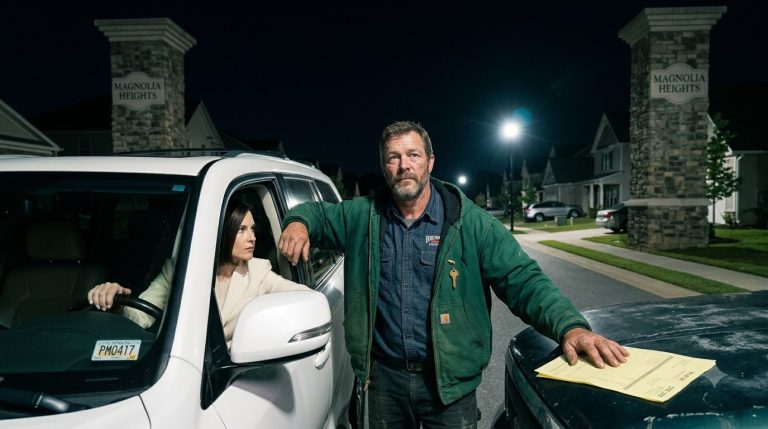
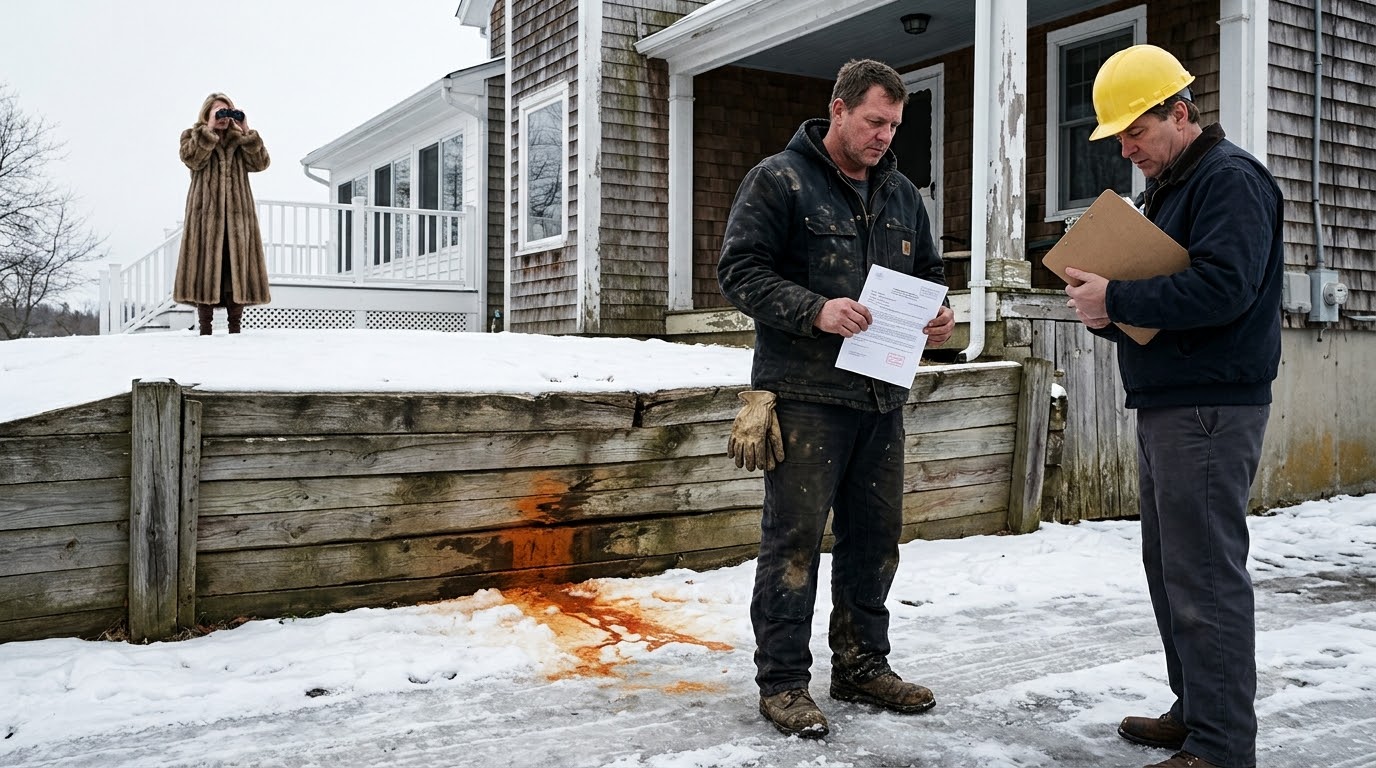
The adhesive on the municipal notice was frozen so brittle it snapped like a dry twig under my thumb. “Code 44B,” it read in bold black ink, the paper fluttering against the weathered cedar siding of my porch as the North wind came howling down the cul-de-sac.
Two hundred feet down the incline, Clare Wells stood on her manicured sunroom deck, wrapped in a floor-length fur coat, binoculars resting against her chest. She didn’t wave. She just held her ground beside the iron railing, her polished leather boots planted firm, watching me read the paper weapon she had summoned. Below her balcony, aligned in a pristine, heated five-bay garage, sat her prized collection of European sedans—glimmering behind clear glass doors like museum pieces.
I turned the worn handle of my chipped ceramic mug, the black coffee inside long gone lukewarm, and looked past her toward the hillside. The snowpack behind my old timber wall was six feet deep, a frozen wedge of ice and packed clay weighing roughly eighty tons. A faint trickle of orange-tinted slush was bleeding from the lower footing, staining the pristine white drift near my driveway.
“I hope you’re taking that eyesore down before the board meeting Tuesday!” Clare’s voice cut straight through the crisp winter air, carrying the sharp, practiced cadence of someone who had never been told no in her six months as HOA president.
I didn’t yell back. I just set my mug on the porch railing, picked up the orange notice, and walked down the slippery wooden steps toward the property line where the timber wall met her immaculate property boundary.
“The wall is holding back the entire drift, Clare,” I said, my voice flat, grounded in the quiet reality of forty years living on this ridge. “You pull these timbers out without a secondary barrier, and the slope loses its footing.”
“It’s unpermitted, it violates neighborhood aesthetic standards, and it’s a visual blight,” she replied, stepping closer to the property line without actually touching the snow. She held a thick, leather-bound notebook tucked under her arm like a shield. “The city inspector agrees with the board. Either it comes down by Friday, or the daily fines begin.”
I looked down at the footing where the orange clay was seeping onto the ice. She didn’t see the physics; she only saw the timber.
CHAPTER 2: PAPERWORK AND DIESEL
I didn’t give her the satisfaction of an argument. I folded the orange ticket twice, tucking it deep into my coat pocket alongside my thick leather work gloves. The paper crackled like dry leaves against my ribs as I turned my back on her deck and headed inside to make the phone call that actually mattered.
An hour later, a grey county sedan pulled up to the curb, its tires crunching over the hard-packed ice. Gary stepped out first, adjusting a yellow hard hat that sat absurdly high on his head. He carried a heavy clip-board, his eyes glued to the top page before his feet even hit the pavement. Behind him, Clare emerged from her front door in an instant, her designer coat unbuttoned just enough to show an pristine silk scarf, her heels clicking precisely against her cleared driveway.
“Inspector Gary,” Clare called out, her voice dripping with artificial warmth that didn’t reach her eyes. “Thank you for coming out so quickly. As you can see, the property owner is still refusing to address the hazard.”
Gary didn’t look at the slope. He didn’t look at the six feet of packed winter ice or the massive cedar timbers bowing under forty tons of hydraulic pressure. He looked at paragraph three, section B of his code book. “Sir,” Gary said, his voice flat, monotonous, and entirely stripped of human judgment. “City code 44B is straightforward. Unpermitted structural additions within ten feet of a drainage easement must be removed. Aesthetics must conform to the HOA guidelines set for the lower quadrant.”
“The wall isn’t an aesthetic choice, Gary,” I said, stepping between him and the timber footing. I pointed down at the base, where the faint, rust-colored sludge was slowly oozing through the snowpack. “That’s clay runoff from the upper ridge. You force me to pull these anchors without a replacement barrier in place, and gravity does the rest.”
“Replacement requires a secondary structural application,” Gary replied, flipping to a blue form on his clipboard without missing a beat. “Which requires adjacent property owner sign-off for design continuity. Mrs. Wells has filed a formal objection to any timber or poured-concrete installation.”
Clare offered a polite, razor-thin smile, crossing her arms over her notebook. “We have high standards in this cul-de-sac. A limestone facade or reinforced cinder system is the only approved structure for this slope. Anything less degrades the property values of my garage facilities.”
I knew the cost of a three-hundred-foot limestone retaining wall. It was fifty thousand dollars—cash I didn’t have, and cash she knew I didn’t have. She wasn’t trying to fix the slope; she was trying to force a foreclosure.
“So the order stands,” Gary said, handing me a white carbon copy with a stamped red signature at the bottom. “Full abatement by Friday at five PM. Failure to comply results in a five-hundred-dollar daily civil assessment, followed by municipal lien proceedings.”
I looked at the white sheet, then at Clare, whose eyes glinted with quiet, triumphant malice. She thought she had used the city to corner me. She didn’t realize she had just signed an order to pull the plug on a dam.
“Alright,” I said quietly, taking the carbon paper. “Friday it is.”
I didn’t call a lawyer. I didn’t go live on social media or knock on doors looking for sympathy. I drove down to the industrial park at the edge of town, parked outside a rusted corrugated metal bay, and walked into the smell of hydraulic fluid and diesel exhaust. Sal Marino was sitting at a greasy formica desk, turning a heavy iron bolt between two grease-stained fingers.
“Sal,” I said, dropping the city abatement order on his desk. “I need the excavator.”
Sal picked up the paper, his calloused thumb smudging the fresh red ink as he scanned the municipal seal. He looked up at me, his bushy eyebrows pulling together over dark, sharp eyes. “Alex, that slope is holding back half the mountain. You pull those bottom ties in this weather, and that clay is going to grease the skids.”
“The city says it comes down, Sal,” I said, meeting his gaze. “Official order. No replacement permitted.”
Sal stared at me for three long seconds. Slowly, a low, grunting laugh rumbled deep in his chest. “You’re a mean old dog, Alex. A real mean old dog.” He tossed the iron bolt into a metal coffee can with a heavy clank. “I’ll have the rig on your driveway by seven AM Friday.”
CHAPTER 3: PULLING THE PINS
Sal leaned out the cab window, wiping a sleeve across his steam-fogged windshield. Exhaust burped black into the freezing air, smelling heavy of sulfur and hot oil. “Last chance to call off the circus, Alex,” he called down over the roar of the engine. “Sky’s dumping another three inches by noon.”
“City deadline is five PM, Sal,” I said, stepping onto the icy slope with my shovel. I tapped the carbon copy of the abatement notice jammed into my jacket pocket. “We follow the letter of the law.”
Clare’s sunroom door slid open with a sharp, metallic screech. She stepped onto her upper balcony wearing a heavy down parka, holding a steaming mug in one hand and her leather binder under the other arm. “Make sure you clear every piece of that timber off the easement line!” she shouted across the yard. “If there’s a single splinter left on the lower terrace, I’m calling inspector Gary back before lunch!”
I didn’t answer. I just motioned to Sal with a single nod.
The hydraulic arm groaned as Sal dropped the heavy bucket against the top retaining beam. Metal teeth bit into the aged cedar with a sickening crunch. The moment the first twenty-foot timber was ripped free from its steel anchor pins, the ground beneath my boots gave a sickening, shuddering lurch.
“Whoa!” Sal killed the throttle, the engine dropping to a low throbbing hum. He shoved the cab door open, staring down at the exposed slope. “Alex, look at the seam.”
Where the top timber had rested for thirty years, there was no solid soil. A thick, wet ribbon of bright orange clay was exposed to the cold air, wet and slick as fresh grease, sliding imperceptibly over a smooth sheet of blue bedrock beneath. The snowpack above wasn’t sitting on ground; it was floating on a lubricated ramp, held back purely by the weight of the timber grid we were actively destroying.
“That’s a subterranean runoff channel,” Sal spat onto the snow, his eyes wide. “The whole ridge is sitting on an underground grease trap. You pull the bottom two tiers, and this entire bank is going into her driveway.”
“Keep pulling, Sal,” I said, my voice steady despite the vibration traveling through the soles of my boots. “Official city order. Complete removal demanded.”
“You’re out of your mind,” Sal muttered, but his hands went back to the hydraulic joysticks.
By eleven o’clock, the storm picked up. Heavy, wet snow flakes began to pelt the exposed slope, adding hundreds of pounds of fresh weight to the unanchored clay. Clare came out to her lower driveway twice, taking photos on her phone with a tight, satisfied smirk, completely oblivious to the soft, wet popping sounds echo-ing from the hillside twenty feet above her roof line.
With a final screech of twisting metal, Sal hauled the last structural tie out of the mud. The wall was gone. In its place stood a raw, twenty-foot bank of trembling frozen earth and slush, groaning quietly under the heavy sky. I stepped over to the property line, unrolling a reel of cheap orange plastic safety fencing, stapling it to thin wooden stakes driven into the frozen mud.
“There,” I said, wiping wet sleet from my forehead with the back of my glove. “Code compliance complete.”
Sal climbed down from his machine, handing me a official work invoice stamped in dark red ink across the front: Work performed strictly under municipal abatement order. Extreme risk of slope failure noted.
“Sign it,” Sal said, his voice flat. “Because when this hill moves, I want my name off the lawsuit.”
I signed the slip against the hood of his truck, keeping the yellow customer copy for myself. As Sal backed his trailer out of the cul-de-sac, the low rumble of the diesel died away, leaving only the quiet, sinister sound of wet clay slipping against stone in the dark afternoon.
CHAPTER 4: THE SOUND OF BUCKLING STEEL
A low, guttural pop echoed through the freezing darkness, followed by the wet, tearing sound of earth giving up its hold on bedrock.
I didn’t move. The orange plastic safety fencing snapped in two with a sharp crack, the wooden stakes splintering under a wave of heavy, ice-choked mud. Fifty feet below, the floodlights illuminating Clare’s glass garage bay caught the sudden, unnatural bulge in the darkness as eighty tons of frozen clay accelerated down the incline.
Then came the rumble—a heavy, mechanical growl that vibrated straight through the floorboards of my porch and up into my jaw.
The avalanche hit the lower structure like a battering ram. The reinforced glass doors didn’t just shatter; they buckled inward with a deafening screech of twisting aluminum and exploding tempered glass. A wall of white snow and orange sludge surged through the openings, sweeping over the polished concrete floors.
Tires screeched as luxury sedans were shoved sideways into steel support beams. Paintwork crumpled against concrete walls under the relentless pressure of the slide. Mirrors snapped off, hoods bent like cardboard, and within six seconds, all five of Clare’s prized vehicles were completely buried under a five-foot blanket of frozen debris.
Clare’s sunroom door slammed open so hard the frame rattled. She stumbled onto the balcony in a fur-lined robe, her hair wild, her face completely drained of color as she stared at the shattered, mud-filled tomb below.
“My cars!” she shrieked, her voice cracking into an unhinged scream that pierced the cold night air. “My cars! What did you do?!”
I raised my mug, taking a slow sip of cold air, my posture relaxed against the porch railing. “I followed the municipal abatement order, Clare. Removal mandated by five PM.”
“You did this on purpose! This is destruction of property! You’re going to prison!” She slammed her fist against her iron railing, her body trembling with helpless rage as the last bits of slush trickled through her broken garage doors.
Down the cul-de-sac, blue and red emergency lights began to cut through the swirling snow as a police cruiser rounded the corner, its tires crunching carefully over the slick pavement toward the disaster.
CHAPTER 5: THE PAPER SHIELD
Deputy Miller held his flashlight low, the beam cutting through the swirling sleet to illuminate the shattered glass and crushed roofs buried inside Clare’s lower bay. His boots sank two inches into the thick, orange-tinted mud spilling across the asphalt.
“Sir,” Miller said, his breath fogging heavy in the cold air as he turned toward me. “Are you the owner of the upper lot where this slide originated?”
“I am,” I said, handing him the damp manila envelope. “And before you ask, everything you’re looking at was done under strict municipal directive.”
Clare came charging down her snow-covered driveway, her fur-lined robe trailing in the slush, her mascara running down her pale cheeks in jagged black streaks. “He destroyed my garage!” she shouted, pointing a trembling, manicured finger straight at my chest. “Arrest him! He deliberately pulled down the retaining wall to ruin my collection! He has no permits! He acted maliciously!”
Miller didn’t raise his voice. He unbuttoned the top latch of his clipboard and took the manila envelope from my hands. “Ma’am, please step back to your porch. I need to review the documentation.”
“I am the HOA president!” Clare’s voice hit that shrill, unhinged pitch of someone whose authority was evaporating in real time. “I don’t need to step back! He committed a criminal act!”
Miller ignored her, unfolding the paper stack under his flashlight beam. First came the orange Notice of Violation from Inspector Gary, stamped with mandatory abatement by Friday at five PM. Beneath it was the formal denial of my secondary permit application—signed personally by Clare Wells on behalf of the board, rejecting any timber, poured concrete, or cinder block replacement due to aesthetic non-compliance.
“Look at the third page, Deputy,” I said quietly, my hands resting deep in my coat pockets. “That’s the contractor’s work order from Sal Marino. Stamped ‘Work Performed Under Protest.’ It explicitly states that removing the unpermitted timber wall without an immediate structural replacement would cause catastrophic slope failure.”
Miller’s thumb held the page down against the biting wind. He read the contractor’s warning, then flipped back to the denial form signed by Clare. His head turned slowly toward her.
“Mrs. Wells,” Miller said, his tone dropping into a dry, flat register. “You ordered the removal of the upper barrier, and you formally blocked the installation of a replacement wall?”
“It didn’t match neighborhood standards!” she yelled, her voice shaking as she stepped into the mud. “He was supposed to build a limestone facade! He was required to comply!”
“A limestone wall costs fifty grand and takes six weeks for municipal approval,” I said, looking her dead in the eye. “You gave me five days to abate or pay five hundred dollars a day. You forced the removal, blocked the safety net, and gravity did the rest.”
Miller refolded the papers, slipping them safely back into my envelope before handing it back to me. He looked at the five buried luxury cars, then back at Clare, whose breathing had turned ragged and shallow under the flashing red lights.
“Ma’am,” Miller said, pulling out a small notepad. “This isn’t a criminal matter. This is a civil hazard created by conflicting municipal and HOA mandates. You’ll need to contact your primary insurance carrier. But based on this paper trail, your policy is going to take the full brunt of the structural damages.”
Clare stared at him, her mouth opening and closing without a single sound coming out. Her eyes darted from the officer to the mound of mud burying her sedans, the sudden, crushing weight of her own bureaucracy collapsing around her shoulders.
CHAPTER 6: THE QUIET BOUNDARY
Sal stepped back from the wall, scraping a trowel across the face of a heavy gray block to clean off a line of wet mortar. The limestone stood eight feet tall, reinforced deep into the bedrock with steel rebar and thick drainage weep-holes, designed to divert the ancient clay runoff safely away from the lower lots.
Across the street, a white moving van was backed up to Clare’s driveway. Two men in blue jumpsuits were loading silver-framed patio furniture and stacks of taped cardboard boxes into the cargo bay.
Clare emerged from her front door carrying a small acrylic briefcase. She didn’t look up at the ridge, and she didn’t look down at the empty, newly repaired garage where her luxury sedans used to sit before the insurance adjusters hauled them away as total losses. When her eyes accidentally caught mine, her jaw set tight, her shoulders stiffening under her coat before she climbed into the passenger seat of her husband’s crossover and pulled away down the cul-de-sac for the last time.
The HOA board had held an emergency meeting the week prior. Without Clare’s loud insistence, they quietly rescinded her arbitrary aesthetic guidelines, formally adopting the city inspector’s safety standards as the new community standard.
“That’s the last course, Alex,” Sal said, walking up the wooden steps toward my porch, his heavy boots leaving dust on the pine boards. He wiped his hands on an old rag, looking down at the gleaming stone barrier protecting the slope. “That wall will outlive both of us. The city signed off on the final inspection an hour ago.”
“Appreciate it, Sal,” I said. I reached over to the small wrought-iron table beside my chair and picked up the payment check, handing it to him.
He took the check, checked the number, and tucked it into his shirt pocket with a short nod. “You know, if she had just let you fix the timber three weeks ago, it would’ve cost her nothing.”
“People like Clare don’t want things fixed,” I said, leaning back in my chair. “They just want to be the ones holding the hammer.”
Sal gave a low chuckle, turning to head back down to his truck. “Well, gravity’s got a bigger hammer than any board president.”
I took a slow sip of my coffee, feeling the warm ceramic against my palms. Below my property, the cul-de-sac was still and quiet under the pale afternoon sun. The limestone wall stood solid and silent against the ridge, holding the earth exactly where it belonged.