The Iron Boundary of Mesquite Ridge: How an Honest Worker Dismantled Petty Bureaucracy
CHAPTER 1: THE ORANGE NOTICE
The heat coming off the driveway asphalt hit my boots like a warm furnace draft.
I set down the steel socket wrench against the workbench, the metal clinking dryly in the quiet afternoon air.
Crooked across the white paint of my garage door sat a square of bright orange paper, stuck firm with cheap masking tape.
I pulled the tape off in one slow motion, the sticky residue tearing against the fresh stucco finish.
“Unsafe Storage,” the bold text read, signed with a sharp, computer-generated stamp at the bottom.
Across the curb, a silver sedan idled, its driver holding a digital camera flush against the tinted driver-side window.
I didn’t yell, and I didn’t chase the car as it pulled away into the desert dust.
I just turned the heavy chrome socket between my fingers, feeling the cool weight of forged steel against my calloused palm, and looked at the empty street.
They thought a piece of colored paper would make a man hand over his peace.
CHAPTER 2: PAPER THREATS AND DESERT DUST
The sun burned hot and flat over the fresh asphalt of Mesquite Ridge, turning the air into a shimmering wall of dry gas fumes and cheap stucco dust.
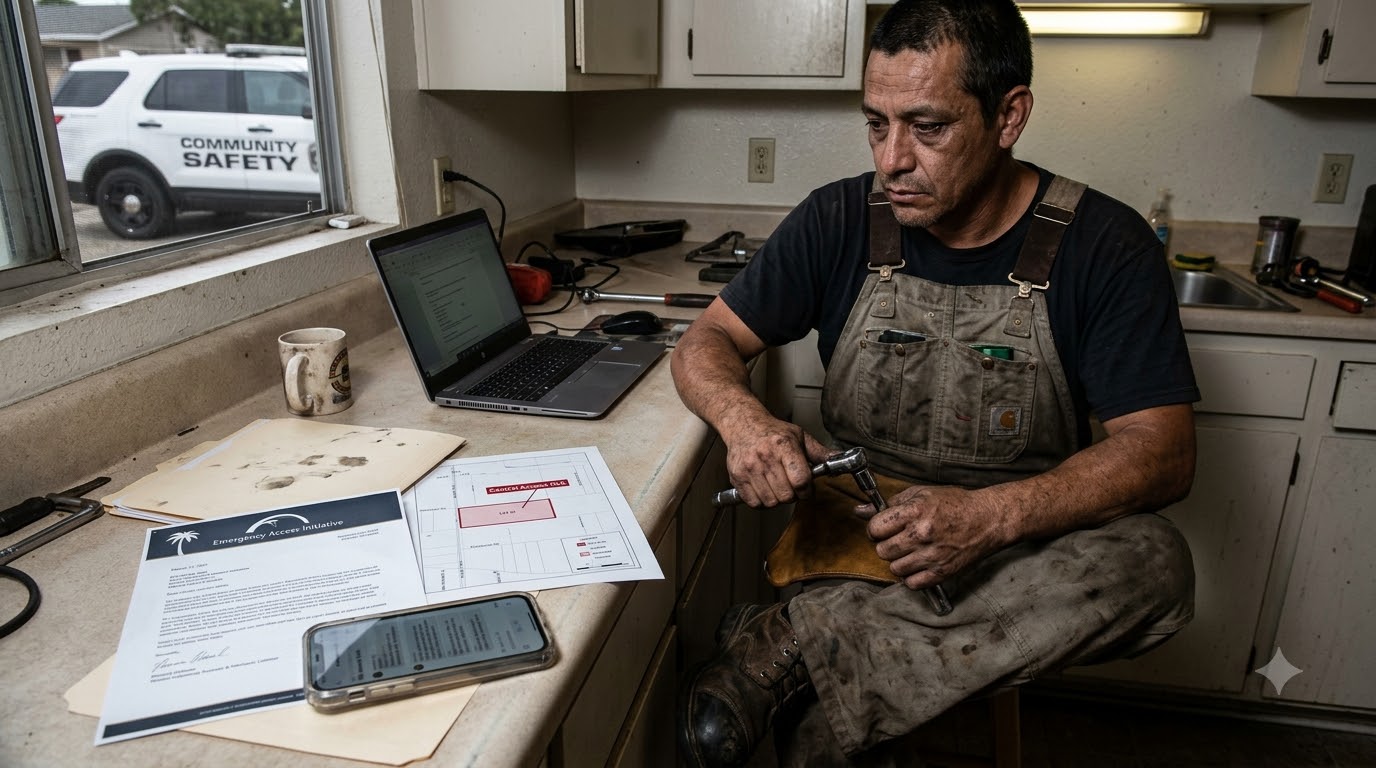
I sat at the kitchen counter, sliding a sheet of heavy printer paper across the laminate top.
The letterhead carried the official subdivision logo—a stylized palm tree over a sweeping arch—with Veronica Hail’s name printed dead center in crisp, dark ink.
“Emergency Access Initiative,” the bold header stated, demanding either a physical key or a smart lock code to be logged into a master registry within forty-eight hours.
I picked up the heavy chrome socket wrench from the counter, rolling the cool six-sided cylinder across my knuckles before setting it down beside my phone.
I pulled up the county planning database on my laptop, the screen reflecting the dark circles beneath my eyes.
Buried three layers deep under scanned developer maps, a multi-million-dollar regional pilot grant document flared on the screen—a red rectangle labeled Central Access Hub sat squarely over my lot number.
My front door wasn’t just a entrance to them; it was a line item on an unapproved government budget.
The front porch floorboards creaked outside, followed by the dry, metallic rattle of my mailbox flap shutting.
I didn’t rush to the window, and I didn’t reach for my phone to call Dan or any other old favor in law enforcement—I was fighting this on my own dirt.
Through the narrow side glass, I watched a woman in a neon safety vest walk toward a white SUV idling at the curb, a digital camera dangling from her wrist.
She didn’t glance back, but her presence lingered like smoke from a brush fire moving steadily toward my fence.
I folded the printed grant map once, creasing the edge sharp with my thumb, and slid it into a fresh Manila folder alongside the orange citation.
If Veronica wanted to turn a working man’s home into public infrastructure, she was going to have to break her own teeth on the legal fine print first.
A sharp chime echoed from my phone, cutting through the hum of the air conditioner.
I tapped the screen, opening an incoming email from the HOA main portal—a notice of pending daily assessments, rising by two hundred dollars for every sun that set on my refusal.
I closed the laptop lid, listening to the soft click of the plastic latch catching in the silence.
Veronica Hail thought money and paper threats could starve out common sense, but paper burns easily when you know where to hold the match.
CHAPTER 3: THE WHISTLEBLOWERS LEAK
The glowing screen cut through the dim room, displaying two sentences from a number I didn’t recognize.
“You don’t know me. I do maintenance for the HOA. You’re right about the grant.”
I picked up the chrome socket wrench, feeling the chill of the metal against my palm as a secondary attachment lit up the screen—a crisp screenshot of an internal board chat.
Veronica Hail’s name sat at the top of the chat logs in bold text above a message sent less than an hour ago.
“Rios is the problem case,” her message read. “Once we get his access, the rest will comply. Use contracted officers if necessary.”
A second image loaded beneath it—a scanned budget spreadsheet listing “Contracted Security Enforcement” under a line item previously marked for drought-tolerant landscaping.
I didn’t call the sheriff, and I didn’t post the image to the neighborhood social page.
Instead, I opened my browser, attached the screenshot to the pending state grant oversight file, and sent the entire packet to the county engineer’s secure inbox.
My thumb hovered over the socket wrench’s heavy shaft, turning the tool slowly over the counter surface while I waited for the server confirmation icon to turn green.
The reply came back three minutes later from the county oversight office: “File received. Do not engage alone. We are elevating to state compliance.”
Outside, a low hum vibrated through the glass as the white community safety SUV rolled past my driveway for the third time tonight, its headlights cutting dark shadows across my living room wall.
Veronica wasn’t just trying to standardize a lock; she was using a shell enforcement team to force a paper default on my lot.
I backed up the chat files to three separate cloud drives, closed the phone, and set it flat beside the heavy socket wrench on the counter.
The board thought they were clearing a simple obstacle on a desert map.
They were about to find out what happens when you try to build an illegal hub on a working man’s foundation.
CHAPTER 4: THE PORCH SIEGE
I opened the front door three inches, keeping my boots set behind the frame.
The tallest man stepped directly into the gap, his shoulder crowding the jamb while his right hand rested flat against his belt line.
“Spare key,” he said, his voice flat and practiced. “HOA emergency ordinance. Hand it over.”
“You’re standing on private property,” I said, setting the chrome socket wrench vertically against the entryway doorframe. “You have no legal warrant and no state authorization.”
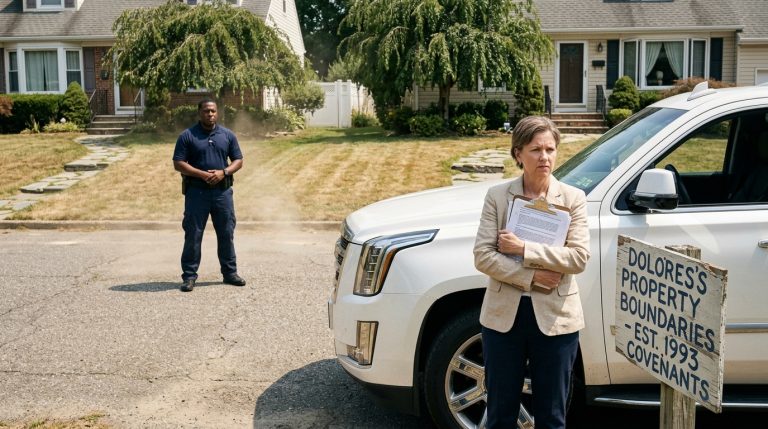
Across the curb, Veronica Hail stood on the sidewalk in her bright red blazer, holding her phone high to record every breath I took.
“Non-compliance escalates, Mr. Rios,” she called out, her tone sharp enough to draw three neighbors out onto their lawns. “We are standardizing access for community safety.”
The guard on the right shifted his weight, his vest stretching tight over his chest—and that was when I caught the detail.
The plastic mounting clip on his shoulder vest was totally blank, completely missing the state-mandated security guard licensing stamp required on all private guard gear.
“You aren’t state-licensed security,” I said, looking the lead man dead in the eyes. “You’re paid muscle operating on an unapproved grant proposal.”
The lead guard’s jaw clenched, his eyes darting toward Veronica as her recording phone dipped half an inch.
“Hand over the key,” the lead man repeated, taking a half-step forward so his boot toe crossed my threshold. “Or we enforce compliance right now.”
I didn’t reach for a weapon, and I didn’t back into my hallway.
I leaned my weight into the solid oak doorframe, holding my ground while my phone in my back pocket recorded every word directly to the state regulatory server.
CHAPTER 5: THE BUREAUCRATIC COUNTERMOVE
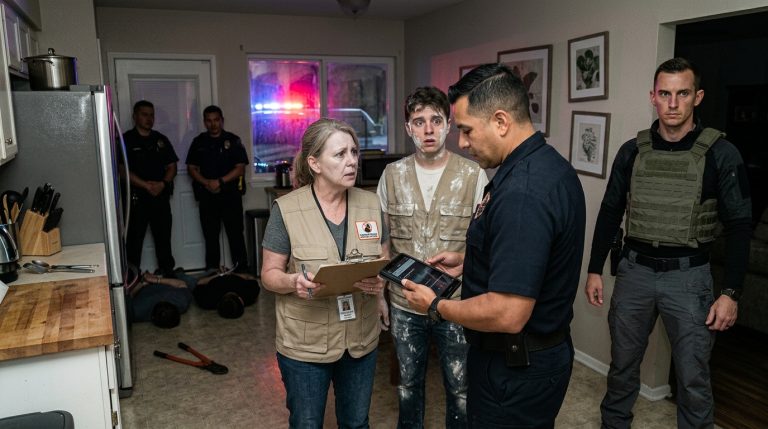
A silver state-inspection sedan pulled up behind Veronica’s red blazer, followed immediately by two county code enforcement trucks.
A tall woman in a dark business suit stepped out of the silver sedan, carrying a thick binder and a digital tablet already lit up with blue regulatory seals.
“Step off that porch,” she said, her voice clear and devoid of any dramatic flare as she crossed the asphalt. “State Grant Oversight Office. We have an immediate freeze order on all Mesquite Ridge Pilot operations.”
Veronica stepped forward, her heels clicking aggressively against the concrete as she raised her phone screen.
“You have no standing here—this is a private HOA safety initiative!” Veronica snapped, her voice tightening at the edges. “These homeowners signed CC&Rs that authorize emergency access!”
“They signed bylaws,” I said, tapping my phone screen to display the county database log to the inspector. “Not an unapproved grant proposal that turns private property into a municipal utility hub without homeowner consent.”
The state inspector looked past Veronica, taking in the three men in cheap vests and pointing her tablet directly at the lead guard’s unbranded shoulder clip.
“Unlicensed security enforcement,” she noted, tapping the screen twice. “Operating under a fraudulent grant application using state funding references. That is a class-one regulatory violation.”
The lead guard took a step backward off my threshold, his eyes darting toward the street as the county code officers began taking high-resolution photos of the men, the vests, and Veronica’s red blazer.
Veronica’s face flushed dark red, her hands trembling as she lowered her recording phone, frantically trying to delete the active group chat on her screen.
“This is a administrative error!” she yelled, stepping toward her car as the county inspector pulled out a formal stop-work order stamped with state seals. “My legal team will have this cleared by morning!”
“Your legal team can answer to the state attorney general’s office,” the inspector replied flatly, handing her the formal injunction sheet. “All HOA assessment powers and grant funds are suspended as of five minutes ago.”
Veronica clutched the paper, her breath coming in shallow, ragged bursts as the three hired enforcers quietly retreated toward their unmarked SUV without saying another word.
She stood alone on the curb in the desert heat, surrounded by neighbors who watched in absolute silence as her borrowed authority dissolved into paper waste.
CHAPTER 6: RECLAIMED SOIL
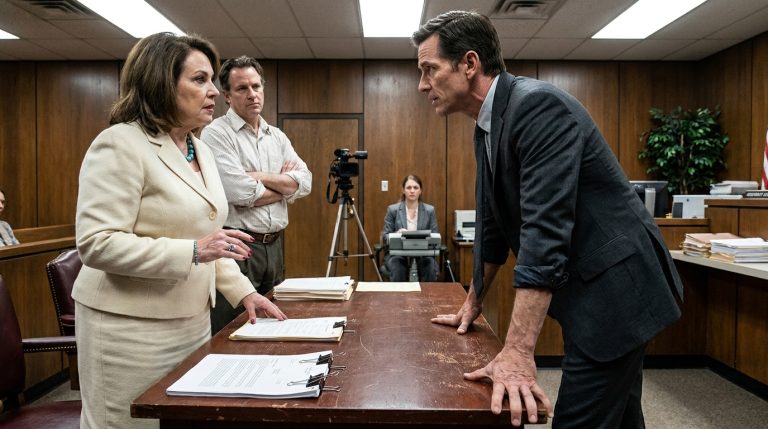
“You can’t do this!” Veronica shrieked, her voice cracking across the silent cul-de-sac as two county deputies arrived to supervise the enforcement order. “I built this community! I’m protecting your home values!”
“You tried to sell my front door to a state grant program for akickback,” I said, my voice low and steady as I walked down my porch steps.
She opened her car door, her face pale, mascara running down her cheek from the desert heat, still trying to type frantically into her phone to file a emergency motion.
The deputy reached out, placing a firm hand on the top of her car door frame to keep it open.
“Ms. Hail, you need to step away from the vehicle,” the deputy said, pulling up the formal county citation on his handheld radio. “State oversight has frozen all HOA assets pending a forensic audit of the board accounts.”
The entire street held its breath as Veronica’s phone slipped from her fingers, clattering onto the dry gravel of the shoulder.
She didn’t get to make a grand speech, and she didn’t get to threaten another fine.
She just sat in the back of the county vehicle, staring blankly out the tinted window as it pulled away toward the main highway, leaving the neighborhood in absolute quiet.
An older neighbor from across the street walked over slowly, carrying a cup of instant coffee in one hand and a small stack of orange violation notices in the other.
“We didn’t know what she was doing with those grant papers, Arthur,” he said, tossing the orange notices straight into my driveway recycling bin. “We just thought she had the law on her side.”
“Nobody has the law on their side when they’re lying on paper,” I replied.
I turned back toward my house, walking up the driveway where the low western sun cast long, clean shadows across the fresh stucco.
I opened the garage door, picked up the chrome socket wrench from the workbench, and set it back into its slot in the steel red toolbox.
I clicked the heavy iron latch shut, turning the key until the lock snapped tight in my palm.
My home was just a house on a dusty desert lot, but the door belonged to me—and no paper threat in Mesquite Ridge was ever going to change that again.