The Price of Clean Concrete: How One Working-Man Refused to Be Broken by Petty Suburban Royalty
CHAPTER 1: THE MUD AND THE LEXUS
The coffee in my paper cup was cold, but the vibration of the idling engine was warm through the soles of my work boots.
A four-hundred-year-old white oak sat across the main boulevard of Magnolia Heights like a dead leviathan, its roots ripped from the Georgia clay and pointing toward the sky. Leaves, crushed mailboxes, and shattered slate shingles covered the manicured lawns. My foreman, Miguel, stood near the front tire of my truck, his hands jammed deep into his grease-stained work apron, waiting for my signal.
“Eight men on payroll,” Miguel said, his voice low against the rumble of the Ford diesel. “If we sit here looking at it, we’re burning eighty bucks an hour in pure air.”
I didn’t answer. I just rolled the brass hydraulic key between my thumb and forefinger inside my jacket pocket—the same notched piece of brass my father used to bled the lines on his 1978 Caterpillar. The metal was smooth, cold, and heavy.
A white Lexus SUV pulled up onto the muddy shoulder, its tires crunching over splintered pine branches without slowing down. The driver’s door swung open, and Patricia Morrison stepped out directly into three inches of Georgia red clay.
She didn’t flinch at the mud on her pristine cream-colored pantsuit. Her hair was cut into a sharp, angled bob that didn’t move in the humid morning wind. She held an iPhone up like a shield, snapping rapid photos of the fallen oak before turning the lens directly on my truck.
“You’re Drummond?” she asked. Her voice was crisp, pitched with the kind of practiced authority that expected immediate posture changes from whoever she was talking to.
“Ethan Drummond,” I said, stepping down from the cab. The clay sucked at my boots, making a heavy, wet sound. “Your board called about the storm debris.”
“The storm was two nights ago,” Patricia said, lowering her phone just enough to look me in the eye. “Our residents cannot access the south gate. This entire street is unacceptable.”
“It’s three hundred tons of green timber, ma’am,” I said, pointing toward the massive trunk blocking the boulevard. “Mother Nature doesn’t check the neighborhood covenants before she snaps an oak.”
Her left eyebrow twitched, just a fraction of a millimeter. “We don’t pay for commentary, Mr. Drummond. We pay for clear roads. Can your crew handle this, or do I need to call a firm from Atlanta?”
“We handle it,” I said. “But it isn’t just cutting logs. Those root balls pulled up the curb. The drainage ditches are packed with silt. To do this right, clear the thoroughfares, and haul the green waste to the county line, you’re looking at eighty-five thousand dollars. Three weeks minimum.”
Patricia took a slow step forward, her spotless designer shoes sinking deeper into the muck. She didn’t look down at them once.
“Eighty-five thousand is absurd for lawn care,” she said flatly.
“It isn’t lawn care,” I said, my thumb pressing hard against the notched brass key in my pocket. “It’s heavy demolition and road restoration.”
She stared at me for three long seconds, evaluating the gray in my beard and the faded logo on my denim shirt. A tight, bloodless smile touched the corners of her lips.
“Get your machines moving,” she said, her voice dropping into a quiet, icy register. “Send your standard agreement to the HOA portal tonight. The board will approve net-thirty terms once the main boulevard is open.”
“Net-thirty isn’t standard for storm response,” I noted.
“It is for Magnolia Heights,” she replied, turning on her heel and marching back toward her Lexus without looking back. “Or you can load your trailer and drive back to the county line.”
CHAPTER 2: UNSPOKEN ORDERS
“Watch your step, boss,” Miguel called down over the rattle of the idle engine. “Neighborhood kids must’ve thrown a bottle at the tracks overnight.”
“Glass clears,” I said, rolling the brass key across my knuckles before shoving it back into my pocket. “Focus on that red oak. The board wants the main thoroughfare open before the evening commute.”
By noon, the diesel exhaust hung thick under the damp pine canopy. My guys were working like a precision clock—Tommy and Jake dropping the heavy branches with two-stroke saws, Russell backing the dump truck up to the curb with six inches to spare on either side. We were moving earth and wood, the kind of honest friction you can measure in sweat and cleared asphalt.
Then the white Lexus pulled up again.
Patricia didn’t get out this time. She lowered the passenger window just enough to let her voice cut through the noise of the chipper. She motioned toward the cul-de-sac on Lot 12, where a jagged granite retaining wall showed a fresh bulge from the soil pressure.
“Drummond,” she called out. “That wall needs to come down while your trackhoe is right here.”
I walked over to the driver’s side, wiping grease from my palms onto a rag. “That retaining wall wasn’t in the walk-through, Mrs. Morrison. It’s structural masonry on private property.”
“It’s an HOA common-element hazard caused by your heavy equipment,” she said, her tone as flat and polished as the glass on her dash.
“My tracks haven’t been within forty feet of that Lot 12 curb,” I said, keeping my voice low and steady. “That wall was bowing before the storm ever hit Georgia.”
She reached for her phone, turning the screen toward me. She wasn’t recording a video; she was framing a photo of my excavator’s bucket sitting twenty feet from the cracked stone.
“If that wall collapses onto the public sidewalk, the HOA will hold Drummond Excavation liable for the structural hazard,” she said quietly. “Or you can clear the stone, haul the rubble, and reinforce the grade while your crew is already clocked in.”
“I don’t work on verbal threats, ma’am,” I said. “You want that wall down, write up a formal change order and sign it.”
A thin, razor-sharp smile touched her lips. She didn’t offer a pen. She didn’t reach for a clipboard.
“We don’t do mid-project paperwork for minor safety adjustments, Mr. Drummond,” she said, raising the power window an inch. “Fix the wall, or I pause the net-thirty authorization for the main boulevard cleanup. It’s all one job.”
She rolled the window all the way up, leaving the Lexus idling in the middle of the road. Inside the cool cabin, her hands stayed firmly on the steering wheel, completely still.
I stood in the red mud, watching my crew across the street. Miguel had the trackhoe bucket hovering over a five-ton log, waiting on my nod. Behind the bowing retaining wall on Lot 12, right where the cracked stone met the muddy drainage ditch, a patch of fresh gray hydraulic cement caught the harsh glare of the midday sun—slathered roughly over dark, weathered cracks that had been leaking groundwater for years.
“Boss?” Miguel shouted over the diesel roar. “We taking the oak first, or moving to the rocks?”
“Take the oak,” I said, my thumb clamping hard against the brass key in my pocket. “And stay off the curb on Lot 12.”
CHAPTER 3: THE COLD INVOICE
The street lamps of Magnolia Heights flickered on, casting long, clean shadows across dark asphalt that had been choked with crushed oak timber three weeks ago. Not a stray leaf remained in the gutters.
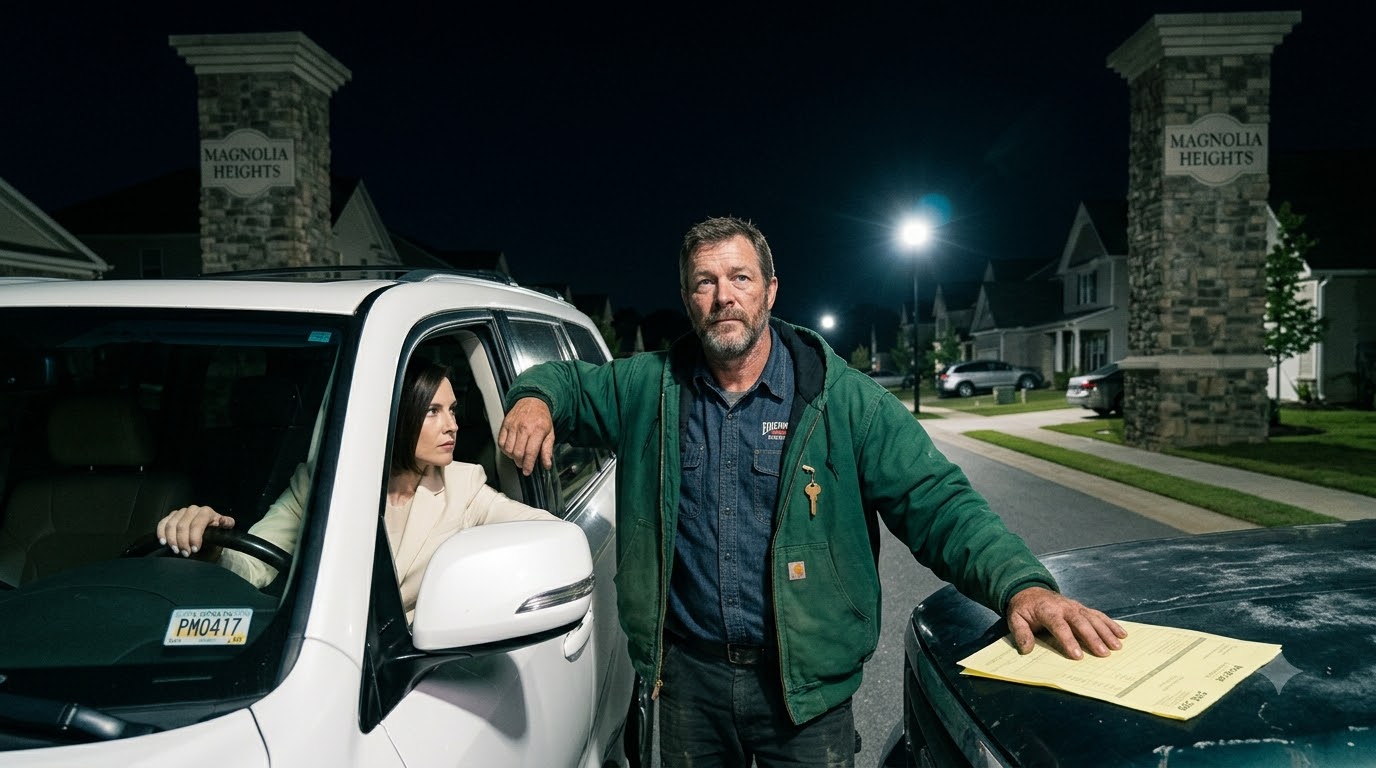
I smoothed out the yellow paper against the hood of my truck. Ninety-eight thousand five hundred dollars. The base clearing, plus the stump grinding, fence repairs, and drainage work Patricia had requested in person every afternoon while standing by my excavator.
Her Lexus glided to a stop near the curb. She didn’t turn off the engine. The driver’s window dropped three inches.
“It looks presentable,” she said, her eyes fixed straight ahead on the stone entrance monument. “Deliver the final paperwork to the clubhouse office.”
I walked over, resting my elbow on the door frame, holding out the carbon receipt. “I have the itemized breakdown right here, Mrs. Morrison. Work is complete.”
She didn’t reach for the paper. Instead, she took a slow sip from a stainless steel tumbler, her manicured fingers perfectly still.
“Eighty-five thousand was the approved figure,” she said smoothly. “That is the amount the board authorized.”
“The eighty-five was for the main boulevard road clearance,” I said, my voice dropping an octave. “The stump grinding, the storm drain clearing at the south cul-de-sac, the fence line—you asked for those daily. That’s another thirteen thousand five hundred in machine time and crew labor.”
“I asked for the neighborhood to be made whole,” she replied, finally turning her head to look at me. Her face was entirely motionless, completely devoid of heat. “My verbal inquiries were operational updates, Mr. Drummond. They were not authorizations for scope expansion.”
A cold knot tightened in my gut. I rolled the brass hydraulic key between my fingers inside my pocket, pressing the sharp metal notch against my thumb until it bit into the skin.
“My men put in a hundred and forty hours of overtime on those stumps,” I said. “You stood right there and watched Russell haul twelve loads of fill dirt.”
“Then you should have secured a signed, written change order before starting,” she said flatly. “As president, I am legally bound to enforce board budget caps. We will disburse eighty-five thousand on net-thirty terms. Not a penny more.”
“And if I don’t accept eighty-five?”
“Then you can file a dispute with our legal counsel,” she said, pulling the power window switch. “Though I doubt a small excavation outfit enjoys paying retainer fees while payroll runs every Friday.”
The glass sealed shut. She shifted into drive and pulled away, leaving me standing in the exhaust fumes under the warm street lamps.
Across the road, Miguel was throwing the heavy tie-down chains over the excavator tracks on the flatbed. He looked over at me, wiping sweat from his forehead with the back of his forearm.
“We good, Ethan?” he called out, his voice tired. “The guys are asking if the checks go out Friday.”
I looked at the yellow sheet in my hand, then at the spotless asphalt stretched out behind her luxury car.
“The checks go out Friday,” I said, folding the paper into a tight, sharp square. “Load the trackhoe.”
CHAPTER 4: THE CORNERED CONTRACTING LINE
The LED beam sliced through the damp darkness, illuminating the underside of the stone footing. Ground water dripped steadily from a seam six inches deep into the soil bank.
I reached out with my bare index finger, scraping away a layer of wet gray paste. Beneath the fresh layer of hydraulic cement was an old, rusted iron patch plate bolted directly into crumbling limestone. The bolts were flaking orange rust—years of slow, steady soil erosion that had nothing to do with my twenty-ton excavator.
“Ethan?”
A flashlight beam cut across my boots. Carol, the younger HOA board member who’d brought my crew cold water on day three, stepped carefully over the muddy curb. Her raincoat was zipped up to her chin, her hands tucked deep into her pockets.
“You shouldn’t be out here in the dark,” she said, her voice barely carrying over the wind in the pines.
I stood up, wiping my muddy hand on the thigh of my jeans, my thumb automatically feeling for the notched brass key in my pocket. “This wall didn’t bow because of my trackhoe, Carol. Someone patched this three seasons ago.”
Carol looked at the beam of light resting on the rusted iron plate, then swallowed hard. She didn’t look surprised.
“Patricia told the board you cracked the drainage main during the tree removal,” Carol whispered, glancing nervously back toward the main boulevard. “She said the HOA is going to have to pay fifty thousand to fix the culvert if we don’t hold your funds.”
“The drainage main is forty feet east,” I said, step by step stepping closer to her beam of light. “She’s covering something up.”
Carol’s throat shifted as she looked down at her mud-smeared sneakers. “The reserve fund is empty, Ethan. We were supposed to have two hundred thousand in the capital maintenance account for stormwater repairs. When the storm hit, Patricia told us the bank holding the funds had an administrative freeze.”
“There is no freeze,” I said flatly.
“I know,” she said quietly. “I asked for the bank statements yesterday afternoon. She refused to open the ledger. She said board members aren’t authorized to review active vendor audit files.”
I turned my flashlight back onto the rusted patch plate, tracing the crack where the soil had washed away beneath Lot 12—which sat directly on the border of Patricia’s personal property line.
“She didn’t want the storm debris cleared,” I said, the reality snapping together like teeth on an excavator bucket. “She wanted my heavy machinery on site so she could blame my crew for the structural failure she’s been hiding under her own yard.”
Carol didn’t contradict me. She just pulled her raincoat tighter against her chest. “She hired a legal firm this morning, Ethan. They’re filing an injunction against your company for property damage tomorrow at nine.”
“Let them file,” I said, my voice quiet and cold as the rain starting to fall. “My bank account might be bleeding, but stone doesn’t lie under oath.”
CHAPTER 5: THE DEPOSITION TRAP
Her lawyer, a young man in an immaculate navy suit, tapped his pen against a yellow legal pad. Patricia sat rigid beside him, her cream-colored blazer unbuttoned just enough to show a heavy gold chain at her throat. She stared at the brass fitting key sitting on the varnish between us as if it were a dead insect.
“Mr. Drummond,” her attorney said, leaning forward. “You’re asking this tribunal to enforce ninety-eight thousand dollars in billing, despite having zero written, signed change orders for the work performed outside the primary boulevard.”
“I am,” I said, my voice quiet in the air-conditioned room.
Patricia let out a short, puffing breath through her nose—a sharp sound of disdain. “He took advantage of a disaster,” she said directly to the court reporter whose fingers hovered over the stenotype machine. “He brought heavy machinery into a private community, tore up our curbs, and then fabricated emergency line items when he realized the HOA had assets.”
“You swore under oath ten minutes ago that Drummond Excavation caused the structural failure at Lot 12,” I said, keeping my hands resting flat on the mahogany. “You testified my trackhoe bucket struck that wall on the second afternoon.”
“Because it did,” she snapped, her knuckles turning bone-white against her leather handbag. “The stone gave way under your driver’s negligence.”
I pulled the top eight-by-ten glossy photograph from my stack and slid it across the polished wood.
The image showed a cross-section of the soil bank beneath Lot 12. A red metal scale ruler rested against the rusted iron patch plate, surrounded by ancient, dark roots that had grown directly through the iron bolt holes.
“That’s a soil core taken three days ago by a certified geotechnical engineer,” I said. “The rust oxidation on those bolts takes approximately six years in North Georgia clay. The hydraulic cement slapped over the front was applied less than three months before the storm hit.”
Patricia didn’t touch the photo. Her attorney looked down at it, his pen freezing mid-stroke.
“That retaining wall has been collapsing since 2020, Mrs. Morrison,” I continued, looking straight into her ice-gray eyes. “And according to the county property registrar, Lot 12’s drainage easement runs directly into your personal parcel.”
“This is irrelevant fishing,” her lawyer interjected, though his voice had lost its crisp edge. “We are here regarding contractor fraud.”
“We’re here regarding why ninety-eight thousand dollars was withheld,” I said. “You claimed the HOA reserve fund couldn’t disburse payment because of my ‘unauthorized work.’ But Carol from your board turned over the bank ledger logs last night.”
Patricia’s posture shattered for half a second. Her right hand twitched toward her phone on the table before she forced her fingers to curl into a tight, quiet fist.
“The reserve fund didn’t have two hundred thousand,” I said, leaning in just enough to cut the distance between us. “It had six hundred dollars. Because three weeks before the storm, eighty-eight thousand was transferred directly into a shell entity registered to your maiden name.”
“That was a legal management retainer!” she shouted, slamming her palm down onto the mahogany table so hard her gold bracelet clattered against the wood. “You have no right—you are a dirt mover! You dig holes in the ground! You don’t question how a premier residential community manages its capital!”
“I don’t care about your capital,” I said, reaching out and picking up my brass key, holding it firmly between my fingers. “I care about my eight men on payroll. And now the District Attorney has the core samples.”
She glared at me, her chest heaving under her crisp blazer, her teeth clamped tight as her lawyer hurriedly pulled her arm down to force her back into her chair. She didn’t sign a settlement. She didn’t offer a dime. She just stared at me with pure, unadulterated venom.
CHAPTER 6: THE FINAL RECKONING
The blue and white lights flashed silently against the brick facade of her two-story home, reflecting off the spotless hood of her Lexus.
Patricia came down the front steps with her head held unnaturally high, her hands cuffed behind her back over a tailored trench coat. She wasn’t yelling. She wasn’t crying. Even in defeat, she gripped her pride like a weapon, glaring at the deputy’s shoulder as he guided her into the back seat.
The rear door clicked shut with a heavy, final thud.
Carol walked across the manicured lawn toward my truck, carrying a leather-bound board registry under her arm. She stopped near my driver’s side door, watching the cruiser turn slowly around the cul-de-sac.
“The court freeze lifted thirty minutes ago,” Carol said, handing me a slip of paper alongside the cashier’s check. “One hundred and fifteen thousand dollars. Full invoice, interest, and the engineering audit fees.”
I looked down at the check. The paper felt thick and crisp in my calloused hands, the black ink bold and unyielding.
“The board voted unanimously last night,” Carol added softly. “We’re filing a civil lien on her property to recover the rest of the reserve fund. She’s officially barred from serving on any corporate or residential board in the state.”
“A woman like that always thinks she can outrun the bill,” I said, thumbing the edge of the certified paper before folding it once and placing it into my breast pocket.
“She thought because we lived in big houses, we’d rather cover her mess than make a scene,” Carol replied, offering a faint, weary smile. “Thank you for making the scene, Ethan.”
“I just moved the dirt,” I said.
Across the street, the morning sun hit the stone monument at the entrance of Magnolia Heights. The trees were gone, the roads were wide and clear, and the drainage ditches flowed quietly toward the river without obstruction.
I reached into my jeans, pulled out the greasy brass hydraulic key, and slid it into the ignition of my truck. The diesel engine roared to life on the first turn, steady and grounded.
Miguel was waiting back at the yard with eight men and a fresh list of equipment repairs. I put the truck in gear and drove past the stone entrance, heading back out toward the open county line.