The Marble Floor And The Broken Sole: How A Ten-Year-Old Boy Brought A Corporate Bank To Its Knees
CHAPTER 1: THE COLD MARBLE
The counter was built for adults who carried briefcases and wore silk ties. Wesley reached the edge on his tiptoes, his thrift-store jacket swallowing his small frame like a heavy blanket.
“Excuse me, sir. I’d like to check my account balance, please.”
Branch manager Bradley Whitmore stopped midway through adjusting his gold-plated cufflink. He looked down slowly, his gaze crawling from the cracked soles of Wesley’s sneakers up past the frayed denim to the boy’s tense, unblinking eyes.
A sharp, theatrical laugh broke from Bradley’s throat, bouncing off the high vaulted ceilings of the marble lobby.
“Check your account?” Bradley’s voice carried deliberately, designed to pull the attention of the surrounding tellers and waiting patrons. “This is First National Heritage Bank, kid. Not a welfare office or a lost-and-found bin.”
Bradley stepped closer, his expensive sandalwood cologne washing over the counter and sharp against the stagnant indoor air. He shook his head, a smirk curling the corner of his mouth as he gestured toward Wesley’s feet with an outstretched pen.
“Look at those shoes. Look at that jacket. Another street kid looking for a handout.” Bradley raised his voice to capture the rest of the room. “You people are all the same. Get out before I call security. We serve real customers here.”
The security guard near the brass-framed entrance shifted his weight, his heavy hand coming to rest deliberately against the black rubberized grip of his baton.
A wealthy man in a crisp golf polo laughed from the leather seating area behind Wesley, his voice booming over the hum of the air conditioning. “Throw him out already. He’s stinking up the place.”
Laughter rippled through the lobby, a tight wave of cruel, unified amusement. Not a single person moved to close the distance or offer a word of defense.
Wesley’s throat tightened, a dry, burning pinch that made it difficult to swallow. His fingers curled inward, digging deep into the fabric of the brown paper envelope clutched in his left hand.
“Sir, I have an account here,” Wesley said. His voice shook slightly, thin and small against the vastness of the room, but it did not break. “My grandmother opened it for me. She passed away two months ago. She left me this.”
He lifted the envelope, holding it out flat across the polished wood of the counter. Inside were the folded documents, the worn passbook, and the final handwritten letter from Eleanor Brooks.
Bradley didn’t take the envelope. He stared at it for a fraction of a second before rolling his eyes toward the ceiling in dramatic exasperation.
“Your grandmother,” Bradley muttered, turning his head just enough to wink at Chelsea Morrison, the senior teller leaning over the adjacent terminal. “Let me guess. She also left you a private island and a fleet of luxury cars.”
Chelsea’s lips curled into a sharp, synchronized sneer. “Sir, should I call the police? This kid is obviously running some kind of scam.”
Bradley waved a dismissive hand, leaning his hip against the counter as he reached down and snatched the envelope roughly from Wesley’s grip.
“Not yet,” Bradley said, his eyes dropping to the documents as he yanked them free. “Let’s see what kind of con he’s pulling first.”
CHAPTER 2: THE ISOLATED CORNER
Wesley sat with his shoulders hunched, his fingers locked tightly around the frayed edges of the brown paper envelope. The lobby hummed with the rhythmic clatter of receipt printers and the steady drone of efficient business.
Nobody looked toward the janitor’s closet. To the tellers and the passing patrons in tailored coats, the ten-year-old boy in scuffed sneakers was nothing more than an architectural blemish.
A middle-aged man in a charcoal wool suit stepped up to the main counter, dropping a stack of deposit slips onto the polished wood. Chelsea Morrison greeted him with an immediate, glowing smile, her hands moving across the keyboard with practiced speed.
No manager was called. No extra identification was demanded. The transaction finished in under two minutes with a crisp handshake and a polite nod of farewell.
Wesley watched the man walk out the glass doors, clutching his leather briefcase. He shifted his weight on the hard seat, his sneakers barely grazing the polished tile floor.
The air near the service entrance smelled faintly of fresh floor wax and commercial bleach, sharp enough to sting the back of his throat. His fingers traced the rigid outline of the bank card hidden inside the envelope, feeling the raised numbers of the platinum reserve tier pressing against his thumb.
Ten feet away, Chelsea brought Bradley a fresh paper cup of coffee from the rear breakroom. They stood shoulder-to-shoulder beside the gleaming water cooler, their heads tilted together in quiet conversation.
Bradley’s eyes flicked sideways toward Wesley’s corner, a cold, dismissive look that vanished behind a smirk as Chelsea let out a sharp, muffled laugh.
Wesley lowered his gaze to his lap, his chest tightening with a hot, prickling sensation that made it difficult to draw an even breath. He pulled Grandma Eleanor’s letter from the envelope, the folded paper soft and worn from a lifetime of being held too tightly.
My brave Wesley, her shaky cursive read, never let anyone make you feel small.
The words blurred behind a sudden film of moisture, but he refused to let the tears fall, blinking rapidly against the sting. His phone buzzed sharply against his thigh, the vibrating hum cutting through the ambient drone of the bank.
He pulled the cracked device from his pocket, the screen fractured into a spiderweb of hairline cracks across the display. A text from Uncle Lawrence glowed in the dim light: Stuck in a tight regulatory meeting. Be there in twenty minutes. You’re doing great, champ.
Wesley stared at the glowing letters for three long seconds, feeling the profound weight of an empty waiting room and a thirty-minute clock ticking down against an impossible wall.
CHAPTER 3: THE INTERROGATION DESK
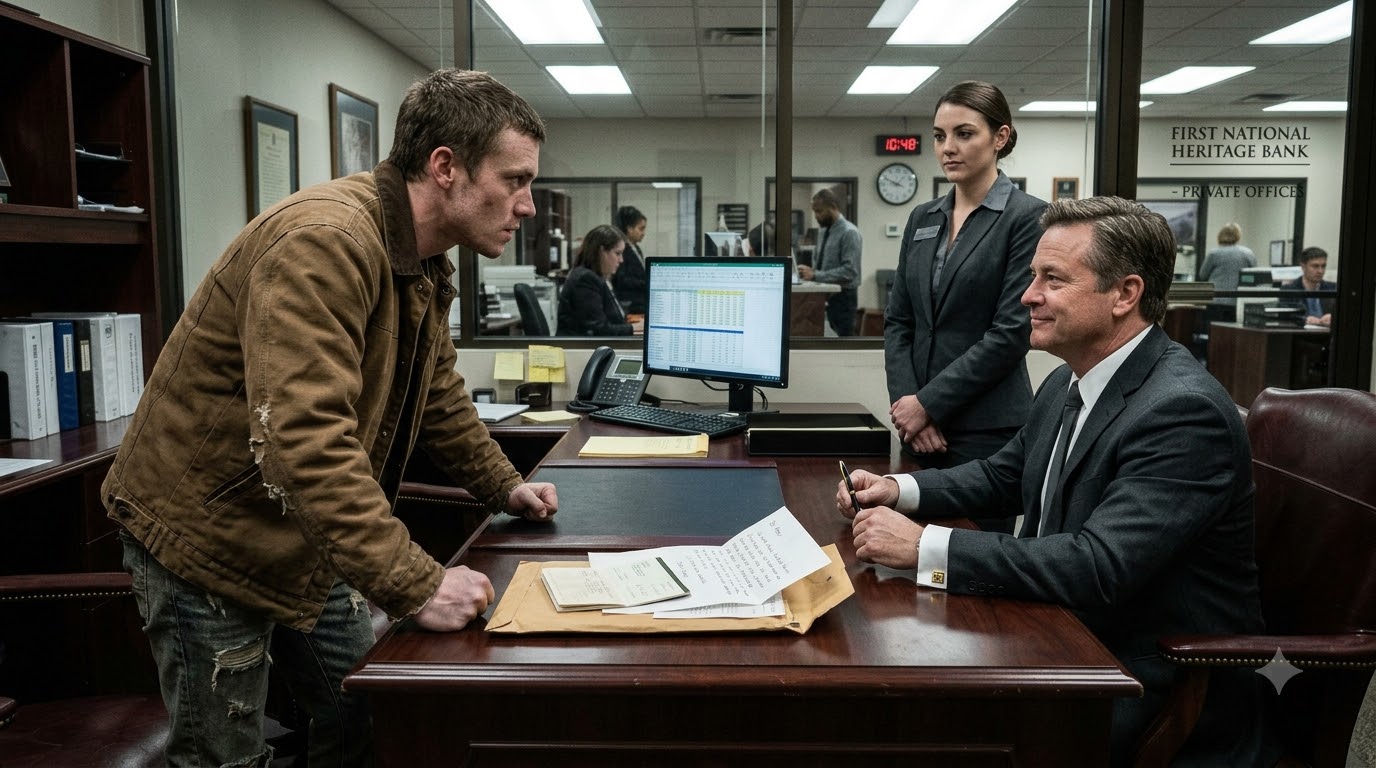
“Sit down,” Bradley said, pointing a gold-trimmed pen at the seat.
Wesley lowered himself into the chair, placing his school ID and the brown envelope squarely in the center of the desk.
Bradley did not touch the documents. He leaned back in his leather executive chair, lacing his fingers across his expensive silk tie.
“Let’s try this again, kid,” Bradley said, his voice dropping into a clinical, practiced drone meant for the overhead security cameras. “You claim you have an account here. You claim your grandmother left you money. But you have no proper identification, no guardian present, and no proof of address.”
Bradley reached out with two fingers, picking up Wesley’s school ID as if it were coated in grease.
“Lincoln Elementary School, fifth grade,” Bradley read aloud, tossing the plastic card back onto the desk where it skidded toward the edge. “This proves absolutely nothing. Any kid can print a card. Where are your parents?”
The question hit Wesley like a physical shove against his chest. His father had left before he was born, and his mother’s memory lived only in faded photographs.
“I live with my uncle,” Wesley said, his voice coming out thin and tight.
“And where is this mysterious uncle?” Bradley asked, his smirk widening as he glanced toward the tellers. “Let me guess. He’s a billionaire philanthropist. That’s why a ten-year-old in thrift-store shoes is walking around with high-tier bank documents.”
Before Wesley could answer, Chelsea leaned over the edge of the partition, whispering directly into Bradley’s ear.
Bradley nodded, his eyes hardening into a cold, predatory gleam as he turned back to the boy.
“I’m freezing this account pending a full security investigation,” Bradley announced, his tone rising so the nearby patrons could hear every word. “You’re running a scam, kid, and you’re done here.”
Wesley reached out, his small fingers trembling against the smooth wood of the desk. “You can’t do that. That’s my grandmother’s savings.”
Bradley stood up, smoothing his jacket with deliberate arrogance. “Security, escort this kid out of my sight.”
CHAPTER 4: THE PUBLIC SPECTACLE
“Ladies and gentlemen, I apologize for this disruption,” Bradley announced, his voice lifting into a practiced theatrical projection that filled the entire hall.
He planted his hands on the edge of the customer service desk, gesturing broadly toward Wesley as six waiting patrons turned in unison to watch the spectacle.
“This is what we deal with every single day,” Bradley continued, milking the room for sympathetic nods. “People who don’t belong in institutions like this trying to walk out with what isn’t theirs.”
A murmur of agreement rolled through the front rows of seating. Diane Campbell, standing near the glass doors with her handbag clutched tightly against her ribs, stared at the floor with a pale, stricken expression.
Wesley stood frozen under the weight of a dozen critical eyes, his throat locking tight against the humiliation.
“I didn’t steal anything,” Wesley said, his voice straining to carry across the open space. “My grandmother worked forty years for that money.”
“Spare me the sob story,” Bradley snapped, stepping out from behind the counter to loom over the boy. “Every con artist has a dead relative and a rehearsed tale. Jerome, do your job and clear the lobby.”
Jerome Davis stepped forward from his post by the brass door, his boots clicking against the marble with heavy, measured cadence.
The security guard looked down at Wesley’s scuffed sneakers, his jaw tight as a muscle twitched in his cheek. Eleven years of silence hummed in the air between them, a quiet, corrosive bargain traded for a pension and a paycheck.
Jerome extended a hand, his fingers hovering inches from Wesley’s shoulder without touching him.
“Come on, son,” Jerome murmured, his voice rough and stripped of authority. “Let’s head outside.”
Wesley pulled back, refusing the escort, and walked toward the exit under the crushing weight of public silence.
CHAPTER 5: THE SILENT THRESHOLD
He pulled his knees up against his chest, staring down at the cracked screen of his mobile phone resting on his frayed denim knee.
A dozen pedestrians walked past the bench without a glance, their expensive winter coats brushing against the thin fabric of his jacket.
Inside the glass doors, Jerome Davis stood rigidly beside the entrance, his eyes locked on the floor tiles just beyond the metal frame.
The security guard’s hand twitched against his trouser seam, the fingers curling into a fist as he replayed the moment he watched the boy walk out alone.
Wesley flipped the cracked phone over, his thumb brushing against the splintered glass as he checked the battery icon glowing dimly in the gray November light.
No new text messages. No missed calls from Uncle Lawrence, who remained trapped behind closed boardroom doors while the afternoon slipped away.
He opened the brown envelope once more, sliding out Grandma Eleanor’s letter to trace the shaky blue ink of her final paragraphs.
Carry your dignity with pride, baby, she had written, her hand steady despite the failing strength in her fingers. They can take everything else, but they can never touch who you are.
A sharp reflection flickered across the glass of the sliding doors behind him, catching the movement of Diane Campbell stepping out of the lobby.
She stopped three feet from the bench, her designer handbag clutched in both hands like a shield against her ribs.
“I saw what happened,” Diane said, her voice shaking as she looked down at the boy’s bowed shoulders. “I stayed inside when I should have said something. I am so sorry.”
Wesley looked up slowly, his eyes dry but heavy with the exhaustion of a battle he never asked to fight.
“You came back outside,” Wesley said quietly, his voice offering an anchor to a stranger drowning in her own guilt.
Diane pressed her lips together, her eyes shining with unshed tears as she nodded toward the bank’s administrative entrance.
“I’m going inside to file a formal witness statement,” Diane said, her voice hardening with sudden resolve. “Every single word of what that manager did is going on the record.”
She turned and marched back toward the glass doors, her heels striking the pavement with a sharp, deliberate rhythm that echoed off the brick facade.
CHAPTER 6: THE UNYIELDING COLLAPSE
The numbers glowing against the display did not flicker or change.
$487,263.
Bradley’s mouth opened and closed silently, his breath catching in his throat as the reality of the balance settled over the room.
“I didn’t know,” Bradley whispered, his hands trembling as he gripped the edge of the mahogany desk. “If I had known there was that amount—”
“That is exactly the problem,” Patricia Edwards said, her voice cutting through the office air like cold steel. “Your respect for a client has a price tag attached to it.”
Wesley stood beside the desk, holding his grandmother’s worn paper envelope against his chest while his sneakers rested firmly on the tile.
Bradley slumped back into his leather chair, the realization of his ruined career washing over him in a slow, suffocating wave. Fifteen years of climbing corporate ladders, sacrificed in fifteen minutes of unearned arrogance.
Patricia stepped forward, sliding a formal suspension notice across the polished wood toward him. “Effective immediately, you are terminated for cause, your bonus is forfeit, and your credentials are revoked.”
Bradley looked up, searching for an opening, a loophole, a desperate final defense, but found only the unyielding wall of corporate accountability.
There was no rescue, no sudden stroke of luck, and no escaping the evidence recorded on the security logs.
Outside the private office, the bank lobby hummed with quiet order, the staff returning to their posts under a new and heavier understanding of basic human decency.
Wesley turned toward the glass doors, stepping out into the late afternoon air with his shoulders back and his chin held high.
He didn’t need wealth or titles to command respect; he carried his grandmother’s dignity locked safely inside his heart.
On the stone bench by the exit, he paused for a brief second to adjust his jacket before walking down the steps into his future.