
The Price of Rusted Stone: How Pragmatic Silence and Unyielding Truth Brought an Empire Built on Arrogance to Its Knees
CHAPTER 1: THE RUSTED THRESHOLD
The iron gates of Rosemere Hall swung inward with an expensive, oiled purr that sounded entirely too rehearsed.
Duchess Isolde Fairmont adjusted the coarse cotton knot of her apron, her calloused knuckles brushing against the heavy wood of the delivery gate. The morning chill clung damply to her coat, carrying the sharp scent of wet gravel and chemically trimmed boxwood.
A stout housekeeper with grease-stained cuffs and eyes narrowed into permanent suspicion shoved past her, nearly sending a wicker basket of flour tumbling into the mud.
“You are late,” the woman snapped, her voice grating like dry sandstone. “The butcher’s boy dropped the tallow by the scullery, and if it stays there another minute, Mrs. Sloane will have my cap on a spike.”
“I was told to report this morning,” Isolde answered quietly. Her voice lacked the practiced, bell-like resonance that usually commanded drawing rooms across Mayfair. It was flat, worn down to the grain, deliberately small.
“Then report less and move more,” the housekeeper barked, jabbing a thumb toward the narrow stone steps leading down into the bowels of the estate. “We are not running a convent for slow thinkers. Get down to the pantry and find your apron strings.”
Isolde did not flinch. She stepped across the threshold, her heavy-soled shoes striking the damp flags of the service corridor with a dull, heavy thud.
Above her, through the thick oak floors and high-arched ceilings, the muffled chime of crystal bells began to ring—a frantic, impatient summons from the upper chambers where Miss Evadne March was already demanding her morning chocolate.
The air in the scullery smelled of stale grease, boiling cabbage, and cheap lavender polish. It was a simulation of grandeur, propped up by high ceilings and borrowed silver, reeking of the frantic desperation of new money trying desperately to bury its origins.
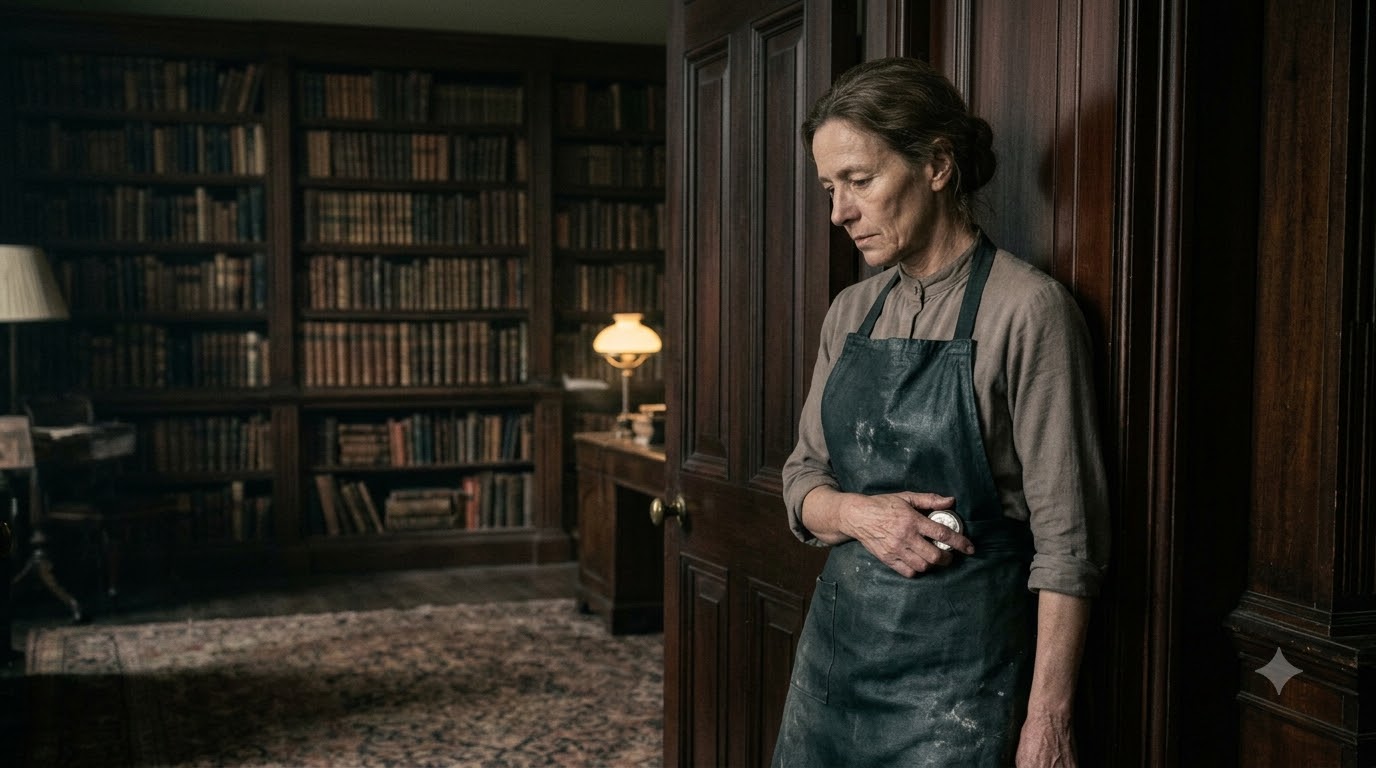
Isolde set her small canvas case against the damp wall, her fingers tracing the smooth, hidden wood of the pocket watch tucked deep within her lining—a steady, ticking anchor in a house built entirely on shifting sand.
Let them look at the apron, she thought, watching a young kitchen maid drop a tin cup in sheer terror as a head footman stormed past.
They would learn soon enough that a house built on borrowed stones offers very little shelter when the wind finally turns.
CHAPTER 2: THE SOUND OF SILK
The air in the long gallery smelled of stale wax and expensive rosewater.
Miss Evadne March stood before a gilded mirror, her pale silk gown rustling with every calculated shift of her posture. Two young maids pinned her hem with trembling fingers, their heads bowed so low their chins nearly touched their collarbones.
Evadne practiced a soft, breathy smile, turning slightly to catch the afternoon light across her pearls.
“Too sharp,” she murmured to her reflection, her voice dropping into a register designed to simulate helpless innocence. She softened her eyes, letting out a delicate, practiced sigh. “Better.”
Isolde stepped into the gallery, her heavy-soled shoes making no sound against the thick Persian runner. She kept her head tilted downward, projecting the absolute invisibility of a servant who knew her place.
Evadne caught sight of her in the glass and her features snapped instantly into cold disdain.
“Set the tray on the side table and do not breathe on the silver,” Evadne ordered, not even bothering to turn around.
Isolde took a measured step forward, her movements deliberate and controlled. As she passed the trailing hem of Evadne’s gown, the coarse fabric of her own skirt brushed lightly against the silk.
The sharp crack of an open palm against skin echoed off the high plaster walls.
Tea rattled instantly in the fine china cups as Isolde staggered one step sideways, her left hand rising slowly to touch her cheek where a bright red mark bloomed across her skin.
Evadne stood rigid, her chest heaving with sudden, unmasked fury. “You clumsy, wretched creature. Do not touch what you could never afford to buy.”
Down the hall, a young maid dropped a bundle of fresh linens, the soft thud breaking the heavy silence. No one else moved.
Isolde lowered her hand, her expression entirely neutral. There was no shrinking back, no plea for mercy, and no flash of fear in her eyes.
Evadne mistook the absolute stillness for cowering submission, her mouth curving into a triumphant smirk. “Clean the tray, clear your face, and get out of my sight before I have the housekeeper strip your wages.”
Isolde picked up the silver pot with steady, unhurried fingers. She did not look back as she retreated toward the service stairs, but inside the lining of her coarse wool apron, her thumb found the cold, familiar metal of her hidden pocket watch.
The debt had been entered into the ledger. And a ledger, once written, had to be balanced to the last farthing.
CHAPTER 3: THE SAFFRON LEDGER
Isolde paused in the shadow of the door frame, her fingers resting lightly on the cold brass latch.
Inside the small study adjacent to the library, the low murmur of voices cut through the quiet hum of the estate’s floor heating.
“The boy is simpler than I hoped,” Bernadette Sloane’s voice carried a sharp, self-satisfied edge. “He would sign away Scotland if we asked with a smile and a warm plate.”
Evadne’s light, musical laugh followed immediately, unburdened by any pretense of warmth. “He is not foolish, mother, merely desperate to be adored. And once the ring is secure, Fairmont House must be stripped of those dreadful portraits.”
Isolde’s thumb pressed into the pocket watch hidden beneath her apron, feeling the steady mechanical beat against her palm.
“And the old woman?” Bernadette asked, her tone dropping into a calculating whisper.
“She can be packed off to the dower house in Kent,” Evadne replied without a second of hesitation. “Endless gardens, damp air, complete silence. Old women love being quietly removed.”
The sound of rustling parchment reached the doorway.
“And the bank vaults?” Bernadette pressed further.
“Gradually,” Evadne murmured. “One does not kick open a vault when the key is handed to you on a velvet cushion.”
Isolde stared into the dim space of the landing, her internal vision flashing back to the countless ledgers she had signed over thirty years of managing the estate’s true foundations.
They thought the empire was built on title alone, blind to the paper thin margins holding their borrowed lifestyle together.
A heavy footstep shifted on the carpet inside the room, signaling the end of the private conference.
Isolde stepped backward into the shadows just as the latch clicked, letting the silence close over her like cold water.
CHAPTER 4: THE BLACK MOTORCARS
Three grand motorcars turned through the iron gates in strict, unyielding order.
Their black bodies shone sleekly against the gray Surrey sky, each front door bearing the silver crest of Fairmont House.
Footmen and guests froze on the front steps, their conversations dying instantly as the vehicles swept to a smooth, synchronized halt beneath the portico.
Bernadette Sloane straightened her lace collar, a triumphant smile spreading quickly across her face.
“They have come to honor the alliance properly,” she murmured, smoothing her satin skirt with trembling fingers.
Evadne adjusted her pearls in the reflection of the doorway glass, stepping forward with an air of practiced grace.
“It is only right,” Evadne whispered, her eyes locked on the lead car. “The estate is finally acknowledging our place.”
Basil Thorncroft stood nearby, his expression clouded with a sudden, unnameable unease as the lead car door clicked open.
The senior footman stepped out first, his face a mask of absolute severity.
Mr. Vale emerged immediately behind him, his silver hair catching the pale light as he removed his white gloves with agonizing slowness.
Bernadette swept forward, her hands outstretched in welcome.
“Mr. Vale, what an extraordinary surprise,” she began, her voice dripping with artificial warmth.
Mr. Vale did not even slow his stride. He walked past her as though she were a discarded pile of laundry on the floor.
Bernadette’s outstretched hands dropped into the empty air, her smile cracking down the middle.
Mr. Vale marched straight across the wide marble foyer, past the stunned guests, past Basil, and directly toward the service corridor entrance.
Every eye in the grand room followed him, locked in total, terrified confusion.
He stopped precisely three paces in front of a plainly dressed woman holding a wooden tea tray.
And then, with agonizing deliberation, the chief steward bowed deeply from the waist.
CHAPTER 5: THE WEIGHT OF STEEL
Mr. Vale held his posture, his white gloves resting against his thigh as he bowed deeper still before the plain-capped woman.
The movement sent a tremor through the assembled guests that felt almost physical.
Bernadette Sloane caught her breath, her chest stuttering as she clawed at the air.
—There has been a mistake, she gasped, her voice cracking into a high, frantic pitch. —She is only a scullery girl. A common drudge from the gatehouse.
Mr. Vale straightened slowly, his eyes fixed on the silver-streaked hair beneath the wool cap.
He did not look at Bernadette. He spoke with the quiet, chilling clarity of a judge reading a final decree.
—Her Grace, Duchess Isolde Fairmont, does not require a gatehouse introduction.
The words landed like iron weights across the Persian carpet.
Evadne stumbled backward, the back of her knees slamming hard against the velvet sofa. Her carefully constructed expression of sweet innocence completely shattered, leaving behind a pale, panicked mask of rage.
—You lie, Evadne hissed, pointing a trembling finger toward the steward. —She stood in the corridor. I told her to clean the tray. She is a nobody.
Basil Thorncroft remained frozen near the marble fireplace, his face completely drained of color.
He stared at the old wool apron, then up at the fading red mark still visible on his mother’s cheek.
—Mother, Basil whispered, the word tearing raw from his throat as he dropped heavily to his knees.
Isolde did not look down at her son. Her gaze remained steady, fixed entirely on the woman who had traded cruelty for ambition.
—Bring the household staff forward, Isolde commanded.
The double doors of the drawing room swung open, and the terrified kitchen and hall staff filed in, forming a shaky line along the wall.
Mr. Vale gestured to the trembling housekeeper.
—Tell her Grace what instructions you were given regarding the service entrances.
The housekeeper pressed her palms together, her voice shaking violently.
—We were ordered… Mrs. Sloane ordered us to force all humble visitors through the rear cellar so the estate’s appearance remained grand for the gentry.
Bernadette lunged forward, her face twisted in fury.
—You ungrateful wretch, you are lying to save your skin—
—Silence, Mr. Vale cut her off with a single, sharp syllable.
A young kitchen maid stepped forward from the line, tears spilling over her lashes as she pointed directly at Evadne.
—I heard her in the morning room. She said the Duchess would be shipped off to a damp dower house in Kent so they could empty the family vaults without interference.
The room erupted into panicked murmurs.
Evadne pushed past her mother, her face flushed with defensive rage.
—They are making it up! It was a joke! Everyone misinterprets words when they are nervous! We did nothing wrong!
Basil raised his head slowly from the floor, his eyes wide with horror as he looked at the woman he had defended with his life.
—You planned to exile my mother, he said, his voice dropping into a dangerous, heavy register.
—We planned for the future! Evadne shrieked, finally dropping every pretense of grace as her fingernails dug into the sofa fabric. —That old woman belongs in the past! This estate is ours!
Isolde finally turned her gaze fully upon them, her expression unmoved by the screaming.
—A house built on stolen stones does not belong to anyone, Isolde said quietly. —And your lease on Rosemere Hall has officially expired.
CHAPTER 6: THE DUSTY GRAY AFTERMATH
The great drawing room felt remarkably small once the noise of entitlement had been stripped away.
Bernadette Sloane slumped against an unpolished armchair, her fingers twitching helplessly against the frayed fabric as the reality of seized assets and called-in loans settled over the room like winter fog.
Evadne stood near the darkened window, staring out into the empty courtyard where three black motorcars had already vanished down the Surrey road.
—You cannot do this, Evadne muttered, her voice dropping into a flat, exhausted whisper as she realized no amount of performance could rewrite a ledger locked by law. —We have obligations. We have society.
Isolde did not pause near the doorway. Her cape was fastened high against her chin, her hands tucked neatly inside her ordinary gloves.
—Society recognizes accounts when they are paid, Isolde said plainly. —Yours are settling now.
Basil remained standing beside the unlit fireplace, his face bearing the heavy, unsparing lines of a man who had finally learned the true cost of blinding himself to character.
He looked at Evadne not with anger, but with a cold, absolute vacancy.
—Pack your things, Basil told her, his voice devoid of any hesitation. —The bailiffs arrive at dawn.
Within days, the grand illusion of Rosemere Hall was unraveled room by room.
The bright statues near the fountain were tagged with inventory numbers, the borrowed art was cataloged for auction, and the family name was quietly erased from the social columns of the morning papers.
Months later, under the steady gray drizzle of a London winter, the gardens of Fairmont House smelled of wet earth and newly trimmed hedges.
Basil moved silently across the gravel path, his sleeves rolled to his elbows, carrying a heavy wooden crate of seed trays toward the estate greenhouses alongside the tenant workers.
He no longer walked through the world expecting applause or automatic favor. Every task was earned, every hour accounted for.
Duchess Isolde watched him from the quiet warmth of the second-floor library, her thumb turning the smooth gold casing of her pocket watch before clicking it shut with a definitive, satisfying snap.
Beside her, a young woman in a neat dark coat organized a stack of ledgers, her posture steady and unburdened by fear.
Isolde looked out across the lawn where the spring roses were beginning to push through the damp soil.
Power, she noted silently, was never proven by the silk one wore or the noise one made when a gown brushed against the floor.
It was measured solely by what remained when the pretense was stripped away and the ground was finally left clean.