The Muddy Reflection: How One Nebraska Farm Boy Changed the Course of the Normandy Breakthrough
CHAPTER 1: THE ATTIC OVERLOOK
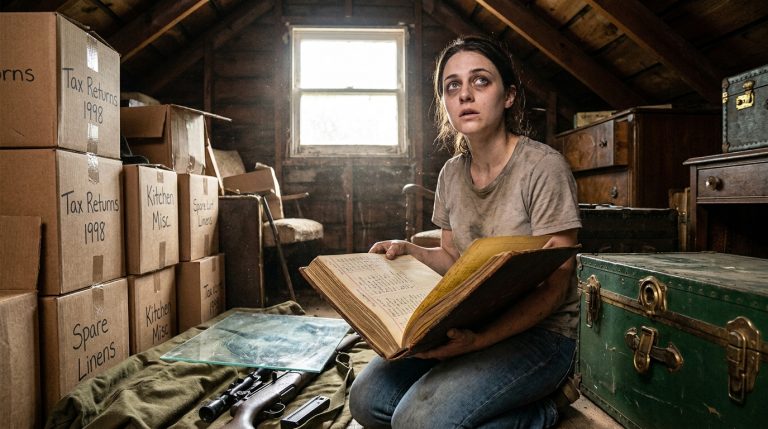
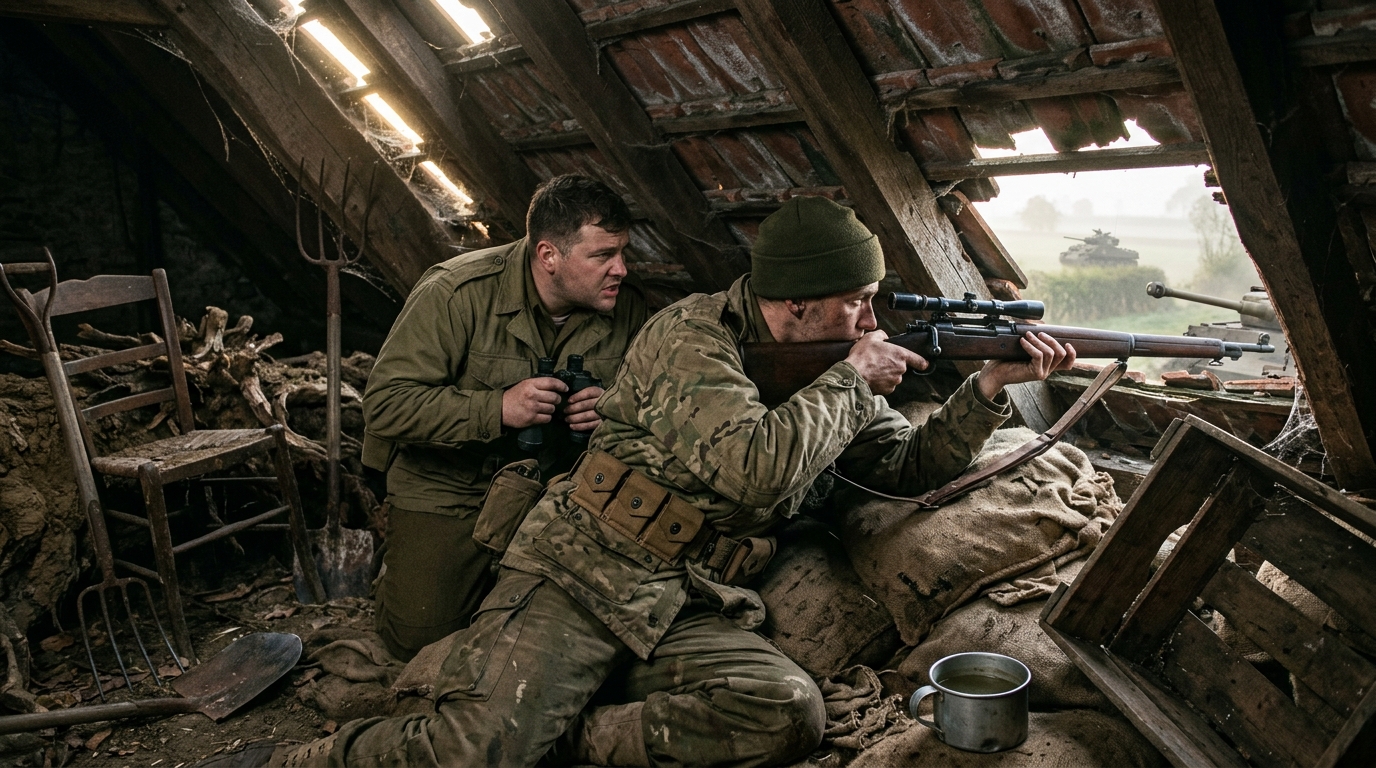
The dust in the abandoned farmhouse attic smelled of old straw and pulverized plaster.
Daniel Reeves kept his cheek pressed flat against the wood stock of his Springfield, his breath shallow as a bead of sweat tracked slowly down his temple.
Through the cracked roof tiles, the morning mist still clung to the Norman fields below like a damp shroud.
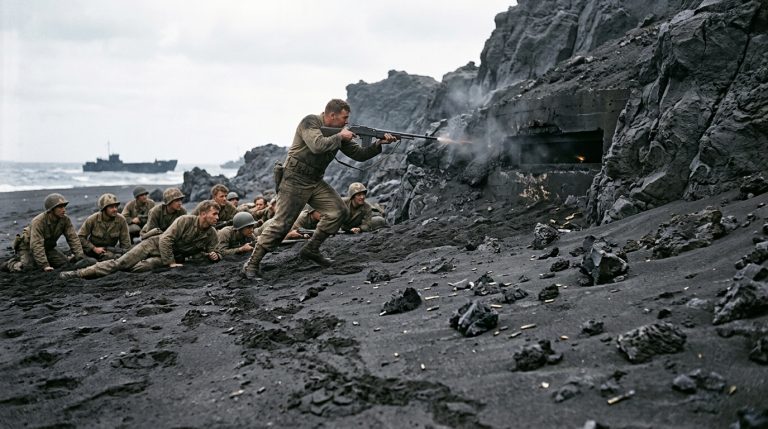
Thirty yards down the sunken road, the lead American Sherman tank rumbled forward with a heavy, rhythmic groan of diesel and clanking steel.
The hatch on the turret stood wide open.
A young crewman laughed, tossing a cigarette butt into the wet ditch as if they were driving down a Sunday lane in Ohio.
They had no idea what was waiting for them just beyond the bend.
Frank Kowalsski shifted beside him, his heavy boots scraping softly against the loose floorboards.
“Dany,” Frank hissed, his voice tight with a sudden spike of tension. “Look at that ridge to the northeast. Something just moved in the brush.”
Daniel didn’t answer right away.
He slid the focus ring on his scope a fraction of an inch, letting the blurred leaves sharpen into hard reality.
A dense earthen bank topped with centuries-old oak roots cut across the pasture, concealing the bulk of a German Panzer 4.
Only the long snout of its main gun and the upper rim of the turret were visible.
The German commander stood half out of the hatch, his field glasses pressed to his eyes as he calmly tracked the approach of the American column.
“He’s got the crosshairs dialed right into the choke point,” Daniel said, his voice dropping into a flat, exhausted whisper. “They’re walking right into an iron box.”
“Call it in to headquarters,” Frank urged, his hand already hovering over the radio handset. “We did our job. We spotted the armor.”
Daniel reached down without taking his eyes off the scope.
His fingers brushed against the rough surface of a dented tin cup sitting beside his ammunition pouches.
Inside the cup, a small pool of murky water collected from an early morning shell crater reflected the pale, low-angle light of the rising sun.
The radio crackled with a burst of static, relaying the distant voice of command ordering all sniper teams to maintain strict focus on infantry and leave armor entirely to the tank destroyers.
The Sherman rolled another ten yards closer to the kill zone.
Daniel’s thumb tested the cold metal edge of the tin cup, his mind flashing back to the dry dust of Nebraska and the bitter winters when a missed shot meant an empty plate.
The manual said one thing.
Reality said another.
The German officer on the distant tank lowered his binoculars and reached for his radio throat-mic.
CHAPTER 2: THE SILENT ORDER
The sharp crack of the Springfield rattled the crumbling plaster of the attic walls.
Below, the lead Sherman tank jerked to a grinding halt before reversing frantically into a deep roadside ditch.
Frank Kowalsski slammed his hand against the wooden floorboards, his face draining of color.
“You just took down a Panzer commander,” Frank shouted over the lingering metallic echo of the bolt action. “Captain Hayes gave a direct, explicit order to leave armor alone.”
Daniel did not blink.
He worked the bolt with mechanical precision, a spent brass casing spinning through the air to ping against the floor.
“Look through your spotting scope at the ridge,” Daniel muttered, his eyes fixed on the smoke rising from the opposing hedgerow. “If we stayed quiet, ten American kids in those steel coffins would be burning right now.”
Through the cracked lens of the scope, the second German tank turret twitched violently.
The enemy crew was blind without their spotter, thrashing their massive gun barrel toward empty air.
The radio handset hanging by the window suddenly hissed with a sharp burst of static.
The voice of the command operator crackled through the speaker, tight with sudden confusion and panic.
“Overwatch Two, report,” the radio squawked. “What is your status? We have reports of erratic enemy armor movement near Delta 47.”
Frank grabbed the receiver with a shaking hand, casting a frantic glance at Daniel.
“We have a confirmed threat,” Frank spoke into the mic, his knuckles turning white. “Commander at Delta 47 neutralized. Two more panzers waiting in the brush. Advise element to hold position.”
The radio buzzed with a tense silence before the operator came back on the line.
“Hold your position, Overwatch Two,” the voice commanded, though the rigid tone had dissolved into nervous urgency. “Tank destroyers are twenty minutes out. Do not let them advance.”
Daniel adjusted the angle of his dented tin cup.
The low morning sun caught the murky water inside, casting a diffused, blinding streak across the field toward the second German position.
A helmeted head popped up from the opposing hatch, squinting against the glare.
“They’re taking the bait,” Daniel whispered, taking up the slack on his trigger.
CHAPTER 3: THE FIRST FLASH
The morning breeze cut sharply across the shattered roof tiles, carrying the acrid stench of cordite and damp earth.
Daniel kept his eye glued to the rubber eyecup of the Springfield, ignoring the heavy sweat stinging his brow.
Seventy yards out, the second Panzer commander shifted inside his open hatch, cursing in a harsh whisper that carried faintly over the quiet pasture.
“He’s scanning our sector,” Frank muttered, his knuckles whitening as he gripped the spotting scope. “He knows where that last shot came from.”
Daniel tilted the battered tin cup another fraction of an inch to the left.
The murky water inside caught the low slanting rays of the morning sun, bending the light into a sharp, blinding beam.
He didn’t need orders from a desk in Washington, and he didn’t need a formal manual to tell him how to keep breathing.
He needed patience, a steady pulse, and the blind arrogance of an enemy who thought he was untouchable.
“Let him look,” Daniel whispered, his finger tightening on the trigger guard.
The reflected glare bounced off the muddy surface and flashed directly across the German officer’s eyes.
The man squinted hard against the unexpected burst of light, throwing a gloved hand up to shade his face.
For two precious seconds, the enemy commander exposed his upper chest above the steel rim of the turret to find the source of the flash.
Daniel exhaled slowly, letting his lungs empty completely.
The crosshairs settled squarely on the center of the German’s uniform.
CHAPTER 4: THE RIPPLE OF DEFIANCE
Frank grabbed the empty casing before it could roll into the floor cracks, his fingers slick with cold sweat.
“That’s four commanders down,” Frank breathed, staring through the spotting scope at the chaos unfolding along the distant hedgerow. “The whole line is breaking apart.”
Below them, the German armor was no longer advancing with orderly discipline.
The surviving tank crews were slamming their hatches shut, sealing themselves inside blind steel boxes as panic took root.
Without leadership from the top, the heavy vehicles ground to a halt, churning the wet Norman soil into thick, useless mud.
Daniel pulled the bolt back into place with a sharp metallic clack, his muscles aching from the sustained strain.
“They thought they were safe behind the manual,” Daniel muttered, wiping grease from his thumb. “They didn’t count on a farmer who knew how to use the morning light.”
The radio handset beside the broken window hissed back to life, cutting through the heavy silence of the ruined attic.
“Overwatch Two, this is Baker Six,” the voice of the infantry commander came through, thick with disbelief and newfound urgency. “Whatever you are doing out there, keep doing it. The panzers are blind.”
Frank keyed the receiver, his voice steadying as the reality of their defiance set in.
“Copy that, Baker Six,” Frank spoke, casting a sidelong glance at Daniel. “Tell the boys to move up while the door is open.”
Daniel reached out and gripped the edge of the tin cup, feeling the dry residue of clay inside.
The battle wasn’t over yet, and division headquarters was still waiting down the road.
CHAPTER 5: THE COMMAND TENT
The canvas walls of the division command tent snapped violently against their wooden poles under the damp Norman wind.
Major General Charles Ghart sat behind a field desk littered with map fragments, his eyes fixed on the dented tin cup resting squarely in the center of a typed incident report.
Daniel stood at rigid attention, his boots caked in dried mud from the hedgerows, feeling the heavy, scrutinizing weight of every star on the general’s collar.
“You had explicit operational orders from Captain Hayes to leave armored vehicles entirely to the tank destroyers, Private Reeves,” Ghart said, his voice flat and devoid of warmth. “Nineteen separate times you chose to disregard that directive.”
Daniel did not shift his weight.
“Sir, the manual was written for open fields in North Africa, not fifteen-foot earthen banks where tanks sit blind until they open fire,” Daniel replied, his voice raspy from hours of breathing cordite smoke. “Ten men in those Sherman columns were already dead before I lifted the rifle. Standing pat on doctrine doesn’t stop iron from tearing through steel.”
Colonel Sydney Bingham leaned forward from the shadows of the tent, his face tightening with bureaucratic outrage.
“Insubordination in the face of enemy contact is a court-martial offense, Reeves—you compromised the entire chain of command to play field engineer with a drinking cup.”
“It wasn’t engineering,” Daniel said, his gaze locked straight ahead. “It was common sense.”
Major Winterborn, the British liaison officer, cleared his throat softly, breaking the tense silence as he picked up the stained tin cup and turned it over in his hands.
“In His Majesty’s forces, we have a saying about rules guiding the wise and binding the foolish, General,” Winterborn observed quietly. “The boy saved an entire company from a slaughterhouse. Punishing him for saving lives sets a rather grim precedent for initiative.”
Ghart stared at Daniel for a long, suffocating moment before sliding a formal recommendation paper across the desk.
“You’re not facing a firing squad, Reeves, but we can’t encourage a free-for-all,” Ghart stated, tapping a heavy finger against the parchment. “You’re getting a Bronze Star with a V device for tactical innovation—and starting tomorrow, you will teach every sniper division in this theater how to turn ditch water and sunlight into a weapon.”
CHAPTER 6: THE LONG ECHO
Decades drifted by like dry autumn leaves across the North Platte plains.
Daniel sat at his old oak kitchen table, his weathered fingers tracing the smooth, dented side of a tin cup that had long since lost its coating of Norman clay.
Ellen stood quietly by the window, watching the afternoon sun stretch long shadows across the golden wheat rows outside.
A heavy wooden box rested between them, filled not with medals or military dispatches, but with twenty-seven faded letters written by men whose names he had never known during the smoke of June forty-four.
One letter, worn soft at the folds from endless reading, lay open under his palm.
“Thomas Bennett wrote again,” Daniel said, his voice deep and raspy with the quiet weight of years. “His oldest boy just graduated from college—named him Daniel, same as before.”
Ellen walked over, placing a warm hand gently upon his shoulder.
“They’re living proof of what you did out there, Dany,” Ellen whispered, looking down at the ink-stained paper. “You didn’t just save soldiers. You saved entire families that never would have been.”
Daniel stared into the empty metal cup, remembering the sharp crack of the Springfield and the terrifying mathematics of grace that separated life from ash.
The military manual had taught doctrine, but necessity had taught him how to see through the glare.
He closed the wooden lid with a soft, final click, the sound echoing through the quiet house like a closed door on the past.
The war was decades behind them, but the ripples of a single improvised choice would stretch out across generations, touching lives under every sunrise that ever broke over the plains.