The Frozen Grid of the Ardennes: A Soldier’s War Against Time and Tyranny
CHAPTER 1: THE IRON CELLAR
The brass thread of the Kar98k oiler cap bit into the frozen skin of my thumb. I didn’t wince. You don’t wince when the air is minus twelve and the pine needles under your boots sound like stepping on broken glass. I unscrewed the cap, dropped the greasy felt applicator into the notch of the bolt, and dragged it once across the blueing.
“Put that away, Becker,” Hauptmann Dressler said. He didn’t look up from the schoolhouse desk. His red pencil hovered over a requisition sheet that had more red slashes on it than black ink. “The oil freezes in the receiver anyway. You know that.”
“Force of habit, Herr Hauptmann,” I said. My voice sounded flat, stripped clean by three days of cold cabbage and zero sleep.
On the center of the scarred oak table sat the green canvas crate. It looked like a heavy bread box, square and unbothered by the damp cellar rot creeping up the stone walls. Feldwebel Kraus stood by the dark window, his thumb hooked in his leather belt, watching the narrow slit where the blackout curtain met the frame.
“It’s not a trap,” Kraus muttered. He spat on the floor. The spit didn’t run; it just sat there on the stone. “They didn’t leave it to blow us up. They left it because they had another one in the back of the truck.”
Dressler finally set the red pencil down. It rolled three inches and stopped against a pristine, unsharpened grease pencil with the bold stamp HQ-OKW pressed into its side. In a sector where we were reusing envelope flaps for message slips, that pencil looked like a piece of jewelry. I stared at it until Dressler covered it with his forearm.
“It doesn’t matter why they left it,” Dressler said softly. “Look at the layout. Look at the dials. A child could set this frequency. A private with two weeks of drill.”
The heavy oak door at the top of the cellar stairs didn’t knock; it slammed open against the stone casing. Boots came down the steps—not the worn, cardboard-soled march boots we wore, but high-grade leather, stiff and polished under a coat of fresh road mud.
Major Von Rademacher stepped into the lantern light. His wool coat was double-breasted, dry, and smelled of wood coal and fine cognac. Behind him, two field gendarmes held their submachine guns across their chests, muzzles pointed at the floorboards between my feet.
“Where is it?” Von Rademacher asked. He didn’t look at Dressler. He looked at the table.
Dressler didn’t stand up immediately. He took two seconds to cap his pen. “The American transceiver set, Major. PFC Becker brought it in from the forward tree line an hour ago.”
Von Rademacher stepped to the table and picked up the coiled black handset by its cord. He swung it once, like a dead fish, then tossed it back onto the olive-drab casing.
“Contaminated,” the Major said flatly. “Or a direct Trojan instrument. Divisional intelligence has issued an immediate decree regarding captured enemy signal material.”
“Major,” Dressler said, his voice dropping into that dangerously calm register schoolmasters use right before they hand out a suspension. “The frequency architecture alone proves they are running direct-line calls to their 105mm batteries. If we examine the call-sign grid—”
“We do not examine enemy propaganda, Hauptmann,” Von Rademacher interrupted. He signaled the two gendarmes. “Seize the unit. It is to be cast into the fuel pit behind the command post and destroyed with thermite immediately.”
Kraus took half a step forward, his hand dropping toward his bayonet hilt. I caught the edge of his wool sleeve with two fingers and squeezed hard enough to feel the frozen weave of his coat.
“Major,” I blurted out, the words tearing out of my throat before common sense could stop them. “They moved their line in six minutes. We saw the boot prints. They don’t use the radio to talk to their generals. They talk to the guns.”
Von Rademacher turned his head slowly. His eyes were small, pale, and entirely devoid of the exhaustion that had hollowed out the rest of us. He looked at my shoulder straps, saw the single chevron of a Private First Class, and sneered.
“Then they will talk to empty woods, Private,” Von Rademacher said. He gestured to his men. “Take it. Hauptmann Dressler, your sector line at the ridge has three severed wire connections. You will have your men repair the landline before 1000 hours, or you will answer to the court-martial panel in St. Vith.”
The gendarmes grabbed the canvas straps of the SCR-300. They didn’t haul it with respect; they yanked it off the oak table, knocking Dressler’s inkwell onto its side. Black ink pooled across the map of Bastogne, swallowing the blue pencil lines we’d spent all night drawing.
The heavy door slammed shut behind them, leaving the smell of diesel exhaust and expensive wool hanging in the cold cellar air.
Dressler didn’t move for ten seconds. He just watched the black ink drip off the edge of the desk, dropping clack… clack… clack… onto the frozen dirt floor.
“Get the wire spool, Becker,” he said quietly.
“Herr Hauptmann?”
He reached out, grabbed the HQ-OKW red pencil, and snapped it cleanly in half between his fingers. He threw the pieces into the cold stove.
“The wire, Private. We have six kilometers of dead copper to twist together in the dark.”
CHAPTER 2: THE WIRE AND THE FROST
The wind on the open ridge didn’t blow; it scraped. It took the moisture right out of your nostrils and left a taste like raw iron on the back of your tongue.
“Hold the line slack,” Kraus grunted, his boots slipping twice on the rutted ice before he found purchase against an exposed root. “If it snaps under the snow, we’ll be out here till daylight looking for the break.”
I hauled three loops of dark grey field wire from the reel, my canvas mittens stiff as cardboard. We weren’t using light assault wire. This was double-braided lead-core cable—heavy, stupid, and obsolete. The kind of wire designed for a war that stayed in neat trenches instead of dissolving into dark woods every six minutes.
Up on the eastern spur, three miles behind us, a flare popped into the clouds. It hung there like a dirty tallow candle, casting a sick greenish glow over the black pines.
“That’s not ours,” Kraus muttered, freezing mid-step. He dropped his shoulder, letting the wooden frame of the spool rest against his thigh. “German flares burn white. That’s American.”
“They’re closer than three miles,” I said.
I knelt in the slush, pulling the wire taut to check the insulation. Ten feet back, where the cable dipped into a water-filled ditch, something caught the pale light of the flare. It wasn’t ice.
I reached down, dragging my hand through the freezing mud until my fingers hit metal. A fresh, clean cut. The copper threads inside the rubber casing didn’t look snapped by an artillery fragment or torn by a tank tread. The ends were sheared clean off at a forty-five-degree angle, sharp and deliberate.
Pliers.
“Kraus,” I whispered, not moving from my knee.
“Keep walking, Becker. The Major gave us until 1000 hours.”
“Look at the cut.”
Kraus stepped back, his eyes darting to the black tree line twenty paces to our left. He leaned down, squinting at the sliced cable in my hand. His jaw tightened until the muscle below his ear throbbed against his collar.
“That wasn’t an American patrol,” Kraus said quietly. “An American scout cuts a wire, he takes a six-foot section with him so you can’t twist it back together in the dark. He doesn’t leave the ends touching in the mud.”
He was right. It was a lazy break. The kind made by someone who wanted the line down just long enough to force a repair detail out into the open, but didn’t want to waste thirty seconds stripping the insulation. Someone who knew our repair manual by heart.
A sharp, metallic clack echoed from the treeline—the unmistakable sound of a bolt dropping into battery on a German Mauser.
“Down,” Kraus hissed, dropping the heavy spool.
We hit the frozen mud together as a single rifle shot split the dark. The bullet didn’t whistle; it cracked past my ear like a dry twig snapping, slapping into the oak trunk behind us with a wet thud.
“Don’t shoot!” Kraus yelled toward the trees, pressing his cheek flat into the snow. “Twelfth Volksgrenadier! Line detail!”
Silence stretched across the ridge, heavy and suffocating. The flare overhead flickered once and died, plunging the road back into pitch darkness.
“Identify!” a voice called out from the pines. It was young, high-pitched, and trembling with an edge of sheer panic. “Identify or the next one goes into your ribs!”
“Feldwebel Kraus! PFC Becker!” Kraus shouted back, his hand slowly reaching down to drag his rifle through the slush. “We’re laying wire for Hauptmann Dressler! Who the hell is firing on friendly troops?”
A shadow detached itself from a snow-covered birch. A young corporal stepped out, his helmet sitting crooked on his head, a Kar98k held tight against his hip. Behind him, two more shadows stayed low in the brush.
“There is no line detail,” the corporal said, his voice cracking on the last word. “HQ pulled the perimeter back to the river two hours ago. We were ordered to shoot anything moving along this ridge.”
I pushed myself up onto one elbow, cold slush soaking straight through my trousers to the skin. “Who gave that order?”
The corporal didn’t lower his rifle. “Staff officers from St. Vith. They passed through in two Kubelwagens at midnight. Said the ridge was abandoned. Said anyone still up here was a deserter or an American infiltration team.”
Kraus stood up slowly, wiping a smear of grey slush from his chin. He looked at the severed wire in my hand, then back at the young corporal.
“Von Rademacher,” Kraus said softly.
The corporal didn’t answer, but his eyes shifted away from ours.
They weren’t fixing the line. They were cutting us off from the schoolhouse on purpose.
CHAPTER 3: THE BUREAUCRATIC TRAP
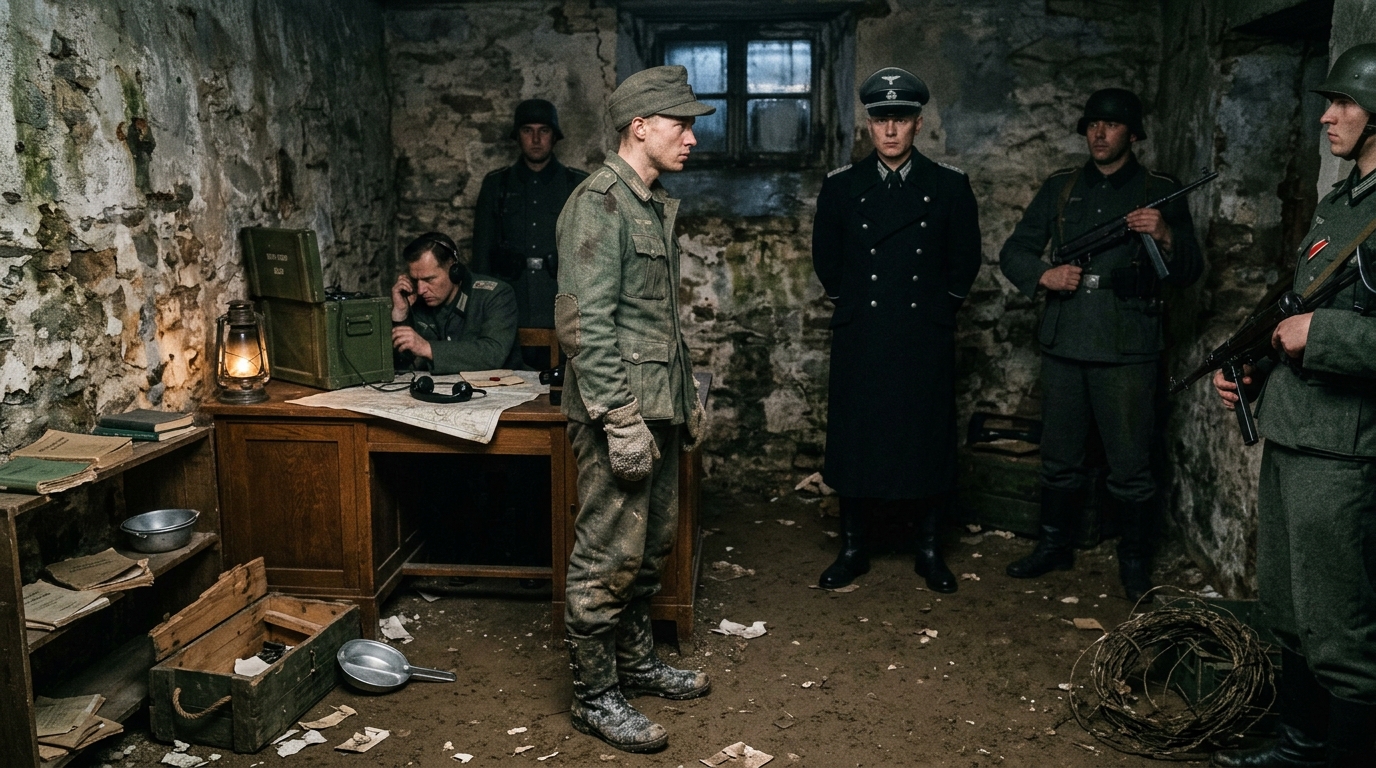
The lantern oil was almost gone. It flickered on Dressler’s cheekbones, casting long, sharp shadows that made his eyes look like empty sockets in a skull.
“They cut it,” I said, tossing the two clean-sheared wire ends onto his map. The copper cores gleamed dull red in the yellow light. “Not the Americans. A corporal from the 26th told us HQ ordered the ridge cleared at midnight.”
Dressler didn’t look surprised. He reached into his coat pocket and pulled out a single sheet of blue onion-skin paper, folded twice, stamped with a heavy wax seal that had already cracked along the edges.
“Major Von Rademacher forgot his dispatch copy,” Dressler said softly. “It was tucked behind the blotter.”
Kraus stepped into the cellar, squeezing his bulk through the frame, his uniform reeking of woodsmoke and wet wool. He unslung his Kar98k and leaned it against the stone wall with a loud, metallic clatter.
“They’re pulling back to the river,” Kraus said, wiping a line of grey slush from his throat. “That corporal said the staff cars left at 2200.”
“Read it, Becker,” Dressler instructed, sliding the onion-skin paper across the ink-stained wood. “Your English is poor, but your German is good enough to understand operational directives.”
I picked up the paper. The typing was crisp, typed on a fresh ribbon from a divisional machine that had never seen a drafty cellar.
12th Volksgrenadier Division to serve as fixed operational anvil along Line Sector B. Retreat prohibited prior to 0600 December 21st. Staff elements and heavy transport route prioritized through St. Vith corridor.
“Fixed operational anvil,” I read aloud. My throat felt like it was full of fine sand. “That means rearguard.”
“It means bait,” Dressler corrected. He picked up his brass Kar98k oiler cap, twisting it back onto the threads with a slow, rhythmic screeech-screeech. “Von Rademacher knew the American set wasn’t a trap. He knew their signal network was real. He knew their 105s would walk a barrage up this valley the moment their forward observers marked our position.”
“If he knew,” Kraus said, his voice dropping an octave, “why burn the radio?”
“Because if divisional headquarters acknowledges that the enemy coordinates fire in four minutes,” Dressler said, looking up, “they have to order an immediate general withdrawal. And if four thousand infantrymen fill the road to St. Vith, the staff officer staff cars can’t get across the river.”
The silence in the cellar wasn’t quiet. It was the heavy, thumping pressure of three men realizing they were already dead on paper.
Outside, far to the west, a low hum started. It didn’t sound like artillery. It sounded like a hundred heavy trucks idling in the snow, waiting for a signal that wasn’t going to come down a wire.
“They cut our lines so we couldn’t report the withdrawal,” I said, my thumb tracing the sharp, cold edge of the sliced cable. “They didn’t want us asking for fire support. They wanted us to sit in these foxholes until the Americans flattened the ridge.”
“Von Rademacher is currently four miles west,” Dressler said, standing up slowly. He took his wool coat off the back of the chair and pulled it over his narrow shoulders. “He has two staff cars, four guards, and a crate of champagne from the supply depot.”
Kraus reached down, picked up his rifle, and checked the magazine floorplate with a sharp flick of his thumb. “The road to the river is three miles if we cut through the creek bed.”
“We don’t have orders to retreat, Feldwebel,” Dressler said, his voice dripping with dry, razor-sharp irony.
“The Major gave us our orders,” Kraus growled, stepping toward the door. “He told us to fix the wire.”
Dressler reached down, scooped up the broken pieces of the red HQ-OKW pencil from the ash tray, and shoved them into his pocket.
“The line is fixed,” Dressler said, looking at me. “Isn’t that right, Private?”
“Completely restored, Herr Hauptmann,” I said. “Every inch of it.”
A high, thin whistling sound began somewhere high above the clouds—the distinct, fluttering scream of incoming 105mm shells coming in fast from the west.
CHAPTER 4: THE COLD REALITY
A second high-explosive round tore through the canopy overhead, showering the stone yard with splinters of frozen pine and blinding white flash. The concussion slammed my head back against the masonry, leaving a high-pitched ring in my ears that drowned out the wind.
“Four minutes,” Dressler said, his mouth right against my collar. He didn’t scream; he spoke with the flat, tired precision of a schoolmaster closing a ledger. “That’s their response window. They marked the ridge, called the grid, and the battery executed.”
Kraus pulled himself out of the slush, his hands coated in wet clay, his face pale under the black soot. “The road to the river is choked. Von Rademacher’s Kubelwagen is stuck at the bridge.”
“He won’t make the bridge,” Dressler said, reaching down to pull me up by my coat strap. “The Americans don’t shoot at soldiers. They shoot at intersections.”
A third explosion ripped the roof clean off the schoolhouse behind us, throwing slate tiles across the dirt like flying razors. We didn’t run like panicked recruits; we moved with the heavy, plodding cadence of men who knew that speed meant nothing under a walking barrage. You just keep your head down and step where the ground isn’t rising up to meet you.
We cut south, sliding down the embankment into the drainage ditch that ran parallel to the creek bed. The water in the ditch was ankle-deep, slush-heavy, and cold enough to turn your toes numb in twenty seconds.
Half a mile down the trail, where the timber thinned out near the stone arch bridge, the headlights of two staff cars cast long, desperate beams through the swirling snow. The engines were screaming, wheels spinning uselessly against the rutted ice of the incline.
Major Von Rademacher stood on the running board of the lead car, his double-breasted wool coat unbuttoned, his voice raw as he screamed at three drivers trying to shoulder a stalled supply wagon off the road.
“Move it!” Von Rademacher shouted, waving his service pistol at the drivers. “Clear the lane! This is a divisional command vehicle! I have priority clearance for St. Vith!”
Dressler stopped at the edge of the tree line, twenty yards away, leaning his shoulder against a pine trunk. He pulled the brass oiler cap from his pocket, unscrewed it, and let the oily felt drop into the snow. He didn’t pick it up.
“Major,” Dressler called out, his voice cutting through the roar of the idling engines.
Von Rademacher spun around, his hand tightening on the grip of his pistol. When he recognized Dressler’s mud-caked face, his expression twisted from panic to pure rage.
“Hauptmann!” Von Rademacher barked, taking two strides through the slush toward us. “Why are you off your assigned sector? You were given a direct operational order to hold the schoolhouse ridge!”
“The wire broke, Major,” Dressler said quietly.
“Then you splice it!” Von Rademacher stepped up to Dressler, his chest heaving, his face red despite the sub-zero wind. “You stay in those positions until 0600! You are committing field desertion! I will have you court-martialed and shot against the bridge wall before sunrise!”
Kraus didn’t pull his rifle up. He just shifted his stance, placing his heavy boot firmly between the Major’s leather boots, anchoring his weight against the slush.
“There’s no court-martial coming, Major,” I said, stepping up beside Dressler. “And there’s no wire left to fix.”
Von Rademacher’s eyes darted to my face, then down to the muddy canvas of my sleeves. “You insolent little trash—you speak when you’re spoken to! I am a senior staff officer of the Twelfth Volksgrenadier—”
“You’re a man in a ditch, Major,” Dressler interrupted, his voice dropping into a absolute, unshakeable calm. “And the Americans are already on your frequency.”
Von Rademacher froze. The pistol in his hand dipped two inches. “What?”
A sharp, warbling whistle cut through the dark above the bridge—not a single shell, but a battery volley of four 105mm rounds coming down in a tight pattern.
“They don’t ask for permission from a general,” Dressler whispered, stepping past the Major toward the deep timber on the southern bank. “They just give the radio to the man who can see the problem.”
We didn’t look back when the barrage hit the bridge. We didn’t run.
We crossed the freezing creek thirty yards upstream, stepping carefully over the slippery stones, keeping our weight low and our hands free. The forest on the southern bank was thick, dark, and silent, untouched by the administrative orders, the red pencils, or the broken chains of command.
An hour later, deep in the thicket, the noise of the artillery faded into the distance.
Kraus sat down on an overturned birch log, unbuttoned his canvas gaiters, and began wringing the freezing water out of his wool socks with slow, methodical twists of his thick hands.
Dressler sat beside him, pulling out his small black notebook. He opened it to the fresh page he had marked that morning. He didn’t use the red HQ-OKW pencil. He pulled a stub of standard black lead from his pocket, pressed the point to the paper, and drew a single, clean line straight across the page.
“Where to now, Herr Hauptmann?” I asked, pulling my Kar98k across my knees and wiping a streak of meltwater off the steel receiver with my thumb.
Dressler closed the notebook, tucked it inside his coat, and looked out through the dark trunks toward the west, where the sky was turning the pale, quiet grey of early morning.
“West,” Dressler said softly. “Until we find someone who knows how to listen.”