The Survey of Truth: A Landowner’s Siege Against the Beige Kingdom of Oakwood Estates
CHAPTER 1: The Line in the Red Clay
The morning sun hadn’t yet crested the ridge, leaving the valley in a cool, bruised purple. It was the only time of day the Holloway Grant felt truly mine, before the world woke up and started demanding things.
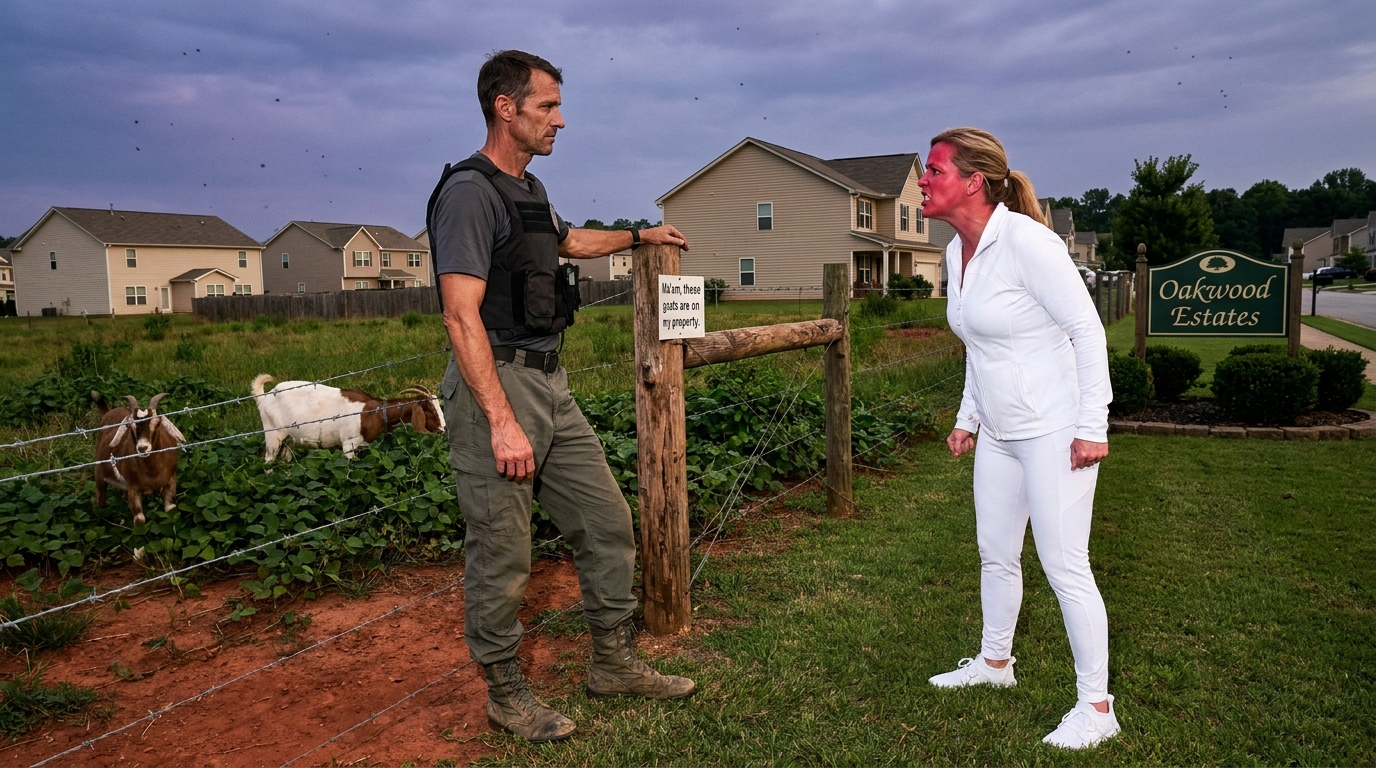
“Get your filthy farm animals away from my pristine lawn or I’ll have them put down.”
The voice cut through the stillness like a jagged piece of glass. Karen—the woman who had appointed herself the architect of our suburban stagnation—stood ten feet away. She was trembling. Not from the cold, but from a rigid, theatrical rage.
I looked at her, then down at Daisy and Buttercup. They were busy stripping the leaves off a stubborn patch of kudzu, completely unbothered by the woman vibrating with indignation on the other side of the invisible line.
My hand rested on the cedar post of the fence. I didn’t reach for a weapon, and I didn’t raise my voice. Three tours as a combat engineer in landscapes far less forgiving than this one had left me with a quiet, hollow stillness. I had learned that the loudest person in the room is rarely the one holding the actual power.
“Ma’am,” I said, my voice steady, stripped of any inflection that might give her the satisfaction of a reaction. “These goats are on my property. They are contained. They are working. They are not your concern.”
Karen’s face went a shade of red I’d only ever seen in signal flares. “I am the president of this HOA,” she screeched, the word covenant hitting the air like a curse. “Everything in this community is my concern! You will receive a notice. The fines will be immediate.”
I watched her for a moment, noticing the way her expensive running shoes looked out of place against the raw, red clay of the border. She believed the fence line was a suggestion. She believed the beige shingles of the subdivision behind her were the center of the world. She had no idea that beneath her manicured lawn, the ground belonged to me, and the legal documentation of that ownership was currently resting in a locked drawer in my office, waiting for the right moment to be read aloud.
I turned my back on her. It was a dismissal that cut deeper than any insult. Behind me, I heard the sharp, frantic clicking of her shoes against the pavement as she retreated to her fortress of beige stucco. The air felt heavy, charged. A small, peculiar detail caught my eye—a single, bright red thread snagged on the barbed wire of my fence. It hadn’t been there yesterday. I frowned, reaching out to brush it away, only to realize the birds that usually greeted the dawn with a chorus had gone completely, disturbingly silent.
The fuse was lit.
CHAPTER 2: The Weight of Paper
The silence in the valley wasn’t peaceful; it was heavy. It felt like the pressurized calm before an IED detonates, the kind of quiet that makes the hair on the back of your neck stand up. I walked back toward the house, my boots crunching rhythmically on the red clay. Every step felt measured, an old reflex from years of walking through terrain that didn’t want you there.
Inside, the house was cool and dim. Sarah was at the oak table, her hands wrapped around a ceramic mug. The steam rose in thin, lazy ribbons, but her eyes were fixed on the kitchen counter. There, lying like a dormant threat, was a thick, off-white envelope. It was heavy. Dense. It had the kind of weight that only bureaucracy can manufacture—the weight of people who have nothing better to do than measure the length of their neighbors’ grass.
I didn’t reach for it immediately. I washed my hands at the sink, feeling the grit of the red clay swirl down the drain. It was a small, grounding ritual. In the military, you learned that you didn’t touch the package until you had assessed the perimeter.
“She left it in the mailbox,” Sarah said. Her voice wasn’t afraid, but it was edged with a sharpening resentment. She was a nurse; she spent her days stitching together the consequences of other people’s carelessness. She had no patience for people who tried to stitch together problems where none existed.
I dried my hands and walked over to the counter. The envelope was sealed with the aggressive precision of someone who took their volunteer HOA position as seriously as a military promotion. I picked it up. As my fingers closed around the thick stock, a memory flared: the sensation of handling a stack of operational intelligence reports in a dim tent in a province where the maps were always wrong. The texture was identical. The same sense of manufactured authority, the same attempt to exert control over a chaotic environment. I suppressed the thought. This wasn’t a war zone. It was Tennessee. And yet, the gut-check remained: someone was trying to force a tactical shift on my ground.
I slit the envelope with a paring knife.
Inside was a twelve-page document. Official Notice of Covenant Violation. The words were embossed, straining for a gravity they didn’t possess. I skimmed the jargon. Non-domesticated agricultural animals. Failure to maintain aesthetic standards. Olfactory pollution. The language was a masterclass in pseudo-legal posturing. They had even attached a schedule of fines, compounding daily. According to their math, I was already in debt for over a thousand dollars.
I pulled out a chair and sat opposite Sarah. I began to spread the pages out on the table, creating a grid of intimidation.
“She’s citing the bylaws for Lot 17,” I said, pointing to a highlighted paragraph. “She thinks my ridge is part of their 50-acre carveout.”
Sarah leaned in, her eyes scanning the text. “Can she actually hit us with a lien, Jack? Or is this just noise?”
“It’s noise that can turn into a legal headache if we don’t silence it properly,” I replied. I felt the familiar, slow-burning focus take over. This wasn’t about the goats. It wasn’t even about the lawn. It was about the integrity of the Holloway Grant. If I let them annex the property line with a fraudulent violation notice, they would eventually push for more. It was a basic territorial principle: you draw the line at the first intrusion, or you lose the ground entirely.
I looked out the window. My goats, Daisy and Buttercup, were still grazing near the pasture fence, oblivious to the bureaucratic assault occurring ten yards from their hay pile. They were ecological tools, nothing more. To Karen, they were a breach of her sterile, beige reality.
I reached for my phone and started drafting a list. I needed the original survey maps, the deed, and the full text of the ground lease—the one my lawyer, David Chen, had been so meticulous about. I needed to build a fortress out of paper, something so technically sound that the HOA wouldn’t even know how to begin to argue against it.
“I’m going to my office,” I said, rising from the table. “I’m going to pull the files. We don’t reply to this as neighbors, Sarah. We reply as a legal entity.”
“She thinks she’s running a kingdom,” Sarah said, her voice quiet. “She needs to realize she’s just a tenant.”
I nodded. That was the core of it. She was so blinded by her own sense of self-importance that she hadn’t looked at the actual boundaries of the land she lived on. She was a guest who had decided to become the landlord, and she hadn’t even bothered to check the lease.
As I walked toward my office, I paused, glancing back at the kitchen. The envelope lay open on the table, its contents fanned out. It looked innocuous enough, just paper and ink, but it felt like a declaration. The silence of the birds outside still hung in the air, a vacuum waiting to be filled. I pushed the door open to my office, the room smelling of old books and dried cedar. It was time to start the counter-offensive. I didn’t need to shout. I just needed to be right.
CHAPTER 3: The Reconnaissance of Shadows
The office felt like a sanctuary of logic, but logic wasn’t going to be enough. I needed to see how the opposition operated on the ground. Sarah agreed with a nod that spoke of shared resolve, and I stepped out of the front door, leaving the comfort of the ridge behind. The air outside was humid, thick with the smell of sun-baked asphalt and the sharp, chemical tang of high-end lawn fertilizer. It was a sterile smell, designed to mask the natural decay of the earth.
I started my walk at the edge of the subdivision, moving with a deliberate, slow-paced gait. I wore simple clothes—jeans, a faded gray t-shirt—and kept my eyes scanning the terrain. To anyone else, I was just a man enjoying a walk on a Tuesday afternoon. To me, this was intelligence gathering.
The streets of Oakwood Estates were laid out in a series of monotonous, winding loops. Every house was a mirror image of the one next to it, differing only by the color of the front door or the height of the hedges. It was a layout designed for conformity. I passed a man in his front yard, a leaf blower strapped to his back. He didn’t look up. As I got closer, he focused his entire attention on a single stray leaf, his posture rigid. It was the posture of a man who was afraid that if he paused, he might be scrutinized.
That was the power Karen had built. It wasn’t derived from the law; it was derived from the fear of being noticed.
As I rounded the corner of the third loop, I felt the familiar prickle of being watched. I didn’t turn my head—a habit drilled into me in environments where a sudden movement could invite a response. I kept my stride even. A beige sedan was idling three driveways down, its windows tinted deep enough to render the interior a dark void. It wasn’t moving. It was just sitting there, a heavy, motionless presence against the light-colored curb.
I turned onto a side path that led toward the clubhouse—the administrative heart of the HOA. The ground beneath my boots transitioned from the gravel of my pasture to the smooth, artificial perfection of the subdivision’s concrete. The difference was palpable. Here, the earth felt dead, trapped under layers of poured stone and manicured sod.
I stopped near a cluster of large, ornamental shrubs that provided a clear view of the clubhouse parking lot. I wasn’t there to make a scene; I was there to observe. I noticed the lack of activity. For a community this size, it was unnaturally quiet. There were no kids playing in the street, no dogs barking, no music drifting from open windows. It was a town of ghosts, all hiding behind closed blinds.
I pulled out my phone, pretending to check a message, and angled the camera toward the clubhouse’s main entrance. The door opened, and a woman—one of the few I recognized from the neighborhood committee meetings—stepped out. She was clutching a stack of pastel-colored flyers, her hands trembling. She glanced over her shoulder twice before she hurried toward her car. She looked like she was breaking a quarantine.
I stored the image in my internal map. Fear, I realized, didn’t just isolate the victims; it made them hyper-aware of the space they occupied. If I could tap into that awareness, if I could give them a reason to shift their focus from the fear of Karen to the reality of their own residency, the entire structure would become unstable.
A rattle of dry weeds drew my attention back toward the boundary line. A patch of tall, invasive fescue was encroaching on a sidewalk, and a small, weathered sign—”HOA Property: Violators will be Fined”—was leaning at an angle. It was the only thing in the entire subdivision that looked like it had been touched by a living, breathing hand. The irony wasn’t lost on me. They were so terrified of a little grass that they had let the actual infrastructure rot.
I stood there for a long moment, breathing in the smell of dry, sun-baked earth. The sedan was still idling down the street, a dark, watchful eye in the beige landscape. I felt a surge of cold, analytical clarity. Karen thought she was playing a game of aesthetics, but this was a game of property, of leverage, and of historical record. And as I looked at the neighborhood, I realized that for all its sterile, uniform appearance, it was fundamentally flawed. It was built on a foundation that had likely lapsed years ago, a truth hidden behind decades of suburban theater.
I didn’t need to provoke a confrontation. I just needed to keep walking, keep observing, and keep accumulating the data that would eventually make their own rules turn against them. I turned and began the walk back to the ridge, my footsteps silent on the warm pavement. I had seen the tension, I had seen the fear, and most importantly, I had seen the cracks. The reconnaissance was complete. Now, it was time to find out what was really buried in those archives.
CHAPTER 4: The Executive Session
The gravel in the clubhouse parking lot crunched under my tires, a sharp, abrasive sound that seemed to echo in the humid evening air. I killed the engine and sat for a moment in the dark cab of my truck, watching the clubhouse. The structure was a low, beige building that looked like a tombstone for individuality. Through the tinted windows, the sickly, flickering glow of fluorescent lights spilled onto the asphalt.
I didn’t rush. I grabbed the briefcase from the passenger seat. It was heavy—not just with paper, but with the potential to unravel the carefully maintained illusion inside. Beside me, Sarah sat in silence, her hand resting on the center console. She didn’t need to say anything; we had already laid out the tactical plan.
“They’re going to try to shut you down,” she said, her voice steady. “They’ll lean on the bylaws the moment you mention the lease.”
“Let them,” I replied. “The bylaws only work if the ground they’re written on is solid.”
We stepped out of the truck. The air felt heavy, like a storm was holding its breath. As we walked toward the entrance, I could see the silhouettes of people moving behind the clubhouse windows. They were already gathered—a congregation of residents summoned by the promise of order, waiting for their president to tell them everything was fine.
I pushed the door open. The sound of the latch clicking into place felt final, like a chamber being locked.
The room was sweltering. The ventilation system hummed with a low, dying rattle, failing to combat the heat of twenty bodies packed into a space meant for half that number. At the front of the room, behind a long folding table that looked entirely too small for the weight of the moment, sat Karen and her board. She looked like she was conducting a symphony, her hands poised on the edge of the table, her eyes scanning the room for dissent.
When she saw me, her posture didn’t change, but her smile—a thin, practiced thing—tightened. The room quieted, the murmur of nervous conversation dying out as if a volume knob had been turned to zero.
“Mr. Turner,” she said, her voice resonant and smooth. “We are in an executive session. You were not invited to participate in the board’s internal deliberations.”
“This isn’t a deliberation, Karen,” I said, my voice cutting through the stuffy, stale air. I kept my gait steady as I walked toward the front table, feeling the eyes of every resident glued to my back. I wasn’t an intruder; I was an owner. “It’s a public notice of intent.”
I placed the briefcase on the table. It made a solid, heavy thud that seemed to vibrate against the plastic tabletop. Karen’s gaze dropped to the case, and for a split second, I saw a flicker of genuine irritation. She was used to people who argued with emotion—people who shouted, who cried, who threw their hands up in frustration. She didn’t know how to handle someone who brought a briefcase, a neutral expression, and an absolute, unshakable adherence to the record.
“We have a schedule,” one of the board members to her left muttered, looking at his watch with practiced nervous energy.
“I’m sure you do,” I said, turning my attention to him. “And I’m sure it’s very important. But we need to address the structural solvency of the community. I have some documentation here regarding the ground lease that I think the board—and the residents—should be made aware of immediately.”
Karen tapped her gavel. It was a rhythmic, impatient sound. “This board is not interested in your personal grievances, Jack. We are here to enforce the rules. The violation on your property is a matter of record. The fines are accumulating. Are you here to pay them?”
I didn’t answer her directly. Instead, I pulled a copy of the official county plat from the briefcase. I laid it out, smoothing the creases with my palm. The paper was crisp, professional, and entirely unassailable.
“I’m here to clarify the boundaries of your jurisdiction,” I said. “And the nature of the entity that is attempting to impose these fines. The board is currently operating under a set of assumptions that, quite frankly, aren’t supported by the foundational documents of this property.”
A man in the back row shifted in his chair, the plastic legs screeching against the tile floor. People were leaning forward now. They were listening, and more importantly, they were starting to look at Karen not as their protector, but as a party in a dispute.
Karen’s face was beginning to flush, the color rising from her neck in a slow, steady tide. She reached for a file, her fingers fumbling slightly with the edge of the paper. She was trying to maintain the facade of the queen in her court, but the air in the room was shifting. It was no longer her domain.
“We don’t need a lecture on history,” she said, her voice rising in pitch. “We need compliance. If you aren’t here to discuss the removal of the animals, you need to leave.”
“I think the residents would prefer to know why their board is focused on my goats instead of the status of their land,” I said. I looked around the room, making eye contact with the man I’d met near the garden—George. He was watching me with a look of intense, expectant curiosity.
I didn’t open the briefcase yet. I left the map on the table. It was a silent challenge. I stood there, motionless, letting the silence draw the tension tighter and tighter. Karen was waiting for me to break, to get angry, to give her the opening she needed to have me removed. She was a master of the emotional combat, but she was entirely defenseless against a man who had no intention of participating in her drama.
“I’m not leaving,” I said, my voice barely above a conversational level. “And I think the board should be very, very careful about what they decide to do next.”
The room was perfectly, painfully still. I could hear the hum of the fluorescent lights and the distant, muffled sound of a car passing on the main road. The trap was set. Now, I just had to wait for the target to reach out and touch it.
CHAPTER 5: The Paper Trail of Rot
The silence in the clubhouse was not just an absence of sound; it was an absence of authority. Karen stood at the front table, her knuckles white where they pressed into the faux-wood surface. The residents weren’t looking at her anymore. They were looking at the briefcase, at the map, and then back at me. I didn’t move. I let the weight of the moment sit in the room, letting the residents draw their own conclusions about why their board president was so terrified of a piece of paper.
“This meeting,” Karen said, her voice strained and thin, “is closed. There will be no further discussion of private land disputes.” She reached for the gavel, but her hand trembled, and the wood struck the table with a dull, unimpressive thud that lacked its usual bite.
I didn’t argue. I didn’t need to. I reached out and took the map from the table, tucking it back into my briefcase. “Discussing boundaries is a courtesy, Karen. Following the law is an obligation.”
I turned, and as I walked toward the back of the room, George caught my eye. He gave a single, almost imperceptible nod. He knew. The seed of doubt was planted, and in a community built on a foundation of manufactured perfection, doubt was a corrosive acid.
We exited into the humid night, the air feeling shockingly cool against the heat of the clubhouse. “She’s rattled,” Sarah said, her voice low as we reached the truck. “You saw the way she looked when you mentioned the lease?”
“She knows the foundation is shaky,” I said, sliding the key into the ignition. “She’s just terrified that someone else will notice.”
The reconnaissance hadn’t just yielded intelligence; it had created a fracture. But we needed the smoking gun. We needed the proof that the authority she wielded was being used to bleed the community dry. The next morning, fueled by a pot of coffee that tasted like burnt beans and resolve, we began the legal maneuver David Chen had laid out. Jessica Miller, a homeowner who had been on the receiving end of Karen’s petty tyranny for years, was our gateway.
She filed the formal request to inspect the financial records, citing the exact state statutes that Karen couldn’t legally ignore. We didn’t ask for a summary. We asked for the ledgers, the invoices, the bank statements—the raw, unfiltered data.
Two days later, we were back in that same clubhouse, but the atmosphere was inverted. Karen was forced to provide access. She sat in the corner of the room, her presence reduced to a bitter, watchful shadow. Boxes were piled high on the long table—dusty, cardboard repositories of four years of managed misery.
“Start with the maintenance contracts,” I said to George. He had joined us, his retired accountant’s mind eager for the puzzle. “Follow the money on the landscaping.”
The hours bled into one another. We went through file after file, our hands stained with the gray, fine dust of aged paper. It was tedious work, the kind of grunt work that would have driven a lesser person to quit. But every invoice we pulled was a brick in the wall we were building around her.
Then, it happened. A frantic whirring noise erupted from the clubhouse’s small office printer. A plume of thin, acrid blue smoke curled out of the paper tray. The machine shuddered, made a dying, mechanical groan, and fell silent. The smell of ozone and overheated plastic filled the room.
“Looks like the tech is as neglected as the roads,” George muttered, leaning back and rubbing his eyes.
But I wasn’t looking at the printer. I was looking at the folder in his hand. He had pulled an invoice from ‘Prestigecapes LLC’—the company Karen had contracted to handle the landscaping. The invoice was for a “Seasonal Drainage Upgrade” completed during the height of the coldest, driest month of the previous year. The amount was six thousand dollars.
“Look at the address on this,” George said, sliding the paper toward me.
The address for Prestigecapes LLC was a P.O. Box in a town two counties over. I pulled out my phone and did a quick business registration search. The owner listed for the LLC was Gerald Paplowski.
I looked up at Karen. She was staring at us, her expression a mask of manufactured indifference, but her eyes—those eyes were wide, tracking every movement of the paper in George’s hand.
“He’s her brother-in-law, isn’t he?” Sarah whispered, her voice sharp with realization.
I looked at the invoice again. The signature on the bottom, approving the payment, was Karen’s. It wasn’t just a conflict of interest. It was a direct, documentable funneling of community funds into the pockets of her own family.
The air in the room seemed to thin. I had the evidence. I had the paper trail that led directly to the core of her corruption. I didn’t need to shout, I didn’t need to confront her right then and there. I just needed to secure the copies.
I pulled a small, portable scanner from my bag. As I methodically fed the pages through, I felt the shift. We weren’t just fighting a neighbor; we were dismantling a racket. And for the first time, I felt the cold, hard weight of reality: Karen wasn’t just a bully. She was a criminal, and she had left a trail of breadcrumbs that led straight to the gallows.
CHAPTER 6: The Atomic Disclosure
The clubhouse fell into a silence so profound it felt like the air itself had been evacuated. Outside, the sky had finally opened up, the rain drumming a chaotic, uneven rhythm against the clubhouse roof, masking the sound of our own breathing. I stared at the scanned image on my tablet—the signature, the P.O. Box, the inflated costs. It was all there, laid out with the clinical precision of a trap.
“She’s been bleeding this community for years,” George said, his voice barely a murmur. He was staring at the stack of invoices, his hands trembling slightly, not with age, but with a righteous, tempered fury. “We’re talking thousands, Jack. Maybe tens of thousands. This isn’t just incompetence. It’s theft.”
I stood up, the chair scraping harshly against the floor. I walked to the window and looked out into the rain. The streets of Oakwood Estates were slick and dark, the beige houses looking like silhouettes in a graveyard. For a moment, the weight of the Holloway Grant settled over my shoulders, heavy and immovable. I hadn’t wanted this. I had come here for the silence, for the rustle of leaves in the old-growth forest, for a place where I didn’t have to carry the weight of other people’s wars. Instead, I had become the custodian of a suburban nightmare.
“We have enough to trigger a formal investigation,” Sarah said from behind me, her voice cutting through the damp, stagnant air. “But Karen won’t just walk away because we have a folder of receipts. She’ll fight. She’ll say it’s a setup. She’ll turn this into a smear campaign against us.”
I turned back to them. David Chen’s words from our last meeting echoed in my mind: The lease is the killshot.
“We’re not going to use this in a court of public opinion,” I said, my voice low and hard. “We’re going to use it to force a breach of contract.”
I pulled the thick, yellowed document from my bag—the 1988 ground lease. It felt different in my hands now, less like a legal curiosity and more like a weapon. I placed it on the table, the edges of the pages frayed and yellowed by time.
“David found this,” I began, my gaze sweeping across the small group. “The developer who built this subdivision didn’t just walk away. They dissolved. And when they dissolved, they failed to renew the ground lease. We’re sitting on a time bomb, and Karen is too busy playing queen to realize the floor is about to give way beneath her.”
Jessica Miller leaned in, her eyes widening as she caught the implication. “Wait—are you saying the lease is already void?”
“I’m saying the option to renew expired six months ago,” I said. “Technically, the HOA is currently occupying this land without a valid lease. If we serve them with a notice to cure these financial breaches, they have ninety days to fix it—which includes removing the board and turning the books over for a forensic audit. If they fail, the lease is terminated.”
The implications hit the room like a physical blow. The absolute, terrifying reality of their position. For twenty years, they had paid dues, followed the rules, and built their lives on land they assumed was theirs. Now, they were learning that their entire neighborhood was a legal house of cards.
“If the lease terminates,” George said, his voice hollow, “what happens to our homes?”
“The land reverts to me,” I said, my voice stripped of any warmth. “But I don’t want your houses. I want a community that isn’t being run by a criminal who thinks her authority is absolute.”
I saw the change in their expressions. The fear was still there, but it was being replaced by a cold, pragmatic resolve. They realized that their only path to security—the only way to save their investments, their homes, and their peace—was to do exactly what Karen had spent years trying to prevent: they had to take control of their own community.
“What do we need to do?” Jessica asked, her voice steady now, devoid of the frantic edge it had held a week ago.
“We issue the notice,” I said. “We give them ninety days. And in the meantime, we ensure that every single homeowner knows exactly why the board is being challenged. We don’t hide the truth. We don’t sugarcoat the risk. We let them know that Karen’s ego is the only thing preventing them from a secure future.”
I started to organize the files, moving with a rhythm that felt like clockwork. The rain continued to batter the building, a steady, relentless reminder of the world outside. We were no longer victims of an HOA; we were the architects of its downfall.
As I packed the last of the scans into my bag, I looked over at the corner where Karen had been standing hours before. She was gone, but the ghost of her influence still hung in the air—the smell of perfume, the rigid posture of her remaining loyalists, the lingering sense of a reign built on sand.
“This is going to get ugly,” George said, standing up. “She’ll try to burn it all down before she lets us take it.”
“Let her,” I said, zipping the bag shut. “The fire only works if there’s nothing left to stand on. And by the time we’re done, she’ll be the only one left in the ashes.”
I walked toward the door, feeling the weight of the briefcase in my hand. The reconnaissance was over. The evidence was secured. The strategy was set. Now, it was just a matter of waiting for the ninety days to pass—or for the board to make the first mistake. And knowing Karen, that mistake was already coming.
CHAPTER 7: The Pink Line
The dawn didn’t bring warmth; it brought a flat, gray light that made the beige houses of Oakwood Estates look like cardboard cutouts. I stepped onto the porch of my home on the ridge, the air tasting of wet limestone and impending winter. My boots were laced tight. In the back of my truck sat the equipment: wooden stakes, a heavy-duty mallet, and rolls of fluorescent pink surveying tape.
This wasn’t legal posturing anymore. This was physical geometry.
I didn’t wait for the sun to fully rise. I started at the northernmost point of the property line, where the forest floor gave way to the manicured, artificial turf of the subdivision. My movements were rhythmic, devoid of hesitation. Every fifty feet, I drove a stake into the red clay until it stood firm, and then I wrapped it in the harsh, vibrant pink tape.
The color was offensive in this landscape. It screamed against the beige siding of the neighboring houses. That was the point.
By the time I reached the middle of the line—the stretch that bordered Karen’s backyard—the neighborhood was waking up. Curtains twitched. Blinds clicked upward just a fraction of an inch, just enough to see who was encroaching on their territory. I didn’t look at them. I kept my head down, my focus purely on the physics of the boundary.
Clang. The mallet hit the stake. Clang. It hit the earth.
I was halfway through the stretch behind Karen’s house when the back door opened. She didn’t come out in a velour tracksuit this time. She was dressed in something dark, something that looked like armor, her hair pulled back so tight it made her eyes look wide and predatory.
“You’re trespassing,” she said, her voice not a scream, but a cold, precise blade. “I have the police on speed dial. This is harassment.”
I didn’t stop swinging the mallet. The stake sank another six inches into the clay. “I’m surveying my land, Karen. Check the plat if you have questions about where the line is. You’re standing on my property right now.”
She stopped. The shift in her posture was almost imperceptible, a slight tightening of her shoulders. She realized, for the first time, that she wasn’t the one holding the gavel. She looked at the line of pink stakes—a jagged, unapologetic scar across her landscape—and then back at me.
“You think this works?” she whispered, her voice losing its edge, sliding into something more desperate, more jagged. “You think some tape and some wood is going to make these people turn on me? They like the order. They like the rules.”
“They liked the rules when they were protected by them,” I said, driving the final stake into the ground. I stood up, the metal mallet feeling like a lead weight in my hand. “They don’t like being the target. And they’re done being the funding source for your brother-in-law’s lifestyle.”
She flinched. The mention of the landscaping contracts didn’t cause her to argue; it caused her to close in on herself, her expression flickering with a sudden, sharp realization. The files hadn’t just been a threat; they were the end.
I tied the last length of pink tape to the stake. It fluttered in the wind, a bright, garish warning.
I didn’t wait for her to respond. I picked up the mallet and the remaining stakes and turned away. The silence of the neighborhood was absolute now. The watching eyes were no longer curious; they were fearful, darting from the pink line to the woman standing on her patio.
As I walked back to my truck, I could feel the tension radiating off the houses. It was a pressure cooker, and I had just turned the dial to the max. My phone buzzed in my pocket—a text from David Chen. The notice to cure has been delivered to their counsel. The clock starts now.
I climbed into the truck, the smell of dust and iron filling the cabin. The survey was done. The line was drawn. The community was no longer a uniform expanse of beige; it was now bisected by a reality that could no longer be ignored. I looked at the line of pink stakes, marching straight through the heart of the illusion. It was ugly, it was jarring, and it was the most honest thing this neighborhood had seen in thirty years.
The ninety-day countdown wasn’t just a legal deadline. It was the time the board had left to decide whether they wanted to go down with the ship, or whether they would finally break the rudder that was steering them into the rocks. I put the truck in gear, the engine turning over with a steady, mechanical thrum that sounded like the ticking of a clock.
CHAPTER 8: The Clearing of the Fog
The ninety days had passed with a slow, suffocating tension that had pressed down on Oakwood Estates like an unseasonal winter. Every day had been a test of nerves—the board scrambling, the frantic emails, the hushed, nervous conversations in driveways that stopped the moment I walked by. But today, the air felt different. It was thin, sharp, and empty.
I stood on the ridge, watching the community below. A U-Haul was parked in Karen’s driveway. It was a mundane, utilitarian vehicle, yet here, parked in the center of her beige empire, it looked like a hearse.
I walked down the slope, my boots finding the familiar path I had worn into the clay over the last three months. I didn’t go to her door. I walked to the edge of the property line, where the last of the pink stakes still stood, bent slightly by the wind. Karen was coming out of her house, her movements devoid of the sharp, commanding energy that had once defined her. She looked smaller, her expensive, armor-like clothing hanging loose on her frame.
She saw me and stopped. There was no argument left. No threats of liens. No talk of covenants. She looked at the house, then at the U-Haul, then finally at the pink line that marked the boundary of the land she had tried to possess.
“You really did it,” she said. Her voice was flat, hollowed out by the sheer weight of the consequences. She wasn’t just losing her seat; she was losing the identity she had grafted onto this community.
“I didn’t do anything, Karen,” I said, my voice steady. “I just enforced the contract. You were the one who decided the rules didn’t apply to you.”
She looked away, her eyes fixing on the horizon. “I wanted it to be perfect. I wanted this place to mean something.”
“It means something now,” I said. “It means the people who live here know who they are, and they know what they own. That’s more than you ever gave them.”
She didn’t reply. She turned back to the house, to the boxes waiting to be loaded, and I turned back to the ridge. The denouement of the conflict wasn’t a fire; it was the quiet, inevitable settling of the earth.
I made my way back up the hill to where Sarah was waiting. The house stood solid, its timber frame quiet. I walked into the mudroom, peeling off my boots and leaving the grit of the subdivision outside. Inside, the air was warm, smelling of coffee and cedar—the smell of a home that was truly owned, not just occupied.
Later, I walked out to the pasture. Daisy and Buttercup were grazing near the new fence I had built—a sturdy, honest structure of split rail that looked like it belonged to the land. I ran my hand over the rough, weathered wood, the splinters catching slightly on my palm. It was a simple repair, but it felt significant. I had been worried about keeping them out, about maintaining the line, but now, the line was just a boundary, not a cage.
Sarah came out to join me, her hand slipping into mine. We stood in the deepening twilight, watching the lights in Oakwood Estates come on. They didn’t flicker with the nervous, erratic energy of the past few months. They burned steady and bright.
“Is it over?” she asked.
“It’s just beginning,” I said. “But the rot is gone.”
I looked at the land, the vast, rolling expanse of the Holloway Grant. It wasn’t just a parcel of earth anymore. It was a responsibility I had finally stepped into, a weight I had learned how to carry without breaking. The petty tyranny was gone, replaced by a quiet, collective stability. There would be disagreements, there would be neighborly spats, but they would be settled by people who lived here, not by a regime of fear.
I felt a profound sense of stillness, the kind I hadn’t known since before I’d left the service. The conflict had been a crucible, a brutal, necessary process that had cleared the fog and left the truth standing in the open. I looked at the goats, chewing contentedly in the dark, and finally, for the first time since we moved here, I felt like I was home.