The Deep Blue Ledger: A Story of Retribution, Property Lines, and Cold Justice
CHAPTER 1: THE SNAP OF THE BOX
The fresh zinc bolt driven into the white oak post didn’t belong there.
It held up a slab of laminated plastic that read Private HOA Waters — Members Only. The ink was still dark, smelling of cheap factory solvent over damp pine bark.
I reached out, pinched the heavy brass lead sinker in my jacket pocket, and tapped the metal against the zinc head. Hard. Once. Twice. The sound carried across the mist-covered surface of Pine Ridge Lake like a sharp hammer tap on granite.
“You’re trespassing, Mr. Blackstone.”
The voice cut through the morning air, tight and thin.
Margaret Windham stood thirty yards up the grassy incline, framed by the floor-to-ceiling glass of her new deck. Her pink cardigan was buttoned tight against the dawn chill. In her right hand, she held a black leather-bound notebook. In her left, a pair of compact binoculars.
I didn’t answer. I kept my eye on the tip of my fiberglass rod, watching the line tension where it entered the glass-smooth water.
“Did you hear me?” Her designer shoes crunched on the wet gravel as she descended the slope. “This water is restricted. The board voted on the enforcement schedule on Tuesday.”
“There is no board, Margaret,” I said. My voice was low, gravelly from disuse.
“The petition had eight signatures,” she said, stopping five feet short of the shoreline. Her helmet-haired silhouette blocked the pale yellow morning light. “That constitutes a working majority of the front-facing shoreline parcels. The notice was delivered to your mailbox.”
“It went in the stove.”
“Then you’ll pay the daily non-compliance fee.” She flipped open the notebook, clicking a silver pen with a sharp, mechanical snap. “Fifty dollars starting today. Plus administrative fees.”
Gravel crunched up near the access trail. A white county cruiser pulled up, its tires rolling slowly over the frost-crusted dirt. Deputy Charlie Morrison killed the engine. He sat in the cab for three seconds, his head resting against the steering wheel before he opened the door and stepped out.
“Theo,” Charlie said, his boots dragging in the dirt. He didn’t look at me. He looked at the water. “Got a phone call.”
“I see that,” I said.
“She filed a formal notice of interference with private community asset management,” Charlie muttered, stopping next to the oak post. He touched his belt, shifting his weight. “I have to ask you to pack it up.”
Margaret stepped forward, her chin lifted, her thumb stroking the edge of her silver pen like a winning poker chip. “He needs to be cited, Deputy. On the record.”
“Charlie,” I said softly, not turning around. “Your dad helped me frame the rafters on my cabin back in ninety-nine.”
“I know, Theo,” Charlie said, his voice dropping an octave. “Just… give me a break here. Pack the box. Please.”
I reeled in the line. The wet monofilament whistled through the guides, dripping cold lake water onto my leather boots. I unhooked the lure, set the rod in the brass brackets of my wooden tackle box, and lowered the heavy lid.
The metal latch engaged with a loud, metallic CLACK.
The sound slammed across the quiet cove, ringing off the glass windows of Margaret’s house and echoing toward the far tree line.
Margaret smiled—a tiny, controlled curling of her painted lips. She made a quick notation in her book. “Thank you, Deputy. I expect a copy of the incident log by noon.”
She turned on her heel, her heels digging deep, ugly divots into the soft lakeside turf as she marched back up toward her mansion.
Charlie exhaled through his nose. “I’m sorry, Theo. Her lawyer’s been calling the sheriff’s desk twice a day.”
“Don’t worry about it, Charlie,” I said, lifting the tackle box by its thick steel handle. The brass weight in my pocket felt cold, heavy, and solid against my thigh. “She thinks she bought a view.”
“She bought eighty feet of shoreline, Theo.”
I looked out over forty acres of dark, spring-fed water, then down at the wet gravel under my boots.
“She bought eighty feet of dirt,” I said. “And she didn’t check what’s underneath it.”
I turned my back on the lake and started the slow walk up the trail toward my cabin.
CHAPTER 2: PAPERWORK AND PAPER TIGERS
The driver’s side door of my ninety-seven Ford slammed shut, the rusted latch catching with a dry, iron thud that vibrated straight up through my wrist.
I sat in the cab for five seconds, watching the diesel exhaust drift past the side mirror before I jammed my right hand into my coat pocket. My fingers wrapped around the brass lead sinker. It had absorbed the heat from my leg, but the metal remained hard, smooth, and uncompromising.
The two-lane county road into downtown took twenty minutes. I didn’t turn on the radio. The only sound was the rhythmic hum of the mud tires on asphalt and the clatter of loose fishing gear in the truck bed.
The county courthouse was a three-story brick monstrosity built in 1964, smelling perpetually of floor wax, industrial bleach, and stale diner coffee. I pulled into a stall near the rear loading dock, stepped out, and let my boots hit the cracked concrete.
Inside, the Land Records Office sat in the basement, past a row of noisy vending machines.
Joyce Miller sat behind the high oak counter, a pair of half-moon reading glasses perched on the tip of her nose. She was seventy-one, wore a knit cardigan the color of dried mustard, and had spent forty-two years managing every deed, mortgage, and survey map filed in the county.
“Theo,” she said, not looking up from her ledger. “You’re off your lake early. The bass stop biting?”
“A new hatch came in,” I said, leaning my forearms against the scuffed wooden counter. “Hard-shelled. Loud.”
Joyce looked over the rims of her glasses, her sharp blue eyes sizing me up in half a second. “Margaret Windham.”
“You know her?”
“She was in here three weeks ago,” Joyce said, pulling a pencil from behind her ear. “Demanded the master plat maps for Pine Ridge Cove. Wanted to know where the public right-of-way ended so she could file an application for a private neighborhood covenant.”
I rolled the brass sinker inside my pocket. “Did she file it?”
Joyce didn’t answer immediately. She stood up, her knee joint giving a dry pop, and walked toward the rows of ceiling-high steel filing cabinets lining the back wall. Her fingers danced over the green label tags until she stopped at a heavy drawer marked Unincorporated Associations & Covenants: 2020–Present.
She pulled the handles. The heavy steel drawer slid open with a sharp, metallic screech that echoed off the cinderblock walls.
“She brought in a stapled packet,” Joyce said, flipping through manila folders with practiced speed. “Paid the fifty-dollar preliminary review fee. Got a receipt.”
Joyce stopped. Her thumb hovered over a tab labeled Pine Ridge Lake HOA. She pulled the folder, laid it flat on the metal cabinet top, and opened it.
The folder was empty except for a yellow receipt carbon and a single, un-notarized cover sheet.
“She didn’t file the articles,” Joyce said, her voice dropping. “No property descriptions, no boundary survey overlay, no signed consent from three-quarters of the adjoining deed-holders. It’s a phantom filing, Theo.”
I took a slow breath, letting the smell of old paper fill my lungs. “So those citation letters she’s handing out…”
“Are scrap paper,” Joyce said flatly. She snapped the empty folder shut and slid it back into the steel slot. “Without a recorded master declaration tied to the county land index, her so-called board has the legal standing of a boys’ treehouse club. She can’t levy fines, she can’t restrict water access, and she certainly can’t call Charlie Morrison to haul you off.”
“She called him this morning,” I said. “Charlie had to enforce it because she showed him a stamped paper.”
Joyce snorted, a sharp, bitter sound. “She showed him the receipt for the filing fee. Charlie’s a good boy, but he doesn’t know land code from a Sears catalog.”
She leaned over the drawer, her eyes narrowing as she pointed a thin finger at the bottom index tab of the cabinet.
“But there’s something else, Theo. When she was in here digging around, she wasn’t just looking at the shoreline plats. She asked for the old industrial index for Tract-58. Said she wanted to check for old drainage easements.”
The name hit my ears like a stone dropped into a dry well.
Tract-58.
“What did you tell her?” I asked, keeping my voice level.
“Told her those records were archived in the state vault in ninety-two,” Joyce said, looking straight into my eyes. “Told her if she wanted to see the original grant deeds from the forty-three survey, she’d have to go through the state archivist. She didn’t like that. Said she had contacts in the capital who could expedite it.”
I pulled my hand out of my pocket and laid the brass sinker on the oak counter. The heavy metal set down with a solid thud.
“Joyce,” I said softly. “Pull my grandfather’s deed index. The 1958 transfer from Thompson Mining.”
Joyce didn’t move for two seconds. Then she turned back to the ledger vaults.
CHAPTER 3: LINES IN THE SILT
The brass sinker felt heavier when I scooped it off Joyce’s oak counter and slipped it back into my wax-canvas coat.
“I’ll need the certified plat copies, Joyce,” I said, my voice cutting through the hum of the basement lights. “And call Jake Patterson. Tell him I need a boundary crew at the eastern cove before the afternoon storm hits.”
Joyce pulled two yellowed blueprint sheets from the binder, stamped them with the county red-ink seal, and slid them across the scuffed wood. “Jake’s already out in the township. He’s running lines for a culvert up on North Ridge. I’ll radio his truck.”
Forty minutes later, the red tailgate of my Ford dropped onto the gravel pull-off near the lake’s eastern marsh.
The sky had turned the color of wet slate. Wind whipped across the water, driving whitecaps against the reedy shore and smelling heavy of ozone and turned soil.
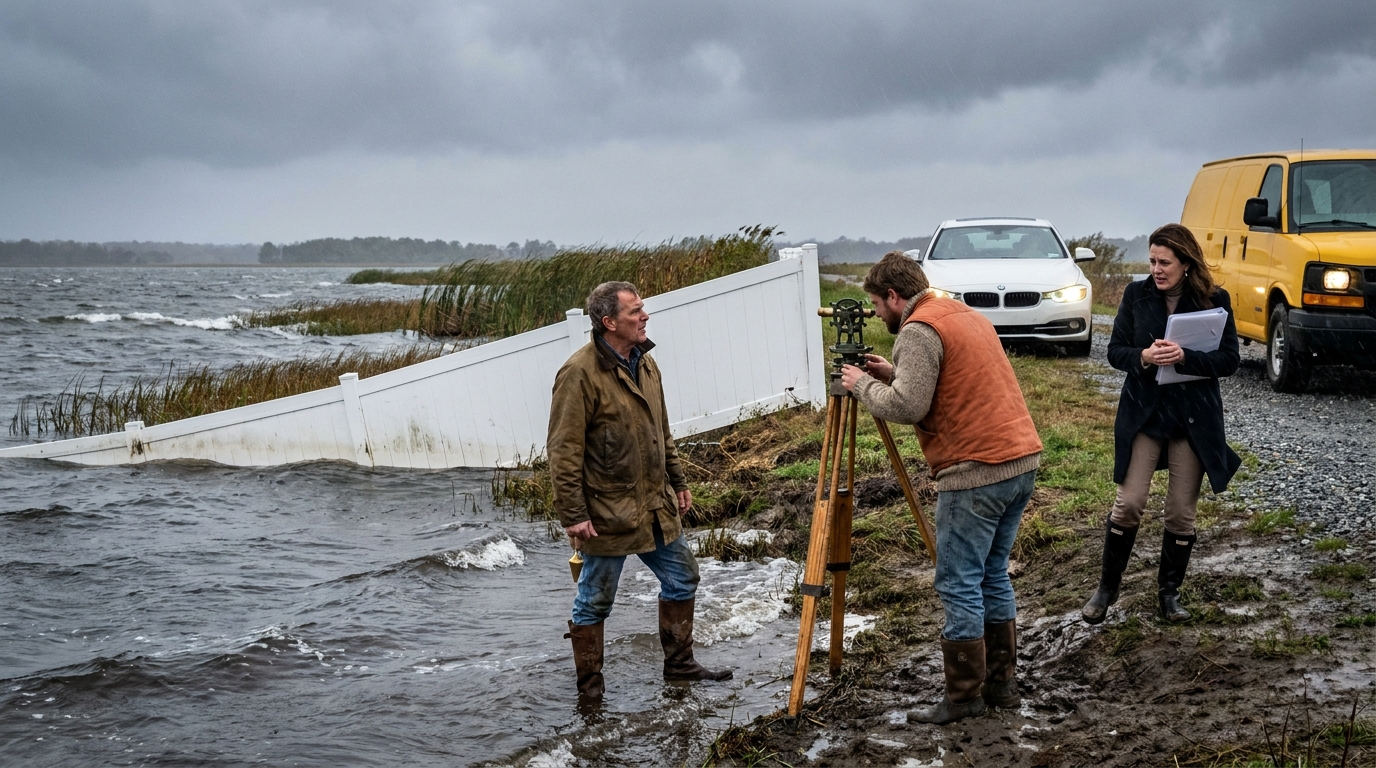
Jake Patterson’s yellow utility van pulled in behind me, spray from his rear tires washing over the weeds. Jake stepped out, adjusting a faded orange vest over a thick wool sweater. He reached into the back and hauled out a brass-fitted surveyor’s transit mounted on a scuffed oak tripod.
“Joyce said you needed a boundary verify, Theo,” Jake said, squinting through the mist at Margaret’s white vinyl fence fifty yards down the spit. “She said it was urgent.”
“It’s three hundred bucks if you run the original baseline pins before the sky breaks,” I said.
Jake didn’t ask questions. He pulled a three-hundred-foot steel measuring tape and a set of iron marking pins from his van. We walked down to the water’s edge where the mud met the high-reed line.
“The 1960 township map shows the high-water line set at nine hundred and twelve feet above sea level,” Jake said, setting the tripod legs deep into the sodden bank. He leveled the glass sight with a steady thumb, turning the brass adjusting screws until the bubble centered in the oil vial. “Where’s her property marker?”
I pointed my boot at a fresh square granite monument set six feet inside the treeline. Margaret’s white fence ran three inches past it, extending straight down into the shallow mud where my old boat launch sat.
“That monument was dropped three months ago,” I said. “Her contractor set it.”
Jake leaned over his sight, his eye pressed tight to the rubber eye-cup. He stayed frozen for thirty seconds, the cold rain starting to spot his orange vest.
“Hold the target rod on her corner post, Theo,” he grunted.
I grabbed the ten-foot aluminum sight rod, walked into the calf-deep mud, and planted the steel foot right against the bottom rail of Margaret’s white fence. The ice-cold lake water soaked straight through my leather boots, biting into my ankles.
Jake adjusted the fine-focus knob. A low whistle came through his teeth, sharp and dry against the rising wind.
“Theo,” Jake called out over the sound of the rain hitting the lake. “Bring the rod back five feet.”
I stepped backward, the suction of the mud pulling hard at my soles. I planted the rod again.
“Back another ten,” he shouted.
I moved ten feet deeper into the water, the cold waves lapping against my knees. I shoved the rod down until it hit solid rock under the silt.
“Stop right there,” Jake said. He locked the sight, stepped back from the tripod, and pulled out a worn black field notebook. He flipped through pages smeared with graphite and mud. “Her deed calls for eighty feet of frontage measured from the 1960 ordinary high-water line. But look at the water level.”
I wiped rain out of my eyes, looking down at the submerged rod.
“Her contractor didn’t use the township baseline,” Jake said, walking down the bank with his hands shoved into his pockets. “He used the artificial summer fill line. Theo, her white fence isn’t just on the shore—her decorative patio and thirty feet of that white vinyl setup are sitting thirty feet past her actual legal boundary.”
My thumb rubbed against the wet canvas of my pocket, finding the hard outline of the sinker.
“She built on the lakebed,” I said.
“She built past her deeded dirt,” Jake corrected, pointing his pencil at the water sloshing around my knees. “The high-water mark extends thirty feet into what she thinks is her front yard. By county code, everything past that original baseline isn’t her lot.”
A sharp car horn blasted from the top of the ridge.
Margaret’s white BMW sat at the edge of the gravel road, its headlights cutting through the gray rain. The driver’s side door swung open, and Margaret stepped out, shielding her head with a plastic file folder. Her designer boots skidded twice on the mud before she caught her balance against a pine trunk.
“What are you doing on this parcel?” she screamed over the wind, her voice shrill and tight. “I told the deputy you were served! This is a private construction zone!”
Jake didn’t even turn around. He reached down, picked up his transit, and wiped the rain off the lens with his thumb.
“Lady,” Jake said, his voice flat as a slab of steel. “You might want to call your builder. Because according to the county survey index, half your back lawn belongs to Tract-58.”
Margaret stopped dead in the mud, her folder slipping an inch. “What did you just say?”
I stepped out of the water, my soaked boots heavy with mud, and looked her straight in the eyes.
“You don’t own the water, Margaret,” I said softly. “And you don’t even own the ground under your fence.”
CHAPTER 4: THE IRON VAULT
The mud on my work boots hardened into a stiff, gray crust long before the truck cleared the county line.
I kept my eye on the highway lane markers, the rain fading into a dreary, low-hanging mist that smeared against the windshield. Beside me on the bench seat lay the yellowed survey plat Jake had stamped, smeared with a thumbprint of lake silt right over the boundary markers for Tract-58.
The decoy had played its part. Pointing out Margaret’s thirty-foot encroachment into the shoreline buffer had stalled her builders, but it wasn’t the killing blow. A property line dispute meant months in civil court, land arbitrations, and endless injunctions. Margaret had the capital to bleed the rest of the cove dry while her bogus HOA racked up daily non-compliance fines.
To break her completely, I needed the root.
Three hours of asphalt hummed under the tires before the state capital’s granite limestone towers broke through the gray horizon.
The State Historical Records Annex sat two miles south of the legislative plaza, a cold, windowless concrete structure smelling of ozone, industrial floor sealant, and fifty years of accumulated paper decay. I parked in the basement visitor lot, grabbed my wax-canvas coat, and walked up the stone steps into the subterranean basement terminal.
The main desk was manned by an archivist whose silver name tag read H. Vance. He had narrow shoulders, thick wire-rimmed glasses, and hands stained light brown around the knuckles from decades of handling acidic newsprint.
“Industrial deeds,” I said, stopping at the brass counter. “Nineteen-forties mineral conveyance files.”
Vance didn’t look up from his computer terminal. “County?”
“Oakhaven. Pine Ridge Basin.”
“That basin was surveyed under the 1941 Mining Infrastructure Emergency Act,” Vance said, his voice dry as a rustling page. “All commercial leases are digitized in Sector 4.”
“Not the leases,” I said, leaning forward until my wet sleeves pressed against the polished granite counter. “The baseline property transfers. Thompson Mining to private holdings, 1943 through 1958.”
Vance’s fingers stopped over his keyboard. He slowly raised his head, his small eyes sharpening behind his spectacles.
“The Thompson Mining portfolio isn’t in Sector 4,” Vance said softly. “It’s classified under historical industrial reserves. Drawer 14 in The Iron Vault.”
He pulled a heavy brass key ring from his drawer, unlocked an iron pass-through gate, and motioned for me to follow him down a narrow, windowless hallway flanked by steel-reinforced doors.
The basement temperature dropped ten degrees as we descended. At the far end of the corridor stood a reinforced riveted steel door with a mechanical wheel lock. Vance turned the brass key in the keyhole, gripped the iron wheel with both hands, and spun it counter-clockwise.
The steel locking pins retracted with a heavy, hollow CLACK.
Inside, row upon row of dark green industrial flat-file lockers stretched thirty yards into the gloom. The air was dry, refrigerated, and thick with the heavy scent of old parchment and copper-base ink.
“File series 1943-B,” Vance said, clicking a bare halogen overhead pull-chain. “Drawer 14.”
He pulled the heavy drawer. The roller bearings screamed against rusted steel tracks before coming to a hard stop. Inside lay thick, blue-cloth binder books bound with brass screws, each bearing an embossed silver stamp on the leather spine.
My hand trembled slightly as I reached into the drawer. My calloused fingers brushed over the faded silver lettering: Thompson Mining Company — Comprehensive Land & Resource Conveyances: Tract-58 through Tract-90.
I lifted the heavy binder, set it on the metal consultation table, and unbuckled the leather straps.
The pages were thick, heavy vellum, yellowed at the edges but preserved in the cold dry air. I flipped past the 1941 exploration surveys, past the failed copper test yields, straight to the 1943 master liquidation grant.
Section 4, Paragraph B.
I ran my thumb over the dark black ink, reading the legal phrasing slowly, letting every word burn into my memory.
“…and hereby conveys, grants, and transfers in perpetuity to Theodore B. Blackstone Sr., his heirs and assigns, not merely subsurface mineral extraction rights, but absolute, unencumbered fee-simple title to the entirety of the lakebed, silt basin, springheads, and all attached surface-water usage rights encompassing the forty acres of Pine Ridge Lake…”
My thumb stopped over a folded parchment insert glued to the bottom margin. It was a tax exemption stamp dated 1958, bearing my grandfather’s signature alongside a county assessor’s seal.
The high-water mark didn’t matter. The shoreline boundary didn’t matter.
Margaret hadn’t just built a fence on county buffer land. Her entire house, her dock, her manicured lawn, and every drop of water her HOA claimed to regulate sat directly on top of private land owned, taxed, and deeded to the Blackstone family line for eighty-three years.
“Find what you were looking for?” Vance asked from the doorway, his arms crossed over his chest.
I pulled out my phone, laid the camera flat over the parchment seal, and took three high-resolution photographs of the master seal and section numbers. Then I snapped the heavy binder shut, the leather straps buckling with a crisp, final sound.
“Yeah,” I said, slipping my phone into my pocket alongside the heavy brass sinker. “I found the whole lake.”
CHAPTER 5: CHECKMATE IN THE COUNCIL HALL
The brass handle of the county assembly hall door was cold, slick with the condensation of eighty people packed into a room designed for fifty.
I pushed the door open, my heavy work boots thudding against the scuffed vinyl tile.
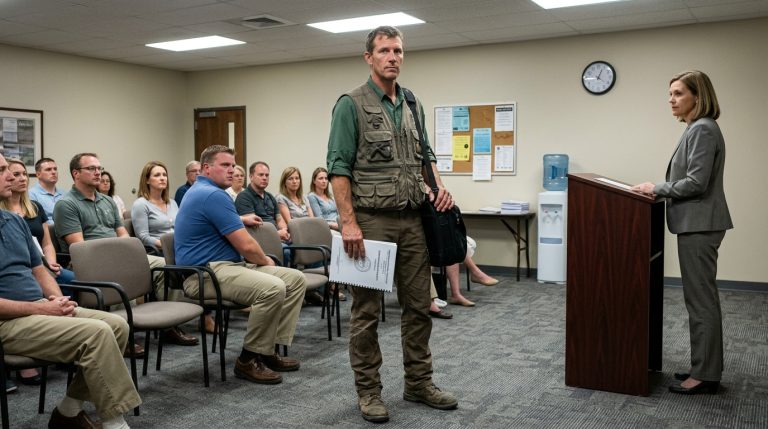
At the front of the room, Margaret Windham stood behind the speaker’s lectern, flanked by her three corporate-blazer allies and a tall silver-haired lawyer holding a pristine leather briefcase. Behind them, a digital projector cast a glossy slide deck onto a pull-down screen: Pine Ridge HOA: Optimizing Community Infrastructure & Liability.
“…and as demonstrated by these shoreline aerials,” Margaret’s voice resonated through the PA system, tight, practiced, and unyielding, “unregulated access to the basin directly undermines municipal safety standards and depresses property appraisals across the entire cove.”
Deputy Charlie Morrison stood by the side exit, his arms crossed, looking down at his boots. In the second row sat Betty Kowalski, her trembling hands clutching a manila folder filled with fifty-dollar daily fine notices for her garden gnomes.
“Therefore,” Margaret continued, clicking her wireless remote to advance the slide to a bulleted list of enforcement actions, “we request the commission formally ratify our association’s authority to execute lien filings against non-compliant parcels, starting with Tract-58.”
Commissioner Rodriguez leaned toward his microphone, adjusting his spectacles. “Ms. Windham, before we entertain a motion, the board requires proof of master covenant recording with the county land desk.”
Margaret smiled, her teeth white and sharp under the fluorescent tubes. “We filed the master intent package three weeks ago, Commissioner. The filing fee receipt is attached to Exhibit A.”
“Intent isn’t a recorded deed, Margaret,” I said.
My voice didn’t rise, but it hit the concrete room like an iron bar dropped on wood.
The entire room turned. Margaret’s smile locked into place, her knuckles whitening where she gripped the edges of the podium.
“Mr. Blackstone,” Commissioner Rodriguez said, raising a hand. “You’ll have three minutes during open public commentary.”
“I don’t need three minutes,” I said, walking down the center aisle. My wax-canvas jacket was still damp from the morning rain, smelling of cold wool and wood smoke. I reached into my coat, pulled out the certified paper packet Joyce had stamped, and laid it flat on the commissioners’ oak dais. “I only need ten seconds.”
Margaret’s lawyer stepped forward, snapping his briefcase shut. “Commissioners, this is an irregular interruption. Mr. Blackstone has been repeatedly cited for unlawful trespass on private HOA waters—”
“There are no HOA waters,” I said.
I pulled three certified nine-by-twelve document prints from my coat—the high-resolution scans Vance had sealed in The Iron Vault two hours ago—and slid them across the table directly in front of the county attorney.
“Exhibit One,” I said flatly. “1943 Master Grant from Thompson Mining to Theodore Blackstone Senior. Section Four, Paragraph B. Conveys not just mineral claims, but complete, fee-simple title to the entirety of the lakebed, silt basin, and surface water rights of Pine Ridge Lake in perpetuity.”
The county attorney picked up the top sheet. His eyes widened slightly as his thumb ran over the raised gold state archive seal on the margin.
“Exhibit Two,” I continued, pointing a calloused finger at the second page. “County Assessor Tax Index, 1958 through present day. Annual tax receipts paid in full on forty acres of submerged property by the Blackstone estate.”
I turned slowly, facing Margaret where she stood behind her podium. Her breath came shallow and fast, her polished composure cracking like dried clay.
“And Exhibit Three,” I said, my voice dropping into a cold, steady rhythm. “A physical boundary overlay run this afternoon by licensed township surveyor Jake Patterson. It shows thirty feet of your vinyl fence, your concrete patio, and your secondary drainage basin built directly on top of my private property.”
The room went dead silent. The only sound was the low hum of the projector fan hanging from the ceiling.
Margaret’s lawyer leaned over the dais, skimming the legal descriptions on the archived deed. He stopped at the 1943 grant clause, read it twice, then slowly straightened his tie. He didn’t look at Margaret. He stepped two inches away from her side.
“Margaret,” the lawyer muttered under his breath, his voice catching in his lapel mic. “This is a fee-simple water title. They own the basin.”
“That’s impossible!” Margaret’s voice broke into a high, sharp screech. She slammed her hand onto the podium, her notebook sliding off the edge and hitting the tile floor with a loud thwack. “We bought frontage! The real estate listing said common area access! He’s just an old man sitting on a dock!”
“He’s the owner, Ms. Windham,” Commissioner Rodriguez said, setting down the papers. He looked over his glasses at Charlie Morrison. “Deputy Morrison, you can stand down on those trespassing calls.”
Charlie let out a long, slow breath, uncrossing his arms. A tiny, unstoppable grin tugged at the corner of his mouth as he nodded to me.
“Furthermore,” Rodriguez said, his gavel hovering two inches above the sound block, “this commission finds that the entity operating as the Pine Ridge HOA possesses zero legal authority to levy fines, restrict access, or construct property improvements on Tract-58. Any unrecorded fee collections are hereby referred to the District Attorney for civil fraud review.”
The gavel slammed down with a sharp, echoing BANG.
In the second row, Betty Kowalski let out a shaky sigh and pulled a handkerchief from her purse, wiping her eyes.
Margaret stood frozen behind the podium, her face drained of color, her eyes staring blankly at the gold seal on my grandfather’s deed. Her three board members were already backing toward the rear exit, silently slipping out the double doors without saying a word.
I didn’t smile. I didn’t raise my voice. I simply reached down, gathered my grandfather’s deeds off the oak table, folded them neatly in half, and slid them back into my coat pocket.
CHAPTER 6: THE EMPTY SHORE
The paper felt thick and heavy through my coat lining as I stepped through the double doors of the county building out into the cold night air.
Puddles in the asphalt lot reflected the amber streetlights, rippling as a light rain began to fall. Behind me, Margaret’s white BMW sat under a light post, its driver’s door left half-ajar. She was sitting in the front seat with the dome light on, her head rested against the steering wheel, staring blankly at a stack of un-notarized HOA covenants scattered across her lap.
She didn’t look up when my Ford started with a low rumble. I didn’t press the horn. I backed out slowly, the mud tires catching on the wet gravel, and turned onto the two-lane road heading north toward Pine Ridge Lake.
By Friday afternoon, the county enforcement order had been served.
I stood on the porch of my cabin, holding a steaming mug of black coffee. Across the cove, a flatbed utility truck idling in the dirt pull-off made a dull, mechanical whine. Two county road crew workers in orange jackets were using claw bars to pop the white vinyl fence posts out of the damp turf.
Each post came up with a wet, sucking sound from the mud—SCHLUCK.
They loaded the fence sections one by one into the back of the truck, along with the laminated Members Only signs and the brass-mounted security camera housing Margaret had bolted to the oak post three weeks ago.
Jake Patterson stood by his survey truck at the water’s edge, driving three foot-long iron rebar stakes into the ground along the true boundary line of Tract-58. Every strike of his sledgehammer—THANG, THANG, THANG—echoed across the glass-smooth surface of the lake, clear and sharp in the quiet afternoon air.
Gravel crunched on the drive behind my cabin. Betty Kowalski walked down the path, wearing her yellow raincoat and holding a cardboard box under one arm.
“Theo,” she called out, her voice lighter than it had been in months.
“Betty,” I said, setting my coffee cup on the porch railing.
She set the cardboard box down on my wooden steps. Inside sat a hand-painted ceramic garden gnome holding a miniature fishing rod, its red hat chipped at the tip.
“I brought this back out to the front yard this morning,” Betty said, her thumb tracing the chipped paint on the gnome’s elbow. “Thought you ought to see it before I set it by the hydrangeas.”
“Looks good, Betty,” I said. “Where’s the rest of them?”
“On the porch,” she chuckled softly, looking out across the water toward Margaret’s parcel. A large wooden FOR SALE sign now stood near the edge of the driveway, pushed deep into the mud. “She’s moving out on Monday. A real estate company from the city took the listing.”
“She get her price?”
“Not likely,” Betty said, shaking her head. “Word gets around when a parcel comes with thirty feet less yard than advertised. And nobody wants to buy into a neighborhood where the lake belongs to the fellow in the log cabin.”
I walked down the steps, my boots crunching softly on the wet pine needles.
The lake was quiet. The loons were out near the deep channel by the springhead, their calls drifting across the water like low whistles. The mist was rising off the surface, turning pale yellow as the afternoon sun broke through the clouds over the ridge.
I walked down to the white oak post where the zinc bolt had been driven three weeks ago. The bolt was gone, leaving a clean, dark hole in the wood.
I set my wooden tackle box down on the flat stone at the boat launch. The brass latches were slightly pitted from years of lake moisture, showing a dull patina where my thumb had pressed against them thousands of times. I pulled my oil rag from the side pocket, opened the lid, and wiped down the steel hinges, working the oil into the joints until they moved without a sound.
The brass lead sinker in my pocket was cool to the touch. I pulled it out, tied it to the end of my ten-pound test line, and tested the knot with a firm tug.
The monofilament held tight.
I stood at the edge of the launch, my boots planted firmly in the damp mud of my grandfather’s land, and swung the rod back. The line whistled as it cut through the air, sending the weight sailing forty yards out into the dark, cold water.
The sinker hit the surface with a small, clean PLOP, sending a wide circle of ripples expanding outward until they touched both shores of the cove.
I reeled in the slack, felt the heavy brass settle onto the firm silt of the lakebed, and sat down on the wooden bench to wait.