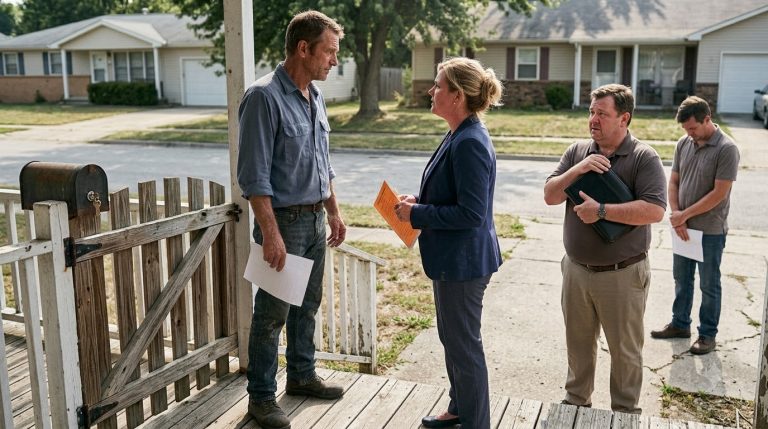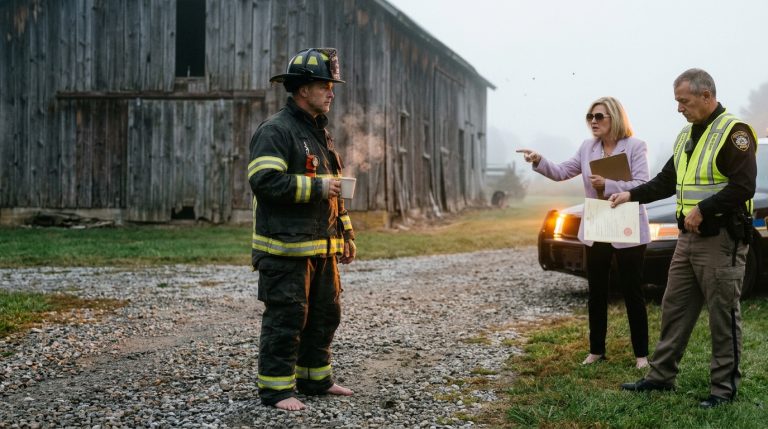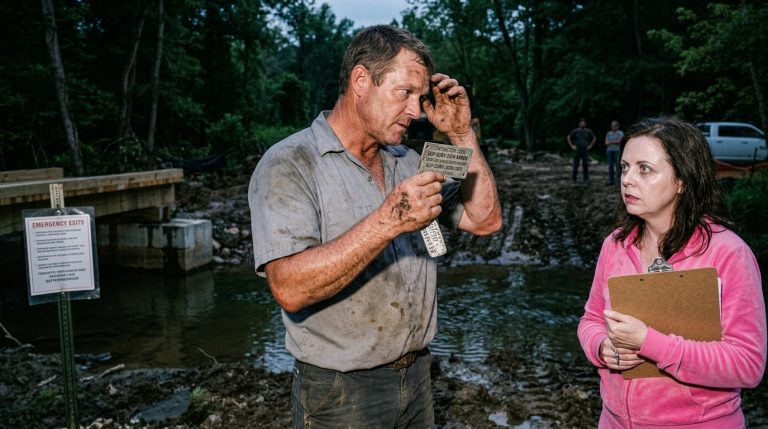
The Bitter Wells of Pinehaven: A Story of Poison, Revenge, and Silent Retribution
CHAPTER 1: THE TASTE OF COPPER
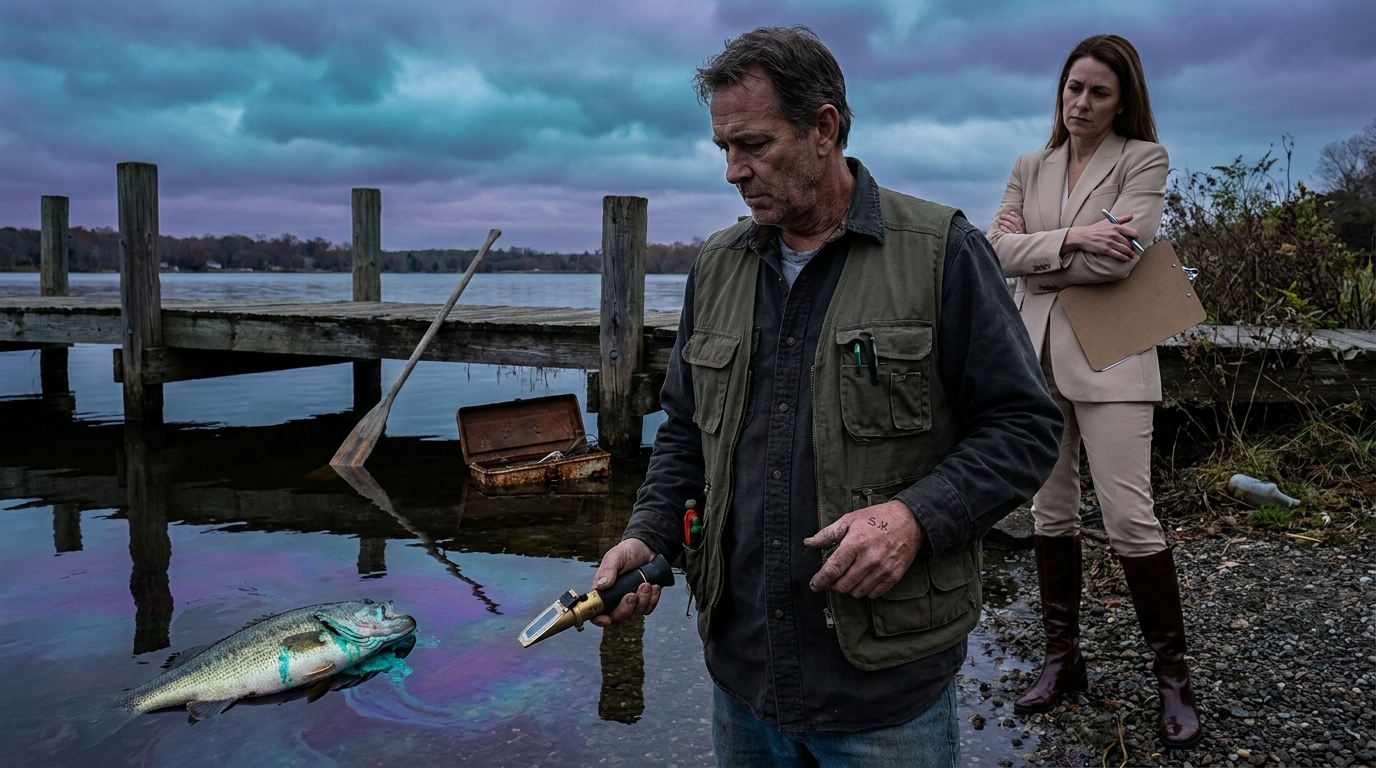
The water didn’t ripple right. At 5:12 a.m., the surface of Pinehaven Lake should have carried the dull, dark sheen of morning limestone spring. Instead, a slick violet oil spread across the weeds near the dock, turning the reflection of the dawn sky into a bruised purple.
Then came the smell. Cold iron. Battery acid. The chemical tang hit the back of my throat before the high heels even ground into the gravel behind me.
I didn’t turn around. I reached into my coat pocket and pulled out the brass refractometer—Sarah’s initials, S.H., scratched into the casing near the eye-piece. My thumb wiped a streak of grease off the lens.
“This is a decorative water feature now, Dale,” Sandra Kirkpatrick said. Her voice had that smooth, laminate polish she used on real estate listings. “Algae control. The board approved the maintenance schedule.”
The plastic bag in her hand rustled. Fifty pounds of industrial copper sulfate, half-empty, slouched against her designer boots.
I dipped the glass slide into the edge of the scum. I set the cover. Raised the scope to my right eye.
“Forty parts per million,” I said. My voice was low, flat. Thirty years in municipal water treatment doesn’t leave room for shouting. “Safe limit for fish is zero point zero five. You just dropped enough copper in here to strip the paint off a hull.”
“It’s pond maintenance,” she snapped. Her clipboard tapped against her forearm with a rhythmic, sharp click-click-click. “This neighborhood is upgrading its aesthetic. Fishing attracts… an undesirable demographic. We have property values to consider.”
“You have a limestone shelf eight feet down,” I said. I thumbed the brass adjustment screw on the meter until the reticle clicked into place. ” Karst-47 formation. It doesn’t hold water like a bucket. It breathes.”
“I don’t care about the mud, Dale.” She stepped closer. The scent of her expensive lavender perfume fought the chemical burn rising off the water and lost. “The signs go up at noon. No fishing. No dock access. If you cast a line in this water tomorrow, I’m issuing a fine directly to your lot.”
She turned on her heel. The gravel screamed under her footwear as she walked back toward her Mercedes.
I stayed on the dock. Below my boots, the first largemouth bass rolled belly-up. Its gills were caked in a thick, turquoise slime. Its mouth opened and closed in silent, suffocating rhythm.
I didn’t reach down to save it. You don’t save what’s already dead.
Instead, I opened my notebook, uncapped my pen, and wrote down the exact timestamp, the wind direction, and the blue-green discoloration spreading south toward the underground spring intake.
The water was already taking the poison down.
CHAPTER 2: BOUNDARY MARKS AND BROKEN LIMESTONE
The largemouth didn’t drift. It hung suspended in the top three inches of the water column, its silver belly catching the grey pre-dawn light like a tin plate. The turquoise cloud of copper sulfate swirled around its gills, thick enough to see through the glass lens of my refractometer.
My left hand held the brass body of the meter tight enough to press the etched S.H. into the meat of my thumb. The metal was cold. It stayed cold even when your palm was sweating.
A sharp crack echoed under my feet.
One of the pilot posts supporting the dock’s outer deck shifted. Decades of damp cedar meeting limestone mud had rotted the lower lag bolts, and my weight, combined with the shifting current of the spring intake below, gave out three inches of ground. I didn’t jump back. I dropped my center of gravity, planting a boot on the solid cross-beam anchored to the shore rock, feeling the wet grit of limestone dust slide beneath my sole.
The lake was sinking into itself.
I slid the refractometer into my coat pocket, retrieved my notebook, and stepped off the sagging timber onto the shoreline gravel. The Mercedes was already gone, its tire tracks left as deep, sharp ridges in the damp clay near my mailbox. Sandra didn’t drive like someone who lived here. She drove like someone leasing the road.
I walked the perimeter fence—my fence, set by a surveyor named Miller back in May of ’87.
At the property line where my lot met the common HOA easement, two new steel T-posts stood driven fresh into the turf. Bright orange powder-coat paint, still tacky to the touch, covered the top four inches. Hanging between them was a heavy-gauge aluminum sign, bolted down with tamper-proof Torx screws.
NOTICE: DECORATIVE WATER FEATURE. NO RECREATIONAL USE. NO TRESPASSING. BY ORDER OF PINEHAVEN HOA BOARD.
I reached out and touched the metal. The paint was so fresh it left a faint orange circle on the tip of my index finger.
They’d driven the western post eight inches inside my corner monument. I knew where that rebar pin sat because I’d cleared the briars off it every spring for twenty years to keep the surveyor’s flag visible. Sandra hadn’t just posted a notice; she’d planted iron in my dirt.
I didn’t pull the post. You don’t pull a stake when you’re building a legal file—you document where the trespass rests.
I pulled a tape measure from my belt, hooked the tab on the center of the surveyor’s original iron rod, and pulled the yellow steel line out until it touched the fresh orange post. Eight point two inches.
“Documenting the scenery, Dale?”
The voice came from across the road. Bill Rodriguez was standing by his mailbox, holding a plastic tumbler of coffee. He was in his work boots, his denim jacket stained with grey hydraulic fluid at the cuffs. Bill had run a backhoe crew for the county before his knees gave out. He’d lived in the subdivision since ’89.
“She put iron inside my corner, Bill,” I said. My voice barely carried across the quiet pavement.
Bill took a slow sip from his cup, his eyes tracking from the orange sign down to the dead water lapping at my dock pillars. “She had a crew out here at four in the morning. Two boys in a flatbed. Said they were working on board orders. I told ’em the line belonged to Lot 47. They said they were paid by the hour, not the map.”
“She dumped fifty pounds of copper in the spring cove,” I said.
Bill stopped chewing his lip. He looked toward the water, then back at his coffee cup. He lowered the tumbler an inch. “Copper? For what?”
“Algae.”
“There wasn’t no algae,” Bill said flatly. “The spring runs sixty-two degrees year-round. It stays clear as gin unless someone digs up the bank upstream.”
“It’s not about algae,” I said. I stepped over the orange T-post, leaving it right where Sandra’s crew had pounded it into my sod. “It’s about the use rights. If she turns the lake into a managed landscape asset, the fishing rights tied to the ’87 Covenant don’t apply. She’s trying to extinguish the easement by altering the primary use.”
Bill stared at me for three long seconds. His weathered face didn’t move, but his thumb began to scrape at a dried patch of grease on his jacket sleeve—over and over, a slow, unconscious rhythm.
“Dale,” he said, dropping his voice an octave. “My well head is eighty feet from that cove. On the lower limestone bench.”
“I know,” I said. “The Karst-47 fissure runs southwest. Straight under your driveway.”
Bill looked down at the coffee in his hand. The steam rising off the black surface seemed to stall in the cold morning air. Slowly, deliberately, he poured the liquid out into the gravel at his feet. The dark stain soaked straight into the stone.
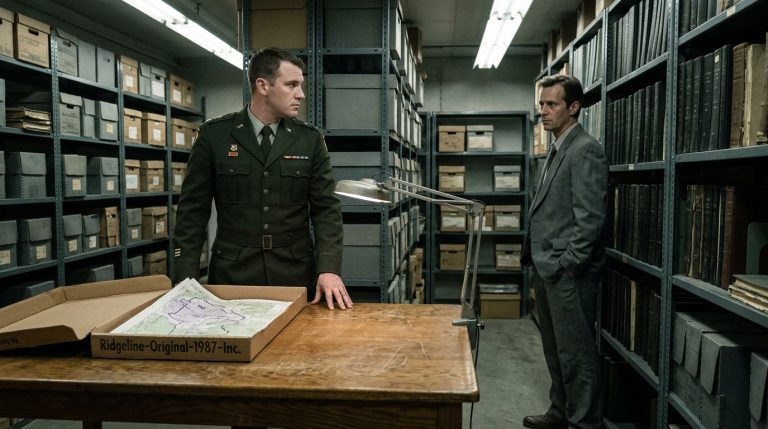
“I’m going to the courthouse,” I said. “I need the original plat map with the 1987 Covenant seals.”
“I’ve got a socket set,” Bill said, looking back at the orange sign. “We can take those Torx bolts down in two minutes.”
“Leave ’em,” I said. “Every hour that sign stands inside my pin is another count of willful trespass. Let her think the metal holds.”
I turned and walked back toward my porch. Behind me, I heard Bill’s heavy work boots turn on the asphalt, his pace faster now, heading straight back to his front door where his wife was likely setting the breakfast table.
I went inside, picked up my truck keys, and grabbed the manila folder labeled Pinehaven – Original Access.
The paper inside was yellowed at the edges, smelling faintly of old cedar closet and dry ink. The covenant wasn’t just a set of rules; it was a land grant tied to the original deed of Lot 47.
When I turned the key in the ignition of my F-150, the engine turned over heavy, its belts squealing once against the damp air before settling into a steady rumble. I backed out of the driveway, my eyes catching the reflection of my dock in the side mirror.
The turquoise haze in the water was spreading, moving in a slow, silent wedge toward the limestone shelf where the underground springs fed the deep earth.
CHAPTER 3: THE POOL CLEANERS CERTIFICATE
The starter motor clicked once, groaned against the damp air, and then the V8 caught with a heavy rumble that vibrated through the floorboards. In the side mirror, the blue-green streak on the cove didn’t dissipate. It stretched, thinning into long, fibrous fingers that followed the current directly toward the submerged intake of Karst-47.
I pulled out of the gravel drive, shifting into second gear as the tires crushed wet oak leaves into the asphalt.
Fourteen miles down Route 9 took me past the county deeds office. The hallway inside smelled of industrial floor wax and old paper. The clerk behind the counter, a woman named Martha who’d processed my original parcel filings back in ’87, didn’t even ask for my ID. She slid a heavy leather-bound volume across the laminate counter—Book 112, The Aquifer Registry & Land Grants.
My fingers traced the faded red ink along the margin of Page 414.
1987 Covenant, Parcel 47-B. Retaining absolute sub-surface usage, springhead management, and riparian extraction rights.
Stamped right beneath the notary’s embossed foil seal was a secondary filing code in faint purple ink: KARST-47 CONSERVATION EASEMENT – STATE WATER RESOURCES BOARD.
Sandra hadn’t just trespassed on private land. She had dumped unregistered agricultural chemicals directly into a designated sub-surface recharge basin.
I paid three dollars for certified photocopies, watched Martha stamp each page with the gold seal, and folded them into my coat pocket next to Sarah’s brass meter.
When I pulled back into Pinehaven at 10:45 a.m., a white Ford F-150 with magnetic side door signs was parked diagonally across the public boat launch. The stencil on the door read: AQUATIC SOLUTIONS PROFESSIONAL – RESIDENTIAL & COMMERCIAL MAINTENANCE.
A young guy in a neon-yellow safety vest was leaning over the tailgate, dipping a paper test strip into a plastic beaker of lake water. He couldn’t have been more than twenty-six. His sneakers were spotless, and a brand-new clipboard rested against his ribs.
Sandra stood three feet away, arms crossed over her tailored beige jacket, her heels sinking half an inch into the wet turf.
“It’s showing a mild pH imbalance, Mrs. Kirkpatrick,” the kid was saying. He held the paper strip up to a color chart printed on the side of a plastic tube. “Bit of organic buildup. We can shock it with a localized algaecide package by Thursday.”
I shut off my engine and stepped out of the truck. The smell hit me before I crossed the pavement—not lake mud, but the harsh, bleach-heavy stench of standard swimming pool chlorine coming from the bed of his Ford. Stacked behind his tool rack were four five-gallon buckets of commercial pool shock and two bags of copper carbonate.
“What’s your license number, son?” I asked, stopping at the edge of the gravel.
The kid blinked, turning around. His hand twitched, dropping the paper test strip into the grass. “Ex-excuse me?”
“Your applicator license,” I said. My boots stayed planted on the road margin. “Department of Agriculture, Category 5 Aquatic Pest Control. What’s the number on your card?”
Sandra stepped between us, her phone already held at chest height like a shield. “Dale, back off. Kyle is a certified environmental consultant. I hired him on behalf of the board to conduct a safety audit.”
“Kyle cleans pool filters,” I said, eyeing the magnetic sign on his truck door. The corner was peeling, showing a faint outline where a previous phone number had been scraped off. “That’s a pool maintenance rig out of Clayton County. He doesn’t have an aquatic pesticide license, and those paper strips he’s dipping don’t measure heavy metal saturation.”
Kyle’s face flushed red, the color climbing right past his neon vest to his hairline. His thumb began rubbing a tear in the foam handle of his clipboard—a quick, nervous micro-action that contradicted his attempt to stand straight. “I have a commercial operator permit,” he muttered.
“For swimming pools,” I said. “Poured concrete basins. You put copper carbonate in this spring, and the limestone’s going to turn it into soluble copper ions within six hours. It won’t stay in the cove. It’s going down the karst.”
“That is enough,” Sandra snapped. Her voice hit that sharp, high register she used when a buyer tried to negotiate closing costs. “Kyle’s company is fully bonded. His report will be submitted to the county health board on Thursday as proof that this water feature requires full chemical remediation. Your primitive fishing activities are creating a public health hazard, and we have the scientific documentation to prove it.”
“Show me the lab chain of custody,” I said to Kyle.
Kyle looked at Sandra, then down at his spotless sneakers. He didn’t answer.
“He doesn’t need to show you anything,” Sandra said. She pulled a folded sheet of paper from her pocket and thrust it toward my chest. “This is an official notice of an emergency HOA board hearing. Thursday night, seven o’clock. We will present Kyle’s findings, approve the drainage plan for the fountain installation, and formally revoke your access to Lot 47’s dock.”
I didn’t take the paper. I let her hand hold it in the cold air between us until her fingers began to tremble slightly from the effort.
“I pulled the 1987 Covenant this morning, Sandra,” I said softly. “The state easement is attached to the deed. If you drain this cove to put a fountain in, you’re breaking a state water seal.”
Sandra smiled. It was a cold, practiced curve of her lips that didn’t reach her eyes. “A forty-year-old piece of paper isn’t going to stop a modern board from protecting property values, Dale. The world moved on. You should have moved with it.”
She turned and walked toward Kyle’s truck, gesturing for him to pack up his gear. Kyle didn’t look at me as he tossed his beaker into the bed, the plastic clattering against a stack of pool skimmers.
I stood on the asphalt and watched them drive off.
Behind me, the lake was quiet. But when I walked down to the water’s edge and knelt by the pilot posts, I noticed something new.
A small, trickling sound was coming from the base of the bank—not the spring pushing water out, but the sound of surface water being sucked down into a fresh fissure where the limestone shelf met the shore. The copper cloud wasn’t just floating anymore.
It was disappearing into the dark.
CHAPTER 4: THE SUBSURFACE BREACH
The sound wasn’t louder than a running garden hose, but in the damp quiet of the cove, it sounded like a drain opening under a floorboard. Glug-glug-glug.
I shifted my weight on my right knee, the cold mud soaking through my work trousers. I reached down into the shallow water near the post, my fingers tracing the jagged edge where the grey limestone shelf met the shore clay. A two-inch crack ran beneath the mudline, sucking a steady stream of turquoise-tinted water straight down into the dark.
I pulled my hand back. My fingernails were coated in a pale, chalky silt that reeked of chemical copper.
Sarah used to keep a glass gallon jar on the kitchen counter back in 2018. Every Tuesday at dawn, she’d walk down to this exact post, fill the jar, and leave it by the sink to settle before testing the conductivity. “If the mineral count jumps three points in an hour, Dale,” she’d say, wiping her spectacles on her apron, “it means the deep shelf is shifting.”
My thumb scraped the chalk off my knuckles. The shelf wasn’t just shifting. It was drinking.
I stood up, my knee joint grinding with a dull pop, and walked back to my truck. From the tool box behind the cab, I retrieved a twenty-foot section of clear plastic tubing, a hand-siphon pump, and three sterile glass sampling bottles from my old municipal kit.
By 1:15 p.m., I was standing on Bill Rodriguez’s side lawn, fifty yards southwest of the lake line.
Bill’s wellhead rose eight inches out of the turf—a four-inch green steel casing capped with a cast-iron sanitary seal. Bill came out his side door carrying a pipe wrench and a red steel toolbox, his gait heavy and uneven.
“You think it crossed the bench already?” Bill asked, stopping two feet from the casing. His hands didn’t shake, but he set the wrench down on the grass with a heavy, deliberate thud.
“Karst-47 doesn’t filter, Bill,” I said, setting my glass bottles on the well lid. “It’s a conduit. The limestone acts like a pipe network. If Sandra’s copper reached the fissure at nine this morning, your pump intake is sitting right in the plume.”
Bill didn’t argue. He kneeled down, his joints creaking, and applied the wrench to the brass sampling bib at the base of the casing. The threads groaned against years of rust before breaking free. He backed the valve off two full turns.
Water sputtered out in a hard, clear jet, splashing against the green grass.
I held a glass bottle under the stream. At first glance, the water looked clean. Clear. Cold.
Then I held the bottle up against the white sleeve of Bill’s work shirt.
A faint, milky haze hung in the center of the glass—tiny suspended particles of copper carbonate reacting with the natural calcium in the groundwater. I uncapped Sarah’s brass comparator kit, pulled two drops of reagent from the small dropper vial, and squeezed them into the sample.
The liquid in the glass turned a dark, bruised violet instantly.
“Zero point four milligrams per liter,” I said. My voice didn’t rise. “Eight times the federal drinking water threshold. It’s in your tap, Bill.”
Bill stared at the purple glass in my hand. His jaw set hard, his teeth clicking together once before he spoke. “My granddaughter drank two glasses of milk mixed with tap water this morning before school.”
“Shut the main breaker off,” I said. “Don’t run the dishwasher, don’t flush the toilets. Every gallon you pump pulls more of the plume from the fissure into your gravel pack.”
Bill stood up so fast his knee gave a sharp snap. He didn’t look at me. He walked straight to his basement bulkhead door, pulled it open, and disappeared into the dark below. A second later, the hum of his submersible pump cut out, leaving only the sound of the wind in the pine branches above us.
I walked back to my F-150, set the purple sample bottle on the dashboard, and pulled out my phone.
I dialed the regional office of the Environmental Protection Agency in Atlanta. I didn’t ask for customer service or the general inquiry line. I dialed the direct extension for the Emergency Response Branch—a number I’d kept in my wallet since the 2011 chemical spill at the municipal plant.
“Regional Dispatch, Officer Vance,” a voice answered after two rings.
“My name is Dale Hutchinson,” I said, looking through my windshield at Sandra Kirkpatrick’s two-story brick colonial down the street. “Retired supervisor, Public Water System ID 0440012. I am reporting an active, unpermitted chemical discharge into a class-one sub-surface drinking water aquifer.”
I gave him the parcel coordinates, the reading from Bill’s well, the license number on Kyle’s truck, and the exact timestamp of Sandra’s fifty-pound dump.
“Mr. Hutchinson,” Vance said, the sound of keyboard keys clicking rapidly in the background. “Is this a municipal distribution system?”
“It’s a forty-seven-home private well cluster feeding off a Karst-47 limestone recharge,” I said. “The surface discharge occurred five hours ago. The plume is already inside the residential pump zone.”
The clicking stopped.
“Stay at the location, Mr. Hutchinson,” Vance said, his tone shifting from routine logging to flat, quiet precision. “Do not attempt to treat or flush the wellheads. An inspector from the Water Division will be on site by sixteen hundred hours.”
I hung up the phone and set it on the passenger seat next to my yellowed copy of The 1987 Covenant.
Down the street, Sandra’s garage door rolled open. Her black Mercedes backed out slowly onto the asphalt, its shiny bumper reflecting the grey afternoon sky. She didn’t look toward my truck as she turned the wheel and drove toward the subdivision entrance.
She was heading to the printer to pick up her glossy flyers for Thursday night’s meeting.
I reached out, picked up Sarah’s brass meter from the console, and turned the cold metal over in my palm. The purple water in the glass bottle beside it didn’t settle. The silt stayed suspended, dark and heavy in the glass.
CHAPTER 5: THE SENSOR TRAP
The purple silt in the sampling bottle didn’t settle. Four hours later, at 6:58 p.m., the liquid inside the glass vial resting on my lap still held that bruised, toxic overcast.
I sat in the third row of folding chairs in the Pinehaven Community Center. The room smelled of wet raincoats, stale coffee, and the sharp chlorine wash the janitor used on the linoleum. Sixty residents packed the aluminum chairs, their coats rustling like dry corn husks every time someone shifted.
Up front, Sandra Kirkpatrick stood behind a portable lectern. A projector hummed above her head, throwing a bright white rectangle onto the pull-down screen behind her. She wore a tailored black blazer, her manicured nails tapping against her gold pen as she adjusted her microphone.
Tap-tap-tap.
“Good evening, neighbors,” Sandra began, her voice smooth, amplified, and rich with projected warmth. “Before we discuss our beautification roadmaps for the coming fiscal quarter, I want to address the unauthorized recreational activities that have compromised our lake front.”
A quiet hum went through the room.
Sandra clicked her wireless remote. A slide appeared on the screen—a enlarged, grainy photo of my dock, with a red circle drawn around my tackle box and fishing rods.
“For months, our board has worked to elevate Pinehaven’s standards,” she said, leaning over the lectern. “Kyle from Aquatic Solutions has completed a preliminary assessment. The lake requires immediate chemical stabilization and structural capping to prevent bacterial runoff from unmanaged shoreline use.”
I reached under my chair, my boots planted flat on the floor. Beside my right ankle sat a black plastic Pelican case—the portable digital spectrometer I’d requisitioned through the county water board thirty years ago and kept calibrated in my workshop.
I didn’t yell. I didn’t interrupt.
I reached down, flipped the two plastic latches, and opened the lid. The small LED display glowed green in the dark under my seat. Connected to the unit were three ten-foot fiber-optic sensor leads that I had run through the floor vent twenty minutes before the doors opened, tapped directly into the raw feed line from the building’s pressure tank.
Bill Rodriguez sat two chairs to my left. His arms were crossed tight over his chest, his eyes fixed on the back of Sandra’s neck. His right boot tapped a slow, steady pulse against the floor.
“We have scheduled a full fountain installation for next Monday,” Sandra continued, her voice rising over the low murmur of the crowd. “Which will require a seventy-two-hour surface draw down. This will permanently eliminate the stagnant conditions created by unregulated fishing.”
“Sandra,” I said.
My voice wasn’t loud, but thirty years of giving commands over the roar of high-pressure pumps carries. The room went dead silent.
Sandra stopped mid-sentence. Her hand hovered over the slide clicker. “Dale, public comment is reserved for the final fifteen minutes of the meeting. Please hold your—”
I stood up. I didn’t grab the lectern. I picked up the plastic sample bottle from my lap and set it on the edge of the table near the front row, right next to her pitcher of ice water.
The purple liquid caught the bright white light of the projector.
“That sample came from Bill Rodriguez’s wellhead at one-fifteen today,” I said. “Copper carbonate. Zero point four milligrams per liter.”
Sandra’s eyebrows pinched together, a tiny crease breaking her smooth foundation. “Whatever private well issues Mr. Rodriguez is experiencing are outside the scope of HOA maintenance—”
“The well pulls from Karst-47,” I said. I tapped the spacebar on the laptop sitting on the side table—the one I’d plugged my spectrometer into before the meeting started.
The projector screen flickered. The photo of my dock disappeared.
In its place appeared a high-resolution geological survey map of Pinehaven Subdivision, dated October 14, 1987. Red dotted lines ran beneath every single lot, branching like veins from the central springhead at Lot 47 directly toward forty-seven individual well markers.
Overlaid on the map was a real-time digital line graph. The green line sat flat at zero until 5:12 a.m. this morning. Then it spiked vertically, shooting straight into the red zone marked TOXICITY THRESHOLD.
“That’s the live feed from the community center’s intake pipe right now,” I said, pointing at the screen. “The copper sulfate you poured into my cove at dawn didn’t stay on the surface. It went straight into the limestone shelf. Every tap in this room is connected to that graph.”
Gasps rippled through the rows. Mrs. Peterson, sitting in row two, dropped her glass of water onto the linoleum. The ice cubes skittered across the floor.
“That is a complete fabrication!” Sandra’s voice cracked, losing its laminate polish. She slammed her hand onto the lectern. “He’s using unapproved equipment! He’s manipulating data to intimidate this board because he wants to fish!”
“Kyle doesn’t have an aquatic license, Sandra,” I said, my voice dropping lower as the room grew louder. “And your board didn’t file a environmental impact permit before dumping agricultural chemicals into a state-protected recharge basin.”
“It’s a decorative pond!” she shouted, her face flushing dark red beneath the overhead lights. “The board has absolute authority over surface aesthetics!”
“Not over the 1987 Covenant,” I said.
I reached into my jacket, pulled out the gold-sealed certified copy from Martha’s office, and laid it flat on the table next to the purple water bottle.
“Page forty-two,” I said. “Sub-surface rights retained by the state water board. Karst-47 is a regulated public water source. You didn’t remediate a pond, Sandra. You poisoned an aquifer.”
The double doors at the back of the hall swung open with a heavy hydraulic hiss.
Two men in dark blue windbreakers stepped into the light. White block letters across their backs read: U.S. ENVIRONMENTAL PROTECTION AGENCY – ENFORCEMENT. Behind them stood Agent Vance, holding a thick manila folder and a federal inspection warrant.
Sandra’s clicker slipped from her hand. It hit the floor, the battery cover popping off and sliding across the tile until it bumped against the toe of Agent Vance’s boot.
She looked at the agents, then at the red spike on the projector screen, then down at the purple glass sitting beside her water pitcher. Her lips opened, but no sound came out.
“Sandra Kirkpatrick?” Agent Vance said, his boots clicking evenly as he walked down the center aisle. “We have an emergency environmental containment order for Parcel 47. You need to step away from the podium.”
CHAPTER 6: THE CLEAR RUN
Sandra didn’t step back. Her fingers dug into the mahogany edges of the lectern until her knuckles turned the color of chalk.
“You don’t have jurisdiction over a private residential association,” she spat, her voice ringing sharp against the concrete ceiling. She grabbed a sheet of paper from her binder, thrusting it toward Vance’s chest. “This is an internal property board! The county zoning office approved our maintenance charter back in—”
Agent Vance didn’t take the paper. He reached into his coat, pulled out a blue folder stamped with the seal of the United States District Court, and set it flat over her microphone.
“Section 301 of the Clean Water Act, Mrs. Kirkpatrick,” Vance said, his voice dropping into a quiet, unyielding register. “Unlawful discharge into a primary sub-surface recharge zone. You signed the agricultural chemical purchase receipts at the Grain & Feed on Monday under the HOA tax ID. That makes it a corporate felony.”
Sandra’s mouth worked, but no sound came out. She looked past Vance to the two officers standing in the aisle, then at the crowd of sixty neighbors sitting in frozen, dead silence.
Her gaze finally landed on me. I didn’t move. I sat behind my spectrometer, my hand rested flat on the yellowed parchment of The 1987 Covenant.
“You,” she whispered. The word carried no anger—just the sudden, hollow realization of a gambler who had bet on a hand that was never in the deck. “You knew the whole time.”
“I told you on Monday morning, Sandra,” I said softly, my voice barely carrying over the hum of the projector. “The water doesn’t care about the board bylaws. It just follows the limestone.”
Agent Vance took her by the elbow—not roughly, but with the firm, practiced weight of federal authority. “We have a mobile testing unit outside, Mrs. Kirkpatrick. You’re required to accompany us to the district office to sign the emergency containment order.”
She let them guide her down the aisle. Her heels didn’t click on the linoleum this time; she walked with her head down, her black blazer pulling tight across her shoulders. When the double doors swung shut behind her, the room remained motionless for ten full seconds.
Then Bill Rodriguez stood up. He walked to the front table, picked up the purple sampling bottle, and set it carefully back in my Pelican case.
“The EPA’s bringing two tanker trucks of clean water by eight tonight,” Bill said to the room, his voice heavy and grounded. “We’re hooking ’em directly to the main manifold at the pump house until the state flush crew clears the karst.”
Nobody argued. Nobody called for a motion. The board was dead, but the neighborhood was still breathing.
Six weeks later, the rain came down cold and steady over Pinehaven.
I stood on the end of my dock at 5:30 a.m., wrapped in my canvas work coat. Below my boots, the lake level had dropped eighteen inches from the state flushing operations, but the water was clear again. Cold, gin-clear spring water pushing up through the limestone joints at sixty-two degrees.
Sandra’s Mercedes was gone from her driveway down the street. The bank foreclosed on the colonial three days after the federal court imposed the initial four-hundred-thousand-dollar remediation lien under The Aquifer Registry mandates. The board dissolved itself by unanimous vote at the end of October, reverting all lot management back to the original 1987 deed parameters.
I reached into my pocket and pulled out Sarah’s brass refractometer.
The brass was scratched near the hinge, the metal showing thirty years of salt, sweat, and mineral dust. I unscrewed the eyepiece lens, took a small piece of dry flannel from my cleaning kit, and carefully wiped away a smudge of dried river silt from the glass prism.
The brass threading was stiff. I worked a drop of gun oil into the groove, turning the screw back and forth until it moved without a hitch—smooth, quiet, and precise.
I dipped the glass slide into the water lapping against the pilot post. Set the cover. Raised the scope to my right eye against the pale morning light.
Zero point zero two parts per million. Natural mineral background.
A faint ripple broke the surface ten feet out. A young largemouth, six inches long, broke the grey water, its tail clicking against a lily pad before darting back toward the deep limestone shelf.
I lowered the meter, slid it back into my breast pocket right over my heart, and picked up my casting rod. I unhooked the silver spoon lure from the bottom guide, held the line between my index finger and the cork grip, and whipped the tip back.
The reel sang its quiet, high-pitched song as the lure sailed out over the clear, cold spring, dropping into the dark water right where the deep channel begins.