The Iron Anchor: A Veteran’s War for the Soil and the Line Between Two Worlds
CHAPTER 1: The Iron Anchor
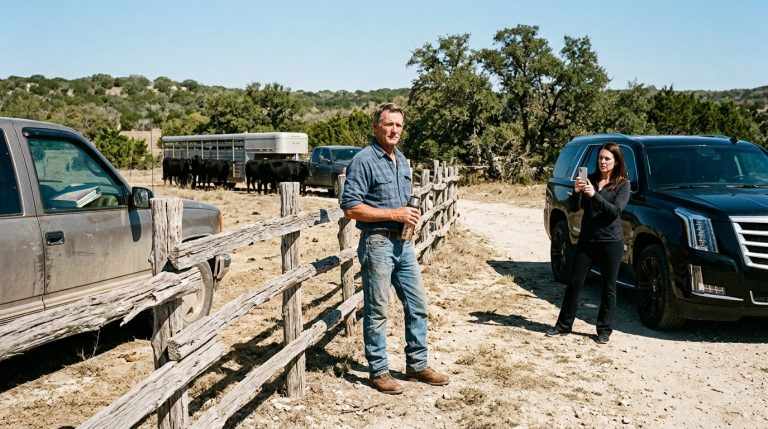
The gate to Stone Creek Ranch wasn’t just a physical barrier; it was the line where the air changed. On one side, the manicured, sterile scent of suburban lawn fertilizer; on the other, the smell of dry earth, wild mint, and the iron tang of the creek water that had carved this valley for centuries. I sat in the cab of my truck, the engine idling low, watching the white Mercedes block the entrance.
It was a spotless machine, the kind that had never seen a gravel road, and it sat there like an insult against the weathered wooden posts that held the rusted sign: Stone Creek, 1952.
I didn’t reach for the horn. I didn’t reach for my phone. I reached for the thick, manila envelope on the passenger seat, the leather of my boots clicking against the floor mats as I opened the door. The heat was already rising, a dry Texas shimmer that promised a long, brutal day.
Karen Whitfield stepped out of the driver’s seat. She was dressed for a boardroom, not a ranch road—sharp lines, muted colors, and a phone pressed to her ear. She was already talking, her voice thin and precise, cutting into the morning hum of the cicadas.
“Officer, there is a man refusing to leave our property,” she said, her eyes never meeting mine as she scanned the surrounding pasture. She was standing six inches onto the ranch side of the property line, her expensive heels sinking slightly into the soft, red dirt.
I didn’t rush. I walked forward, keeping my hands visible, the weight of the original deed in the envelope feeling like a tactical asset. I remembered the terrain, the way the fence line angled toward the creek, the exact placement of the buried iron survey pin I’d hammered into the earth ten years ago.
“You’re trespassing,” she said, finally snapping the phone shut and turning her gaze toward me. It was a practiced, cold stare—the look of a woman who dealt in contracts and commission percentages. “This is a private community entrance. You are blocking the flow of residents.”
I stopped at the edge of the gate, near the post where the original 1952 marker was almost swallowed by the wood. I looked down. The ground had been disturbed recently; someone had been digging around the base of our boundary marker, trying to pry it out or bury it under the new stone pillars they’d erected.
“This is the entrance to Stone Creek Ranch,” I said, my voice steady, stripped of the fatigue that had followed me home from the deployment. “My grandfather filed this deed before your subdivision was a blueprint. You’re standing on family property, Karen.”
She laughed—a dry, sharp sound—and gestured to the sprawling luxury homes behind her. “Property lines evolve. We’ve already had a professional survey. That post is a relic, not a boundary.”
She turned back to her car, confident. But she hadn’t noticed the fresh scratch on the iron pin I’d exposed with my boot. She didn’t know the land as well as she thought. And as the distant, mournful howl of a siren began to bleed into the quiet of the valley, I realized she had no idea the trap she’d just walked into.
CHAPTER 2: The Iron Line
The siren didn’t just herald the law; it announced an audience. As the cruiser’s light bar began to pulse—blue and red jagged flashes against the morning haze—I didn’t move. My boots remained planted where they were, digging into the soft earth at the base of the gate post. Karen had stepped back, her phone pressed tight against her ear, that smug, calculated smile returning to her face. She thought the arrival of the uniform was the end of the argument. She thought it was the start of my eviction.
“Officer!” she called out, her voice pitching up, shifting into that practiced, breathless tone of the victim. “He’s been aggressive. He refused to leave the easement, and he’s clearly agitated.”
I stayed still, letting the heat of the sun and the dust in the air define the space between us. My hand didn’t shake. The Army Corps hadn’t taught me how to win arguments with HOA presidents, but they had taught me about the absolute, immovable physics of boundaries. You don’t argue about a line; you point to the marker and let the math do the work.
Officer Miller stepped out of his cruiser. I knew Miller; he’d been patrolling this stretch of the county for years, the kind of guy who judged people by how they treated their livestock and how well they kept their fences. He walked toward us, his hand resting casually on his belt, his eyes scanning the ranch entrance, then the pristine, out-of-place Mercedes, and finally, my boots.
“Garrett,” Miller said, nodding. He didn’t look like he was coming for an arrest. He looked like he was coming to be annoyed by a waste of his time. “Karen. What’s the situation?”
“He’s trespassing,” Karen repeated, gesturing sharply to the stone pillars of the subdivision entrance. “Our community attorney has been very clear. This is residential territory. He’s interfering with a public easement.”
I looked down at the iron pin again. The vibration of the siren had died down, replaced by the low, insistent drone of the insects in the tall grass. My vision felt slightly warped by the heat rising off the road—a shimmering, liquid distortion. For a second, I could almost see the lines of the original 1952 survey projected over the land, the way the road deviated just enough to suggest the surveyor had been hurried or sloppy. I felt a surge of paranoia—a cold prickle at the base of my neck—wondering if the pin had been moved. Had they dug it up? Had they reset it when they built their monument to suburban entitlement?
“Officer,” I said, my voice grounding me, “the deed is in my hand. This land, including the access point for the subdivision’s entrance, is original Stone Creek property. I’m not trespassing on my own dirt.”
Miller stepped closer, his boots kicking up a small cloud of red dust. He looked at the iron marker I was pointing to, then looked at the heavy, manufactured stone of the HOA pillars. He didn’t say anything, but he held up a hand to stop Karen from launching into her next script.
“Garrett,” Miller said quietly, “you know the process. If there’s a boundary dispute, this isn’t a police matter. It’s civil.”
“It’s a criminal trespass if they are modifying boundary markers, Miller,” I replied. I saw Karen’s eyes flicker. She wasn’t used to being called out on the technicalities of property law; she was used to the vague, threatening language of HOA covenants.
“I’m not leaving,” I said, looking directly at her. “And the cattle need this road. They’ve been using this path for seventy years. If your HOA has a problem with the land their entrance is sitting on, they can take it up with the county records office. Until then, the gate stays open.”
Karen opened her mouth, a retort ready to fly, but Miller held his ground. He looked at the gate, then back to the Mercedes. “Karen, he’s got a right to be on his property. Unless you have a court order signed by a judge declaring this a public roadway or an HOA easement, I’m not arresting anyone for standing on their own land.”
She froze, her face flushing a dark, blotchy red. She was realizing, perhaps for the first time, that the uniform wasn’t a weapon she could wield at will. She turned and stomped toward her car, the slamming of the Mercedes door echoing like a gunshot across the quiet pasture. As she backed up, her tires spun, throwing gravel and dirt against the fence, a final, spiteful gesture of entitlement.
I stood there, the dust settling around me, the silence of the ranch rushing back in to fill the void left by her anger. Miller leaned against his cruiser, watching her drive away.
“You’re going to have a long summer, Garrett,” he said, not unkindly. “She’s not going to just walk away from this.”
“I know,” I said, my eyes fixed on the iron pin. It was still there. It was still the anchor. “I’m just getting started.”
As Miller drove off, I walked to the edge of the fence line and gripped the wooden post. My palms were sweating, but my resolve was cold. I wasn’t just defending a ranch; I was beginning the process of dismantling a lie. I needed to know why the subdivision’s entrance had been built where it was, and I needed to know exactly who in the county had signed off on the original survey.
I headed for the truck, the weight of the task ahead of me feeling heavier than the duty gear I’d carried overseas. There were records in the courthouse that needed to be found, and I had the training to find them. I wasn’t going to fight a PR war on social media; I was going to fight a war of attrition in the archives.
CHAPTER 3: The Surveyors Shadow
I didn’t head for the courthouse yet. Not immediately. I sat in the cab of my truck for a long minute after Miller’s cruiser had faded into the distance, my hands gripping the steering wheel until my knuckles turned white. The adrenaline was still humming through my system, a sharp, restless energy that made the interior of the cab feel too small. Miller was right—Karen wouldn’t just walk away. She was the kind of person who viewed a setback not as a signal to stop, but as a technical obstacle to be cleared with more money and more paperwork.
I reached over to the passenger seat and pulled the manila envelope into my lap. I needed to see the markers. Not just the one by the gate, but the rest of the line. The 1952 survey wasn’t just a piece of paper; it was a physical truth etched into the landscape of the Hill Country.
I started the engine. The truck roared to life, a deep, guttural sound that seemed out of place against the quiet, manicured backdrop of the subdivision entrance. I didn’t drive into the subdivision; I pulled the truck onto the shoulder of the county road, putting the boundary line between me and the encroaching stone pillars.
The sun was climbing higher, the heat beginning to bake the life out of the air. I grabbed my tool kit from the truck bed—a heavy, canvas bag filled with steel stakes, a transit level, and the original, yellowed field notes my grandfather had kept in a weather-beaten leather journal. The smell of the gear was comforting: oil, old canvas, and the sharp, metallic scent of high-grade steel. It was the smell of precision.
I walked the fence line, my boots crunching over the dry, sun-bleached grass. Every few yards, I stopped, checking the terrain against the notes. My grandfather had been a man of terrifying consistency. His measurements weren’t just estimates; they were calculated with the same rigor he’d used when laying foundations for the Corps of Engineers.
As I moved further from the road, the sounds of the subdivision—the distant hum of a lawnmower, the trill of a decorative bird bath—began to fade, leaving me alone with the wind and the rustle of the oaks. I found the second marker under a tangle of wild briar near the edge of the property. I knelt, pushing the thorns aside. My hands were steady now, the movement mechanical and practiced.
I scraped the dirt away with a pocketknife until I felt the cold, unyielding bite of iron against the blade.
It was there. Just as it had been for seventy years. A small, rusted spike driven deep into the limestone bedrock, holding its ground against everything the years had thrown at it.
I set up the transit level, the tripod sinking into the baked earth. I looked through the sight, aligning the crosshairs with the gate post marker, then sweeping the scope toward the line of the HOA’s entrance. The realization hit me with the force of a physical blow: the stone pillars weren’t just bordering our land; they were aggressively, undeniably deep into the ranch’s footprint. They were sitting on fifteen feet of our soil.
I stood there for a long time, the transit level framing the reality of the encroachment. My phone buzzed in my pocket—a notification from the county tax portal I’d been monitoring. I checked it, my thumb hovering over the screen. The tax assessment for the entire boundary stretch was paid in full by the Stone estate, dating back to the homestead filing. The county records matched the physical reality I was looking at through the lens.
They hadn’t just made a mistake. They hadn’t just been careless.
Karen Whitfield and her development company had built their “community entrance” on a foundation of theft. The monument to their exclusivity was literally rooted in land that didn’t belong to them. A sudden, cold clarity washed over me. I wasn’t fighting an HOA president; I was fighting an architect of a fraud.
I began to pack the tools, my movements precise and deliberate. I knew exactly where I had to go now. I didn’t need to guess anymore. I needed to pull the records. I needed to see exactly which county official had signed the plat maps that authorized the Metobrook Estates development.
I walked back to the truck, my shadow stretching long and thin across the red dirt. The silence of the ranch felt different now—it wasn’t just a lack of noise, it was a waiting, a patient expectation. I started the truck, the engine vibration humming through my boots, and turned toward the county seat.
The road to the courthouse was winding, a two-lane stretch of asphalt that hugged the contours of the hills. My mind was already racing, categorizing the names of the county planners, the development firms, the legal signatories. I was already planning the extraction of the data, the sequence of the files I needed to pull from the archives.
As I drove, I looked in the rearview mirror one last time at the subdivision entrance. It looked smaller, somehow, less imposing against the scale of the valley. It was just a thin, brittle veneer covering a broken foundation. And I was the one who held the blueprint to prove it.
I arrived at the courthouse an hour later. The building was an imposing, gray-stone structure from the early 1900s, smelling of floor wax, old dust, and the heavy, stagnant air of bureaucracy. I walked through the double doors, my boots echoing against the marble floor, and headed for the property records department. The clerk behind the counter, a woman named Martha who had been filing deeds since before I was born, looked up over her spectacles as I approached.
“Garrett Stone,” she said, her voice dropping into a professional, sympathetic register. “I heard about the trouble you’ve been having. You’re here for the boundary records?”
“I’m here for the original plat maps for Metobrook Estates, Martha,” I said, my voice as neutral as a slab of steel. “And every document related to the 1987 property transfer records.”
She went quiet, her expression shifting from sympathy to something much more guarded. She looked around the empty office, then lowered her voice. “That’s a lot of paper, Garrett. And a lot of it… well, it’s not exactly the kind of thing they like people digging into.”
“I have the right to know what’s on my land, Martha,” I replied, my eyes fixed on hers. “And I have the patience to read every page.”
She nodded slowly, turning to the heavy, metal filing cabinets that lined the back wall. “I’ll see what I can find. But be careful, Garrett. Some things are buried for a reason.”
I stood there, waiting, the silence of the courthouse settling around me like a shroud. I was ready.
CHAPTER 4: The Paper Trail
Martha didn’t return for a long time. I stood at the high counter, my elbows resting on the worn-out laminate, listening to the rhythmic clicking of a stapler from somewhere in the back and the distant, muffled voices of county clerks discussing lunch plans. The air in the records office was thick, recycled through vents that had probably never been cleaned, carrying the scent of pulverized paper and floor polish.
Every second that ticked by felt like a tactical disadvantage. If Karen’s people had influence here—and I suspected they did—my presence in the archives would be reported to the development office within the hour. I needed to move, but I was bound by the pace of the system. I occupied the time by scanning the room. My military training had conditioned me to map environments: entry points, blind spots, the location of the backup server closet. I noticed a security camera mounted in the corner, its red LED blink-rate indicating it was active, but its field of vision was static, focused on the counter.
Finally, a heavy door creaked open. Martha emerged, not with a tidy stack of folders, but with a crate of loose, yellowed papers and a single, bound ledger. She set them on the counter with a soft thud that sent a small cloud of dust dancing into the light.
“It’s messy, Garrett,” she whispered, her eyes flickering toward the security camera. “The records from ’87 are… incomplete. There was a flood in the basement archives back in the nineties. Some of these were salvaged, but others were just left to rot.”
I didn’t answer. I reached for the ledger, my hands moving with surgical care. The pages were brittle, the ink faded to a ghostly sepia. As I flipped through, my eyes darted across the rows of property transfers. I was looking for the 1987 quit-claim deed—the one that had ostensibly authorized the transfer of the 25 acres to Bradley’s company.
I found it halfway through the ledger. It was a standard, two-page form, but as I scanned the signature line, the hair on my arms stood up. The name of the county official who had signed the transfer wasn’t the department head at the time. It was a deputy clerk who had died only months after the filing. And the supporting survey map? It was stapled to the back, but the scale was wrong. The lines were hand-drawn, overlapping existing property boundaries in a way that defied basic engineering logic.
Suddenly, the overhead scanner at the desk flickered and died. A thin wisp of acrid, electronic smoke drifted from the machine.
“Darn thing,” Martha muttered, tapping the keys uselessly. “It’s been glitching all morning. I’m sorry, Garrett. You’ll have to do this the hard way.”
The hard way meant manual transcription. I pulled out my notebook and a pen. I had to record the discrepancy—the signature, the surveyor’s seal that looked suspiciously like a photocopy of a photocopy, and the missing witness signature. I worked with the precision of a field engineer, my eyes locked on the text.
Clue one. The surveyor’s seal was dated a full year before the land was officially rezoned. That was impossible under county regulations. It was a document manufactured to justify a land grab that hadn’t even been legally cleared yet.
“Martha,” I asked, keeping my head down, my pen flying across the page, “who authorized the survey firm that worked on the Metobrook expansion?”
She leaned in, her voice barely a breath. “It was an outside firm. Based in Dallas. They only did work for the county for about eighteen months, then they dissolved right after the project broke ground. Bradley Development paid their retainers directly.”
Clue two. A shell firm. The deeper I went, the more the architecture of the fraud revealed itself. It wasn’t just a mistake; it was a ghost operation. They had created a temporary legal entity to rubber-stamp the boundary encroachment, then wiped it from existence.
My back was tight, my eyes aching from the strain, but I couldn’t stop. I needed to see if there was any mention of the water rights. If the 25 acres were stolen, the riparian rights attached to them—the right to the creek—were technically still with my family’s original homestead deed.
I flipped to the back of the ledger. There, buried in a folder marked ‘Miscellaneous Correspondence,’ was a copy of a letter from the county planning board addressed to my grandfather. It was dated 1952. My pulse spiked. I started to read it, but the sound of the heavy front door opening made me freeze.
The clatter of expensive heels on the marble floor was unmistakable.
I didn’t look up. I tucked the notes into my jacket and closed the ledger, sliding it just an inch toward Martha.
“Garrett,” a sharp, familiar voice cut through the stillness.
I slowly rotated on my heel. Karen stood at the entrance to the records department, looking immaculate, a smug, predatory light in her eyes. Behind her stood a man I hadn’t seen before—a lawyer, judging by the way he held his briefcase like a shield.
“You’re a long way from your ranch, Mr. Stone,” she said, her smile not reaching her eyes. “I heard you were digging into files that have nothing to do with you. I would be very careful about accusing the county of clerical errors. Libel is a very expensive hobby.”
I didn’t let my expression change. I maintained the same neutral, disciplined calm I’d used to brief commanders in the field. “I’m just checking the property lines, Karen. If the records are accurate, you have nothing to worry about.”
She stepped closer, her perfume—something floral and cloying—masking the scent of the old paper. “We’ve checked the records. Everything is perfectly legal. You’re just wasting your time and creating a headache for people who have much more influence than you do.”
I looked at her, really looked at her, seeing the slight tremor in her hands. She was overcompensating. She was scared.
“Influential people make mistakes, Karen,” I said, my voice steady. “Especially when they start building on land that isn’t theirs.”
She didn’t react with anger this time. She just turned to the lawyer. “Make sure he understands the consequences of this interference,” she said, then turned and walked out, her exit as polished as her arrival.
I waited until the sound of her heels faded, then turned back to Martha. “I’m not done yet,” I said, opening the ledger back up.
There was a fire in my chest now, a cold, hard resolve. I had the discrepancies. I had the names. I had the start of the thread that would unravel their entire suburban kingdom. And now, I knew one more thing: they were watching me, which meant I was finally hitting where it hurt.
CHAPTER 5: The Diesel Morning
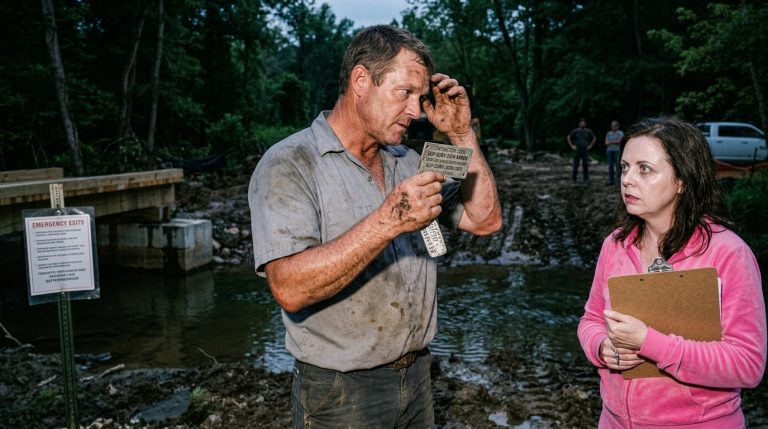
The first sound I heard wasn’t the birds. It was the low, growling idle of a backhoe—a heavy, mechanical sound that had no business being on my property at four in the morning. I was still half-asleep, sitting in the truck with the engine killed, the dew-slicked windshield fogging up as I stared at the dark silhouettes of excavators chewing into the riparian zone near the creek.
The air was thick with the smell of diesel—a sharp, industrial bite that clung to the back of my throat, instantly grounding me in the reality of the threat. Karen wasn’t waiting for the legal process anymore. She was forcing the issue, bypassing the boundaries entirely by physically altering the landscape.
My hands felt heavy on the steering wheel. I remembered my grandfather—the way he’d stare at a blueprint for an hour, his brow furrowed, before making a single, precise mark. He never rushed. He never fought fire with fire. He fought it with logic and physics. I needed that same discipline now. I reached into the glove box, pulled out my high-intensity flashlight, and a small, handheld survey transit.
I didn’t storm the construction site. That was exactly what she wanted—a confrontation that would end with me in handcuffs and her with an emergency injunction. Instead, I climbed out of the truck, the crunch of gravel under my boots sounding deafening in the stillness of the valley.
I moved to the treeline, keeping low, letting the shadow of the oaks swallow me. The excavators were tearing into the bank, creating a wide, raw scar of wet mud where the creek’s natural flow was being diverted. It was a chaotic, sloppy job. They were destroying the root systems of the old-growth timber, the very trees that kept the bank stable.
I set up the transit and began to record the coordinates. Every movement was slow, deliberate. I wasn’t just observing; I was documenting an environmental crime in real-time. I filmed the license plates of the machinery, the lack of erosion-control silt fences, and the way the debris was being pushed directly into the water. The deeper I looked, the clearer the “decoy” strategy became. Karen was framing this as a “flood prevention” project—a desperate, manufactured public safety campaign. But the engineering was fundamentally flawed. By diverting the creek here, they were creating a pressure point that would cause a surge downstream, flooding the very homes they claimed to be protecting during the next heavy rain.
She was gambling that the neighbors were too scared of “agricultural runoff” to notice they were being sold a death trap.
My skin crawled with the realization of the risk. If I didn’t stop them, that creek would jump its banks at the first heavy storm, and the resulting damage to the subdivision would be used as a final argument to condemn the ranch as an unstable hazard.
I crept closer, the mud sucking at my boots. A worker in a high-visibility vest was standing near the edge of the pit, shouting instructions over the roar of the idling machine. I stayed back, the transit tucked against my chest, feeling the hum of the earth beneath my feet.
Then, the worker stopped, pulling a phone from his pocket. He turned, and for a split second, the beam of his headlamp swept across the treeline. I pressed myself flat against the rough bark of an oak, my breath hitched in my throat.
Steady.
The beam passed over me, illuminating the hollow where I was crouched, but he didn’t stop. He turned back to the machinery, waving his arms.
I needed to get back to the truck. I had enough proof to initiate a state-level emergency review, but I couldn’t stay here. I pulled back, moving with a rhythm that felt like second nature—step, pause, breathe. It was a soldier’s pace, ingrained by years of navigating terrain where silence was the only thing standing between you and detection.
As I reached the edge of the pasture, the memory of my grandfather’s workshop on a Sunday morning surfaced—the way he’d meticulously cleaned his tools, explaining that a messy workspace led to messy outcomes. He had respected the land as a living system, not a resource to be exploited. Karen didn’t see a landscape; she saw a ledger. She saw property values. She was blind to the mechanics of the valley, and that was her weakness.
I reached the truck and eased the door shut, keeping the latch depressed until it clicked softly. I started the engine, shifting into neutral to let it roll down the slight incline of the road before engaging the transmission. I didn’t want to alert them that I was leaving, and I certainly didn’t want to start a pursuit.
I reached for my phone as I pulled away from the site, the screen glow harsh against the pre-dawn darkness. I didn’t call the police. I didn’t call the county. I called the state water development board’s emergency enforcement line.
“This is Garrett Stone,” I said when the dispatcher answered, my voice steady and cold. “I’m reporting an unauthorized, high-impact disturbance of a protected waterway at the perimeter of Metobrook Estates. I have full documentation of the violation, and I have the survey data to prove it is a critical flood hazard. I want a state inspector on-site by eight a.m.”
I hung up, the silence of the truck settling in. I wasn’t done with the night, but the first move was made. Karen thought she was playing a game of intimidation. She didn’t realize that I was playing a game of structural integrity. And now, she had just handed me the evidence I needed to lock her out of her own operation.
The road back to the ranch was empty, the dark hills looming like shadows on either side. I watched the clock. The sunrise was less than two hours away, and by the time the sun hit the valley, I would be waiting.
CHAPTER 6: The Eye of the Storm
The sun didn’t bring warmth; it brought a harsh, unforgiving light that stripped the shadows from the construction site, exposing the full scale of the destruction. I remained in my truck, parked on the county road with a clear line of sight to the excavation. The backhoe was still, its bucket buried deep in the torn-up earth like a scavenger’s claw. The workers were gone, likely alerted by the early-morning activity or perhaps by Karen herself.
A state vehicle pulled up, a dark sedan with the official seal on the door. It slowed as it approached the entrance, rolling past the piles of raw, upturned clay and the stagnant, muddy pooling where the creek had been diverted. The driver didn’t get out right away. He sat there, his silhouette visible through the glass, clearly surveying the damage.
I didn’t wait for him to approach. I grabbed the transit and my field notes, got out, and met him halfway.
The inspector was a man who looked like he’d spent thirty years reading EPA codebooks. He stepped out of the car, his khakis spotless, a clipboard tucked under one arm. His name tag read H. GALLOWAY. He surveyed the site, his eyes narrow, and he didn’t look happy.
“Mr. Stone,” he said, not offering a handshake. “I’m Galloway. I received your report. The call said unauthorized waterway modification. Looking at this, I’d say ‘catastrophic’ is a better term.”
“It’s not just a modification, it’s a violation of federal riparian statutes,” I said, pointing toward the bank. “They’ve severed the main channel without a permit, and look at the load-bearing stress they’re putting on the downstream slope. It’s a flood hazard for every home in that subdivision.”
Galloway walked toward the site, his boots crunching on the dried mud. I followed, keeping pace, pointing out the markers I’d flagged. As he bent down to inspect the soil composition, I noticed something that stopped me cold. On the back bumper of his sedan, there was a faint, clean rectangle in the dust—the shape of a decal that had been recently removed. It was a standard government fleet car, but the missing emblem—a specialized environmental task force sticker—wasn’t just peeled off; it looked like it had been scrubbed away with solvent.
Why would a state inspector hide his specialized affiliation?
“This isn’t standard procedure,” Galloway muttered, more to himself than to me. He poked at the sediment with a small, stainless-steel probe. “The diversion isn’t just illegal, it’s engineered to fail. It’s designed to create a bottleneck, not a drain.”
He looked at me, his gaze analytical, cold. “Who authorized this?”
“The Metobrook Estates HOA,” I said. “And the development company behind them, Whitfield.”
He didn’t blink. He just started taking photos, his movements brisk and efficient. But my eyes kept returning to that missing decal on his bumper. It didn’t fit. If this was a routine state enforcement call, why the effort to disguise the vehicle?
“I’ll need to file a formal report,” Galloway said, his tone shifting. “But this is going to take time. The state’s backlog is massive. You’re looking at months of litigation before we can even issue a stop-work order that sticks.”
Months. He was telling me that by the time they acted, the damage would be irreparable. The creek would be permanently diverted, the riparian rights would be compromised, and the physical reality of the ranch would be fundamentally altered.
“Months isn’t an option,” I said, stepping closer. “This is a direct violation of my family’s 1952 homestead deed. My riparian rights are federally protected. You have the authority to issue a cease-and-desist right now.”
Galloway looked at me, a flicker of something—impatience, or perhaps frustration—crossing his face. “I have the authority, yes. But I have to follow the chain of command. If I act too quickly without a full environmental impact study, they’ll have me in court for procedural overreach within twenty-four hours. That’s how these people play the game.”
“Then play it back,” I said. “I have the survey data. I have the plat maps proving their entire entrance and drainage project is sitting on stolen property. If you can’t stop them on environmental grounds, stop them on title grounds.”
He hesitated. He looked back toward the subdivision, then toward the ranch. “Title law is messy, Stone. You’re asking me to step into a land-use war that’s well above my pay grade.”
“I’m asking you to protect the state’s resources from an illegal modification,” I pressed, keeping my voice low. “The paperwork is in the county archives. I’ve already done the digging. If you need a reason to shut this down, I can give you the documentation to make it airtight.”
He looked at me for a long time, the wind whipping the dry grass around our ankles. The silence was heavy, punctuated only by the distant, rhythmic ticking of his sedan’s cooling engine.
“Get me the records,” he finally said, his voice clipped. “If you can give me proof that this is built on land they don’t hold title to, I’ll have the legal grounds to bypass the environmental study. But if the records are shaky—”
“—they aren’t,” I interrupted.
“I’ll be in touch,” he said, turning back to his car. “But be careful, Stone. You’re poking at a hive. They aren’t just protecting a subdivision; they’re protecting an investment that’s effectively bankrupt.”
He drove off, leaving me alone in the churned-up mud. I watched the car until it disappeared over the rise, my mind reeling. Bankrupt. If the subdivision was failing, that meant the pressure to seize my land wasn’t just greed—it was survival. They needed the 25 acres to liquidate the assets.
I turned back toward the ranch. The sun was fully up now, the heat radiating off the raw, scarred earth. I had the inspector, I had the evidence, but I also had a new, sharper sense of the danger. They weren’t just going to stop; they were going to get desperate.
And desperate people, as I’d learned in the field, were the most dangerous kind of enemies. I walked back to the truck, my boots feeling heavy, the weight of the coming confrontation settling into my shoulders like armor. I needed to call Nolan. It was time to file for the quiet title.
CHAPTER 7: The Structural Audit
The dawn didn’t bring relief; it brought a relentless, blinding glare that seemed to pick apart every flaw in the ranch’s exterior. I was in the workshop, my hands busy but my mind elsewhere, going over the load-bearing calculations for the barn rafters one last time. Every beam, every joist, every bolt—I had checked them against the original blueprints, then checked them again against the modern residential codes Dale Krueger was using as his weapon.
The air in the workshop was cold, even though the sun was already baking the tin roof. I could smell the faint, lingering scent of motor oil and sawdust, the familiar odors that had defined my life since I was a boy. But today, the space felt different. It felt exposed. I could hear the wind whistling through the gaps in the siding, a sound that usually meant nothing, but now felt like a taunt.
I looked up at the rafters, and for a heartbeat, the light seemed to shift. I could almost see my grandfather standing on the ladder, his hands calloused and steady as he tightened a bolt. Don’t build for the weather you have, he’d always said. Build for the weather you hope you never see.
I shook the thought away. Paranoia was a luxury I couldn’t afford.
A gravel-crunching sound outside snapped me back to the present. A vehicle. I stood up, wiping my hands on a grease-stained rag, and walked to the roll-up door. Dale Krueger’s sedan was parked in the middle of the ranch yard, looking absurdly out of place among the rusted tractors and the weathered wooden fence lines.
Krueger stepped out, his clipboard tucked under his arm like a shield. He was wearing that same pressed khaki outfit, his eyes scanning the barn with an expression of performative disapproval.
“Mr. Stone,” he called out, not bothering to move past his own front bumper. “We’re here for the final inspection on the structure citations. I trust you’ve had time to address the modifications requested.”
I stepped out into the light, my boots hitting the gravel. I kept my posture relaxed, but my eyes were sharp, scanning him for any sign of that same hidden allegiance I’d seen in Galloway. He didn’t have a missing decal, but his briefcase was suspiciously high-end—a custom-stitched leather bag that looked far too expensive for a local code enforcement officer.
“Everything is to code, Dale,” I said, my voice measured. “And as I’ve provided in the certification documents, these aren’t residential structures. They’re agricultural. They fall under state exemption.”
Krueger didn’t answer. He walked past me, his gaze fixed on the barn’s main support beam. He didn’t look like he was inspecting; he looked like he was hunting. He ran a gloved hand along the wood, his eyes scanning the joints.
“We’re looking for evidence of unauthorized habitability,” he muttered, opening the barn door.
Inside, the light was dim and smelled of old straw and manure. Roosevelt was standing in the far stall, his massive head turned toward us, his dark eyes tracking Krueger’s every movement.
“Unlicensed auto-repair business,” Krueger continued, pointing his pen at my workbench. “I have photos of a transmission being rebuilt here. That’s a violation of zoning ordinances.”
“I fix my own equipment, and I help my neighbors,” I said, my voice hardening. “It’s not a business. It’s part of ranch operations.”
“The evidence suggests otherwise,” Krueger said, his tone oily. “My office has received several complaints about the noise and the volume of traffic. You’re running a commercial operation in a restricted zone, Mr. Stone. That’s a fireable offense, zoning-wise.”
He pulled out a camera and started clicking photos—not of structural flaws, but of tools. My wrenches. My welding rig. My spare parts. It was all performative, a way to build a file that looked like a legal investigation while being entirely devoid of substance.
Then, he stopped. He was looking at a set of blueprints I’d left on the workbench—the ones I’d used to verify the barn’s structural integrity.
“What’s this?” he asked, his voice suddenly sharp.
“Engineering schematics for the barn. I told you, I’m a structural engineer. I certified the integrity myself.”
Krueger picked them up, his gloved fingers tracing the stamps and the professional seals. For the first time, his composure wavered. He hadn’t expected me to be a licensed professional; he had expected a stubborn, angry rancher who couldn’t tell a load-bearing wall from a partition.
“This doesn’t change the zoning classification,” he said, but his voice lacked the confidence it had held a moment ago. “Agricultural status requires proof of active commercial production. If you can’t prove the cattle are generating a consistent profit—”
“—I have the tax records for forty years,” I cut him off. “I have the sales receipts for every calf sold since the late eighties. My grandfather kept everything. Do you want to see them?”
Krueger didn’t answer. He stood there, the blueprints clutched in his hand, his eyes scanning the barn again, looking for a way to turn the truth into a liability.
“I’ll be filing my report,” he said, his voice curt. “Don’t count on the state accepting your own self-certification. We’ll be requiring an independent audit.”
He turned and walked toward his car, his pace brisk, almost frantic. He knew he’d hit a wall. He couldn’t just invent a code violation for a building that was over-engineered by federal standards.
I stood in the barn, the silence returning, heavy and thick. I’d survived the inspection, but it wasn’t over. He’d be back with that audit, and he’d try to drag it out for as long as possible, hoping to bleed me dry on the legal fees.
I looked at Roosevelt, who had shifted to face the barn door, his tail swishing once, slowly. The bull sensed the tension too. I walked over and rested a hand on his flank, the rough texture of his hide grounding me.
The strategy was working—I was pushing them into a corner—but the cost was mounting. I was losing time, I was losing sleep, and I was losing the ability to tell where the ranch ended and the war began.
I went back to the workbench and gathered the blueprints. I needed to send these to Nolan. If Krueger wanted an audit, he was going to get one—but it was going to be on our terms, and it was going to be so thorough that it would expose every single one of his fraudulent past investigations.
The storm was getting closer. I could feel it in the shifting pressure of the afternoon, in the way the silence hung in the air, waiting for the first strike of lightning.
CHAPTER 8: The Basement Ledger
The basement was a labyrinth of steel shelves and suffocating humidity. The air tasted of rot and wet concrete, a sharp departure from the sterile, air-conditioned world of the main offices upstairs. I moved through the narrow aisles, my flashlight beam cutting a jagged, yellow path through the gloom. The boxes were stacked haphazardly—a graveyard of forgotten administrative decisions.
Martha hadn’t been lying about the flood. The lower shelves were ruined, the paper fused into solid, pulpy bricks of cellulose. I waded past them, my boots sounding hollow on the concrete, headed for the back corner where the pre-1990 ledgers were stored.
I needed to find the specific box for the 1987 property transfers. If the records had been tampered with—if the “quit-claim” that Bradley’s company held was indeed built on an illegal transfer—then the original ledger would be the only physical proof left.
I found the box tucked behind a row of mildewed election records. It was heavy, taped shut with brittle, yellowed masking tape that tore away like dead skin under my fingers. Inside, the documents were a mess. Folders were mislabeled, dates were out of order, and entire sections seemed to have been torn out.
I sat on the floor, the cold seeping through my jeans, and began to sift through the debris.
Clue three. I found a signature card for the deputy clerk who had signed off on the transfer back in ’87. I pulled my notebook out, comparing the ink to the transfer deed I’d seen upstairs. The ink in the ledger was fresh, almost startlingly clear, while the deed I’d seen earlier was faded.
It wasn’t just a forgery. The document I’d seen upstairs was a replacement. Someone had been here before me, swapping out the original pages for forgeries, but they had been sloppy. They had forgotten to age the ink.
My heart rate climbed, a steady, rhythmic thrum in my ears. I wasn’t just searching for proof of a zoning error; I was searching for proof of a long-term, coordinated fraud.
Then, I saw it. Tucked behind a divider for the 1988 tax assessments, I found a thin, manila folder labeled ‘Developmental Contingency – Stone Property.’
I opened it. It was a private memorandum from Bradley Whitfield to the county planning director, dated months before the subdivision plans were ever filed. It outlined an “accelerated acquisition plan,” detailing specific payments made to county officials to expedite the quit-claim process.
I stared at the paper. It was the smoking gun. It was the evidence that the entire project was founded on criminal collusion.
I heard the sound of a heavy door locking above me.
The sound was unmistakable—the sharp, metallic clack of a deadbolt. My breath hitched. The basement had only one exit, and the lights, which had been flickering since I arrived, suddenly cut out completely, plunging me into absolute, velvet darkness.
The silence that followed was heavy, artificial. It wasn’t just a power outage; it was a trap.
I stayed completely still, my flashlight dimmed, focusing my hearing on the space above me. Someone was on the stairs. The sound of footsteps—slow, deliberate, and entirely unhurried—echoed against the concrete. They didn’t sound like a clerk; they sounded like a hunter who knew exactly where the prey was hiding.
I scrambled back, shoving the ledger and the memorandum into my field jacket. I needed a way out, but the air intake vent in the corner was too small, and the stairs were now a bottleneck. I shifted my weight, feeling the rough texture of the concrete against my palms. There was a service ladder in the back of the room, designed for the maintenance crew to access the utility pipes. It was high up, nearly near the ceiling, and behind a wall of rusted, decommissioned ventilation equipment.
I moved quietly, my boots barely brushing the floor. The footsteps on the stairs were getting louder, a rhythmic metallic tapping. They weren’t hiding their presence; they were announcing it.
I found the ladder and began to climb, the rungs biting into my palms, the metal vibrating with each movement. I didn’t dare turn on the light. I climbed by feel, my muscles screaming from the tension, until I reached the crawlspace access.
As I pushed the cover aside and pulled myself into the narrow, dusty duct, the basement door at the bottom of the stairs swung open. A single, focused beam of light swept across the floor, illuminating the spot where I had been sitting seconds before.
“He was here, Bradley,” a voice said—a voice I recognized instantly. It was Dale Krueger. “The box is open. He found the memo.”
“Then he doesn’t leave the courthouse,” the second voice replied. Bradley. Cold, detached, and entirely ruthless.
I lay in the dark, my heart hammering against my ribs, the documents pressed against my chest. I had the truth, but I was now trapped in the very infrastructure I was trying to expose. I had to reach the roof access before they cordoned off the building.
I crawled forward, the metal duct echoing with every move I made. The air was hot, choked with decades of dust, and the crawlspace was a claustrophobic cage. I had no other choice. I moved toward the sound of the ventilation fans, toward the only way out of a building that had become a prison.
I was no longer just an engineer defending a ranch. I was a man who knew too much, and they had just confirmed it.
CHAPTER 9: The Vent and the Verdict
The ductwork was a narrow, claustrophobic coffin of sheet metal. I dragged myself forward, my elbows raw and burning, feeling every vibration of the building through the rungs of the frame. Below me, the footsteps stopped. I held my breath, my lungs tight and protesting, and pressed my cheek against the cold, galvanized surface of the vent.
“Check the maintenance closet,” Bradley’s voice drifted up, distorted but clear through the metal floor. “He had to exit through the service shaft.”
“I’m already on it,” Krueger replied. The sound of a heavy metal door being slammed followed.
They were downstairs, searching the maintenance area, oblivious to the fact that I was ten feet above them, navigating the building’s internal skeleton. I continued to crawl, my movements calculated and slow. Every shift of my weight threatened to create a metallic groan that would give me away. I reached a junction where the main exhaust line fed into the roof access, a vertical shaft that promised the open air.
I checked the documents tucked inside my jacket. They were still there, safe, though I could feel the sharp edge of the memorandum digging into my ribs. These papers were the only thing that mattered now—they were the structural integrity of my entire life, the blueprint of the fraud that had brought this all down upon me.
I reached the vertical riser. It was narrow, just wide enough for me to pull myself up, hand over hand. I didn’t think about the risk. I didn’t think about the drop. I thought about the ranch—the smell of the hay, the sound of the creek, the stubborn, iron-pin reality of the 1952 markers. My grandfather had built on that land to last for centuries. They were trying to build their empire on a lie, and lies, I had learned, always had a failure point.
I pushed against the roof hatch. It was heavy, stiff with rust and years of disuse, but I threw my shoulder into it, gritting my teeth against the strain. It gave with a sharp, piercing shriek of metal.
I rolled out onto the roof, the night air hitting me like a cool, damp cloth. The courthouse sat on the high point of the town, and from here, I could see the valley spread out below like a dark, silent map. The subdivision lights were distant, twinkling like artificial stars, while the dark, unbroken expanse of the ranch stood in stark, silent contrast.
I didn’t waste a second. I bypassed the main stairwell, knowing they would be guarding the exits, and headed for the fire escape that clung to the rear of the building. I descended in the shadows, my boots silent on the rusted metal rungs.
I dropped to the alleyway ground, the impact jolting through my legs, and slipped into the darkness of the parking lot. My truck was still where I’d left it, tucked behind a dumpster. I reached the cab, slid inside, and started the engine—not with a roar, but with a cautious, quiet ignition.
I drove out of the lot, checking the rearview mirror constantly. No headlights followed. They were still inside, searching a basement that was already empty.
I didn’t go back to the ranch. I drove straight to Nolan McCarthy’s home, the miles blurring in a rhythmic, exhausted haze. I pulled into his driveway, the headlights catching the porch light. Nolan was waiting on the porch, a silhouette in the dim glow, looking as though he hadn’t slept in days.
I climbed out, the documents still held firmly against my chest. As I walked up the porch steps, I didn’t say a word. I simply reached into my jacket and laid the documents on the porch table, beneath the yellow glare of the bug light.
Nolan picked them up, his eyes widening as he scanned the memo. He didn’t speak for a long time. He just read, then read again, his face sharpening into a mask of pure, vindictive focus.
“They didn’t just break the law, Garrett,” he finally said, his voice dropping to a whisper. “They built a legal death trap. This isn’t just a quiet title action anymore. This is a federal racketeering case.”
I leaned against the porch railing, the exhaustion finally crashing over me, a physical weight that threatened to pull me to the deck. “What does it mean for the ranch?”
“It means you won,” Nolan said, looking at me, his eyes bright with a dangerous light. “Tomorrow morning, we don’t go to the county commissioners. We take this to the District Attorney, and we file the injunction in federal court. We don’t just stop the project. We bring the entire development company down.”
The night air felt different now—cleaner, sharper. I looked out toward the dark horizon, toward where my ranch lay in the deep, quiet shadow of the valley. The fight had been long, the cost heavy, but the foundation was finally solid. They had underestimated the strength of a man who knew the value of his own ground.
I closed my eyes, the sound of the wind in the porch chimes steady and calm. Tomorrow, the war ended.
CHAPTER 10: The Quiet Title
The morning sun didn’t just rise; it reclaimed the valley, washing over the ranch in a tide of gold that made the dew on the grass sparkle like diamonds. I stood on the porch with Nolan, watching the light catch the roof of the subdivision entrance a half-mile away. It looked different now—not like a monument, but like a ruin waiting to be dismantled.
We didn’t sleep. We spent the remaining hours of the night in Nolan’s office, the air thick with the smell of strong coffee and the sharp, acidic bite of laser-printed legal briefs. We didn’t talk about the ranch, or the threats, or the claustrophobic terror of the ventilation duct. We focused on the motion—the quiet title action, the federal injunctions, and the request for an immediate freeze on all Metobrook development assets.
At nine o’clock, we walked into the county commissioners’ hearing room. The space was already packed. Karen Whitfield was there, sitting in the front row, her posture stiff, her gaze fixed on the front of the room. When she saw me, her eyes hardened, but there was a flicker of something beneath the surface—a jagged, frantic edge that spoke of her own sleepless night. Bradley sat beside her, but there was a visible, calculated distance between them. They were already beginning to untether.
Commissioner Walsh called the room to order, her gavel sounding like a final gavel strike against a coffin lid.
“We are here to resolve the Stone Creek boundary petition,” she said, her voice echoing in the sudden, absolute silence.
Nolan didn’t make a speech. He didn’t grandstand. He walked to the center of the floor and laid the memorandum from the basement archive on the table. “Commissioners,” he said, his voice flat and authoritative. “We aren’t here to discuss zoning. We are here to discuss fraud. This document is a signed internal memorandum, dated three months prior to the development filing. It proves a deliberate, coordinated effort to bypass county land-use regulations through the systematic subversion of the quit-claim process.”
The room went still. Karen’s face went bone-white.
I watched her. I watched as the reality of the paper hit the table. This wasn’t a zoning issue; it was the end of her life as the HOA queen. She tried to stand, her mouth opening, but the lawyer beside her grabbed her arm, pulling her back into her seat.
“The Metobrook subdivision,” Nolan continued, his voice rising, “is built upon land that was never legally transferred from the Stone estate. The county’s 1987 conveyance was defective at the point of origin. Every single homeowner in that subdivision is currently holding a title that is, by law, invalid. The HOA common areas, the entrance, and the main road—all of it—occupies property that belongs to my client.”
The gasps from the back of the room were visceral. Several of the homeowners I recognized—people who had signed the noise complaints, the people who had cheered on Karen’s crusade—started to stand, their faces twisting with confusion and dawning horror.
Karen finally broke free of her lawyer’s grip. “This is a fabrication! A desperate act by a disgruntled resident!”
“Is it?” I asked. I walked forward, pulling the small, rusted iron pin I’d pried from the ground at the gate out of my pocket. I placed it on the commissioner’s table. It looked small, inconsequential, but it carried the weight of seventy years. “I’ve been maintaining the 1952 markers on this land every year of my adult life. The survey records exist, Commissioner. They were just buried. They were buried to make room for a lie.”
The commissioners huddled, their faces pale as they looked at the documents, then at the iron pin, and finally at the frantic, crumbling image of the woman in the front row.
The resolution didn’t happen in a shout; it happened in a series of quiet, devastating motions. The county counsel admitted the title discrepancy within minutes of reviewing the memorandum. The federal injunction was served before noon.
I stood outside the courthouse as the crowd spilled out. The sun was at its zenith, bright and hot. I saw Karen walk past me. She looked older, her sharp, predatory edge replaced by a hollow, vacant shock. She didn’t look at me. She didn’t look at the subdivision she’d built. She just walked to her white Mercedes, unlocked it, and drove away, disappearing into the traffic.
I drove back to the ranch alone. I didn’t rush. I took the back road, the one that wound through the creek bottom, where the water was clear and the mint grew wild in the shade of the oaks.
When I reached the gate, I didn’t unlock it. I didn’t need to. The temporary barriers were already being dismantled by the county contractors. I pulled my truck onto the gravel, the tires crunching in a sound that felt like a homecoming.
I walked to the boundary marker where I’d stood only weeks before. I took a hammer from my tool kit and, with a slow, deliberate swing, tapped the iron pin back into the earth, resetting it until it was flush with the red, stubborn soil.
I knelt there for a long time, the silence of the ranch flowing around me like a deep, cool river. It was done. The land was clear. The title was held. The future of the creek, of the pasture, and of the family legacy was anchored, deep and solid.
I heard the heavy, rhythmic gait of a horse approaching. It was Sarah, riding up from the lower pasture, her face illuminated by the soft, late-afternoon light. She didn’t say a word as she reined in, just looked at the pin, then at me, and offered a soft, tired smile.
“It’s quiet,” she said, her voice just above the sound of the wind.
“It is,” I agreed, rising to my feet.
I walked toward the barn, my boots steady on the path. I had a workshop to organize, a fence line to reinforce, and a life to rebuild. The dust of the struggle was settling, but the soil beneath it was rich, stable, and mine.
I looked back at the subdivision one last time. The stone pillars stood in the distance, but the chaos had been extracted. The land was reclaiming the lines. And as the shadows lengthened across the valley, I felt the heavy, quiet peace of a man who had finally, against every odd, finished the work his grandfather had started.