The Iron Boundary: How a Rusted Water Tower and Cold Calculation Fought Back Against Corporate Overreach
CHAPTER 1: The Weight of Steel
The hotel room smelled of stale carpet and old steam heating, a heavy indoor smell that had nothing to do with soil or sun. Outside the double-paned window, the city was sliding into a wet twilight, but the light inside was a flat, electric yellow that made my eyes ache. My laptop sat on the small mahogany desk, humming quietly, the screen casting a pale glare across my hands.
My phone buzzed against the wood once, a short, dull vibration, followed immediately by another.
Then Carl’s text came through. Carl did not text to chat. Carl was a man who measured his words the way he measured soil moisture, using only what was strictly necessary to keep things from dying. The message was spare: a single photograph and six words that didn’t make sense until my brain forced them to line up. Hey, wasn’t there supposed to be a tower here?
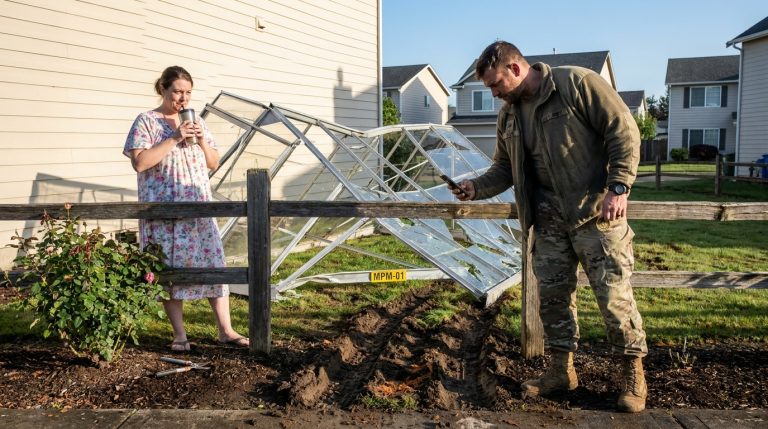
I clicked the image to expand it, watching the pixels sharpen slowly through the bad connection. First came the churned brown earth of the northern corner, dark tire tracks cutting deep furrows where dry grass used to hold the dust. Then came the jagged edge of temporary chain-link fencing, stark and out of place against the boundary line. And finally, the space where the sky should have been broken by rusted red legs and a faded round tank.
There was nothing there. Just gray sky and the distant, uniform roofs of two hundred beige houses creeping across the ridge like an incoming tide.
My chest tightened, a sharp, cold knot forming behind my ribs. I sat completely still, the cursor blinking patiently in an unfinished consulting document while the entire perimeter of my grandfather’s forty-acre orchard vanished into a digital JPEG six thousand miles away. There were only two ways a structure weighing several tons disappears from a secure property line. Either gravity had finally won a war it had been fighting since the 1970s, or someone with a tracked excavator and a deadline had decided my absence was permission.
The phone buzzed again against the wood, a quiet reminder that the distance between my land and this desk was measured in oceans, and whatever had just happened back home was already finished, graded, and covered over.
CHAPTER 2: The Silent Perimeter
The cursor kept blinking, a rhythmic, indifferent pulse against the white background of the screen, but the rhythm of my thoughts had changed entirely. Anger is a noisy state of mind, full of heat and sharp edges, but it burns out fast if you feed it nothing. What settled in its place was something colder, a heavy, flat utility.
I did not close the laptop. Instead, I opened a blank document, typed the date, and began listing names.
Daniel Rey’s name went down first. Daniel was a licensed surveyor whose office sat three miles outside of town, a man who treated boundary stakes the way a surgeon treats sutures. If a fence line drifted three inches over twenty years, Daniel could tell you which winter frost caused it. Second was Laura Chan, a civil engineer whose working life was built around friction losses, flow rates, and the brutal physics of agricultural water supply.
The hotel room was dead quiet except for the low, distant rumble of Lisbon traffic through the double glazing, a muffled sound that could have been anything—wind, heavy machinery, or distance. My fingers moved across the keyboard with a deliberate, mechanical steadiness.
If Carl’s photo was accurate, the northern corner of the property was currently bare dirt and tire tracks. That meant the reserve water system was entirely unbuffered. Without the tower to absorb the pressure spikes, the primary pumps down by the wellhead were fighting a raw, unyielding line every time they kicked on. In July heat, forty acres of walnut and apricot trees drink hard, pulling moisture from the soil faster than a shallow well can recover. If the pressure regulators blew out while I was six thousand miles away, the pumps would run dry, overheat, and weld their own pistons inside twenty-four hours.
The developers knew what they were doing when they picked a three-week window. They had timed it against my absence, calculating that a remote owner would find out too late, argue too softly, or simply absorb the loss as the cost of doing business next to an expanding town.
I picked up my phone, bypassed the international dialing delay, and dialed Daniel Rey’s direct line.
It rang twice before a dry, measured voice answered. “Rey Surveying.”
“Daniel,” I said, keeping my voice flat. “It’s Thomas. I need to know if you can get out to the orchard off County Road 14 today.”
There was a brief pause on the line, the sound of paper shifting against a wooden desk. “The north forty? What’s happening out there?”
“The water tower is gone,” I said.
A heavy, absolute silence settled over the line. It wasn’t an expression of shock; it was the quiet calculation of a professional realizing the math had just broken. Daniel didn’t ask if I was sure. He didn’t waste breath on disbelief.
“Do you want the fast answer or the documented answer?” Daniel asked softly.
“I want the one a judge can read,” I replied.
“Give me two hours to pull the original plats and rig the GPS gear,” Daniel said. “I’ll meet you on the line.”
“I’m in Portugal, Daniel. I can’t meet you there.”
Another pause, shorter this time, carrying the weight of a man reassessing the landscape. “Then I’ll walk it alone. I’ll send you the pins before nightfall.”
The line clicked dead, leaving a faint, high-pitched hiss in the receiver. I set the phone down beside the laptop and looked back at the screen, where the cursor still blinked its steady, unhurried warning against the white page.
CHAPTER 3: The Engineering Blueprint
The faint, high-pitched hiss of the dead receiver faded into the low hum of the hotel room’s heating unit. I kept my hand on the plastic handset for a second longer than necessary, feeling the dull weight of it before placing it back on the cradle. The laptop screen flickered once, refreshing an open email draft to Laura Chan.
If Daniel Rey was already walking the boundary line with a GPS rig under the Northern California sun, I needed to ensure the engineering side of the ledger was moving with the same cold precision. An agricultural water tower built in the 1970s was not something you replaced with a handshake or a catalog order. It was a load-bearing column of a closed-loop system—a localized hydraulic anchor that kept forty acres of thirsty almond and apricot trees from tearing their own valves apart during the July heat spikes.
I didn’t waste time drafting a polite preamble. My fingers moved across the keyboard with the sharp, rhythmic cadence of a ledger entry.
Laura, I wrote. The northern tank is gone. The developers graded right through the corner footprint. I need an assessment of reconstruction standards under current county code for a fifty-foot steel reserve tank and high-pressure riser.
Her reply didn’t take two days; it came back before midnight, slipping into my inbox like a cold draft under a door. Laura was not given to emotional padding. Her message was a dense cluster of engineering constraints, current material costs, and municipal upgrade requirements. Because building codes had shifted significantly since my grandfather bolted those rusted red legs into the concrete pad, a like-for-like replacement was legally impossible.
Under current code, any new structure required modern seismic bracing, certified wind-load engineering, galvanized steel specifications, and upgraded pressure-regulation valving tied directly to the primary well pumps. You couldn’t just weld some scrap plate together and call it fixed. If they knocked it down, they had to rebuild it to a standard that made the original look like a backyard project.
I stared at the figures glowing against the screen, the total projected replacement cost climbing into a bracket that most corporate developers prefer to settle quietly out of court rather than fight in a public zoning board hearing.
The screen cast a dull, pale blue across the coffee-stained desk as I opened a second document, pulling up my digital copy of the original county deed and the old hand-drawn plat maps my grandfather had filed forty years ago. The lines were faded, scanned from yellowed parchment, but the coordinates were absolute. They weren’t suggestions penciled in by a machine operator looking for extra turning radius on a grading corridor. They were iron, ink, and law.
My phone buzzed against the wood again, a short, sharp vibration that broke the silence of the room. It was an email notification, separate from Laura’s message. I clicked it open.
An attachment from Daniel Rey.
No text body, just a single PDF containing the preliminary GPS point-cloud data and a field sketch. I opened the file, zooming in on the coordinate cluster for the northern corner. The digital map overlaid current satellite imagery with his real-time transit data, drawing a clean, unyielding red boundary line across the dirt.
Right beside it, marked in yellow waypoint pins, were the heavy track marks of a tracked excavator. They didn’t brush the line. They didn’t clip the outer edge of an easement. They cut six full feet inside my property boundary, carving deep, ugly ruts directly through the exact footprint where the tower’s anchor bolts used to sit.
Machines leave tracks, and tracks leave evidence. They don’t care about convenience fees, and they don’t negotiate property lines.
I leaned back in the creaking mahogany chair, the leather groaning under my weight, and stared at the glowing screen. The developer’s site manager, Mark, had sent an email earlier claiming an access easement widening for construction grading. But an easement is a narrow knife for a specific purpose; it is not a blank check to bulldoze a permanent structure sitting safely on private land.
They had bet their entire timeline on distance. They assumed an owner six thousand miles away wouldn’t spend the money, wouldn’t call the right engineers, and wouldn’t have the patience to line up the paperwork. They thought silence meant surrender.
I minimized the survey file, opened a new browser tab, and searched the local bar directory for agricultural property litigators in the county. My finger hovered over the trackpad as I found the name Marcus Holloway—a man known locally for a very quiet, very precise style of litigation that didn’t involve shouting in courtrooms.
I didn’t call him yet. I copied his direct office number into my notes, closed the laptop lid with a soft, final click, and sat alone in the darkening Lisbon room, listening to the steady hum of the radiator as the pieces locked silently into place.
CHAPTER 4: The Legal Package
The transition from raw anger to systematic assembly took place across three separate digital workspaces on the mahogany desk. My fingers moved without hesitation, driven by the clean, unyielding parameters of the evidence Daniel Rey and Laura Chan had provided.
Marcus Holloway answered his phone on the second ring, his voice carrying the dry, unhurried cadence of a man who spent his life untangling property disputes in dusty county archives. I didn’t waste time on background color or complaint. I laid out the coordinates, the surveyor’s GPS point-cloud data placing the former tower six feet inside the private boundary line, and Laura’s rigorous engineering calculations regarding modern code-compliant replacement costs.
“You’re thorough,” Marcus had remarked, the paper sliding against his desk on the other end of the line. “Most people call me yelling about trespass. You’re calling me with a balance sheet.”
“I don’t want to yell,” I told him, looking out the double-paned window at the wet Lisbon slate. “I want the file air-tight before it hits their insurance carrier.”
By the fourth day, the formal demand package was complete—a heavy digital bundle containing Daniel’s certified boundary plat, Laura’s structural cost breakdown, high-resolution photographs of the scraped earth, and formal claims for trespass, property destruction, and agricultural irrigation stress. Marcus didn’t just mail it to the developer’s local office; he routed it directly to their primary liability insurance carrier, triggering the internal machinery of corporate risk management.
Insurance companies do not care about neighborhood aesthetics or landscaping visions. They care about liability exposure and paper trails.
Two days after the package landed on an adjuster’s desk halfway across the state, Marcus forwarded me a supplemental file retrieved through initial discovery logs. It was a scanned copy of a sub-contractor crew sheet, stamped with a timestamp from the exact week I had flown to Portugal.
I zoomed in on the document, my eyes tracking down the column of standard operational notes until I hit a highlighted sentence. It was a direct work instruction given to the demolition operator clearing the northern grading corridor: Clear vertical obstructions in grading corridor.
There were no qualifying conditions attached to it. No instruction to verify property pins, no note to cross-reference county plats, no caution regarding the rusty steel legs standing just beyond the developer’s right-of-way. It was a blunt, mechanical command issued by someone higher up the chain who had looked at a map, decided the boundary line was a flexible suggestion, and told the heavy equipment to push forward.
The pieces clicked together with the heavy, satisfying snap of a well-oiled breech. This wasn’t an isolated mistake by a confused driver on a tractor. It was institutional negligence masked by bureaucratic speed—a calculated corporate push that relied entirely on the assumption that a remote landowner would be too far away, too slow, or too unequipped to trace the paper trail back to its source.
I sat back in the creaking chair, the leather groaning under my shift in weight. The Lisbon rain tapped a steady, monotonous rhythm against the glass outside, but the air inside the room felt clear, sharp, and entirely devoid of static. The gray mask had slipped, revealing the simple, mechanical truth underneath. They had bet their timeline on distance. Now, distance was the only thing they didn’t have enough of.