The Weight of the Watershed: How Seven Acres of Red Clay Stood Against the Concrete Tide
CHAPTER 1: THE IRON TIDE
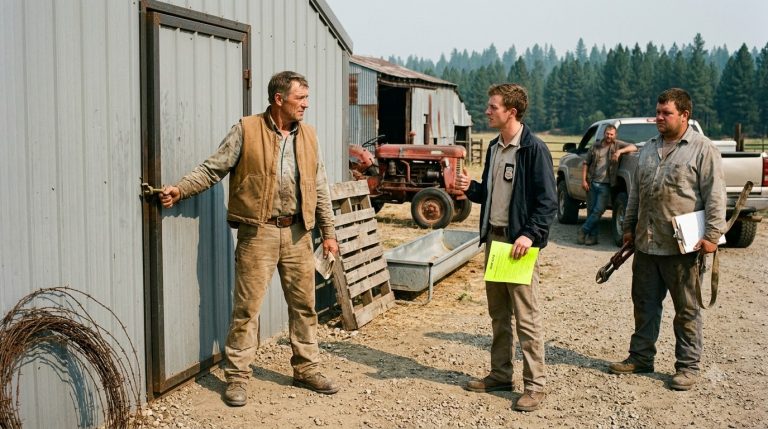
The mud didn’t smell like earth anymore. It smelled like warm asphalt, transmission fluid, and the sharp, chemical tang of a parking lot freshly sealed under a July sun. I stood at the edge of the north pasture, my boots sinking four inches into a slurry that used to be a steady, dependable stand of fescue.
Three weeks ago, that grass held firm. Today, it was a scalp shaved clean down to the grey marl, dragged downward by a concrete channel cut straight through the property line like a surgeon’s incision.
I looked up the slope. Where the scrub trees and the old abandoned soybean field used to breathe, Harbor Point Commons sat squat and gray against the morning haze—a flat-topped fortress of retail convenience complete with a chain pharmacy and a coffee shop where the baristas treated names like loose change. Their parking lot was a vast, ironed sheet of blacktop designed to shed water like a duck’s back. And right at the bottom edge of their slope, aimed directly at my seven acres like the barrel of a twelve-gauge, was a corrugated steel pipe wide enough to swallow a basketball.
Water trickled from it now—a steady, unconcerned gurgle, crystal clear where it left their property and entirely opaque by the time it fouled my soil.
My neighbor Dale was already leaning over his fence thirty yards to the west, wiping grease off his hands with a blue shop rag. “Hell of a gully-washer last night, Tom,” he shouted across the property line, his voice cutting through the hiss of distant delivery trucks down on the highway. “Property values are going up, though. Saw an ad for townhomes going in behind the pharmacy. Everything’s moving forward.”
“Moving forward,” I muttered, shifting my weight as the suction beneath my left heel let out a wet, gasping sigh.
I didn’t answer him. I didn’t have the breath to explain what forward looked like when it was pooling around the foundation of a red shed that already leaned two inches to the left. Instead, I crouched down, ignoring the dampness soaking through the knees of my Carhartts, and ran a calloused finger along the edge of where their concrete apron met my topsoil.
Something didn’t fit. A commercial development of that scale required engineering reviews, drainage bonds, and retention specifications thicker than a telephone book. Water didn’t just choose a path; it was guided by grades drawn on a permit stamped by someone sitting safely in an air-conditioned office fifteen miles away.
As I straightened up, my eyes caught a small detail I’d missed through the drizzle the night before: a wooden surveyor’s stake driven deep into the mud right at the edge of the washout, bearing a faded red ribbon. But the ribbon wasn’t tied to the property line. It was three feet inside my fence line, marking a boundary that hadn’t existed when my father paid off this land twenty years ago.
The silence of the morning was broken only by the automated beep of a semi-truck backing into a loading bay up the hill, a mechanical cricket counting down the minutes until I drove my truck up to those glass doors and asked them who gave them the right to rewrite the watershed.
CHAPTER 2: THE GLASS DOORS OF HARBOR POINT
The highway asphalt was slick, throwing up a thin, grey spray that glazed the windshield of the truck before the wipers could shove it aside. I didn’t rush. Speeding didn’t clear mud, and it certainly didn’t change the grade of a parking lot poured with federal highway concrete and local political ambition. I drove the old truck up the rise, past the rusted sign of the abandoned grain elevator, and swung the nose hard into the neatly lined spaces of Harbor Point Commons.
The air conditioning hit me before the glass sliding doors even finished parting—a dry, sterile blast that smelled faintly of industrial carpet cleaner and burnt espresso. It was eighty degrees outside and fifty-five in the leasing office, a deliberate thermal shift meant to make anyone from the outside feel like they were intruding on something important.
Behind a curved desk of polished white quartz sat a woman with hair pulled back so tight her eyes seemed permanently alert. A silver nameplate on the marble read Ms. Gable. She was looking down at a tablet, her index finger flicking a glass screen with rhythmic impatience.
She didn’t look up when the bell chimed above the door. “Good morning, welcome to Harbor Point. If you’re here about the west-end townhomes, phase two pre-leasing opens next—”
“I’m not here about townhomes,” I said.
My voice had the dry, gravelly weight of a man who spent his mornings talking to livestock and fence posts. She looked up then, her eyes dropping automatically from my face down to the dried red clay caked around the seams of my work boots, then back up to my face with the calculated neutrality of someone trained to handle bounced checks and minor noise complaints.
“Mr. Carter, isn’t it?” she asked, her voice dropping into a register designed to soothe rather than engage. “Property management received your note left with the maintenance crew yesterday.”
“My note was a five-gallon bucket of muddy water I left on your welcome mat,” I said, leaning both hands flat on the polished quartz. The stone was cold enough to bite through my palms. “The pipe at the north boundary isn’t draining a natural swale. It’s pouring twenty thousand gallons of parking lot run-off straight into my lower pasture every time the clouds get heavy.”
Ms. Gable locked her tablet with a soft click and laid it flat on the desk, screen down. She laced her fingers together—neat, manicured, entirely untouched by manual labor.
“The grading for this entire commercial footprint was executed strictly according to regional civil engineering standards,” she recited, each word clipped and level. “Approved by the county planning commission three years prior to groundbreaking. It is natural flow, Mr. Carter. Water follows the path of least resistance downhill.”
“Water follows gravity,” I said, not moving an inch. “That pipe follows a deliberate layout. Your engineers didn’t just let nature take its course; they channeled three acres of impermeable asphalt into a twelve-inch PVC sleeve aimed between my red shed and my southern fence.”
“If you believe there is an infrastructural discrepancy,” she said, her smile thinning into a pale line that lacked any pretense of warmth, “the county engineering department handles zoning disputes on Tuesdays and Thursdays. You are welcome to file a formal grievance through their public portal.”
She reached for her tablet again, dismissal wrapped in administrative courtesy.
“Translation,” I said softly, the words hanging in the chilled air between us, “it’s cheaper to drown my pasture than build the retention cells marked on your original site plans.”
Her hand stopped an inch from the glass screen. For a fraction of a second, the corporate polish flickered—just a microscopic tightening around the corners of her eyes, a tiny hesitation before she recovered her professional mask. She didn’t deny the retention cells. She didn’t ask what site plans I was talking about. She simply tilted her chin up a fraction higher.
“I suggest you contact the county, Mr. Carter. Have a pleasant day.”
I didn’t argue. Arguing with a leasing agent is like yelling at a rain gauge; it doesn’t alter the weather, it just leaves you hoarse. I turned away, the rubber soles of my boots squeaking slightly against the pristine tile, and walked back out into the grey, uncompromising drizzle.
CHAPTER 3: THE SILVERADO AND THE LASER LEVEL
I didn’t start the truck right away. I sat behind the wheel with the engine idling, watching the wipers sweep a rhythm across the glass—thump, wipe, smear, repeat. Through the distorted arc of the rubber blade, the plate-glass windows of Harbor Point Commons reflected a distorted version of my truck, a rusted old tool sitting incongruously against the backdrop of sleek corporate efficiency.
Ms. Gable’s hesitation had been brief, but it was enough. People who are genuinely operating under standard bureaucratic oversight don’t flinch when you mention site plans; they fetch copies to prove their innocence. They don’t lock their screens and tighten their jaw lines. They point to the stamp.
I turned the ignition key, killing the diesel rumble, and reached for the worn leather notebook in the glove box. Inside were the carbon copies of my father’s original 1984 survey, notes I’d scrawled when the county widened Route 12 back in ninety-nine, and the phone number of a man named Marcus Bell.
Marcus didn’t answer on the first ring. I listened to the hollow electronic pulse of the line while a delivery van hissed past my window, kicking up a rooster tail of muddy water that splattered against my passenger door.
“Bell,” a voice finally grunted, competing with the background rattle of an impact wrench.
“Marcus,” I said, leaning my forehead against the cool steering wheel. “It’s Tom Carter. Down off the south ridge. You looked at my drainage issue last fall when the culvert backed up.”
“Carter. Yeah, I remember. Split-rail fence, red shed leaning to the west like it’s had a stroke. What is it now? Did the county come out and tell you water flows downhill?”
“Worse,” I said, shifting my gaze up the slope toward the loading docks behind the pharmacy. “The water’s got a blueprint now. I need someone who knows how to read what’s underneath the asphalt, not just what’s sitting on top of it.”
There was a pause on the other end, punctuated by the metallic clink of a wrench hitting concrete. “Meet me at your north fence line in forty minutes. Bring your boots. The heavy ones.”
Forty minutes later, the rain had settled into a steady, needle-sharp drizzle that coated the open pasture in a sheen of leaden grey. I was standing by the split-rail fence, staring down at the dark, saturated earth where the grass had vanished, when the familiar rattle of an old, suspension-groaning Chevrolet Silverado announced Marcus’s arrival.
He didn’t park in the drive; he backed right up to the edge of the lower field, the heavy tread of his rear tires chewing deep into the mud before he cut the engine. Marcus climbed out wearing a faded canvas coat stiff with dried grease and a yellow hardhat that looked like it had survived three decades of highway construction projects. In his right hand, he carried a black Pelican case containing a laser level; under his left arm was a rolled stack of county plat maps secured with thick rubber bands.
“Look at this mess,” Marcus muttered, stepping out of the truck and immediately sinking an inch into the muck. He didn’t swear; men who work with soil long enough stopped wasting breath on the weather. Instead, he dropped the case onto a dry patch of gravel near the base of the red shed, flipped the latches, and pulled out the tripod with slow, deliberate precision.
“It’s not just runoff,” I said, walking over to meet him. “Ms. Gable inside the leasing office told me it’s standard grading approved by the county.”
Marcus paused, unfolding a metal leg of the tripod with a sharp snap. He looked up at me, squinting through rain-beaded bifocals. “Standard grading doesn’t cut a six-inch drop straight across a natural ridge line, Tom. Standard grading disperses flow across a broad sheet. What they’ve got up there is a funnel.”
He unrolled the county plat maps across the hood of his truck, weighting the corners down with a heavy crescent wrench and a fist-sized river stone to keep the wind from ripping them away. The paper was crinkled, marked with faint pencil notes my father had made decades ago, alongside newer blue-line prints stamped by the regional planning board.
“Look right here,” Marcus said, tapping a gloved finger against a square marked Parcel 4B-Retention. “According to their initial site submittal filed back when they cleared the soybean field, they were mandated to construct two dry-detention basins right along this upper perimeter. Fifty-by-thirty yards each. Designed to hold four hundred thousand gallons of peak stormwater before letting it bleed out into the natural creek bed.”
I leaned in, the smell of damp paper and old ink rising between us. “And?”
“And they aren’t there,” Marcus said flatly. He pointed a fat carpenter’s pencil toward the massive, flat expanse of the parking lot looming above us. “Instead of digging basins, they poured an extra three rows of parking stalls and tied the storm drains directly into a single, high-velocity PVC discharge pipe.”
He looked at me, his eyes steady beneath the brim of his hardhat. “This isn’t an oversight, Tom. Earthmoving equipment costs money. Retention basins take up real estate that could be leased out to a national coffee chain. Someone signed off on deleting those basins from the final build, and they did it knowing damn well where the gravity leads.”
The wind gusted across the open pasture, carrying the faint, sweet scent of roasting coffee beans down from the commercial strip above—a bizarre, jarring reminder of how close their world was to mine, and how little they cared about what happened when the rain started falling.
My hand brushed against the rough, splintered wood of the old fence post. A memory flickered uninvited—my father standing right here thirty years ago, hammering a loose rail back into place, telling me that a man’s boundaries are only as strong as his willingness to defend them against more than just the weather.
“If the basins were in the original permit,” I said quietly, the cold settling deep into my bones, “then the county inspectors had to know they were missing.”
Marcus began winding up the measuring tape, the metal blade clicking back into its yellow plastic housing with a rhythmic, metallic chatter. He didn’t answer right away, but the tight line of his jaw gave me all the confirmation I needed.
“Inspectors check what they’re paid to look at, Tom,” Marcus said, tossing the tape into the back of the Silverado. “Or what leadership tells ’em is important. You want to change the flow? You aren’t going to fix it by talking to a leasing agent behind a quartz desk. You’re going to have to prove the system’s broken right where it hurts them.”
CHAPTER 4: THE QUIET PORCH CALCULATION
The kitchen was dark except for the amber glow of the electric range clock and the intermittent flicker of neon signs bouncing off the wet highway miles away. I spread the county plat maps across the oilcloth-covered table, weighing down the corners with a cast-iron skillet and a jar of pickled peppers.
Marcus was right about the dirt, but dirt didn’t talk to judges. Paper did.
I pulled out the rusted metal tin where my father kept receipts, tax assessments, and the original deed from nineteen-sixty-four. Among the crackling yellow slips was a folded carbon copy I’d forgotten about—a municipal drainage waiver signed back when the county first talked about widening Route 12. My thumb traced the faint, typewriter-stamped ink. It wasn’t just a record of right-of-way; it was an agreement that bound any subsequent commercial development upstream to maintain natural absorption rates or provide equal compensatory volume.
The corporation didn’t just forget the retention ponds. They had requested a variance three years ago, claiming the soil composition on the north ridge was too dense for efficient dry storage. And the county planning commission—hungry for the corporate tax bracket that came with box stores and chain pharmacies—had rubber-stamped it without a public hearing.
Outside, the first heavy drops of an evening squall began to tap against the tin roof, a dry, rhythmic rattling that quickly swelled into a steady hiss.
I didn’t feel anger. Anger made you loud, and being loud in a courtroom or a zoning office just gave the men in tailored suits an excuse to label you a disgruntled neighbor. What I felt was the quiet, immovable certainty of a man checking his fence lines before winter. If the county wouldn’t enforce their own codes, and the developer’s leasing agent preferred to hide behind quartz desks, then the physics of the land itself would have to deliver the message.
I reached for the landline phone tucked in the corner by the pantry, blowing a thick layer of dust off the plastic base, and dialed a number Marcus had scribbled on the margin of a business card.
“Louise,” I said when a gravelly, tobacco-deep voice answered on the third ring. “It’s Tom Carter. Down off the south ridge.”
“Evening, Tom. If you’re calling about another split-rail fence, my price went up ten percent since the lumber shortage.”
“I don’t need wood,” I said, staring out the kitchen window toward the dark slope where the corporate parking lot bled its amber light into my topsoil. “I need an excavator and three days of grading work. We’re putting a basin in the lower pasture. Not for them. For us.”
There was a brief silence on the other end, the muffled sound of a television playing in an empty room, and then a slow, dry chuckle. “A basin on the low side? You realize what happens when that thing fills up, don’t you, Tom? Water doesn’t stop just because you dug a hole.”
“It stops going where they want it to,” I said. “And it starts looking for the next easiest path uphill.”
“Well,” Louise muttered, the friction of a match scraping against a matchbook carrying clearly through the receiver. “I’ve always said those folks up on the hill paved over more than just soybeans. Give me till Monday morning before the ground turns to soup. We’ll bring the iron.”
I hung up the phone and walked back to the kitchen window. The rain was coming down harder now, sheets of water sliding off the dark roof and disappearing into the blackness of the yard. Up on the ridge, the massive neon sign of the pharmacy buzzed and hummed, casting a garish pink glow over the asphalt. I stood there in the dark, watching the water pool against the fence line, and waited for the morning.
CHAPTER 5: CUTTING THE CLAY
The diesel engine rumbled with a deep, chest-vibrating rattle that shook the loose tools in the back of my truck. Louise sat up in the high cab, her face weathered like old saddle leather, peering through a windshield streaked with oil and spray. She pushed the throttle forward, and the heavy iron arm of the machine dipped, the steel bucket biting into the sodden red clay with a dull, tearing groan.
“Hardpan,” Louise shouted over the roar of the motor, her voice raspy and thin through the open window. “You want this basin shallow and wide, or deep and narrow?”
“Wide,” I yelled back, stepping carefully around a pool of standing water that smelled faintly of asphalt runoff. “Make the lip level with the property line. If it fills, it has nowhere to go but back toward where it came from.”
She nodded once, her hands moving with the practiced, effortless grace of a man or woman who had spent forty years carving drainage ditches out of stubborn southern dirt. The bucket rose, dripping wet ribbons of clay, and swung hard to the side, piling a dark, raw ridge of earth along my side of the fence.
There was no artistry to it. Just weight against weight, iron against earth. Every scoop was a deliberate rejection of the invisible lines drawn on corporate blueprints fifteen miles away.
Around ten o’clock, the hydraulic line on the excavator’s main boom gave a sharp, high-pitched squeal. A fine mist of black fluid sprayed across the wet grass as a fitting blew out under the pressure of the dense clay. Louise killed the engine immediately, cutting the noise down to a harsh, ticking silence filled only by the steady patter of the drizzle.
She climbed down from the cab, wiping greasy hands on an oily rag tucked into her back pocket, and walked over to inspect the split hose. “Well,” she muttered, kicking a clod of wet dirt with her steel-toe boot. “That’s what happens when you ask machinery to move material it wasn’t rated for. We’re done for today unless you’ve got a spare high-pressure line in your shed.”
“I don’t,” I said, looking down at the half-formed basin. It was a raw, gaping crater in the pasture, filled inches deep with grey runoff water that mirrored the bruised belly of the sky. “Patch it or leave it. We’ve got enough carved to test the grade.”
“Test it?” Louise scoffed, squinting up the slope toward the neat, asphalt expanse of Harbor Point Commons. “Tom, there ain’t been a cloudburst since midnight. What are you going to test it with—a garden hose?”
“Give it twenty minutes,” I said, pointing toward the northern horizon where the grey had turned the color of wet slate. “The radar’s coming in heavy off the ridge.”
She looked up, sniffed the air like an old hound dog, and then began tossing her tools back into the metal chest on the bed of her service truck. “I’ll be back tomorrow with a new line. Don’t go swimming in your crater until I check the walls.”
She rattled down the gravel drive, leaving me alone with the raw earth and the sound of the wind rising through the split-rail fence. I stood by the edge of the newly dug basin, my boots planted firmly in the wet clay, waiting for the sky to break.
CHAPTER 6: THE BACKFLOW
The storm hit without preamble. One minute the wind was a low murmur through the split-rail fence, and the next, a wall of heavy rain slammed down across the pasture, turning the afternoon light the color of a wet slate shingle.
I didn’t run for the porch. I stayed right where I was, my boots planted on the raw mound of red clay Louise had piled along the boundary, my collar turned up against the freezing needle-pricks of the downpour.
Up on the ridge, the discharge pipe woke up.
I heard it before I saw it—a deep, hollow gurgle echoing through the corrugated steel as thousands of gallons of parking lot run-off hit the pipe’s mouth. Then came the brown, churning sheet, rushing smooth and unbroken through the twelve-inch opening like liquid mud pouring from a chute. It didn’t spread across my lower pasture this time. Instead, it plunged straight into the raw, unlined crater we’d carved that morning.
Within minutes, the basin began to fill. The water swirled in a muddy, angry vortex, carrying bits of lost gravel, flattened grass, and floating debris from the corporate edge above. I watched the surface climb inch by inch up the raw clay walls.
Seventy percent. Eighty. Ninety.
When the water hit the lip of the basin, it didn’t spill over into my lower field. The physics we’d calculated held true. With nowhere else to go and the basin’s edge matched precisely to the downward slope, the overflow met the resistance of the surrounding undisturbed ground and began to spread laterally—creeping slowly, almost politely, back uphill along the precise seam where their pristine concrete parking apron met my rugged topsoil.
By midnight, the rain had tapered off into a miserable, clinging drizzle, but the consequences of the backflow were just beginning to register up the hill.
I didn’t sleep. I sat in the dark kitchen with a cold cup of coffee, watching the distant security lights of Harbor Point Commons cut long, pale beams through the mist. Around three in the morning, the steady hum of delivery trucks idling behind the pharmacy stuttered and stopped. A pair of headlights swept across the upper fence line as a maintenance pickup truck crept along the rear service road, its amber beacon flashing uselessly against the fog.
I pulled my jacket back on, stepped out into the damp chill, and walked the edge of my property line.
Down in the concrete service bay behind the grocery store, a shallow, unwanted lake had formed across the loading docks. It wasn’t deep enough to swamp a building, but it was deep enough to make the delivery ramps impassable. Two truck drivers stood near their idling rigs with their hands jammed deep into their pockets, kicking at the oily puddles with heavy boots, staring down at the water that had nowhere else to run.
My basin had done its job. It hadn’t broken their concrete, and it hadn’t destroyed their property. It had simply handed their water back to them, right where their own calculations said it belonged.
My cell phone buzzed in my pocket, the sharp vibration cutting through the quiet dripping of the trees. I pulled it out and looked at the screen: an unknown number with a regional area code. I let it ring out until it died, listening to the silence return, knowing the men in the tailored suits were finally looking at a map that didn’t just show profit margins, but showed water pushing backward.
CHAPTER 7: THE MEETING BY THE FENCE
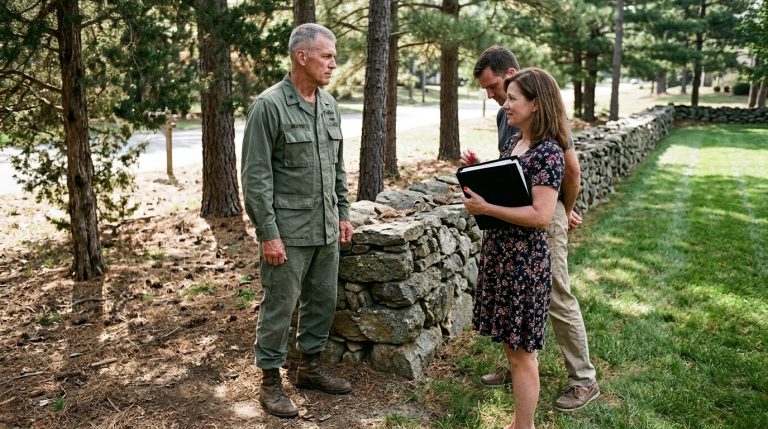
The vehicle doors clicked open in unison, and a man in a charcoal wool suit stepped out, his wingtip shoes immediately sinking an inch into the damp border of the red clay basin. He didn’t flinch, but his eyes dropped instantly to the raw, excavated lip of earth and the capped discharge pipe twenty yards away.
Evan Whitmore didn’t look like a man accustomed to standing in a farmer’s mud. His hair was silver-trimmed at the temples, cut clean and flat, and he carried a leather folio tucked under his arm like a shield. Behind him, a younger associate remained anchored by the passenger door, holding a black umbrella against a drizzle that had finally begun to ease.
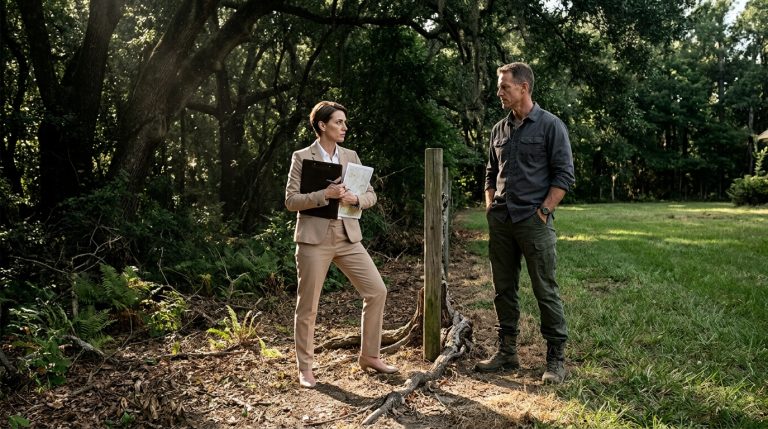
I didn’t move from my spot by the red shed. I had a pair of rusted wire cutters in my right hand, using the oily jaws to clean dried soil from the pivot bolt.
“Mr. Carter,” Whitmore said, his voice carrying clearly over the steady drip of water from the cedar trees. He walked slowly, his stride careful to avoid the deepest parts of the slurry. “Evan Whitmore. I represent Whitmore Development.”
“I know who you are,” I said, not looking up from the pliers. “You’ve got tire tracks all over my south ridge and water pooled against your loading docks.”
Whitmore stopped six feet away, his gaze sweeping over the lean of the red shed, the split-rail fence, and the raw crater of the retention basin before settling back on my face. There was no corporate smile here—no quartz-desk hospitality or clipped administrative patience. There was only the cold, tired assessment of one property owner sizing up another across an expensive mistake.
“We walked the site this morning,” Whitmore said, his tone flat and transactional. “The logistics team tells me your little water feature is routing roughly fifteen percent of our service road runoff back onto our asphalt. It’s causing delivery delays.”
“It’s staying right where it is,” I said, finally dropping the wire cutters into my tool pouch with a dull, heavy thud. “Water follows gravity, Mr. Whitmore. Your engineers just forgot to include the part where it hits a property line that isn’t for sale.”
Whitmore adjusted his leather folio, his fingers tapping a rhythmic tattoo against the dark calfskin. “The configuration of that drainage pipe was cleared through standard municipal channels three years ago. We have permits stamped by the county planning board.”
“I know what you have,” I said, stepping forward until the distance between us closed to the width of a furrow. “I’ve got the original plat maps right on my kitchen table. The ones that show two dry-detention basins right where your third row of parking stalls sits now. You skipped the earthwork to save a hundred grand, and the county board looked the other way because they wanted your commercial tax bracket on their books.”
Whitmore’s eyes narrowed just a fraction—a microscopic tightening of the skin around his temples that confirmed every word of the ledger I’d pieced together. He didn’t look surprised; he looked caught in a crosswind he thought he’d paved over.
“Reworking the entire drainage grid now would cost half a million dollars in excavation and concrete work,” Whitmore said quietly, his voice dropping into a register meant for business. ” Litigation would take two years, tie up your land in injunctions, and cost you more in surveyor fees than this pasture is worth.”
“Try it,” I said. “Every time it rains, your loading docks turn into a wading pool. Let’s see how long your grocery tenants stay happy while their delivery trucks idle in my drainage.”
A heavy silence settled between us, broken only by the distant hum of transport trucks out on the interstate. Whitmore studied me for a long, grinding moment, searching for a bluff, a crack, or a price tag. He found none of them.
“What would resolve this for you, Mr. Carter?” he asked, the corporate armor finally slipping away to reveal the exhausted pragmatist underneath.
“I don’t want your compensation,” I said, pointing a calloused finger straight up the slope toward their asphalt. “I want the water handled where it lands. You build the retention ponds your original site plan called for, you put the underground storage units beneath your parking lot, and you cap that pipe permanently.”
Whitmore stood completely still, his gaze fixed on the raw clay of my basin, calculating the cost of pride against the cost of doing it right. Slowly, he lowered the leather folio to his side.
“If we restore the natural drainage,” Whitmore said, each word measured like a legal contract, “your basin gets graded back into pasture. The pipe gets sealed at the property line. And we handle our own water.”
“And my land gets left alone,” I added.
Whitmore held my gaze for three long seconds, then gave a single, sharp nod. “Construction crews will be here on the first of the month.”
CHAPTER 8: THE DRY PASTURE
The heavy yellow blades of the excavators returned on the first of the month, exactly as Whitmore promised. They didn’t come with glossy architectural renderings or polished corporate PR reps this time; they came with tracked iron, flatbed trailers loaded with corrugated concrete retention modules, and crewmen who knew how to speak the language of soil and grade.
For three weeks, the north ridge looked like a staging ground. Excavators dug deep, square vaults beneath the western edge of the parking lot, dropping massive underground storage tanks into the earth to catch the peak stormwater before it ever reached the property line. The corrugated steel pipe that had served as a direct weapon against my lower pasture was unbolted, hoisted out by a crane, and replaced with a solid, sealed steel plate welded shut across the mouth.
I watched the work from the boundary line, leaning against the rough, splintered wood of the old split-rail fence. Dale wandered over on a Tuesday afternoon, wiping grease off his forearms, squinting up at the activity on the hill.
“I’ll be damned,” Dale said, spitting a bit of tobacco juice into the dry grass. “They’re actually putting in the retention cells. Heard through the grapevine the county planning commission caught hell behind closed doors for signing off on the original shortcut. Turned out the municipal board fast-tracked the variance three years ago specifically to pull that tax bracket away from the neighboring county, knowing full well the watershed couldn’t handle the load.”
I didn’t answer right away. I just watched a backhoe tamp down a final layer of topsoil over the buried retention vaults up on the ridge. The truth had a way of coming out when the weight became too heavy to hide under concrete. It wasn’t just a corporate oversight; it was a municipal arrangement, cleanly stamped and filed away, until a row of seven acres of red clay pushed back hard enough to break the seal.
By late autumn, the work was finished. The raw crater of the temporary basin I had dug along my fence line was graded back out, smoothed over, and re-seeded with fescue. The earth settled, the grass took root, and the land returned to its natural, patient rhythm.
The first big autumn storm hit on a Tuesday night. I didn’t stand out in the drizzle this time. I sat on my porch with a warm cup of coffee, listening to the heavy drum of rain against the tin roof of the red shed. Out on the north ridge, I watched the water run off the asphalt and disappear right where it belonged—into the subterranean vaults and retention cells, contained and managed before it ever crossed my property line. Nothing poured through the capped pipe. Nothing flooded my lower pasture.
The next morning, I drove up to Harbor Point Commons to pick up a few supplies at the hardware store. The parking lot was dry, the loading docks were clear, and delivery trucks idled smoothly against the morning chill. I stopped by the coffee shop near the corner, walked up to the counter, and ordered a black coffee.
When the barista handed me the paper cup, I looked down at the marker scrawled across the side. She’d spelled my name Tom, missing the ‘h’ entirely, just like she always did.
I smiled, took the cup, and walked back out to my truck.
The pasture down the road was just wet enough to smell like iron and dry earth when the sun hit it—not like loss, not like someone else’s shortcut. I shifted the truck into drive, rolled down the window to let the crisp air in, and drove back down the hill. Some folks thought I was stubborn, that I should have taken the developer’s check and avoided the friction. But as I pulled into my drive and looked out across seven acres of steady, unyielding grass, I knew the truth.
Water follows the path of least resistance. So do people. And sometimes, the only way to keep your ground is to stop being the easy path.