The Precise Architecture of Control: How One Quiet Suburban Breach Unraveled an Empire of Surveillance
CHAPTER 1: THE COLD LIGHT OF THE SCREEN
The screen on the tactical monitor did not flicker. It was high-grade hardware, hardwired into a secure local loop that ignored commercial lag. The garage was silent except for the low, rhythmic breathing of two rookie SWAT officers standing five paces down the concrete corridor. Footsteps had to be light. Angles had to be clear.
My thumb rested against the edge of the magnesium casing as the motion alert buzzed again.
03:14 local.
Most notifications were ghosts—a stray tomcat leaping the cedar fence, or the heavy drape shifting under the weight of an offshore draft. But the beam cutting across the western drywall of my living room was crisp, methodical, and entirely deliberate. It was a tactical sweep. A low, creeping light of an LED flashlight held close to the sternum, just the way operators cleared dry-walled corridors when they suspected an interior choke point.
“Keep your weight centered,” I told the rookies, my voice dropping into the low register reserved for live-fire drills. “If your heel hits before the ball of your foot, you’ve already announced your vector.”
Neither of them moved. They were looking at my posture, reading the set of my shoulders. They had no idea the feed glowing on the five-inch OLED display in my palm was broadcasting live from three hundred yards away, inside the exact living room I had left locked forty minutes prior.
The camera mounted above the bookshelf panned three inches to the left. The image sharpened. A pair of cargo pants entered the frame, followed by the dull, matte reflection of a beige utility vest. The vest was unmistakable. It carried a crude, laminated patch stitched with block lettering: Neighborhood safety enforcer, Karen’s patrol.
For a microsecond, the rational mind rejected the geometry of it. A suburban subdivision with manicured lawns and pruned hydrangeas does not require a wedge formation. Yet there they were. A man in cargo pants, a second figure trailing with a fishing hat pulled low over their brow, and a third clutching a plastic walkie-talkie like it was a detonator.
Karen had spent two weeks sliding pink notices onto my front door. Voluntary safety inspections, she had called them, though the ink was aggressive and the deadlines carried the weight of a petty magistrate. I had crumpled the last one without reading past the third line. It was an error in risk assessment. I had measured her as an eccentric nuisance, a woman with too much time and a laminated badge bought online.
I was wrong. She wasn’t playing dress-up anymore. She had crossed the threshold, stepping past the security perimeter with bolt cutters and a conviction born of absolute, unyielding self-righteousness.
The rookies watched me drop my gaze from their stance to the phone screen. The flashlight on the monitor paused over my grandfather’s cherrywood side table, lingering on the brass corners as if searching for a hidden latch.
I locked the phone screen with a sharp, metallic click.
“We’re cutting the session short,” I said, my voice flat, leaving no room for questions. “Real-world case study just dropped.”
As I turned toward the equipment lockers to secure the training gear, a cold draft slipped under the garage door, carrying the faint, metallic scent of damp autumn soil and copper—and off in the darkest corner of the yard, near the utility gate, I noticed the security lens cap for the secondary perimeter camera had been carefully unscrewed and left resting on the grass.
CHAPTER 2: THE THRESHOLD
The hinge on the utility gate gave a dry, protesting pop as I stepped through into the narrow service alley behind the kitchen. The wind had dropped, leaving the suburban night abnormally still, heavy with the artificial scent of treated lawns and distant exhaust. The security lens cap rested on the lawn like a discarded coin, its exposed thread bare to the cool air. Someone had taken it off with intent. Not a loose screw, not structural vibration, but a deliberate twist of fingers trying to blind one eye of the perimeter before the main push.
I didn’t touch the cap. In tactical work, you never disturb an active footprint until you’ve mapped the vectors. Instead, I kept my weight low, boots finding the dead spots on the gravel path where the crunch of small stones wouldn’t carry through the double-pane kitchen windows.
Inside, the house was breathing in the low, rhythmic hum of appliances. But beneath that white noise, there was the unmistakable friction of foreign bodies. A quiet scrape of boot leather against the hardwood transition strip. A muffled whisper debating whether the utility door latch could be bypassed without tripping the secondary sensor.
“They’re by the pantry,” I muttered under my breath, my hand sliding down to the master breaker switch box mounted flush against the exterior garage wall.
The box was cold under my palm. I didn’t hesitate. I threw the main lever with a sharp, heavy clack that vibrated up through the drywall studs.
Instantly, the ambient yellow glow of the kitchen recessed lighting died. The refrigerator hum cut out mid-cycle. The silence that followed wasn’t peaceful; it was the abrupt, suffocating void of a cage dropping in the dark.
From inside the kitchen came a sharp yelp—a startled, high-pitched intake of breath belonging to someone whose tactical preparation began and ended with laminated badges and clipboards. A heavy plastic crate shifted, followed by the clatter of metal tools hitting the linoleum floor. Bolt cutters. That sound has a distinct, ringing pitch when it meets a concrete foundation in the dark. It strips away all pretense of authority, leaving only the raw, chaotic reflex of trespassers caught off-guard.
“Who killed the juice?” a voice hissed from inside the dark kitchen. It was a man’s voice, tight with panic, pitching upward at the edge of control. Kyle. Karen’s boy, brought along to carry the gear because his mother needed muscle that didn’t ask questions.
“Shut up, keep the light down,” a second voice snapped back—older, breathy, trying desperately to sound anchored to a procedure that had just vanished with the current.
I didn’t draw a weapon. In an enclosed domestic space, lethal escalation against civilian interlopers with bolt cutters is a tactical failure. Control is achieved through environmental dominance and psychological friction.
I slipped through the side garage door, which hung half an inch ajar where they had forced the latch, and stepped onto the linoleum. The room was pitch black, but my eyes had already adjusted during the walk from the perimeter fence. To my right, the silhouette of a beige utility vest loomed against the pale gray rectangle of the backyard window.
“You are trespassing,” I said. My voice was low, perfectly level, stripped of any theatrical anger. It didn’t boom; it simply filled the space between the counters like cold water. “Drop the tools. Face the drywall. Exit now.”
The figure in the vest scrambled backward, boots slipping on the slick floorboards. “We’re—this is an authorized community check—you don’t have the right to—”
“Drop the tools, Kyle,” I cut through the stammering, stepping forward two paces. The floor didn’t creak beneath my boots because my heel came down after the toe, weight distributed evenly across the frame.
Panic moves with a distinct, erratic kinetic energy in people who have never trained for darkness. Instead of freezing or complying, a dark mass lunged sideways, bolting blindly toward the narrow hallway leading to the front foyer. It was a textbook flight response, completely unmoored from spatial awareness.
I reached to my belt and flicked the toggle on the high-intensity strobe rig I kept clipped there for disorientation drills.
The hallway exploded into a rapid, blinding succession of 800-lumen pulses. White light fractured off the white-painted drywall, turning the corridor into a stuttering strobe-lit nightmare of disjointed frames.
A heavy thud echoed down the hall a fraction of a second later. Kyle had run straight into the structural corner where the hallway met the guest bath, his shoulder hitting the drywall studs with enough force to rattle the framed prints on the opposite wall. A muffled groan followed, the sound of air being punched out of unconditioned lungs as he slid down the wallpapered surface into a heap on the floor.
“Hands where I can see them,” I said, stepping past the doorway and letting the strobe settle into a steady, dim tactical glow from the floor emitter.
By the time the secondary figures realized they were entirely isolated, their plastic walkie-talkies were clattering uselessly against the linoleum, gripped like life preservers by hands that couldn’t stop shaking. They were face down within thirty seconds, surrounded by the cold, hard geometry of a home that had simply waited for them to trip over their own delusions.
CHAPTER 3: THE BLUE AND RED
The floorboards beneath my boots were still cold from the power outage when the cruiser tires crunched onto the asphalt outside. The arrival was clean—no screaming sirens, just the sharp, rhythmic wash of crimson and cobalt light sweeping across the ceiling plaster.
I stood by the threshold of the kitchen, hands loose at my sides, watching Kyle pick himself up from the baseboard where he had collided with the drywall. He was wiping plaster dust from his beige vest, his breathing ragged and shallow, eyes darting toward the front door like a cornered animal looking for an exit that didn’t exist. Behind him, the two other figures—the man in the fishing hat and an older woman clutching a dead plastic radio—remained frozen face down against the linoleum, pinned less by physical weight than by the sudden, total collapse of their imagined authority.
The front door swung open with a heavy click.
Lieutenant Marquez stepped into the entryway first. His hand rested naturally near his service weapon, but his eyes were entirely clinical, scanning the room with the practiced gaze of a man who spent ten years running urban warrants before taking a district command. He had gone through my tactical instruction course back at the facility three winters ago. He recognized my posture before he recognized my face.
Marquez stopped dead at the edge of the hallway, his boots halting an inch from a pair of heavy-duty bolt cutters resting on the floor. His gaze flicked from Kyle’s bruised shoulder to the shattered composure of the volunteers, then settled on me.
“Decent grouping,” Marquez said quietly, his voice dry, referencing the precise corner impact without giving anything away to the interlopers. “You look like you’re still teaching perimeter defense, Miller.”
“We had an unscheduled intrusion, Lieutenant,” I replied, my tone flat, stripped of any conversational warmth. “Three individuals. Forced entry via the side kitchen latch. Property damage to the utility gate hinge. I want it logged strictly by the book.”
Before Marquez could respond, a shrill, manic spike of sound cut through the room.
Karen had materialized on the front porch, her laminated badge catching the flashing cruiser light like a cheap mirror. She pushed past a junior patrol officer, her heels clicking furiously against the hardwood entry.
“Lieutenant! Thank God you’re here—it’s an ambush!” Karen’s voice was pitched high, vibrating with the frantic energy of a sovereign who suddenly realized her crown was made of painted cardboard. She pointed a trembling finger straight at my chest. “He attacked them! They were conducting an authorized community safety sweep under Section Four of the neighborhood charter, and he lured them into a dark trap!”
Marquez didn’t look at her immediately. He let her words hang in the cold air, letting the sheer absurdity of a “community safety sweep” at three in the morning collide with the reality of bolt cutters and forced locks.
“An authorized sweep,” Marquez repeated, his voice dangerously neutral. He turned his head slowly toward Karen. “At 3:14 AM. With cutting tools.”
“We had reports of unregistered electrical anomalies!” Karen insisted, her chest heaving as she stepped further into the room, her clipboard clutched to her ribs like a shield. “Unusual movement, blacked-out windows—he’s running a compound out of a residential zone! We had every right to secure the perimeter for the safety of the families on this street!”
I didn’t raise my voice. I simply reached into my pocket, pulled out the tablet linked to my local server, and tapped the screen twice.
The wall-mounted smart display behind the kitchen island flickered to life. High-definition audio and wide-angle video filled the room, projecting Karen’s own voice clear as crystal into the quiet space. Instructing volunteers to cut locks. Directing them to search cabinets for evidence of operations. The footage didn’t miss a beat. It showed her standing by the side fence, gesturing with her clipboard, completely unscripted and entirely unhinged.
The sound of her own recorded voice echoing through the kitchen hit Karen like a physical blow. The color drained from her face, leaving her skin the gray-white of wet drywall.
For three seconds, nobody moved. The red and blue lights outside continued their silent, hypnotic rotation across the ceiling, painting the room in alternating strokes of blood and ice. The psychological phantom of old tactical drills—the sharp, sudden realization of a compromised sector—flashed in the back of my mind, reminding me how fragile an ordered environment truly is when people confuse control with ownership.
“Lieutenant,” I said softly, breaking the silence as I handed him the tablet with the local file exports. “Every timestamp is logged. Every asset movement is accounted for. The trespass is complete.”
Marquez took the tablet, his eyes scanning the metadata logs with quiet appreciation. He looked up at Karen, whose mouth opened and closed once without sound. The laminated badge on her vest looked remarkably small now, little more than a piece of laminated trash pinned to a costume that had nowhere left to hide.
“All right,” Marquez sighed, motioning to the patrol officers by the door. “Cuff them for unlawful entry and property destruction. Let’s clear the scene.”
CHAPTER 4: THE LEDGER REVEALED
The heavy oak door of the study remained half-open, casting a narrow strip of amber light across the hallway rug. Marcus Vance stood by the corner of the mahogany desk, his fingers hovering over a stack of manila folders that reeked of damp basement paper and cheap corporate toner. Marcus had spent twelve years working white-collar compliance for federal auditing divisions before burning out and retreating to a quiet consultancy practice. When he heard about the breach at my house, he didn’t call to offer sympathy; he called to request the hard drives.
“You’re looking at a classic shell structure,” Marcus said, his voice dropping into that flat, nasal drone peculiar to investigators who lived on black coffee and cold statistics. He didn’t look up when I stepped into the room, instead sliding a multi-page spreadsheet across the polished timber surface. “An HOA doesn’t accidentally accumulate a twelve-thousand-dollar deficit in maintenance reserves while simultaneously purchasing military-grade motion-activated optics and secure encrypted handsets.”
I didn’t touch the paper immediately. I walked past the desk, my boots clicking softly against the floorboards, and pulled the blinds closed against the empty street outside. The glass was cold, radiating the sharp autumn chill of a neighborhood that looked deceptively peaceful on the surface.
“The funds weren’t just for uniforms and clipboards,” I said, my gaze fixed on the reflection of the study door in the windowpane.
“Uniforms were the front-end distraction,” Marcus corrected, tapping a yellow highlighter against the margin of a receipt printout. “Look at line item forty-two. Vendor listed as Apex Security Solutions, operating out of a P.O. box three towns over. When we trace the wire transfers from the community maintenance account, they clear straight through an intermediary trust managed by a corporate entity named * Meridian Holding Group*.”
He turned the page, revealing a detailed property plat of the subdivision, complete with red ink annotations marking every house on our street. Three specific properties—all of them homes belonging to elderly residents or single owners who had recently faced sudden, compounding code violations—were circled in heavy, aggressive marker.
“They weren’t just watching people,” I murmured, the pieces snapping into a rigid, geometric alignment. “They were engineering compliance failures.”
“Worse than that,” Marcus muttered, his eyes narrowing behind his wire-rimmed glasses. “If an owner gets cited enough times for artificial infractions—high grass, unapproved paint shades, unauthorized garden fixtures—the HOA can place a mechanics lien on the title under municipal bylaws. Once the lien clears legal threshold, the property goes to forced receivership auction.”
The abrasive buzz of a misaligned filing drawer sliding shut down the hall punctuated his words—a minor mechanical glitch in the house’s old infrastructure, but it cut through the silence like a dropped casing. The logic was cold, pristine, and entirely ruthless. Karen hadn’t started out running a neighborhood patrol to protect flower beds; the patrols were a scouting mechanism. Every photograph taken from the bushes, every note logged about work schedules, every forced entry under the guise of an emergency safety check was a calculated stress test designed to break down individual resistance and force distressed property sales into a pre-selected portfolio.
“She wasn’t protecting the community,” I said, the weight of the realization settling into my shoulders. “She was clearing the board.”
“And she used the neighborhood’s own monthly dues to finance her acquisition pipeline,” Marcus added, snapping his briefcase shut with a sharp, echoing thwack. “We take this package to the district prosecutor tomorrow morning, her little administrative empire doesn’t just face fines—it dissolves under federal fraud statutes.”
I looked down at the circled houses on the plat, tracing the sharp red lines with my thumb. The perimeter had been breached, but the counter-offensive was no longer about a broken fence hinge or a midnight trespass. The architecture of her control was standing exposed in the cold light of the desk lamp, and the foundation was already cracking under its own weight.
CHAPTER 5: THE CLUBHOUSE RECKONING
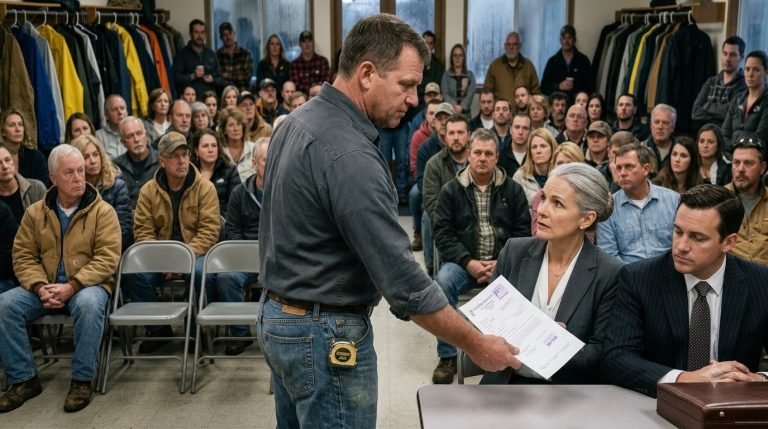
The air inside the community clubhouse was thick with stale coffee and the low, collective murmur of forty residents squeezed onto folding metal chairs. It was standing room only along the back perimeter. Outside, the evening air had turned crisp, but inside, the room radiated a tense, suffocating heat.
Karen sat at the head of the long laminate table flanked by two teenage volunteers wearing matching navy polos, as if coordinated fabric could somehow substitute for legal authority. Her clipboard rested squarely in front of her, the metal clip gleaming under the humming fluorescent tubes overhead. She looked composed, though the faint tension around her jawline betrayed a woman accustomed to unchallenged compliance now facing an unfamiliar geometry of resistance.
I didn’t take a seat. I stood near the back emergency exit, my weight balanced evenly on both boots, arms crossed lightly over my jacket. Marcus remained seated three rows ahead, a thick manila folder resting on his knees like an unexploded ordnance.
“We are here tonight to address administrative overreach and procedural protocol,” Karen began, her voice carrying that practiced, bright cadence she used to open every monthly meeting. She raised a hand to cut off a murmur from the third row. “Certain individuals have circulated sensationalized accounts regarding community safety measures. I assure you, every action taken by the task force was vetted through standard internal reviews for the protection of our property values.”
The silence that followed wasn’t respectful; it was heavy, skeptical, and flat. Nobody nodded. Nobody opened a notebook.
I stepped out from the shadow of the exit door, walking two slow paces forward until the floorboards creaked softly under my heels. The sound drew a few heads around. Karen stopped mid-sentence, her eyes locking onto mine with a flash of sharp, defensive animosity.
“Standard review,” I said, my voice low, cutting cleanly through the hum of the fluorescent fixtures without raising a decibel. “Let’s review the standard, Karen.”
I reached into my pocket, pulled out a small tactical flash drive, and walked it forward, placing it gently on the corner of the laminate table near her clipboard. The plastic casing hit the wood with a sharp, dry tap.
“What is this?” she demanded, her chin lifting as she glared at the drive. “This meeting is closed to unauthorized presentations—”
“It’s an audio and financial export,” I replied, my gaze level, refusing to match her performative panic. “It includes the audio logs of your midnight entry into private residences, the receipts tracking community maintenance funds diverted to Apex Security Solutions, and the Meridian Holding Group corporate filings detailing lien assignments on three properties on this street.”
The name Meridian dropped into the room like a cold stone.
A murmur rippled through the front rows. Old man Henderson, who lived two houses down and had spent three months fighting sudden municipal citations for his garden shed, leaned forward in his chair.
“What’s that about liens?” Henderson asked, his voice cracking slightly.
Karen stood up abruptly, her chair legs scraping harshly against the linoleum. “He is fabricating documents! This is a coordinated attack by someone who runs a tactical compound in a residential zone! He’s trying to undermine the safety of this community!”
She reached for the flash drive as if to sweep it off the table, but my hand closed over the laminate edge first, pinning her wrist in place with minimal, unyielding pressure. It wasn’t violent; it was absolute mechanical control. She froze, her fingers hovering an inch from the plastic casing, her breath catching in her throat as she realized that no amount of administrative posturing could override physical reality.
“The vote to remove you as chair isn’t pending anymore, Karen,” I said softly, releasing her wrist and stepping back. “It’s a matter of public record. The district prosecutor already has the ledger.”
The collective realization swept through the room like a draft. Voices rose all at once—indignant, sharp, demanding answers about funds and forced code violations. Karen stood there for a long, agonizing second, her mouth opening to speak, but the words had nowhere to go. Her empire of clipboards and laminated badges had evaporated into the cold, glaring light of the clubhouse ceiling.
CHAPTER 6: THE REPAIRED HINGE
The mahogany doors of the municipal courtroom closed with a solid, resonant thud that cut off the low hum of the hallway traffic. Inside, the air smelled of floor wax and old paper. The judge’s bench sat high and geometric under the recessed spotlights, casting sharp, rigid shadows across the oak panels.
Karen sat three benches down, her shoulders bowed beneath the weight of formal adjudication. There was no clipboard in her lap, no laminated badge pinned to her jacket. The downtown hearing had lasted four hours, moving systematically through financial audits, municipal code violations, and sworn testimony regarding the Meridian Holding Group shell transactions. When the judge delivered the ruling—heavy financial penalties, a ten-year prohibition from holding any community or corporate office, and a mandatory compliance course—it didn’t arrive with dramatic fury. It came with the quiet, crushing finality of an accounting ledger balancing to zero.
Her husband’s financial collapse—the hidden engine behind the forced property acquisitions and the aggressive surveillance network—had been laid bare in the final exhibits. The intimidation wasn’t about community safety; it was a desperate, calculated liquidation scheme designed to swallow distressed neighborhood titles before foreclosure notices hit the public registry.
“She tried to build an empire out of fear,” Marcus murmured quietly from the aisle seat beside me, adjusting his glasses as he packed his documents into his case. “And she used everyone else’s trust to pay for the bricks.”
I didn’t answer immediately. I kept my eyes fixed on the front of the courtroom where Karen sat alone, her gaze locked onto the polished grain of the defense table. The cornered beast protocol had reached its natural terminus; there were no more procedural loopholes to exploit, no more emergency memos to draft, and no more unauthorized patrols to deploy. Her method had consumed her.
We walked out into the crisp afternoon air, leaving the marble steps behind us. The drive back to the subdivision took twenty minutes of steady, unbroken motion.
When I pulled into my driveway, the sunlight was long and horizontal, catching the edge of the western fence. The neighborhood looked different now—not because the houses had changed, but because the atmosphere had shifted from a guarded, tense silence back into something open and breathing. Curtains stayed wide. Laughter drifted from a lawn two doors down where a teenager was teaching a younger sibling how to adjust a bicycle chain.
I stepped out of the truck, the gravel crunching beneath my boots with a familiar, solid rhythm.
The task wasn’t entirely finished until the physical markers of the breach were corrected. I walked down the side service path toward the backyard utility gate where the hinge had been bent during the midnight intrusion weeks ago. The iron plate was warped, stubborn against the screw thread.
A small, hesitant shuffle sounded near the back gate.
Kyle stood there, his hands shoved deep into his pockets, looking down at the gravel with a stiff, embarrassed posture. He wasn’t wearing a utility vest or holding a radio.
“My mom is packing up the house,” he said quietly, his voice cracking slightly at the edge. “We’re leaving town by the end of the month.”
I didn’t stop working the wrench. The tool gripped the rusted bolt with firm, calculated leverage, turning it a quarter-inch at a time until the metal alignment settled back into true geometry.
“If you’re going to learn how to secure a perimeter, Kyle, you start with the foundation,” I said, not looking up, letting the steady torque of the wrench speak for itself. “It means law. It means consent. It means boundaries. Not playing dress-up.”
He stood there for a long moment, watching the metal alignment shift under pressure. Then, without a word, he stepped past the gate, reached into his jacket pocket, and pulled out a replacement hinge pin he must have brought from home. He knelt beside me on the damp grass, holding the steel steady while I drove the final screw home.
It was a small repair, but it mattered. The hinge moved smoothly now, swinging open and locking shut with a clean, unforced click that echoed softly against the fence panels.
Later that evening, I sat on the front porch with a glass of iced tea, watching the sky fade from amber to deep slate gray. The gnomes were gone from across the street. The blinds stayed open. The air was quiet, heavy with the natural scent of dry earth and cooling asphalt. Power without oversight always attracts those who crave control, but it shrinks the moment it hits the light. I took a slow sip of the tea, watching the shadows lengthen across the driveway, and let the quiet settle back into its proper place.