The Ledger of Legacy: A Calculated Descent of a Suburban Tyrant Through Law and Smoke
CHAPTER 1: The Opening Salvo
The air still hummed with the residual vibration of Karen’s voice, a saccharine, grating sound that lingered in the morning stillness like a bad scent. I didn’t move. I kept my posture relaxed, military-taught, even as the blood in my veins began to cool into the precise, slow-burning fuel of a veteran preparing for an extraction mission.
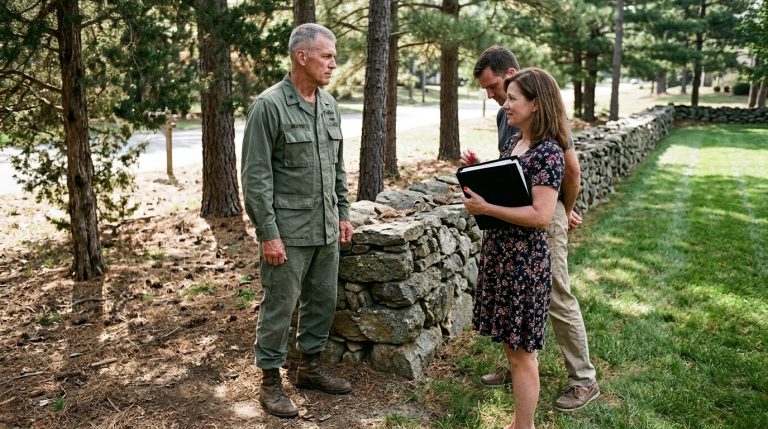
Beyond the gnarled oak that separated my acre from the suburban sprawl, Karen was still shouting something to her board cronies, Carol and Bob. They moved with the frantic, scurrying energy of insects. They held their clipboards like shields, their posture rigid with the self-appointed authority of those who believe they own the horizon. My smokehouse sat in the distance—a dark, silent monument of fieldstone and cedar. It was built to last centuries; their authority was built to last until the next board election.
“They have no idea, do they?”
The voice was soft, belonging to Sarah, who had stepped out onto the porch behind me. She was hugging herself, her eyes tracking the retreating HOA trio.
I didn’t answer immediately. I took a sip of the cold coffee, the liquid sharp and unyielding against my teeth. My gaze stayed fixed on Karen’s back as she reached the curb, her neon-pink suit a garish insult to the muted, natural greens of the woods.
“She thinks she’s defending a standard,” I said finally, my voice stripped of emotion. “She doesn’t realize she’s attacking a sovereign state.”
I set the mug down on the railing. It landed with a dull, heavy thud. The interaction had been simple—a bluff. She had demanded a fine for a structure I had built on land that had been in my family’s name since the administration of Theodore Roosevelt. She saw a violation; I saw the first domino in a chain I was about to trigger.
“She’ll file, won’t she?” Sarah asked, her voice tight. “With the county?”
“She’ll try,” I replied.
I turned and walked back into the house, my boots echoing on the hardwood. I didn’t head for the kitchen or the living room. I walked straight to my office, the small, quiet room where the cedar footlocker waited. The scent of old, dry wood greeted me, a smell that spoke of history and endurance.
I didn’t rush. Rushing was for people who didn’t have the law on their side. I knelt, my hands finding the iron latch. As I lifted the lid, the weight of a century settled into my muscles. Beneath the tarnished medals and the dusty paperbacks, the leather portfolio felt like an extension of my own arm.
I laid the documents on the desk. They were crisp, thick with the heavy texture of government-issued vellum. I saw the date: 1903. I saw the signature. Everything was exactly where it needed to be.
But as I reached for my phone to initiate the documentation, a flash of red caught my eye through the window—the HOA car pulling a slow, predatory U-turn at the end of the driveway. They were watching, waiting for a sign of panic. They wouldn’t see one. I adjusted the window blinds, just enough to catch the angle of their approach, then sat back and began to type the first, cold line of a letter that would be the final piece of their professional ruin.
Something, however, felt out of place. I looked down at the desk. The survey map I had pulled last week was slightly askew, the edge curled as if someone—or something—had brushed against it. I hadn’t moved it.
I glanced at the door. It was locked, as it always was. Yet, the air in the room felt stagnant, colder than the morning outside. I frowned, the sharp focus of my planning momentarily jagged. Was it just the paranoia of the coming fight, or had someone actually been in here?
CHAPTER 2: The Armory of Records
I didn’t move for a long count of ten. My hand remained frozen near the edge of the leather portfolio, my thumb pressing down against the vellum. The silence of the house, usually a comfort, now felt like a held breath. The HOA wouldn’t have physically broken in—not yet. They were bureaucratic predators, not common burglars; they operated through intimidation, through the slow erosion of comfort, through the subtle shifting of items just enough to let you know they were watching.
I stood slowly, my joints making no sound. I walked to the office door and turned the lock, the heavy bolt sliding home with a reassuring, metallic click. I didn’t check the window again. I knew what was out there: the pristine, uniform geometry of Oakwood Preserve, a neighborhood built on the erasure of history, and my acre, the one square hole in their grand design.
The memory hit me then, sharp as a whetstone. My grandfather, sitting in this very chair, his hands mapped with the same calluses I now possessed. He had been looking at this same patent, the heavy paper held in a light, respectful grip. “Jack,” he’d said, his voice a low rasp like sandpaper on cedar, “they’ll come for the land, but they won’t come for the dirt. They’ll come for the rules. They’ll try to write their own laws on top of your history until you can’t see the ground underneath. Don’t let them hold the pen.”
I pushed the memory aside. It was a phantom, a ghost of a warning that had finally materialized in the form of a woman in a neon-pink suit.
I turned back to the desk and methodically smoothed the edge of the survey map. The paper was dry, brittle with age, the ink a faded, iron-rich brown. It wasn’t just a map; it was a geography of defiance. I took out my phone and switched the camera to its highest resolution. I didn’t just capture the whole page; I zoomed in, section by section, ensuring the boundary markers—the creek, the ancient oak, the stone survey pillars—were documented with clinical precision.
This was the first piece of the counter-offensive. I wasn’t just building a defense; I was constructing a fortress of verifiable fact.
I moved to the closet and pulled out a clean, fireproof file folder. I didn’t store the originals in the digital world; I kept them physically here, but I needed to create a duplicate trail. I took the photos, synced them to the secure drive I’d set up, and then began the process of drafting the first formal communication.
My fingers moved across the keys of my laptop, the clatter a rhythmic, disciplined sound. I didn’t write to Karen. I wrote to the board, a collective entity that thrived on the protection of the group.
To the Board of Directors, Oakwood Preserve Homeowners Association, I typed.
My pulse was steady. I didn’t use the angry, reactive language that would satisfy a small mind. I used the language of the state, of the land, of the immutable record. Every word was a tactical strike. I cited the 1903 patent, referencing its status as the highest form of title. I didn’t request they stop; I informed them that any further action would constitute a legal violation with documented consequences.
I wasn’t just writing a letter; I was pinning them to the board.
As I worked, the office felt different. The “discrepancy”—the moved map—nagged at the back of my mind. It was a variable I couldn’t account for, a sign of intrusion that defied their typical bureaucratic modus operandi. If they had touched the map, they were desperate. And desperation, I knew from my time in the field, was the first step toward a mistake.
I finished the draft and hit print. The laser printer hummed, a soft, steady whir that cut through the silence. As the pages fed into the tray, I leaned back, my eyes tracking the movement of a shadow across the office floor—a tree limb swaying in the wind, a natural, unhurried motion that reminded me of the rhythm of the land.
I had the law, I had the history, and now, I had the documentation to prove it. I walked to the printer and picked up the stack of paper. It felt substantial, a weight that had nothing to do with the physical mass of the sheets. It was the weight of a century of ownership, and I was holding it firmly, refusing to let anyone else take the pen.
I walked out of the office, down the hallway, and into the kitchen where Sarah was waiting. She didn’t ask questions; she saw the folder, the way I held it, and the set of my jaw. She knew.
“They’re going to push, aren’t they?” she asked, setting down her own mug.
“They’re going to push until they hit something hard,” I said, my voice quiet, final. “And this acre is the hardest thing they’ve ever encountered.”
I placed the folder on the kitchen island, a declaration of intent left out in the open. I looked out the kitchen window, toward the back of the property, where the smokehouse stood amidst the trees. It was quiet out there, the way it should be. But I knew the peace was a temporary state, a lull before the kinetic energy of our conflict began to reshape the neighborhood. I was ready. The armory was open, and the first volley was already prepared.
CHAPTER 3: The First Volley
Sarah’s gaze remained fixed on the folder. She didn’t reach for it. She knew the weight of it, not just in paper, but in the potential fallout it would bring to our front door.
“If you send this, Jack,” she said, her voice quiet but steady, “there’s no walking it back. This isn’t just about the smokehouse anymore.”
“It was never about the smokehouse,” I replied, moving to the counter to pour a fresh glass of water. My hands were perfectly still. “The smokehouse is just the terrain they chose to fight on. If we don’t hold the line here, the entire boundary of this property becomes a suggestion rather than a fact.”
I took a slow sip, the cool water doing little to dampen the heat of the focus sharpening in my mind. I walked over to the island and opened the folder, flipping the printed pages to ensure the signature lines were crisp. I had already initialed every page, a small, deliberate act of ownership. Every mark was a confirmation that I wasn’t acting out of impulse, but out of a calculated, century-old right.
“What’s the first step?” she asked.
“The post office,” I said. “Certified, return receipt requested. Every single one of them needs a copy. Karen, the board, the management company, their legal counsel. I want their desks buried under the same evidence they tried to ignore.”
We moved through the house with the practiced efficiency of a team that had long ago learned how to operate under duress. I collected the ten envelopes from the printer, checked the addresses I had meticulously cross-referenced against public records, and sealed them. The sound of the adhesive tape—a sharp, tearing friction—was the only noise in the house.
I drove the short distance to the post office with the envelopes sitting in the passenger seat. The late afternoon light was beginning to stretch, casting long, sharp shadows across the manicured lawns of Oakwood Preserve as I passed through. I watched the houses, the identical mailboxes, the carefully curated seasonal displays. Everything was perfect, and everything was artificial. They were living in a simulation of suburban order; I was living on a piece of geography that didn’t care about their bylaws.
The post office was quiet. I laid the ten envelopes on the counter, one by one. The clerk, a woman I’d seen a dozen times, looked at the stack, then at the labels.
“Certified mail for all of these?” she asked.
“Every one,” I said.
As I signed the forms, I realized I was watching the entrance through the glass. Paranoia? Maybe. But in a tactical situation, it was called situational awareness. I watched the movement of every car that passed, the shape of every pedestrian. I wasn’t looking for a threat; I was looking for patterns. The HOA operated on patterns—the morning rounds, the slow, calculated drive-bys, the passive-aggressive placement of notices.
I finished the paperwork and stepped back out into the cooling air. The drive home felt longer than the trip there. I kept my speed constant, my eyes checking the rearview mirror at every turn. There was no one tailing me, but the sense of being observed remained, a prickle at the base of my neck that refused to fade.
When I pulled back into my driveway, the house was silent. Sarah was in the garden, her figure silhouetted against the encroaching shadows of the woods. She looked up as I approached, her expression searching.
“Done?”
“They’re in the mail,” I said.
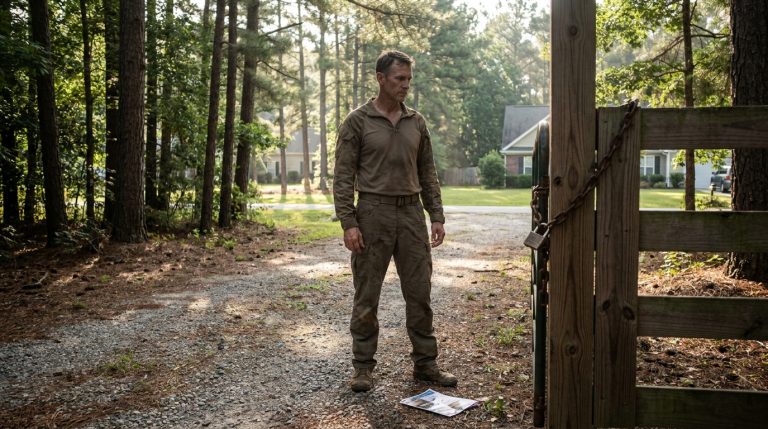
I walked to the back of the property, past the house, and toward the smokehouse. The structure looked solid, immovable, its fieldstone base grounding it to the earth as if it had been there for a hundred years, not three months. I touched the cedar frame. It was cool, damp with the evening dew. This was the target of their frustration, the ‘unapproved edifice’ that had shattered their perception of control.
I stood there for a long time, watching the light fade from the sky. The woods behind the property were dark, the creek bed a silent, winding border. I knew the HOA board would receive these letters by tomorrow morning. I knew the shock, the quick, panicked calls to their lawyer, the frantic efforts to find a loophole in a document that held the full weight of federal law.
I felt no satisfaction yet. Satisfaction was for the end of the campaign. For now, I only felt the clarity of the next move. I pulled out my phone and checked the connection to the new security cameras. The feed appeared—a grid of four crystal-clear views: the driveway, the front approach, the side garden, and the smokehouse perimeter.
I sat down on the stone step of the smokehouse. I had the cameras, I had the paper trail, and I had the history. The board was about to discover that they hadn’t picked a fight with a homeowner. They had picked a fight with a legacy that had survived much harder winters than an HOA board meeting.
I watched the red light of the camera blink in the darkness—a small, steady pulse that told me I was watching them as closely as they were watching me. I wasn’t just sitting in the dark; I was holding the center.
CHAPTER 4: The Surveillance Siege
I didn’t reach for the paper immediately. I watched it from the smokehouse step, my breathing steady, my mind cycling through the potential threats. It was pinned to the base of my garage door with a single, aggressive staple—a deliberate mark of ownership, a claim staked on my territory.
I stood, the gravel crunching beneath my boots with a sound that seemed amplified by the night air. The security camera overhead caught my movement, the lens whirring softly as it tracked me. I approached the garage, my hand moving to the flashlight on my belt. I didn’t click it on yet. I wanted to see if anyone was watching from the tree line, from the shadows that hugged the property edge.
Nothing moved. The stillness of the Oakwood Preserve was absolute, a perfect, curated silence that only served to make my presence feel like a jagged interruption.
I clicked the light on. The beam cut a sharp, white path through the darkness, landing on the paper. It was a formal-looking notice, its edges already curling slightly in the night dampness. I didn’t pull it from the wood. I leaned in, reading the text in the glare of the light. Violation Notice: Unauthorized Landscaping and Perimeter Obstruction.
It was a absurdity, a blatant piece of theatrical harassment. I pulled the staple free with a sharp, metallic ping, the paper coming away in my hand. It was thick, heavier than their standard correspondence.
I walked back to the house, the paper cold against my skin. Sarah was standing in the kitchen, the light spilling out onto the porch. She looked at the notice, then at me. I didn’t say a word. I laid it on the granite counter and took out my phone, opening the security app.
I pulled up the feed from 2:00 a.m. the previous night—the time when the quiet of the neighborhood was usually at its deepest. I scrubbed the footage back, frame by frame, watching the driveway. For an hour, nothing. Then, a dark sedan, headlights off, rolled slowly past the entrance. It didn’t stop, but it slowed, a lingering hesitation that spoke of reconnaissance. Then, nothing.
I checked the timestamp on the notice again. It had been placed within the last two hours. I looked at the footage from the last two hours. There, at 11:15 p.m., a figure emerged from the side path near the ancient oak—a man, slight, his face obscured by a hood. He moved with a practiced, familiar gait, approaching the garage, pinning the notice, and retreating into the dark as if he knew exactly where the blind spots in my camera coverage were.
I froze the frame. I zoomed in on the figure’s hand as he reached for the garage. He wasn’t just pinning a notice; he was checking the lock.
A cold, hard clarity washed over me. This wasn’t just about the smokehouse or the land. This was an attempt to test the perimeter. They were checking for weaknesses, looking for an entry point into the one thing they couldn’t control.
“They’re not just sending letters anymore,” Sarah said, her voice dropping to a whisper as she watched the screen.
“No,” I agreed, my eyes locked on the figure in the video. “They’re trying to see if I’m as prepared as I claim to be.”
I didn’t call the police. That was a game for the naive, for people who expected the system to protect them. I went back to the office. I sat at the desk, the land patent and the survey map laid out before me. I looked at the figure on the screen, then at the documents. The conflict had shifted. It was no longer a battle of wills; it was a battle of geometry. I started to map the camera angles, the blind spots, the approaches.
I wasn’t just a homeowner defending a parcel of dirt anymore. I was an architect of a defense. I opened the digital evidence locker and uploaded the clip. I tagged it: Attempted Trespass / Perimeter Testing.
I worked for three hours, the blue light of the monitor casting long, harsh shadows across the room. I wasn’t feeling the exhaustion. I was feeling the sharp, precise focus of a man who knows exactly how to break an opponent’s momentum. They thought they were testing a man; they were about to find out they were testing a fortress.
I stood and walked to the window. The house was quiet, but the air outside felt different. The stillness wasn’t empty anymore; it was a tension, a coiled spring waiting for the release. I reached out and touched the window frame. It was solid, secure. I turned back to the desk and began to draft the next correspondence, not to the board, but to their counsel, and this time, I wouldn’t be using a stamp. I would be hand-delivering the evidence of their latest failure to cross the Rubicon.
They wanted to see if I was prepared? I was going to show them exactly what happens when you mistake a quiet neighbor for a broken one.
CHAPTER 5: The Paper Trap
The screen flickered. The motion-activated light on the driveway cast a long, distorted shadow across the asphalt. I stood perfectly still, my eyes narrowing as the figure on the screen stepped into the frame again. It wasn’t the hoodied phantom from the night before.
It was Bob—the beefy, silent board crony I’d seen flanking Karen on my porch.
He wasn’t moving with the stealthy, practiced gait of the previous intruder. He was walking with a heavy, clumsy determination. In his hand, he carried a thick, official-looking document—another ‘Notice of Intent to File Lien.’ He reached the garage door, slapped the document against the surface, and paused, his hand lingering on the handle. He pulled. The garage door was locked, a solid, unyielding barrier. He rattled it, the sound echoing through the night, then turned back toward the dark expanse of my property.
He was looking for something. He was scanning the ground, his eyes moving with a desperate, hurried hunger. He was looking for a vulnerability, a crack in the physical reality of my hold on this land.
I didn’t wait for him to find one. I moved to the door, my movements fluid and silent. I didn’t need a weapon; I needed the weight of presence.
The air outside was crisp, the smell of damp earth and coming rain sharp in my nostrils. I stepped out onto the porch, the floorboards silent beneath my boots. Bob was halfway to the edge of the property, his silhouette stark against the glow of the distant streetlights of Oakwood Preserve.
“Looking for something, Bob?”
The sound of my voice in the darkness made him jump. He spun around, his hand flying to his jacket pocket, a reflex I noted instantly. He froze, his shoulders hunching as he realized he was standing in the open, exposed by the light spilling from my porch.
“I… I was just delivering a notice,” he stammered, the practiced, arrogant authority of the HOA board failing him in the face of the immediate, physical reality of the situation.
“You were checking the lock, Bob,” I said, my voice low, stripped of any polite inflection. “You’ve been checking my perimeter for three days. You’re not delivering notices. You’re conducting unauthorized surveillance on a private, non-included parcel.”
I walked down the steps. The gravel crunched, a slow, deliberate sound that drew a line between us. Bob stepped back, his boots scuffing on the driveway. He was a big man, but he carried his weight with the hesitation of someone who had never actually had to fight for anything.
“You don’t understand,” he said, his voice rising, a thin, desperate edge to the words. “The board… Karen says you’re a danger to the investment. We have to ensure the community remains uniform. It’s the bylaws. You signed them when you—”
“I never signed anything, Bob,” I interrupted, closing the distance until I was six feet from him. “My property is not part of your association. You are standing on private land. You are committing trespassing, and I have every second of your movements recorded on four separate cameras.”
Bob’s eyes darted toward the cameras, a flicker of panic finally registering. He was realizing that the rules he lived by—the ones that gave him the power to fine a neighbor for a misplaced trash can—didn’t apply here. He was outside the simulation.
“You think this is a game,” I said, my voice hardening. “You think you can just keep rattling the door until it opens. But you’re not dealing with a compliant neighbor. You’re dealing with the legal reality of a land patent that predates your entire development by nearly a century. Every notice you leave, every car you park on my street, every lock you rattle—it’s just more evidence for the slander of title case my lawyer is finalizing right now.”
He turned, his face pale in the faint light. He didn’t say another word. He started to walk, then broke into a stumbling run, heading toward the boundary where the manicured lawns of Oakwood Preserve began. He didn’t look back.
I watched him go, the adrenaline in my blood shifting into a cold, hard resolution. He was just a tool, a blunt, clumsy instrument in Karen’s hands. But by sending him, she had made a fundamental error. She had escalated from bureaucratic harassment to physical trespassing. She had pushed the conflict into a space where the law moved from ‘dispute’ to ‘action.’
I walked back to the garage and pulled the ‘Notice of Intent to File Lien’ from the door. It was stiff, the paper high-quality, the threat of legal action embossed in bold, arrogant letters. I crumpled it into a ball in my hand.
I walked back into the office, the house feeling more secure than it had in days. I placed the crumpled paper on the desk, right next to the original 1903 patent. The contrast was laughable. One was a foundation; the other was a flimsy, temporary shadow.
I opened the evidence locker on my computer. I saved the video of Bob rattling the lock, flagging it as Criminal Trespass – Board Member Direct Action. Then, I began to draft the final response to their counsel. I wasn’t going to be polite. I wasn’t going to be accommodating. I was going to be the wall that their entire corrupt edifice was about to shatter against.
The pressure was mounting, the board’s erratic, desperate moves signaling that they were nearing their breaking point. I sat back, the room silent, the only sound the steady, rhythmic pulse of the hard drive light. They thought they were the architects of this fight. They were about to realize they were just the demolition crew for their own careers.
CHAPTER 6: Discovery and the Veil
I didn’t answer the door immediately. I let the knocking continue, a steady, measured pulse that seemed to vibrate through the floorboards. I walked to the hallway, my steps deliberate, my eyes tracking the door through the kitchen glass. It was a man in a rumpled suit, his face a mask of professional disinterest, clutching a thick envelope that looked identical to the ones I had sent out days earlier.
I unlocked the door and stepped out onto the porch. The air was heavy, thick with the scent of ozone and wet grass.
“Mr. Miller?” he asked, not waiting for an invitation. “I have a subpoena for you. Discovery phase, Oakwood Preserve versus Miller. You’re being summoned to provide full financial disclosure and all records pertaining to your property.”
I looked at the envelope. It was an overreach, a classic intimidation tactic designed to force me into the vulnerability of exposure. They weren’t just attacking; they were trying to peel back the layers of my private life to find a weakness, anything that could distract from the iron-clad truth of the patent.
“I’ll take it,” I said, my voice steady. I took the envelope, the paper slick and cold under my fingers. “Tell your clients they’ve just provided me with a roadmap for their own audit.”
The man didn’t respond; he simply turned and walked back to his sedan, his work done. I didn’t watch him leave. I walked back into the house, my mind already dissecting the document.
I sat at the kitchen island, the envelope sitting like an intruder on the granite. I opened it. It was a blizzard of legal jargon, a dense, technical effort to bury me in the bureaucracy of discovery. They were demanding records of every financial transaction related to the smokehouse, the property, the very foundation of my life here.
Sarah appeared in the doorway, her face pale. She had watched from the kitchen, her eyes tracking the movement.
“They’re coming for the details, Jack,” she said, her voice barely a whisper. “They want to know everything.”
“They can have all the details they want,” I said, a cold, sharp smile touching my lips. “But they’re going to find out that the details don’t change the foundation.”
I spent the next three hours in the office. I didn’t just organize the documents; I prepared them as a counter-strike. I compiled the financial history of the smokehouse, every receipt for the fieldstone, the cedar, the labor—all documented, all legal, all completely irrelevant to their claims, but perfectly illustrative of the integrity of my work.
But as I delved into the digital records, something else caught my attention. In the HOA’s own publicly accessible files—the ones I’d been monitoring for months—there was a series of recent transactions that didn’t align with the budget. A set of payments to a local landscape firm, marked as ‘consulting fees’ and ‘drainage mitigation.’ I pulled the records for the past three years. The pattern was a heartbeat, a steady, rhythmic diversion of funds that always seemed to coincide with major projects on Karen’s personal property.
I felt a surge of cold triumph. This wasn’t just incompetence. It was the physical texture of their corruption.
I didn’t rush. I saved the files, labeled them with meticulous precision, and added them to the shared evidence locker I had established with Dave. This was the decoy secret, the first layer of the board’s downfall. They had focused on my smokehouse, a harmless, beautiful structure of history, while they were bleeding their own community dry.
The office felt different tonight. The air wasn’t just heavy; it was energized. The subpoena wasn’t a threat; it was a mistake. By forcing me to open my records, they had forced me to look deeper into theirs.
I looked at the screen, the data streams illuminated by the soft light of the monitor. The discovery phase was supposed to be a tool for them. Now, it was a lens. And through it, I could see exactly how the board had built their power, and exactly how little it would take to tear it down. The discovery was complete, and the veil they’d used to hide their greed was already fraying at the edges.
CHAPTER 7: The Media Exposure
The news alert wasn’t just a notification; it was an invitation to the collapse. The report was titled Suburban Siege: The Smokehouse Struggle, and it was exactly the kind of sensationalized, surface-level fodder the news cycle thrived on. I watched the clip as it loaded, my phone’s screen casting a pale, unnatural light across the office.
There was Karen, standing in the parking lot of the community center, her face flushed with a performance of righteous indignation. She was talking about ‘preserving the integrity of the community,’ about ‘unregulated structures,’ and ‘the safety of the neighborhood.’ It was a masterclass in projection, her voice rising to a pitch that sounded less like authority and more like a woman who could hear the walls of her own trap closing in.
I didn’t turn it off. I let the audio fill the room—the grating, saccharine cadence that had defined every interaction I’d had with her for the last six months.
“They’re painting me as the villain, Sarah,” I said, not looking away from the screen.
Sarah stood in the doorway, her arms crossed tight against her chest. “Let them. The public doesn’t know what we know. They haven’t seen the ledgers.”
“That’s exactly why they need to,” I said.
I stood, the chair scraping sharply against the hardwood—a harsh, dissonant sound. The board had forced my hand. They wanted a public fight? They would have one, but it would be fought on the terrain I had prepared, using the evidence they had unknowingly provided during the discovery phase.
I checked my watch. The local news crew would be arriving within the hour, a consequence of the media blitz I had quietly orchestrated behind the scenes. They had the website, they had the documents, and now, they had the hook of Karen’s public breakdown.
I walked to the closet and pulled out a clean shirt, my movements methodical, precise. I didn’t reach for my uniform; I wasn’t fighting this as a soldier, but as a citizen who knew his rights and had the paper to back them up. I needed to look like a man who was right, a man who had been pushed to the edge but hadn’t lost his footing.
The house was quiet, a stark contrast to the storm I was about to invite through the front door. I checked the perimeter cameras one last time. The driveway was empty. The smokehouse stood silent in the dark, its stone walls glowing faintly under the moon.
A car slowed at the end of the road. I watched it pull into the driveway, the headlights sweeping across the front of the house before cutting out. The news crew.
I walked to the front door, the weight of the patent—the physical, tangible reality of my claim—heavy in my mind. I opened the door to the cool, night air. Jessica, the young reporter who had been hounding the story, stepped out, a cameraman right behind her. Her eyes were bright, focused, the look of someone who knew she was standing at the edge of something that was about to break.
“Mr. Miller,” she said, her voice professional, controlled. “You’ve seen the news report? You know what they’re saying about your property?”
“I’ve seen it,” I said. “And I have a few things to clarify.”
I stepped out onto the porch, the light of the cameraman’s rig hitting me hard, blinding, exposing. I didn’t flinch. I waited for the signal, my posture relaxed, my hands steady.
“We’re live in three, two…”
The red light on the camera turned on. It was a small, insistent point of light that felt like a focal point for the entire neighborhood. I looked into the lens. I didn’t see a camera; I saw the board, I saw the HOA, I saw every person who had ever been bullied by a petty tyrant with a clipboard.
I began to speak. I didn’t raise my voice. I didn’t resort to the theatrics of the news report. I spoke with the cadence of the documents I had memorized—the facts, the dates, the specific, immutable reality of the 1903 patent. I watched Jessica’s expression shift from predatory interest to genuine, stunned realization as I laid out the timeline, the harassment, and the evidence of the financial diversion.
I wasn’t just defending a smokehouse. I was dismantling an entire structure of belief. I watched the cameraman’s hands adjust the focus, the lens zooming in on the expression of a man who was not going to break.
As I spoke, the silence of the neighborhood seemed to wrap around us, a heavy, expectant void. I knew that in every house on this street, people were watching. I knew that Karen, in her pristine, beige living room, was watching, her hands likely as cold as the papers she had tried to use to bury me.
I finished my final statement, the truth hanging in the night air, absolute and undeniable. The red light clicked off. The relief was instantaneous, a release of tension that left my limbs feeling light, almost hollow.
Jessica looked at me, her usual professional mask completely gone. “Mr. Miller, if even half of this is true, the entire board is finished.”
“It’s all true, Jessica,” I said. “And I have the documents to prove every single word.”
I turned and walked back toward the house, the night air cool against my skin. The performance was over. The trap was sprung. Now, there was nothing left to do but wait for the inevitable, quiet collapse of everything Karen had fought so hard to control.
CHAPTER 8: The Final Carve
The end didn’t arrive with a shout, but with the steady, rhythmic clicking of a courier service’s scanner as they delivered the final settlement agreement to the HOA’s management office. I stood by the kitchen window, watching the street. The neighborhood, usually so carefully manicured and controlled, felt fragile tonight.
Karen’s house at the end of the cul-de-sac was dark, the usual aggressive lighting that illuminated her front lawn—her personal stage—extinguished.
“They signed it, Jack,” Sarah said from the doorway. Her voice was steady, but there was an underlying tremor of relief.
“They had to,” I replied, not turning from the window. “They ran out of lies, and they ran out of legal ground. The patent was always the wall they couldn’t climb.”
I walked to the office, the room where this entire campaign had been calculated and executed. The leather portfolio lay open on the desk. I reached for the land patent—the heavy, vellum document that had been the silent anchor of my defense. It felt different in my hands now, no longer a weapon, but a legacy. It was the physical proof that this acre had never belonged to the HOA; it was a sovereign island that had simply endured the surrounding tide of their artifice.
The process of the denouement was as precise as the battle itself. The public apology was posted, a stark, clinical admission of their failure to respect property boundaries and their abuse of power. It wasn’t a narrative; it was a surrender. The forensic audit started the next day, a methodical, slow-motion dismantling of the finances Karen had used to sustain her lifestyle. Every ‘landscaping fee’ and ‘consulting invoice’ was traced back to her, the corruption exposed in brutal, black-and-white ledger entries.
I walked out to the back yard, toward the smokehouse. I had prepared the wood, the hickory blocks seasoned to the perfect dryness. I wanted the smell of real, honest work to fill the air—the smell of slow, patient transformation. I struck a match, the flame small and steady, and ignited the fire.
As the smoke began to rise, curling into the twilight sky in a thin, grey ribbon, I felt the world settle. The tension that had been a constant companion, a sharp, metallic hum in the back of my mind, finally faded.
A few hours later, the yard began to fill. It wasn’t a rally; it was a neighborhood. George, Maria, and the others from the alliance arrived, their faces transformed by the quiet, collective relief of people who had been freed from a small, local tyranny. They didn’t talk about Karen, or the lawsuit, or the money. They talked about the garden, about the fence, about the simple, everyday reality of a home that was finally theirs again.
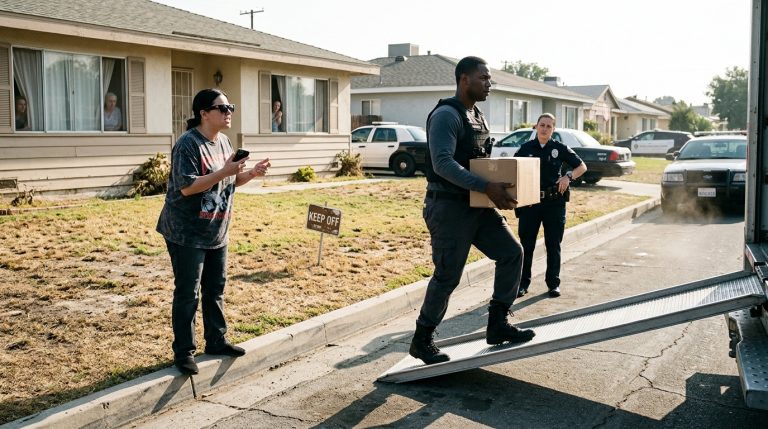
I was at the smoker when I saw it. A yellow moving van, its lights cutting through the dusk, pulling into the driveway of the house at the end of the cul-de-sac. Karen stood on the lawn, her silhouette sharp and diminished against the house that had been her center of gravity for so long. She wasn’t directing a crew; she was standing, for once, in the stillness of her own failure.
She turned and looked toward my property. I didn’t turn away. I stood by the smoker, the carving knife in my hand, the heat of the fire radiating against my face. There was no victory speech, no triumphant shout. There was only the quiet, inevitable reality of a structure that had been built on nothing, finally collapsing under its own weight.
I made the first cut into the brisket. The meat was dark, perfectly crusted, the result of time, heat, and patience. I served the plates, the atmosphere settling into a deep, steady peace.
After the guests left, Sarah and I sat on the porch. The night was cool, the air smelling of hickory and the damp earth of the creek. I looked out at the smokehouse. It stood exactly as it had from the first day—a monument to the land, to my father, to the belief that some things cannot be bought, sold, or codified by a committee.
I reached out and touched the porch rail, the wood worn smooth by a century of Miller hands. I had repaired the section the board had tried to force me to paint, the original, weathered surface preserved. It was a small act of repair, a symbolic closure that felt more significant than any legal filing.
“It’s over,” Sarah said, her head leaning against my shoulder.
“It was over as soon as they tried to argue with history,” I replied.
I watched the last embers of the fire glow in the dark—a small, persistent light that spoke of warmth and endurance. The neighborhood was quiet, the beige houses around us no longer a surrounding sea of surveillance, but a collection of homes beginning, slowly, to breathe again. We had defended the land, and in doing so, we had defended the right to be left alone. I closed my eyes, the weight of the last few months finally dissolving into the quiet, steady rhythm of a peace that was, finally, mine to keep.