The Trident’s Echo: A Quiet Grace Among the Ghost Ships of History
CHAPTER 1: The Gatekeepers Wall
The air on the pier was a thick cocktail of diesel exhaust and the sharp, clean ozone of the sea. It was a texture Arthur knew in his bones, even if seventy years of peace had tried to sand the memory smooth. He stood at the base of the gangway, his heels heavy on the sun-baked concrete, his gaze locked on the USS Dauntless.
“Do you understand me, sir?”
The voice was cold, clipped, and echoed with the frantic, brittle certainty of youth. Lieutenant Rostova stood before him, her blonde hair pulled into a regulation bun so severe it seemed to pull the skin of her face tight. She was a statue of rules. To her, the pier was a theater of control, and Arthur was a rogue variable.
Arthur reached into the pocket of his windbreaker, his fingers brushing the soft, fibrous remains of the letter from the Secretary of the Navy. It was fragile, a ghost of paper. “I have an invitation, Lieutenant.”
Rostova didn’t blink. She didn’t look at the paper he offered; she looked through him, her eyes searching for the standard access pass, the magnetic stripe, the digital validation of existence. When she found none, her jaw tightened.
“Everyone has a story, sir,” she sighed, a sound that carried the weary condescension of someone who spent her life filing humanity into boxes. She glanced at the ensign standing beside her—a young man who looked as though he would rather be anywhere else in the world—and gestured toward the distant, roped-off spectator area. “The public viewing area is that way. This quarterdeck is a controlled space. I suggest you move before I have to involve the master-at-arms.”
Arthur felt the prickle of heat on the back of his neck. It wasn’t the heat of the sun; it was the weight of the crowd’s gaze. They were watching, their phones held up like recording talismans, capturing the spectacle of a frail old man being dismantled by the efficiency of the modern military.
He looked down at his windbreaker. The patch on his chest—the frayed blue circle, the silver trident biting into the storm—seemed to pulse with a low, thrumming vibration. To Rostova, it was an irritant, a souvenir from a garage sale. To him, it was a map of a night where the water turned black as ink and the air tasted of ice and burning diesel.
“I’m afraid I don’t have a current ID,” Arthur said, his voice a low rasp that barely carried over the rustle of the wind.
“Then you are a security risk,” Rostova snapped, stepping into his personal space, her polished boots ringing against the steel. She reached for his arm, her fingers poised to enforce the silence of the law. “Turn around, sir. This is your final warning.”
Just as her gloved hand reached out, the air seemed to shiver. A detail caught Arthur’s eye: a small, jagged tear in the lieutenant’s glove near the thumb, a tiny imperfection in her pristine armor. He wondered if she knew the fragility of the things she held so tightly.
“Lieutenant,” a different voice cut through the air, deeper, rougher, and carrying the unmistakable salt of a career at sea.
Arthur turned to see a Chief Petty Officer striding toward them, his phone pressed to his ear. He wasn’t looking at Arthur; he was looking at the patch, his eyes widening with a sudden, dawning recognition that hadn’t yet touched the lieutenant’s face.
The world of protocols was about to fracture.
CHAPTER 2: The Breaking Point
The air suddenly thinned, replaced by an artificial, sterile pressure that made Arthur’s lungs ache. Lieutenant Rostova’s gloved hand was mere inches from his sleeve. He saw the movement in slow motion—the slight tension in her wrist, the precise, practiced arc of her fingers intended to pin him to the concrete. But the Chief’s voice, a gravel-throated directive slicing through the murmurs of the crowd, hit the space between them like a shockwave.
“Lieutenant, stand down.”
Rostova froze. Her hand hovered in the air, a suspended threat, her fingers splayed slightly as if she were trying to catch a falling object. She didn’t retreat immediately; her training held her in place, a conflict between the order she’d just received and the momentum of her own rigid authority. She turned her head, her jaw set in a line of forced composure, toward the Chief. The ensemble of the pier seemed to hold its breath.
“Chief Miller,” Rostova began, her voice a shade higher than before, “this man is a non-authorized civilian in a restricted quarterdeck zone. Protocol dictates—”
“Protocol is being handled, Lieutenant,” the Chief interrupted, his gaze never leaving Arthur’s jacket. He didn’t look at Rostova. He looked at the trident, his eyes tracing the faded, fraying threads of the blue circle. He looked at Arthur not with the disdain of an officer enforcing a border, but with the quiet, searching intensity of someone looking at a relic that had suddenly begun to breathe.
Arthur felt the phantom weight of the past pressing against his chest. The silence on the pier deepened, no longer filled with the curious whispers of onlookers, but with a heavy, expectant void. The Chief had seen the patch. He didn’t know the full history—the cold, the fire, the way the night air tasted like metallic ruin—but he understood the language of the mark. It wasn’t a souvenir. It was a scar.
“Step back, Lieutenant,” the Chief said, his tone softening to a warning. “You’re making a mistake.”
Rostova’s hand dropped to her side. She looked at the Chief, then at Arthur, her eyes darting between them. She was a creature of the rulebook, and the rulebook had no entry for a man who could command the attention of a Chief Petty Officer just by existing. Her face reddened, the color spreading from her neck to her cheeks, the mask of her smug certainty beginning to show hairline fractures.
Arthur remained still. His heart was not racing; it was rhythmic, steady, a veteran’s pulse. He felt the cold spray of the harbor wind on his face, and for a fleeting second, his vision blurred. He wasn’t on a sun-drenched pier in the present. He was standing on the deck of a rubber raft, his hands raw and bleeding from the grip of a cold, wet rope. The memory was a physical phantom—the smell of cordite, the hollow ache of grief for the men who hadn’t made it back. It was a sensation of such intense, crushing clarity that he had to fight to keep his balance on the solid concrete.
“I am the Officer of the Deck,” Rostova said, her voice strained, struggling to reclaim the narrative. “I have my orders, Chief. If you have an issue with them, you can take it up with the Command Staff after this event. Right now, this man is being detained.”
“Ma’am,” the Chief said, his voice dropping, “the Command Staff is exactly who I’m talking to.”
He held up his phone, the screen dark, but his posture radiating a singular, iron-clad purpose. The crowd had gone deathly silent. The families of the crew, the local dignitaries—they were all watching, sensing that the thin, invisible line between a routine ceremony and a public disaster was fraying.
Arthur felt a strange, detached pity for the young lieutenant. She was so convinced that the world was composed of clear edges and rigid surfaces. She was terrified of the gray, of the unknown, of the possibility that the past could reach out and touch her with a reality that defied her regulations. She didn’t realize that she was merely a character in a much older, much darker story.
“You’re being naive,” Rostova hissed, her gaze darting toward the VIP section where the senior officers were beginning to notice the static. She wasn’t just defending a protocol; she was defending her own vision of the world, her own relevance. “This isn’t a game. This is an active naval vessel.”
“I know exactly what this is,” the Chief replied, stepping between her and Arthur, effectively shielding the old man from further escalation.
Arthur watched the interaction, the subtle shifts in power. He knew that the moment the Admiral arrived, the lieutenant’s entire reality would shatter. He wondered if she would be able to reconstruct it, or if the shards would leave her permanently altered. He leaned back on his heels, the fraying patch on his windbreaker feeling like the only real thing in a world of polished brass and starched uniforms.
“It’s almost time,” Arthur murmured, barely a whisper, yet in the silence, it carried like a bell.
Rostova’s eyes snapped back to him, her expression a mix of frustration and genuine bewilderment. “Time for what, sir?”
Arthur looked at the USS Dauntless, the gray titan looming above them. He didn’t answer. He simply waited. He knew the cost of what was coming. He knew that when the Admiral stepped onto the pier, the truth wouldn’t just be revealed; it would be forced into the light, and there would be no going back to the comfort of the rules.
A low, resonant sound began to build in the distance—the synchronized rhythm of heavy, polished boots against steel. The command staff was moving.
CHAPTER 3: The Admirals Awakening
The vibrations from the steel gangway traveled down into the concrete of the pier, a low, structural hum that Arthur felt through the thin soles of his old shoes. Rear Admiral Thompson descended first, his stride wide and heavy, carrying the gravitational authority of four decades in uniform. Behind him came the ship’s captain and the executive officer, their faces set like granite blocks against the pale morning light. The crowd’s murmuring dissolved completely, replaced by the sharp, metallic snap of standard salutes being rendered across the quarterdeck.
Lieutenant Rostova’s arm sliced through the damp sea air, her posture locking into an impossible, bone-deep rigidity. Her eyes were fixed straight ahead, dilated with a sudden, freezing panic that she tried to mask behind a flawless military bearing. Her jaw remained clenched so tightly that a small muscle in her cheek twitched rhythmically.
“Admiral on deck,” Chief Miller announced, his voice dropping into a low, respectful register as he stepped back, creating a clear path between the arriving high command and the small circle of friction.
Thompson didn’t stop until he was exactly two paces away. The air around him smelled of stale coffee, expensive starch, and the faint, bitter scent of gun oil. He ignored Rostova entirely at first, his gray eyes sweeping over Arthur with an intense, scanning gaze that seemed to take in every line on the old man’s face, the worn fabric of his windbreaker, and the soft, faded blue circle of the patch on his breast.
Arthur didn’t lower his head. He watched the Admiral’s expression shift—not to anger, but to a complicated, guarded mask of calculation. In the high command’s eyes, Arthur saw a sudden, terrifying shift in the narrative. They didn’t see a hero yet; they saw a crisis. The way the captain shifted his weight, the quick, worried glance the executive officer shot toward the roped-off press area where cameras were still raised—it was all there. To them, Arthur was a tragic liability, a fragile old veteran suffering from the slow erosion of memory, who had somehow slipped past outer security with an outdated administrative form letter. A public arrest on the deck of a newly commissioned warship would be an unmitigated disaster for the service’s image.
“Lieutenant Rostova,” the Admiral said, his voice quiet, lacking the booming theatricality of a public reprimand, but carrying a chilling, subterranean weight. “Report.”
Rostova’s throat swallowed hard, the movement visible above her starched white collar. “Sir, the individual bypassed the primary checkpoint without a valid common access card or biometric credential. He is in possession of non-regulated personal correspondence and refused to vacate the controlled quarterdeck space upon direct order. I was preparing to escort him to base security for temporary detainment and medical evaluation, sir.”
The captain stepped forward slightly, his eyes fixed on the letter protruding from Arthur’s pocket. “Did you verify the document’s origin, Lieutenant?”
“It’s a standard veteran outreach template, Captain,” Rostova insisted, her voice tight, fighting to stay within the safe harbor of her regulations. “It lacks an active barcode or verification seal. Given the individual’s age and apparent disorientation regarding security boundaries, I determined that handling the matter through official security channels was the safest course of action for all parties.”
Arthur stood quietly within the center of their collective focus, his fingers resting lightly against the fabric of his jacket. He could feel the underlying logic of their movements. They were circling him like a fragile object that might break and leave a stain on their pristine ceremony. They wanted him gone, not out of malice, but out of a desperate desire to protect the smooth, unblemished surface of their schedule. The decoy reality had locked into place: to them, he was a lost old man who needed to be handled with gentle, quiet diplomacy before the journalists noticed the scene.
The Admiral stepped closer, the gold braid on his visor catching the dull reflection of the clouds above. When he spoke to Arthur, his tone changed, softening into a measured, deliberate patience that one might use with a child or a patient. “Mr. Corrian, is it? I understand you’ve come a long way to see the ship today. It’s a fine vessel. But the lieutenant here is just trying to ensure everyone’s safety. Perhaps my flag lieutenant can escort you to the VIP pavilion? It has a much better view of the harbor, and we can find you a comfortable place to sit.”
The offer was an elegant cage. It was designed to pull him away from the gangway without a scene, to bury the friction in a comfortable corner where the rules wouldn’t be challenged.
Arthur looked at the Admiral’s hand, noting the slight tremor in the older officer’s fingers—a subtle sign of the immense pressure building beneath the calm exterior. He reached into his pocket and slowly drew out the letter, the paper soft as flannel from decades of keeping it close in a cedar chest. He didn’t offer it to Rostova this time. He held it out toward the Admiral, his thumb resting directly over the faded, hand-inked signature at the bottom—a signature that didn’t belong to a bureaucratic template clerk.
“I didn’t come for the view, Admiral,” Arthur said, his voice a dry rustle that seemed to pull the air out of the space between them. “And I’m not lost.”
Thompson didn’t take the letter immediately. He looked at Arthur’s steady, unblinking eyes, then down at the paper. The wind caught the edge of the sheet, revealing a glimpse of the official watermarked bond beneath the surface grime—a detail that Rostova’s rapid scanning had completely missed.
The captain took a half-step back, his eyes narrowing as he caught sight of the Chief Master Chief, who had quietly moved to the edge of the pier, his phone still held low against his thigh, his face pale as he watched his superiors handle a situation that was rapidly sliding away from their control. The seeds of a deeper complication were already taking root in the silence of the harbor.
CHAPTER 4: The Salute
Admiral Thompson did not look at the letter again. He looked at Arthur, and in that gaze, the veneer of diplomatic management evaporated. The Admiral’s posture shifted, his shoulders dropping from the rigid, public-facing arc of a commander to the focused, predatory tension of a man navigating a live tactical situation. He signaled to his aide with a sharp, imperious jerk of his chin.
“Secure the perimeter,” Thompson ordered, his voice no longer the measured, diplomatic rasp he had used seconds prior. It was a blade of ice. “Nobody—and I mean nobody—leaves this area. Lieutenant, stand by.”
Rostova’s face went pale. The command hit her like a physical blow. She stood frozen, her gloved hands still at her sides, her world of orderly rules collapsing under the weight of an authority she didn’t understand. She looked at Arthur, her eyes searching for some sign that this was a mistake, a prank, or a cruel delusion, but the old man’s face was a map of calm stone.
Thompson turned, his boots thudding against the steel ramp as he strode back up toward the Dauntless, his command staff scrambling in his wake. Arthur didn’t move. He stood on the concrete, the wind whipping the collar of his windbreaker, his eyes fixed on the gray hull. He knew what was happening in the bridge of that ship. He knew the sensation of an old, locked door being forced open—the flicker of secure databases, the decryption of files that had been sitting in the dark for seventy years, the sudden, sharp realization of what he truly represented.
Minutes crawled by, each one thickening the air with anticipation. The crowd, sensing the tectonic shift in the mood, pulled back. The families and naval enthusiasts stood in a tight, uneasy knot, their phones silent now, their focus entirely on the man in the worn windbreaker. Arthur felt the eyes of the crowd, the prickle of their uncertainty, but he felt something else, too—a profound, aching resonance. He was a bridge between two worlds: the loud, digital, hyper-efficient present and a quiet, submerged history written in salt and sacrifice.
Suddenly, a resonant, metallic tone echoed from the ship’s internal speaker system—a warning hum that heralded an announcement. But no announcement came. Instead, the gangway gate, which had been locked shut by Rostova’s command, buzzed open.
The Admiral reappeared at the top of the ramp. He wasn’t alone. He walked with a singular, reverent purpose, the ship’s captain and the executive officer flanking him, their expressions stripped of the annoyance and impatience that had defined them only moments before. They didn’t walk; they descended with a rhythmic, measured cadence that turned the ramp into an altar.
Thompson stopped precisely one pace in front of Arthur. The silence was absolute. Even the seagulls circling the harbor seemed to have hushed, the world narrowing down to the space between the Admiral’s polished boots and Arthur’s worn sneakers.
The Admiral’s hand moved with a grace that felt like a choreography of decades. He brought his right hand to his brow in a salute so sharp, so devastatingly precise, that it seemed to slice the very air. It was a gesture of total, unadulterated acknowledgment. Behind him, the captain and the executive officer mirrored the motion, a wall of gold-braided authority rendering an honor that left the crowd reeling.
Arthur felt the weight of his own arm as he lifted it. He didn’t offer a military salute; he gave a slow, respectful nod, his hand resting briefly against the fabric of his jacket.
“Mr. Corrian,” Thompson said, his voice thick, carrying the unmistakable rasp of suppressed emotion. “I am sorry for the delay.”
The Admiral turned slightly, his gaze sweeping the pier, catching the horrified, shaking form of Lieutenant Rostova. “For those of you who don’t understand what you are seeing,” the Admiral boomed, his voice vibrating with a sudden, searing intensity, “this man is not a security risk. He is the architecture of our survival.”
He reached out, his hand hovering near Arthur’s shoulder but not touching him, as if Arthur were something sacred. “Operation Sea Serpent. Spring, 1952. While the world looked the other way, twelve men went into the dark so that the light could keep burning. And tonight, we find that the last of them is still standing, reminding us of the cost.”
The crowd erupted into a low, stunned murmur, then a heavy, reverent silence. Rostova looked as if she were going to faint. The reality of the situation had finally pierced her armor: she hadn’t been managing a security risk; she had been trying to clear away history with a broom. The humiliation was total, but the weight of it was something far greater than mere professional embarrassment. It was the weight of a missed connection, the crushing awareness of her own profound, blinding ignorance.
Arthur watched her, his heart heavy with a singular purpose. He had not come to shame her. He had come to ensure that the memory of the eleven men who hadn’t made it back—the radio man from Ohio, the navigator, the boy who dreamed of the light—would be recognized, not as a casualty of training, but as the foundation of the very ship that loomed above them.
“Admiral,” Arthur said, his voice cutting through the ringing silence. “The ship is waiting.”
CHAPTER 5: The Aftermath
The transition from the public theater of the pier to the sterile, pressurized environment of the flagship’s administrative office was a blur of harsh lighting and the rhythmic thrum of the ship’s engines—a heartbeat of steel that seemed to mock the softness of the world outside. Lieutenant Rostova walked behind the Admiral, her boots feeling weighted by lead. Every step was a calculation of loss. She had entered the morning with a map of the world that was simple, legible, and rigid; now, that map was nothing more than ashes.
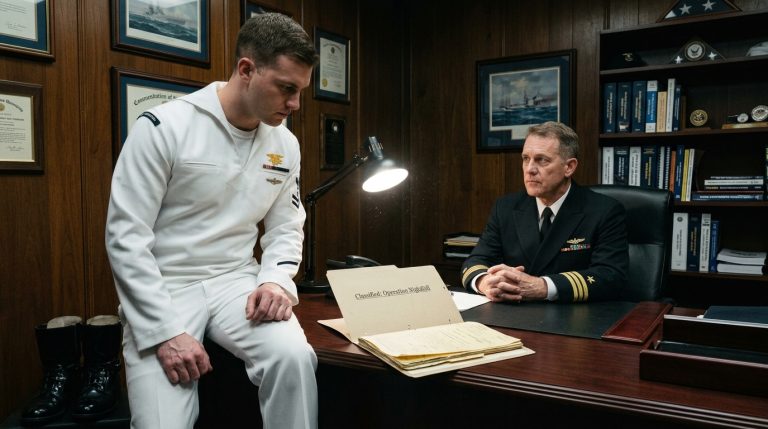
Inside the flag captain’s office, the air was stagnant, tasting of ozone and industrial cleaner. Admiral Thompson took his place behind the mahogany desk, a relic of tradition in a room dominated by flat-screen monitors displaying live status reports of the ship’s commissioning. He didn’t sit. He remained standing, his posture a taut wire of contained fury and professional disappointment.
“Lieutenant,” he said, his voice quiet, which was somehow far worse than the booming authority he had used on the pier. “You had a direct line of sight to a piece of history, and you treated it like a nuisance. I want you to explain to me, in detail, what you were thinking when you placed your hand on that man’s arm.”
Rostova stood at attention, her back aching from the strain of holding her posture. “Sir, my assessment was based on the standard security protocols for a controlled event. I observed an individual who lacked proper documentation, displayed signs of distress, and was disrupting the flow of the ceremony. I believed I was acting in the best interest of the vessel’s security.”
“Security,” the Admiral repeated, the word tasting like bile. He walked around the desk, his shadow stretching across the linoleum floor. “You talk about security, but you failed to grasp the most basic tenet of the uniform you wear. You are not a gatekeeper, Lieutenant. You are a representative of an institution built on the backs of men like Arthur Corrian. If you cannot discern the difference between a threat and a foundation, then you have no business occupying the position of Officer of the Deck.”
The sting of his words was worse than any formal reprimand. It was a rejection of her core identity. She had spent her entire career turning herself into a model of efficiency, a mirror of the regulation, and here she was being told that her very efficiency was a failure of the spirit.
“I didn’t know, sir,” she whispered, the confession feeling like a jagged stone in her throat.
“You didn’t look,” Thompson corrected, his voice hardening into a blade. “That is the failure. You looked, and you saw only what you were trained to see. You looked for the missing pass, the wrong uniform, the incorrect ID. You never once looked at the man. You never once considered that the history of this ship was walking in front of you.”
He leaned closer, the gold oak leaves on his shoulder insignia catching the harsh overhead light. “The Secretary of the Navy didn’t invite Mr. Corrian to this ceremony because he needed a photo opportunity. He invited him because the service is losing its memory. We are becoming so efficient at the mechanics of war and the logistics of peace that we are forgetting the human cost that makes it all possible.”
The silence in the room stretched, punctuated only by the distant, muffled sound of the crew moving in the corridors. Rostova felt a profound, aching cold in her chest. She had wanted to be a guardian; she had succeeded only in becoming an obstacle.
“Your career is not over, Lieutenant,” the Admiral said, his voice shifting slightly, losing some of its biting edge. “But your current path is. I am assigning you to a new command-wide training initiative. You will spend the next six months reviewing the archives of naval special operations. Every mission, every loss, every individual sacrifice that was buried under the red tape of the Cold War. You will catalog them, you will document them, and you will learn the names of the men who gave their lives so you could stand on this deck today.”
He returned to his seat and began typing on his computer, the finality of his action signaled by the rhythmic tapping of the keys. “You have until 0800 tomorrow to prepare your initial assessment of Operation Sea Serpent. I want to see that you understand what you missed today. You are dismissed.”
Rostova turned, her movements wooden, her world tilted on its axis. She walked out of the office, the sterile, bright corridor stretching out before her like an endless tunnel. She had come here expecting a reprimand; she had received a haunting.
As she reached the gangway, she caught a glimpse of Arthur Corrian standing on the pier below. He was speaking with the ship’s captain, his hands moving with a gentle, deliberate grace as he described something in the distance. He wasn’t looking at the ship anymore; he was looking at the harbor, his gaze fixed on the dark, churning water of the channel.
She paused, watching him. He looked fragile, yes—his windbreaker thin, his hair white and sparse—but there was a profound, quiet strength in his posture that she hadn’t noticed before. He was a survivor of a world that had tried to erase him, and yet here he was, still standing.
For the first time in her life, she felt a genuine, desperate desire to know—not to document, not to audit, but to understand. She turned away from the gangway and walked toward the archives deck, her pace slow and deliberate. She had a long night ahead, and for the first time, she was afraid she might not be able to bear the weight of what she was about to learn.
CHAPTER 6: The VFW Hall
The Tuesday afternoon was gray, a muted, rain-drenched affair that turned the city streets into slick, mirrored corridors. Inside the VFW hall, the air was still, heavy with the scent of floor wax, stale beer, and the dry, lingering dust of decades. Arthur sat in his customary booth near the back, his fingers wrapped around the ceramic mug of his cooling coffee. The room was mostly empty, the quiet broken only by the rhythmic hum of a refrigerator and the soft, steady patter of rain against the single, high window.
The door creaked, a thin blade of damp, cool light slicing across the floorboards. Eva Rostova stepped inside. She was dressed in civilian clothes—a simple wool coat, dark trousers—and without the starched collar and the severe geometry of her uniform, she looked startlingly young. The brittle, aggressive certainty that had defined her on the pier had evaporated, leaving behind a sharp, raw vulnerability. She clutched a thick, hardcover volume to her chest: The Complete History of Naval Special Warfare.
She scanned the room, her gaze finding him in the back booth. She hesitated, her hand gripping the edge of her coat, before walking toward him with a slow, deliberate pace. Her movements lacked the military precision he had seen before; they were tentative, laden with the weight of the last twenty-four hours spent in the archives.
Arthur watched her approach, his expression unchanged, a small, welcoming crinkle forming at the corners of his eyes. “Lieutenant,” he said, the old habit of address slipping out.
She corrected him with a faint, tired smile. “Eva, sir. Please.” She stopped at the edge of his table, the book resting against her ribs like a shield. “I’ve spent the night in the records room. I’ve read the reports, the declassified logs, the accounts of the harbor defenses in 1952. I… I saw the names.”
“Sit,” Arthur replied, gesturing to the empty chair across from him.
She sat, her movements stiff. She placed the book on the table between them, the spine cracked and worn from heavy use. She looked up at him, her eyes bright with a mixture of shame and a newfound, desperate resolve. “I didn’t understand the cost. I saw the rules, but I never saw the men. I saw the institution, but I never saw the lives that held it up.”
Arthur reached out, his hand—spotted with age, the knuckles thick and gnarled—resting gently on the cover of the book. He didn’t offer a platitude. He didn’t tell her it was alright, because the cost of the mission hadn’t been alright; it had been a tearing of the world that never fully mended.
“The water is always cold, Eva,” Arthur said, his voice a low rasp that filled the small space of the booth. “And the fear? It stays the same, regardless of the uniform. You weren’t a bad officer. You were just a fast one. You were so busy looking at the horizon that you forgot to look at the ground you were standing on.”
“How did you do it?” she asked, her voice barely a whisper. “How did you go in, knowing that no one would ever know you were there, that if you died, it would be marked as a training error?”
Arthur took a long, slow sip of his coffee, the warmth spreading through his chest. He looked past her, toward the rainy window, toward a memory that had haunted him for seventy years. “We didn’t go in for the history books. We didn’t go in for the parades or the medals. We went in because the man beside you was afraid, and you were the only thing keeping him from drifting into the dark. That’s the only truth that survives the decades. The mission is just a story. The man beside you is the reality.”
He pulled the book toward him and reached for the pen she offered. He didn’t sign his name on the sterile, empty title page. He flipped through the thick, glossy paper, past the maps of Wonsan Harbor and the diagrams of cruiser hulls, until he reached a black-and-white photograph of a team of twelve men, their faces obscured by shadows and salt spray.
In the margin, he wrote in a precise, shaky hand: For Eva. Never forget the sailors, not just the ships.
He pushed the book back to her. She looked at the inscription, her eyes welling up, a singular tear tracing a path down her cheek. The weight of the moment felt complete, a circle closing in the quiet, dim hall. The institutional memory of the Navy had been fractured by her ignorance, but it was being knit back together in the shared silence of this booth, repaired by the very vulnerability she had tried so hard to eliminate.
“I wanted to apologize again,” she stammered, her voice catching. “For the pier. For everything.”
Arthur shook his head. “You apologized when you walked through that door. Learning is the only apology that matters.” He leaned forward, the shadows in the booth deepening. “Now, let me tell you about a man named Danny. He was the best radio man I ever knew, and he was absolutely terrified of the dark. We were in a rubber boat, the waves were hitting us like sledges, and he was humming a song under his breath to keep his teeth from chattering. It was a stupid song, something about a farm in Ohio…”
As he began to speak, the rain continued to drum against the window, a rhythmic, steady pulse. For the first time, Eva wasn’t auditing; she wasn’t processing; she was listening. She sat back, her posture relaxing, her attention focused entirely on the old man’s voice. The ship was out there, gray and looming, but in the VFW hall, the history wasn’t just a record—it was a living, breathing connection, a shared burden being passed from a witness of the past to a steward of the future. The tension of the last two days settled into the wood of the table, turning into the quiet, somber peace of a debt finally acknowledged.