The Weight of Silence: A Veteran’s Measured Justice Against a City of Apathetic Shadows
CHAPTER 1: The Sidewalk Calculus
The motorcycle’s chrome was blinding, a sharp, polished weapon against the gray noon light. Walter didn’t see the bike until his jacket caught the handlebar. The impact was a jar against his shoulder, a momentary friction that set the world off-balance. Then came the strike. It wasn’t a brawl; it was a singular, efficient act of violence. The back of the biker’s hand connected with his cheek with the sound of a dry branch snapping.
Walter hit the pavement hard. His cane skittered across the asphalt, the metal tip clinking against the gutter like a dropped shell casing. He stayed down for a heartbeat, his vision fracturing into shards of grey and black. He didn’t reach for his face; he didn’t check for blood. He reached for the bread.
It was a senseless, instinctual movement. The paper bag had torn, and the loaf was spilling into the grime. He gathered the crumbs, his fingers trembling—not from the blow, but from the realization of how clean the street was, and how invisible he had become. He could hear the laughter from the bar, a low, guttural sound that seemed to vibrate in his chest, more damaging than the fall itself.
He looked up. A woman paused across the street, her eyes darting to his before snapping back to her phone. A man in a suit stepped around him, his stride uninterrupted, his gaze fixed on the horizon. They didn’t see a veteran; they saw a nuisance, a fraying thread on a perfectly tailored city.
Walter pushed himself up, his knees grinding against the concrete. The pain was sharp, immediate, a reminder that the body was no longer the machine it once was. He leaned against a bus pole, the cold metal biting through his sleeve. He breathed in, steadying the rhythm of his heart, forcing the adrenaline to serve his focus rather than his fear.
He didn’t look at the biker. He looked at the shadows lengthening under the bar’s awning. He felt the weight of the phone in his pocket—the cracked screen, the single, designated line. He wasn’t waiting for an ambulance; he was waiting for the realization to dawn on the street that they had struck the wrong shadow. He adjusted his jacket, wiping a smear of blood from his lip onto his cuff, and for a fleeting second, the world felt too quiet, as if the air itself was holding its breath, waiting for the ripple he was about to set in motion.
He tapped the button. One touch. A silent, invisible bridge pulled taut between him and a horizon that didn’t know it was about to burn.
CHAPTER 2: The Signals Echo
The phone in Walter’s hand felt heavier than it had a moment ago. The screen flickered, the single bar of service wavering like a heartbeat on the verge of fading. He didn’t move. He kept his hand pressed to his ear, listening to the rhythmic, oceanic static of the encrypted line. There was no dial tone, no ring—just the sterile, high-frequency hum of a connection being routed through servers that didn’t exist in any public database.
Across the street, the bikers continued their mockery, their laughter now punctuated by the occasional clatter of a beer bottle against the sidewalk. They were entirely oblivious to the fact that the geometry of their world had just shifted. Walter watched them through the narrow gap in the crowd, his gaze detached, clinical. He wasn’t looking at them as men anymore; he was cataloging their positioning, their proximity to the curb, the way the lead biker—the one with the heavy, callous hands—leaned too far back on his heels, overconfident in the silence of the onlookers.
The static in the phone sharpened. A click, precise and metallic, sounded in his ear.
“Confirmed,” a voice said. It wasn’t his son’s. It was the detached, flat tone of an operations coordinator. “Coordinates verified. Eagle 6 is inbound. E.T.A. twelve minutes.”
“Understood,” Walter murmured, the word barely catching the air before the line went dead.
He tucked the phone back into his coat pocket. The movement was slow, deliberate. He felt the cold iron of the bus stop pole beneath his fingers, the rough, flaking paint offering a tactile anchor in the sudden, suffocating stillness. He had sent the signal, but he hadn’t prepared for the physical ache that followed—the realization that he had stepped off a cliff and there was no going back.
He sat back on the bench, his spine rigid. His knee throbbed, a dull, pulsing heat where he’d struck the pavement, but he pushed the sensation into a corner of his mind, locking it away. He needed to be still. He needed to be the ghost in the machine.
A woman walked past, her heels clicking sharply on the concrete—a crisp, rhythmic sound that cut through the muffled roar of the city. She didn’t look at him. She couldn’t see the unseen pulse of the helicopters currently adjusting their vector hundreds of miles away, nor could she hear the quiet, systematic mobilization of men who considered this street their new theater of operations. She was merely walking home, oblivious to the fact that the air around her was growing taut, charged with the static electricity of an impending storm.
Walter checked his watch. The second hand swept past the twelve, its movement jagged. He was a veteran of many fronts, yet the waiting felt different here. In the service, the danger was external, a visible entity you could track, aim at, and contain. Here, the danger was indifference. The danger was the way the crowd had looked at him—not with hatred, but with a total, absolute lack of recognition. He was a remnant, a relic of a time when the uniform meant something, and he was currently sitting on a bench in the middle of a city that had forgotten how to look up.
He felt a sudden, sharp draft, a shift in the wind that smelled of ozone and dry, metallic heat. He looked toward the treeline at the edge of the park. It was subtle—a ripple in the leaves that didn’t match the gentle breeze. He knew that movement. It was the signature of a perimeter being secured.
He didn’t need to see them to know they were there. The “Eagle” protocol was not merely a call for help; it was a deployment of a doctrine. His son had inherited more than just the rank; he had inherited the philosophy that a veteran was a protected asset, a fundamental pillar of the society they had sworn to uphold. If that pillar was struck, the foundation reacted.
Walter felt a flicker of something he hadn’t expected—a surge of pride, quickly tempered by the cold, tactical reality of the situation. He knew his son. He knew that the arrival of the Blackhawk wouldn’t just be an extraction; it would be a demonstration. And demonstrations, by their very nature, were meant to be witnessed.
He gripped the head of his cane, his knuckles turning white. The street was quiet again, the bikers having retreated into the dim, amber light of the bar. The silence was heavy now, a physical pressure that squeezed the air from his lungs. He was the bait, and the trap was closing, but for the first time in twelve years, he felt the heavy, comfortable weight of a purpose that wasn’t just survival. He was the anchor, and the tide was coming in fast.
CHAPTER 3: The Descent of Thunder
The sound started as a vibration in the soles of Walter’s boots, a low-frequency hum that seemed to emanate from the pavement itself. It was the sound of air being punished. Walter didn’t look up immediately. He kept his hands clasped over the head of his cane, his eyes fixed on the shop window across the street. In the glass, he saw the distorted reflection of the sky, a darkening canvas that promised an unnatural weather front.
The thrumming intensified, shifting from a subtle tremor into a rhythmic, percussive pulse that made the loose pane of the bus shelter rattle in its frame. People on the sidewalk stopped. The laughter from the bar died instantly, choked off as if a hand had been clamped over the establishment’s collective throat.
Memory, sharp and jagged, pulled at Walter’s focus. He wasn’t on Broad Street anymore. He was back in the heat of 1970, the air thick with the smell of burning rubber and kerosene, the sound of a Huey thundering overhead as it dropped into the fire to drag his squad out of the jaws of hell. The intensity of the memory was so visceral that he blinked, expecting to see the smoke of Hugh City instead of the sterile, late-afternoon haze of a quiet suburban town.
The sound grew to a roar, a deep, earth-shaking thud that vibrated in the marrow of his bones. Then, the sky over the tree line darkened. A shadow, massive and predatory, eclipsed the sun, sweeping across the rooftops of the shops with the grace of a raptor. The Blackhawk descended, its rotors creating a localized hurricane of dust and debris that forced everyone on the street to shield their eyes.
Walter didn’t flinch. He watched as the aircraft flared, hovering just long enough for the tactical team to spill out like a synchronized, black-clad current. They didn’t move like men; they moved like a single, kinetic organism.
They hit the pavement without a sound, weapons slung low, scanning the horizon with the cold, measured precision of hunters. Within three seconds of the bird touching down on the empty field behind the shops, the entire block had been effectively sealed. No words were exchanged. There were no shouts, no commands given in the air—just a seamless, fluid transition from the sky to the street.
The bartender, who had been laughing a few minutes prior, now stood in the open doorway of the bar, his face drained of color, his hands frozen at his sides. He watched as the tactical team moved, their boots hitting the asphalt with the synchronized thud-thud of a marching cadence.
Walter felt the weight of their gaze as they swept the area. It wasn’t a patrol; it was a cleanup operation. His son, the Commander, stepped from the helicopter last. He didn’t rush. He walked with a heavy, deliberate pace, his posture radiating a command that required no voice. He looked toward the bench.
The connection between them was silent, yet absolute. Walter saw the way his son scanned the biker group—a cold, fleeting evaluation of a threat that had already ceased to exist. The Commander’s face was a mask of granite, his eyes shielded by the brim of his tactical cap, but Walter knew the look. It was the assessment of a leader who had been waiting for a reason to prove that his unit was more than just a set of specialized skills—they were a living, breathing testament to the values his father had instilled in him.
The street, once a theater of indifference, had become a staging ground. As the Commander walked toward him, the crowd retreated, stepping into the shadows of the doorways. Nobody wanted to be in the line of sight of the men who had just descended from the clouds. The biker gang, trapped in the semicircle of the unit’s formation, looked small—their chrome machines now mere toys against the tactical gear of the soldiers.
Walter slowly began to rise. He used the cane, his movements stiff and measured, the physical pain in his knee a distant, manageable nuisance. He didn’t look at the bikers. He looked at his son, watching the way he navigated the space, the way his shoulders stayed squared, the way he occupied the center of the street with a natural, inevitable authority.
The test was underway. The extraction protocol was the mechanical aspect of the operation, but the true objective—the leadership assessment—was beginning to unfold. Would his son see this as a show of force, or as a duty to be performed with the surgical restraint of a professional? Walter saw the Commander pause, his hand lifting just slightly—a signal to his men to hold their position. The restraint was the first sign. His son was not here to conquer; he was here to reset the balance.
As the distance between them closed, Walter felt the air shift again. The hum of the idling Blackhawk behind them served as a constant, thundering backdrop to the silence of the street. It was a symphony of power, directed at a singular point of failure: the men who had dared to strike a man who had already given everything.
CHAPTER 4: The Semicircle
The gap between Walter and the Commander closed with a slow, agonizing deliberation. Every step the Commander took was calibrated, his boots finding purchase on the asphalt with a metallic precision that echoed off the brick facades of the street. Walter stood his ground. He didn’t offer a hand, and he didn’t offer a salute. He simply watched, his grip on the cane tight, his knuckles standing out as white ridges against the weathered leather of his gloves.
The street felt smaller now. The unit had formed a perfect, seamless semicircle, a barrier of matte-black tactical gear and cold, unblinking intent. They had effectively quarantined the bikers, turning the raucous group into a collection of nervous, shifting figures who no longer knew where to look. The lead biker—the one who had struck Walter—was still standing, though his posture had fundamentally collapsed. The bravado that had fueled his earlier violence had evaporated, replaced by a twitching, frantic energy that betrayed his total lack of preparedness for this level of response.
The Commander stopped three paces from Walter. He stood at ease, yet his posture remained a razor-sharp profile against the fading daylight. He didn’t look at the bikers. He didn’t look at the crowd that had begun to press against the edges of the perimeter, their phones held up like defensive totems. He looked only at his father.
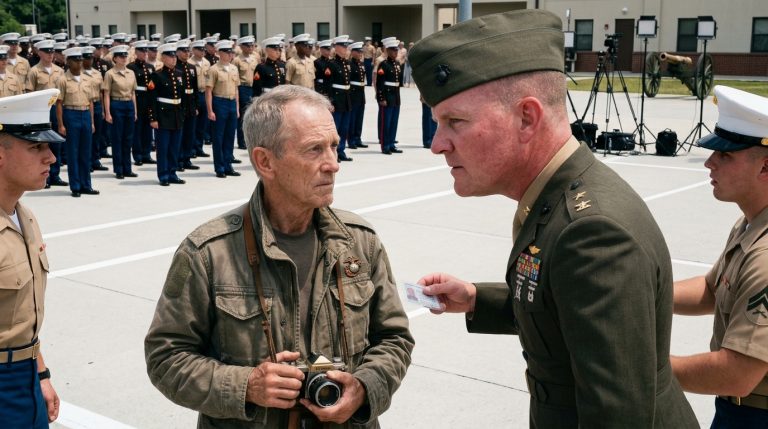
“Dad,” the Commander said. His voice was steady, a low, controlled baritone that carried over the thrumming rotors behind them without the need to raise his volume. “You’re bleeding.”
Walter felt the warmth on his cheek, the dry, crusty sensation of congealed blood. He reached up, his movements stiff, and wiped his lip with a calloused thumb. He didn’t look at the smear of red. “It’s just skin, son. I’ve had worse.”
The Commander’s jaw tightened—a microscopic shift in his expression that only Walter would recognize. It was the same look the boy had worn thirty years ago when he’d scraped his knee but refused to cry in front of the other neighborhood kids. It was a look of suppressed, iron-willed protective instincts.
“Which one of them?” the Commander asked. He still didn’t turn his head. He didn’t need to. He possessed the spatial awareness of someone who had learned to hunt in the dark.
Walter nodded toward the lead biker. The man flinched, a sharp, involuntary jerk that sent his hand toward the handle of his own motorcycle. He stopped mid-motion, his fingers freezing as he felt the collective, predatory focus of the unit shift toward him. It was a pressure so heavy it seemed to physically push the air out of the man’s lungs.
The Commander finally turned. He didn’t move his whole body; he moved only his head, his eyes tracking with the slow, deliberate movement of a turret. The silence that followed was total. The crowd, the wind, the very city itself seemed to hold its breath.
“You chose a target you didn’t understand,” the Commander said, his voice flat, devoid of emotion or inflection. It wasn’t a threat; it was a clinical statement of fact. “You saw an old man. You saw a jacket. You saw an easy point of friction.”
The biker opened his mouth, his throat working convulsively, but no sound came out. The arrogance that had characterized his earlier actions was gone, replaced by a terrified, infantile realization that he had walked into a trap he could never hope to dismantle. He looked to his peers, but they were silent, statues of fear, their hands raised in instinctive, pleading gestures.
“I didn’t come here to debate you,” the Commander continued, his tone remaining terrifyingly calm. “I came here because my father is a veteran of three deployments and two citations. He has endured the violence of worlds you couldn’t imagine existing, and he did so in silence. You decided that silence was weakness. You were mistaken.”
Walter watched his son closely. He was looking for the crack—the moment where the Commander might move from calculated command into pure, unbridled aggression. If the Commander allowed his own anger to dictate the resolution, he would fail the test. The objective was not revenge; the objective was the reclamation of a moral order that had been discarded by the mob.
The Commander’s hand remained at his side. He didn’t reach for his sidearm. He didn’t clench his fist. He was the picture of surgical, detached control. He was operating within the parameters of a leader who understood the weight of his own power. Walter felt a slow, rhythmic warmth spread through his chest—not of comfort, but of vindication. The boy had learned. The boy had mastered the hardest lesson of all: that true strength is not the ability to destroy, but the discipline to refuse to do so until the necessity is absolute.
“Step away from the vehicle,” the Commander ordered.
The biker didn’t hesitate. He took two steps back, his boots stumbling on the uneven concrete. He looked ready to weep, his face pale, his frame shaking. The Commander signaled to one of his men with a subtle tilt of his chin. The soldier moved forward, his motion fluid and silent, and secured the biker’s wrists with a clean, efficient click of plastic restraints.
Walter watched the exchange with a detached, analytical interest. He wasn’t the victim anymore; he was the observer, the architect of the moment, watching the machinery of his son’s unit execute a protocol that had been years in the making. The scene was playing out exactly as the logic of the situation demanded: with consequence, with order, and with a chilling, surgical finality that silenced the very street that had once ignored his pain.