The Echo of the Creed: A Journey from Borrowed Lies to Genuine Human Grace
CHAPTER 1: THE WEIGHT OF THE TAB
The Pinewood Diner smelled of burnt coffee and cheap, reliable hope. It was 7:15 a.m., the hour when the world was supposed to make sense, but for Brent Holloway, the morning was already fraying at the edges. He sat at the counter, his shoulders broad in a black T-shirt that felt tighter than it had last week. The gold embroidery of the Ranger tab over his left chest caught the low light of the North Carolina sun. It looked perfect. It was supposed to look perfect.
He waved his coffee cup, the ceramic clinking against the Formica. “Second Battalion, don’t even get me started,” he said, his voice loud enough to anchor the entire room to his orbit. “Some things, you just don’t talk about. You carry them.”
Denise, the waitress, offered the practiced, polite smile that served as her primary armor. “That’s something, hon,” she murmured, already moving to the next customer.
Brent puffed his chest, feeling the familiar, numbing comfort of the lie. It was a soft, warm blanket. It kept the real world—the strip mall, the extended warranty quotas, the empty apartment—at a distance.
Then, from the back booth, a sound cut through the air. It was the soft, rhythmic click of a wooden cane hitting the linoleum. Henry Dawson, a man whose skin looked like weathered parchment and whose eyes held the clarity of a winter sky, set down his cup. The movement was slow, deliberate, the action of a man who had decided the time for avoiding the inevitable had run out.
“Excuse me, son,” Henry said. His voice wasn’t loud, but it possessed a weight that made the air in the diner feel denser.
Brent turned, his smile already primed—wide, friendly, and carefully curated.
“I wonder,” Henry continued, his gray eyes pinning Brent in place, “if you would do an old man a favor and recite the third stanza of the Ranger Creed for me. Just the third. I have not heard it spoken in a long time, and I would consider it a kindness.”
Brent felt the sugar dispenser in his hand grow cold. The smile on his face didn’t falter, but he felt the ground beneath his stool shift. He had heard the phrase “Ranger Creed” in movies. He knew the shape of the legend. But as he looked at the old man—at the way he sat with his hands folded, not with aggression, but with a terrifying, quiet patience—Brent realized he had no words to answer. He didn’t know the first line, let alone the third. He was a man wearing a costume made of air, and for the first time in fifteen years, the wind was picking up.
CHAPTER 2: THE UNRAVELING OF THE MASK
The silence was the first thing to break. It didn’t crack; it shivered. Brent’s hands, still gripping the sugar dispenser, felt suddenly alien, as if they belonged to a stranger. He looked at the old man—Henry—who sat with his hands folded in a way that suggested he had spent decades practicing the art of waiting.
Brent’s mouth moved, but the practiced, smooth lies he usually deployed—the half-truths about Iraq, the vague mentions of Bravo Company—stuck in his throat like dry ash. He looked toward the kitchen door, hoping for a distraction, a clatter of dishes, a shout from Pearl. But the diner had tuned itself to the frequency of this booth. Even the construction workers had gone quiet, their breakfast forgotten, their eyes fixed on their plates as if studying the grease patterns.
“Sir,” Brent began, his voice higher than he intended. He forced a laugh, but it came out hollow, a brittle sound that died before it could reach the back of the room. “I think there’s been a misunderstanding. I’m just trying to have my breakfast.”
Henry didn’t lean forward. He didn’t raise his voice. He simply held that gaze, that pale, clear gray intensity that stripped away the layers of Brent’s carefully constructed identity. “I’m not in a hurry, son,” Henry repeated, his tone devoid of malice, which somehow made it infinitely more terrifying. “I asked you for the third stanza of the Creed. If you can’t give me the words, I’ll give them to you. But we both know why you can’t.”
Brent felt a cold spike of panic, a physical phantom of a memory that wasn’t his own. For a split second, he felt the oppressive heat of a barracks, the smell of floor wax and sweat, and the crushing weight of failure—a sensation he had spent fifteen years burying under a thin veneer of gold-embroidered cotton. His vision blurred, the diner’s faded high school football photos oscillating on the wall. He wasn’t in a booth in North Carolina anymore; he was suspended in the spotlight of the old man’s judgment.
“You’re a long way from the truth, Brent,” Henry said, the use of his name landing like a physical blow.
Brent’s grip on the sugar dispenser tightened until his knuckles went white. “How do you know my name?”
“I know the look of a man who has forgotten how to be himself,” Henry replied. He reached out, his hand—spotted, scarred, and steady—resting momentarily on the table. “You aren’t a bad man. I see that. But you’re a man who is starving, and you’ve chosen to feed on things that aren’t yours. It doesn’t nourish you. It just makes the hunger worse.”
Brent felt his chest heave. He realized with a jarring clarity that he couldn’t leave. He couldn’t just stand up, walk out to his car, and drive back to his apartment. The air in the diner was being vacuumed out by the old man’s presence. He looked at the coffee cup in front of him, the dark liquid rippling with the slight tremble of the table.
“I don’t know what you want from me,” Brent whispered, his bravado finally dissolving into genuine, jagged fear.
“I want the truth,” Henry said. “Not for me. I don’t need your history. I want it for you. Look at me, Brent. Really look at me.”
Brent finally raised his eyes. He saw the weather-creased face, the accumulation of decades of patience, and he saw the profound, quiet sadness behind the eyes—a sadness that mirrored his own, but carried a weight of substance, of lived, earned experience. There was no judgment in that stare, only an invitation to a place Brent had never dared to go: the place where he had to admit he was nothing.
The diner continued to hum in the background, a distant, muffled existence. Outside, a truck rumbled past on the highway, its vibration rattling the silverware in the dispenser, but inside the bubble of the booth, time had stopped. Brent felt the threads of his fifteen-year charade snapping one by one. The Ranger tab on his chest felt like lead. The stories about the extended warranties, the fake sales conferences, the women he’d impressed—they all seemed like faded, flickering projections on a cinema screen that had just been cut.
“I tried,” Brent said, his voice cracking. He didn’t know why he said it. He didn’t know if he was talking about the enlistment he failed twenty years ago or the life he had botched since. “I tried to be… I just wanted…”
“I know,” Henry interrupted gently. “You wanted to belong to something that mattered. But you chose the wrong way to get there. You chose the costume instead of the character.”
Henry shifted in his seat, the wooden cane sliding slightly on the linoleum. “You’re going to sit here,” Henry said, his voice dropping to a directive that allowed for no argument. “You’re going to finish your coffee. And then, you’re going to tell me exactly how you got to this point. Not the stories. The truth. Because if you walk out that door as you are right now, you will never be free. You’ll just be a man waiting for someone else to ask for the third stanza.”
Brent didn’t move. He felt the cold sweat prickling at his neck. He wanted to run, to sprint into the parking lot, to get into his car and drive until the mountains hid him, but the old man’s words had locked him into place. He looked at the old man—at the steel-gray hair and the steady, unhurried posture—and he knew, with a sudden, sinking dread, that he was at the threshold of the most terrifying moment of his life.
He looked down at his hands again. They were shaking. He reached for his coffee, his movements uncoordinated and raw. The porcelain clinked against his teeth as he took a sip, the bitter heat doing nothing to stop the freezing sensation spreading through his chest. He was being seen, truly seen, for the first time in fifteen years, and the exposure was a burning, searing agony.
“Okay,” Brent breathed, the word hanging in the silence like a confession. “Okay.”
Henry leaned back, his expression softening just a fraction, a barely perceptible loosening of the tension in his shoulders. He didn’t smile, but he looked satisfied. “Good,” he said. “Now, tell me. Start from the beginning. Not the beginning you tell in bars. The real beginning.”
Brent looked toward the window. The parking lot was empty, save for his own car—a mundane, unremarkable vehicle that suddenly felt like the only real thing left in his world. He closed his eyes, the smell of old upholstery and stale diner grease filling his senses, and for the first time, he let the mask slip, let the weight of the last fifteen years collapse inward, forcing him to face the hollow, jagged center of his existence.
CHAPTER 3: THE FIRST SHEDDING
Brent didn’t look at the diner’s exit. He looked at the Formica tabletop, where the scratches in the white laminate seemed to map out his own confusion. Henry sat perfectly still, his hands resting on the wooden cane he had leaned against the booth. The old man’s presence was a steady, immovable force, like a bulkhead in a ship that had already begun to take on water.
“Start,” Henry said, his voice quiet, lacking any urge to hurry.
Brent opened his mouth, and the first word felt like swallowing grit. “It wasn’t… it wasn’t supposed to be like this.” He looked up, his gaze darting to the embroidered Ranger tab on his black T-shirt. He grabbed the fabric, his fingers catching on the gold thread. “I bought this for nineteen dollars online. It arrived in a plastic baggie with a shipping label from a warehouse in New Jersey.”
The admission was flat, devoid of the bravado that usually accompanied his stories. He felt a sudden, sharp nausea. He had spent years telling people it was his issue kit, a memento from a deployment he’d never seen. He’d described the heat of the desert, the sound of rotors, the weight of a ruck—all stolen from documentaries and hearsay.
“I wanted to be someone people stopped for,” Brent continued, his voice trembling. “I wanted to walk into a room and have the silence mean something. Not like this. Not like… being noticed for being a liar.”
Henry watched him, his eyes scanning Brent’s face with a clinical, yet profoundly compassionate, intensity. “The uniform is a shortcut, Brent. You’re trying to borrow a soul because you’re afraid you haven’t built your own. That’s why you can’t recite the Creed. You can memorize words, but you can’t memorize the ache of the men who actually lived them.”
Brent reached for his coffee, but his hand shook so violently that he pulled back before he could spill it. The embarrassment was a hot, stinging itch beneath his skin. “What happens now? If I take this off… who am I? I’ve told this story for so long that my friends, my coworkers… they only know the guy in the Ranger shirt.”
“You’re a man who has been carrying a lie for fifteen years,” Henry said, the steel in his voice softened by a rhythmic, fatherly cadence. “That’s a heavy burden, son. You think the truth is a demolition, but it’s actually the foundation. You have to clear the lot before you can build a house that doesn’t collapse.”
Brent stood up, his legs feeling like they belonged to someone else. He moved toward the back of the diner, near the kitchen door. The air here was cooler, smelling of dish soap and the earthy, reliable scent of the eggs Pearl cooked. He looked at the dumpster lid through the small, rectangular window in the door. It was rusted, a dull orange color that seemed to mock the gold thread on his chest.
He didn’t wait for Henry’s permission. He pulled the T-shirt over his head in one jerky, ungraceful motion, revealing the white undershirt he wore beneath. He stood there for a moment in the center of the diner, exposed and shivering despite the room’s temperature. The lack of the tab felt like a sudden, dizzying loss of gravity.
He walked to the back door, pushed the heavy steel bar, and stepped out into the crisp October air. The sunlight was blinding after the dim, wood-paneled interior of the Pinewood. He walked to the dumpster, his heart hammering against his ribs like a trapped bird. With a trembling hand, he tossed the shirt onto the heap of waste. It looked small, pathetic, and meaningless.
When he turned back, he saw Henry standing in the doorway of the diner, leaning on his cane. The old man didn’t move toward him. He stayed in the frame of the door, a silent sentry.
“That’s the first bit of the weight, Brent,” Henry said, his voice carrying over the light wind. “The next bit is harder. It’s the words.”
Brent looked down at his own hands. They were empty. The shirt—and with it, the artificial gravity of his stolen status—was gone. He felt lightheaded, a sensation of vertigo that made him reach out to steady himself against the brick wall of the diner.
“Now,” Henry said, coming closer, the cane clicking steadily on the asphalt. “You’re going to go home. You’re going to empty your house of every piece of this performance. Not just the shirts. The photos you downloaded. The patches. The lies you tell yourself in the mirror.”
“How?” Brent whispered, his eyes fixed on the dumpster where his identity now lay in the grime. “How do I face them? How do I tell my mother, or Mike, that I’ve been a ghost?”
“You tell them the truth,” Henry said, reaching out to place a firm, calloused hand on Brent’s shoulder. The touch was grounding, heavy with the weight of someone who knew the exact cost of what Brent was about to do. “You tell them you were lost, and that you are trying to find the way back. It won’t be easy. The truth rarely is. But it’s the only thing that won’t burn your hands when you hold it.”
Brent looked at the old man. The lines on Henry’s face seemed deeper in the harsh morning sun, every crease a testament to a life lived in the light of absolute accountability. For the first time, Brent didn’t want to borrow Henry’s strength; he wanted to understand how to build his own.
“Every Sunday,” Brent said, the promise forming in his chest, a solid, tangible thing. “At 7:00.”
“Every Sunday,” Henry confirmed.
Brent walked back to his car, his steps slower, more deliberate. He felt the phantom weight of the Ranger tab still clinging to his chest, a ghost of a lie that he would have to exorcise piece by piece. He sat in his car, the silence of the cabin wrapping around him, and for the first time in fifteen years, he didn’t reach for a story to fill the quiet. He just listened to the sound of his own breathing, the simple, rhythmic proof that he was still here, and that he was, at last, entirely and terrifyingly real.
CHAPTER 4: THE SILENCE OF THE PATH
The road home was a ribbon of gray pavement cutting through the North Carolina hills, the landscape blurring into soft, muted colors that felt like a watercolor painting left out in the rain. Brent kept his hands at ten and two on the steering wheel, his knuckles pale. Every mile he put between himself and the Pinewood Diner felt like a physical tearing away of the man he had been an hour ago.
He glanced at the passenger seat. The void where his “kit”—the patches, the coin, the spare T-shirts—used to sit in his mind felt like a phantom limb. He had spent years decorating his life with these artifacts, telling himself they were markers of a character he was merely “finding,” but now, the emptiness of the passenger seat was the most honest thing he possessed.
He didn’t turn on the radio. He didn’t want the noise. For fifteen years, he had filled every quiet moment with a soundtrack of his own manufacture, a looping, heroic narrative that made the mundanity of extended warranties and strip-mall dinners feel like a tactical mission. Now, the silence was absolute. It was thick, textured, and demanding.
As he drove, his mind flickered back to the booth—to the weight of Henry’s cane against the table, the pale, unblinking gray of his eyes. He realized then that he had never actually seen Henry; he had only seen a mirror. He had looked at the old man and seen the stature he coveted, the gravity he envied. He hadn’t seen the scars, the patience, or the debt. He had been so busy wearing the costume that he hadn’t noticed the man beneath it was fighting for his life.
He reached his apartment building, a cluster of beige-sided units that looked like they had been extruded from the same mold. He sat in the parking lot, the engine ticking as it cooled. This was the staging area for his next task. Henry had been specific: gather every patch, every photo, every document. The “trash bag” mandate felt less like a chore and more like an autopsy.
Brent stepped out of the car. His legs felt stiff, his movements robotic. He walked into his apartment, the air inside stale, smelling of the coffee he’d brewed that morning—a morning that now felt like it belonged to another person. He started in the bedroom, moving toward the closet.
The closet was the headquarters of the lie. He opened the sliding door, and there, hanging neatly on a rack, were two more black T-shirts with embroidered Ranger tabs. He looked at them, and for a fleeting, dangerous second, his mind offered him a pivot: Keep one. Just one, for the gym. Just as a reminder of where you started.
He felt his breath catch. The urge was a physical pull, a hunger for the comfort of the lie. He reached out, his fingers brushing the fabric of the collar, and he felt the familiar rush of false status, the fleeting illusion of significance.
“If it is in your own dumpster, you will be tempted to dig it back out.”
Henry’s words weren’t a suggestion; they were a lifeline. Brent grabbed the shirts, yanked them from the hangers, and dropped them onto the floor. He shoved them into a black plastic trash bag. He moved to his desk, where a small shoebox contained a printed copy of a fake discharge paper he’d meticulously designed on his computer, the fonts and seals copied from online images. He shredded it with his bare hands, the paper cutting his skin, a small, biting sting of reality.
He worked for two hours. It was a rhythm of destruction. Every time he pulled an item from its hiding place, he felt a sharp, stabbing regret—not for the loss of the item, but for the depth of the time he had wasted. He found a challenge coin in a jacket pocket, a brass disk he’d used as a fidget tool during long meetings at the store. He stared at it, the weight of the metal mocking him, before throwing it into the center of the bag.
When he was done, the bag was heavy. It dragged against his hip as he carried it out to the car. He drove for twenty minutes, ignoring his usual route, heading toward a highway rest stop he rarely frequented. The place was desolate, lit by the harsh, flickering amber of high-pressure sodium lights. He dragged the bag to a dumpster behind the vending machines, heaved it over the rim, and watched it land with a dull thud.
He stood there for a long time, the wind whipping his hair, the smell of exhaust and dry dirt filling his lungs. He felt lighter, yet fundamentally hollowed out.
He pulled his phone from his pocket, the screen glow illuminating his tired face. He opened his contacts. He found “Mom.” His thumb hovered over the call button. The prospect of the conversation was a wall he had to climb. He knew what she would say—she would try to be kind, try to deflect, try to tell him it didn’t matter. But he knew it did. It mattered because it was the only way to earn the Sunday call.
He dialed. The ring tone sounded distant, metallic.
“Brent? Is everything okay? It’s so late.”
“Mom,” he said, his voice steadying as he leaned against the cold, corrugated steel of the dumpster. “I have to tell you something. I need you to listen to me, and I need you to understand that I’m not the person you think I am. I’ve spent fifteen years lying about the army. I never served.”
The silence on the other end was a different kind of void—a hurt, confused, fragile silence. Brent waited, his chest tight, his heart racing. He was on the path now. There was no going back to the diner, and no going back to the man who wore the tab. There was only the truth, however much it hurt.
CHAPTER 5: THE WEIGHT OF THE TRUTH
Brent didn’t move for a long time. The phone was still pressed to his ear, though the line had long since gone dead, the connection severed leaving only the hum of the night air. The cold wind of late October cut through his undershirt, a sharp, biting reminder that the armor of his lies was truly gone. He lowered the phone, his fingers stiff, and stared at the dark, uneven surface of the asphalt.
He had spoken the words. He had told her. The sky hadn’t fallen; the earth hadn’t opened up to swallow him. But the feeling of exposure was profound, a raw, nerve-ending vulnerability that made him want to hide. He turned and walked back to his car, his movements sluggish. He had cleared the closet, he had emptied the dumpster, and he had confronted his mother. Yet, as he slid into the driver’s seat, the interior of the car felt like a space he had never truly occupied. It was just a machine, not a bunker.
He turned the key. The engine coughed, then sputtered to life with a rattle that seemed louder than usual. He needed to keep moving. The momentum of the day—the destruction of the past—was a drug of a different sort, and if he stopped, he feared the gravity of his old habits would begin to pull him back.
He drove with the windows down, the cold air hitting his face, trying to scrub away the residual shame. He didn’t head straight home. He found himself driving toward the town where the local recruiter’s office sat, a quiet brick building in the shadow of a larger, more imposing shopping district. It was late—past midnight—but seeing the sign, the simple, stenciled letters, was part of the plan. He needed to look at it, to let the reality of the distance between his past performance and the actual, bureaucratic world sink in.
He parked across the street. The office was dark, a silent monument to the path he had once failed to take. He sat there for nearly an hour, watching the streetlights flicker, watching the occasional car drift by. The internal monologue that usually characterized his nights—the rehearsing of stories, the adjusting of his self-image—was absent. Instead, there was only a growing, gnawing anxiety about the morning. Tomorrow, he would walk through those doors. Tomorrow, he would have to say the words out loud to a stranger who held the keys to the life he had once coveted.
As he watched, a sudden, sharp, freezing rain began to fall. It started as a light mist, then thickened into a driving, stinging downpour that drummed against the car roof with relentless intensity. He shivered, pulling his arms around himself. It was a physical reminder of his own fragility—the way the world could shift, the way the climate could change without regard for his carefully calibrated survival.
He realized then that he couldn’t just “apply” for a new life. He was a man who had lied for fifteen years. The recruiter wouldn’t see a “redeemed soul”; he would see a thirty-eight-year-old man with a sketchy past and an inexplicable, desperate need. The stakes were no longer about ego; they were about necessity. He needed to work, he needed to matter, and he needed to stop being a ghost.
He restarted the car and drove back to his apartment, the rain turning the road into a slick, black mirror. When he arrived, he didn’t go inside immediately. He sat in the dark, the rhythmic pinging of the rain against the metal roof the only sound. He pulled the paper napkin Henry had given him from his wallet. The ink, in its careful, blocky handwriting, was still perfectly legible, even in the dim light.
Master Sergeant Henry Dawson.
He thought about the Sunday calls. He had one more day before the first call, but he realized with a sudden, sinking clarity that he couldn’t wait until Sunday to prove he was on the path. He needed to be on the path right now.
He pulled out his laptop and searched for the local VFW post he had researched earlier. He found the contact information—a generic email and a phone number for the post commander. He didn’t write an email. He didn’t draft a formal letter. He simply stared at the information, the screen brightness aching in his eyes.
He would call them in the morning. He would tell them he was a volunteer, a civilian with no background, someone who just wanted to learn how to cook for people who had earned their place in the world. The thought was terrifying. It lacked the glamour of the Ranger tab, the safety of the soldier-mystique. It was humble, hard, sweaty work.
He looked at his own reflection in the darkened window. He looked older, tired, and unpolished. There was no gold-embroidered tab to pull his gaze away from his own flaws. For the first time, he saw a man who was capable of growth, but only if he were willing to embrace the friction of being ordinary.
The rain drummed on, a steady, relentless reminder that the world was still turning, indifferent to his crisis, and that he was now, finally, a part of it. He closed his laptop and leaned his head back against the seat, his eyes heavy. The path wasn’t a destination; it was the next step, the next word, the next hour of being honest when it would have been easier to lie. And he was, for the first time in his life, ready to take it.
CHAPTER 6: THE RECKONING AT THE RECRUITERS DESK
The door opened with a hiss of pneumatic pressure, and Brent stepped into the climate-controlled stillness of the office. The air smelled of floor polish and stale paper, a sharp, sterile scent that brought back a sudden, vivid memory of the day he had left this place two decades prior. He remembered the feeling of smallness, the burning shame of the knee issue that had been misdiagnosed, and the pride he had protected by turning his back on the challenge.
A recruiter sat at a desk in the corner, a sergeant whose uniform was pressed to an impossible sharpness. He didn’t look up immediately, his eyes tracking across a document on his computer screen. Brent stood there, his hands shoved deep into his jacket pockets. He felt the cold air of the morning still clinging to him, a sharp contrast to the stagnant warmth of the office.
“Help you?” the sergeant asked, his voice clipped and efficient.
Brent took a breath, the air filling his lungs, and felt the weight of the last few days—the dumpster, the call to his mother, the long drive. He walked to the desk, his legs steady. He hadn’t rehearsed a story. He hadn’t prepared a pitch.
“I’m thirty-eight,” Brent began, his voice surprisingly clear. “I tried to enlist twenty years ago. I got washed out for a knee issue that turned out to be nothing. And since then, I’ve spent fifteen years lying about it. I’ve spent fifteen years pretending to be someone I’m not.”
The sergeant paused, his fingers hovering over the keyboard. He looked up, his brow furrowing as he studied Brent. There was a hard, skeptical edge in the man’s eyes, the look of someone who had heard every excuse in the book.
“I’m here,” Brent continued, his gaze unwavering, “because I want to know if there’s any way to serve. I know I’m over the age limit for active duty. I know I’m not the ideal candidate. But I need to do something that isn’t a lie. I need to know what a man like me—a man who has spent his life running from the truth—can do to contribute.”
The sergeant leaned back, the leather of his chair creaking. “You’re thirty-eight, you’ve got no service record, and you’re telling me you’ve spent the last fifteen years faking it?”
“Yes,” Brent said. “I am. And I’m not asking for a pass. I’m asking for a path.”
The sergeant looked at him for a long time, the silence stretching out until the hum of the cooling system seemed deafening. He wasn’t looking at Brent with disdain anymore; he was looking at him with a strange, analytical curiosity. “You know, the military isn’t a penance for a bad life, Holloway. It’s a commitment to a standard. If you’re looking for forgiveness, you’re in the wrong building.”
“I’m not looking for forgiveness,” Brent countered, the memory of Henry’s voice in his mind like a guiding star. “I’m looking for a way to carry my own weight. I’ve lived a borrowed life for too long. I’m finished with that.”
The sergeant tapped a pen against his desk, the sound a rhythmic, sharp percussion. He opened a file on his screen, his expression unreadable. “You’re not going to be a Ranger. You’re not going to be infantry. Those days are long gone for you. But there’s a civilian support program—DoD-run, base-level logistics, family support coordinators. It’s not flashy, and it’s not for people looking for glory. It’s about maintenance. It’s about being the person on the ground when things go wrong.”
Brent felt his chest tighten. The recruiter wasn’t offering a hero’s journey; he was offering work. Hard, grinding, unheralded work.
“What does the job look like?” Brent asked.
“It looks like paperwork. It looks like eighteen-hour days in a warehouse or a community center. It looks like answering the phone when someone’s life is falling apart and you’re the only one who can help them find a form or a contact. It’s boring, it’s frustrating, and it’s entirely invisible. And you don’t get to tell stories about it in bars.”
Brent nodded. He thought of the Saturday mornings at the VFW, the smell of burnt coffee and the sound of men talking about things that actually happened. He thought of Henry, waiting in the back booth. “I’ll take it,” Brent said.
The sergeant stared at him for another beat, then gestured to a stack of forms on the corner of the desk. “Fill these out. Every single one. If there’s a discrepancy—any discrepancy—we’re done. I do background checks that make the FBI look like they’re sleeping. You lie to me once, you’re out.”
“I won’t lie,” Brent said, and he meant it with a finality that seemed to echo in the small office.
He took the forms. He sat at a small, plastic table in the center of the room and began to write. He spent the next three hours detailing his life, his job history, his medical issues, and the truth about his past. He didn’t rush. He didn’t hide. He wrote with a deliberate, painstaking care, as if he were building a house, one brick at a time, making sure each one was level, each one was set in mortar.
When he finally handed the stack back to the sergeant, his hand was steady. He felt an odd, hollow sensation—the feeling of a debt finally beginning to be paid. The sergeant took the paperwork, glanced over the first few pages, and looked back at Brent.
“You’re not going to like the process,” the sergeant said, his tone still professional but losing the sharp edge of hostility. “It’s going to be slow. It’s going to be invasive. But if you’re still standing at the end of it, you’ll have earned your place.”
Brent walked out into the afternoon sunlight. The air was warmer now, the rain gone. He stopped on the sidewalk, the concrete beneath his feet feeling firm. He was Brent Holloway, thirty-eight, civilian, a man with a stack of forms in a recruiter’s office and a path that stretched out in front of him, hidden in the dust and the gray of a life he had finally begun to build himself. He took a breath, the simple act of living feeling, for the first time, like enough.
CHAPTER 7: THE KITCHEN OF TRUTH
The VFW post sat at the end of a gravel-dusted lane, a low-slung building constructed of cinderblock that had been painted a color somewhere between grey and forgotten. It lacked the polished, sterile veneer of the recruitment office, possessing instead the weary, functional character of a place that had served its purpose for decades. Brent walked toward the side entrance, the heavy kitchen door propped open by a wedge of wood.
The air that drifted out was thick with the scent of coffee, bacon grease, and something humbler—the smell of potatoes being boiled in industrial quantities.
“You’re late,” a voice barked.
Brent stopped. A man in an apron that looked as if it had survived a war of its own stood by the steam table, a spatula in one hand. He was thick-bodied, with a face that seemed carved from granite, his hair a thinning brush of white. This was the post commander, a man named Miller who didn’t care about background checks or personal histories; he only cared if you could handle the heat.
“Sorry,” Brent said, stepping inside. He didn’t offer a lie. He didn’t offer a story about traffic or a misremembered time. “It won’t happen again.”
Miller grunted, his gaze sliding over Brent’s simple, unadorned clothing. “Apron’s on the hook. Scrub in. We’ve got two hundred souls to feed by 0800, and the potato peeler is broken. Use the knife.”
Brent moved to the sink, scrubbed his hands, and tied the apron around his waist. It was a coarse, heavy material that felt like armor of a different kind—not the kind he’d bought online, but the kind that actually protected you from the mess. He grabbed a knife and a bucket of russet potatoes.
For the next four hours, the world narrowed down to the blade. Slice, peel, clean. Slice, peel, clean. The rhythm was hypnotic, a repetitive meditation that left no room for the ghosts of his past. Whenever the old urge to weave a narrative—to tell the men working alongside him about some imaginary tactical operation—began to bubble up, he cut it off. He focused on the starch on his hands, the dull ache in his shoulder, the sheer, unvarnished physical reality of the work.
He found himself working next to a man named Elias, who had lost a leg in a conflict Brent had only read about in history books. Elias didn’t talk much, but he moved with a fluid, practiced efficiency that made Brent’s own clumsy efforts look even more stark.
“You’re working that knife like you’re trying to win a fight,” Elias said, not looking up from his own task.
“Trying to get it right,” Brent replied.
“Getting it right isn’t about speed,” Elias said, his voice gravelly. “It’s about knowing exactly how much you can take off before you ruin the thing.”
Brent slowed his blade. He looked at the potato in his hand. He wasn’t trying to build a legend; he was just trying to feed someone. The simplicity of it struck him as profound. He thought of his mother, of the phone calls, of the Sunday conversations with Henry. He was learning that the “path” wasn’t a hero’s quest—it was a series of small, consistent acts of service that, when stacked together, eventually looked like a life.
Midway through the morning, the rush hit. Men began filtering in, a tide of veterans whose faces told a thousand different stories. The noise level spiked. Orders were shouted, plates clattered, and the kitchen turned into a theatre of controlled chaos. Brent found himself running food, clearing tables, and refilling coffee cups. He saw faces that were worn down by time, eyes that had seen things he could only imagine.
He didn’t try to impress them. He didn’t try to find a seat at the table and regale them with war stories. He just served. He learned the names of the regulars. He learned who wanted their eggs soft and who wanted their toast burned. He was just Brent—no Ranger tab, no stolen valor, just a man in an apron, moving through the world without the need to be the center of it.
Near the end of the shift, as the last of the breakfast crowd drifted out, Brent found himself cleaning the floor near the back exit. Miller walked by, pausing for a moment to watch him. The commander didn’t praise him, didn’t offer a pat on the back, but he gave a curt, almost invisible nod.
“You’re back tomorrow?” Miller asked.
“I’m back tomorrow,” Brent said.
He stepped outside for a moment, the cool air of the afternoon washing over him. He felt exhausted, his muscles singing with a tired, honest ache. He looked at his hands—they were stained with dirt and starch, the skin slightly raw from the work. They were the hands of a man who was actually doing something, and for the first time in fifteen years, he didn’t feel the need to hide them or paint over them with a false history.
He reached into his pocket and felt the corner of the napkin where Henry had written his phone number. The paper was worn, the edges fraying, but the ink was still bold and clear. He was still on the path. He had survived the recruiter, he had survived the kitchen, and he was ready for the next step, whatever it required. He stood there in the quiet of the VFW parking lot, watching the sun dip behind the trees, finally understanding that the strength he had spent so long pretending to possess had been there all along, hidden in the mundane, hard-won reality of the work itself.
CHAPTER 8: THE WAKE OF A RANGER
The Methodist church was a cavern of hushed whispers and dampened sunlight. Brent stood at the lectern, his hands steady against the worn wood, the grain of the oak pressing into his palms like a physical anchor. He felt the weight of the hundreds of eyes upon him—the generals with their medals, the veterans with their calloused hands, and Pearl, standing near the back, her face a mask of restrained grief.
He spoke the final words, his voice resonating through the nave without tremor. “I am not a Ranger. I will never be a Ranger. But because of Henry Dawson, I am, for the first time in my life, a man. Thank you, sir. Thank you for everything.”
The silence that followed wasn’t empty; it was saturated. It was a silence earned through years of weekly phone calls, Saturday mornings in the VFW kitchen, and the slow, agonizing process of replacing a costume with a life. As he walked back down the aisle toward the pew where Catherine waited, he saw Eleanor. She reached out, her hand finding his as he passed, her touch soft, fragile, yet vibrant with an undeniable strength.
“He loved you, Brent,” she whispered, her voice barely audible above the rustle of the departing congregation. “You were his proof.”
Brent sat beside his wife and their young daughter, Eleanor, who was sleeping in her mother’s arms, oblivious to the history that had just been unspooled. The weight of the moment pressed down on him, not with the crushing force of a lie, but with the grounding stability of truth. The debt was settled. Not because he had done enough to balance the ledger—that was impossible—but because he had accepted the responsibility of the path.
He watched the pallbearers lift the casket, the rhythmic, heavy movement of their shoulders a physical testament to the legacy Henry had left behind. He followed the procession out into the cooling October air of the churchyard, where the North Carolina hills rolled away in infinite layers of blue and gray.
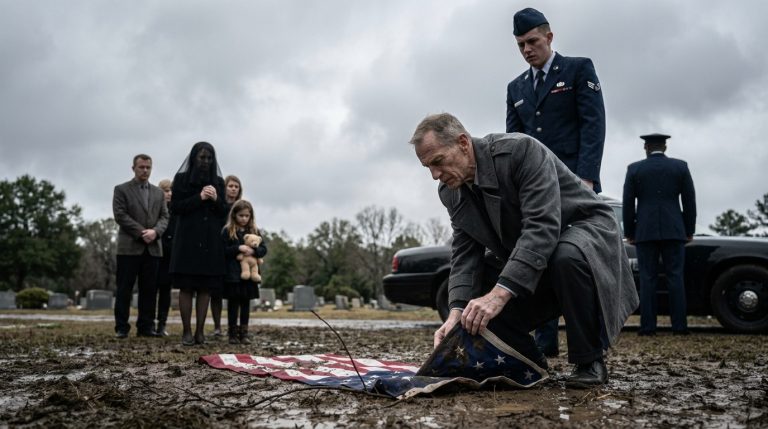
The burial was a masterclass in quiet efficiency. The flag was folded—a crisp, geometric dance of fabric and precision—and presented to Eleanor with a formality that felt both ancient and immediate. As the crowd began to thin, drifting toward the parking lot and the long, slow drive home, Brent remained by the headstone. He didn’t feel the need to say a final goodbye. The phone calls, the work, the struggle—that was his ongoing conversation with Henry.
“Are you ready?” Catherine asked softly, her hand resting on the small of his back.
“In a minute,” Brent said.
He leaned down and placed his hand on the cold stone. He thought about the third stanza of the Creed, the words he had committed to memory that first, terrifying year. Never shall I fail my comrades. He hadn’t failed them. He hadn’t failed the man who saw the fracture in him and chose to heal it instead of breaking him further.
He walked back to his car, moving with a steady, unhurried gait. The world was still there, vast and demanding. He had a family, a job, and a lifetime of being ordinary to get back to. There was no more pretense, no more need to stand out. He opened the door for Catherine, buckled his daughter into her seat, and sat behind the wheel.
As he turned the key, he looked in the rearview mirror. For the first time in his life, he didn’t look for the mask. He didn’t check for the angle of his chin or the projection of his posture. He simply saw a man—a father, a husband, a person who had learned the hard, beautiful lesson that the most heroic thing one can do is to stop pretending and start serving.
He pulled out of the churchyard, the tires crunching over the gravel. The road ahead was long, and he knew there would be days of frustration, days where the old ghost of the lie might whisper in his ear, but he didn’t fear it anymore. He knew the path. He had walked it, he had earned it, and he would keep walking it, not as a hero, but as a man who finally understood that his life was not a costume to be worn, but a truth to be lived, every single day, one honest step at a time. The car crested the hill, and he drove toward the horizon, the silence of the landscape a wide, open promise of all that was yet to be built.