The Echo of the Wrench: Reclaiming the Rhythm of Service in the Shadows of Steel
CHAPTER 1: The Weight of Silence
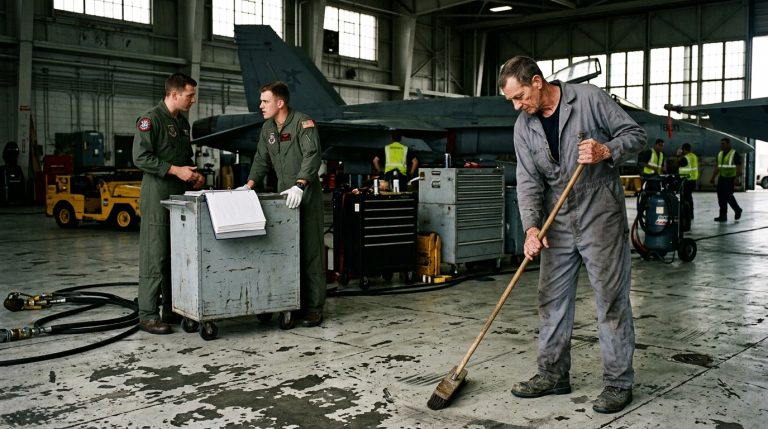
The AH-64E Guardian sat in the center of Hangar 7, a dormant beast of glass and composite, stripped of its majesty. To the technicians swarming around its frame, it was a $72 million puzzle, a tangled web of fiber optics and digital sensors that refused to wake. To Daniel Torres, standing ten feet back with a mop bucket that groaned at every turn of its caster, it was simply a friend who had lost its way.
Torres kept his gaze low, his movements practiced and small. He had been invisible for three years, a shadow in a green jumpsuit that had seen better days. He scrubbed a stubborn grease stain from the workbench, his knuckles white against the handle of the rag. He didn’t look at the screen where the diagnostic codes flashed their insistent, mocking warnings, but he could feel the frustration radiating from the group like heat from a furnace.
“It’s not in the bus, Davis,” Keller snapped, his voice tight, stripped of the polish he wore for the cameras. “Check the primary coupling again. We are four hours from the mountain becoming a tomb.”
Sergeant Davis, sweat beading on his forehead, wiped his hands on a grease-slicked rag. “Sir, we’ve checked the coupling. We’ve checked the entire secondary chain. The software keeps reverting to a safety lock before it can even reach ignition.”
Torres shifted the weight of his bucket. He smelled the familiar, sharp tang of hydraulic fluid—not the clean, refined scent of a fresh build, but the metallic tang of something pushed to its absolute limit. It wasn’t a digital error; it was a physical hesitation, a machine screaming in a language the diagnostic software simply wasn’t designed to translate.
He took a half-step forward, his own hand brushing the worn, electrical-tape-wrapped handle of the torque wrench at his hip. The cold iron bit into his skin, a grounding presence that pulled him back from the urge to intervene. He knew the cost of crossing the line. He knew the sharp look that followed when an old man offered a solution that ignored the new rules.
“Maybe it’s a ghost fault,” a young voice mumbled from the back, trembling slightly under the weight of Keller’s stare.
Keller spun, his face a mottled, angry red. “This is not a ghost story, Private. This is a failure of engineering and a failure of leadership.”
Torres felt the familiar, dull ache in his chest—not of anger, but of recognition. He saw the Private’s shoulders sag, the way his hands curled into fists, the slow erosion of his confidence under the abrasive friction of Keller’s command. It was a cycle as old as the machines themselves, a grinding down of the spirit that was just as dangerous as any mechanical failure.
Torres reached for his cart, turning his back on the machine. He had learned the lesson of invisibility well, but as he turned, he caught a flicker of something in the corner of his eye—a small, dark smudge on the tail rotor housing, a smear of something that didn’t belong in a sterile bay. He stopped, his grip tightening on the handle, his heart skipping a beat.
CHAPTER 2: The Anatomy of the Ghost
The smudge was small—a faint, oily smear of darkened lubricant on the tail rotor housing that looked, to any passing eye, like a simple oversight by the maintenance crew. But to Torres, it was a fingerprint of incompetence, or perhaps, something far more sinister. He remained frozen, his hand still gripping the cold, unyielding metal of the cart’s handle. The hangar noise, a cacophony of clattering tools and urgent, frustrated voices, seemed to dampen, drawing back into the periphery as his mind began to deconstruct the anomaly.
He hadn’t seen a grease seal leak like that in over a decade. It wasn’t the fresh, viscous drip of a blown gasket; it was an aged, baked-on residue that had been exposed to the friction of the rotor housing for a long, quiet time. It was as if the aircraft was sweating a history that the modern diagnostic suite—that pristine, digital Oracle—had deemed nonexistent.
“You deaf or just stupid?”
The voice was thin, reedy, and belonged to a private whose face was still soft with the remnants of basic training. He stood a few paces behind Torres, a clipboard clutched to his chest like a shield.
Torres didn’t turn immediately. He allowed his eyes one final, lingering investigation of the smudge before exhaling a breath he hadn’t realized he was holding. He shifted his posture, the slight pop of his knees punctuating the momentary lull in the hangar’s activity.
“Neither, son,” Torres said, his voice as steady and unadorned as the concrete floor beneath them. “Just looking for a spot I missed with the mop.”
The private sneered, a reflexive mimicry of the older officers. “Move it. You’re clogging the flow. Colonel Keller is already two seconds away from having a stroke, and I don’t need to be the one he blames for the janitor standing around staring at the hardware.”
Torres turned, his movements deliberate, forcing his hands to stay loose rather than curling into the fists that remembered the weight of a rifle in a desert wind. The memory washed over him—the ghost—of a similar smudge on an Apache tail rotor in 2004, the night the air had smelled of cordite and the desperate hope of twenty-three men. In that moment, the sterile, climate-controlled air of Hangar 7 vanished, replaced by the choking heat of the Fallujah night. He remembered the feeling of the metal: burning hot, vibrating with the strain of a bird held together by sheer will and field-expedient fixes.
He blinked, and the desert evaporated. The harsh, fluorescent glare of the hangar lights reasserted itself, stinging his eyes. The private was still watching him, impatient, his foot tapping a nervous, erratic rhythm against the floor.
“You heard me,” the private pushed.
“I heard you,” Torres replied. He began to push his cart again, the wheels emitting their signature, piercing squeal. It was a sound he usually detested, but now, it provided a necessary cover—a mundane, irritating reality that kept him tethered to the present.
He moved toward the perimeter, his mind racing. If the smear was what he thought it was, then the hydraulic system wasn’t just failing; it was being choked from within, a victim of a design contradiction that only the older, manual-override systems understood. The diagnostic sensors weren’t picking it up because the code looked for a break, not a bottleneck.
He reached the edge of the hangar and pulled his cart into the narrow, shadowed space between a stack of storage crates and the heavy steel bay doors. He couldn’t leave. He could feel the urgency of the mission—the knowledge that six souls were huddled on a ridge, their window of survival shrinking with every degree the thermometer dropped. If he walked out those doors, he would be safe, invisible, and comfortable. But the silence of the machine would remain.
He reached down, his fingers finding the familiar, rough texture of the electrical tape on his wrench. The sensation was cold, solid, and absolute. It was the only truth he had left in a world that seemed to have traded competence for connectivity.
A few yards away, Colonel Keller was shouting again, his voice cracking with the strain of a man losing his grip on his reality. “I don’t care if the computer says the valve is open! Open it manually! If we lose this bird, we lose the rescue, and I am not having that on my record!”
Torres leaned against the cold corrugated wall, his eyes never leaving the Apache. The private had moved on, but Sergeant Davis had taken his place, looking lost, his hands hovering over a diagnostic screen that was flickering with a rhythmic, dying light. Torres watched the man’s posture, the way his shoulders slumped—the classic, heartbreaking stance of a good man who had been told to solve a problem with tools that were part of the problem itself.
Torres looked down at his own gnarled hands. He had spent three years believing that his time had passed, that the language of the machine he spoke was a dead tongue. But as he watched Davis struggle, he realized that wasn’t true. The machine hadn’t changed its soul; it had only wrapped itself in a thicker skin of digital noise.
He gripped the wrench, the metal biting into his palm. He needed to get back to that tail rotor. He needed to see the bypass valve for himself. He took a slow, deep breath, the air tasting of stale coffee and the ozone of high-powered electrical systems. He was a janitor, yes. But he was also a man who understood the rhythm of the bird, and right now, the bird was dying.
CHAPTER 3: The Intersection of History and Necessity
Torres watched from the shadows as Colonel Patricia Hayes traversed the expanse of the hangar. She didn’t walk like the other officers; there was a measured, grounded cadence to her stride, a lack of the performative urgency that defined Keller’s every movement. As she drew nearer to the Apache, the ambient noise of the hangar seemed to recede, held at bay by the weight of her authority.
Torres felt the cold iron of the wrench against his hip, a constant, steady pressure. He knew he should step back, melt into the recesses of the bay where the janitorial supplies were kept, but his feet remained rooted. He had spent three years practicing the art of being unseen, yet in the presence of someone who possessed the weary, sharp-eyed intelligence of a veteran commander, his invisibility felt fragile, almost performative.
Hayes stopped. She didn’t look at the mechanics or the diagnostic screens; she looked at the Apache, her gaze tracing the silhouette of the machine as if she were reading a map etched in steel. When she finally turned, her eyes didn’t sweep the room; they locked onto the shadows where Torres stood. There was no recognition in them—why would there be?—only a quiet, searching assessment.
“Colonel Keller,” she said, her voice carrying across the hangar without needing to be raised. “Status.”
Keller straightened, his clipboard practically vibrating in his grip. “Ma’am, we are troubleshooting the secondary ignition loop. It’s an intermittent fault. I’m confident we’ll have it bypassed within the hour.”
Hayes didn’t answer immediately. She walked to the edge of the Apache’s tail rotor assembly, the very spot where Torres had noticed the telltale smear of old grease. She bent down, a movement that was neither performative nor hurried, and brushed her gloved finger against the housing. When she pulled it back, she inspected the residue.
“This isn’t a ghost fault, Colonel,” she said, her voice deceptively calm. “This is a failure of maintenance history.”
Torres felt his breath hitch. She was looking at the smear—the very piece of evidence that the diagnostic software was programmed to ignore.
“Ma’am?” Keller stepped closer, his face tight with defensive frustration. “The logs are updated to the second. There is no history here other than standard deployment.”
“Then the logs are lying to us,” Hayes countered, standing up. She didn’t look at Keller; she looked at the space where Torres was standing. Her gaze felt like a physical weight, peeling away the layers of his janitorial cover. “Does anyone else have a different perspective on this hardware? Someone who isn’t looking at a screen?”
The hangar fell into a silence so absolute that the hum of the cooling fans sounded like a roar. Sergeant Davis looked at his boots. The Boeing engineers looked at their laptops.
Torres could stay where he was. He could wait for Hayes to turn away, and he could slide out the side door into the cool, uncaring air of the afternoon. But the image of the six alpinists on the ridge—trapped, freezing, waiting for a mechanical miracle that the computers were actively sabotaging—slipped into his mind. It wasn’t about the medal he had pinned away in a box at home, or the stripes he had traded for a mop; it was about the machine. The machine was hurting, and he was the only one in the room who knew its language.
He took a step forward. The sound of his boots on the concrete was soft, but in the silence, it seemed to ring like a gunshot.
“Ma’am.”
Hayes turned her head, her posture shifting only slightly, as if she had been expecting him to speak all along. “Yes.”
Torres didn’t wait for Keller’s inevitable interruption. He moved past the crates, his hands open and empty, his movements slow and deliberate. He stopped ten feet from the Apache. “The diagnostic trees are looking for a break in the logic, ma’am. They’re assuming the software knows what the hardware is supposed to look like.”
Keller’s face darkened, the color flushing from his neck up to his temples. “Colonel Hayes, I must insist that—”
“Quiet, Colonel,” Hayes said, not taking her eyes off Torres. She gestured toward the aircraft. “Explain.”
Torres pointed a steady finger at the tail rotor assembly, at the spot where the old grease sat, a dark, silent witness to a past modification. “There’s a thermal valve bypass in the secondary system that was part of the original design architecture, back when the bird was first prototyped. It’s not in the digital manual. It’s not in the update logs. But it’s still there, beneath the new layers. The system thinks it’s a closed circuit, but if that valve has shifted, it’s acting like a dead weight. It’s not a software error, Colonel. It’s an anatomical one.”
He realized, as he spoke, that he was no longer using the deferential, hushed tone of a maintenance worker. He was speaking as an engineer, his voice resonant with the authority of thirty years spent under the skin of these machines. He watched Hayes’s face, looking for the flicker of dismissal, the condescension that had been his constant companion for three years.
He didn’t find it. Instead, he saw a deepening of her scrutiny, a calculation occurring behind her eyes that had nothing to do with the mission and everything to do with him.
“You’re talking about a field modification from the late nineties,” she said, not as a question, but as a realization.
“Yes, ma’am,” Torres replied.
“And you know how to bypass the bypass?”
“I built them, ma’am,” he said, the words simple and devoid of ego. “Back when ‘fly-by-wire’ was just a fancy way of saying you hoped the copper didn’t melt.”
Hayes looked at the Apache, then back at Torres. The tension in the hangar was no longer one of failure; it was one of uncertainty. Keller looked as if he might implode, his career collapsing under the weight of an old man in a stained jumpsuit.
Hayes reached into her pocket, withdrew a pen, and scribbled something on her notepad. She didn’t look at Keller when she spoke. “Sergeant Davis, give this man whatever he needs. Colonel Keller, you and I are going to have a very long conversation about the accuracy of our maintenance logs.”
She turned and began to walk away, but paused when she was alongside Torres. Her voice was just a murmur, barely audible over the hum of the hangar. “I don’t care about your rank, Sergeant. I care about that bird. Do not make me regret this.”
Torres watched her walk away, her silhouette framed by the harsh, fading light of the bay doors. He felt the weight of the wrench at his hip—not as a tool, but as a commitment. He turned to the Apache. The path forward was clear, but as he reached for the access panel, he noticed something else—a small, anomalous wire bundle tucked into the corner of the housing, a color-coding that didn’t match the standard wiring diagram. A chill, unrelated to the hangar’s climate, ran down his spine. This wasn’t just an old modification. Someone had been inside this bird, and they had left a signature that was as deliberate as it was hidden.
CHAPTER 4: The Anatomy of the Machine
Torres felt the cold wire bite into his calloused fingertips. He pulled gently, testing the tension. It was anchored deep within the housing, a deliberate, professional placement that spoke of intent rather than mechanical fatigue. Someone hadn’t just modified the Apache; they had lobotomized it, effectively locking the secondary hydraulics in a state of permanent bypass that the modern diagnostic suite—blinded by its own reliance on digital perfection—could never interpret.
“Master Sergeant?”
Sergeant Davis’s voice was hushed, hovering just above the ambient roar of the distant hangar cooling fans. He was crouched on the opposite side of the tail rotor, his face etched with a mix of anxiety and a dawning, fearful respect.
“Don’t touch the outer sheath,” Torres whispered back, his voice rough. He didn’t look up. His eyes were tracing the path of the wire, following its intrusion into the primary control loom. “This isn’t a factory install. It’s a shunt. Someone put this here to force the system into a perpetual loop.”
Davis leaned in, his breath hitching. “Why would anyone do that? That’s sabotage, sir. That’s a court-martial offense.”
“Sabotage requires a malicious actor, Sergeant,” Torres murmured, his hands moving with the precision of a surgeon. “This… this looks like insurance. Someone wanted to make sure this bird stayed on the ground.”
He reached for the small bypass clamp Davis had provided earlier. His hands were steady, but the air in the bay felt thinner, charged with an unspoken threat. As he went to seat the clamp, the small pry bar he’d been using to clear the access panel slipped. It clattered against the aluminum casing, a sharp, metallic sound that seemed to echo for an eternity.
Torres froze. The movement had been a fraction too aggressive, a consequence of his own mounting, simmering rage. He took a sharp breath, forcing himself to settle into the familiar rhythm of the labor. He couldn’t afford to be clumsy. He couldn’t afford to be anything other than the tool that fixed the machine.
He bypassed the shunt, his fingers working the tension on the auxiliary line with a grace that felt like an echo from another life. He wasn’t just a janitor anymore; he was a man reclaiming the only ground he had ever truly understood. He tightened the tension, feeling the physical resistance of the line as it locked into place.
“I’ve got it,” Torres announced, his voice regaining its steel. “Davis, get back to the cockpit. The secondary valve is going to need a manual prime before you cycle the hydraulics. If you do it through the computer, the software will detect the change and hard-lock the system again. You have to force the mechanical state.”
Davis didn’t argue. He scrambled away, his boots skidding slightly on the concrete. Torres stayed where he was, his hand still resting on the fuselage. He could feel the weight of the aircraft above him—the thousands of parts, the intricate history of its service, and now, the dark secret hidden within its veins.
He moved his hand to the wire bundle he had pulled free. It was still warm, a phantom heat that lingered in his palm. He realized then that he was no longer just fixing a helicopter for a rescue mission. He was pulling at a loose thread that connected the present failure to the very institutional rot that had discarded him three years ago.
He stood up, his knees complaining, his back stiff. He didn’t head for the exit. He walked to his janitor’s cart, his movements measured and heavy. He picked up his old, tape-wrapped torque wrench and tucked it securely into his belt. He felt the cold, familiar weight of it, a stark contrast to the delicate, dangerous wires he had just unearthed.
He watched Davis scramble into the cockpit. The hangar seemed to hold its breath. Even the mechanics in the distance had paused, their collective attention drawn toward the machine that had become the epicenter of their world.
Torres walked toward the cockpit ladder. He didn’t care about the risk anymore. If the system was rigged, then the rescue mission itself was a gamble against a stacked deck. He reached the ladder and looked up, meeting Davis’s gaze through the bubble canopy.
“When I give you the sign, cycle the manual release,” Torres commanded, his eyes scanning the cockpit’s digital sprawl. “Forget the screen. Listen to the bird. She’ll tell you when she’s ready.”
As he stepped back, a shadow fell across the concrete. He looked up to see a pair of polished, black combat boots standing inches from his own worn sneakers. He didn’t have to look up to know who it was. The air shifted, becoming colder, more clinical.
“Master Sergeant Torres,” a voice said—a voice that was as sharp and sterile as the diagnostic software itself.
It was an investigator from the Base Command, his face a mask of official, impenetrable indifference. He held a tablet in his hand, the blue light washing over his features. “Colonel Hayes has authorized your assistance, but I’m afraid I’m going to need you to step away from the aircraft. There are… irregularities in the maintenance log that require your immediate clarification.”
Torres felt the hum of the hangar return, but it was different now. The tension was no longer about the mountain ridge; it was about the secret he held in his hand, and the man who had arrived precisely when the truth began to bleed out of the steel.
CHAPTER 5: The Roar of Redemption
The investigator didn’t move, his presence as rigid and unyielding as a bulkhead. He waited, the tablet hovering in the air between them like a blade.
“I don’t have time for this,” Torres said, his voice flat, his gaze shifting from the investigator to the cockpit, where Sergeant Davis was waiting for the signal.
“The timeline is irrelevant, Master Sergeant,” the man replied, his tone devoid of inflection. “What is relevant is the unauthorized modification you’ve performed on a seventy-two-million-dollar asset. That wrench on your belt—”
“Is the only reason that bird is going to leave the ground today,” Torres interrupted. He didn’t look at the man. He was watching the Apache’s rotors. They were still, but there was a subtle change in the air pressure around the housing—a slight, almost imperceptible shift in the tension of the hydraulic lines.
The investigator leaned in, his voice dropping to a harsh, private hiss. “You think you’re a hero? You’re a liability. You were purged from the records three years ago for a reason. This unit doesn’t need ‘analog geniuses.’ It needs order. And you are a disruption to that order.”
Torres felt a tremor of something cold and sharp pierce through his chest. Purged. The word echoed in his mind, a heavy, discordant note that suddenly made sense of the three years of invisibility, the way the paperwork had vanished, the way his call sign—Wrench—had been treated like a profanity by those who didn’t know its history. He wasn’t just a janitor because he was old; he was a ghost because someone in the chain of command had decided he didn’t exist.
“Give me the sign, Davis!” Torres shouted, his voice cracking the hangar’s silence.
The investigator reached for Torres’s arm, but Torres moved with a speed that belied his age, a fluid, desperate motion born of thirty years on the deck. He twisted, using the momentum of his own shift to keep the man at bay, his hand coming to rest on the secondary release lever of the hydraulic housing.
Inside the cockpit, Davis didn’t hesitate. He slammed the manual release.
The Apache shuddered. It wasn’t the smooth, digital transition of a fly-by-wire system; it was a violent, physical grunt of machinery fighting for life. Metal groaned against metal. The secondary valve, long dormant and choked with the grime of neglect, suddenly yielded to the pressure of the manual prime.
The engine roared—a deep, guttural, earth-shaking thunder that vibrated through the concrete floor and into the soles of Torres’s feet.
The investigator stumbled back, the blue light of his tablet falling to the floor, forgotten. The hangar erupted in a chaos of noise and motion. The rotors began to spin, cutting through the stagnant air of the bay with a rhythmic, hypnotic whump-whump-whump that signaled the bird’s return to the skies.
Torres stood amidst the gale force of the downdraft, his hair whipping against his eyes. He felt a profound, aching relief, but it was dampened by the sudden realization of his own isolation. The man in front of him wasn’t an isolated agent of bureaucracy; he was the first wave of a system that had fought to keep the Apache grounded, a system that feared the very competence he had just displayed.
“You’re done,” the investigator shouted over the roar of the engine, his face twisted with genuine, frantic frustration. “You think you’ve won, but all you’ve done is provide the evidence we needed to lock this facility down!”
Torres didn’t answer. He couldn’t. He was watching the Apache. It was lifting, its frame straining and settling into the air with the grace of a predator returning to its natural element. It was a beautiful, terrifying sight—the perfect marriage of design and stubborn, human will.
He felt a hand on his shoulder. He turned. It was Sergeant Davis, who had jumped from the cockpit, his face smeared with grease, his eyes wide and wet with tears.
“She’s flying, sir,” Davis yelled, his voice barely rising above the thunder. “She’s actually flying!”
Torres looked at the man—at the way he was shaking, the way he was looking at Torres not as a janitor, but as a lifeline. The investigator was still standing there, shouting into his radio, his face a portrait of failed containment.
Torres looked down at his belt. His old, tape-wrapped wrench was still there, its handle slick with the grease of the repair. He had broken the loop. He had forced the machine to speak, and in doing so, he had forced the system to reveal its own fragility.
He didn’t know what would happen when the bird returned. He didn’t know if he would be arrested, reassigned, or erased even further into the shadows. But as he watched the Apache vanish into the gray, swirling clouds toward the ridge, he felt the heavy, anchor-like weight of his isolation begin to lift. He wasn’t a ghost. He was an engineer. And for one last, glorious moment, the world had seen him work.
“Sir?” Davis pulled at his arm. “They’re trying to cut the comms. We need to get to the observation deck. We need to track the flight path.”
Torres nodded, his eyes lingering on the empty space where the bird had been. He took one final breath of the fuel-heavy air, a scent that tasted of home, of memory, and of a truth that was finally, finally, beginning to emerge from the rust. He turned and began to run—not away from the conflict, but toward the records, toward the history that someone had tried so hard to bury.
CHAPTER 6: The Quiet Horizon
The walk to the administration wing was a slow, deliberate trudge through the bowels of the base. Torres kept his hand on his wrench, not out of fear, but out of necessity; the cold iron was the only thing keeping him from dissolving into the sterile, linoleum-tiled hallways. Beside him, the investigator walked with a rhythmic, detached cadence, his silence as heavy as a sentencing.
They reached the doors of the archive—a restricted zone, even for base personnel. The investigator tapped a code into the keypad. The door hissed open, revealing a room that smelled not of jet fuel or grease, but of dry, decaying paper and stagnant air. It was a tomb of forgotten service, rows of floor-to-ceiling filing cabinets holding the lives of thousands who had served and been retired.
“Sit,” the investigator said, pointing to a small, utilitarian chair near a desk.
Torres sat. He watched the man move to a terminal, his fingers dancing across the keys with a fluid, digital ease that contrasted sharply with the labored, manual life Torres had lived for the last three years.
“You were asking about your records,” the man said, his voice finally losing its edge, replaced by a dull, professional exhaustion. “You want to know why you were erased.”
He turned the screen toward Torres. It was a personnel file, but it was riddled with red-line strikeouts. There, beneath the redacted lines, was the truth—not a mistake, not a glitch in the system, but a deliberate, administrative reclassification. He hadn’t been fired; he had been de-indexed. In the eyes of the digital military, he had ceased to be a soldier the moment he had finished his service, his file sequestered into a “cold storage” archive that was slated for permanent deletion during the next server migration.
It was an automated cull, a statistical optimization that hadn’t accounted for the human cost—the man who kept the machines flying long after the world had forgotten his name.
“It wasn’t personal, Sergeant,” the man said, his eyes finally meeting Torres’s. “You were simply… obsolete data.”
Torres felt the weight of the years settle in his shoulders, but it wasn’t the crushing burden he had expected. It was a cold, hard clarity. He looked at the screen, at the redacted history of his life, and then he looked down at his own hands—gnarled, stained, and utterly, undeniably real. He hadn’t been obsolete to the Apache. He hadn’t been obsolete to the twenty-three men he had pulled from the fire, or to the six souls who were, at this very moment, flying home because he remembered what a machine was supposed to feel like.
“I’m not data,” Torres said, his voice quiet but resonant in the empty room.
He stood up. The investigator didn’t move to stop him. Perhaps he had realized, in that moment, that there was nothing left to erase. Torres walked to the exit, his boots silent on the floor.
He emerged from the archive into the fading light of the late afternoon. Outside, the hangar was quiet. The base had resumed its normal, humdrum existence, the crisis of the morning seemingly dissolved into the ether. He walked toward the main hangar doors, his path taking him past the spot where the Apache had lifted off.
There, sitting on a workbench, was his old, dented bucket. He walked over to it and picked it up. His hands, still stained with the dark oil of the repair, gripped the handle. He took a heavy, rusted bolt—one that had shaken loose during the engine’s test-fire—and placed it gently into the bucket.
He moved toward the center of the bay, where a small, cluttered workbench stood, the surface scarred and pitted by decades of maintenance. He saw a set of discarded, slightly bent shims—components that had been replaced and forgotten. He sat down and began to work, his movements slow, practiced, and deeply rhythmic. He straightened the shims with a small hammer, the sound ringing out in the empty hangar—a deliberate, steady song of restoration.
A moment later, he heard footsteps. He looked up. It was Sergeant Davis, standing in the doorway, his uniform still grease-stained, his face drawn but bright.
“They’re back, sir,” Davis said, his voice trembling with a quiet, genuine emotion. “The alpinists. They’re safe. The bird is being prepped for the next deployment.”
Torres nodded, his work on the shim never faltering. He looked at the piece of metal in his hand—straightened, functional, and ready for service. He passed it to Davis.
“Keep that in your kit,” Torres said. “It’s not in the manual, but it’ll hold the coupling true.”
Davis took the shim as if it were a medal. He stood there for a long moment, the silence between them filled with a profound, unspoken respect. Then, he turned and walked back toward the flight line, his step purposeful and light.
Torres sat alone in the vast, echoing silence of Hangar 7. He looked at his hands, then at the wrench on his belt, and finally at the empty, expansive sky visible through the bay doors. The world was cold, the system was indifferent, and the history books would likely never mention the old janitor who had kept the steel alive. But as the sun began to dip below the horizon, casting a long, warm glow across the floor, he felt a deep, enduring peace. He had fixed the machine, and in doing so, he had fixed the rhythm of his own life.
He picked up his mop. He had a hangar to clean.