The Horizon Project: Echoes of Grace in the Quiet Waters of a Reclaimed Bay
CHAPTER 1: THE TIDE OF RETURN
The morning light in Bayfield Shores didn’t filter; it bruised. It hit the surface of the inlet in long, violet-streaked lines that made the water look like shattered glass. Walter Briggs kept his boots slow, the weight of his stride familiar on the wooden boards of the new marina. The wood here was too clean, synthetic composite designed to mimic nature but failing to capture the scent of the sea. It smelled like antiseptic and expensive wax.
He didn’t look at the cafe, nor the tourists hovering near the wine bar, their faces glued to screens, searching for the perfect image of a life they hadn’t actually lived. He focused on his boots. Scuffed leather. Salt-stained. Stitched with care, not glued by a machine.
When he reached the end of the pier, his heartbeat slowed to a cadence he’d mastered decades ago. This was the spot—Slip 1. The town had given it back with a fanfare of speeches and ribbons, but the space felt cavernous.
He reached out for the heavy hemp rope of the Horizon Bell, but his fingers met cold, unyielding metal instead. A brushed-chrome cleat, sterile and perfectly polished, had replaced the weathered wood he’d hand-carved in 2009.
Walter stopped. He leaned down, his knees popping with the protest of age, and touched the chrome. It was slick, almost oily under his fingertips. It felt wrong—a sterile intruder in his sanctuary.
From his belt, the brass compass gave a violent, sudden shudder. The needle, usually reliable as a heartbeat, swung erratically, spinning a frantic circle before pointing sharply toward the center of the marina, where the water was deepest and darkest.
He didn’t move. He simply watched the needle. It shouldn’t have been reacting. There was no iron down there, not this far out, not enough to pull a needle with that kind of desperate torque. He looked toward the Horizon Bell, bobbing gently in the tide. She looked fragile, a mahogany ghost in a graveyard of fiberglass.
A sharp, rhythmic tapping on the dock behind him broke the silence.
“Mr. Briggs? We were told you’d be here by dawn.”
The voice was thin, crisp, and sounded like it belonged in a boardroom, not a pier. Walter straightened, his spine clicking into place. He didn’t turn around yet. He felt the weight of the compass in his palm, still vibrating against the magnetic pull of the bay. He looked at the boat, then at the horizon, and finally, he looked at the reflection in the chrome cleat.
It wasn’t the harbor manager. It was a man in an expensive wool coat, standing far too still for a harbor, his hands folded in a way that suggested he was holding something back. And behind him, resting on the deck of the Horizon Bell, Walter saw it: a small, black device taped to the underside of his railing, pulsing with a rhythmic, green light.
CHAPTER 2: THE STERILE INTRUDER
Walter did not turn. The silence of the morning, usually filled with the rhythmic slapping of water against the mahogany hull, felt suddenly vacuum-sealed. The man behind him—the man in the expensive wool coat—remained perfectly still, a dark silhouette against the overly bright, synthetic backdrop of the new marina.
Walter’s eyes remained fixed on the green pulse of the device. It blinked with a cold, mechanical regularity that set his teeth on edge. It didn’t belong on a boat that had weathered three hurricanes and a dozen Gulf storms. It didn’t belong on a vessel that was a memory keeper.
“Mr. Briggs,” the man repeated, his voice smooth, devoid of any salt-air grit. “You’re a difficult man to catch at the right time.”
Walter exhaled, the sound a low, gravelly rasp in his throat. He reached out, his calloused thumb brushing against the rough, sun-warmed wood of his gunwale, seeking some anchor to reality. The contrast between the living, breathing texture of the mahogany and the slick, artificial feel of the new cleat was jarring. For a fleeting second, a wave of vertigo hit him, the docks beneath his feet appearing to tilt. Was this real? Or had the pressure of the last few weeks finally cracked the casing of his patience, leaving him to hallucinate threats where there were only harbor improvements?
He gripped the rail tighter. The wood bit into his skin—painful, honest, real. He turned slowly, not with the quickness of a younger man, but with the deliberate caution of someone who knew that movement was a chess move.
The man was younger than Walter expected, perhaps in his late thirties, with features as clean-cut and unremarkable as a stock photograph. He didn’t look like a thug. He looked like an auditor. He held a leather-bound portfolio under one arm, and his eyes were flat, professional, and entirely unreadable.
“I’m Elias Thorne,” the stranger said, not offering a hand. “I represent the firm that manages the infrastructure upgrades for Bayfield Shores.”
Walter didn’t ask why an infrastructure representative was sneaking around his boat at dawn. He let the silence hang, a weaponized pause that forced Thorne to fill the space.
“We’ve noticed some… anomalies in the docking telemetry,” Thorne continued, his gaze flicking briefly toward the device under the rail. “It seems the Horizon Bell is generating a unique magnetic interference. It’s affecting the automated mooring systems in the new slips. We had to calibrate.”
“Calibrate,” Walter echoed. The word tasted like copper. “With a bug taped to my railing?”
Thorne’s expression didn’t shift. “A sensor, Mr. Briggs. To ensure compliance with our updated safety protocols. We can’t have legacy vessels interfering with the digital architecture of a premium destination.”
Walter looked past him. The other slips were empty, save for a few sleek fiberglass cruisers that sat like silent, unblinking eyes. He thought of the kids he was meant to take out today—the Title One group, the ones with secondhand backpacks who needed the rhythm of the wind more than they needed a lecture on marina compliance.
“The wind doesn’t care about your telemetry,” Walter said softly. He stepped around Thorne, his movements heavy but steady. He reached under the rail. His fingers found the adhesive tape—it was cheap, poorly applied, already losing its grip in the morning humidity. He peeled it away in one swift motion. The green light blinked once, twice, and then died as he crushed the small circuit board between his thumb and index finger.
Thorne didn’t flinch, but his eyes narrowed. “That is property of the marina, Mr. Briggs.”
“It’s an intrusion,” Walter corrected, dropping the mangled plastic onto the synthetic dock boards. It clattered—a hollow, cheap sound. “If you have a problem with my boat, you talk to me. You don’t shadow me like a thief.”
“We are simply protecting an investment,” Thorne said, his voice dropping an octave, losing its professional sheen. “Bayfield is evolving. You seem to think you’re exempt from that. But the truth is, the water here is owned by people who don’t appreciate ghosts from the past, especially ones that insist on taking up premium space.”
Walter walked to his cabin door, his hand resting on the brass latch. It was cool and solid. “I’m not a ghost, Mr. Thorne. And this isn’t an investment. It’s a home.”
He stepped into the small, cramped cabin of the Horizon Bell. The scent of linseed oil and old, dry pine greeted him—a stark, grounding contrast to the antiseptic air of the pier. He heard Thorne’s footsteps retreat down the dock, rhythmic and precise, until they faded into the general hum of the marina’s waking machinery.
Walter sat on his small bunk, his heart hammering against his ribs. He pulled his brass compass from his pocket again. It was still pointing toward the center of the bay, but now, the needle was locked, vibrating with a high-pitched, metallic whine. He realized then that it wasn’t just the boat. The entire harbor was humming, a frequency just below the range of human hearing, vibrating through the pilings and into his very bones.
He looked at his hands. They were shaking. He wasn’t afraid of Thorne. He was afraid of the realization that the man wasn’t just a harbor bureaucrat; he was a symptom of something buried deep under the mud of Bayfield Shores. Something that was finally waking up.
He stood up, moved to his small galley, and poured a cup of cold coffee from his thermos. The liquid was dark, bitter, and bracing. He drank it slowly, staring out the porthole at the distant, grey line of the horizon. He needed to get the kids out, but he knew, with a certainty that chilled him, that today wasn’t going to be a simple fishing trip.
He checked his pocket. He had the list of students, the weather charts, and a small, worn photograph of his old crew. He tucked them into his jacket. Then, he reached into the locker beneath his bunk and pulled out a heavy, canvas-wrapped bundle. It wasn’t fishing gear. It was his old logbooks—the ones from the ’80s and ’90s.
He didn’t know exactly what he was looking for, but the compass was pointing toward the history he had long since folded away. The marina wanted him to be a ghost? Fine. He would go back to the records of the storms he had survived, the lives he had pulled from the water, and see if he could find the thread that connected those ghosts to the electronic hum currently poisoning his slip.
He stepped back out onto the deck. The sun was fully up now, casting long, harsh shadows across the marina. Miss Laya Jennings was walking down the pier with her students, their backpacks bright specks of color in the desaturated gray of the modern dock.
Walter forced a smile, tucking the compass deep into his pocket. He would teach them to tie knots. He would teach them to read the wind. But he would keep one eye on the dark, deep water near the center of the bay, where the needle refused to rest.
CHAPTER 3: THE MAYORS COMPROMISE
The gravel in the marina parking lot crunched under the tires of a dark sedan—a sound far more aggressive than the gentle lapping of the tide. Walter, still standing on the deck of the Horizon Bell, wiped a smudge of adhesive from his thumb onto his trousers. He didn’t look up immediately. He watched the reflection of the car in the water: a black, distorted shape encroaching on the calm, blue-gray of the inlet.
Miss Laya Jennings stood nearby, her hand resting on the shoulder of a small boy who looked at the towering masts of the yachts with wide, hungry eyes. She looked toward the parking lot, her expression shifting from relief to a guarded curiosity.
“Mr. Briggs,” she murmured, her voice barely audible over the distant roar of a yacht engine turning over in a nearby slip. “Is that the Mayor? I thought he was in the capital for the infrastructure vote.”
“He’s where the noise is loudest,” Walter said, his voice flat.
The car door opened, and Mayor Halloway stepped out. He was a man of expensive suits and even more expensive smiles—the kind that didn’t quite reach his eyes, which were forever scanning for a camera lens or a dissatisfied donor. He didn’t walk toward the marina office. Instead, he made a beeline for the dock, his polished oxfords clicking a sharp, authoritative rhythm on the wood.
Behind him trailed two men in suits, one of them carrying a briefcase that looked like it had never seen a day of labor in its life.
Walter didn’t move to greet him. He stayed on the deck, his hands tucked into his pockets, his posture loose but ready. He felt the weight of his old logbooks tucked inside the cabin—a record of a time when Bayfield had been a town of people, not a collection of assets.
“Walter!” The Mayor called out, his voice pitched for a public address. He offered a smile that was all teeth and practiced warmth. “I heard about the… recent adjustments to the docking arrangements. I wanted to come down personally to smooth things over.”
Walter watched as the Mayor stopped a few feet from the gangplank, carefully keeping his distance from the salt-sprayed wood of the Horizon Bell.
“Adjustments,” Walter said, the word heavy. “Is that what they’re calling surveillance now, Mr. Mayor?”
The Mayor’s smile didn’t waver, but his eyes flickered toward the mangled remains of the sensor that Walter had crushed and left on the dock. The Mayor’s assistant stepped forward, his gaze fixed on the plastic debris with an expression of cold, professional disapproval.
“A misunderstanding, Walter,” the Mayor insisted, spreading his hands. “The new management firm, they’re just… over-eager. They have metrics to meet, benchmarks for the ‘Gold Star Marina’ certification. It’s for the good of the town. If we don’t modernize, we don’t attract the capital required to keep Bayfield afloat.”
“The town was floating just fine before,” Walter replied. He looked past the Mayor, toward the cluster of new, glass-walled condos that loomed over the waterfront like silent sentinels. “Now it feels like we’re being drained.”
Laya stepped forward, her voice surprisingly firm. “Mr. Mayor, these children are here for an educational trip. They’ve been waiting for weeks. Does the ‘Gold Star’ certification include making them feel unwelcome on their own waterfront?”
The Mayor turned his attention to Laya, his posture shifting into that of a man addressing a minor irritation. “Of course not, Miss Jennings. We value the outreach program. In fact, we want to expand it.” He turned back to Walter, lowering his voice. “Walter, I’ve been talking with the developers. They want to offer you a permanent, subsidized slip—right here in Slip 1. They’ll even cover the maintenance costs for the Horizon Bell.”
It was a peace offering, wrapped in the smooth, suffocating silk of a bribe. Walter felt a tightness in his chest. A subsidized slip. No more fighting for his place, no more hiding his boat in the shadows of the fuel dock. But the cost was written in the way the Mayor wouldn’t meet his eyes. They didn’t want him there because they valued his legacy; they wanted him there as a prop, a living museum piece to give the new marina a veneer of authenticity.
“And what’s the catch?” Walter asked, the question hanging in the cold, morning air.
“No catch,” the Mayor said, too quickly. “Just… a bit of cooperation. We have some promotional events planned for the season. Ribbons, photos, maybe a few interviews about the ‘History of Bayfield.’ We want to show the world that the old and new can coexist.”
Walter looked at the Horizon Bell. She was old, yes. But she was honest. She had saved lives, taught children, and borne witness to the changing tides of the town. She wasn’t a prop for a brochure.
He saw the assistant reach into the briefcase and pull out a glossy pamphlet, a rendering of the “New Bayfield,” featuring a sanitized, idealized version of his boat sitting at the center of the docks, surrounded by laughing tourists who looked like they’d been generated by a machine.
“I’ll think about it,” Walter said, his voice quiet.
“Don’t take too long, Walter,” the Mayor said, his tone sharpening ever so slightly. “The harbor is changing with or without us. It’s better to be a part of the wave than to be swept under by it.”
The Mayor turned, his assistants trailing behind him like shadows. They walked back toward the sedan, their voices muted as they spoke into phones, their presence already beginning to dissolve into the background hum of the marina.
Walter remained on the deck, watching them depart. Laya looked at him, her brow furrowed with concern.
“Are you really going to consider it?” she asked.
Walter didn’t answer immediately. He looked down at the compass in his pocket. It had stopped vibrating, but the needle was still skewed, pointing not North, but toward the glass-walled condos.
“I’m not going to be a prop, Laya,” he said, his voice low. “But I think it’s time I figured out exactly what they’re trying to build under all this glass.”
He stepped off the boat, his boots hitting the dock with a solid, resonant thud. He needed to find out why the Mayor was so desperate to keep him here, why the management firm was so concerned about his boat’s “telemetry,” and what was hidden in the depths of the harbor that made a simple fishing trip feel like a dangerous mission.
He looked at the students, their faces bright with the simple, uncorrupted hope of childhood. He had a duty to them—to show them that the world was more than just images and assets. He would take them out. He would teach them. And while he did, he would start looking beneath the surface, where the truth was kept, quiet and cold, in the dark water.
CHAPTER 4: THE IRIDESCENT THREAT
Walter kept his eyes on the water. The sheen wasn’t like any motor oil he had seen in his forty years on the coast. It was vibrant, almost bioluminescent, a swirling galaxy of neon purples and sickly greens that seemed to feed on the light. It didn’t drift with the tide; it clung to the mahogany hull of the Horizon Bell as if it were seeking something.
He reached down, his fingers hovering just above the surface, and felt a unnatural heat radiating from the water. He pulled back, wiping his hand on his trousers, the scent of something sharp and metallic lingering in the air—acrid, like ozone and rot.
“Mr. Briggs?”
The voice belonged to Laya. She had wandered back toward the dock, her expression shifting from curiosity to genuine alarm as she looked down at the swirling rainbow slick. The children had been ushered toward the cafe by a volunteer, but she had stayed, her gaze fixed on the unnatural stain on the water.
“It’s not engine oil,” Walter said, his voice low. He didn’t look up. He watched the way the slick seemed to pulsate, a rhythmic expansion and contraction that matched the phantom hum he’d felt through the dock pilings.
“I’ve never seen anything like it,” Laya whispered, stepping closer to the edge of the pier. “It looks almost… industrial, but there isn’t a factory within fifty miles of Bayfield Shores.”
Walter grabbed a long-handled brush from the locker, intending to scrub the residue away, but as the bristles touched the water, the slick didn’t break. It wrapped around the brush, the iridescent film clinging to the synthetic fibers like a living thing. He hauled the brush back, the water dripping from it thick and viscous, and dropped it onto the dock. The wood hissed where the liquid touched it, the finish bubbling and turning a dull, gray white.
“Whatever that is,” Walter said, his jaw tightening, “it’s eating the varnish. It’s eating the dock.”
He thought of the Mayor’s offer—the subsidized slip, the promise of “integration.” Was this the integration they were talking about? A slow, chemical erosion of everything that wasn’t built for the new era? He stood up, his joints aching, and looked toward the center of the bay. The USS Sovereign and its companion ships were gone, leaving behind a silence that felt heavy and expectant.
“They’re hiding something,” Laya said, her voice trembling. “The harbor management, the ‘telemetry’ updates, this… this contamination. It’s all happening in the areas they’ve most aggressively ‘upgraded.’”
Walter moved to the bow of the boat, his eyes scanning the pier. The new marina was a masterpiece of planning, but from this angle—down low, at the waterline—he saw the cracks. The seamless joints of the composite decking were already beginning to warp where they met the water. The stainless steel pilings were pitted with a strange, reddish corrosion that didn’t match the salt-water exposure of the region.
“They aren’t just curating an image,” Walter realized, the thought crystallizing in his mind. “They’re trying to cover up a failure. A massive, structural, environmental failure.”
He thought of Elias Thorne, the man in the wool coat, and the device he’d left on the railing. It wasn’t just to track his boat; it was to monitor the effects of the water on his vessel—a control group in a experiment he hadn’t consented to.
“Laya, get the kids away from the water,” Walter commanded, his voice sharp with a sudden, protective urgency. “And don’t tell the marina office. Don’t tell anyone.”
“Why? If this is toxic, we need to report it.”
Walter looked at her, his expression grim. “To who? The Mayor? The people who just paid for a ‘Gold Star’ rating? If this gets out, they won’t clean the water. They’ll clear the area. They’ll shut down the docks, seize the boats, and ‘sanitize’ the evidence before anyone gets a chance to see what’s really under the surface.”
He walked back to his cabin and emerged a moment later with a heavy, galvanized bucket and a sample bottle. He didn’t care about the risk to his own health. He needed a sample—proof that the “premium destination” was built on a foundation of chemical neglect.
He dipped the bottle into the slick. The water felt thick, resistive, as if it were trying to hold onto the liquid. He capped it tight, the glass cold and vibrating in his hand, and tucked it into the hidden compartment of his logbook bag.
As he stood back up, he saw Thorne standing at the edge of the parking lot, watching him. Thorne didn’t approach. He just stood there, his hands in his pockets, his posture perfectly still. He was a sentinel, a watchdog for a company that was turning the bay into a closed-loop disaster zone.
Walter didn’t look away. He stood on the deck of his boat, his scuffed boots planted on the mahogany he’d laid with his own hands, and stared the man down. Thorne lingered for a heartbeat, then turned and walked away, disappearing behind the glass walls of the marina office.
Walter felt a cold clarity settle over him. He wasn’t just fighting for a place to moor his boat anymore. He was fighting for the bay itself. He walked over to the helm and engaged the starter. The Horizon Bell hummed to life, her engine a familiar, throaty rumble that sounded like a defiant heartbeat against the sterile silence of the modern harbor.
He didn’t know if he could stop them, or if the truth would be enough to wake the town up. But as he looked at the bottle in his bag, he knew that for the first time in fifteen years, he was no longer just a retired sailor. He was a target, and in the game of chess he was playing, he was finally ready to make his first move.
He waved to Laya, a silent signal, and pointed toward the inlet. She understood. She began gathering the children, her face set in a mask of determination. They were going to leave the dock, but they weren’t going for a fishing trip. They were going to the research station in the neighboring town, where a friend of Walter’s, an old biologist, still kept a microscope that could see more than just what the harbor management wanted the world to believe.
The Horizon Bell pulled away from the dock, the iridescent oil trailing behind them like a ghost, a shimmering, toxic promise of what was still to come. Walter looked ahead, his eyes narrowing as he steered into the open water, the wind picking up and carrying the scent of salt, and something deeper, darker, and infinitely more dangerous.
CHAPTER 5: THE BIOLOGISTS LENS
The research station, a cluster of weathered white shacks on a jagged peninsula, looked less like a scientific outpost and more like a wreck that the tide had refused to claim. Walter brought the Horizon Bell to a slow crawl, the engine’s idle a low vibration against the hull. The water here was different—clearer, colder, and free of the neon-hued poison that clung to the marina.
He stepped off the boat onto the slippery, barnacle-encrusted dock. The wood here was grayed and soft, yielding under his weight. It was honest rot, not the sterile, artificial degradation he’d seen at the marina. Laya followed him, her face tight, her eyes scanning the horizon for any sign that they had been followed.
“My friend, Silas, keeps his equipment in the east wing,” she said, gesturing toward a door that leaned precariously on rusted hinges. “He doesn’t like visitors, especially not ones coming from the new harbor.”
Walter didn’t respond. He stepped into the building, his nostrils filled with the sharp, acidic tang of formaldehyde and brine. It was a sensory trigger—the scent hit him like a physical blow, and suddenly, he wasn’t standing in a research shack. He was in a flooded town in 1984, the air thick with the same smell, the sound of helicopter blades deafening, his younger hands pulling a child from a window-well. The memory was so vivid he could feel the cold, oil-slicked water on his skin.
He blinked, grounding himself by gripping the doorframe. The wood was rough, splintered. It was the present. He was Walter Briggs, and the water today didn’t contain the detritus of a storm; it contained the deliberate waste of a corporation.
“Silas?” Laya called out.
From the back of the room, a manhunched over a microscope straightened up. Silas was all sharp angles and wild, gray hair, his lab coat stained with decades of sea-spray and ink. He looked at them, his eyes sharp behind thick, circular spectacles.
“I told you, Laya, no more fish samples this week,” Silas grumbled, his voice like gravel in a blender. “The salinity levels are haywire, and my equipment is older than the state itself.”
“This isn’t a fish,” Walter said, stepping into the dim light. He pulled the sample bottle from his jacket and placed it on the workbench. The glass clicked against the metal surface.
Silas frowned, picking up the bottle. He held it to the light, the iridescent film inside shifting and churning. His expression changed instantly—the irritation vanished, replaced by a cold, clinical intensity. He unscrewed the cap, the smell of ozone filling the small room, and he didn’t even flinch. He poured a drop onto a slide and slid it under the lens.
Walter watched the man, his heart beating a slow, steady rhythm against his ribs. He felt the phantom weight of the past on his shoulders, but his gaze remained locked on the present.
“Where did you get this?” Silas asked, his voice barely a whisper.
“The marina. Slip 1. It’s coming from the foundation, Silas. Not from a boat. From beneath the dock.”
Silas didn’t look up. He adjusted the fine-focus knob, his brow furrowed. “This isn’t an industrial pollutant, Walter. It’s an organic accelerant—a synthetic compound designed to force rapid tissue growth. It’s used in closed-loop aquaculture, but in the open bay? It would cause a biological chain reaction.”
“What does that mean?” Laya asked, her voice tight.
“It means that if this spreads,” Silas said, finally looking up, “the entire bay becomes a petri dish. Whatever they’re building down there—whatever ‘infrastructure’ they claim to be installing—it’s not for the public. It’s for them. They’re creating an environment that favors a very specific type of growth.”
“The ‘Gold Star’ rating,” Walter murmured, a cold dread pooling in his stomach. “They’re not curating a resort. They’re cultivating a private resource.”
Silas walked to a large, dusty map tacked to the wall, his finger tracing a line from the marina to the deep-water trench offshore. “If they have the rights to the bay floor under the guise of ‘modernization,’ they could be farming high-value rare species in total secret. They use the marina as a filter, an airlock to keep the outside world from seeing what’s beneath the surface.”
Walter felt a surge of cold, hard focus. It was a scam, but a massive one—a long-term play to monetize the ocean floor by destroying the very life that existed there, replacing the natural ecosystem with a synthetic farm that they controlled. And they needed him out of the way because he was the only one who actually spent time on the water, the only one who noticed when the tide felt wrong.
“We need proof,” Walter said, his voice quiet. “Not just a sample. We need to see what’s beneath the concrete.”
“You’re talking about diving the pier,” Silas said, shaking his head. “The area is restricted. Motion sensors, thermal cameras. You’ll never get near the pilings.”
“I don’t need to get near the pilings,” Walter said, a plan forming in his mind, rooted in the tactical logic he’d used back in the service. “I just need to know how their filtration system is routed. If they’re pumping that compound in, there has to be a return line. A way to cycle the water.”
Silas looked at the compass sitting on his desk—the same one Walter had carried. He picked it up, turned it over, and his eyes widened. He clicked a hidden switch on the casing, and the needle stopped spinning, locking onto a new heading—not North, but a fixed point in the marina.
“This isn’t just a compass, Walter,” Silas said, his voice dropping. “It’s a signal receiver. Someone wanted you to find something.”
Walter took the compass back, the metal cool in his hand. He hadn’t realized the device had been tampered with, or by whom. But the heading was clear. It wasn’t pointing at the marina office. It was pointing directly at the Mayor’s personal pier, a quarter-mile down the coast.
He looked at Laya. “We’re going to need a diver.”
“The current is too strong for a civilian diver,” Laya cautioned.
“I’m not a civilian,” Walter said, his voice firm. “And I know a few people who aren’t, either.”
He turned back to the boat, the sun setting behind the research shack, casting long, bruised shadows across the water. The mystery was no longer a matter of aesthetics or pride. It was a matter of survival, and for the first time in fifteen years, Walter felt the familiar, dangerous pull of a mission. He was going back to the marina, but this time, he wasn’t going to play by their rules.
CHAPTER 6: THE PAPER TRAIL
The sky over Bayfield Shores had curdled into a bruised purple in the span of ten minutes. One moment, the horizon was a flat, deceptive blue; the next, a wall of wind slammed into the Horizon Bell, turning the calm inlet into a chaotic, frothing mess of whitecaps.
Walter stood at the helm, his knuckles white against the wheel. The wind whipped his cap from his head, the sudden cold biting into his skin like needle-points. The boat groaned, the mahogany ribs flexing with a sound that signaled deep, structural stress. He didn’t have enough time to fight back to the open sea or reach the public docks.
“Hold on!” he shouted to Laya, who was bracing herself against the cabin bulkhead, her eyes wide as she watched the marina’s luxury cruisers bob violently in their slips.
The Horizon Bell surged, the engine coughing as the intake struggled with the rising swell. Walter scanned the shoreline. Directly ahead lay the auxiliary pier—a stretch of rusted, unused docking infrastructure that belonged to a defunct salvage operation. It was restricted, guarded by automated gates and high-resolution cameras, but in the heat of the squall, it was the only shelter for a mile.
He spun the wheel hard, the boat sliding through the surf with a grace that surprised him. He brought the Horizon Bell in fast, the hull scraping against the rough, barnacle-crusted pilings of the auxiliary pier. He scrambled to the deck, rope in hand, and lashed the boat down just as the first sheets of rain hammered the harbor.
The sound was deafening—a roar of water on tin, on wood, on the surface of the bay. Walter waited for the worst of it to pass, his chest heaving. Laya crawled out of the cabin, her hair plastered to her face, her hands shaking as she smoothed her soaked jacket.
“We shouldn’t be here, Walter,” she said, her voice strained. “The security sensors—they’ll have flagged us the moment we crossed the perimeter.”
“Let them come,” Walter said, his eyes scanning the pier. The auxiliary dock was deserted, but it wasn’t empty. Stacked high against the rusted salvage sheds were rows of shipping crates, their stenciled labels weathered but legible. MARINA INFRASTRUCTURE – DIVISION 7.
He stepped onto the pier, the wood beneath him slick with black sludge. He walked toward the nearest shed, his boots echoing in the sudden lull between gusts. The door was ajar, hanging on a single, bent hinge. He pulled it open, the heavy steel grating against the concrete floor.
Inside, it wasn’t salvage equipment. It was a command center.
The walls were covered in monitors, all displaying live feeds of the marina. He saw himself, standing on the deck of his boat, frozen in a high-resolution frame. He saw the Mayor’s office. He saw the fuel station. But what caught his attention were the digital schematics scrolling across the main screen—a blueprint of the harbor’s floor.
“Look at this,” Laya whispered, stepping up behind him.
The screen showed a deep-water pipe, miles long, snaking from a hidden facility under the Mayor’s pier all the way out to the shelf. It wasn’t just a filtration system. It was an intake pipe for the “synthetic compound” Silas had identified.
Walter felt a surge of cold fury. He reached out, his hand hovering over the keyboard. He didn’t know how to navigate the system, but he saw a file folder labeled Project Kintsugi: Legacy Allocation.
He tapped the screen. The file opened. It wasn’t a project for marina development; it was a liquidation schedule. The developer—the firm that had ousted him—wasn’t just running a farm. They were selling the rights to the bay’s bio-data to global pharmaceutical firms, using the “marina upgrades” as the cover to strip-mine the ocean floor for genetic patents.
They weren’t building a luxury destination. They were building a laboratory, and when the bay had been harvested dry of its natural genetic stock, they intended to shutter the harbor, blame a ‘biological collapse,’ and disappear with the profits.
“The Mayor,” Walter said, his voice dropping. “He’s not just in on it. He’s the guarantor.”
He saw a series of emails open on a secondary monitor. They were signed by the developer and addressed to a holding company. “Briggs is a persistent nuisance. His presence is the only thing delaying the final audit. If the project isn’t clear by the end of the month, we lose the grant funding.”
The sound of a heavy engine idling at the end of the pier broke his concentration.
Walter looked out the shed door. A dark SUV had pulled up, its headlights cutting through the driving rain. A man in a high-visibility security jacket stepped out, followed by Elias Thorne.
“They’re here,” Laya said, her voice rising in panic.
Walter looked around the shed. There was no back exit. He looked at the main server, the drive spinning with the data that could blow the entire operation apart.
He didn’t hesitate. He grabbed a small, external drive from his kit, jammed it into the port, and held his breath as the progress bar crept toward completion.
“Ten seconds,” he whispered, his eyes fixed on the screen.
Outside, the security guard unholstered a flashlight, the beam cutting through the gloom, searching for the source of the unauthorized dock entry. The Horizon Bell groaned against the pier, the sound a desperate, final warning.
Walter pulled the drive just as the door to the shed began to swing open. He grabbed Laya’s hand, pulled her toward the shadows behind the stacked crates, and held his breath, his heart a steady, thumping beat against the silence of the storm.
CHAPTER 7: THE MIRROR IMAGE
The flashlight beam cut through the damp darkness of the shed, a harsh, unwavering finger of light that turned dust motes into tiny, suspended stars. Walter held his breath, his back pressed hard against the rough, splintered edge of a shipping crate. He could feel Laya’s shoulder against his—a small, steady point of contact in a world that had suddenly tilted toward disaster.
The guard stopped. The light lingered for a heartbeat on a stack of empty pallets, then swung toward the monitors.
“See anything, Elias?” the guard asked. His voice was thick, bored, the tone of a man who dealt with trespassers as a routine nuisance rather than a threat.
“The sensor trigger was precise,” Thorne’s voice answered from just outside the door. It was cold, clinical, and devoid of the professional polish he’d used earlier at the marina. “Someone was in the system. They pulled a hard drive.”
Walter felt a spike of adrenaline so sharp it made his vision swim. He tightened his grip on the drive in his pocket, the plastic edge digging into his palm. He looked at Laya; her face was a pale oval in the gloom, her eyes locked on the guard’s boots as they paced closer to their hiding spot.
“If they’re still in here,” the guard said, the flashlight beam sweeping across the very crate Walter was huddled behind, “they’re trapped.”
Walter didn’t wait. He shifted his weight, his boot finding purchase on a loose piece of scrap metal. He didn’t think; he reacted. He reached out, grabbed a heavy, rusted iron pipe from the floor, and swung it—not at the guard, but at the industrial light fixture hanging from the ceiling.
The pipe connected with a satisfying, resonant crash. The bulb shattered, plunging the shed into a chaotic, strobing darkness as the wires sparked and hissed.
“Hey!” the guard shouted, spinning toward the sound, his light flailing wildly.
“Run,” Walter whispered to Laya.
They scrambled from the shadows, moving with a desperate, low-slung agility born of years spent dodging storm-surges and shifting deck-loads. They bypassed the guard, who was struggling with the sparking wires, and burst through the shed’s side door into the teeth of the storm.
The rain was an icy wall, stinging their eyes and turning the pier into a treacherous, glass-slick obstacle course. They didn’t head for the Horizon Bell—that would be the first place Thorne would look. Instead, Walter veered toward the auxiliary pier’s catwalk, a narrow, rusted structure that spanned the gap toward the old cannery ruins.
They ran, their lungs burning, the taste of ozone and sea-salt heavy on their tongues. Behind them, the guard’s flashlight bobbed in the dark, and Thorne’s voice—raised in a shout of pure, calculated fury—cut through the roar of the rain.
“Seal the perimeter! Don’t let them reach the mainland!”
Walter didn’t look back. He shoved Laya toward a small, maintenance hatch in the catwalk. It was locked, but the metal was corroded, the hinges eaten away by decades of neglect. He drove his shoulder into it, the impact vibrating through his tired bones, and the lock snapped with a brittle, metallic pop.
They tumbled inside, landing on the cold, damp concrete of the old cannery floor. It was dark, smelling of deep, stagnant water and the heavy, musky scent of rotted kelp.
“We need to get to the road,” Laya gasped, shivering uncontrollably.
“They’ll be watching the road,” Walter said, his voice a low, raspy command. He shone his small penlight across the floor. He wasn’t looking for an exit; he was looking for a way to use the environment against them.
He saw it: a series of old, heavy-duty floor grates that led down into the harbor’s original, pre-modernization drainage system. It was a dangerous, archaic network of tunnels that ran directly under the entire marina.
“We go down,” Walter decided, his mind already mapping the route back to the Horizon Bell via the water, not the docks.
“The drainage system?” Laya asked, her voice incredulous. “Walter, that’s where the waste is dumped. It could be toxic.”
“It’s our only chance,” Walter said. He pried the grate open, the sound of rushing water echoing up from the dark abyss below. He looked at the drive in his hand—the proof that the developer was strip-mining the bay. He realized then that he couldn’t just escape. He had to lead them into a trap of his own making.
He looked at Laya, his eyes hard and clear, the exhaustion that had been weighing him down suddenly replaced by the cold, tactical clarity of a man who had survived a dozen storms.
“You stay here,” he said. “Get to the main road, find your friend, and get this drive to the local news office. Don’t look back. Don’t wait for me.”
“Walter, no—”
“Go!” he snapped, the authority of his old rank coming through in the command.
She hesitated, then nodded, her eyes filling with a mixture of fear and resolve. She turned and sprinted toward the far end of the cannery as Walter lowered himself into the dark, churning water of the tunnel.
As he submerged, the cold was a shock that threatened to steal his breath. He clung to a rusted ladder, listening as the heavy boots of the security team thundered on the floorboards above him. He felt the vibration of their pursuit, the calculated, cold violence of a system trying to crush a single, stubborn soul.
He moved silently through the dark, the water swirling around him, the iridescent oil clinging to his skin like a second, toxic shroud. He wasn’t just a retired sailor anymore. He was the current, the tide, the force that was about to break the dam of their deception.
He pushed forward, deeper into the dark, his hand gripping the cold iron of the wall, his path illuminated by the dim, flickering light of his determination. He knew the way. He had been born in the water, he had saved lives in the water, and he would be the one to see this through to the final, necessary end.
The marina above him was silent, unsuspecting, but beneath the surface, the truth was beginning to rise.
CHAPTER 8: THE SUBTERRANEAN VEIN
Walter clawed his way along the tunnel wall, his fingers scraping against wet, slick concrete that felt more like hardened mud than stone. The water in the drainage system was waist-deep and surging, pulling at him with the weight of a thousand storms. Every movement required a brutal, calculated expenditure of energy. The air was thin, tasting of sulfur and the sharp, metallic tang of the synthetic compound he’d sampled earlier. It wasn’t just sewage—it was the concentrated, toxic byproduct of the farm beneath the bay.
He moved by feel, his hands tracing the rough curvature of the culvert. He knew the geography of this system. Years ago, before the marina had been “upgraded,” these drains had been simple conduits for runoff. Now, they had been reinforced with steel and monitored by sensors that pulsed with a faint, rhythmic heat against his palm. He had to be careful. If he tripped a vibration alarm, the automated bulkheads would slam shut, sealing him into a pressurized tomb of waste.
A beam of light pierced the darkness ahead, reflected in the swirling, oily water. Walter flattened himself against the curved wall, his heart drumming against his ribs like a panicked bird. Two guards were wading through the tunnel fifty yards ahead, their flashlights cutting erratic swathes through the gloom. They were speaking, their voices carrying with eerie clarity through the hollow space.
“Thorne is livid,” one of them said. “He wants the drive recovered and the old man silenced before the morning tide. If the leak hits the local press, the whole Bayfield project is toast.”
“He’s in these tunnels somewhere,” the other replied. “The motion sensors tagged him at the cannery drain. He can’t go back, and the exit at the marina main-gate is welded shut.”
Walter drifted backward, moving with the current, his boots making no sound against the slime-slicked floor. He realized then that they weren’t just searching—they were herding him. They were pushing him toward the deep-water intake valve, the point where the bay’s natural ecosystem was being systematically liquidated. If he could reach that valve, he didn’t just have a bargaining chip; he had a kill switch for the entire facility.
He took a slow, agonizing breath, his lungs burning with the chemical-heavy air. He needed a distraction. He reached into his pocket and pulled out the brass compass. The needle was spinning wildly now, reacting to the massive magnetic fields generated by the intake turbines. He couldn’t trust it for direction, but he could use the battery-operated illumination circuit he’d rigged earlier—the one Silas had helped him wire.
He pulled the compass apart, exposing the delicate, glowing filament, and shoved it deep into a crevice in the tunnel wall. He jammed it behind a rusted pipe and let the light bleed out into the tunnel, a pale, artificial glow that stood out in the oppressive darkness.
He slipped under the surface, holding his breath as the murky water enveloped him. It was freezing, the temperature leeching the warmth from his body, but he didn’t move. He waited.
The guards’ voices grew louder, then stopped.
“What’s that?” one of them hissed. The light intensified, focusing on the crevice. “A flare? Is he trying to signal someone?”
“Check it out,” the other said.
As they moved toward the light, Walter surfaced, his hand finding the rusted valve lever he had been aiming for. It was jammed with years of corrosion and chemical buildup, a dead, immovable weight of iron. He braced his feet against the tunnel wall, his muscles screaming in protest. He remembered the weight of the crab traps, the pull of the currents in the Gulf, the resistance of the storms he had navigated in his youth.
He pulled.
The sound of snapping metal echoed through the tunnel—a sharp, violent crack like a gunshot. The valve groaned, then shifted. It was moving.
“There! Over there!” a guard screamed, the flashlight beam whipping around to illuminate Walter just as he gave a final, desperate heave.
The valve slammed open, and the pressure difference was instantaneous. A massive, roaring vortex of seawater surged into the tunnel, a wall of force that hit the guards with the weight of an express train. They were swept off their feet, their flashlights spinning into the dark as they were carried backward by the sudden, violent intake of the bay.
Walter hung onto the ladder, his body buffeted by the torrent, his hand still gripped to the lever. He was exhausted—a deep, marrow-level fatigue that threatened to pull him into the dark with them. But he held on.
As the surge subsided, the turbine alarms began to wail—a long, mournful sound that signaled a total system failure in the intake sector. The lights in the tunnel flickered and died, replaced by the red, pulsating glow of emergency beacons.
He looked toward the main gate. The water pressure had knocked the seal loose, a gap just wide enough for a boat to pass. He turned, the cold water dragging at his legs, and began to swim toward the faint, gray light of the bay, the drive still tucked safely in his pocket. He was beaten, bruised, and shivering, but he had opened the door. The project was leaking, the secret was flooding, and for the first time, he was the one in control of the tide.
CHAPTER 9: THE ANCHORS WEIGHT
Walter hauled himself over the gunwale of the Horizon Bell, his muscles screaming in protest. He collapsed onto the deck, the wood slick with rain and salt spray. The boat felt wrong—heavy, sluggish, unresponsive. He scrambled to the helm and jammed the key into the ignition, turning it with a frantic, desperate motion.
Nothing. Not even a click.
He didn’t need to look to know what they had done. He could hear the low, rhythmic hum of a localized frequency jammer emanating from the marina’s new docking poles, a deliberate interference designed to freeze the ship’s electronic systems. Thorne hadn’t just been tracking him; he had been waiting for the moment he returned to the boat to lock him down.
“Briggs!”
Thorne’s voice boomed across the water, amplified by the marina’s PA system. He was standing on the pier, silhouetted against the harsh, white glare of the security lights. He didn’t look like a bureaucrat anymore; he looked like a predator.
“The drive, Walter. Throw it into the water and walk away. You’ve played your part, and honestly, you’ve done a commendable job. But you’re out of your depth.”
Walter stood up, his legs shaking. He looked at the bay. The intake valves were still roaring, the massive turbines churning the water into a violent, frothing white. Thorne was right—he was out of his depth. But he wasn’t alone.
He reached into his pocket, his fingers finding the drive. It was hot, a dull, pulsing heat that told him the security team was trying to remotely overwrite the files. He had seconds, maybe less.
He looked toward the marina entrance. He saw a flash of movement—a car screeching to a halt at the edge of the pier. It was Laya, her face pale, the headlights illuminating the scene. She had the news crew with her.
Thorne saw them, too. His composure shattered. He gestured to the guards, his voice rising into a sharp, jagged command. “Stop them! Do not let them reach the perimeter!”
Walter knew the game was over. He didn’t have to win; he just had to make sure they couldn’t win, either. He looked at the Horizon Bell—his memory keeper, his relic. He realized then that he couldn’t save the boat and the evidence.
He moved to the midship, his hands flying over the manual release for the anchor chain. It was an old-school, mechanical system—no electronics, no chips, just steel, iron, and physics.
“If you want this data,” Walter shouted, his voice a low, gravelly roar that carried across the water, “you’re going to have to reach for it!”
He didn’t throw the drive. He lashed it to the heavy, iron fluke of the anchor and pulled the manual release with all the strength he had left.
The chain screamed—a raw, metallic shriek that drowned out the hum of the marina’s electronics. The anchor plunged, the massive weight dragging the heavy steel chain down into the deep-water intake vortex. It didn’t just sink; it was pulled into the suction of the turbines.
The impact was instantaneous.
The Horizon Bell groaned, the entire structure of the boat shuddering as the anchor line went taut, pulling the vessel toward the center of the intake. A massive, grinding crash echoed through the harbor as the anchor fouled the turbine blades. The grinding sound escalated into a shriek of tearing metal, a cacophony of failing iron and shattered glass.
The intake turbines shuddered to a halt, the sudden, violent stall sending a shockwave of pressure back through the pipes. The entire marina pier surged, the water level dropping and then violently erupting as the system pressure backfired.
Thorne was thrown to his knees, his face a mask of disbelief as the lights across the marina blinked out, one by one.
Walter didn’t wait to watch the fallout. He dived. He went over the side, hitting the cold, churning water of the inlet, and swam. He swam with the rhythmic, brutal efficiency of a man who had pulled others from the deep and knew exactly how to survive the pull of the tide.
Behind him, the marina was descending into chaos. Alarms blared, emergency lights cycled in rhythmic, frantic pulses, and the surface of the water was filled with the debris of the sabotage. He surfaced near the shoreline, gasping for air, his lungs burning.
He pulled himself onto the rocks, the cold, gritty earth of the coastline a welcome, solid embrace. He stood up, shaking, and looked back at the harbor. The Horizon Bell was listing, her hull compromised, but she was still there—a quiet, stubborn silhouette in the wreckage of the marina’s sterile dream.
Laya was there, running toward him, her face a blur of relief and terror. Behind her, the flashing lights of news vans illuminated the scene—cameras, reporters, the raw, unvarnished truth beginning to play out for the rest of the world.
He had lost his boat, his home, and his peace. But as he looked at the marina—the facility already beginning to settle into the mud of the bay—he knew he had kept the only thing that mattered. He had kept his word. He had been a keeper of values, a protector of the water, and he had reminded them all that honor doesn’t retire. It waits, it watches, and when the tide finally turns, it rises to meet the truth.
CHAPTER 10: THE ANCHOR HOLDS
The silence that followed the storm was absolute. The intake turbines, once a roar of predatory industry, were now mere hulks of cooling metal. Thorne stood near the water’s edge, his expensive wool coat drenched and ruined, his face drained of all color as the local authorities—tipped off by Laya’s delivery of the drive—began cordoning off the facility. There was no argument left in him. The evidence, pulled from the ruined turbines and broadcast across the state, was too absolute to deny.
Walter stood a few yards away, his boots heavy with the grit of the tunnel, his hands calloused and raw. He watched as the developer, a man whose name had been a shadow in every board meeting, was led toward the waiting cruiser in cuffs. It was a quiet, almost anticlimactic end to a battle that had felt like it might consume the entire town. There was no grand monologue, no final standoff—just the cold, mechanical process of justice, the law taking back the space that had been stolen.
The Payoff was clear in the expressions of the residents beginning to gather at the pier. The fishmonger, the small-business owners, the teachers—they looked at the marina not as an alien, sterile entity, but as a part of their own community once more. The Poetic Justice was evident in the sight of the heavy industrial machinery, once used to strip-mine the bay’s genetics, now being tagged and seized by state environmental agents. They would be dismantled, their power inverted, their utility returned to the community they had sought to exploit.
As the morning progressed, the frenetic energy of the police and reporters began to fade, replaced by the steady, rhythmic life of a town that had finally found its footing. Walter walked over to the spot where his Horizon Bell was docked. She was battered, her paint stripped in places, her mast leaning slightly, but she was still afloat.
He climbed aboard, the deck familiar beneath his feet. He reached into his pocket and pulled out the brass compass. It was dented from the struggle, the casing scuffed, but when he opened the lid, the needle swung true, locking onto North with a steady, unbreakable confidence. The magnetic interference was gone. The bay was quiet.
He turned to find Laya standing on the pier, holding a thermos of coffee. She looked tired, her eyes red-rimmed, but she was smiling—a genuine, soft smile that touched the fraying edges of their shared struggle. He stepped onto the pier and took the cup from her, the warmth of the ceramic soaking into his chilled palms.
“The Horizon Project,” she said quietly, gesturing toward the line of children and parents beginning to congregate near the dock, waiting for a chance to see the boat. “They’re still waiting, Walter. They don’t care about the news or the headlines. They just want to learn.”
Walter looked at the children, their faces bright with the same curiosity he had nurtured for fifteen years. He felt the weight of the last few weeks—the betrayal, the fear, the chemical rot—begin to settle and dissolve, like silt in a calm pool. He took a sip of the coffee, its warmth grounding him in the reality of the present.
He walked over to the section of the pier that had been damaged during the intake collapse. He knelt down, pulling a small, handheld toolkit from his bag. He spent the next hour working, his hands moving with the practiced, steady rhythm of a craftsman. He wasn’t rushing. He replaced the warped boards, sanded the rough edges until they were smooth, and secured the new railing with the same care he had once used to build the Horizon Bell.
Symbolic Closure. The dock, once the site of his humiliation, was now the site of his repair. He wasn’t just fixing a pier; he was restoring the boundary between the town and the water, ensuring that the space remained public, protected, and open.
As he finished, he heard a familiar step behind him. He looked up to see Admiral Rain standing there, his dress whites pristine against the backdrop of the waking harbor. The Admiral didn’t speak for a long time. He simply stood beside Walter, watching the tide roll in—a gentle, rhythmic washing that scrubbed the remnants of the oil slick from the shore.
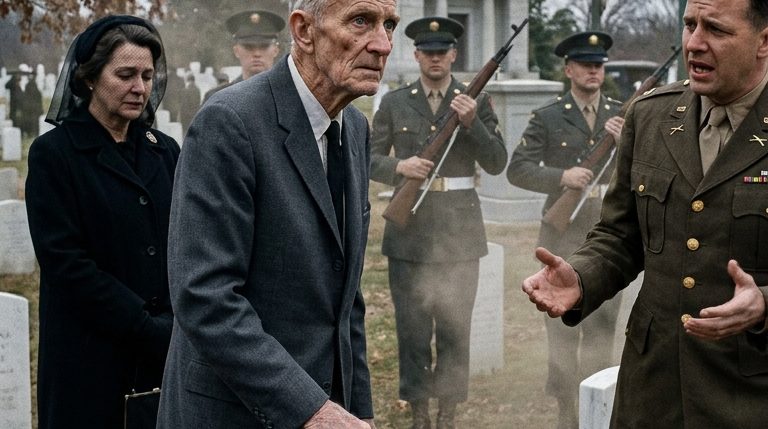
“A nation is only as strong as its remembrance,” the Admiral said, echoing the words of the monument. He looked down at Walter’s hands, then at the boat. “You did well, Command Master Chief.”
“I just kept showing up,” Walter replied, a quiet, deep emotional connection passing between them—a shared understanding of the duty that outlived the uniform.
The Admiral nodded, offered a crisp, final salute, and turned to walk back toward the fleet, their presence now a symbol of support rather than intervention. Walter remained on the dock as the sun climbed higher, casting a warm, golden light over the inlet.
He stepped back onto the Horizon Bell, the boat swaying gently in the harbor’s breath. He wasn’t looking back at the battle. He was looking out at the water, at the way the light danced on the surface, at the horizon that still held the promise of a thousand stories. He was home. The bay was clean, the people were remembering, and the tide was, at long last, coming in.