The Weight of Iron: Thomas Dancy Defends His Mountain Legacy Against the Encroaching Dust of Progress
CHAPTER 1: THE PROPERTY LINE
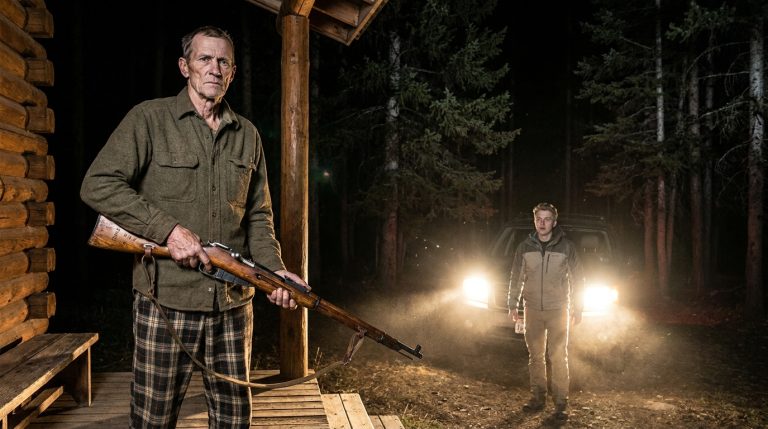
The air at four thousand feet was thin and tasted of pine resin and cold damp, but this morning, it was tainted. Thomas Dancy stood on the edge of the south-facing slope, his cane pressing firmly into the softening mud. Below him, his workshop sat in silence, the lathes and reloading benches cold and still, but his attention wasn’t on the tools.
It was on the access road.
A black SUV, polished to a shine that looked alien against the rugged, weathered timber of his property, sat idling near his primary gate. The engine’s hum was a low, rhythmic vibration that felt intrusive, a mechanical heartbeat that didn’t belong to the mountains.
Thomas felt the familiar weight of his own body—the ache in the reconstructed left knee and the stiffening of the lumbar spine—but he didn’t lean into the cane. He held it with a loose, practiced grip, his eyes tracing the line of the vehicle. He didn’t recognize the make or the license plate. It was a city machine, an expensive, pressurized bubble of leather and glass that had no business being on a fire road designated for logging and emergency access only.
He walked down the slope. His gait was slow, calculated, the cane tapping against a protruding quartz rock with a rhythmic, metallic tink. The sound was dry, sharp, and entirely intentional.
As he neared the gate, he noticed it. The chain securing the heavy iron latch had been tampered with. It wasn’t broken—that would have been amateurish—but the wire-twist binding the padlock had been neatly unwound and replaced with a loose, makeshift loop.
His grip on the cane tightened, a reflexive action. He hadn’t been to this gate in three weeks, not since he’d finished the repairs on the north-facing fence line, but he knew every link, every rusted staple, and every loose stone on these twelve acres. The discrepancy was a physical jab in his ribs.
The driver’s side door of the SUV opened. A man stepped out, wearing polished boots that immediately sank a quarter-inch into the wet clay of the shoulder. He looked to be in his forties, dressed in expensive outdoor gear that looked like it had never touched a real trail. He adjusted his glasses, then looked at Thomas with a practiced, synthetic smile that didn’t reach his eyes.
“Mr. Dancy,” the man said, his voice smooth, projected with the confidence of someone who had practiced the greeting in a rearview mirror. “I’m Julian Vance. I sent the letter last week about the survey project. I’m afraid I didn’t wait for your reply.”
Thomas stopped ten feet away. He didn’t acknowledge the introduction. He looked past the man, toward the dark, dense brush of the hollow behind the SUV. The wind was shifting, bringing with it the scent of wet leaf rot and distant smoke.
“You’re on private land,” Thomas said. His voice was gravel, low and steady, lacking any of the forced volume the stranger was using.
“I’m aware, sir. I’m just trying to make sure the topography maps match the deed we have on file,” Vance said, his smile tightening. He took a half-step forward. “We’re looking to secure the perimeter for the new development project. It’s a significant investment, Mr. Dancy. It would be a shame for you to be standing in the way of progress.”
Thomas looked down at the gate, then back at the man’s polished boots. He noticed the slight tremble in the man’s right hand—a subtle, involuntary flicker of nerves. The man wasn’t just here for a survey. He was afraid.
“The survey’s done,” Thomas said. “And the progress you’re looking for isn’t on this property.”
He turned, the movement fluid despite his age, and began the slow climb back up the ridge. He didn’t look back to see if the SUV moved. He didn’t have to. He knew the sound of someone who had just lost their leverage. The engine revved, a sharp, aggressive snarl of a frustrated machine, but it didn’t drive forward. It stayed.
He reached his workshop, the interior smelling of oil and old wood, and he stopped at the workbench. He didn’t pick up a rifle. Instead, he reached into the corner, pulled back the loose floorboard he’d set in 1994, and looked at the cold, dark void beneath. The item he kept there was small, heavy, and wrapped in thick, oil-stained canvas. It wasn’t a weapon. It was a history he thought he’d finished burying.
He heard the crunch of tires on gravel outside—the SUV was turning around—but he didn’t move. The silence of the mountain had been broken, and for the first time in years, the vibration in his hand wasn’t from coffee. It was from the certainty of the coming winter.
CHAPTER 2: THE TERMS OF THE TREAD
The SUV had not merely left; it had retreated with a deliberate, slow-motion crawl, its tires churning the damp mountain soil into a slurry that would take days to settle. Thomas stood by his workbench, his hand resting on the rough, splintered edge of the floorboard. He did not move to open it. He did not need to. The knowledge of what sat in that dark, narrow cavity—the leather-bound journals, the cold, damning ink of his own younger hand—was a weight that had never truly left him. It had simply gone dormant, a secondary pulse beneath his own.
He exhaled, a long, slow release that carried the chill of the cabin air, and finally pulled his hand away from the floorboard. The man, Vance, had mentioned a survey. It was the standard language of encroachment. In his twenty-six years, Thomas had seen men like Vance before—the ones who arrived with polished boots and empty promises, acting as the vanguard for something much larger and far less polite. They were the ones who didn’t understand the terrain, who assumed that because a man lived alone and moved with a cane, he was a variable that could be solved with a checkbook or an intimidation tactic.
He moved toward the door, his movements measured. The knee flared, a sharp, white-hot reminder of his anatomy’s refusal to cooperate, but he leaned into the rhythmic tink-tink of the cane against the pine floor. He exited into the cool afternoon. The woods were quiet now, the aggressive mechanical drone replaced by the rustle of wind through the skeletal branches of the oaks.
He walked the perimeter of his fence line. It was an old habit, a tactical necessity he had maintained since he broke ground on the timber-frame structure in 1994. Back then, he had built with a specific purpose, positioning the cabin’s orientation to maximize line-of-sight across the eastern approach. As he walked, a sudden, intrusive memory surged—the taste of cheap coffee, the feeling of the hammer in his hand, and the way he had meticulously measured the distance between each fence post, calculating sightlines for an environment that felt, even then, like a bunker disguised as a home. The memory was vivid, sharp-edged, and entirely unbidden. It carried the scent of wet cement and raw ambition.
He reached the section of the fence where the SUV had idled. The mud was deeply rutted. He knelt, his joints protesting, and inspected the ground. There, caught in the deep tread mark of a high-end radial tire, was a small, discarded plastic tag—a survey marker, neon orange, stamped with the logo of a firm he didn’t recognize.
He picked it up. The plastic was slick with oil. He turned it over in his calloused fingers. The intrusion was no longer a theory; it was a physical artifact. This wasn’t just a misplaced developer; this was a reconnaissance team mapping his property for something specific.
A shadow moved at the edge of the clearing. A deer, wary and silent. Thomas didn’t startle. He remained in his crouch, watching the creature. He noticed the way it skirted the fence line, its ears twitching toward the access road. Even the wildlife avoided the scent of the diesel exhaust that still hung, faint and greasy, on the air.
He stood, the cane serving as a stable pivot. He looked toward the house, then back toward the distant, unseen main road. They would be back. Men like Vance didn’t take “no” for an answer because their paychecks didn’t allow for it. And they would come with more than just surveys next time.
He needed to shift his posture. For years, he had been the retired veteran, the quiet mentor, the man who lived in the bubble of his own making. Now, he had to be something else. He had to be a surveyor of a different kind—a man mapping his own defenses, accounting for his own liabilities, and deciding what part of his life he was willing to burn to keep the rest of it intact.
He started the slow walk back to the cabin. His mind worked with the cold, diagnostic efficiency that had once allowed him to navigate the jungles of El Salvador and the mountain passes of Colombia. He began to inventory his assets. Not just the tools in the shop or the rifle in the safe, but the invisible network of leverage he had maintained in the county—the people he had helped, the veterans who looked at him with an unearned, mythic respect, and the quiet, forgotten favors he had called in over the decades.
He reached the cabin porch. The sun was dipping below the western ridge, casting long, bruised shadows across the overgrown garden. Catherine’s herbs—thyme, sage, lavender—were fighting a losing war against the creeping brambles. He reached down, pulling a stubborn weed from the edge of a bed, his fingers sinking into the cold, damp earth.
The security firm Vance represented wouldn’t be looking for property lines. They would be looking for the “cache.” They were looking for the buried, the lost, and the incriminating. They were looking for the very things that Thomas had spent the better part of his life ensuring stayed beneath the soil.
He stood up, brushing the dirt from his palms. The silence of the cabin was no longer a sanctuary; it was a staging area. He realized, with a grim, pragmatic clarity, that the fence he had been repairing wasn’t just to keep the deer out. It was to define a border. And he had just been served notice that the war he had been fighting for thirty years had finally come home.
CHAPTER 3: THE FRICTION OF THE FENCE
Thomas stepped inside the cabin, the heavy door thudding shut behind him with a finality that echoed in the quiet air. He walked to the workbench and laid the survey tag down on the scarred wood. Next to it sat his heavy, iron-handled wire cutters—tools that had seen decades of service on ranges and in the wild. He picked them up, the weight familiar and grounding, and looked out the narrow, east-facing window.
The sky had bruised into a deep, slate gray. The wind was picking up, rattling the timber-frame structure in a way that sounded almost conversational, a low-frequency hum that vibrated through the floorboards. It was the smell of a Georgia mountain storm—heavy, electrified, and promising to turn the access road into a river of mud within the hour.
He didn’t need to check the weather app on a screen he didn’t own; his joints told him everything he needed to know. The pressure drop was already manifesting as a dull, pulsing ache in his reconstructed knee, a reminder of every mile he’d walked in the rain. He moved to the small closet behind his winter boots and pulled out a heavy, canvas-lined jacket. As he cinched the belt, his hand brushed against the shoebox—the one with the medals. He hesitated, his fingers tracing the edge of the cardboard, then pulled his hand away. Not today.
He grabbed a heavy flashlight and a bundle of galvanized fencing wire from the shop’s wall. If Vance and his firm were planning to map his property, they would be watching the access road. But they would also be watching for signs of activity—for the movement of a man who was supposed to be fading away.
He stepped back out into the cooling air. The storm was moving fast, the cloud base dropping until it snagged on the high ridges like torn wool. He worked his way down to the fence line, his movements slow and deliberate, the cane finding secure purchase on the slick clay. The damage he had noticed earlier—the loose wire, the slight depression in the mud—wasn’t just a sign of a trespassing vehicle. It was an invitation.
He knelt by the fence post, the damp earth soaking through his trousers. He worked the wire with the pliers, his movements economical, a series of precise twists and pulls. The technique was the same as he had used in the field: minimal motion, maximum tension, absolute security.
While he worked, he listened. The forest had gone silent. The birds had stopped their chatter, the insects had retreated, and the world held its breath. It was the kind of silence that preceded a significant change in the theater of operations. He knew that silence well; it was the sound of a world preparing to be broken.
A sudden, sharp crack echoed from the direction of the access road—not a gunshot, but the snap of a heavy oak branch succumbing to the wind. Thomas didn’t flinch. He adjusted his grip on the pliers, his eyes scanning the tree line. He noticed a flash of metallic blue—the paint of a surveying transit, tucked away in the brush near the property line.
They were still here. They were waiting out the storm, or perhaps waiting for him to move, to reveal his patterns.
He didn’t give them the satisfaction of a reaction. He finished securing the fence, the wire pulled tight, a barrier that whispered of his intent. He would not be pushed, and he would not be mapped. He stood up, the pain in his knee sharp enough to make him catch his breath, but his expression remained a mask of gray stone.
As he turned to head back to the cabin, the first heavy drops of rain began to fall, slamming into the dry leaves with the force of small stones. He didn’t rush. He walked back to the cabin with the steady, rhythmic pace of a man who knew exactly how much distance he had to cover and how much time the environment would allow him.
Back inside, he set the pliers on the workbench and stood in the center of the room. The cabin was a vessel of his past, filled with the tools of a life defined by precision and distance. He walked to the center of the room, stopped, and looked at the floorboards. He knew that underneath, the journals were waiting—records of events that had long since been classified, forgotten, and suppressed.
He had intended to keep them buried. He had intended to live out the remainder of his days in the quiet, deliberate rhythm he’d cultivated. But the neon tag on his workbench and the men watching from the tree line had changed the math.
He walked to the window. The rain was coming down in sheets now, obscuring the world beyond the clearing. In the gray, swirling distance, he saw a faint, artificial flicker of light—a flashlight or a vehicle signal—near the perimeter.
He didn’t go for the rifle. He went for the fireplace. He stirred the embers, feeding them a few shards of kindling until the flames began to lick at the chimney’s throat. He would not hide the secret, but he would prepare to protect it. He was a sovereign entity on these twelve acres, and he had learned long ago that the only way to defend a territory was to ensure the enemy never understood the terrain as well as you did.
He sat in the chair by the fire, his hands folded over the head of his cane, and waited for the storm to fully descend. The war wasn’t in the past. It was in the mud, in the rain, and in the men who thought they could walk onto his land and take what was buried in the dark.
CHAPTER 4: THE ANATOMY OF A BREACH
Thomas rose from the chair before the last glow of the hearth had truly expired. His joints were stiff, complaining with every movement, but he ignored them with the practiced indifference of a man whose body had long since ceased to be the primary factor in his decisions. He moved to the kitchen, his hand resting on the counter as he listened. The rain had subsided to a rhythmic, claustrophobic drip from the eaves, but the forest remained unnaturally quiet.
He walked to the mudroom and pulled on his boots. His gaze caught the reflection in the mirror hanging by the door. His face was a map of lines and hard, fixed angles, his eyes the color of flint. He didn’t look like a retired janitor; he looked like a man waiting for a signal. He stepped out onto the porch, the air biting and sharp. The ground was treacherous, a slick veneer of mud over the red clay, but he walked with the confidence of someone who had spent his life reading the topography of danger.
He moved toward the fence line he had painstakingly repaired only hours before. It was here that he saw it. The wire was intact, the staples tight, but near the base of the third post, a small, black, cylindrical object was nestled in the wet leaves. He knelt, his knee pulsing with a sharp, familiar agony, and picked it up with the side of his hand, careful not to disturb any potential prints. It was a high-end trail camera, modified with an external battery pack and a cellular transmitter.
He didn’t open it. He didn’t look for the brand. He knew exactly what it was—a passive observer, a silent witness that had been recording him, his movements, and his patterns while he sat in the dark. It was a clear, tactical escalation. They weren’t just surveying the land; they were tracking the resident.
He stood, the camera cold and heavy in his palm. The frustration didn’t rise as heat; it crystallized into a cold, focused resolve. He turned toward the workshop, his pace steady despite the slick ground. As he walked, he felt the familiar, low-level vibration in his hand—the same tremor that signaled his brain was processing variables faster than his muscles could respond. He was being managed, mapped, and measured, and the arrogance of it was a friction he could no longer tolerate.
He reached the workshop, the smell of oil and old wood greeting him like an old friend. He set the camera on the bench and pulled out his heavy-duty wire cutters. He didn’t smash the device; that was the act of an amateur. Instead, he pried the casing open, his movements precise and surgical, exposing the delicate circuit board and the SIM card. He removed the card, held it up to the light, and felt the weight of the realization settle in his chest: this was not a local developer’s tool. It was high-grade, enterprise-level surveillance, the kind used by private military contractors who operated in the shadows of legal accountability.
The realization shifted the ground beneath him. They weren’t looking for a “cache” of equipment; they were looking for a reason to legally dispossess him, and the presence of such sophisticated surveillance suggested they had already identified the specific leverage point they needed.
He moved to the corner of the shop, pulled the loose floorboard back, and reached into the dark. His fingers brushed the rough, oil-stained canvas. He pulled it out, set it on the bench next to the disassembled camera, and unwrapped it. The journals were there, their edges frayed, the paper brittle with age. He flipped to a page at random, his eyes scanning the cramped, faded script. It was all there—the dates, the locations, the names of men who were likely now sitting in government offices or boardrooms, men who would consider these pages a lethal threat to their stability.
He had buried them to protect Elise, to ensure she never had to navigate the debris of his past. But now, the threat was on his doorstep, and the “decoy” they were hunting—the supposed military cache—had become the bait.
He heard the crunch of tires—no, the heavy, muffled tread of boots—on the access road. More than one set. He turned to the window, his eyes narrowing as he saw figures moving through the trees, silhouettes against the gray, dripping woods. They weren’t hiding anymore. They were searching the perimeter, their movements coordinated, tactical.
He didn’t panic. He moved to the back of the shop, his hands working with the muscle memory of a lifetime. He wasn’t reaching for a weapon; he was reaching for the tools of a different kind of survival. He began to pack, not for flight, but for transition. He had to move the journals, he had to secure his legacy, and he had to do it before the men in the woods realized that the old man in the cabin wasn’t a static target.
He pulled a heavy, waterproof duffel from the rafters, the material thick and durable. He started shifting the contents of the workbench—not the weapons, but the gear he would need to disappear into the terrain he knew better than anyone else. He was a creature of these mountains, and if they wanted a chase, he would give them a masterclass in the grammar of the ridge and hollow.
He looked at the journals one last time, their contents a quiet, damning testament. He wrapped them in plastic, sealed the seams with tape, and slipped them into the bottom of the duffel. Then, he stood, the cane in one hand, the bag in the other. The cabin was a trap, and the woods were a labyrinth. He stepped toward the back exit, his jaw set, ready to turn the hunter’s own tactics against them.
CHAPTER 5: THE DECOY UNMASKED
Thomas stepped into the rain, his boots finding purchase on the slick, leaf-covered earth. The duffel bag was a dead weight against his shoulder, the contents shifting with a dull, rhythmic thud that sounded to his ears like a heartbeat. He didn’t look back at the workshop. He moved toward the dense cedar thicket that bordered the creek, the shadows there long and fragmented by the dying light of the storm.
His mind was a precise instrument, filtering the sensory overload of the forest. The wind was gusting, pushing through the canopy in erratic waves. Each gust brought a different scent: damp cedar, ozone, and beneath it all, the faint, chemical smell of treated fabric—tactical gear.
He stopped near the creek bed, the water rushing over smooth stones with a low, chaotic roar. He needed to verify what he had seen. Was it real, or was the old, ingrained phantom of his service finally beginning to bleed into his reality? He leaned against the rough bark of a pine, his breath coming in steady, controlled intervals. He closed his eyes for a heartbeat, clearing the static, and then opened them, forcing his focus to the periphery.
There. A movement. Not a silhouette, but the unnatural bend of a fern near the creek bank—a deliberate, human motion, lacking the erratic grace of a deer.
Thomas shifted his weight, his cane sinking deep into the mud. He realized then that the men in the woods weren’t hunting a man; they were hunting an idea—the “cache” they thought he had hidden years ago. They were fixated on the decoy, the myth of the buried gear. He could use that.
He lowered the duffel bag into a crevice beneath a rotted log, covering it with a layer of wet leaves. It wasn’t the journals he was hiding; it was the empty weight of his own reputation. He took the brass casings from his pocket—the ones he had reloaded decades ago—and scattered them near the log. A breadcrumb trail of manufactured history.
As he stood, a voice cut through the sound of the creek, thin and artificial. “Dancy. We know you’re on the move.”
The sound came from behind him, amplified by a directional speaker. Thomas didn’t startle. He turned, his movements slow and agonizingly deliberate. A figure emerged from the brush, dressed in matte-black gear, hands empty but clearly trained. It was Vance, his “survey” look replaced by the flat, predatory posture of a security operative.
“You’re trespassing, Vance,” Thomas said, his voice level.
“We’re here for the archive, Tom,” Vance replied, stepping closer, his boots heavy on the gravel. “The firm doesn’t care about the land. They care about what you left in the dirt back in ’94. You hand over the journals, and we walk away. You keep playing the quiet hermit, and things are going to get very complicated for your granddaughter.”
The mention of Elise hit Thomas like a physical blow. The air suddenly felt thin, the cold rain biting into his skin. He saw the shift in Vance’s stance—a subtle, calculated move to close the distance.
“You think you know what’s in those pages,” Thomas said, his voice dropping into a register that made Vance pause. “You think you’re here for a payday.”
“I think I’m here for a job,” Vance corrected, his hand moving toward his jacket.
Thomas didn’t wait. He didn’t reach for a weapon, but he moved with a sudden, kinetic violence that the man in front of him had clearly not expected from a 78-year-old with a cane. He swung the cane—not as a walking aid, but as a lever—catching the back of Vance’s knee with a strike so precise it sent the man collapsing into the mud.
Thomas was on him before he could recover, his hands locking onto Vance’s collar. He wasn’t acting out of anger; he was acting out of a surgical necessity. He leaned in, his face inches from Vance’s, his eyes hard and unblinking.
“You aren’t here for a job,” Thomas hissed, his voice a low, terrifying vibration. “You’re here for a grave. And you have no idea who you’ve been digging for.”
He pushed Vance away, sending the man sprawling into the rain-slicked grass. He stood over him, the cane held with the casual lethality of a rifle, his posture radiating a command that transcended the physical. He had shattered the decoy. He had revealed that the “cache” was a lie, and in doing so, he had forced Vance’s hand.
Vance looked up, a mix of shock and dawning fear on his face. The power dynamic had shifted. Thomas was no longer the old man in the cabin; he was the ghost the firm had been terrified of all along.
Thomas turned away, leaving the man in the mud. He moved back toward the creek, the forest closing in around him. He had triggered the escalation. The firm would come now—not with surveyors, but with everything they had. And that was exactly what Thomas needed. He had to lead them to the truth, on his own terms.
CHAPTER 6: THE WEIGHT OF THE TRUTH
Thomas did not wait for the men in the woods to organize. He knew their training, their reliance on procedure, and the arrogance that came with superior numbers and high-end surveillance. He moved not with speed, but with an economy of motion that left him positioned in the shadows of the creek bed.
Vance’s team broke from the tree line, their flashlights cutting through the gray, drizzling twilight. They were looking for a cache. They were scanning the ground for the burial site they assumed Thomas had been guarding for three decades. They were ignoring the one thing they should have been watching: the man who had already anticipated their every move.
Thomas stepped out from the cover of the cedar, the duffel bag in his hand. He wasn’t holding it like a burden anymore. He swung it onto the damp earth, the heavy thud of the journals inside echoing against the sound of the rain.
“Is this what you’re looking for?” Thomas asked. His voice wasn’t loud, but it carried across the clearing with the authority of a gunshot.
Vance spun around, his weapon trained on the center of Thomas’s chest. The rest of the team fanned out, their movements disciplined but jagged with sudden uncertainty. They had expected a resistance they could break; they had not expected the target to hand them the prize.
“The cache,” Vance spat, his voice strained. “Open it.”
Thomas didn’t move. He stood, his cane held firmly, his gaze fixed on Vance. “It’s not what you think. It’s not gear. It’s not money. And it’s not something you can take back to your firm to leverage against me.”
He reached down and unzipped the duffel. He pulled out the wrapped journals, their edges dark and stained by time. He tossed them into the mud at Vance’s feet. “Read them. Read what we did in ’94. Read the names of the men who gave the orders. Read the names of the men who sat in rooms just like the ones your firm sits in today, and decided that what we did in those hollows didn’t matter.”
Vance hesitated, then crouched, his hands trembling as he touched the brittle plastic. He ripped the seal, the sound of tearing plastic loud in the silence. He opened the first book, the pages yellowed and dense with Thomas’s meticulous, pained handwriting. His flashlight beam played over the entries—dates, coordinates, lists of names. As he read, the predatory posture of the team began to dissolve. They weren’t reading a field manual; they were reading a witness statement that had been waiting for the light for thirty years.
“This is…” Vance stopped, his face draining of color. The other operatives moved closer, their lights illuminating the damning ink. They were professionals, trained to suppress empathy, but they were also men who recognized the weight of a liability that couldn’t be buried.
“That,” Thomas said, his voice hard, “is the legacy you were sent to find. It’s not a weapon you can sell. It’s a bomb that will level your firm the second it hits the public record.”
Vance looked up, his eyes searching Thomas’s face for a bluff. He found nothing but a terrifying, calm certainty. Thomas had spent thirty years protecting Elise from this, burying the truth to ensure she lived in a world where her grandfather was a hero, not a war criminal. But in doing so, he had created a silence that the world had tried to fill with its own, colder agenda.
“You can’t just let us walk away with this,” one of the operatives said, his hand hovering near his holster.
“You aren’t walking away with it,” Thomas said. “You’re going to walk away from it. And if I see so much as a shadow of your firm on this mountain again, those journals go to every major press outlet from here to D.C.”
The tension in the clearing was suffocating. Vance looked at the journals, then at the man who had laid them out with the precision of a master sniper. Thomas Dancy wasn’t a static target. He was the architect of his own destruction, and he had chosen the time and the place to reveal the foundation.
Vance stood slowly, leaving the journals in the mud. The team withdrew, their movements uncoordinated, their objective shattered. They didn’t speak. They didn’t threaten. They retreated into the woods, leaving the old man standing by the creek, the weight of his past finally returned to the earth.
Thomas waited until the sound of their vehicles faded into the distance. Then, he picked up the journals. He walked back to the cabin, the rain beginning to let up, a sliver of cold, gray light breaking through the clouds.
Inside, he knelt by the fireplace. He didn’t hesitate. He tossed the journals into the hearth, page by page, watching as the evidence of his sins turned into gray, curling ash. He burned the record of the war he had fought, the war he had survived, and the war he had been waging in his own mind for thirty years.
When the last page was ash, he sat in his chair and stared at the cooling embers. The silence in the cabin was different now. It was no longer a cage; it was a sanctuary. He reached out and touched the arm of his chair, the wood solid and familiar. He heard the door creak, and then, a soft, familiar voice.
“Pop?”
Elise stood in the doorway, her coat soaked, her eyes wide with a quiet, uncritical love. Thomas looked at her, and for the first time in his life, he didn’t feel the need to hide. He reached out, his hand steady, and took hers.
“I’m here, Ellie,” he said.
He felt the fatigue, the deep, rattling exhaustion of a man who had finally finished a long, impossible march. He watched the last of the ash drift up the chimney, the smoke clearing, the cabin settling into the cool, mountain air. He was a man with nothing left to hide, and for the first time in his life, he was simply, and profoundly, home.