The Walnut Box on the Marble Table: How a Childhood Betrayal Finally Collapsed a Lifetime of Controlled Silence
CHAPTER 1: THE KITCHEN WINDOW
Margaret’s reflection stared back from the cold double-paned glass, framed by the pristine white columns of the estate porch.
Outside, the black car idled against the gravel, its engine dying with a soft, final shudder.
She watched the rear door swing open, releasing a tall figure in a dark, unadorned coat with hair pulled back tight against the skull.
Fifteen years of calculated silence condensed into a single breath that refused to drop into her lungs.
Her wedding ring tapped the porcelain rim of her coffee cup once, a sharp, metallic ping that broke the heavy morning quiet of the kitchen.
She did not need a name or a greeting to identify the posture.
It was the exact stillness of Elaine, carried forward by a girl who had survived a rainy night in October.
The weight of the gray cloth held in both hands against the stranger’s chest told Margaret everything her mind tried to reject.
She had four minutes before the brass chime echoed through the foyer.
Four minutes to flatten the rising panic in her throat and force her posture into the immaculate mold of a woman who owned half the county.
Her legs felt hollow beneath her silk robe, threatening to give way before she even reached the top of the grand staircase.
CHAPTER 2: THE DINING ROOM TABLE
The grandfather clock in the hall kept its slow, heavy rhythm, measuring out seconds that felt like hours.
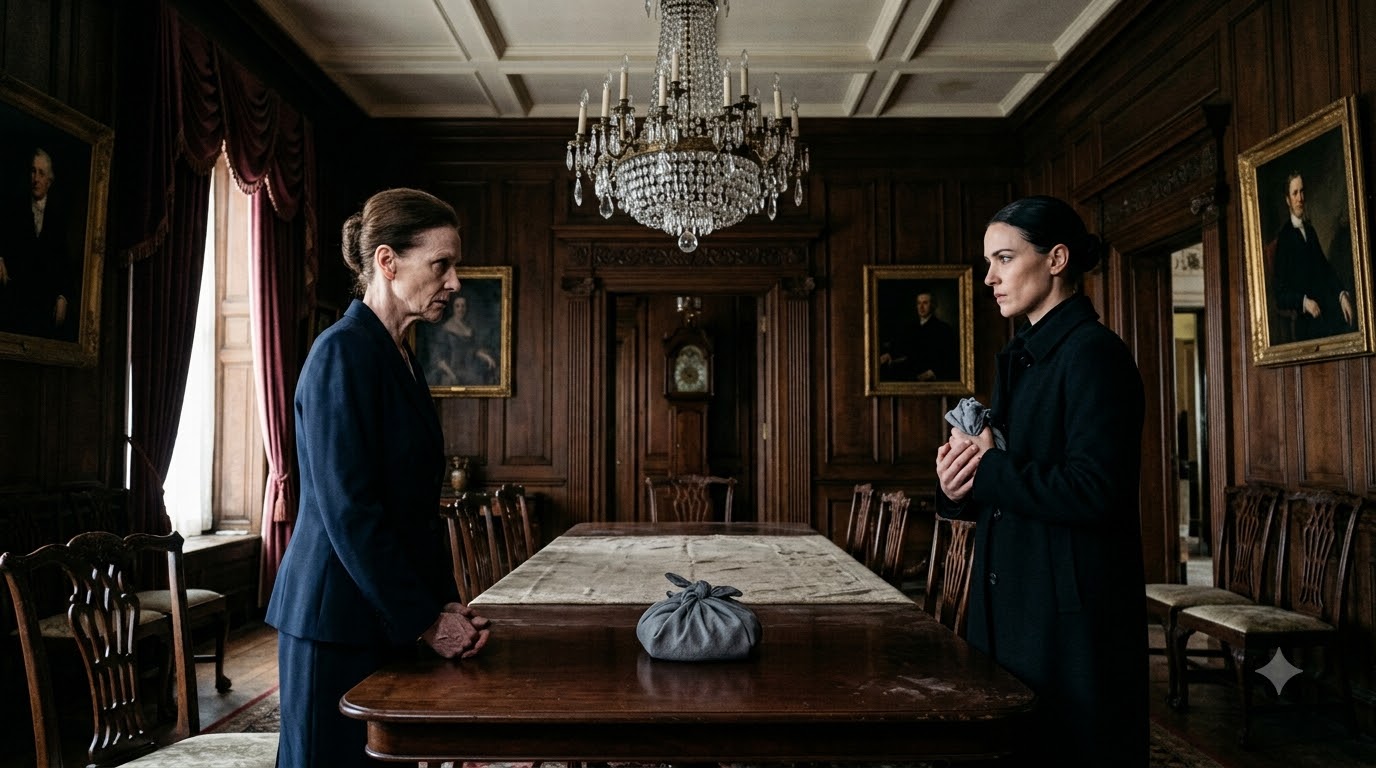
Margaret did not offer a seat.
She stood at the far end of the long mahogany table, her knuckles pressing down against the wood until her skin lost its color.
Grace remained standing by the foyer entrance, her dark coat buttoned to the collar, holding the gray-cloth bundle against her chest with both hands.
The air between them carried no warmth, only the lingering dust of a house that had closed its doors to the outside world a decade and a half ago.
“You didn’t call ahead,” Margaret said, her voice tight and dry, straining to reclaim an authority that had begun to slip the moment tires crunched on the gravel outside.
“If I had called ahead, the doors would have been locked,” Grace replied, her tone level and completely devoid of anger.
Margaret’s jaw tightened, her eyes narrowing as she searched the young woman’s face for a familiar trace of childhood fear that no longer existed.
“This is private property,” Margaret snapped, taking a sharp step forward before checking herself against the edge of the table. “Whatever grievance you think you have from fifteen years ago belongs in the past, where it was left.”
Grace did not flinch at the motion, nor did she retreat a single inch toward the open front door.
Instead, she walked slowly toward the dining table, her boots clicking softly against the marble tiles with deliberate, unhurried purpose.
She reached the opposite end of the mahogany surface, looking directly past Margaret toward the empty chairs that lined the room.
“The past doesn’t stay where you leave it when you build a house on top of it, Margaret,” Grace said softly, setting the wrapped package down upon the polished wood.
CHAPTER 3: THE FAILED DEFENSES
Margaret’s hands gripped the back of the dining chair with a white-knuckled intensity that betrayed her rigid posture.
She rattled off a calculated list of real estate deeds, corporate timber assets, and high-priced county attorneys as if volume alone could push the visitor back through the front doors.
“The lawyers went over every page of your father’s will,” Margaret said, her voice rising in sharp, defensive pitches. “You have no claim on this house, on the company, or on a single piece of silverware in this kitchen.”
Grace remained seated across the table, her hands resting flat and motionless on either side of the gray cloth bundle.
She did not blink, nor did she dignify the financial inventory with a nod or a word of protest.
“If you have recorded this conversation, my attorney will file for every penny you are worth before the week is out,” Margaret barked, leaning forward over the polished wood.
“I am not recording anything,” Grace replied quietly.
Margaret paused, her thin lips parting as she ran through her mental checklist of legal countermeasures and found them all completely useless against someone asking for nothing.
The silence that followed was heavy and flat, broken only by the distant, hollow ticking of the grandfather clock in the foyer.
CHAPTER 4: UNCOVERING THE PAST
The gray textile shifted under Grace’s steady fingers, sliding away across the polished wood with a dry rustle.
Beneath it lay the dark walnut box, its surface scarred by time and the faint, jagged fracture line across the lid.
Margaret’s breath hitched sharply in her chest, a sudden biological betrayal that she could neither swallow nor suppress.
“You kept it,” Margaret whispered, the practiced courtroom armor cracking down the middle.
“I kept all of it,” Grace replied, her voice dropping into a register that carried no warmth or invitation.
The brass latch clicked open with a metallic snap that echoed loudly against the high white walls of the dining room.
Inside the velvet lining rested the silver locket, the pressed flower, and the small, heavy circle of gold that had shaped fifteen years of silence.
Margaret took a single, involuntary step backward, her eyes locked on the metal band as if it were a physical weight pressing down on her shoulders.
“I was ten years old,” Grace continued, leaning closer across the table. “Do you have any idea what it is to grow up believing you were the reason your own father lost his daughter?”
CHAPTER 5: THE WEIGHT OF YEARS
The last remnants of Margaret’s posture folded inward as her knees gave way beneath the weight of the open container.
She caught the edge of the mahogany seat, lowering herself ungracefully into the cushion because her legs refused to bear her up another second.
Her free hand remained pressed against her throat, fingers clawing slightly at the fine silk of her collar as if trying to force air into a tightening chest.
“I didn’t come here for the house,” Grace said, her voice remaining terrifyingly steady in the silent room. “I didn’t come for the money, or a lawsuit, or a story in the local paper.”
Margaret’s shoulders shook with a dry, hollow rhythm, the silent acknowledgment of a woman whose carefully constructed fortress had just been dismantled from the inside out.
“You built an entire life on a manufactured lie, Margaret,” Grace continued, sliding the box an inch closer across the polished grain. “And I grew up anyway.”
The tears finally broke down the lines of Margaret’s jaw, dropping dark and wet onto the pristine wood without a sound of theatrical mourning.
She could not deflect the truth, she could not threaten a lawyer who asked for nothing, and she could no longer hide behind the empty prestige of the Whitfield name.
CHAPTER 6: THE QUIET AFTERMATH
The silver locket and the small gold band rested between them on the wood, reflecting the pale morning light through the high windows.
Grace closed the lid of the dark walnut container with a soft, final thud that cut through the silence of the room.
She pushed it across the polished grain until it came to rest against her stepmother’s trembling hands.
“This is yours now,” Grace said, her voice entirely stripped of triumph or malice. “You can keep it, burn it, or leave it where it lies; it changes nothing of what happened.”
Margaret could not lift her head, her face buried in her hands as the unvarnished weight of fifteen years caught up with her.
Grace turned away from the table, her boots clicking once against the marble foyer before stepping out onto the gravel driveway.
The rented car waited quietly at the edge of the property, its engine cool and silent under the autumn trees.
She opened the door, slid into the passenger seat, and looked back at the grand white columns one last time.
There was no shouting, no dramatic police sirens, and no grand public reckoning—only the heavy, inescapable quiet of a life lived entirely on a falsehood.
She gave the driver a quiet nod, and the car rolled down River Road, leaving the iron gates behind for good.
Back at the farmhouse outside Athens, the black-eyed Susans swayed gently in the afternoon wind against the garden fence.
Grace stepped out of her truck, walked up the wooden steps, and left the front door open three inches.
She walked inside, sat down at her wooden desk, and reached for a stack of open case files without looking back.