The Silent Ridge Where a Montana Hunter Remade Modern Tactics Against an Unforgiving Enemy Force
CHAPTER 1: The Pinned Valley
The frost on the fallen pine bark was thick enough to flake off in gray scales under Carl’s heavy boots.
Down in the depression of the Vosges valley, thirty-four men of Baker Company lay pressed flat against the damp earth, breathing in shallow, ragged gasps that plumed into the freezing 38-degree air.
Lieutenant Morrison crouched behind a fractured boulder, his hand white-knuckled around the radio handset that crackled with dead air and static denial.
“Artillery is denied. Friendly troops are too close,” Morrison snapped, his voice tight with the frantic edge of a man watching his perimeter bleed out drop by drop.
Carl didn’t look down at the huddled squad; he kept his eyes locked on the jagged ridgelines looming three hundred yards above them through a sparse screen of alpine firs.
Eleven Americans were already dead before the morning frost had even begun to melt off the ferns, picked off by unseen marksmen who understood geometry, windage, and the absolute value of elevated concealment.
“They’re standard-issue professionals, Sergeant,” Morrison muttered, sliding down against the stone and wiping a sleeve across his sweat-streaked forehead. “Trained schools. Scoped Mausers. They have us bracketed.”
Carl rubbed his thumb slowly along the oil-darkened wooden stock of his personal Winchester Model 70, feeling the checkering bite into his skin.
“They have the textbooks,” Carl said, his voice flat, low, and stripped of any military cadence. “They don’t have the woods.”
Morrison turned his head sharply, eyeing the civilian rifle cradled in the sergeant’s arms with open skepticism.
“This isn’t a hunting trip, Whitlock. You aren’t tracking deer out in the Rockies,” Morrison said, his jaw tightening as another sharp crack echoed off the northern granite, chewing bark inches above the lieutenant’s helmet.
“Grizzlies are smarter than these boys,” Carl replied without blinking, his gaze steady on the timberline where the shadows were slowly pulling back from the rocks.
“A bear doesn’t read a manual, Lieutenant. It reads the wind, it reads the micro-terrain, and it knows when you’re lying to yourself.”
Morrison stared at him, weighing the impossible math of their survival against the sheer absurdity of sending one man with a civilian hunting scope into a sector controlled by nine entrenched snipers.
“You have until noon,” Morrison said, his voice dropping low as he looked back down at the bleeding wounded near the center of the hollow.
“If your methods don’t stop them, we won’t have anyone left to bury by nightfall.”
Carl didn’t salute, and he didn’t offer reassurance.
He simply checked the safety slide on the .30-06, felt the familiar friction of the steel, and turned his back on the company lines to walk straight toward the steep, silent timber of the eastern slope.
CHAPTER 2: Into the Timber
The slope steepened immediately, turning into a lung-burning climb of loose slate and wet roots.
Carl kept his head down, letting his boots find the natural breaks in the granite where the stone offered firm footing without a ring of rolling gravel.
Up ahead, the dense canopy of fir and hemlock swallowed the pale morning light, leaving the trail shadowed and bitterly cold.
A sharp, metallic clink echoed faintly from the ridgeline far to his left—a canteen cup striking a belt buckle or a cleaning rod tapping against steel.
Carl froze instantly, pressing his shoulder flat against the damp gray bark of an ancient larch.
His fingers tightened around the checkered wood of the Winchester, the oil-darkened stock feeling like an extension of his own pulse.
He didn’t check his watch; time in the timber was measured only by the height of the sun through the jagged branches and the slow, heavy burn in his chest.
Scanning the rise through the dim undergrowth, he noticed something out of place near a split-trunk pine fifty yards up slope.
A patch of dark wool brushed against the gray green needles—not the natural sway of a bough, but the deliberate, cautious shifting of a man trying to adjust a heavy firing position.
The enemy marksman was dug in behind a natural breastwork of fallen timber, completely unaware that the hunter had closed half the distance while the valley below was still holding its breath.
Carl closed his eyes for a single heartbeat, let his breathing settle into a slow, rhythmic pull of the freezing mountain air, and started moving again without a sound.
CHAPTER 3: The First Calculation
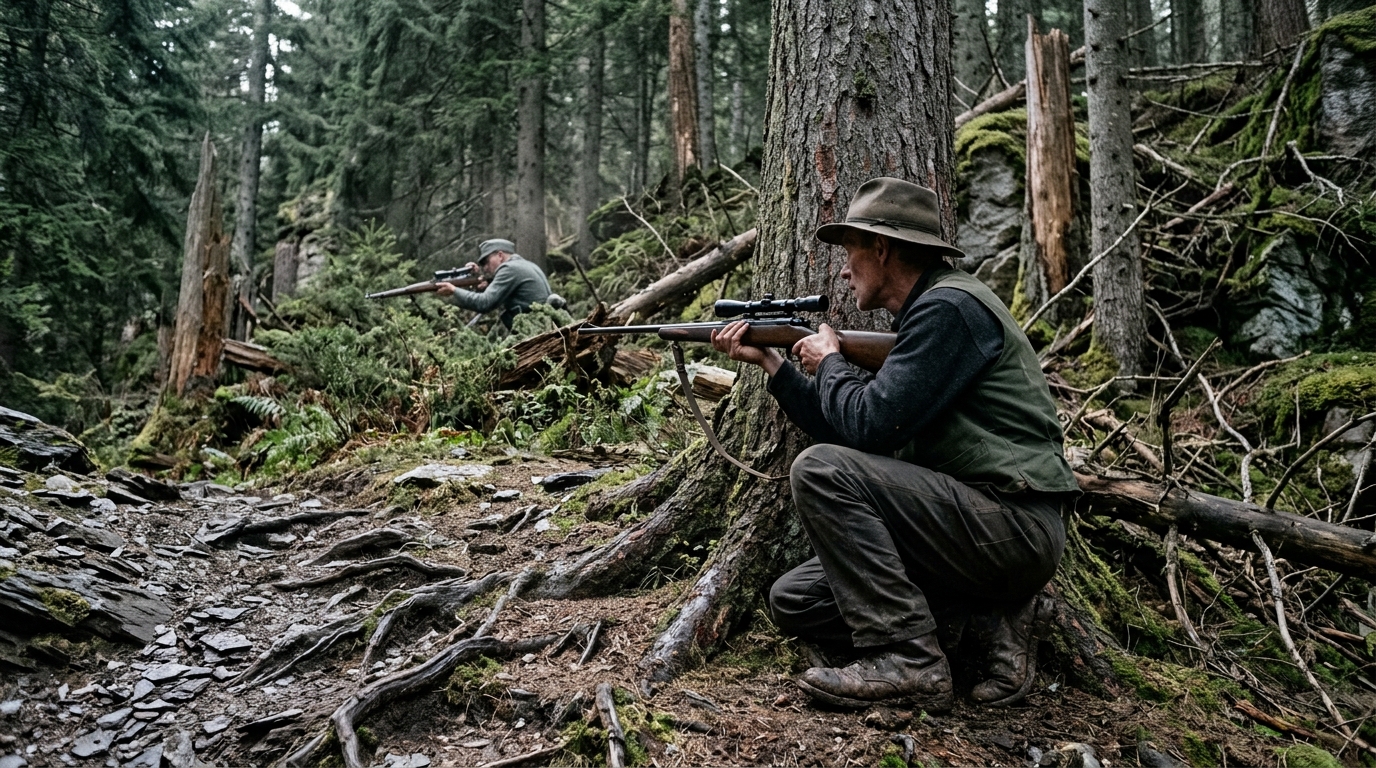
The distance across the rocky depression was three hundred and eighty yards of open air, swept by a light, shifting crosswind from the west that drifted pine needles toward the ravine.
Carl settled his shoulder deeper into the dip of the wood, bringing the Lyman Alaskan scope down until the crosshairs intersected the dark wool of the enemy coat.
The German marksman three hundred yards away was busy twisting his scope elevation drum, entirely focused on sweeping the lower valley where Baker Company lay pinned.
A sharp, metallic click of a bolt sliding home echoed faintly across the gorge from a secondary position to the south, reminding Carl that he was not hunting a single target, but a coordinated network of professional killers.
Carl exhaled half his breath, locked his elbow against his knee to counter the mountain chill, and began his trigger squeeze.
The three-pound break of the customized trigger came clean and silent against the ambient hiss of the wind through the pines.
The .30-06 round cleared the barrel with a sharp, dry crack that bounced off the granite walls before the lead had even crossed the valley floor.
Across the gorge, the target jerked forward over his rifle stock like a cut pine falling in a dead calm, sliding off the ledge into the gray brush without another twitch.
Carl didn’t stay to watch him hit the dirt; he worked the bolt instantly, chambering a fresh round with a smooth, metallic rasp.
The echo of the shot was still rolling down the canyon when the remaining marksmen on the southern ridge started firing blindly into the hollow below, reacting out of pure panic to a threat they couldn’t see.
Carl tracked the flash through his scope, noting the erratic pattern of their muzzle smoke.
They thought they were fighting a textbook military force, but they were about to learn what a Montana winter taught a man about patience.
CHAPTER 4: The Predator Shift
The forest went dead silent as the remaining marksmen realized their panic had only given away their spacing.
Carl didn’t rush the gap between the rocks; he kept his profile low, sliding his boots over the wet moss with the careful, deliberate rhythm of a man tracking an old silver-tip through the high timber.
A twig snapped forty paces ahead—a dry, unnatural pop that didn’t blend with the steady drip of melting frost from the pine boughs.
Carl froze, his shoulder pressing against the cold slate of a boulder while his thumb rested lightly on the checkered stock of the Winchester.
The enemy was waiting out the silence, hoping the hunter would lose patience and break cover first.
They thought in terms of military doctrine, where a stalemate was solved by volume or retreat.
Carl thought in terms of patience, knowing that a cornered target under sustained isolation always makes a mistake in timing.
At three hundred yards, a figure in mud-stained wool detached itself from the shadow of a fallen cedar, attempting a quiet relocation toward the upper trail.
Carl raised the barrel without a sound, tracked the motion smoothly through the low-power scope, and waited for the man to halt at the natural pinch point of the trail.
The shot went clean through the thin mountain air before the target even realized the pattern had broken.
CHAPTER 5: The High Ground
The western ridge offered a commanding angle down into the scrub-choked gullies where the remaining enemy marksmen had gone to ground.
Carl settled his weight into the dip of the stone, ignoring the bitter draft that whistled across the open shale.
A tiny, microscopic glint of reflected light—no larger than a pinhead—flashed from beneath a low-hanging canopy of dwarf firs four hundred yards down slope.
It was the telltale signature of an antireflective lens cover or a brass bezel catching the midday glare through an unshaded gap in the branches.
The marksman down there thought he was invisible, anchored securely behind a natural stone parapet that blocked all lower angles of approach.
He didn’t account for the hunter being directly above him, reading the terrain through the patient eyes of someone who had spent decades outsmarting apex predators in the high country.
Carl adjusted his elevation turret by two clicks, compensating for the steep downhill angle and the thin mountain air.
He rested his cheek firmly against the cold walnut stock, letting his breathing slow until the crosshairs steadied completely over the shadow beneath the firs.
The final two enemy combatants were still watching the lower valley, refusing to believe anyone could scale the upper cliffs without making a sound.
Carl squeezed the trigger, and the sharp crack of the .30-06 echoed off the stone walls before the falling shell casing even hit the granite dust.
CHAPTER 6: Silence on the Ridge
The final piece of camouflage netting across the opposing rocks fluttered once under the heavy mountain gust, then slumped into the dirt.
Carl worked the bolt one last time, catching the spent brass case in his rough palm before tucking it securely into his canvas pocket.
The valley below was quiet now, the dead silence broken only by the steady dripping of thawing frost from the fir branches overhead.
He didn’t wait to watch the mist clear or listen for the distant shouts of Baker Company crawling out from the freezing hollow.
The ridgeline was clear of threats, and the absurd notion that standardized military doctrine held a monopoly on survival had been permanently corrected by sixteen years of tracking in the high country.
He slung the rifle over his shoulder, checking the secure fit of the leather strap against his canvas coat.
Turning his back on the empty rocks, Carl started the long, quiet walk back down the timbered slope toward the waiting line of trees.