The Measured Line: A Quiet War Over Old Soil and the Price of Unyielding Property Rights
CHAPTER 1: The Measured Line
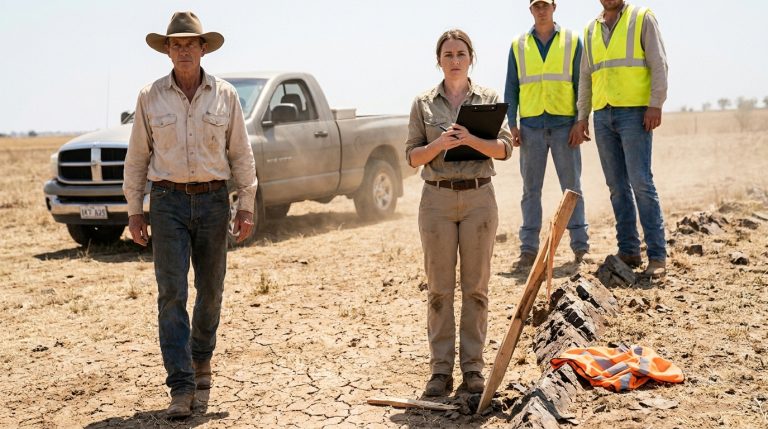
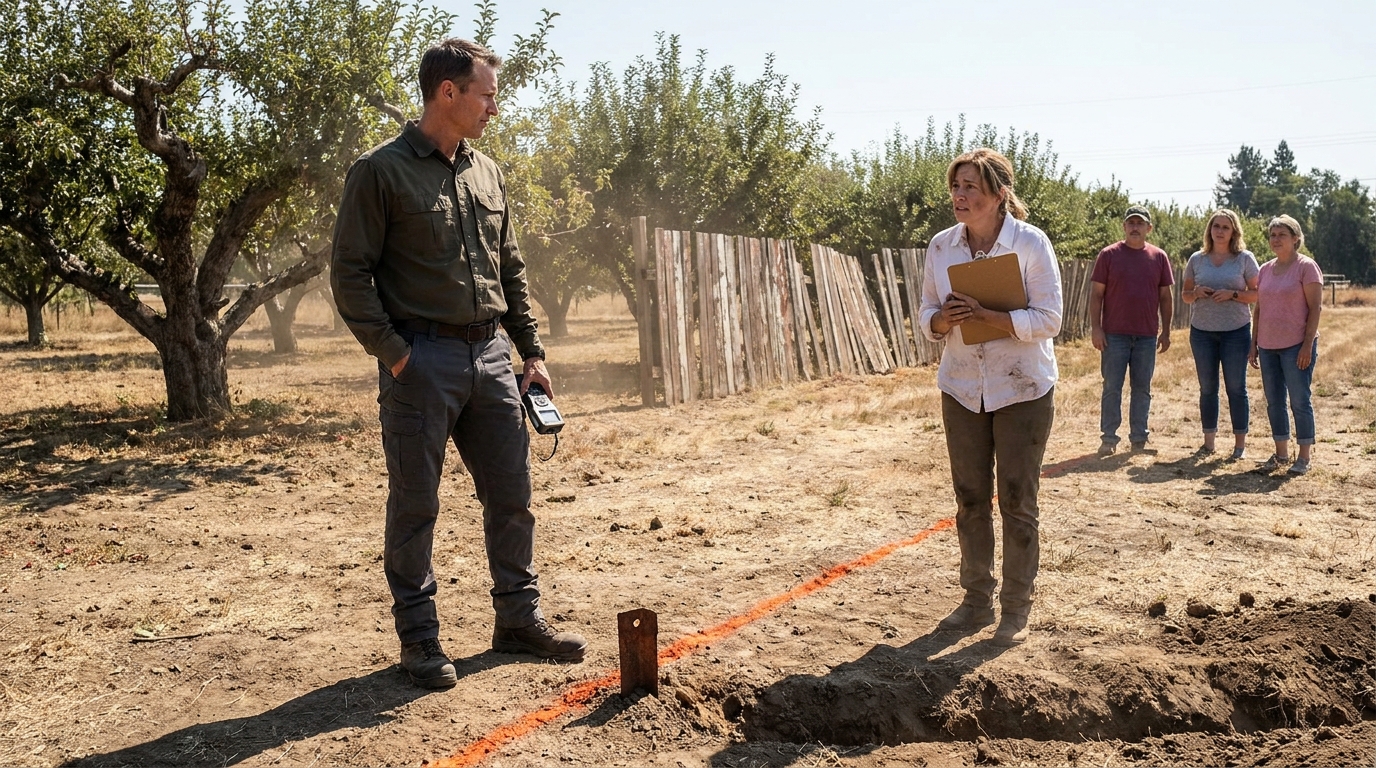
The orange paint didn’t just sit on the grass; it seemed to slice through it, a neon-bright scar defining territory that didn’t belong to them. From the driver’s seat of my truck, I watched the nozzle of a contractor’s spray can hiss. The sound was thin, swallowed instantly by the vast, open space of my three-acre lot. They moved with the casual arrogance of people who believed they were doing the neighborhood a service, unaware that every movement was being parsed by the digital eyes I’d spent three weeks calibrating.
Karen De La Croix stood in the center of it all. She was pointing toward my back fence, her gestures sharp, cutting through the dry, iron-scented air. She wore a crisp white blouse that looked entirely out of place against the backdrop of my grandfather’s gnarled apple trees. She was explaining the path, her voice a low murmur that I didn’t need to hear—I knew exactly what she was saying. The path would connect the park to the street. It would be a “benefit.” It would be, in her mind, an inevitable correction of a historical oversight.
My phone, mounted to the dash, vibrated. A silent notification: Motion Detected. The system was already archiving, mapping their coordinates against the survey markers I’d flagged in the software weeks ago.
I didn’t move. There was a friction in my chest—the cold, steady hum of preparation. I spent fifteen years in federal infrastructure compliance. I understood the language of boundaries. I knew that when people like Karen began using the word “community” to describe private property, it was rarely about the good of the public. It was about the convenience of the few.
The contractor with the shovel dug into the soil near my garden. He hit a rock, a sharp, jarring clink that echoed back to me. He didn’t know he was violating a property line that had been legally sealed since 1963. He was just a man following orders, taking a paycheck from an HOA president who hadn’t realized that the land she was violating wasn’t just a plot of dirt; it was a carefully documented, legally fortified legacy.
I watched him lean into the shovel, the metal blade sliding through the dry earth. My hands gripped the steering wheel, the leather cold and worn under my palms. I could have stepped out then. I could have shouted, stopped the work, and started the argument. But arguing is for people who think they can convince their opponent. I wasn’t here to convince anyone. I was here to document the transgression until it became their undoing.
The wind picked up, carrying the faint, dry scent of dust and the metallic tang of the rusted gate latch on my fence. Karen turned, her eyes sweeping toward the house as if she sensed someone watching. She looked straight through the windshield of my truck, but she didn’t see me—she only saw an empty driveway.
She turned back to her team, gesturing again at the fence. They were going to tear it down. They were going to pave over the memories of a man who taught me that property lines are the only true walls left in this world.
As she moved toward the garden, she stumbled slightly on an uneven patch of ground. She looked down, irritated, and kicked at a small, jagged stone—the exact spot where my grandfather had buried his iron survey marker in the heat of a summer just like this one. She didn’t know what was beneath her boot, and she didn’t know that the conversation she was about to have with the man in the hard hat was going to be the final nail in her professional coffin.
The silence of the yard was shattered by the shrill beep of a measuring tape being retracted. I looked down at my phone. The audio levels were spiking. Karen was starting her pitch. I put the truck in park, but I didn’t reach for the door handle. I simply watched, waiting for her to say the one thing that would make this legal disaster unavoidable.
CHAPTER 2: The Paper Fortress
I didn’t let the tension snap. I let it stretch.
Karen remained in the yard, her silhouette framed against the early afternoon glare. She was talking, her mouth moving in that rapid, practiced rhythm of someone who had never been told “no” by a man in a truck. I watched her through the glass, my fingers drumming a slow, steady rhythm against the steering wheel. I wasn’t just watching; I was timing. Every second she stood there, every instruction she gave those contractors, was being woven into the digital tapestry that would eventually define her legal reality.
I reached for my phone, but not to dial. I opened the file management app for the camera network. Camera two was still live. I could see the sweat on the contractor’s forehead as he leaned over the fence. He looked toward the house, then back at Karen. He was hesitating. Good. Hesitation is the first crack in any foundation.
The phantom thought hit me then—a sudden, sharp recollection of my grandfather. I could almost see him sitting on the porch, his calloused hands resting on the fireproof box in his lap. People don’t steal land, Daniel, he used to say, his voice like dry leaves over gravel. They steal the perception of it. They make you doubt your own walls until you stop looking at the deed and start looking at their maps.
I looked down at the dash. The dashboard clock clicked over to 2:50 PM.
I turned the ignition, the engine’s rumble a deep, low vibration that I felt in the soles of my feet. I didn’t rush. I drove the truck forward, slowly, the tires crunching over the gravel driveway with a sound like grinding teeth. The noise was deliberate. It wasn’t an aggressive roar; it was a measured, mechanical announcement of arrival.
As I pulled closer to the gate, I saw Karen’s posture shift. She didn’t turn around immediately, but her shoulders tightened, pulling up toward her ears. That was the first sign of the internal pressure shifting. She knew the truck wasn’t just passing by.
I put the truck in park and cut the engine. The silence that rushed back into the backyard was heavy, weighted by the scent of dry weeds and the faint, biting aroma of fresh paint. I stepped out of the truck. The ground felt solid, unforgiving. I didn’t head for the backyard directly. I walked to the side of the house, my boots scuffing the concrete path—a path I had poured myself years ago.
I kept my hands in my pockets, my fingers finding the hard, cool edge of my keys. My internal inventory was running: my grandfather’s deed was in the folder in the passenger seat, the certified survey was in the glove box, and the encrypted backup drive was tucked deep in my bag inside the house. I had everything I needed to win, but the rules of this particular game demanded that I let them lose on their own terms.
Karen had finally turned. She was watching me approach, her hand still clutched around her clipboard as if it were a shield. She looked annoyed, her brow furrowed in a mask of professional irritation. She was already framing the narrative in her mind—the “unreasonable neighbor” disrupting a vital community improvement.
“You’re making a mistake, Daniel,” she called out before I was even ten feet away. Her voice was thin, lacking the authority she usually projected in her HOA circulars.
I stopped. I didn’t walk right up to her; I kept a distance of about fifteen feet—a tactical buffer. I wanted her to feel the empty space between us, the legal divide that she was currently breaching.
“I’m observing a group of people destroying my fence,” I said, my voice steady, stripped of any inflection. “I’m not making a mistake. I’m documenting one.”
She let out a sharp, dismissive huff, a sound of practiced frustration. “This is a sanctioned project. The HOA board authorized this easement based on historical community usage. If you would just step aside, we can complete the surveying and—”
“There is no easement, Karen,” I interrupted. I kept my tone flat, almost bored. “There is no record of an easement. There is no historical usage agreement. There is only a line on a map that you drew yourself.”
I watched her face then. It didn’t flash with guilt. It flashed with calculation. She was already searching for the counter-move, looking for the angle that would allow her to ignore the reality of the property line. She looked at the man with the folder, then back at me, her eyes narrowing. She was going to try to double down.
“We have the development plans,” she insisted, tapping the clipboard. “The county records are… they are often incomplete for older properties. The HOA has internal documentation that proves the community’s right of way.”
“Internal documentation isn’t law,” I said, taking one step forward. Just one. “And you know that as well as I do. You’re an intelligent person, Karen. You understand the risk of fraud. Signing a contract to perform construction on land you don’t own—that’s not a zoning error. That’s a liability.”
The man in the hard hat shifted his weight. He was looking at me now, really looking at me, assessing the situation. He wasn’t looking at the map anymore; he was looking at the man who was telling him that he was standing on ground that could swallow his business license.
I felt the grit of the yard under my heels. Everything was exactly where it needed to be. The hook was set, the tension was high, and the structural integrity of her plan was already starting to fray. I didn’t need to shout. I didn’t need to threaten. I just needed to let the weight of the truth hang in the dry, still air.
CHAPTER 3: The Silent Surveillance
Karen didn’t answer. She couldn’t, because the man in the hard hat was looking at her, and for the first time, he wasn’t just waiting for orders—he was evaluating his exposure. I didn’t say another word. I let the silence do the work. I stepped toward the gate, the rusted hinges groaning in protest—a high, piercing shriek that sounded like tearing metal.
“The gate’s stuck,” I muttered, more to myself than to them. I gripped the latch. It was stubborn, coated in years of oxidized iron and grime. I had to plant my feet, the soles of my boots digging into the dry, unyielding earth. I pulled, the iron biting into my palm, the sheer friction of the rusted mechanism a physical obstacle I had to grind through. It was a tedious, clumsy moment, but I didn’t rush it. I let them watch me struggle with my own property. It reinforced the reality: this was a place that didn’t open for just anyone.
When the latch finally gave, it snapped back with a violent thwack. I pushed the gate open just enough to step through, leaving them on the outside of the boundary I had just physically reinforced.
“You’re making a record, Daniel,” Karen said, her voice tighter now, losing that smooth, HOA-boardroom polish. “You’re making a record of something you don’t even understand.”
I didn’t turn around. I walked toward the back of the house, my pace measured and slow. I needed to check the camera housings. My grandfather always said that if you want to know what a man is hiding, look at where he avoids walking. Karen was currently avoiding the east side of the yard, the very place where her orange lines met the reality of my survey markers.
I reached the eave of the house. I climbed a short, collapsible ladder I kept tucked behind the shed—a piece of utility equipment that looked perfectly mundane to any observer, but served a precise tactical purpose. I checked the camera housing. It was secure. The lens was clean, free of the dust that the contractors’ digging had kicked up. I adjusted the angle by a fraction of a millimeter, ensuring the frame captured the exact point where their shovel had broken the crust of the soil.
From my vantage point on the ladder, I had a clear view of the entire theater. Karen was back at the truck, her voice raised, arguing with the man with the folder. The contractors were packing their tools into the flatbed with a speed that bordered on panic. They were cutting their losses. They weren’t fighting for the path anymore; they were fighting to get their equipment off my land before a deputy arrived.
I watched Karen’s hands. She was gesturing frantically, her fingers stabbing the air. She was losing her leverage, and she knew it. The “project” was disintegrating into a pile of spray paint and bad math.
I descended the ladder, my movements fluid and quiet. When I reached the ground, I saw the man with the folder heading toward his SUV. He caught my eye. He looked tired—the kind of tired that comes from realizing you’ve been lied to by someone you trusted to handle the paperwork. He didn’t wave. He just started his engine and backed away, the tires spinning on the gravel, kicking up a cloud of dry, gray dust that settled over my garden.
I waited until they were gone. I waited until the sound of their engines faded into the distant hum of the main road. Only then did I walk to the garden, to the spot where the shovel had bitten into the earth. I knelt down. The soil was cool, dark, and damp just inches beneath the surface. I looked at the orange line—a vibrant, ugly streak of artificial color.
I took out my phone and accessed the camera controls. I saved the last sixty minutes of footage into a separate, encrypted partition on the internal drive. It was a gold mine. Not just for the trespassing, but for the documentation of intent. She had been explicit. She had believed she was safe behind the thin, fragile shield of an HOA title.
I stood up, brushing the dirt from my knees. I looked toward the house. The windows were blank, reflecting the sky, but I knew the truth. My house was no longer just a home; it was a recording studio for a legal drama.
I went inside and made coffee. I didn’t rush. The house was quiet, the kind of quiet that feels like a held breath. I sat at the kitchen table, the laptop open, the files populating the screen in a clean, orderly list. I had the raw data. Now, I needed the context. I began to cross-reference the measurements the man in the hard hat had cited with the legal survey I’d pulled from the county site.
The discrepancy wasn’t just a minor error. It was a massive, calculated deviation. They had been trying to map the path over a patch of land that, according to the original 1963 survey, was marked as ‘Restricted Utility Buffer’. I frowned. I had assumed it was just a land grab, but this was more specific. Why this exact path? Why this specific strip of buffer?
I tapped my fingers on the edge of the laptop, the plastic cool against my skin. There was something about the soil here. My grandfather had always kept this area free of deep-rooted trees, even when he planted the orchard. He’d kept it simple, grasses only. I had always thought it was for drainage.
I pulled up the utility easement maps. Nothing was listed. But then I looked at the historical municipal records for the area—documents that weren’t part of the subdivision planning, but part of the original town development from the late fifties. There was a note. A small, handwritten addition on an old water-main schematic that I had never paid much attention to.
It wasn’t a water main. It was something else. A high-voltage conduit, buried deep, abandoned decades ago when the town planners realized the soil here was too prone to shifting for large-scale infrastructure.
My pulse jumped. If the HOA path wasn’t about “access,” if it was about the path itself, then Karen hadn’t been trying to build a walkway. She had been trying to get someone else to pay for the excavation of a site that held a massive, potentially hazardous, abandoned liability. She was trying to use the HOA’s money—and my property—as a front for something that would have required tens of thousands in permits and environmental clearance.
I stared at the screen, the cursor blinking like a heartbeat. The trespass was just the tip of the spear. Karen wasn’t just a controlling HOA president. She was a woman drowning in a liability that wasn’t hers to hide, and she was betting that if she just kept moving, no one would ever stop to look beneath the grass.
CHAPTER 4: The Confrontation in the Weeds
The screen glowed with the stark, blue light of municipal records, casting long, geometric shadows across the kitchen table. My eyes felt gritty, the result of two hours spent parsing through scanned PDFs that were supposed to be boring, routine documentation. Instead, they were evidence.
I reached for my coffee mug, but it was empty. I didn’t get up. I couldn’t tear my eyes away from the screen. The connection was undeniable. The HOA hadn’t just been trying to build a path; they had been trying to clear an excavation site for the underground conduit I’d identified in the old city water schematics. It wasn’t about the park at all. The park was just the pretext to get machinery on my land, under the guise of an ‘easement,’ to reach the failure point of that old, high-voltage conduit before the city inspectors could flag it as a massive liability.
A heavy, metallic clink from outside pulled me back to the present. I stiffened, my hand instinctively going to the edge of the laptop. I stood up and walked toward the back window, moving with a predator’s caution.
The sun was dipping low, casting the yard in a bruised, violet light. There, near the fence line, was a figure. It wasn’t Karen. It was a man, dressed in a nondescript dark jacket, pacing the perimeter of the area where the contractors had been digging. He held a handheld device—not a phone, but something more specialized. A geiger counter? A moisture sensor? He was moving with a focus that was entirely professional.
I didn’t wait for him to cross the threshold. I unlocked the back door and stepped out, the cool evening air biting into my skin. The man froze as the door clicked shut behind me. He wasn’t startled; he was simply assessing.
“You’re trespassing,” I said, my voice cutting through the evening stillness.
The man turned. He was older, his face etched with the kind of lines that only come from years of doing work that isn’t meant to be talked about. He didn’t look at me with malice; he looked at me with a profound, weary indifference.
“I’m not with the HOA,” he said, his voice gravelly. He gestured to the device in his hand. “I’m just checking the soil integrity. Your fence line is sitting on a major shifting zone. I’d be careful where I walk if I were you.”
“Who sent you?” I kept my distance, my boots sinking slightly into the soft earth.
He didn’t answer. He tucked the device into his pocket and started walking toward the gate. He didn’t look back, and he didn’t run. He just moved with a deliberate, practiced speed that made me realize I wasn’t just dealing with Karen’s amateur theatrics anymore. The pressure was real, and it was moving beneath the surface.
I walked to the spot where he’d been standing. The grass was flattened, and there, partially buried in the loose dirt left by the contractors, was a piece of paper—a folded receipt, damp from the evening dew. I picked it up, my fingers trembling slightly. It was a vendor invoice for a specialized soil containment team. The billing address wasn’t the HOA; it was a shell corporation I didn’t recognize.
I felt a cold shiver trace my spine. Karen hadn’t just embezzled funds to build a path; she was acting as a proxy for an organization that was desperate to conceal the environmental collapse of the land beneath my feet.
The weight of the receipt in my hand was immense. It was the physical proof that this wasn’t just a neighborhood property dispute. It was a corporate cover-up using the HOA as a blunt instrument. I walked back inside, the Rusted Surfaces of my world suddenly feeling less like a fortress and more like a sinking ship. I sat down at the table and opened the file again. This time, I didn’t look for property lines. I looked for the money.
The trail was there, buried in the municipal planning records—a string of approvals signed by Karen, each one moving the project forward, each one authorized by a board that had no idea what they were actually approving. She wasn’t just the queen of the neighborhood; she was a gatekeeper for a liability that could ruin the entire subdivision if it ever saw the light of day.
The phone on the table buzzed. It was a text from Tom. ‘Gerald is asking for the meeting minutes from the March board session. Karen hid them, Daniel. You need to know why.’
I looked at the receipt, then at the screen. The pieces were locking into place with a sickening clarity. I wasn’t fighting a neighbor anymore. I was fighting a secret that someone was willing to spend thousands to keep buried under my garden.
CHAPTER 5: The Paper Trail
I didn’t reply to Tom. I couldn’t. The weight of the invoice in my hand felt heavier, more textured, as if the paper itself were radiating the gravity of the secret it represented. I moved away from the window, the floorboards under my feet groaning in a familiar, rhythmic protest. The house was quiet, but it was a different kind of quiet—it was the silence of a house holding its breath.
I went to the closet, to the shelf where my grandfather’s fireproof box sat. It was heavy, the steel cold against my palms. I unlocked it, the key turning with a crisp, satisfying click. Inside, the documents were organized with a precision that bordered on the obsessive. Deeds, surveys, tax receipts—a sixty-year history of a line drawn in the soil. I pulled out the original municipal water-main schematics I had kept for years, the ones I’d thought were just curiosities of local history.
As I unfolded the brittle, yellowing paper, the scent of dust and ancient, trapped time filled the room. It brought back a sudden, sharp memory of his old shed—the rain drumming relentlessly against the tin roof, his hand resting on my shoulder, his voice low and firm: “Some things get buried because they can’t be fixed, Daniel. Just make sure you don’t go digging for them unless you’re prepared to handle the fallout.”
At the time, I thought he was talking about the garden, about the old roots that made digging a chore. Now, looking at the complex, labyrinthine schematics of the high-voltage conduit running directly beneath my eastern fence line, I realized he was talking about the neighborhood itself. He knew. He had known all along that the land wasn’t just dirt; it was a containment zone for a failure that the city had tried to pave over decades ago.
I compared the schematic to the fake map Karen had circulated. The alignment was too perfect. The “walking path” she was pushing for wasn’t a shortcut to the park; it was an excavation plan that followed the exact path of the failing, high-voltage conduit. She wasn’t building a path. She was trying to force a city-funded excavation that would hide the liability of the failed conduit under the guise of an “improvement project.”
My pulse thrummed in my ears, a steady, driving rhythm. I reached for the laptop. I needed to see the meeting minutes Tom had mentioned. I accessed the private portal Gerald, the interim president, had set up for the board. It was a digital archive, and it was a mess. Karen had clearly spent months deleting and obfuscating records, but she hadn’t been thorough enough.
I found the file labeled ‘March_Board_Internal’. I opened it, my eyes scanning the lines of text. There it was: a motion, buried under a footnote about landscaping expenses, authorizing an ’emergency infrastructure assessment’ signed only by Karen. No board vote. No public notice. Just a signature, a date, and a stamp from a shell corporation—the same one that had issued the invoice I’d found in the dirt.
The room felt smaller, the air suddenly thick and hard to breathe. The realization hit me with the force of a physical blow. Karen wasn’t acting alone. She was the fall-girl for a larger, more sophisticated operation—a group of local developers and officials who had invested in the subdivision and were now desperate to prevent the environmental fallout of that failed conduit from devaluing their entire portfolio.
I stood up and walked back to the kitchen, my movements rigid. I grabbed the receipt from the table and held it up to the light. It wasn’t just paper. It was the key to the entire structure. If I took this to Gerald, if I showed him the link between the fake map, the unauthorized expenditures, and the shell company, the whole thing would explode.
But as I stepped toward the door to head to Gerald’s house, I stopped. The handle was cold under my hand. I paused, listening. The house was silent, but outside, the night was anything but. A car door slammed down the street. The distant, muffled rumble of a vehicle moved slowly past my house, then stopped, the engine idling.
I turned off the kitchen light, the room plunging into darkness. I looked out through the blinds. A black sedan sat at the edge of my driveway, its headlights doused. They were watching. The realization that my investigation hadn’t gone unnoticed sent a jolt of ice through my veins.
I went to the back of the house, to the room where I kept my own, personal server logs. I didn’t need to go to Gerald’s—not yet. I needed to move faster, smarter. I sat at the console, my fingers dancing across the keys, creating a backup of everything—the footage, the schematics, the invoices, the records. I sent a copy to a remote, encrypted drive that only I could access.
The car outside didn’t move. The idling engine was a low, persistent sound, a mechanical heartbeat in the darkness. They were waiting for me to leave, waiting to see what I would do with the evidence. I leaned back in my chair, the friction of the desk under my elbows. I was the sovereign of this land, but for the first time in sixty years, the line wasn’t just a boundary. It was a battleground.
CHAPTER 6: The HOAs Fractured Front
I moved away from the server console, my muscles locked in a state of hyper-alert exhaustion. The backup was complete. Every file—the invoices, the schematics, the intercepted communications—was safely stored off-site. But the physical reality of the situation remained: I was currently sitting in the eye of a storm that was threatening to tear the neighborhood apart.
I didn’t turn the lights back on. I navigated the house by the dim, pulsing glow of the streetlights filtering through the blinds. Every floorboard, every familiar creak of the house, felt magnified. I went to the kitchen and retrieved my grandfather’s fireproof box, tucking the original deed and the most damning schematics into a heavy, waterproof bag. If I was going to be forced out, I wouldn’t leave a single scrap of history behind for them to burn.
Outside, the car’s engine suddenly kicked over. The sound was a sharp, guttural roar that shattered the neighborhood’s manufactured silence. The sedan pulled away from the curb, its tires biting into the asphalt with a sudden, screeching friction. I didn’t breathe until the sound of the engine had completely dissipated into the distance.
They had been waiting for me to react, to panic, to run. By staying silent, I had denied them the opening they were looking for.
I checked my phone. Another text from Tom. ‘The board is meeting in an hour. Gerald is losing control. Karen’s supporters are claiming the financial audit is a smear job. They’re calling for a vote to remove Gerald.’
The strategy was simple: consolidate, deflect, and silence. They were pushing for a vote before the audit could be made public. If they managed to oust Gerald, they’d regain control of the board, shred the remaining evidence, and install someone who would ensure the “improvement project” was completed—and the liability successfully buried under three acres of my land.
I grabbed my jacket. I wasn’t going to hide. I was going to the meeting.
The drive to the community clubhouse was short, the streets of the subdivision quiet and eerily still. As I approached the building, I could see the reflection of the interior lights dancing on the wet pavement. There were more than a dozen cars parked in the lot—a gathering, not a meeting.
I parked at the far end of the lot, in the shadows, and walked toward the clubhouse. I didn’t approach the main entrance. I knew the layout of the building; I’d helped my grandfather with some of the original site surveying years ago. There was a service entrance near the back that opened into the utility corridor. It wasn’t elegant, but it was efficient.
As I pulled the service door open, the smell of damp concrete and stagnant air hit me. I moved through the corridor, my footsteps muffled by the industrial carpeting. I could hear the muffled, angry roar of voices echoing from the main room. They were shouting, their voices layered in a chaotic, uncoordinated chorus of accusation and defense.
I reached the vent that overlooked the back of the podium. I didn’t step into the room. I stayed in the dark, the metal grate cool against my face.
Gerald was at the podium, looking exhausted. He held a stack of papers—the audit. Below him, the room was divided. Karen’s allies were scattered throughout the crowd, their voices the loudest, their accusations the most pointed. They were painting Gerald as a usurper, a man who was using “baseless audits” to settle personal scores with the former leadership.
“This board is not a court of law!” one of the vocal opponents screamed, a man I recognized from the neighborhood association meetings. “We don’t care about these spreadsheets! We want the path built! We want the values maintained!”
Gerald tried to speak, but he was shouted down. The room was spiraling. It was no longer a debate; it was a mob. They didn’t want the truth; they wanted the narrative that justified their comfort.
I reached into my pocket and touched the flash drive. I had a choice. I could go in there and drop the entire truth, or I could play it exactly how my grandfather had taught me: wait for the moment when the pressure reaches its breaking point, and then apply the force exactly where it will cause the most collapse.
But as I watched, something shifted. A woman in the back—a neighbor I knew, someone who had always been a quiet supporter of the association—stood up. She wasn’t shouting. She was holding up a printed copy of the insurance company’s rejection letter.
“If this audit is false,” she called out, her voice clear and piercing in the sudden lulls, “then why did the insurance company refuse to cover our legal fees for the path? Why are we personally liable?”
The room went dead silent. The question wasn’t just a challenge; it was an anchor. It cut through the outrage and hit the only thing that mattered to them: their own pocketbooks.
Karen’s allies didn’t have an answer. They looked at each other, their bravado leaking out of them like air from a punctured tire. They were bullies who had never expected to be asked a question that couldn’t be shouted down.
I leaned against the wall, the cool metal of the vent vibrating with the tension of the room. The shift had begun. The fracture wasn’t just in the board anymore; it was in the entire foundation of their belief. And they were going to do the rest of the work for me.
CHAPTER 7: The Resignation of the Queen
I didn’t wait for the moment to pass. I pushed through the service door, the metal echoing with a sharp, dissonant clang that stopped every conversation in the room. I stepped into the light, the sudden brightness blinding after the gloom of the utility corridor. Two hundred faces turned toward me—some curious, some hostile, all of them strained by the pressure of the last hour.
Karen was standing at the podium, her back rigid. When she saw me, her expression didn’t crumble; it hardened into a mask of pure, calculated defense. “Daniel,” she said, her voice projecting to the back of the room with artificial calm. “This is a private association meeting. You are not a member. You need to leave.”
I didn’t stop walking. I moved down the center aisle, the floorboards groaning under my boots. I could feel the eyes of my neighbors tracking me, a mixture of fear and growing suspicion. I reached the front of the room and stopped directly in front of the podium.
“I’m not here as a neighbor, Karen,” I said, my voice cutting through the space with a low, steady intensity. “I’m here as a property owner with a filed complaint for fraudulent misrepresentation and embezzlement of HOA funds.”
The room inhaled. The sound was audible, a sharp, collective gasp. Karen’s composure flickered—the first crack in the porcelain. “This is slander,” she hissed, leaning over the podium. “You have no proof.”
I pulled the flash drive from my pocket and held it up. “I have the contracts you signed with the construction firm. I have the invoices from the shell company you used to divert maintenance funds. And I have the video evidence of you authorizing work on my land based on a map you fabricated.”
I turned to the crowd, scanning the faces I’d known for years. I saw Rick, the neighbor who had stopped waving—he was staring at me, his face pale. I saw Gerald, who was looking at me with a desperate, silent plea for the truth.
“The walking path wasn’t for the community,” I said, my voice rising just enough to reach the back of the hall. “It was an excavation cover for a failing high-voltage conduit that this board wasn’t told about because it would have bankrupted the subdivision’s environmental insurance. Karen didn’t lead this board. She misled it to protect a liability that wasn’t hers to manage.”
Karen stood frozen, her clipboard still clutched in her hand, but it was useless now. She reached for the microphone to override me, but Phil—the board member who had challenged her earlier—stepped forward and unplugged the cord. The silence that followed was total.
She looked around the room, searching for a face that would offer her the familiar, unthinking support, but all she found were mirrors reflecting the truth. People were starting to whisper, to pull out their phones, to look at the documents Gerald was holding. The illusion of her authority had evaporated, replaced by the cold, hard geometry of the evidence.
“It’s over, Karen,” I said, my voice quiet but firm. “The insurance company is already looking at the shell company you’ve been funneling money into. The contractors are filing their own lawsuits. There is no map that can fix this.”
She stood there for a heartbeat, her gaze darting to the service door, then back to the room. She was looking for an exit, a way to spin the narrative, but there was no more space to maneuver. The gravity of the room had shifted, pulling away from her and toward the reality of what she had done.
Without a word, she reached down, picked up her clipboard, and walked off the podium. She didn’t look at anyone. She didn’t offer a final speech. She simply navigated through the crowd—people instinctively parting to let her pass, as if she were carrying a contagion. She walked out the main doors, the sound of her heels clicking on the concrete floor the only punctuation to the collapse of her empire.
The room remained motionless. Gerald moved to the podium, his hands shaking slightly as he looked at the drive I’d placed on the stand. I turned and walked back toward the service entrance. I didn’t stay for the aftermath. I didn’t need to hear the apologies or the frantic explanations. The work was done. The line had held, and the truth had finally reclaimed the ground it had been buried beneath.
CHAPTER 8: The Quiet Settlement: The Line Held
I walked back to my truck, the gravel crunching under my boots with a rhythmic, grounding finality. The night was vast, silent, and indifferent to the bureaucratic collapse unfolding inside the clubhouse. For the first time in months, the weight that had sat on my chest—the constant, grinding pressure of defending my borders—felt like it was beginning to dissipate.
I sat in the truck for a long moment, staring at the darkened silhouette of my own home in the distance. The property was dark, save for the single security light I’d left on over the back deck. It looked small, vulnerable, yet undeniably solid.
The next few weeks were a blur of legal depositions, audit reports, and the slow, inevitable dismantling of the fraudulent operation. The developers, terrified of the environmental liability of that high-voltage conduit, settled quickly to avoid a public trial. They bought the land from the original owners—not from the HOA—and committed to a multi-year, city-supervised remediation project that would seal the conduit properly, far away from my property line.
Karen De La Croix simply vanished. The local news ran a brief feature on the HOA’s financial mismanagement, and by the time they mentioned her name, she was already gone, her house sold to a young couple who spent their weekends planting flowers and ignoring the HOA bylaws entirely.
I returned to my backyard on a Sunday morning, just as the sun was cresting the oak trees. The air was crisp, smelling of rain-washed stone and damp, fertile earth. I walked to the east fence line. There was no more orange spray paint. The grass had grown over the scars where the contractors had dug their holes.
I knelt by the fence, where I had replaced the final panel that had been damaged during the initial trespass. I ran my hand over the weathered wood. The fence was solid, the posts set deep, the line held.
I pulled a small, brass surveyor’s plumb bob from my pocket—the one my grandfather had passed down to me. I let it dangle, watching the weight settle perfectly vertical against the post. It was a simple, ancient tool, and it told me exactly what I already knew: the boundary was true.
I heard the sound of a bicycle bell, then a laugh. A young kid was riding down the new paved path—the one that now curved respectfully around the edge of my property, a wide, sweeping arc that connected the park to the street without touching a single inch of my soil. His mother was walking behind him, pushing a stroller. She looked up, saw me standing by the fence, and offered a polite, genuine wave.
I waved back.
There was no triumph in the gesture, no lingering bitterness. Just a profound, quiet sense of order. I wasn’t the neighbor who fought the community; I was the neighbor who kept his word. My grandfather’s land was safe, and the line remained, uncrossed and respected.
I walked back toward the house, the rhythm of my footsteps light against the grass. Inside, the fireproof box sat on the kitchen table, its contents now just paper and ink—a record of a war that had been fought and won. I took the documents out, one by one, and returned them to the box. I didn’t need to check them anymore. I knew what they said, and more importantly, I knew what they were worth.
I poured a cup of coffee and walked out onto the back deck. I sat in the old wooden chair, the one that needed a bit of varnish but still held my weight perfectly. I watched the shadows of the trees stretch across the yard. The house was quiet, the property was secure, and for the first time in fifteen years, I didn’t feel the need to check the camera feeds. I didn’t need to. I was home, and the fence was standing.
I took a sip of the coffee, letting the warmth settle into my bones, and watched the day begin, free, quiet, and entirely mine.