The Iron Perimeter: A Cold Precision Saga of Lakefront Soil, Industrial Retribution, and Sacred Soil
CHAPTER 1: THE SMELL OF CRUSHED PETALS
The air should have smelled like coffee and damp topsoil.
Instead, it smelled like raw diesel fuel and scorched rubber.
Dale Hutchinson killed the Ford’s engine, his right thumb rhythmically sliding the brass wheel of a worn Mitutoyo caliper back and forth inside his jacket pocket. Click-slide. Click-slide. Zero point zero zero inches. Precision was the only thing that kept a machine from tearing itself apart under stress.
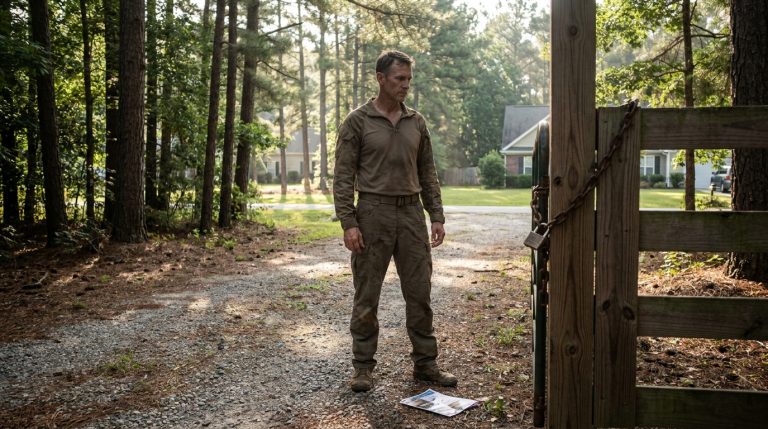
He stepped out onto the driveway. The gravel didn’t crunch right under his boots; it felt loose, shaken loose by heavy machinery.
Then he saw the yellow tail of the excavator parked across his property line.
Dale didn’t sprint. At sixty-two, with three decades of Akron Steelworks quality control stamped into his marrow, sprinting was a waste of kinetic momentum. He walked with a heavy, deliberate stride past his garage, rounding the corner to the southern slope facing Willowbrook Lake.
The Queen of Sweden roses were gone.
Fifteen years of Martha’s life—twenty-seven heirloom bushes grafted from her grandmother’s estate in Kentucky—lay churned into a greyish-brown paste. The roots had been ripped clean out of the Celtic-knot herb spiral, dangling like snapped tendons in the midday sun. The cedar meditation bench, hand-sanded and double-varnished, was split down the spine, pinned beneath a pile of shattered clay pots.
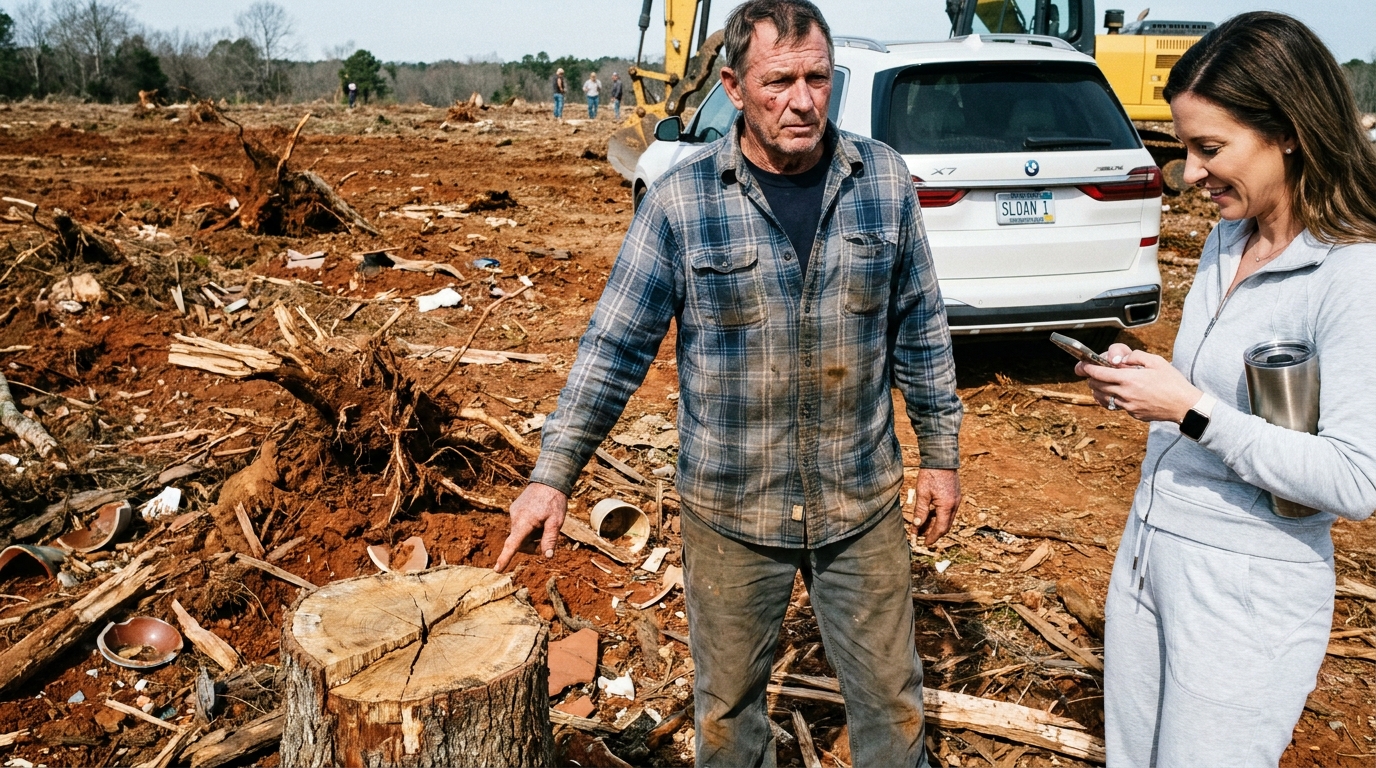
A woman stood in the center of the destruction wearing crisp grey athleisure and holding a high-end thermal tumbler. Her white BMW X7 was idling twenty feet back, its vanity plate gleaming: SLOAN 1.
“You’re on my deed,” Dale said. His voice was low, flat, missing the tremor most people expected from a grieving widower in a faded flannel shirt.
Sloan Kensington didn’t flinch. She took a slow sip from her tumbler, her manicured fingers adjusting the strap of her visor.
“Oh, Dale. You’re back.” She didn’t look at the torn earth; she looked at her phone screen, checking a notification. “Don’t get yourself worked up. That overgrown tangle was an absolute eyesore. It was dragging down the curb appeal for the entire cove.”
“That was my property line,” Dale said, his left hand coming out of his pocket to point directly at the cracked oak stump thirty feet out. “And those were heirloom David Austins.”
“The previous owner gave me verbal clearance to clear the sightline for my outdoor living extension,” she said, her tone smooth, practiced, calibrated for corporate conference calls. “I’m doing you a favor, honey. I’m putting in a dual-tier lounge and a hydro-spa. It elevates the whole neighborhood’s valuation.”
“You dumped the root systems,” Dale said, stepping closer until the smell of her floral perfume warred with the stench of engine exhaust. “Where are the plants?”
Sloan gestured vaguely toward a commercial dumpster parked at the edge of the asphalt. “Contractor hauled the scrap away. Look, if you need a referral for a clean lawn service, I have three on retainer. But we’re modernizing this strip.”
Click-slide. The caliper jaw opened inside his pocket. Four inches. Exactly the width of a boundary pin.
“I have a county survey from 2022,” Dale said quietly.
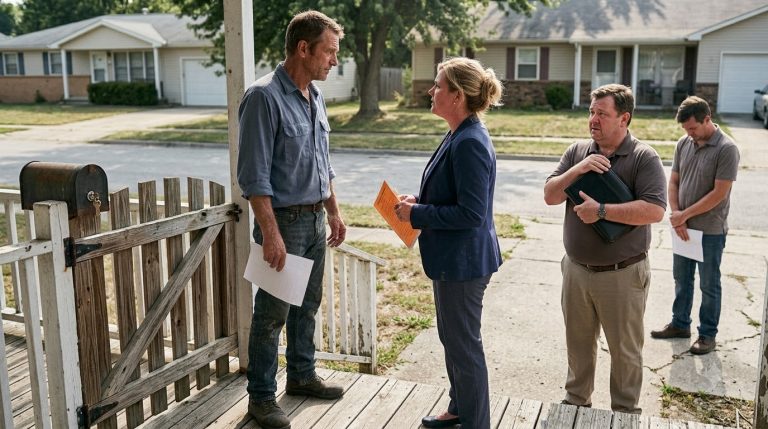
“Surveys are fluid, sweetie,” Sloan smiled, stepping around a pile of crushed pink petals without looking down. “Besides, progress doesn’t stop for sentimentality. Ask the HOA board. I was appointed district coordinator on Tuesday.”
She turned her back on him, raising her voice to call out to the excavator operator hovering near the cab. “Hey, Mike! Clear those last stumps into the pit by four! I want the concrete poured before the weekend!”
Dale stayed motionless on the perimeter of the destroyed plot. His heart wasn’t pounding; it was settling into a slow, cold rhythm—the exact operational tempo he used when a fifty-ton steel billet came off the rolling line three thousandths off-spec.
He didn’t yell. He didn’t threaten. He reached down, picked up a single torn stem holding a bruised pink petal, and rolled it between his calloused fingers until the sap ran cold against his skin.
Sloan had no idea how many measurements went into a foundation. But she was about to learn.
CHAPTER 2: THE STEEL PIN AUDIT
The diesel exhaust lingered long after the white BMW’s taillights vanished down Lakeshore Drive.
Dale opened his hand. The rose stem was a purple smear against his palm, the thorns having barely scratched the thick, leathery calluses built from thirty years of handling hot rolled steel. He wiped the sap on his work trousers, his eyes tracking the fresh tread marks left by the heavy machinery.
The excavator had bitten six feet past where Martha’s split-rail fence used to stand.
He walked to the utility shed behind his house, his boots sinking two inches into the damp grey clay. Inside, the air smelled of cedar shavings, three-in-one oil, and dry peat moss. He didn’t reach for a shovel or a rake. He grabbed a brass-headed mallet, a two-foot steel trenching rod, and a heavy-duty Bosch metal detector with an analog signal needle.
From the top shelf, next to a stack of yellowing municipal documents, he picked up the leather case containing his original Mitutoyo Caliper. The thumb wheel turned with a fluid, silent drag. Zero. Perfect calibration.
By 06:00 the following morning, the lake mist was sitting low on the water, thick enough to muffle the distant hum of the interstate. Dale stood on the edge of the property line, wearing his insulated work coveralls.
He flipped the toggle switch on the metal detector. The machine hummed, its low-frequency speaker sending a steady pulse into the quiet air.
He swept the coil six inches above the churned dirt where the rose garden had been. Three feet from the edge of Sloan’s newly poured concrete footings, the detector squealed—a sharp, high-pitched spike that pegged the needle into the red zone.
Dale dropped to one knee. He used a trowel to scrape away four inches of wet topsoil, digging until the blade struck something solid and unyielding.
It wasn’t a rock. It was the flat, ribbed top of a three-quarter-inch rebar stake capped with a yellow plastic surveyor’s button. The stamped numbers were coated in orange rust, but the raised letters were legible under his thumb: PROPERTY BOUNDARY — COUNTY RECORD 1987.
He pulled a fifty-foot steel tape measure from his belt and hooked the brass tongue over the center of the iron pin.
He walked forty feet due south toward the drainage ditch, unspooling the steel ribbon. The tape ran straight beneath the cantilevered edge of Sloan’s newly framed cedar deck, passing beneath the hot tub platform, and ending near her glass-panel patio doors.
Dale squinted through the morning gloom, comparing the physical tape with the laminated plot map resting on his knee.
The survey marker wasn’t on the border of Sloan’s deck. It was sitting twenty-three feet inside her construction zone. The entire hydro-spa, forty feet of multi-tier decking, and half her retaining wall had been erected on soil deeded to 247 Lakeshore Drive.
He picked up his brass mallet and tapped the steel rod against the pin. Clang. Clang. The tone was clear, deep, solid. The iron pin hadn’t been moved by a frost heave. It was anchored six feet into bedrock.
A sharp chime echoed from the corner of his eaves.
The motion-activated surveillance camera he’d mounted the night before whirred, its optical lens zooming in on the property line. The camera’s digital overlay displayed a precise GPS timestamp across the bottom of the feed: 06:14:22 AM — 41.1082° N, 81.5121° W.
Dale stood up, wiping the damp earth from his knees. He didn’t look up when a second-story window shade on the house next door snapped open.
Sloan stood behind the double-paned glass, framed in silk sleepwear, holding a glass mug. Her face was motionless, but her hand stayed on the edge of the blind, pulling it back just far enough to watch him measure the distance between the iron stake and her hot tub base.
Dale didn’t wave. He didn’t point. He took out his notebook, noted the exact distance down to the fraction of an inch, and closed his caliper with a clean, sharp click.
The deck wasn’t an oversight. It was a structural seizure. And every square foot of it sat on Martha’s ground.
CHAPTER 3: STRATEGIC STARVATION
The window shade on the second floor clicked shut.
Dale didn’t rush to roll up his steel tape measure. He pulled the ribbon tight, letting the metal edge bite into his gloved thumb, before allowing the spring mechanism to draw it back into its casing with a dull, rhythmic snap.
By 08:30, the mist had burned off, replaced by the thin, sharp sunlight of late autumn. Dale sat at his kitchen table, a mug of black coffee cooling beside his elbow. Spread out across the Formica surface were three decades of property documentation: the original deed from 1987, the county tax assessor’s plat map, and a freshly printed copy of the neighborhood HOA master charter—specifically the Section 12-B Covenant governing structural modifications.
Outside, a hydraulic winch whined, its high-pitched drag tearing through the quiet neighborhood air.
Dale pushed back his chair and stood. He walked to the front window, his fingers resting on the wooden sill.
A flatbed tow truck from Vance’s Automotive was idling in his gravel driveway. Its steel ramps were extended, and the operator was currently hooking a thick transport cable to the front axle of Dale’s 2008 Ford F-150.
Dale stepped out onto the porch, the screen door slapping shut behind him.
“What’s the issue?” Dale asked, his voice steady as he descended the wooden steps.
The tow truck driver, a broad-shouldered man in grease-stained coveralls, glanced up from the winch control box. He looked uncomfortable, his eyes flicking toward the white BMW parked across the cul-de-sac.
“HOA violation call,” the driver said, pulling a yellow carbon receipt from his vest pocket. “Private property blockage. Got a complaint filed through the district coordinator stating this truck’s rear bumper is encroaching six inches onto the common access lane.”
“This is my deeded driveway,” Dale said, stepping up to the winch cable. “It’s been parked in this spot for six years.”
“Look, buddy, I just take the calls,” the driver muttered, handing over the yellow slip. “She paid the dispatch fee up front and signed the municipal impound authorization. If you want it unhooked, it’s three hundred and eighty dollars in cash or certified check at the yard in Cuyahoga Falls.”
Through the driver’s side window of the BMW idling down the curb, Sloan Kensington sat with one hand on the leather steering wheel. She didn’t look directly at Dale. She was wearing oversized dark sunglasses, her chin tilted up as she adjusted the air vents, her expression entirely detached.
Dale didn’t argue with the driver. He didn’t raise his voice or reach for the cable. He pulled his wallet, extracted four crisp hundred-dollar bills from his pension withdrawal, and handed them over without a word.
“Keep the change,” Dale said flatly. “Give me the receipt with the complainant’s signature.”
The driver hesitated, then stamped the bill paid and ripped off the white copy. “You’re taking this real quiet, mister.”
“Documentation doesn’t need to be loud,” Dale replied.
He waited until the flatbed backed out and cleared the cul-de-sac before walking over to his mailbox. Inside lay three identical white envelopes from the Willowbrook Lake Estates Board. Each contained a fifty-dollar citation for noise violations logged at 07:15 AM—filed under three different variant spellings of Sloan’s maiden name.
Dale took the envelopes back into his kitchen and lined them up against the Section 12-B Covenant document.
He pulled up his laptop, opening the public property registry for Summit County. He wasn’t looking at his own parcel anymore. He was searching Sloan’s transaction history.
The records were public, but you had to know how to navigate the county’s legacy database. Thirty years in quality control meant Dale knew exactly how to track an anomaly through an audit trail.
Sloan had acquired 249 Lakeshore Drive two years prior through a contested divorce settlement. Filed under the domestic relations division was an attached financial schedule: a mandatory buyout order requiring her to liquidate or refinance $280,000 in equity to her ex-husband within sixty months.
The deadline was ninety days away.
Dale scrolled further down, cross-referencing her property tax filings with a commercial short-term rental portal. There it was—a high-resolution listing featuring the pool, the hot tub, and the multi-tier cedar deck. Luxury Waterfront Retreat — $450/night.
In three of the promotional photographs, the blurred background clearly showed Martha’s remaining Queen of Sweden rose bushes framing the edge of the hot tub deck.
Sloan wasn’t just expanding her yard. She was using his deeded soil to generate illegal short-term rental revenue, leveraging the unpermitted construction to artificially inflate her property appraisal before the court-ordered refinance deadline hit.
Without those twenty-three feet of lake frontage, her total square footage dropped below the minimum required for her mortgage underwriting. The moment the boundary was enforced, her equity vanished, triggering an immediate bank default.
Dale closed the laptop lid with a soft, solid thud.
He reached into his pocket, pulled out the Mitutoyo caliper, and set it on top of the court records.
She thought she was playing a game of intimidation. She didn’t realize she had laid her entire financial life on a foundation built three thousandths of an inch off-center.
CHAPTER 4: THE UNDERGROUND ASSEMBLY
The laptop lid settled into its rubber stops with a quiet, dense click.
Dale didn’t linger at the kitchen table. He reached for his keyring, selected the heavy brass skeleton key for the basement door, and clicked the lock open. Down in the unheated sub-basement, where the smell of cured concrete mixed with damp limestone, he flipped on the overhead fluorescent strip. The bulb flickered twice, casting long, sharp shadows across a six-foot workbench.
Pinned to the corkboard above the vice was an old blueprint from his plant days: The Akron Blueprint, detailing the heavy hydraulic lift gates used in the mill’s cooling flumes.
Dale pulled a pad of grid paper from a drawer and laid his brass ruler across it. He didn’t draft by eye; he drafted to the thousandth.
Twenty minutes later, he dialed a landline number from memory.
“Jerry?” Dale said into the receiver. “It’s Dale. I need two three-ton double-acting hydraulic rams and a compact 2,000 PSI electric pump unit. The kind we used on the flume diverters.”
On the other end, the voice was raspy, dry from forty years of shop smoke. Jerry Martinez, former chief maintenance engineer at Akron Steel, paused. “You building a dump bed, Dale?”
“I’m setting a property line,” Dale said quietly. “And I need it buried six feet deep before Friday.”
Jerry let out a low, whistling breath. “I’ll grab Tom Bradley and the skid-steer with the narrow trenching bucket. We’ll be there at midnight.”
The sky over Willowbrook Lake was black and starless when a plain white panel van and an unmarked flatbed pulled onto Dale’s gravel driveway without headlights. Jerry and Tom stepped out into the damp cold, their boots making no sound against the grass.
“She’s in Chicago until Thursday evening,” Dale said, nodding toward the dark, silent windows of 249 Lakeshore Drive. “Sales conference. Her security cameras cover her driveway and her front porch. They don’t cover the six-inch drainage gap between our lots.”
Tom Bradley, a compact man with scarred knuckles and a carpenter’s pencil tucked behind his ear, dropped a heavy roll of high-density polyethylene conduit into the mud. “Where’s the boundary, Dale?”
Dale walked to the edge of the churned dirt where the rose garden used to be. He tapped his boot against the rusted iron pin buried beneath the soil. “Right here. The line runs ninety feet straight down to the lake shore. We trench six inches on my side of the iron.”
For four hours, working under the cover of a canvas tarp suspended between three oak trees, the three men moved with silent, rhythmic discipline.
Tom drove the micro-trencher, its carbide teeth slicing a clean, eight-inch-wide channel into the grey clay, six feet deep. Jerry routed the steel-braided hydraulic lines through the buried conduit, anchoring them directly into reinforced concrete footings poured into the trench bottom.
Dale assembled the cedar fence panels inside his garage. Each six-foot section was custom-built with a structural steel core, hinged at the base to a subterranean hydraulic cradle. When collapsed, the fence lay completely flat inside a buried steel housing flush with the lawn, concealed under a layer of loose mulch and turf.
When two thousand pounds of hydraulic pressure filled the fluid lines, the cylinders would pivot upward, driving the cedar panels from underground to a vertical height of six feet in eighty-seven seconds.
By 04:30 AM, the trench was backfilled, packed down with a hand tamper, and covered with fresh mulch. From five feet away, the ground looked like nothing more than a freshly weeded flower bed running along the property line.
Dale stood near the pump house—disguised as a small wooden bird feeding station near his back porch—and tapped his phone screen.
Inside the buried steel trough, a hydraulic valve opened with a faint, buried thump. Beneath the turf along Sloan’s deck, the hidden steel framework shifted a fraction of an inch, testing the seal under static line pressure.
“Pressure holds at eighteen hundred,” Jerry muttered, checking the digital gauge inside the pump housing. “It’ll push through four inches of packed dirt, packed gravel, or anything else sitting on top of that boundary without dropping a pound of force.”
“Good,” Dale said, tightening the bleeder screw with his thumb. “Now we wait for Thursday.”
He walked Jerry and Tom out to their trucks, paying them in cash from his workbench drawer. As the panel van rolled silently down Lakeshore Drive, a cold autumn wind whipped off the water, rattling the loose plastic sheeting on Sloan’s unfinished deck extension.
Dale turned back toward the dark house, his thumb tracing the knurled edge of the brass key in his pocket. The perimeter was laid. The pressure was locked. The trap was set.
CHAPTER 5: THE MIDNIGHT BREACH
The wind howling off the cove rumbled low against the house frame.
Dale stood in the dark of his back porch, watching the rain slant across the property line. Down near the lawn edge, a silhouette moved through the gale, swinging a ten-pound steel sledgehammer in heavy, desperate arcs.
CLANG.
The blow cracked against the steel junction box Tom had mounted as a dummy line near the oak tree.
Sloan stood in her drenched grey workout fleece, her breath coming in ragged, white plumes. She raised the hammer again, her hands slick with rain, and drove the wedge head down into the electrical conduit. She swung with wild, untrained force, driven by the panic of three cancelled booking confirmations flashing on her phone screen and a court summons pinned to her dashboard.
CLANG.
The heavy metal housing fractured. A spark snapped in the damp dark, followed instantly by the sharp, bitter stench of shorted copper wiring.
Sloan let the hammer head drop to the wet grass, panting, a thin, triumphant laugh escaping her throat. She wiped the rain from her eyes, stepping back toward her deck. She thought she’d severed the line. She thought she’d killed the power.
She didn’t know about the pressure-release sensor wired inside the basement pump.
Inside the pump house beneath Dale’s porch, a solid-state relay clicked closed.
Deep underground, six feet beneath the soaked mulch, two thousand pounds per square inch of hydraulic pressure flooded the secondary fluid lines.
The ground along twenty-three feet of Sloan’s patio didn’t just shake; it parted.
With a low, deep hydraulic groan, the subterranean steel cradles pivoted upward. The buried cedar panels, backed by structural iron ribs, sheared straight through four inches of decorative river rock, through the joists of her lower lounge tier, and straight through the center of her glass-fiber hot tub shell.
The sound was like a tree trunk snapping under ice.
The composite deck boards buckled, splintering upward with sharp, rifle-shot cracks. The heavy acrylic basin of the hydro-spa split clean down the middle, four hundred gallons of steaming, chlorinated water exploding outward in a violent, foaming surge.
Water, pool noodles, and floating drink caddies swept across the ruined timber, cascading down into the grey clay ditch.
Sloan froze. The sledgehammer slipped from her numbed fingers, thudding uselessly into the mud.
Rising out of the shattered deck—exact, straight, and vertical—stood six feet of solid cedar fencing, locked into place by three-inch hydraulic rams. The top rail aligned perfectly with the GPS survey stakes, dividing her outdoor spa into two useless, flooded halves.
Dale stepped off his porch, pulling a heavy rubber flashlight from his coat pocket. He clicked the beam on, cutting through the steam and rain.
The light illuminated the fence posts, the split deck, and Sloan standing waist-deep in the cascading water, her hair plastered across her face, staring in total, paralyzed horror at the wooden wall that had just grown through her foundation.
“What did you do?” she shrieked, her voice cracking over the sound of rushing water. “What is this? You booby-trapped my yard!”
“I put up a boundary fence,” Dale said, his voice flat and steady over the roar of the draining tub. “On my deeded line. To the fraction of an inch.”
A red strobe light swept across the wet pavement of Lakeshore Drive. A county cruiser turned into the driveway, its tires crunching on the gravel, called by the automated noise sensor triggered during the sledgehammer impact.
Deputy Martinez stepped out into the rain, his flashlight beam joining Dale’s, sweeping over the sledgehammer resting in the mud, the severed decoy wiring, and the six-foot fence bisecting the ruined deck.
“Evening, Deputy,” Dale said calmly, handing over a waterproof folder containing his county permit and survey records. “Looks like we had a structural failure on the property line.”
Sloan pointed a shaking, mud-stained finger at Dale, her voice rising to a shrill scream. “Arrest him! He destroyed my pool! He built a machine under my house!”
Deputy Martinez looked at the survey map, looked at the sledgehammer sitting at Sloan’s feet, and then looked at the cedar fence standing straight as a gun barrel along the GPS line.
“Ma’am,” Martinez said, pulling a pair of steel cuffs from his belt. “I suggest you step out of the ditch and put your hands behind your back.”
CHAPTER 6: THE UNANIMOUS AUDIT
The steel bracelet clicked around Sloan’s right wrist with a dull, ratcheting snap.
She didn’t fight as Deputy Martinez escorted her up the muddy incline toward the idling patrol cruiser. Her jaw was set, her eyes hollow, her wet fleece dripping onto the back seat as the door slammed shut. The rain tapered into a thin, freezing mist that clung to the six-foot cedar panels standing straight and unyielding through the middle of her shattered deck.
Dale stood at the boundary line until the red tail lights disappeared down Lakeshore Drive. He turned off his rubber flashlight, walked into his garage, and picked up his Mitutoyo Caliper. He closed the jaws, checked the digital zero against the hard stop, and slipped it into his jacket pocket.
Seventy-two hours later, the Willowbrook Lake Estates Community Center smelled of stale urn coffee, floor wax, and damp coats.
Forty-three residents filled the metal folding chairs. At the front table, Jim Richardson sat flanked by the board secretary and the municipal building inspector.
Sloan sat three rows back, dressed in a muted navy suit, her legal counsel whispering in her ear. She kept her posture rigid, but her right hand twitched rhythmically against her leather briefcase—a nervous, involuntary motion that contradicted her cold gaze.
“Item four on the docket,” Richardson announced, tapping his gavel. “The boundary dispute and structural encroachment at 247 and 249 Lakeshore Drive.”
Sloan’s attorney stood immediately, unfolding a crisp white legal pad. “Mr. Board, my client was the victim of an unpermitted, aggressive mechanical installation that destroyed over fifty thousand dollars of personal property. We are requesting an immediate injunction against Mr. Hutchinson and an emergency assessment to cover restoration.”
Dale didn’t hire a lawyer. He walked to the podium carrying a single black three-ring binder.
He didn’t raise his voice. He opened the binder flat against the wooden lectern, revealing a laminated sheet drawn strictly from The Akron Blueprint archives and county registry seals.
“On October twelfth,” Dale said, his voice carrying clearly across the silent room, “Mrs. Kensington filed an application to extend her lower deck tier. Under the Section 12-B Covenant of this association, any structural modification within fifty feet of the lakefront requires a certified survey and board sign-off.”
He flipped to the second tab.
“Mrs. Kensington never submitted a plan because her deed was executed under a fraudulent 1987 subdivision overlay. She knew the twenty-three feet of lake frontage belonged to parcel 247 before she closed on the property. She used my wife’s grief to execute an uncompensated land grab, attempting to artificially inflate her property valuation before her court-ordered divorce refinance deadline.”
Sloan bolted upright, her face flushes of red. “That is false! That overlay was—”
“Sit down, counselor,” Richardson warned, waving a hand toward Deputy Martinez, who stood quietly near the back exit.
Dale flipped to the third tab. “The county prosecutor has finalized the audit. Mrs. Kensington’s contractors moved the certified iron survey pins—a felony under Ohio Revised Code. Furthermore, audio recordings provided by the Summit County Surveyor’s office confirm an attempted cash bribe to alter the GPS coordinates filed with the auditor.”
He laid three certified bank drafts on the board table.
“As of eight o’clock this morning, a binding settlement was signed in municipal court. Mrs. Kensington has ninety days to remove every framing joist, concrete footing, and pipe from parcel 247 at her own expense. In addition, eighty-five thousand two hundred dollars in back rent, fence installation compensation, and garden restoration funds have been deposited into an escrow account.”
The room remained dead silent for three full seconds. Then Mr. Peterson from across the street began to clap, a slow, steady rhythm that quickly swept through the entire room until forty-three residents were standing.
Sloan didn’t speak. She picked up her briefcase, her lawyer frantically grabbing his papers, and walked out the side door into the grey afternoon light without looking back.
Two weeks later, the excavators returned to Lakeshore Drive. But this time, they belonged to Tom Bradley.
They didn’t tear through the soil; they carefully lifted the broken composite boards and hauled away the cracked fiberglass tub. By the end of the week, twenty-three feet of lakefront soil had been graded, leveled, and enriched with three tons of organic compost and coffee grounds.
Dale stood in the center of the restored plot as the sun began to dip below the western treeline.
Beside him, Beth Tatum and three elderly neighbors from down the cove were unloading burlap-wrapped root balls from the back of his Ford F-150. Twenty-seven heirloom David Austin rose bushes—including six Queen of Sweden varieties shipped directly from Kentucky— lay ready for the earth.
Dale knelt in the soft, rich topsoil. His hands were dark with dirt, but his fingers were steady.
He dug the first hole twelve inches deep, measuring the clearance with his thumb. He set the root ball into the damp earth, gently packing the soil around the crown until it stood firm against the evening breeze.
A flash of bright crimson caught his eye on the top rail of the cedar fence standing quiet and secure along the true property line.
A male cardinal landed on the wood, dipping its head before letting out a clear, sharp whistle into the twilight.
Dale reached into his pocket, pulled out the Mitutoyo caliper, and laid it on the wooden bench beside Martha’s restored garden journal. The brass wheel didn’t need turning. The measurement was complete.
He picked up his coffee mug, sat back on the cedar bench, and watched the red bird sing over the fresh green shoots.