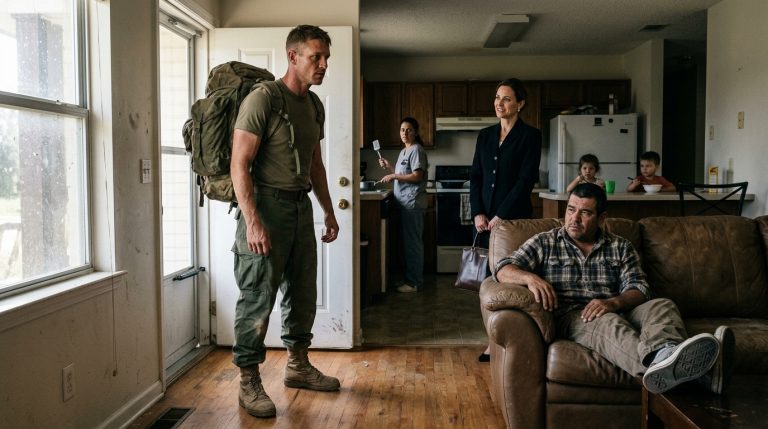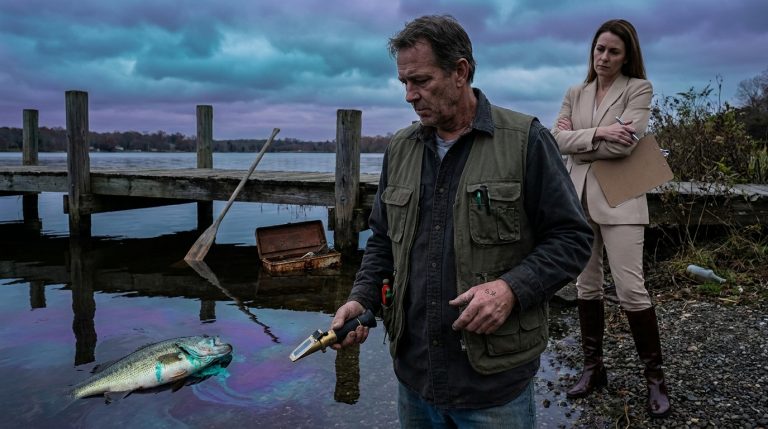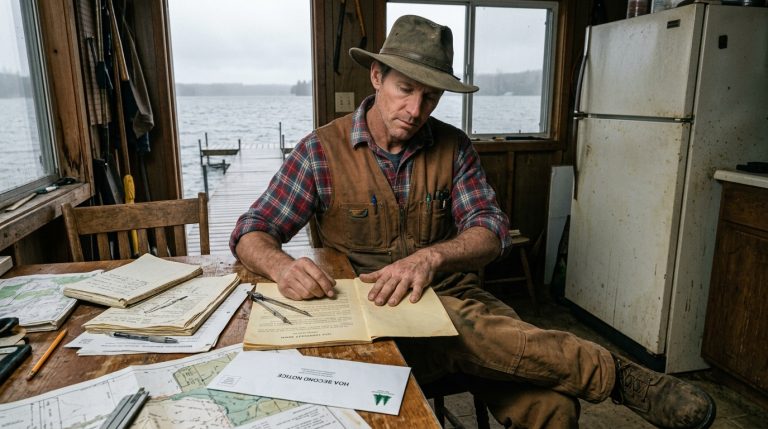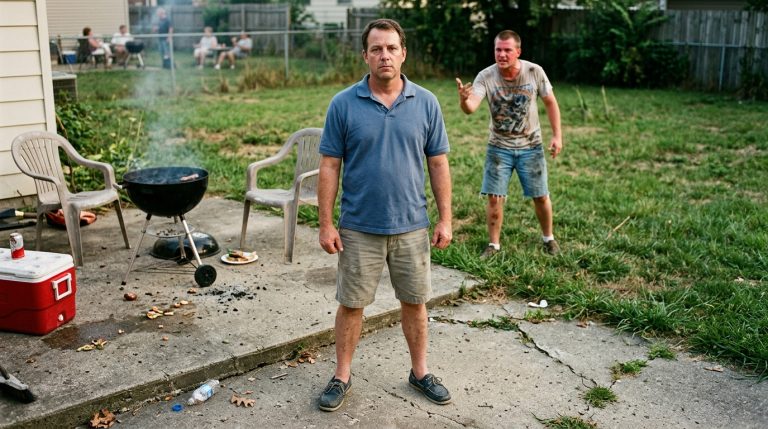
The Iron In The Soil: A Hill Country Reclamation
CHAPTER 1: DUST AND BRASS
Fresh gray gouges tore through the cedar wood.
My thumb traced the sharp edge of the scrape, feeling the raw splintered grain beneath the dry dust. Grandfather had carved STONE CREEK – 1952 into that gate post with a broad chisel after his second tour in Korea. For seventy years, the wood had weathered into a dark, iron-hard bronze. The scratches were fresh. Mechanical. Made by a stainless-steel tape measure or a surveyor’s rod.
Behind me, the engine of my ’98 Ford diesel idled with a heavy, rhythmic thrum, heat rising off the hood in shimmering waves. In the bed, my Army duffel sat under a layer of West Texas grit. Eighteen months in the dust, and the first thing waiting for me on county road 114 was a violation on my own timber.
I turned slowly.
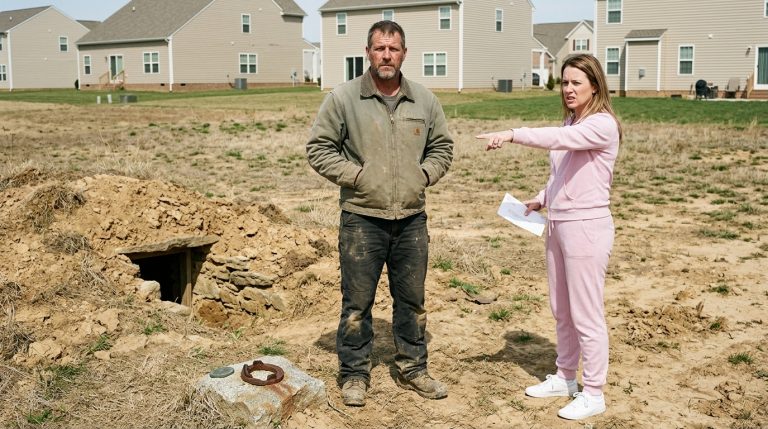
A white Mercedes sedan sat broadside across the gravel apron, blocking the iron cattle gate. Its paint job was immaculate, blinding in the Hill Country sun.
Inside, a woman with stiff blonde hair held a cell phone to her ear. Her lips moved behind the tinted glass—sharp, precise, hurried.
I didn’t reach for my keys. My hand went into my right pocket, fingers wrapping around the cold, heavy brass frame of my grandfather’s sliding caliper. I thumbed the thumb-wheel back and forth. Click. Click. Click. Three-thousandths of an inch clearance.
The car door opened. High heels clicked against the crushed limestone.
“You need to turn that vehicle around,” she said. No greeting. No introduction. Her voice had the polished, practiced cadence of a corporate sales rep reading a pitch. “You’re idling on community access property.”
I looked at her. Forty-five, crisp linen blazer, gold watch that caught the light like a mirror signal.
“This is Stone Creek Ranch,” I said. My voice sounded rough to my own ears, scraped raw by two days of interstate driving. “Gate’s mine. Road’s mine.”
“Not anymore.” She smiled, but her eyes remained cold, calculating, assessing my dust-stained work shirts and steel-toed boots like an unwelcome pest. “I am Karen Whitfield, President of the Meadowbrook Estates Homeowners Association. This entryway was annexed under county ordinance three months ago to maintain aesthetic uniformity for the subdivision.”
She tapped her clipboard. A thick stack of white bond paper rustled in the dry wind.
“You have livestock on the north pasture,” she continued, stepped closer, her perfume cutting through the smell of hot diesel and crushed cedar. “Rooster, or whatever that bull is named, is in direct violation of Section 4-B of our residential covenants. Unregistered agricultural noise and waste emissions.”
“His name is Roosevelt,” I said. My thumb locked the caliper wheel. “And he’s sat on this side of the fence since before your subdivision was a blue-sky tax shelter.”
“The law has updated, Mr. Stone,” Karen said softly. Her smile tightened, dangerous and smooth. “Your father failed to file the updated residential variance before he passed last spring. This whole sector is zoned R-1 suburban now. You are operating an illegal commercial farm in a master-planned community.”
Distance chimed down the valley. A faint, rising siren tone cutting through the oak trees.
“I’ve already contacted the Sheriff’s department,” Karen said, adjusting her sunglasses. “Officer Bradley is on duty today. He’s very familiar with our enforcement protocols. If you attempt to open that gate or move that truck onto community property, you will be cited for criminal trespass.”
I didn’t answer. I reached into the cab of the Ford, pulled out a faded leather binder from under the bench seat, and stepped toward her.
She didn’t flinch. She stood her ground on the gravel, confidence radiating from her like heat off asphalt. She truly believed the paper in her hand outranked seventy years of iron pins driven into Texas dirt.
“This is the original land patent,” I said, holding the binder without opening it. “Signed by the county commissioner in 1952. Grandfather homesteaded two hundred acres. Agricultural exemption is perpetual under Texas Property Code Section 251.”
“Obsolete,” Karen snapped, her tone shifting from polite authority to razor-edged impatience. “Our legal team at Whitfield Development reviewed the county overlay last month. You’re an island inside our perimeter now. You conform, or we fine you out of existence. Five hundred dollars a day, starting at midnight.”
Down the road, blue lights flashed through the cedar canopy. The patrol car was coming fast.
Karen didn’t look back at the lights. Her eyes stayed locked on mine, waiting for the flinch, the anger, the careless mistake that would give her lawyer leverage.
“You’ve been deployed a long time, Mr. Stone,” she whispered, her voice dropping so low the idling diesel almost swallowed it. “Things changed while you were away. This isn’t country anymore.”
I looked down at the fresh scratches on the gate post. Then at her Mercedes.
My thumb released the brass caliper. It closed with a sharp, metallic clack.
“We’ll see what the soil says,” I said.
CHAPTER 2: THE GEOMETRY OF INTRUSION
The metallic clack of the caliper jaw closing in my pocket echoed against the heavy idle of the diesel truck.
The blue lights of the cruiser didn’t splash like a warning; they cut through the heat shimmer in clean, rhythmic pulses, turning the white Mercedes into a strobe of cold ice and shadow. Gravel crunched under Goodyear tires as Officer Tom Bradley brought the squad car to a stop angled across the ditch line, pinning the access apron between us.
Karen didn’t step back. Her posture stiffened, her spine locking into the unyielding posture of a woman who viewed law enforcement as a private concierge service.
Tom stepped out, his heavy black boots planting solidly into the dirt. He adjusted his duty belt, the leather creaking in the silence. He was thirty-eight, three years older than me, with a face lined by Texas sun and two deployments in Helmand Province before he took the badge. His eyes swept the scene—the Ford, the Mercedes, the scratches on the cedar post, my hand still resting inside my pocket.
“Garrett,” Tom said, his voice flat, neutral. “Mrs. Whitfield.”
“Officer,” Karen said instantly, taking a half-step forward to control the physical space. Her voice dropped into that rehearsed, crisp pitch. “I’m glad you’re here. Mr. Stone is obstructing a public access artery and refusing to comply with a lawful residential zoning notice. He’s also operating an unregistered heavy vehicle on HOA property.”
Tom looked at her, then turned his gaze to me. “You just get back, Garrett?”
“An hour ago,” I said. “Pulled up to open my own gate. Found a car parked in the turnout.”
“It is not his turnout,” Karen interjected, her fingers tightening around her clipboard until the knuckles turned ivory. “The county realignment overlay passed by the board in March designated this entire corridor as a secondary drainage and access easement for Meadowbrook Estates. It’s marked under Project Vanguard infrastructure planning.”
The phrase hung in the air—Project Vanguard. It sounded like corporate fluff, the kind of placeholder name developers threw on pitch decks to impress regional banks. But the way her jaw twitched when she said it was a micro-action that betrayed her composure. It wasn’t just an HOA project. It was something deeper in Whitfield Development’s ledger.
Tom pulled a small notebook from his breast pocket. “Mrs. Whitfield, County Road 114 is a maintained public right-of-way. The Stone property gate has been at this exact coordinate since the 1950 survey.”
“Which was superseded,” she snapped, stepping closer to Tom. “Our legal counsel filed the updated boundary realignments with the clerk’s office. Mr. Stone’s family failed to contest the overlay within the ninety-day window. Under municipal code, that constitutes abandonment of non-conforming agricultural use.”
“My father was in a hospice bed in San Antonio ninety days ago,” I said, my voice dropping an octave, dead and level. “And county overlays don’t extinguish fee-simple land patents.”
Tom looked between the two of us. He knew the history. He’d hunted deer on the back forty of Stone Creek when we were kids. But he wore a uniform now, and in a county rapidly turning into master-planned developments, the paperwork held the gun.
“Here’s where we’re at,” Tom said, taking out a pen. “Mrs. Whitfield, you’re blocking a private agricultural gate. If Garrett needs to pull his rig through to his own homestead, you have to clear the apron.”
“I am standing on HOA land!” she said, her voice finally cracking through the polished veneer, exposing the sharp, jagged frustration underneath. “If he moves that truck onto this gravel, I will file charges for willful property destruction!”
“Tom,” I said quietly. “Look at the ground.”
Tom looked down. I pulled my hand from my pocket, holding the brass caliper, and pointed the hardened steel tip toward the crushed rock near her white designer heels.
“Three inches below that top layer of crushed limestone is a square iron pin,” I said. “Driven four feet into the limestone bedrock by my grandfather in June of 1952. The county benchmark is forty feet east, anchored to the culvert. If her surveyor shifted this line fifteen feet north to carve out her fancy entrance, he didn’t just re-establish a boundary—he committed survey fraud.”
Karen’s eyes flicked to the dirt, then back to me. A microscopic drop of sweat ran down the side of her neck, disappearing into her crisp linen collar.
“That’s absurd,” she whispered. “Our engineers are licensed.”
“So am I,” I said. “Army Corps. Infrastructure and terrain analysis. I know how to read a transit, Mrs. Whitfield. And I know when someone is lying on a plat map.”
Tom rubbed the bridge of his nose. He could smell the legal firestorm brewing, and no sheriff’s deputy wanted to be caught in the middle of a boundary war between a decorated veteran and a developer with a political war chest.
“Mrs. Whitfield,” Tom said, his tone leaving no room for negotiation. “Move the Mercedes. Let him get his truck off the road.”
She stared at Tom, then at me. Her top lip drawn thin over her teeth. “This isn’t over, Officer. He will have formal code enforcement citations on his door by tomorrow morning. Every cow, every barn, every piece of rusted junk on this property will cost him five hundred dollars a day.”
She turned on her heel, her shoes grinding viciously into the gravel, and climbed into the Mercedes. The engine purred to life, a whisper of German engineering, and she backed the car out with a violent spray of loose stone, spinning the wheel toward the gates of Meadowbrook Estates.
The dust settled slowly, coating the hood of my Ford in a fresh layer of white powder.
Tom let out a long breath, pulling his hat off to wipe his brow with the back of his forearm. “She’s not lying about the code enforcement, Garrett. Bradley Whitfield’s got two former county inspectors on his payroll now. They’ve been squeezing the old properties along the creek for six months.”
“Let them squeeze,” I said, stepping toward my truck.
“You can’t fight a developer with a 1952 deed and a bad attitude, man,” Tom said, his voice dropping into a personal tone. “They’ve got paper. They’ve got money.”
I reached for the door handle of the Ford. The metal was burning hot under the Texas sun, biting into my palm.
“Paper burns, Tom,” I said. “And money doesn’t move iron pins.”
I climbed into the cab, slammed the door, and slotted the transmission into gear. As the truck lumbered through the open gate and onto the dirt lane of Stone Creek Ranch, I looked in the side mirror.
Tom was still standing by his cruiser, watching me go. And on the gravel apron behind him, barely visible in the dust, lay a crumpled yellow slip of paper Karen had dropped—a preliminary municipal inspection notice stamped with a file code that made my eyes narrow: Ref: Quitclaim-87 / Pending Approval.
I pulled the Ford up to the main house, killed the engine, and let the silence of the ranch wash over me. But the air didn’t smell like peace. It smelled like dry brush, hot oil, and war.
CHAPTER 3: WATER RUNOFF
The yellow paper felt waxy between my thumb and forefinger.
I smoothed the crease against the hot fender of the Ford. The header was crisp, black laser print: NOTICE OF UNAUTHORIZED LAND USE & DRAINAGE ALTERATION. Down in the fine print, right above the legal signature line, sat the reference tag Tom Bradley’s squad car lights had illuminated minutes before: Ref: Quitclaim-87 / Pending Approval. Underneath it, written in red ink with a heavy, impatient hand, was a handwritten notation: Texas-Water-Board-Permit-404 pending jurisdictional review.
They were moving fast. Faster than a standard municipal code office ever operated unless someone was greasing the gears with corporate money.
I folded the slip, pushed it deep into my front pocket alongside the caliper, and walked south across the yard toward the treeline.
The grass changed thirty yards down. The dry, brittle needlegrass gave way to thick green bermuda, fed by the underground seep of Stone Creek. The air cooled instantly, dropping five degrees under the canopy of seventy-year-old bur oaks. The smell of hot motor oil and dust faded, replaced by cold limestone and crushed wild mint.
Then the rumble started.
It wasn’t thunder. It was a low, rhythmic vibration felt through the soles of my work boots before it reached my ears. A hydraulic motor whining under load.
I broke through the river birch thicket and stopped at the fence line.
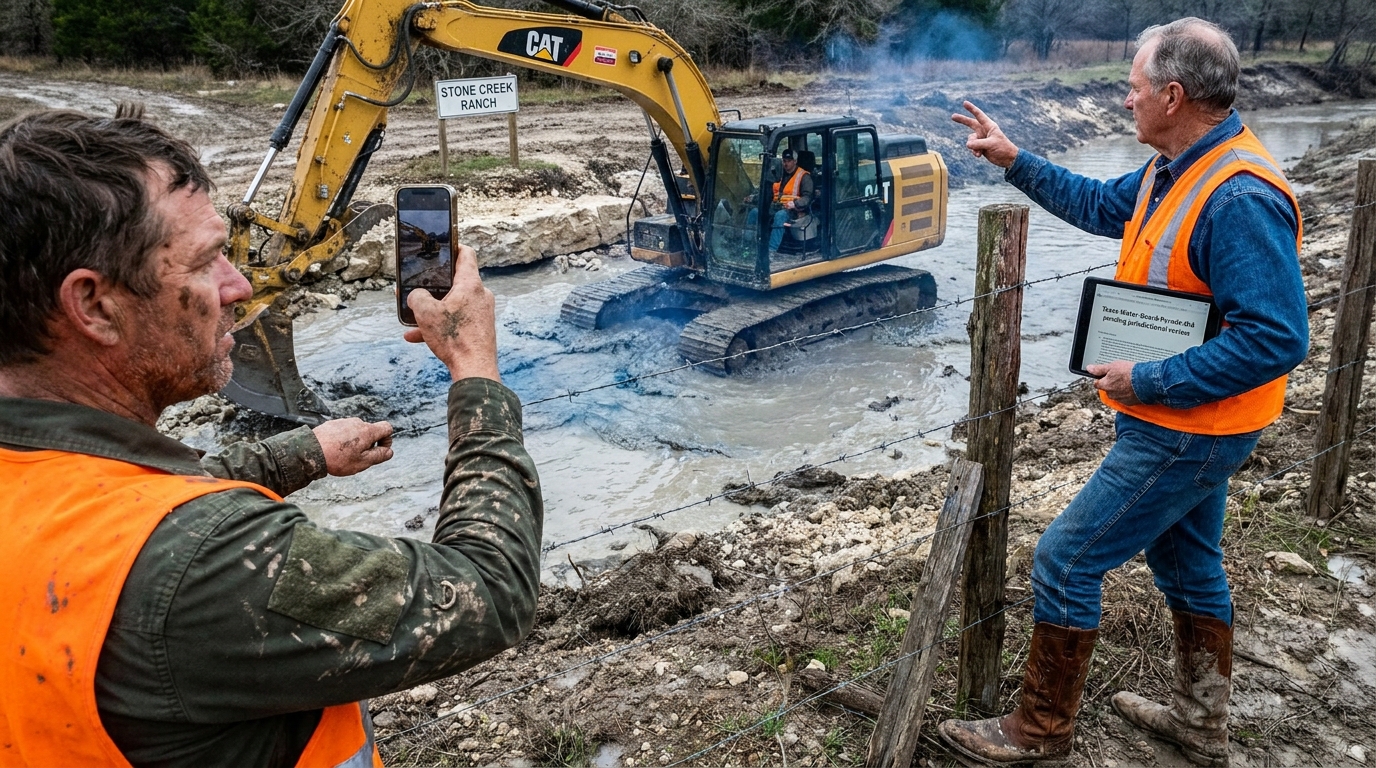
Fifty yards downstream, right on the boundary wire where my grandfather had strung four strands of barbed wire in ’52, a yellow Caterpillar excavator sat idling in six inches of clear running water. Its steel tracks had churned the pristine gravel bed into a muddy, gray slush. Diesel fumes hung heavy under the shade trees, blue and acrid.
Two men in bright orange vests stood on the bank holding survey smart-poles. Beyond them, standing on the newly graded HOA access road in a pristine hardhat, was Bradley Whitfield.
He was fifty, built like a former college athlete who had gone soft around the middle, wearing tailored denim and custom leather boots that had never touched actual mud. He held a tablet in one hand, gesturing toward the limestone ledge that formed our natural cattle crossing.
“Hold the bucket there,” Bradley called out over the roar of the diesel engine. “Clear those rocks out. We need a six-foot channel cut through to the culvert.”
“Hey!” I shouted.
The bucket stopped. The excavator operator throttled down the engine, the high-pitched turbine whine dying to a throaty chug.
Bradley turned slowly. He didn’t look surprised. He tucked the tablet under his arm and stepped toward the fence line, stopping three feet short of the barbed wire.
“Garrett,” he said. His voice was smooth, baritone, conditioned by years of bank presentations and city council hearings. “Welcome home. Sorry about the noise. We’re doing some necessary hydrological mitigation.”
“You’re track-deep in a protected Texas waterway,” I said, stepping up to the wire. “And you’re on the wrong side of the creek.”
“Not according to the revised drainage map,” Bradley replied, tapping the tablet. “The HOA board approved a flood abatement easement last week. High-volume rain events from the new paved surface upstream are backing up. We’re widening the channel to protect the properties on Oak Ridge Court.”
“You’re diverting natural flow,” I said. “This creek feeds my lower pasture. Roosevelt drinks fifty gallons a day out of that limestone pool you just filled with silt.”
“Progress requires management, Garrett,” Bradley said, his tone infuriatingly reasonable, like an uncle explaining compound interest to a child. “You can’t expect a two-hundred-acre cattle operation to choke off storm runoff for a forty-million-dollar residential development. It’s a public safety hazard. Karen’s already filed the environmental complaint with the county.”
I didn’t argue. I didn’t raise my voice. I looked past him, scanning the yellow paint on the excavator’s boom. A small metal plate near the pivot joint bore the contractor’s registry decal: Whitfield Infrastructure LLC.
He was using his own construction arm to dig out my creek, billing the HOA for the labor, and using county safety language to shield himself from trespass liability.
“Where’s your state permit?” I asked.
Bradley’s eyes narrowed just a fraction. The smooth smile stayed, but the skin around his temples tightened. “The county handles local drainage overrides.”
“The county handles culverts on public roads,” I corrected him, taking two steps along the wire until I was staring directly at the freshly cut bank. “The Texas Water Development Board handles navigable streams. This creek has riparian protections attached to the 1952 homestead deed. You cut that limestone ledge, you change the baseline water table for three miles downstream.”
“We have a provisional permit,” Bradley said smoothly, though his thumb rubbed against the edge of his tablet—an unconscious micro-action that contradicted his calm posture.
“You have a pending permit,” I said, pulling the yellow slip from my pocket and holding it up so he could see the red ink. “Permit-404. Unapproved. Which means every bucket of gravel your operator pulls out of that water is an unpermitted modification of state waters. That’s a ten-thousand-dollar-a-day federal fine under the Clean Water Act.”
The excavator operator turned his head in the cab, looking down at Bradley through the glass.
Bradley didn’t move. The air between us grew tight, stretched thin over the sound of idling machinery and the slow drip of muddy water off the excavator bucket.
“You’re out of your depth, Garrett,” Bradley said softly, dropping the friendly neighbor act. “You spent eighteen years in the Army digging ditches and reading maps. I run a fifty-million-dollar firm. My legal team has five land-use attorneys on retainer. You don’t have the capital to fight a single motion in district court.”
“I don’t need five attorneys, Bradley,” I said. “I have a phone, a camera, and the direct line to the regional enforcement officer at the Texas Commission on Environmental Quality. He was my platoon commander in Kunar.”
I pulled out my phone, stepped right up to the top strand of barbed wire, and pointed the lens at the excavator’s tracks sitting in the muddy water, capturing the contractor plate, the churned limestone, and Bradley’s face in a single high-resolution frame.
“Shut the rig down,” I said. “Or the field inspector is here before the sun drops behind that ridge.”
Bradley stared at me. The corporate charm was entirely gone now, replaced by the cold, calculating glare of a man who realized he had underestimated the terrain. He lifted two fingers toward the excavator cab.
The operator cut the ignition. The diesel engine sputtered and died, leaving only the sound of muddy water trickling over broken rock.
“This doesn’t fix your pasture, Garrett,” Bradley said, his voice quiet, dangerous. “By Monday morning, the county code enforcement team will be on your front porch with a search warrant for your workshop. Let’s see how well your grandfather’s paperwork holds up against thirty structural violations.”
He turned and walked back toward his truck, his leather boots caked in gray creek mud.
I stood by the fence, watching the mud settle slowly in the clear water. The creek was still flowing, but the water was dirty now. And downstream, right where the flow crossed under the HOA boundary line, a fresh plastic survey marker fluttered on a wooden stake—stamped with a file code that matched the yellow paper in my pocket.
They weren’t just diverting water. They were trying to force an environmental violation on my land to trigger a forced county acquisition.
I turned back toward the house, my boots sinking into the wet mud. The war wasn’t on the road anymore. It was in the soil, the water, and the paper trail.
CHAPTER 4: PAPER ARMOR
The mud in my boots sucked with a wet, heavy rhythm as I climbed the bank.
Before I even cleared the cedar ridge, the high-pitched whine of a light-duty V6 echoed off the metal barn roof. A white Ford F-150 with county seals emblazoned on the doors sat idling in the gravel turn-around, right beside my pickup.
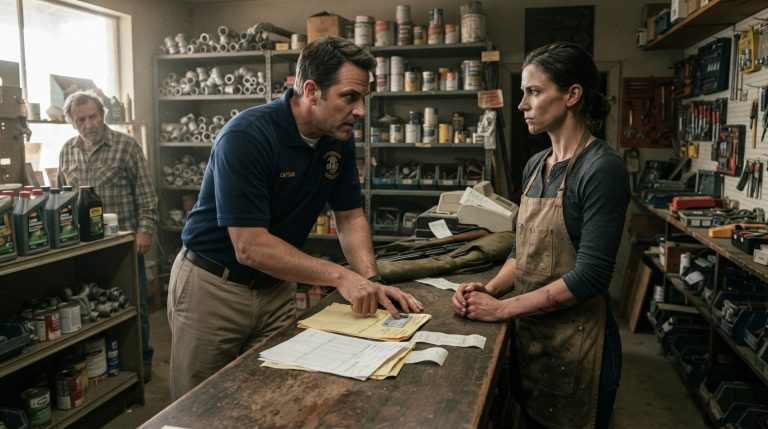
A guy in pressed khakis and a high-vis vest stood on the concrete apron of my main workshop. He held a clip-board under his arm and a digital measuring wheel in his right hand. He was taking photos of my grandfather’s 1968 Hobart arc welder with a ruggedized tablet.
I didn’t break stride. The gravel crunched under my wet work boots as I closed the fifty yards between us.
“Can I help you?” I asked.
The inspector turned. He was thirty-five, sharp-featured, with a silver name tag pinned above his pocket: D. Krueger — Municipal Code Enforcement. His boots were spotless, the leather uncreased, smelling faintly of synthetic waterproofing spray.
“Garrett Stone?” Krueger asked, pulling a stylus from his pocket. “I’m performing an administrative inspection pursuant to Municipal Safety Variance 114-B. We received multiple formal complaints regarding unauthorized commercial operations and uninspected industrial structures in a residential buffer zone.”
He didn’t hand me a copy. He just pointed the camera at the timber trusses supporting the workshop roof. Snap.
“This workshop was built in 1962,” I said, stepping onto the shade of the concrete pad. “Under County Agricultural Exemption 402. It’s an farm maintenance shop, not a commercial enterprise.”
“That exemption applied to unincorporated land,” Krueger said flatly, tapping the tablet screen with quick, practiced strikes. “Under the Meadowbrook Estates expansion overlay—specifically the Project Vanguard municipal realignment—this perimeter fell under Tier-2 residential building codes three months ago. This structure lacks a commercial fire suppression system, unapproved wiring conduits, and uncertified load-bearing roof trusses.”
He walked over to my heavy-duty bench grinder, tapping the cast-iron casing with his stylus.
“This is an uninspected commercial tool,” he continued. “Operating an unlicensed vehicle repair business carries a penalty of five hundred dollars per day per uninspected unit. You have four uncertified pneumatic lines running off that compressor.”
“I fix my own tractor,” I said. “And I fix my neighbor’s hay bailers when they shear a pin. That’s not a business. That’s living in Texas.”
“It’s a commercial violation,” Krueger replied without looking up. He reached into his leather portfolio and pulled out a bright neon-orange sticker—a municipal red-tag notice. He peeled the adhesive backing with a sharp scritch. “Until this structure undergoes a full structural engineering review by a county-approved contractor, this workshop is condemned for human occupancy.”
He reached toward the main double doors to slap the red tag across the iron latch.
My hand came out of my pocket. I didn’t grab him. I swung the heavy steel jaw of the double-doors shut with a dull, echoing clang, blocking the latch with my shoulder.
Krueger froze. His thumb stayed hovering an inch from the steel. “Obstructing a county official carries a class-B misdemeanor charge, Mr. Stone.”
“You’re using the wrong code book, Mr. Krueger,” I said softly.
I reached behind me, flipped open the wooden cabinet mounted beside the breaker box, and pulled out a laminated black binder. I dropped it onto the workbench between us. It hit the galvanized steel top with a heavy, dead thud that rattled his stylus.
“Page twelve,” I said.
Krueger frowned, his eyes flicking down to the binder. “I don’t need to review your personal records—”
“That’s my Professional Engineer license,” I cut him off, my voice dropping into that flat, unyielding cadence I used when inspecting combat bridge spans in Nangarhar. “Texas Board of Professional Engineers, License Number 114892. Specialty: Structural and Infrastructure Mechanics. Master’s Degree from Texas A&M, five years active Duty with the Army Corps of Engineers.”
Krueger’s fingers twitched against the edge of his clipboard.
“Under Texas Natural Resources Code Section 251.005,” I continued, stepping closer until he had to tilt his head back to maintain eye contact, “agricultural structures built prior to suburban annexation are governed exclusively by state agricultural building standards, not municipal residential overlays. As a licensed P.E., I am legally qualified to self-certify the structural integrity of any non-residential building on my own deeded property.”
I pulled a red ink pad and a heavy brass seal from the binder. I stamped the bottom of the laminated sheet right in front of him.
“That shop roof is rated for eighty-pound snow loads and hundred-and-twenty-mile-an-hour straight-line winds,” I said. “It’s built out of full-sawn yellow pine and three-quarter-inch steel plate. If you slap a red tag on that door without a court-ordered injunction signed by a district judge, I will file a formal complaint against your inspector license with the State Board for tortious interference and regulatory fraud within the hour.”
Krueger stared at the red ink seal. The crisp, bureaucratic confidence drained out of his face, leaving behind a tight, thin-lipped mask of annoyance.
“You think you can hide behind military paperwork?” he muttered, lowering the orange sticker.
“I’m not hiding,” I said. “I’m standing on my own concrete. Now show me the work order.”
He hesitated. For a second, his eyes flicked toward the bottom corner of his clipboard, where a printed blue cover sheet was tucked beneath his inspection forms.
I didn’t ask permission. I reached out and flipped the top page back with my thumb.
There it was. A corporate voucher stamp at the bottom of the page: Bill to Account: Whitfield Development Corp / Escrow Retainer Vanguard-09. And right beside it, typed in pale gray carbon text, was a cross-reference tag that made my chest tighten: Deed Audit Cross-Ref: Quitclaim-87.
Krueger pulled the clipboard back sharply, his face flushing dark red. “This inspection is suspended pending legal review,” he snapped.
“Make sure you tell Bradley Whitfield,” I said, stepping back from the door to let him pass. “And tell him his inspector left tire tracks on an unpaved agricultural easement.”
Krueger didn’t answer. He turned, his spotless boots kicking up gray limestone dust as he hurried back to his county truck. The driver’s door slammed shut, the engine revved high, and the white F-150 spun its tires on the gravel apron, throwing loose rock against the fence wire as he retreated toward County Road 114.
I stood under the tin roof of the workshop, the smell of hot zinc and old pine heavy in the air.
I picked up the black binder and looked down at the paper Krueger had tried to hide. It wasn’t just about zoning fines or noise complaints anymore. Whitfield wasn’t using county code officers to clean up the neighborhood—he was using them to create a paper trail of structural violations to justify an emergency land seizure under county blight ordinances.
And at the center of it all sat that eighty-seven quitclaim deed.
I walked over to the Ford, opened the driver’s side door, and picked up my cell phone. I dialed a number I knew by heart.
“Nolan,” I said when the line picked up on the second ring. “Get your coat. We’re going to the state archives in Austin.”
CHAPTER 5: THE ARCHIVES
The phone speaker crackled once in the humid silence of the cab as Nolan McCarthy’s voice rasped through the speaker. “Austin? Garrett, if we’re pulling microfiche from the General Land Office on a Friday afternoon, you better have a damn good lead.”
“I have a file code,” I said, my knuckles white against the steering wheel. “And an inspector who looked like he’d just seen a ghost when I stamped my own shop.”
Shadows stretched long across the dashboard as the Ford swept down Highway 281, the heat haze on the asphalt dissolving into seventy miles of hard pavement. The roar of the diesel engine settled into a steady, vibrating drone until four hours of heat-slicked road broke when the tires finally crunched onto the gravel parking apron of the State Library and Archives Building in Austin.
Nolan was already waiting under the limestone portico, wearing a rumpled seersucker suit that had seen thirty years of county courtroom dust. His leather briefcase was scuffed at the corners, smelling of stale pipe tobacco and menthol drops.
“Room 204,” Nolan said without greeting me, turning toward the heavy bronze doors. “I called in a favor with the assistant archivist. They pulled the 1987 Hill Country conveyance boxes before the vault locked.”
Inside, the basement reading room smelled of cold vinegar, disintegrating cellulose, and eighty years of trapped dust. Fluorescent tubes buzzed overhead, casting a sickly green glare over row after row of gray steel microfilm readers.
The archivist—a woman named Martha with thick spectacles hanging from a beaded chain—wheeled out a heavy steel cart carrying four gray cardboard archival boxes. On the side of the lead box, printed in faded blue ink, was the county survey code: Vol. 412 — Hill Country Parcel Transfers (1982–1990).
Nolan set his briefcase on the laminate table, pulled a brass magnifying glass from his coat, and sat down with a groan of old joints. “Alright, Garrett. What are we looking for?”
“File Quitclaim-87,” I said, sitting beside him. “It’s referenced on every violation notice, every drainage waiver, and Krueger’s inspection log. Whitfield keeps citing it as the baseline authority for the Meadowbrook Estates perimeter.”
Martha adjusted her glasses. “1987 was a transitional year. The county switched from hand-bound deed ledgers to microfiche reels. Half those filings were processed during the regional land boom before the oil bust.”
I pulled the first reel from Box 2 and slotted it into the glass carriage of the microfilm reader. The motor hummed, throwing a harsh square of white light onto the frosted glass screen. I spun the hand crank, sending hundreds of black-and-white deed scans whirring past in a dizzying blur of cursive ink and clerk stamps.
Click. Click. Click.
“Slow down,” Nolan murmured, his thumb rubbing against his brass magnifying glass. “There. Volume 412, Page 108.”
I backed the crank up three turns until the image locked on screen.
The document was titled Quitclaim Deed of Dedication — County Road 114 Corridor. Dated August 14, 1987. It purported to transfer twenty-five acres of unallocated timberland from the county right-of-way to a long-defunct entity called Hill Country Land Holdings Inc.—the predecessor firm bought out by Bradley Whitfield’s father in 1999.
“Look at the metes and bounds,” I whispered, pointing my thumb at the screen.
Nolan leaned closer, his magnifying glass hovering over the projected text. “Coordinates start at the culvert benchmark… runs north along Stone Creek… wait.” He stopped. His thumb locked against the brass frame. “That baseline uses the 1952 homestead marker.”
“My grandfather’s iron pin,” I said.
“Garrett,” Nolan said, his voice dropping into an icy hush. “Look at the notary seal.”
I zoomed the optical lens in two notches. The text grew large and grainy, the black ink bleeding into the white background.
The notary stamp at the bottom of the page bore a commission number from Travis County. But right across the signature line of the county commissioner, the ink was different. It wasn’t the dark, iron-gall ink used on the rest of the ledger. It was a flat, carbon black stroke—a cut-and-paste photostat copy overlay.
“They didn’t transfer county land,” Nolan whispered, his eyes wide behind his thick lenses. “The county never owned those twenty-five acres. When your grandfather homesteaded in ’52, he retained the fee-simple mineral and surface title to the entire creek loop. In 1987, the county clerk made a clerical mapping error during the road realignment, writing ‘unallocated public ground’ on a plat map that was never verified by a ground survey.”
“And Whitfield bought that paper,” I said, the realization settling into my chest like lead.
“Worse,” Nolan said, pointing to a small reference stamp in the top right margin that both of us had almost missed: Linked Filings: Project Vanguard Master Trust / Texas-Water-Board-Permit-404 Ref. “Whitfield’s firm found the clerical mistake fifteen years ago when they bought out Hill Country Land Holdings. Instead of clearing the title or buying the acreage from your father, they filed Quitclaim-87 to cover the gap. They knew the title was defective.”
“Why?” I asked. “Why build an eight-hundred-thousand-dollar entrance and a community center on land with a broken title?”
“Because they needed forty contiguous acres to qualify for the multi-million dollar bank loan that financed the entire Meadowbrook Estates development,” Nolan said, his finger tapping the frosted glass screen until it vibrated. “Project Vanguard isn’t an infrastructure upgrade, Garrett. It’s a corporate asset-backed loan pool. The bank holds the mortgage on the entire subdivision based on a title guarantee that relies on this exact paper.”
He looked up from the machine, the green fluorescent light catching the deep lines in his face.
“If Quitclaim-87 is invalid,” Nolan said softly, “the developer doesn’t just lose the entrance. The entire subdivision title is uninsurable. Whitfield Development committed corporate bank fraud when they pledged your twenty-five acres as loan collateral.”
I sat back in the wooden chair, the motor of the microfilm machine humming in the quiet basement.
Layer 1 was gone. It wasn’t a zoning dispute. It wasn’t an HOA president trying to clean up a neighborhood, or a minor boundary line squabble between neighbors.
The entire Meadowbrook Estates development was built on a lie—a twenty-five-acre stolen foundation that my grandfather’s 1952 land patent still legally covered.
“Nolan,” I said, my voice dangerously calm as I stood up from the table. “How fast can you draft a quiet title action and a notice of trespass?”
Nolan closed his briefcase with two sharp, metallic snaps. “I can have the filing stamped by the district clerk before nine o’clock Monday morning. But Garrett… once you serve this paper, Whitfield isn’t going to send code inspectors with clipboard stickers anymore. You’re threatening to collapse his entire corporation.”
I reached into my pocket, my fingers wrapping around the brass caliper.
“Let him come,” I said. “He’s standing on my dirt.”
CHAPTER 6: CONCRETE AND IRON
The steel jaw of the caliper pressed flat against my palm, cold and unyielding against my skin.
Nolan’s leather shoes clicked down the granite steps behind me, his breath coming in short, heavy rasps. “Remember, Garrett. Monday o’clock district clerk. We file the quiet title action first. You do not engage them until the injunction hits the docket.”
Shadows stretched long across the asphalt as the Ford roared out of Travis County, the heat haze on Highway 281 dissolving into seventy miles of dark, open Texas road. Dawn broke over the Hill Country in a long streak of bruised purple and rust, four hours of silent driving ending when my tires crunched onto the limestone turn-around at County Road 114.
I didn’t turn into the driveway. I pulled the Ford crosswise over the gravel apron, cutting the ignition.
The white Mercedes was already there, parked five feet from my cattle gate with its high beams burning through the morning mist. Beside it sat Bradley Whitfield’s black Yukon and a flatbed trailer loaded with yellow steel road barriers.
Karen stood on the shoulder in a dark business suit, her arms crossed tight against her chest, a thick manila folder held under her arm like a shield. Bradley stood by the trailer, his tailored sleeves rolled up, speaking low and fast into a cell phone while two workers in work boots unloaded concrete parking stops.
“Mr. Stone,” Karen said, her voice cutting clean through the damp air as I opened the truck door. She didn’t smile this time. Her composure was gone, replaced by an icy, razor-edged velocity. “You are in direct violation of a municipal infrastructure order. Whitfield Development is installing permanent access barriers along this easement pursuant to the Project Vanguard development plan.”
I walked to the back of my pickup, unlocked the tailgate with a loud, metallic clack, and pulled out a fifty-foot coil of five-eighths-inch hardened alloy chain and a heavy-duty yellow Master Lock.
“Bradley,” I called out, ignoring her completely.
Bradley stopped talking into his phone. He lowered the device slowly, his thumb rubbing against the glass screen—the same tell he’d shown at the creek.
“You’re making a mistake, Garrett,” Bradley said, stepping toward the wire fence. “Our legal team spent all night reviewing the county overlay. The easement dedication stands. You block this turn-around, and the county sheriff will have you in handcuffs by noon for obstructing a public utility corridor.”
“Your legal team reviewed the wrong ledger, Bradley,” I said. I dragged the heavy steel chain out of the bed, the links rattling like iron teeth against the tailgate. “They looked at the microfiche. They didn’t look at the deed.”
Karen stepped forward, her heels grinding into the loose crushed rock. “File Quitclaim-87 is a recorded county conveyance! It grants our corporate entity sole ingress and egress rights for this entire sector!”
“Quitclaim-87 is a forged photostat overlay,” I said, my voice dead level as I wrapped the first loop of chain around the 1952 cedar gate post. “Filed in August of eighty-seven over a clerical mapping error. The county never held title to these twenty-five acres. My grandfather retained fee-simple surface and mineral rights under his original land patent.”
Bradley froze. The color drained from his face so fast it looked like he’d been struck. “What are you talking about?”
“Project Vanguard,” I said, looping the heavy chain through the iron spokes of my cattle gate and pulling it taut. “You pledged these twenty-five acres as unencumbered loan collateral to secure your multi-million dollar master financing package. You didn’t just trespass on my pasture, Bradley. You committed corporate bank fraud.”
Karen looked at her husband, her brow furrowing in sudden, sharp confusion. “Bradley? What is he talking about? The title insurance cleared the Vanguard parcel three years ago.”
Bradley didn’t look at her. His eyes stayed locked on mine, wide and bloodshot in the morning light. “You can’t prove that. The county clerk’s office stamped that filing.”
“Martha at the State Archives disagrees,” I said. “And so does Nolan McCarthy. He’s standing in front of the district judge in Johnson City right now with the 1952 patent, the 1987 microfilm ledger, and a certified copy of Texas-Water-Board-Permit-404 showing your unpermitted creek diversion.”
The silence that fell over County Road 114 was absolute, broken only by the low, distant lowing of Roosevelt from the lower pasture and the slow drip of condensation off the Mercedes bumper.
The two workers on the flatbed trailer stopped moving. One of them looked at Bradley, then dropped his work gloves onto the wooden deck. “Boss… is this private property?”
“Get back to work!” Karen snapped, her voice cracking into a high, hysterical pitch. “He’s bluffing! He’s a disgraced veteran trying to shake down a legitimate development!”
“He’s not bluffing, Karen,” Bradley said quietly. His voice sounded hollow, completely deflated, stripped of every ounce of corporate authority. He let his cell phone drop into his coat pocket. “He found the baseline.”
“What?” she whispered, turning on him, her fingers digging into her manila folder until the paper crumpled. “What do you mean he found the baseline? We spent six hundred thousand dollars on those entrance pillars!”
“Built on my soil,” I said.
I pulled the chain tight, slotted the heavy Master Lock through the final link, and snapped the shackle home. The iron lock closed with a dull, heavy click that echoed off the cedar trees.
I turned around, stepping up to the wire fence, three feet from where Bradley stood.
“You have two choices, Bradley,” I said softly, the words coming out slow, precise, and unyielding. “You can leave your heavy equipment on this turn-around and let the district judge issue an emergency injunction that freezes your entire corporate credit line by two o’clock today. Or you can load your concrete, pull your Mercedes off my gravel, and instruct your HOA board to sign a full lease agreement for the entrance road at ten times the agricultural rate.”
Bradley stared at the yellow Master Lock hanging from the iron chain. His jaw worked silently, his chest rising and falling in shallow, desperate breaths. He knew the math. If the bank caught wind of the defective title on Project Vanguard, every credit facility his firm held in the county would be called in before the weekend.
“How much?” Bradley rasped.
“Bradley!” Karen screamed, her face flushed dark red. “Are you out of your mind? We don’t negotiate with him!”
“Shut up, Karen!” Bradley shouted, turning on her with a sudden, violent desperation that made her take a step back, her heels slipping on the limestone dust. “He has the original patent! If this hits the news, the bank forecloses on the whole subdivision!”
He turned back to me, his hands shaking slightly as he shoved them into his pockets. “How much, Garrett?”
“Nolan will send your attorney the paperwork by noon,” I said. “It includes a permanent conservation easement along Stone Creek, the immediate withdrawal of every municipal code citation, and a formal public apology to this county for regulatory harassment.”
Bradley looked down at his mud-stained leather boots, then nodded once—a single, sharp jerk of his head. “Get the truck loaded,” he told the workers, his voice barely a whisper. “We’re done here.”
He turned and walked back to his Yukon, his shoulders slumped, looking twenty years older than he had three days ago. Karen stood alone on the apron for a long moment, staring at me with pure, unadulterated hatred, before she slammed her manila folder onto the hood of her Mercedes, climbed into the driver’s seat, and spun her wheels in a cloud of white dust, fleeing down the road toward the gates of Meadowbrook Estates.
The dust settled slowly over the turnout.
The workers drove the flatbed away, the rumble of their diesel engine fading down the valley until the countryside returned to silence.
I stood by the post, breathing in the cold morning air. It smelled of wet earth, crushed cedar, and the clean, running water of Stone Creek flowing undisturbed over limestone bedrock.
I reached into my pocket, pulled out the brass caliper, and set it on the flat top of the cedar gate post. I picked up a small steel file from my truck bed, held the post firmly, and began smoothing away the fresh scratches Karen’s surveyor had left on the old wood.
File. File. File.
Metal against timber. Rough cedar turning smooth under my hand, restoring the carved numbers my grandfather had cut seventy years ago: 1952.
Roosevelt lumbered up to the fence line, his massive head resting over the top wire, his dark eyes watching me work. He let out a long, quiet breath that misted in the morning cool.
I finished the edge, put the file back in my toolbox, and picked up the caliper. I slipped it into my pocket, resting my palm against the cool metal frame.
The fence was built. The iron pins were solid. And the land was still ours.