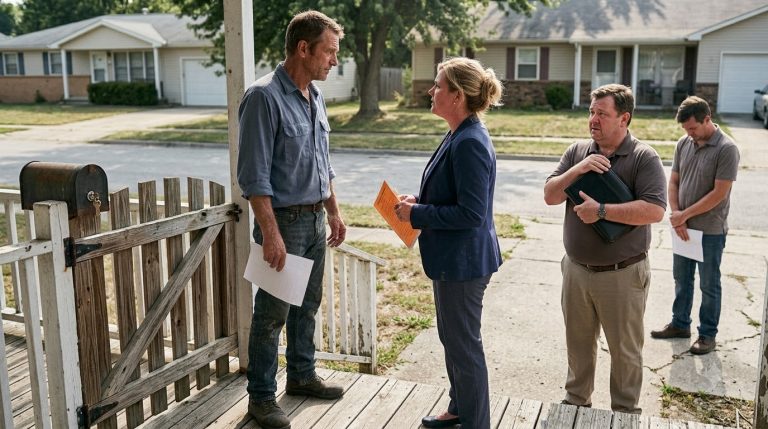
The Iron Perimeter: How a Retired Firefighter Stood His Ground Against a Corrupt Suburban Empire
CHAPTER 1: The Frost on the Driveway
The silence of Maple Hollow Estates wasn’t the kind born from peace; it was the manufactured quiet of a loaded gun resting on a velvet table.
Mark stood barefoot on the edge of his own gravel drive, the wool of an old fire and rescue sweatshirt bunching around his collar. A thin grey curl of steam drifted from the rim of his ceramic mug, rising into the biting air of an October dawn. His toes had gone numb five minutes ago, though he didn’t shift his weight. He knew the look on a cop’s face when they were walking into a setup they hadn’t bothered to verify. It was the same hollow, tight-jawed expression he had seen a hundred times on rookies stepping up to a smoke-choked door for the first time.
Across the asphalt, standing precisely three feet outside the property line on manicured turf, Claudine Mercer held her clipboard like a magistrate presenting a death warrant. Her sunglasses were oversized, opaque shields reflecting the flashing amber lights of the cruiser parked diagonally across his entrance. Her pastel blazer looked entirely out of place against the raw, rotting timber of Mark’s leaning old barn, a stark division between synthetic order and lived-in weight.
“That man is trespassing on HOA property,” Claudine called out, her voice engineered to carry across the damp morning air with absolute certainty. She lifted a polished fingernail, pointing directly at his chest as if the gesture alone had physical mass.
The younger officer nearest to him blinked twice, eyes darting from Mark’s bare feet to the notepad clutched in his trembling gloved hand. “Sir,” the rookie began, his voice pitching slightly upward with forced official weight, “we got a call about an unauthorized individual refusing to vacate a common buffer zone.”
Mark didn’t blink. He lowered his mug slowly, letting the dark surface of the coffee settle. Twenty years of running into burning buildings while Tulsa turned its back had taught him one immutable law: the noise never matters until the heat changes.
“If this is trespassing,” Mark said, his voice flat, gravelly, and entirely devoid of panic, “I’ve been breaking the law every morning for six months. And let me tell you, the coffee’s better on this side of the line.”
The older officer, a weathered sergeant with graying temples who had been leaning against the cruiser door, pushed off the metal frame. He didn’t look at Claudine. Instead, his eyes locked onto Mark’s posture—the absolute lack of defensive twitching, the steady, measured drop of his shoulders. Experience recognizes experience.
“You got ID for this address, mister?” the sergeant asked, stepping past his rookie partner.
Mark didn’t reach for his pockets. He turned his heel against the loose stones, walking two deliberate paces to the bottom wooden step of his porch where a heavy manila folder lay pinned beneath a rusted cast-iron wedge. He lifted the tab. Inside, the county clerk’s stamp stared back, the red ink crisp and unyielding against the cream stock of the original deed.
He handed the folder across the property line, his fingers brushing the cold air between them. The sergeant flipped the cover back, his thumb tracing the embossed seal. A slow, heavy silence settled over the driveway, broken only by the distant idle of the patrol car’s engine.
Across the street, the rigid alignment of Claudine’s posture fractioned. Her hand dropped an inch from its accusatory angle, the pastel fabric of her sleeve shifting as her fingers tightened white-knuckled around her clipboard. She took a half-step forward, her heels clicking sharply against the municipal concrete, opening her mouth to override the silence before the sergeant could speak.
CHAPTER 2: The First Notice
The sergeant’s thumb did not move. He stood on the damp gravel, his eyes tracking the red ink of the county clerk’s stamp across the heavy cream stock, measuring the weight of an official seal that had outlasted every subdivision built on the county tax rolls.
Across the dividing line, the sound of Claudine Mercer’s heel scraping against the municipal asphalt cut through the morning air like dry pine snapping under a boot.
“That document is irrelevant,” Claudine said, her voice rising an octave, stripping away the polished insulation she usually wore like armor. She took another step forward, her pastel blazer catching the amber glare of the cruiser’s flashing lights. “The master covenants for Maple Hollow Estates supersede county plats filed prior to the 2004 incorporation. That structure, that gravel, that entire approach—it violates Section Four, Paragraph B of our community bylaws.”
The sergeant didn’t look up from the deed. He tilted the paper slightly, catching the early morning light to check the embossed texture against the grain. “Lady,” the sergeant said slowly, his voice flat, “the county clerk’s office is three miles down the road. This paper says Mr. Reeves owns the land his house sits on, and it includes sixty feet of this drive. It doesn’t say anything about your bylaws.”
“Because the association wasn’t properly notified of the historical carve-out during the secondary zoning shift!” Claudine’s hand snapped upward, the tip of her clipboard narrowly missing the young rookie’s nose. Her eyes flashed behind the oversized sunglasses—not with confusion, but with the frantic, calculating edge of someone whose entire architecture of control was suddenly tilting on its foundation. “Ask him about the barn. Ask him about the unauthorized outbuildings. He has no permit for commercial-grade storage.”
Mark took a slow sip from his mug. The coffee had cooled, losing its bite, but the ceramic remained warm against his palms. A phantom scent drifted past him on the cold draft—not woodsmoke, but the chemical tang of melted plastic from that Tulsa warehouse he’d hosed down on Christmas Eve twenty years ago. The smell of things burning from the inside out while people stood outside in the snow, watching their investments turn to ash, swearing they had everything insured.
“It’s a barn,” Mark said, his voice dropping an octave, dragging the focus back down to earth. “It was here when Ronald Reagan was in office. If it’s commercial, someone forgot to tell the swallows nesting in the rafters.”
The younger officer looked from Claudine to Mark, his hands hovering uncertainly near his utility belt. “Uh… Sergeant? What do we—”
“We write up a civil non-action report,” the sergeant interrupted, handing the manila folder back to Mark with a sharp, controlled motion. He met Mark’s eyes for a fraction of a second—a brief, unspoken acknowledgment between men who understood that paper only has power if you let it burn you. “Property dispute. Take it to municipal court if there’s a boundary contest. This isn’t a police matter.”
The sergeant turned his back on Claudine before she could draw another breath, his boots crunching over the gravel as he climbed back into the cruiser. The door slammed shut with a heavy, final thud. The amber lights flickered off, leaving the gray morning to settle back over the acreage like a wet wool blanket.
Claudine stood frozen for three heartbeats, her chest rising and falling beneath the pastel fabric in short, jagged motions. Then, she pulled a small leather-bound notepad from her coat pocket, her pen scratching against the page with enough force to tear the paper.
“You think this is finished, Mr. Reeves?” she called out, her voice dropping into a low, venomous register as she spun on her heel and marched back toward her idling white Lexus. “The association has teeth you don’t even know exist. Enjoy your morning coffee.”
The Lexus gravel-spun out of the cul-de-sac, its tires spitting small grey stones against Mark’s fence line.
Mark didn’t watch her leave. He looked down at the manila folder in his hand, feeling the thickness of the stack. Sonia was right about one thing—people who built their entire lives out of rules usually had something heavy buried underneath the floorboards. He walked back up the wooden steps, pushing the front door open into the dim warmth of the kitchen.
On the kitchen island sat the white envelope that had arrived yesterday morning, its gold-scripted logo gleaming under the overhead light. Violation Notice: Final Remediation Warning. He picked it up, sliding his thumb beneath the sealed flap. Inside wasn’t just a fine; it was a certified demand for compliance, threatening a statutory lien if the property wasn’t brought up to Maple Hollow standards within fourteen days.
Fourteen days.
Mark tossed the envelope onto the table next to the county plat map. He pulled out a black marker, uncapped it with his teeth, and drew a thick, unbroken line around the exact perimeter of his four acres, sealing his boundaries against the blue-shaded digital map the HOA had printed off their website.
The front gate sensor chimed—a low, mechanical ping from the old driveway bell he’d wired up the second week he moved in.
Mark looked out the window. A heavy-duty postal truck was idling by the mailbox at the edge of the property line. The driver didn’t get out; he simply tossed a thick, square package onto the gravel near the post and drove off without looking back.
Mark set his mug down, the ceramic clinking sharply against the wood. He walked down the steps, his bare feet meeting the cold stones of the drive. The package wrapped in brown butcher paper was heavy, secured with thick nylon twine. There was no return address. Just a string of typed numbers stamped across the front label.
He knelt in the damp dirt, cutting the twine with his pocketknife, and pulled back the paper. Inside sat a stack of photocopied bank ledgers, stamped with the routing numbers of a regional credit union, accompanied by a single typewritten note: You’re looking at the wrong fence, firefighter. Check where the money goes.
CHAPTER 3: The Blueprint of a Land Grab
The brown butcher paper felt heavy against Mark’s palms, the texture coarse and damp from the morning air. He remained kneeling on the loose gravel of his drive for three seconds after the postal truck’s tires chewed away into the distance, listening to the engine whine down the asphalt curve of Maple Hollow Estates before fading entirely into the backdrop of suburban quiet.
He didn’t open the bundle on the ground. Instead, he gathered the twine ends in one hand, stood up, and carried the package back up the wooden steps of the porch. The floorboards groaned under his weight—a familiar, settling timber sound that had anchored him through five months of isolation.
Inside the kitchen, the overhead light hummed a low, synthetic frequency. Mark set the bundle next to the county plat map, the black marker lines he had drawn earlier cutting a bold boundary across the paper. With his pocketknife, he sliced through the nylon twine, peeling back the thick paper to reveal a stack of photocopied bank ledgers and a thin, folded sheaf of regional credit union routing sheets.
There was no polite welcome brochure this time. No gold-embossed script welcoming him to the community.
Mark pulled out a single page near the middle, his thumb tracking down a column of figures marked Community Enhancement Fees. The numbers didn’t align with standard municipal utility maintenance. They looped in and out of a secondary corporate account registered under a localized shell name—Maple Hollow Management LLC—with a signature line at the bottom that matched the sharp, severe scrawl Claudine Mercer had used on every notice taped to his gate.
He reached for his coffee mug, found it empty and cold, and set it down without drinking. Twenty years of fire investigation taught him how to read the ghost trails of a burn pattern: you don’t look at where the flames are roaring; you look for where the fuel was poured before anyone struck a match. The HOA wasn’t just managing architectural compliance. They were running a closed-loop siphon, and his four acres—sitting right at the western throat of the development—were the last unmapped property blocking their expansion corridor into the county tax breaks.
A soft tap against the front window made him look up.
A gray stray cat, its fur matted with burrs, sat on the porch railing, staring at him through the glass with unblinking yellow eyes. Beyond the porch, the white Lexus was nowhere in sight, but the silence hanging over the cul-de-sac felt heavier now, charged with a different kind of static.
Mark didn’t hesitate. He pulled his phone from the pocket of his fire and rescue sweatshirt, unlocked the screen with a stiff thumb, and dialed a number he had saved three weeks ago after a brief conversation at the local hardware store.
The line rang twice before a crisp, professional voice answered. “Sonia’s office.”
“Sonia,” Mark said, his voice flat and steady against the hum of the kitchen light. “It’s Mark Reeves. I’ve got a stack of bank ledgers on my kitchen table that suggest our friend Claudine isn’t just worried about my fence line.”
There was a brief pause on the other end, the sound of paper shuffling against a wooden desk. When Sonia spoke, her tone dropped into something sharp and focused. “What kind of ledgers, Mark?”
“The kind that show community enhancement fees routed straight into a private account,” Mark said, leaning over the table, his eyes tracing the columns of unauthorized withdrawals. “And they’ve been using fake zoning maps to justify the land grab. I think it’s time we open a proper war room.”
Another pause, shorter this time, followed by the dry click of a pen cap being removed. “I’ll be at your place in twenty minutes, Mark. Put the coffee on—and don’t sign anything if another notice shows up before I get there.”
The line clicked dead. Mark lowered the phone to the table, his gaze shifting back to the window where the gray cat had already slipped away into the shadows of the old barn. The air inside the kitchen felt dry, smelling faintly of old paper and diesel fuel. He picked up his black marker, uncapped it, and drew a second, darker circle around the shell account routing numbers on the ledger. The perimeter was shifting. The fire was no longer outside the gate; it was burning right in the middle of the floor plan.
CHAPTER 4: The Shadow in the Lexus
The black ink of the marker smelled faintly of solvent, sharp and medicinal against the stagnant air of the kitchen. Mark didn’t cap the marker immediately. He kept his fingers braced against the edge of the laminate table, staring down at the photocopied bank ledgers that had materialized on his doorstep like a silent flare in the dark.
Twenty minutes wasn’t long to wait, but in a house stripped down to bare necessities after five years of widowed isolation, every minute stretched like a tendon under strain. He walked away from the table, his bare feet making no sound on the floorboards, and pulled the kitchen curtain back two inches.
Outside, the morning frost was beginning to sweat under a pale, watery sun, turning the gravel drive into a sheen of grey moisture. But it wasn’t the weather that caught his eye. Fifty yards down the road, parked half-shadowed beneath the low-hanging branches of a neighbor’s ornamental maple, sat the white Lexus. The tinted driver’s side window was rolled down an inch, just enough to catch the reflection of the morning light on glass. No one moved inside, but the machine idling there was a sentinel of pressure—a quiet reminder that the perimeter was being watched, measured, and systematically eroded.
Mark let the curtain fall back into place. He didn’t feel anger; anger burned too fast, sputtering out like wet kindling when things got hot. Instead, he felt that familiar, cold focus he used to get when suiting up in the rear of Engine Four while the radio crackled with a third-alarm roof collapse. You don’t fight the smoke; you look for the anchor points.
A soft crunch of gravel outside broke the silence—not the heavy whine of a postal truck, but the precise, deliberate click of a car door closing with heavy German engineering.
Mark turned from the window as headlights swept across the lower pane of glass, painting pale bars across the kitchen wall. A moment later, two firm raps sounded against the front door wood—not the timid tap of a neighbor, but the double-knock of someone accustomed to walking into hostile rooms and demanding answers.
He crossed the room in three strides and pulled the door open.
Sonia stood on the porch, her navy suit jacket buttoned against the chill, her briefcase held in a gloved hand. Her expression was neutral, but her eyes were sharp, scanning the perimeter toward the parked Lexus down the road before locking onto Mark’s face.
“You didn’t answer my text,” Sonia said, stepping past him into the warmth of the hall without waiting for an invitation. Her heels clicked sharply against the floorboards as she walked straight into the kitchen, shedding her leather gloves onto the counter. “And from the look of that white sedan down the cul-de-sac, our friend is stepping up her timeline.”
“She’s nervous,” Mark said, closing the heavy wooden door behind her and throwing the deadbolt with a solid, echoing thud. “People only start crowding the fence line when they realize the ground underneath their feet is hollow.”
Sonia stopped in front of the table, her gaze dropping instantly to the spread of photocopied bank ledgers and regional credit union routing slips scattered around the county plat map. She didn’t touch them right away; she leaned down slightly, her eyes tracking the columns of figures where the Community Enhancement Fees looped through the shell account labeled Maple Hollow Management LLC.
“Where did you get these, Mark?” she asked, her voice dropping into a professional register, completely stripped of casual warmth.
“Left on the drive this morning wrapped in butcher paper,” Mark replied, pulling out a wooden chair and sitting down opposite her. “No return address. Just a note telling me to look past the fence line.”
Sonia reached into her briefcase, pulled out a pair of wire-rimmed reading glasses, and slipped them on. She didn’t look surprised. She pulled a yellow legal pad and a silver pen from her bag, dragging the ledger closer to her under the overhead light.
“This isn’t just an internal bookkeeping discrepancy,” Sonia muttered, her pen hovering over a row of unauthorized withdrawals totaling over a hundred and sixty thousand dollars within eighteen months. “If these routing numbers trace back to the primary community escrow account, Claudine isn’t just violating association bylaws. She’s running a systemic diversion scheme under the cover of municipal architectural enforcement.”
She looked up, her gaze meeting Mark’s across the cluttered table. “She’s using fake zoning citations and threats of liens to keep everyone in the neighborhood too terrified to look at the books. But if these ledgers are clean—if we can legally subpoena the regional credit union—her entire administrative firewall collapses.”
Before Mark could answer, a sharp rap echoed from the front porch—heavier this time, accompanied by the distinct sound of someone rattling the brass handle of the front door.
Sonia froze, her pen poised over the paper. Mark stood up slowly, his eyes fixed on the grain of the front door as the handle rattled again, followed by a muffled, frantic voice calling out from the porch.
“Mr. Reeves! Open the door, please—it’s Miguel. She’s changing the locks on the common gate!”
Mark didn’t look back at Sonia. He stepped out of the kitchen into the narrow hallway, his boots hitting the floorboards with a heavy, deliberate rhythm, carrying him toward the front door where the next fire was already being lit.
CHAPTER 5: The War Room Opens
The brass door handle rattled a second time, loose in its strike plate, accompanied by the muffled scrape of a boot sole against the wooden porch boards.
Mark didn’t wait for Sonia to follow. He reached the heavy oak door in three long strides, his fingers wrapping around the cold iron latch and throwing it open.
Miguel stood on the threshold, his breath pluming white in the chill morning air, his contractor’s jacket zipped high against his chest. His hands were empty, raw-knuckled and stained with dark grease at the cuticles, his eyes darting back toward the access road where Maple Hollow Estates transitioned into public asphalt.
“They’re putting a chain across the south utility easement,” Miguel said without preamble, his voice tight, dropping into a harsh whisper. “A heavy-link steel chain with a combination padlock. Claudine’s husband brought the posts in an hour ago while the delivery trucks were backed up. If they lock that gate, my equipment stays trapped on the other side of your line.”
Mark stepped out onto the porch, pulling the door half-shut behind him to keep the warm air trapped in the hall. The morning wind bit straight through the fabric of his fire and rescue sweatshirt, carrying the sharp, mineral scent of crushed stone and damp cedar.
“Did they touch the western property pins?” Mark asked, his voice low, steady, and entirely flat.
“Not yet,” Miguel said, shaking his head. “They’re staying ten feet clear of your actual boundary post because they know the county surveyor marked those pins last month. But they’re choking the access road down to a single lane. Anyone trying to reach your drive or my shop has to pass right under their windows.”
A soft click behind them signaled the heavy inner door opening further. Sonia stepped out onto the porch, her briefcase tucked under one arm, her wire-rimmed glasses still perched on the bridge of her nose. She looked past Miguel toward the distant glint of the sunrise catching the windshield of the white Lexus parked down the block.
“That’s not just a nuisance,” Sonia said, her voice sharp as broken glass. “If they restrict the established utility and access easement without a formal superior court injunction, they’re in direct violation of state civil code. It’s a localized blockade designed to isolate your property and force an emotional response.”
Mark looked down at his own hands, the knuckles scarred from decades of pulling hot metal and shattering glass. A blockade wasn’t a legal maneuver; it was an act of siege. It meant Claudine realized the paper warnings weren’t working and was trying to build a physical cage before the financial audit hit her books.
“We don’t need a court order yet,” Mark said, turning his gaze back to Miguel. “We need a wrench and thirty minutes.”
Sonia’s eyes narrowed slightly behind her lenses. “Mark. If you cut a lock installed by a registered community association on common asphalt—even if it’s disputed territory—they will use it to file an immediate criminal mischief complaint. That plays right into her hands.”
“I’m not going to cut it,” Mark said, walking down the steps onto the gravel drive. He stopped at the edge of his property line where the old cedar fence met the public right-of-way. “I’m just going to remind them who owns the roadbed underneath it.”
He turned back to the kitchen window, calling out over his shoulder. “Sonia, grab that extra copy of the county clerk’s utility plat from the table. Miguel, go get your heavy-duty tape measure and two orange cones from the back of your truck. If they want to play civil engineer, we’ll show them how the county actually draws a line.”
The tension in the air hung thick and abrasive, the kind of silence that precedes the first crackle of a structural fire. Sonia watched him for a beat, her expression tightening into a hard, professional resolve, before she turned and stepped back into the house. Miguel didn’t hesitate; he spun on his heel and jogged toward his truck parked by the barn.
Mark stood motionless on the gravel, his boots planted firmly in the grey stones, his eyes fixed on the distant glint of the Lexus. The perimeter was shrinking, but the heat was finally moving where it belonged.
CHAPTER 6: The Paper Trail of Embezzlement
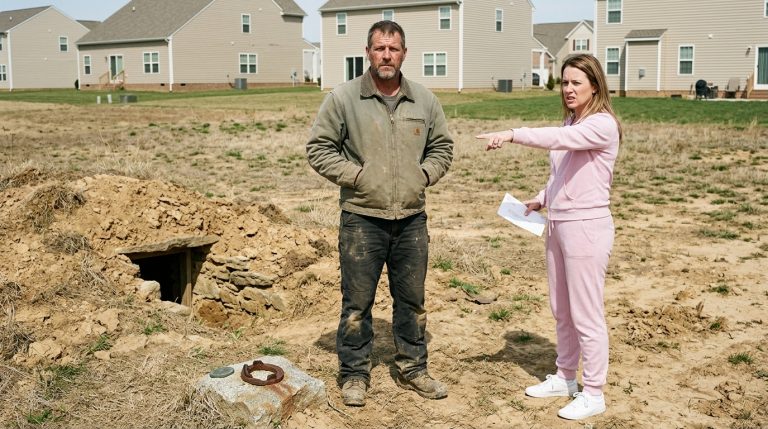
The gravel shifted under Mark’s boots with a sharp, grinding crunch as he walked back toward the edge of the property line. In his hand, the rolled county utility plat felt stiff, the paper edges curling slightly in the damp air. Miguel was already waiting by the side of his truck, holding two bright orange safety cones and a heavy steel tape measure, his breath pluming white against the grey morning light. Sonia stood a few paces behind him, her arms crossed over her navy suit jacket, her eyes fixed on the empty stretch of the access road where the HOA had threatened to drop their chain.
“They haven’t chained it yet,” Miguel murmured, tossing the cones onto the gravel with a hollow plastic thud. “Looks like they’re waiting for mid-morning traffic to die down so nobody asks questions.”
“They won’t need to chain anything once we drop this at the regional credit union,” Mark said, his voice level. He unrolled the plat map across the hood of Miguel’s truck, holding the corners down with a heavy iron wrench he’d grabbed from the workbench. “Sonia, show him what you found in those ledgers.”
Sonia stepped forward, unzipping her leather briefcase to pull out a yellow legal pad covered in sharp, methodical ink calculations. She pointed a gloved finger at a specific row of numbers near the bottom of the page.
“It’s not just a localized slush fund,” Sonia said, her voice dropping into a tight, professional register. “The community enhancement fees collected from every homeowner in Maple Hollow aren’t going into municipal maintenance or structural reserves. Over the last eighteen months, exactly one hundred and sixty thousand dollars has been systematically siphoned through a secondary corporate entity registered under Maple Hollow Management LLC. And every single withdrawal authorization bears Claudine Mercer’s personal signature.”
Miguel whistled softly, staring down at the figures. “That’s why she’s been auditing everyone for every cracked sidewalk and faded fence slat. She’s not trying to keep property values high; she’s trying to squeeze every extra dollar out of the neighborhood to cover a hole in her own balance sheet.”
“A hole she can’t patch anymore,” Mark added, his eyes narrowing as he traced the western boundary line on the map. “Not now that the county tax rolls show her unrecorded adjustments.”
The air between them grew heavier, charged with the quiet, dangerous momentum of a gear finally catching its teeth. For weeks, the intimidation had been a slow drip of psychological pressure—fake citations, midnight drive-bys, and yellow warning slips taped to mailboxes. But seeing the raw math on the page changed the physics of the conflict. The paperwork wasn’t a weapon used against them; it was the evidence that trapped the aggressor inside her own perimeter.
“We don’t wait for her next notice,” Mark said, rolling the plat map back up with a sharp snap of paper. “Sonia, you take the certified routing copies and file the formal embezzlement disclosure with the county prosecutor’s office before noon. Miguel, keep your shop doors open and your cameras rolling if anyone from the association approaches your fence.”
Sonia nodded, sliding the legal pad back into her briefcase with a crisp zip. “And you, Mark?”
“I’m going to stay right here,” Mark said, looking toward the end of the cul-de-sc where the white Lexus had finally begun to reverse out of its hiding spot under the maple tree. “Let her come check the fence line again. We’re done dodging sparks.”
CHAPTER 7: The Courthouse Hammer
The courthouse hallway smelled of floor wax and wet wool, a stale, institutional dampness that clung to the stone walls like soot after a basement fire. Mark sat on a varnished wooden bench near Room 304, his heavy canvas jacket resting across his knees, his calloused thumbs locked together. Beside him, Sonia kept her briefcase open on her lap, her pen scratching quick, final notes onto a docket sheet while the distant murmur of the county auctioneer echoed through the high-ceilinged atrium.
“The regional credit union certified the default notice ten minutes ago,” Sonia murmured without looking up from her legal pad. Her voice was steady, but her fingers moved with the sharp, compressed energy of someone feeding tape into a receiver. “The HOA’s balloon payment on the common area maintenance bond lapsed at midnight. Because the association structured their operational loans using community assets as direct collateral, the entire portfolio is up for immediate judicial disposition.”
Mark shifted his weight on the bench. The wood groaned under him—a dry, protestful sound. Twenty years of running into burning buildings had conditioned him to look for the structural load-bearing points before stepping onto a floor. Right now, the entire bureaucratic weight of Maple Hollow Estates rested on a single financial hinge: a debt clause Claudine had buried in the small print of the association’s founding charter, assuming no one would ever live long enough or dig deep enough to read it.
“And Claudine?” Mark asked, his eyes fixed on the heavy double doors at the end of the hall.
“She’s inside,” Sonia replied, finally closing her briefcase with a crisp, echoing snap. “Her legal counsel tried to file an emergency injunction an hour ago, but the judge tossed it out when the prosecutor attached the bank ledgers showing the systematic embezzlement. She’s sitting in the back row of the auction room, watching every bid like she expects the gavel to break in half before it hits the podium.”
A sharp buzzer sounded down the hall, followed by a metallic voice calling out docket numbers over the public address system.
Sonia stood up, smoothing the front of her navy suit jacket. She looked down at Mark, her expression tightening into a sharp, vindicating mask. “It’s time, Mark. Your brother Caleb transferred the wire funds into the escrow account twenty minutes ago. All you have to do is walk in there, place the final bid, and collect the keys.”
Mark stood slowly, his boots meeting the grey linoleum floor with a heavy, deliberate thud. He didn’t feel a surge of triumph; relief didn’t work that way when you spent your whole life putting out other people’s fires. It felt more like the quiet settling of ash after a long night of cutting firebreaks—the realization that the heat had finally run out of fuel.
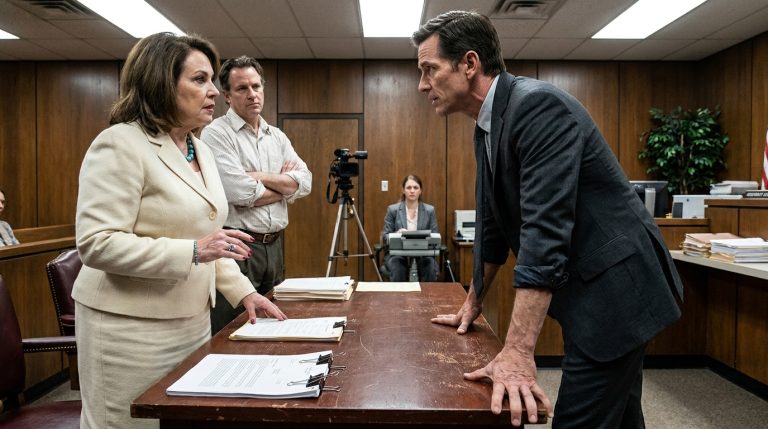
They walked through the double doors into the auction room. The air inside was warm and dry, smelling of stale paper and floor polish. Under the glare of fluorescent overhead panels, a dozen people sat scattered across the wooden pews. Near the front, flanked by her bewildered legal counsel, sat Claudine Mercer. Her pastel blazer looked stark against the dark oak of the courtroom, her sunglasses clutched so tightly in her gloved hands that the white leather was creasing under her knuckles. Her eyes locked onto Mark the moment he stepped past the threshold, wide and burning with a frantic, disbelieving fury.
Mark didn’t look away. He walked down the center aisle, his shoulders square, his posture as steady as a stone foundation.
At the front podium, the auctioneer looked over his half-glasses, checking the final ledger page clipped to his clipboard. “Final call for parcel forty-two, Maple Hollow Common Assets and Administrative Governance rights. Current high bid stands at six hundred and ninety-one thousand dollars. Do I have an increment?”
Mark stepped to the front rail, pulled a certified bank cashier’s check from his canvas jacket pocket, and laid it flat on the wooden surface.
“Matched and closed,” Mark said, his voice carrying clearly across the quiet room.
The auctioneer blinked, glanced down at the check, and then looked up at the registry clerk. A heavy, suspended silence filled the room—the kind of quiet that precedes a roof collapse, where every breath feels heavy and loud.
The auctioneer raised his wooden gavel, his arm cutting a sharp arc through the fluorescent glare, and brought it down with a sharp, echoing crack against the block.
“Sold. To Mark Reeves.”
In the front row, Claudine’s breath caught in a sharp, audible gasp. Her hands flew up to her mouth as the realization hit her with the force of a detonating wall: the man she had spent six months trying to fine, threaten, and legislate out of existence hadn’t just broken her perimeter. He now owned the entire neighborhood from the ground up.
CHAPTER 8: The Ashes Clear
The gavel’s echo died against the high oak paneling of the courtroom, leaving behind a vacuum of air that felt thin and cold. Mark stood unmoving at the front rail, his hand resting flat against the varnished wood where the cashier’s check had just been processed. Across the room, Claudine Mercer’s fingers unclenched from her sunglasses, the plastic frames slipping from her grip to clatter hard against the wooden floorboards.
She stood up abruptly, her legal counsel grabbing her elbow in a desperate, hushed attempt to pull her back into the bench.
“You can’t do this,” Claudine breathed, her voice cutting through the quiet room, thin and brittle like dry leaves underfoot. She looked past the clerk toward the judge’s empty bench, her composure finally shattering into raw, jagged panic. “That association was built on twenty years of community planning. You’re an outsider. You don’t have the legal right to—”
“The debt clause was recorded in the county registry in 2004, Mrs. Mercer,” Sonia interrupted, stepping smoothly past the rail with her briefcase held at her side. Her voice was calm, measured, and absolute. “Section Twelve, Paragraph Four. Any default on the municipal infrastructure bond transfers administrative title and governance rights directly to the primary lienholder of record. We didn’t break your system. We simply read the fine print you thought nobody else would ever bother to check.”
Before Claudine could answer, the heavy double doors at the back of the courtroom swung open with a sharp click. Two county detectives in plainclothes stepped inside, accompanied by a local magistrate holding a signed arrest warrant for corporate fraud and embezzlement. The cold air from the hallway rushed in behind them, carrying the sharp, metallic scent of the street.
The detectives didn’t rush. They walked down the center aisle with the slow, inevitable momentum of a rising tide, their boots clicking against the linoleum. When they stopped beside Claudine’s row, the sound of the steel cuffs sliding from their holsters carried across the room like a dry snap.
Mark watched as the cuffs closed around her wrists, the silver metal catching the harsh glare of the fluorescent overheads. There was no theatrical struggle, no grand speech—just the quiet, mechanical weight of accountability catching up to someone who had spent years outrunning the rules she enforced on everyone else. As they led her down the aisle toward the exit, she didn’t look back at the room; her eyes were fixed straight ahead on the heavy doors, hollow and blank.
The courtroom slowly emptied, the murmurs of the remaining onlookers fading out into the hallway until only Mark and Sonia were left standing by the front rail.
“It’s done,” Sonia said, closing her leather briefcase with a soft click. She looked over at Mark, a faint, tired smile touching the corners of her mouth. “The judge signed the dissolution order for the old management LLC twenty minutes ago. The community trust is officially established, and the neighborhood assets revert back to the individual homeowners by tomorrow morning.”
Mark nodded slowly, feeling the tension finally drain out of his shoulders—the lingering muscle memory of decades spent waiting for the next alarm bell to ring. “Thanks, Sonia.”
“Don’t thank me yet,” she said, turning toward the exit. “Mrs. Keen is already organizing a neighborhood potluck for Friday night, and she specifically mentioned she wanted to talk to you about the placement of the community garden gate.”
Mark gave a dry, quiet huff of laughter, picked up his canvas jacket, and walked out of the courthouse into the grey afternoon light.
Two days later, the air over Maple Hollow Estates smelled of wet cedar and woodsmoke.
The heavy steel chain had been removed from the south access road, replaced by an open, unhindered gravel path where delivery trucks and children on bicycles crossed without looking over their shoulders. Down the street, Miguel’s truck was parked in front of the Keen residence, where a group of neighbors were busy repairing a section of decorative picket fencing that had been neglected for years.
Mark sat on the bottom wooden step of his front porch, the morning frost melting from the blades of grass along his drive. In his right hand, he held a ceramic mug filled with hot, dark coffee, the steam curling upward into the crisp autumn air.
His left hand held a small brass wood-plane.
The fence post near the corner of the old barn had taken a glancing blow from the white Lexus back when the harassment was at its peak, splintering a small strip of grey cedar near the base. Mark hadn’t called a contractor, and he hadn’t filed a notice. He simply sat in the quiet of his own four acres, drawing the iron blade across the grain of the wood stroke by slow, rhythmic stroke until the splintered edge was smooth, clean, and flush with the rest of the timber.
A shadow fell across the gravel.
Mark looked up to see Miguel walking up the drive, holding two cold bottles of beer by the neck, his face dusted with sawdust and grease.
“Quiet morning,” Miguel said, stopping at the edge of the porch and offering one of the bottles.
Mark set the wood-plane down on the step, reached out, and took the cold glass. The condensation felt sharp and real against his calloused palm. He took a slow swallow, tasting the malt and the crisp bite of the wind, then looked out over his land—past the restored fence, past the leaning barn, and out toward the wide, open horizon where the road finally belonged to the people who walked it.
“Yeah,” Mark said, a faint, steady smile touching his lips. “It’s quiet.”