The Weight of the Sky: A Veteran’s Quiet Return to the Forge of His Legacy
CHAPTER 1: The Shadow on the Tarmac
The heat shimmered off the concrete, turning the flight line into a mirage of heat waves and distorted horizons. Roger Bentley stood, his hands resting on the cool, textured rubber of the A-10’s landing gear. He was eighty-two, and the world felt smaller, more brittle, but the metal beneath his palm was familiar—a cold, grounding anchor in the sweltering afternoon.
“Go on then. Start her up.”
The voice was slick, a thin veneer of authority stretched over a core of impatience. Roger didn’t look up immediately. He focused on the nose of the Warthog, on the slight discoloration of the paint where the Gau-8 Avenger cannon protruded—a seven-barreled maw that had, in another lifetime, chewed through the very geography of a desert war.
Captain Davis stepped into his periphery, polished boots catching the glare of the sun. He looked as crisp as a fresh document, a man whose uniform was an armor against the messiness of history. He gestured toward the bubble canopy with a manicured hand, his smirk a rehearsed performance for the cluster of young airmen nearby.
“Show us how it’s done, old-timer,” Davis pressed, his tone dripping with a condescending amusement that turned the air sour. “Or is all that new-fangled glass a bit too much for you? Maybe you’ve forgotten how to flip a few switches.”
Roger felt the familiar, bone-deep vibration of the aircraft. It wasn’t a mechanical memory; it was the phantom sensation of a thousand missions, the smell of burnt propellant and the sharp, metallic tang of adrenaline. He looked at the captain—at the silver bars on his collar that gleamed with a self-importance that had never been tested by fire—and then at the patch on his own sleeve. It was a faded, crude scorpion in a circle of sand, a piece of fabric that looked like trash to the captain, but felt like a contract to Roger.
“The auxiliary power unit requires a ground check before the ignition sequence,” Roger murmured, his voice a low, raspy friction. “Hydraulic pressure needs to be stable at 3,000 PSI. You don’t just turn a key.”
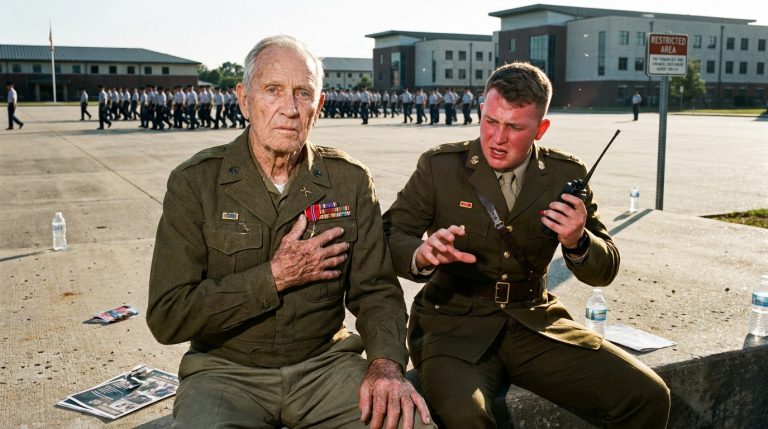
Davis laughed, a sharp, barking sound that didn’t reach his eyes. He leaned in, his shadow eclipsing the aging veteran. “Look, sir. This is a restricted area. The aircraft is a static display. You’re an unescorted civilian wandering onto an active flight line, and my patience is wearing thin. Show me your visitor pass, or I’ll have my men escort you to the gate—and perhaps to medical, if you’re as confused as you seem.”
Roger looked down at his own worn leather jacket, then back at the captain. He reached slowly into his pocket, his movements deliberate. The air shifted. The casual banter of the young airmen died away, replaced by a sudden, electric stillness.
As his hand emerged, holding not a wallet or a pass, but something that caught the sun, Davis’s smug expression flickered—a hairline crack in his composure. And in that same heartbeat, the sound of the base seemed to drop away, replaced by the high-pitched wine of turbofan engines and a voice over the radio that Roger hadn’t heard in forty years, screaming for support as the earth below them turned into an inferno.
He wasn’t an old man on a tarmac anymore. He was a weapon, and he was being pushed toward a line he hadn’t crossed in a very long time.
CHAPTER 2: The Whispering Airmen
The air on the tarmac had grown heavy, thick with the kind of silence that usually follows a thunderclap. Roger did not move. His hand remained held out, a simple, weathered extension of a man who had long ago ceased to care about the theatrics of rank. The captain, Davis, stood frozen in the vacuum of his own unraveling authority. His hand, which had drifted toward his hip, seemed to lose its purpose. The bravado that had fueled his stride only moments before had vanished, replaced by a sudden, hollow pallor.
Roger felt the memory shift—a tectonic slide within his mind. The desert heat surrounding them began to recede, dampened by a mental filter that replaced the humid, sun-baked concrete of the base with the sub-zero bite of a high-altitude cockpit. He could hear it now—the thin, sharp whine of the turbojets, the rhythmic, metallic tick of cooling metal, and the distant, garbled chatter of ground control. It was the “Ghost Cold,” a sensation he had carried since the war, a physical residue of the nights spent at thirty thousand feet, breath frosting against the canopy glass while he waited for the targets to reveal themselves in the valley below.
He looked through Davis, seeing instead the flickering green glow of a HUD that no longer existed. The captain was nothing more than a blurred silhouette against the vast, empty expanse of his own ignorance.
“I asked for your credentials, sir,” Davis managed to rasp, though the command was stripped of its bite. It was a reflex, a desperate attempt to cling to the protocol that had defined his career. His eyes darted toward the young airmen, seeking a reflection of his own authority, but he found none. They were staring at Roger’s jacket. They were staring at the patch—that crude, sand-colored scorpion—with the intensity of acolytes witnessing a relic.
“The patch,” one of the younger airmen muttered, his voice barely audible over the low hum of the distant air conditioning units venting from the nearby hangar. “My grandfather told me about the Scorpion. Said they were the ones who turned the tide at the valley. Said they were the ones who didn’t come back with their planes in one piece, but they always came back.”
The words rippled through the gathered crowd. It wasn’t a challenge; it was a prayer.
Roger let his hand drop. He didn’t offer a badge or a laminated card. He didn’t need to. The recognition in the airmen’s eyes was a stronger verification than any stamp from a government printer. He felt the weight of the moment pressing down on the asphalt. He looked at the A-10, his partner in survival. The paint was peeling in places, revealing the dull, industrial gray of the aluminum underneath, a texture that reminded him of the fraying edges of his own life.
“You’re making a mistake, Captain,” Roger said, his voice as steady as a compass needle in a storm. He didn’t sound angry. He sounded profoundly disappointed, the way a teacher might look at a student who had burned a book instead of reading it. “You’re treating this aircraft like a lawn ornament. You’re treating this base like a gated community. But you’re standing in a church of steel, and you’re mocking the ghosts who paid for the foundation.”
Davis took a half-step back, his boots scuffing against the concrete. The sound was unnaturally loud in the quiet. He looked at his hand, then at the sidearm he wasn’t authorized to carry on a family day, and finally at the absolute, terrifying stillness in Roger’s posture.
“I… this is a restricted line,” Davis repeated, though he was no longer looking at Roger. He was looking at the airmen, who had begun to drift closer, their bodies forming a protective arc that subtly, almost unconsciously, isolated the captain. They weren’t moving against him in mutiny, but they were no longer moving with him in support. The connection between the officer and his unit had been severed by a single, quiet encounter.
Roger leaned back against the tire, the cool rubber pressing into his spine. He knew what was coming. He could feel the shift in the atmosphere, the way the air seemed to vibrate with the anticipation of something inevitable. He didn’t need to be the one to break the captain. The captain was already dismantling himself.
“Chief Wallace is in the building,” Roger remarked, almost to himself. The statement was a casual observation, but it hit Davis like a physical blow. The captain’s eyes widened, the color draining from his face as the realization of his vulnerability crystallized. He had spent his career managing the image of the base, and in doing so, he had forgotten that the base had a memory of its own—a memory that was now waking up, stirred by the presence of the man who had helped build it.
Roger closed his eyes for a brief second, allowing the cold, high-altitude air of his memory to wash over him one last time before grounding himself back in the scorching sun of the tarmac. The friction of the day was beginning to burn, and he knew that for the first time in decades, he would have to play the role of the legend, not for his own sake, but for the sake of the men who still believed that the uniform meant something more than just a place to pin a rank.
He opened his eyes. The captain was still standing there, trapped in his own hesitation, waiting for a reality that was rapidly being rewritten.
CHAPTER 3: The Call to the Chief
The silence on the flight line had acquired a texture, something brittle and crystalline that felt as though it might shatter if anyone dared to breathe too deeply. Captain Davis remained locked in his stance, but the authority he had been trying to project had leaked out of him, leaving behind a man who looked suddenly, painfully small against the backdrop of the massive, squat A-10.
Roger did not press the advantage. He simply stood there, his hand having dropped from the landing gear, his posture relaxed in a way that spoke of a lifetime spent in environments far more hostile than a sun-drenched tarmac. He was watching the captain, observing the minute, nervous tremors in Davis’s jaw, and the way the captain’s eyes kept flicking toward the distant hangar where the maintenance crews were beginning to take notice.
“You mentioned Chief Wallace,” Davis said, his voice straining to regain its usual crispness, though it came out thin and reedy. “That was… an unnecessary invocation.”
“It was an observation, Captain,” Roger replied. His voice was quiet, a low rasp that traveled across the heat-blurred space between them. “I didn’t call him. I didn’t call anyone. I just came to see the bird.”
Roger turned his head slightly, his gaze lingering on the fuselage. He noted the way the afternoon sun caught the rivets. There was a discrepancy—a small, almost invisible detail that only someone who had spent two thousand hours in this specific cockpit would notice. The maintenance plate near the auxiliary power unit, which should have been secured with standard hex bolts, was held in place by a mismatched flat-head screw. It was a minor thing, a repair made in haste, a ghost of a fix from a shift change long ago. It was a physical testament to the fact that this machine was maintained by humans, not by the sterile, automated processes that the base’s new management seemed so obsessed with.
As he watched the screw, he felt a familiar, intrusive thought—a phantom sensation of cold, biting air. He remembered the night he’d had to manually override the hydraulic pressure on this very panel while hovering at a dangerous, low-altitude drift in the dark. The memory was so vivid that for a split second, he could smell the ozone.
Nearby, Senior Airman Garcia, who had been hovering at the edge of the crowd, finally reached into his pocket. His hands were shaking. He didn’t want to cause a scene, but he knew the protocol of history. He pulled out his phone, his thumb hovering over the screen. He caught Roger’s eye for a fleeting moment—a brief, silent communication between two people who understood the gravity of the metal in front of them. Garcia looked away, his expression hardening with a resolve that Davis was too distracted to notice. He stepped back, moving into the shadow of a support truck to place the call.
Roger listened to the distant, rhythmic ticking of the cooling engines. It was a heartbeat. The heat radiating off the asphalt was intense, but it couldn’t touch the internal chill he still felt—the persistent, lingering ghost of a life lived in the margins of war. He turned back to Davis.
“You’re worried about your career, Captain,” Roger said, not as an accusation, but as a plain statement of fact. “You’re worried that if the Chief shows up, if the Colonel hears about this, you’ll be the one left standing in the dust. You see a conflict where there’s only a conversation. And that is why you’re so afraid of the past.”
“I am not afraid,” Davis snapped, but the denial was hollow. He stepped forward, his boots clicking on the concrete, and for a moment, Roger thought he might try to force an exit. But then Davis stopped, his momentum dying. He looked at the A-10, really looked at it, and for the first time, he seemed to see the physical weight of the machine—the scars in the paint, the uneven metal, the history etched into every panel. He was realizing, in real-time, that he was trespassing on ground he hadn’t earned the right to stand on.
The air around them began to fill with the sound of a distant, approaching engine—not the high-pitched whistle of a jet, but the deeper, throaty rumble of a command vehicle. It was moving too fast, a dark silhouette tearing across the flight line, defying the rigid, regulated pace of the base’s daily life.
Roger watched it approach, his eyes narrowing against the glare. He didn’t need to look at Davis to know the captain had heard it too. The silence of the tarmac was broken by the crunch of gravel as the vehicle skidded to a halt near the edge of the display area. The door swung open, and the world seemed to tilt on its axis.
The standoff was ending, but the real challenge—the task of forcing the new generation to acknowledge the weight of the steel they maintained—was only just beginning. Roger shifted his weight, his worn leather jacket creaking in the heat, and waited for the command team to step out.
CHAPTER 4: The Colonels Arrival
The command vehicle, a heavy, black SUV, didn’t just stop; it seemed to impose its will upon the flight line. It skidded to a halt in a spray of gravel, the tires digging deep, protesting the sudden cessation of momentum. The engine cut out, leaving a sudden, ringing silence that felt heavier than the ambient hum of the base.
Roger didn’t flinch. He remained where he was, his shoulder pressed against the cool, unforgiving aluminum of the A-10’s fuselage. He watched the driver’s side door swing open. Colonel Mat stepped out, his uniform pristine, his eyes scanning the tarmac with the focused intensity of a predator who had just caught the scent of a disturbance in his territory. Behind him, Chief Wallace emerged, his face a mask of iron-clad professionalism, his eyes already assessing the situation, taking in the huddled crowd, the frozen airmen, and the visibly wilting posture of Captain Davis.
Davis, sensing the shift in the atmospheric pressure of the flight line, tried to pull himself together. He straightened his shoulders and attempted to fix his expression into something resembling professional military bearing, but the tremor in his hands betrayed him. He took a single, uncertain step toward the Colonel, his mouth opening as if to issue a report, but the words died in his throat.
Colonel Mat didn’t look at him. He didn’t look at the crowd. He walked straight toward the A-10, his gaze locked onto Roger with a terrifying, unblinking focus. The distance between them closed slowly, each step measuring the weight of the moment. Around them, the world seemed to narrow, the chatter of the base fading into the background, leaving only the sound of the Colonel’s boots on the pavement and the rhythmic, metallic ticking of the cooling Warthog.
“Major,” the Colonel said, his voice resonant, carrying across the flight line with an authority that left no room for interpretation.
He didn’t stop until he was three feet from Roger. Then, in a motion that was as fluid as it was precise, the Colonel snapped into an impeccable, rigid salute. It was a gesture of profound, almost religious significance—a salute that ignored the civilian clothes Roger was wearing and recognized the history he carried beneath the worn leather of his jacket.
For the first time since the standoff began, Roger felt the weight of his own anonymity begin to dissolve. He wasn’t just an old man anymore. He was a symbol. He slowly returned the salute, his movements deliberate, his arm steady despite the phantom tremors of the “Ghost Cold” that still rattled his bones. The Colonel held the salute, his gaze fixed and steady, a silent acknowledgement of a debt that could never be repaid.
Chief Wallace stood a few paces back, his eyes surveying the crowd. He noticed Senior Airman Garcia, who had moved closer, his face pale but resolute. The Chief offered a subtle, almost imperceptible nod—a silent confirmation that the call had been heard, and that the order of the day was about to be restored.
Colonel Mat finally dropped his salute and turned, his body language shifting as he pivoted to face Captain Davis. The transition was abrupt, like a switch being flipped. The respect he had shown Roger vanished, replaced by an arctic, weaponized disappointment. He didn’t shout. He didn’t need to. He simply looked at Davis, and the captain seemed to shrink, the sunlight highlighting the sheen of sweat on his brow.
“Captain,” the Colonel said, his voice dropping to a low, menacing level that was far more terrifying than any outburst.
He stood there for a heartbeat, letting the silence grow, letting Davis wallow in the realization of his catastrophic failure of judgment. The crowd, which had been silent before, now seemed to hold its breath. Every eye was on the captain. Every mind was calculating the cost of what had just happened.
Roger watched the interplay, his expression neutral. He felt a sudden, sharp pang of empathy—not for the captain, but for the profession itself. This was the cost of forgetting, he realized. When you treat the past like a burden rather than a foundation, you end up crumbling under the weight of your own arrogance. He reached out and brushed his fingers against the faded paint of the A-10, feeling the texture of the history he had spent his life building. The metal was still warm, but the future felt, for the first time in a long time, like something he could finally trust the next generation to hold.
“You have disgraced the uniform, Captain,” the Colonel continued, his voice echoing against the hangar walls. “And you will explain to me, in detail, how you arrived at the decision to treat a guest of this command as a trespasser.”
The, look in Davis’s eyes was the look of a man watching his entire reality collapse. He didn’t answer. He couldn’t. He just stood there, a broken piece of machinery in a system that had no room for his failure.
CHAPTER 5: The Unveiling of the Legend
Captain Davis remained motionless, a static object in the center of the Colonel’s cold, focused attention. The air on the tarmac had grown thin. Roger watched as the Colonel’s words—the public dressing down of a commissioned officer—rippled outward, affecting not just Davis, but the entire gathering of airmen. The initial shock of the revelation was beginning to harden into something else: a collective, crushing weight of expectation.
Colonel Mat turned away from Davis, his movements measured and precise, and stepped toward Roger. The Colonel’s eyes were bright, almost feverish with the intensity of his respect, but Roger felt a prickle of unease. He had come here for a quiet moment with a machine that held the echoes of his youth, not to be the centerpiece of a military theater.
“Major,” the Colonel repeated, and this time, he gestured toward the A-10 with an open, sweeping motion that seemed to invite the entire flight line to bear witness. “These young men and women… they have only ever known the manuals. They have only ever known the simulations. They need to hear what it was like to fly this bird when it was the only thing standing between our brothers and the fire.”
Roger shifted his weight. The leather of his jacket groaned, a dry, tired sound against the humid heat of the afternoon. He looked at the airmen—dozens of them, their faces masked by a mix of awe and a nascent, growing discomfort. They were looking for a god. They were looking for a story that would justify their own devotion to the machine. But Roger only felt the dampness of his palms and the persistent, nagging ache in his lower back—a physical relic of that final, desperate landing in the desert.
He looked at the plane. Tail 780618. The skin was faded, the color having surrendered to decades of relentless sunlight, and there were patches of newer, mismatched gray where maintenance teams had done their work. It was a patchwork beast, far removed from the pristine, terrifying weapon it had been in his youth. The discrepancy felt like a physical disconnect in his mind; he had anchored his memory to a version of this aircraft that no longer existed, and now, the Colonel was forcing him to project that memory onto this reality.
“It wasn’t a story, Colonel,” Roger said, his voice raspy, struggling to find the right cadence. “It was a shift. A rotation. You fly, you pull the trigger, you land. You don’t think about the ‘heroics’ while you’re trying to keep the hydraulics from bleeding out in your lap.”
The Colonel didn’t seem to hear him. He leaned in, his voice lowered, but still audible to those closest to the aircraft. “The records speak for themselves, sir. Twenty-three tanks. The Ranger rescue. The flight back with the wing on fire. This is a story that keeps the legacy alive.”
Roger looked at the faces nearest to him. Senior Airman Garcia, the one who had made the call, was standing with his hands clasped behind his back, his eyes fixed on Roger with a look of pure, unadulterated faith. It was a look that felt like a trap. If he told the truth—if he told them about the panic, the shaking, the way he had vomited in his oxygen mask after the first run—would they stop looking at him with that hungry, desperate adoration?
He realized then that the Colonel was doing exactly what Davis had done, just with a different flavor of arrogance. Davis had tried to erase the history; the Colonel was trying to weaponize it. Both of them were failing to see the man who stood in front of them.
Roger reached out and tapped the side of the fuselage with a knuckle. The sound was dull, a hollow thud that betrayed the age of the metal. “You want to know what it’s like?” he asked, his gaze drifting over the airmen. “It’s about the silence you hear when the cannon stops. It’s about the smell of the cabin air when you’re breathing it in for the twelfth hour of a mission. It’s about the fact that this plane—this beautiful, broken thing—is the only reason I’m standing here to be insulted by a captain.”
He turned his gaze toward Davis, who was still standing in the dust, his face a mask of ruined pride. “He’s wrong, of course. He’s wrong about the rules. He’s wrong about the protocol. But he’s right about one thing: the history here is a heavy burden. And if you’re going to be around it, you have to be willing to bleed for it, not just stand around and talk about it.”
The tension spiked. The Colonel’s expression flickered, caught between pride and a sudden, sharp realization that he was losing control of the narrative. The airmen shifted, the weight of the moment becoming too much for them to hold. Roger felt the phantom cold of the cockpit again—the sudden, sharp intrusion of the “Ghost Cold”—and for a heartbeat, he couldn’t tell if the heat he felt on his skin was the desert sun or the burning engine he had nursed back to base forty years ago.
He needed to end this. The spectacle was eating away at the very reality he had come to preserve. He stepped away from the fuselage, his movements stiff, and looked at the Colonel. “I’m done, Colonel. The bird needs its maintenance, and I need a place to sit that isn’t under the gaze of a squadron.”
“Sir, we can move to the briefing room,” the Colonel insisted, but Roger was already walking. He didn’t look back. He started moving toward the edge of the tarmac, his pace slow, his mind reeling under the sudden, crushing clarity that he was being dismantled by his own past.
CHAPTER 6: The Dismissal of Arrogance
Roger didn’t look back. The tarmac beneath his boots felt less like a flight line and more like a bridge he was burning as he crossed it. Behind him, he could hear the low, urgent murmur of the Colonel’s voice—likely directing the staff to clean up the wreckage of Captain Davis’s reputation—but it was fading, replaced by the mundane, rhythmic sounds of a functioning base. A baggage tug hummed in the distance. The sharp, mechanical ratcheting of a torque wrench echoed from a nearby hangar.
He was walking toward the perimeter fence, his destination undefined, his goal simply to reach a place where the air didn’t smell like jet fuel and performance reviews. His jacket felt unnaturally heavy, the leather seemingly absorbing the heat of the day, trapping the humidity against his skin. Every step was a deliberate act of rejection.
“Mr. Bentley?”
The voice was tentative, barely cutting through the ambient noise. Roger stopped. He didn’t turn around immediately, letting the pause stretch out, a physical manifestation of his desire to remain disconnected. He eventually rotated, his joints stiff, to find Senior Airman Garcia standing a few yards behind him. The young man looked wretched—his uniform was perfectly pressed, but his posture was slouched, his eyes wide with a combination of lingering awe and genuine, youthful guilt.
“I’m sorry, sir,” Garcia said, staring at the ground near Roger’s scuffed boots. “I didn’t mean for it to… turn into this. The Colonel, he’s… he takes the history stuff very seriously. Maybe too seriously sometimes.”
Roger looked at him. He saw the genuine, raw human concern in the boy’s expression, a sharp contrast to the Colonel’s rigid, performative reverence. It was the same look the young Ranger captain had worn forty years ago—the look of a man who had seen something too large to comprehend and was desperate to find a way to honor it without being crushed by it.
“You did what you thought was right, Airman,” Roger said, his voice softer now, stripped of the steel he’d used with the Captain. “You defended a memory. But you have to understand, Garcia, that a memory isn’t something you can protect by putting it behind glass or by forcing someone to stand next to it.”
“I just wanted to make sure they knew who you were,” Garcia defended, his hands tightening into fists at his sides. “They act like this place is just a factory. They don’t know that these planes—that your plane—is why we even have this base. I thought if they knew, they’d change.”
Roger sighed, the sound lost in the vast, open space of the flight line. “They’ll change when they have to, and not a moment before. You can’t lecture someone into having a soul, and you can’t force them to inherit a legacy just because you point at a plaque.”
As he spoke, a flash of memory struck him with the force of a physical blow—the face of that Ranger captain, his eyes bright with the frantic, terrified gratitude of a man who had stared into the maw of death and lived. He saw the blood on the captain’s fatigues, the way his hands shook as he pressed that patch into Roger’s palm. The memory was so visceral that Roger reached up, his fingers brushing the fabric of the patch on his own sleeve, as if he could feel the ghost of that long-dead soldier’s warmth.
The Phantom Cold of the cockpit surged, a fleeting, icy draft that had no business existing in the desert heat. It reminded him that for all his talk of “moving on,” he was still tethered to the wreckage. He hadn’t just saved those men; he had taken their burden into his own cockpit, and he had been flying with it ever since.
“The history isn’t in the plane, son,” Roger said, his voice cracking slightly. “It isn’t in the patch, or the plaque, or the lecture the Colonel is going to give tomorrow. It’s in the fact that we were there, and we did what was necessary, and we expected nothing in return.”
He gestured toward the hangar, toward the towering, silent form of the A-10 sitting in the distance. “Don’t let them turn you into a historian. That’s just another way to look at the past while ignoring the future. If you want to honor the legacy, do your job. Make sure the hydraulic fluid is at 3,000 PSI. Make sure the rivets hold. Make sure the next pilot who climbs into that cockpit has a chance to come home.”
Garcia looked at him, his mouth opening as if to speak, but the words were clearly insufficient. He nodded, a slow, solemn motion.
Roger turned back to the fence. The gate was open, a narrow sliver of the world beyond the base that looked, for the first time, like an invitation. He began to walk again, his stride a little less stiff, his focus set on the horizon. He was leaving the noise, the anger, and the hollow reverence behind. He was finally going to get that cup of coffee, and for the first time in an hour, he could imagine a future that didn’t involve the ghost of a cockpit or the judgment of a man who didn’t know the first thing about the weight of the sky.
CHAPTER 7: The Coffee Shop Encounter
The coffee shop was small, a quiet, forgotten corner of the world that smelled of roasted beans and damp paper. Roger sat at a booth near the window, the morning paper spread out before him. It was a mundane scene, one he had sought out precisely for its lack of history. There were no rivets here, no roaring turbines, no echoing silences that demanded a tribute of valor.
He was nursing a cup of black coffee, watching the light play across the table—a soft, golden glow that felt warmer than the harsh, unforgiving glare of the flight line. He felt lighter, the phantom weight of the leather jacket now resting on the back of his chair rather than on his shoulders. He was finally just a man in a shop.
Then the door jingled.
He didn’t look up, but he felt the shift in the room’s air—a sudden, subtle drop in temperature. Footsteps, slow and hesitant, approached his booth. They weren’t the crisp, authoritative clicks of a military-issue boot; they were the dull, uneven scuffs of civilian sneakers.
“Sir?”
Roger paused. The voice was thin, stripped of its former slick, condescending veneer. It sounded tired, a voice that had been worn down by long hours of introspection. He slowly lowered the edge of the newspaper, revealing the man standing in the aisle.
It was Davis. He was wearing a plain, nondescript jacket and jeans that looked a size too large for his once-rigid frame. His shoulders were slumped, his face pale and etched with the exhaustion of someone who hadn’t slept well in weeks. He looked like any other man you might pass on the street, entirely indistinguishable from the background noise of the city.
Roger kept his expression neutral. He gestured to the empty seat across from him. “Sit.”
The man hesitated, then complied, his movements awkward. He placed his hands on the table, and Roger noticed they were steady, though they were gripped with a tight, nervous energy. “I know an apology isn’t enough,” the man said, his gaze fixed on his own reflection in the table’s surface. “But they made me read it. Your entire file. Every mission report. Every citation. I had to read them until the ink blurred.”
Roger didn’t interrupt. He watched the man—really watched him—and saw not the captain who had sneered at a scorpion patch, but a man who had finally been forced to stare into the abyss of his own failures. It was a raw, human display, devoid of the performative rituals of the Air Force.
“I spent my life thinking that the uniform was the definition of the man,” the man continued, his voice barely rising above the low hum of the espresso machine. “I thought if I followed the regulations, if I demanded the respect that the rank commanded, I was doing my job. I didn’t understand that the uniform is just… it’s just the casing. It’s what you put inside it that matters.”
He looked up then, meeting Roger’s eyes. There was no arrogance left, only a profound, hollowed-out clarity. “I was a terrible officer, sir. Not because I didn’t know the regs, but because I didn’t know the first thing about the cost of wearing that patch.”
Roger felt a strange sensation in his chest—not resentment, but a quiet, settling peace. The confrontation on the tarmac had been a necessary fire, and this was the cooling metal in the aftermath. The man sitting in front of him wasn’t an enemy; he was a casualty of his own ignorance, and that, in its own way, was a burden far heavier than any military reprimand.
“The history of this wing isn’t a museum,” Roger said, his voice steady. “It’s a responsibility. Every time you climb into a cockpit, every time you walk onto a flight line, you are walking on the work of the people who came before you. If you don’t respect that, you’re not flying—you’re just taking up space.”
The man nodded, a slow, solemn motion that felt like an admission of guilt. “I understand that now. I really do.”
They sat in silence for a long time. It was a heavy, comfortable silence, the kind that only exists after the storm has passed and the wreckage has been cleared away. For a moment, Roger thought about the A-10, the phantom cold of the cockpit, and the way the world looked from thirty thousand feet. He realized that he wasn’t going to miss it—not the violence, not the adrenaline, and certainly not the pedestal. He had reached the end of the line, and the view from this booth, in this quiet shop, was the most honest thing he had seen in years.
“Go on then,” Roger said softly. “You’ve got a life to rebuild. Start by making sure you don’t repeat the mistake.”
The man stood, lingering for a second as if he wanted to say something more, then nodded once and turned to go. The door jingled again as he stepped out into the bright, unfiltered afternoon.
Roger reached for his coffee, feeling the warmth of the ceramic against his skin. It was done. The cycle was closed, the past was firmly back in its box, and for the first time in his long life, he could just be a man reading his paper, waiting for the sunset to turn the world gold.
CHAPTER 8: The Legacy Reframed
Roger remained in the booth for a long time after the man had gone. The shop had grown quieter, the lunch rush fading into the slow, languid pace of a mid-afternoon. He looked down at his hands—they were steady, the phantom tremors of the cockpit finally absent, replaced by the simple, enduring reality of skin, bone, and the faint, permanent callouses of a life spent working with metal.
The truth he had carried—the realization that he was not a god of steel and fire, but a man who had simply survived—settled over him like a warm blanket. Layer 2, the core reality he had guarded for so long, wasn’t about the tanks he’d destroyed or the Rangers he’d saved. It was about the fact that he was the bridge. He was the connector between the fire of the past and the cold, unformed potential of the future. By allowing himself to be seen, by allowing the arrogance of the present to collide with the reality of the past, he had fulfilled the final, unspoken part of the contract he’d signed in the desert.
He looked over at his jacket, draped across the empty seat. The sand-scorpion patch, once a symbol of a blood debt, looked different in the soft light of the shop. It wasn’t a burden anymore. It was a witness.
He stood up, his movements fluid, and put the jacket on. It felt lighter. He walked to the counter, left a generous tip for the waitress who had been kind enough not to ask questions, and stepped out into the afternoon.
The world outside was cooling. The harsh, searing light of the early afternoon had softened into the long, golden shadows of dusk. He walked toward his car, his pace unhurried. As he reached the parking lot, he saw a young man standing near the edge, looking toward the distant, hazy silhouette of the base. It was Garcia. The senior airman was watching the horizon, his hands tucked into his pockets, his posture reflecting a new, thoughtful weight.
Garcia spotted Roger and straightened, his instinctual urge to salute flickering and then dying as he remembered Roger’s words. Instead, he gave a slow, respectful nod.
“I’m heading back to the line, sir,” Garcia said. “There’s still work to do on the bird. She’s not going to keep herself flight-ready.”
“Good,” Roger said, a genuine, quiet smile touching his lips. “That’s exactly where you belong.”
Roger watched the young man walk away, his step confident, his direction clear. The legacy wasn’t in the bronze plaque they had mounted on the fuselage or the lessons the Colonel was forcing down the throats of his staff. It was in the hands of the mechanics, the pilots, and the ones who understood that the machinery they touched was alive with the echoes of the lives it had protected.
He got into his car, the interior smelling of old upholstery and the lingering scent of coffee. He started the engine, the sound small and insignificant compared to the roar of a Warthog, but it was enough. It was his.
He drove away from the base, taking the long way home through the winding backroads. As he drove, he passed a small, public park where children were playing on a set of swings, their laughter drifting on the breeze. He watched them for a moment, the joy in their voices a sharp, beautiful contrast to the memories of fire and thunder that had haunted his dreams for so long. He realized then that he wasn’t haunted anymore. The ghosts had found their rest, and he had found his.
When he finally pulled into his driveway, the house looked smaller, more intimate. He went inside and walked to his workbench in the garage. There, sitting in a wooden box, was a small, brass fitting he had been meaning to fix for months—a piece of a mechanical clock he had inherited from his father. He picked up his tools, the familiar, grounding weight of the wrench in his hand, and began to work.
The task was small, precise, and entirely devoid of grandiosity. It required the same steady hand he had once used to guide a crippled aircraft through a wall of anti-aircraft fire, but here, in the quiet of his own garage, the goal was not survival, but restoration. He worked until the light in the garage began to fade, his hands steady, his mind quiet.
He had completed the circuit. He had passed the torch, not by handing it over, but by lighting the way for those who would follow. He felt a deep, profound sense of catharsis, a release that reached into the very marrow of his bones. The five pillars of his life—the work, the memory, the duty, the connection, and now, this final, quiet peace—had aligned, and for the first time in eighty-two years, he was content to simply be.
The sun set, the world settling into the comfortable, atmospheric peace of night. Roger set his tools down, closed the box, and walked into his kitchen. He poured a glass of water, stood by the window, and looked up at the vast, star-strewn sky. Somewhere, far above, he imagined the thin, high-pitched whine of an A-10 on a night training flight, a lonely, defiant sound that whispered of courage, sacrifice, and the enduring, unbreakable strength of the machines that protected the people on the ground.
He took a slow sip of water, watched the stars, and finally, completely, let go of the past. He was home.