The Weight of Brass: A Legacy Forged in the Quiet, Dusty Corners of a Soldier’s Life
CHAPTER 1: THE FRICTION OF PRESENTATION
The glass doors of the institution stood like a guillotine against the morning sky, clear and unyielding. Emma pushed through them, the weight of a twelve-hour shift dragging at her heels like lead boots. She was not meant to be here in this condition. She was meant to be in the car, changing into a dress that had been pressed and hung with the precision of a surgical drape, but the highway had other plans. It had delivered fourteen broken lives to her ER doors, and she had spent the hours since midnight dismantling the chaos, one stitch at a time.
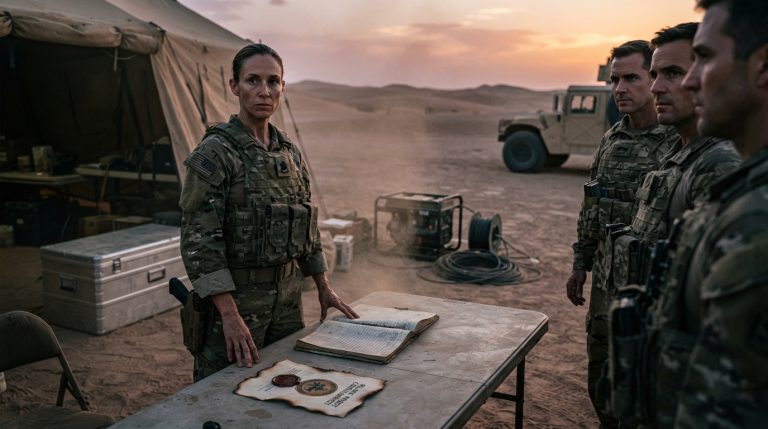
She stood in the lobby, a jagged, exhausted silhouette against the polished marble. The air here was thin, scrubbed clean of the smell of ozone and sweat, and it felt like walking into a vacuum. She felt the coin in her pocket, the brass edge biting into her palm. It was the only thing that felt real—a constant, rhythmic friction against her skin that reminded her of the desert heat and the quiet, crushing finality of her father’s absence.
A woman in a designer jacket drifted toward her, her movements fluid and practiced, the way a predator navigates a familiar territory. She stopped, her gaze sliding over Emma’s badge—smudged with ink—and her hair, which was falling in unkempt strands around her face.
“This is a military-affiliated institution,” the woman said, her voice cutting through the lobby’s hushed hum with the sharp clarity of a scalpel. “There is a standard of dress that reflects the dignity of the occasion. Some of us have enough respect for the ceremony to present ourselves appropriately.”
Emma didn’t look at her. She looked past her, toward the parade ground where the sun was beginning to bake the dust into the iron-grey concrete. She felt the weight of the coin—that smooth, worn brass that had traveled through two decades of her life—and the irony tasted like copper in her mouth. The woman was worried about a dress code, while Emma was still hearing the echoes of the sirens that had defined her morning. She didn’t offer an excuse. She didn’t offer an apology. She simply kept walking, her boots leaving faint, dry dust marks on the pristine stone—a map of where she had been, and a silent testament to the work that had kept her from the car.
The administrator intercepted her near the heavy oak doors, his smile wide, practiced, and utterly hollow. “Ma’am, there’s been a complaint. Perhaps you could wait outside?”
He was doing his job. He was keeping the lobby clean, keeping the optics sharp. Emma reached into her pocket. She didn’t pull out a phone or a pass. She pulled out the coin. She laid it on the polished mahogany desk, and for a split second, the light hit the insignia, revealing the ghost of a unit that had been decimated in a desert storm twenty years ago. The administrator blinked, his hand hovering, his eyes searching the object for a barcode, for an explanation, for anything that matched the polished world he lived in.
Before he could speak, the doors behind Emma swung open with a heavy, rhythmic thud. A shadow fell over the desk, dark and absolute, and the entire lobby seemed to tilt on its axis. Colonel Daniel Marsh walked in, his uniform a sharp contrast to the soft, linen-clad crowd, his eyes locking instantly onto the brass on the desk. He didn’t look at Emma. He didn’t look at the administrator. He stopped walking, his presence filling the space with the gravity of a mountain, his silence suddenly more authoritative than any spoken word.
CHAPTER 2: THE COLONELS RECOGNITION
The silence in the lobby did not come from a lack of sound. It was a physical thing, a thick, pressurized layer of atmosphere that made the air feel heavier, laden with the metallic tang of old brass and the dust of a desert twenty years dead. Colonel Marsh stood anchored in place, his posture radiating the specific, immovable geometry of a man who had spent his life reading maps of dangerous terrain. His gaze, usually sweeping and evaluative, was pinned to the coin on the desk.
The administrator’s breath hitched—a small, frantic sound that seemed loud enough to echo against the polished marble. He looked from the coin to Emma, his eyes wide, flickering with the realization that the “complaint” he had been handling with such smug, practiced efficiency was suddenly a live explosive. He reached for the coin, perhaps to return it, perhaps to distance himself from it, but his fingers trembled.
Marsh’s hand moved faster, a blur of practiced, predatory grace. He caught the coin in his palm, his fingers closing around it with a reverence that was completely alien to this sanitized space. He didn’t look at the administrator. He didn’t look at the woman in the designer jacket, who had taken an involuntary step back, her groomed confidence fracturing like thin glass under heat.
“This,” Marsh said, his voice a low, gravel-edged rumble that seemed to vibrate through the floorboards. “This is not an accessory.”
He looked at Emma then. He didn’t see the scrubs, the smudged badge, or the exhaustion that had been the primary focus of everyone else in the room. He was looking through the exhaustion, down to the frame underneath. He saw the tension in her shoulders, the way she kept her weight balanced on the balls of her feet, even here, in a hallway where no threat existed. He saw the ghost of the desert in her eyes—the specific, flat clarity of someone who has stared into the sun until the world stops being colorful and starts being merely a set of tactical variables.
Emma felt the familiar pull of a phantom memory: the taste of dry, metallic grit in her throat, the relentless, shimmering heat of a horizon that offered no shade, and the sound of a radio chatter that never quite translated to the quiet of a parade ground. She suppressed it, the way she suppressed the ache in her knees and the thrum of caffeine in her blood. She remained still, her hands resting at her sides, palms open. She was not a victim in this room; she was a witness.
“Captain Ray Carter,” Marsh said, the name sounding like a roll call. “First Marine Division.”
He turned the coin over. The smooth, worn side caught the overhead light. “The attrition rates in that unit weren’t documented in the brochures for this institution. I suspect if they had been, the marketing would have been considerably more difficult.”
The woman in the designer jacket cleared her throat, a high, brittle sound. “Colonel, I’m sure this is all very touching, but we have a ceremony to begin. The decorum of—”
Marsh didn’t look at her. He didn’t even acknowledge the interruption. He simply turned, his movements sharp and efficient, and looked at the administrator. “You were about to ask this woman to leave?”
The administrator’s face drained of color, his skin taking on the hue of the grey, polished stone floor. He looked at the tablet in his hand, then at the coin in Marsh’s palm, and finally at Emma. He looked at her with a new, panicked kind of clarity, finally seeing the reality of the badge she wore, the lines around her eyes, and the sheer, unyielding hardness of her stance. He didn’t answer. He couldn’t.
“I asked a question,” Marsh repeated, his voice dropping an octave.
“I… there was a complaint, sir. Protocol. I was merely following the directive regarding the dress code for family members.” The administrator’s voice was thin, frantic, a desperate attempt to shove the genie back into the bottle.
Emma felt the friction of the moment—the way the room was slowly realigning itself around the brass weight in the Colonel’s hand. She felt the urge to leave, to retreat to the quiet of her car and the dark comfort of a life that didn’t require explanations or ceremonies. But the coin was still in Marsh’s palm, and her father’s name was still hanging in the stale, air-conditioned air. She stood her ground, her body functioning on the same automated, survival-focused logic that had carried her through the ER doors at 6:40. She was not going anywhere until the coin was back in her pocket and the truth of what it represented had been acknowledged by the people who had tried to sweep it under the rug of their “standards.”
Marsh stepped closer to the administrator, his uniform crisp and intimidating. “Protocol?” He echoed the word as if it were a foreign language he had no intention of learning. “You are an administrator at an institution built on the sacrifices of men who carried these coins. You don’t get to talk to me about protocol when you don’t even recognize the cost of your own lobby.”
The hallway went deathly quiet. A few people walking toward the entrance doors slowed down, their steps faltering as they sensed the shift in the air. The woman in the designer jacket had retreated further, her husband standing beside her, staring intently at his shoes. The atmosphere was no longer that of a prestigious gathering; it was something raw, exposed, and deeply uncomfortable. It felt like walking into a room where someone had finally pulled the curtain back to reveal the rusted machinery underneath.
Emma watched Marsh, noticing the subtle tension in his jaw, the way his eyes remained fixed on the administrator. He was a man who understood the value of an object, not by its shine, but by the wear and tear on its edges. He walked over to her, his stride measured, and placed the coin back into her hand. His fingers lingered for a second, a brief, silent acknowledgement that existed entirely outside of the social performance surrounding them.
“I have a file to review,” Marsh said, his eyes meeting hers. “And I have a ceremony that requires a presiding officer who knows the difference between a uniform and a duty. Do you have your ticket?”
Emma closed her fingers over the coin, the brass biting into her skin, grounding her. She nodded once.
“Good,” Marsh said, turning back to the administrator. “She sits in the front row. Family section, center. And if I hear that anyone—anyone—has an issue with her appearance, you will be the one explaining to me why you’re unfit for your position. Am I clear?”
The administrator nodded, his motions stiff and jerky. He didn’t look at Emma. He didn’t look at anyone. He just looked at the desk, his world of polished stone and easy complaints having suddenly become very, very small.
Marsh turned on his heel and walked toward the entrance, his presence carving a path through the gathering crowd. Emma stood for a moment, the coin warm in her pocket, the lobby buzzing around her with a renewed, nervous energy. She didn’t look at the woman in the designer jacket, or the administrator, or the people who were now avoiding her gaze as if she were a sharp edge they might accidentally cut themselves on. She simply adjusted her badge, felt the ache in her shoulders, and began to walk toward the doors. The day was not what she had planned, and it was certainly not what they had expected, but for the first time since the morning began, the friction felt exactly as it was supposed to.
CHAPTER 3: THE PUBLIC ERASURE OF IGNORANCE
The transition from the lobby’s pressurized silence to the bustling corridor felt like walking from a vacuum into a storm. Emma moved with the practiced economy of a woman who had navigated field hospitals in the dark; her steps were measured, her eyes scanning the periphery for obstructions. She could feel the stares of the staff, the sharp, inquisitive glances of the parents in linen suits who had witnessed—or heard rumors of—the confrontation at the entrance. The air here was warm, thick with the scent of expensive perfume and nervous energy, but beneath it, there was a faint, biting odor of ozone—a sensory ghost of the morning’s highway collision that refused to leave her clothes.
She reached the threshold of the main auditorium, a vast, cavernous space that smelled of floor wax and anticipation. Before she could cross the threshold, the administrator—the man from the desk, his face now a mottled, blotchy red—appeared from a side office, his movements hurried, almost desperate. He didn’t look at her; he looked at the tablet in his hands, his thumbs dancing across the screen with the manic speed of a man trying to delete evidence before it solidified.
He didn’t acknowledge her presence, even as he brushed past. But in that brief, jarring contact, Emma noticed the discrepancy. He wasn’t just directing traffic; he was purging files. She caught a glimpse of his screen—a digital manifest of the morning’s guest complaints, the list now scrolling rapidly as he checked boxes and hit ‘delete’ with a violence that made his knuckles white. The “complaint” about the dress code was being systematically vaporized. It wasn’t just about the Colonel’s threat; it was a deeper, systemic panic. This institution didn’t just want to avoid the Colonel’s scrutiny; they were terrified that someone might actually dig into why the complaint had been filed in the first place.
Emma didn’t stop. She didn’t confront him. She simply registered the detail, cataloging it with the same dispassionate precision she used to assess a patient’s vital signs. She walked into the auditorium, the expansive space opening up before her like a grand, hollow stage. The front row was a landscape of polished wood and pristine upholstery. She took her seat in the center, her presence a jarring, discordant note in the refined arrangement.
As she sat, she felt the coin in her pocket—the brass edges now warm from her body heat. She watched the room. The people around her were beginning to settle, the ambient hum of conversation tapering into a respectful, muted drone. She saw the woman in the designer jacket three rows back. The woman was sitting with a rigid, unnatural posture, her husband’s hand gripping her forearm so tightly that his knuckles were bloodless. They weren’t looking at the stage; they were looking at the back of Emma’s head, their gazes heavy with a mixture of resentment and a newly blossomed, cold fear.
She knew that look. It was the look of someone who had operated under the assumption that the world followed a specific set of rules—rules that favored their own comfort—only to discover that the world, when pushed, was capable of biting back. They were waiting to see what would happen next, waiting to see if the Colonel would acknowledge her again, or if this was just a momentary lapse in the institution’s standard of order.
Emma folded her hands in her lap, the skin of her palms rough, calloused from years of field work and hospital shifts. She watched the stage. The podium stood empty, a monolith of dark, carved wood waiting for the presiding officer. There was a subtle tension in the room, a collective holding of breath. The institutional machinery was trying to recover its rhythm, trying to absorb the disruption and smooth it over, but the cracks were visible.
She felt a phantom sensation—the weight of a combat pack, the sting of sand against her cheek, the specific, hollow ache of being the one who stood up when the others were forced to stay down. The memory wasn’t a distraction; it was a compass. It reminded her that the discomfort she felt here—the stares, the coldness, the silent judgment—was just noise. It had no power to change the reality of what she had seen, or what she had done.
She caught the eye of a young Marine in the formation just outside the glass wall, a recruit waiting for the signal to march. He looked tired, his eyes bright with a mixture of raw determination and the same, thin-veined anxiety she had seen in her brother. She didn’t smile, but she held his gaze for a second, a silent transmission of presence. He was just starting the road that she had already traveled to its bitter, necessary conclusion.
Then, the lights dimmed. The ambient noise died away, replaced by the sharp, rhythmic cadence of a drum beat from the corridor. The doors opened, and the color guard began their slow, measured entry. Emma didn’t move. She didn’t look at the administrator, who had now taken a position against the back wall, his eyes darting frantically between the doors and the stage. She sat in the center of the front row, the brass coin in her pocket a steady, beating heart, and waited for the Colonel to return. She was here for James. The rest was just the friction of the world, and she had never once been afraid of the grind. She simply leaned into it, letting the weight of the moment settle onto her shoulders, prepared for whatever revelation the Colonel might bring to the podium, knowing that in a room full of people performing their dignity, she was the only one who had earned it.
CHAPTER 4: THE PASSING OF THE GUARD
The transition was absolute. As Colonel Marsh stepped back from the podium, the auditorium air seemed to thin, the artificial hum of air conditioning replaced by the oppressive, expectant heat of a truth finally spoken aloud. Emma sat, her hands resting on the fabric of her scrubs. The badge on her chest—scratched, utilitarian, and honest—caught the light. She didn’t look at the crowd. She felt them: a thousand eyes, suddenly stripped of their social armor, shifting from casual judgment to an uneasy, reverent recognition. The woman in the designer jacket had slumped back in her seat, her face no longer composed, but drained, as if the foundation of her belief in the institution had been quietly pulled out from beneath her.
Marsh walked down from the stage, his pace unhurried, the steady, rhythmic cadence of his boots striking the floor acting as the only sound in the vast room. He didn’t head for the administrators or the high-ranking staff along the side. He walked straight to the front row. He stood before Emma, his expression a quiet study in iron-grey resolve. He held a document in his hand—the offer for the combat medic instructor position—and he didn’t need to speak to clarify what it meant.
“The curriculum is rigid,” Marsh said, his voice low, intended only for her. “It is designed to produce officers who know the rules of engagement, the logistics, and the theory of combat. But it has always lacked the one thing that cannot be taught in a lecture hall. It lacks the memory of the field.”
Emma looked up at him. The exhaustion was still there, a thin layer over her senses, but the haze had cleared. “I don’t teach theory, Colonel.”
“I am not asking for theory,” he replied. “I am asking for the friction. I am asking for the truth of what happens when the gear fails and the casualties mount.”
He held out the document. Emma took it. Her fingers brushed against the heavy, textured paper—a small, physical anchor to a future that felt as heavy and as real as the brass coin in her pocket. The irony wasn’t lost on her; the same institution that had tried to bar her from the lobby for her “appearance” was now, through the force of its own internal crisis, forced to recruit the very reality it had tried to sanitize.
James, standing in formation just outside the glass, caught her eye. He wasn’t the boy she had raised on a nurse’s salary and her father’s memory; he was a Marine. He saw her now—not as the protective shield he had always known, but as a peer in the grit of service. He stood a little straighter, his jaw set with a new, somber clarity. The passing of the coin had not just been an exchange of metal; it had been the transfer of a burden.
As the ceremony moved toward the pinning, the atmosphere shifted again. The administrator, still lingering at the periphery, moved with a newfound, frantic humility, clearing a path for her to reach the field. There was no more friction from the staff, only a wide, deferential space carved out for her. It wasn’t respect, not yet—it was a survival instinct. They had realized that the ‘grieving daughter’ was a mask that could no longer hold.
Emma walked out onto the parade ground, the grit of the earth crunching beneath her soles. She walked past Holloway, who remained seated, staring blankly at the ground, unable to reconcile the morning she had staged with the reality she had been forced to witness. Emma didn’t offer a glance. She didn’t need the satisfaction of a victory; the truth had already dismantled the antagonist more effectively than any speech could have.
She met James at the center of the field. The air was dry, the sun high and unforgiving. She pinned the insignia to his collar, the metal cold and sharp against her thumb. She smoothed his uniform—the same way her father would have—and felt the finality of the loop closing.
“You have the coin,” she said softly.
“I have it,” James replied, his voice thick with a new, tempered steel.
She stepped back, the ceremony around them beginning to blur into a backdrop of disciplined movement and muffled commands. She reached into her pocket, fingers brushing the empty space where the coin had been for twenty years. It felt strange—not a loss, but a lightness. She had carried the ghost of her father through the fire of the ER and the heat of the field, and now, he was home in the hands of the brother he never knew.
She turned to see Marsh waiting at the edge of the field. He was watching the recruits, his expression distant, thoughtful. She walked toward him, the folded document safe in her hand. She thought about the 64 young Marines she would meet in six weeks—the ones who would walk into the dark, and the ones who would need to know how to walk out. She thought about the metallic tang of the desert, the weight of the work, and the reality that she was still here, still standing.
She reached the edge of the field and stopped beside the Colonel. She looked out over the parade ground—the precise alignment, the crisp, rhythmic motion—and finally let herself exhale. The silence that followed was not the heavy, oppressive silence of the lobby, but the clean, still silence of a duty finished and a new one begun. She was a combat medic. She was a survivor. She was a teacher. And for the first time in twenty years, she was exactly where she needed to be.