The Iron Ledger: A Forgotten Man’s Final Entry into the Halls of Power and Privilege
CHAPTER 1: THE LOBBY STANDOFF
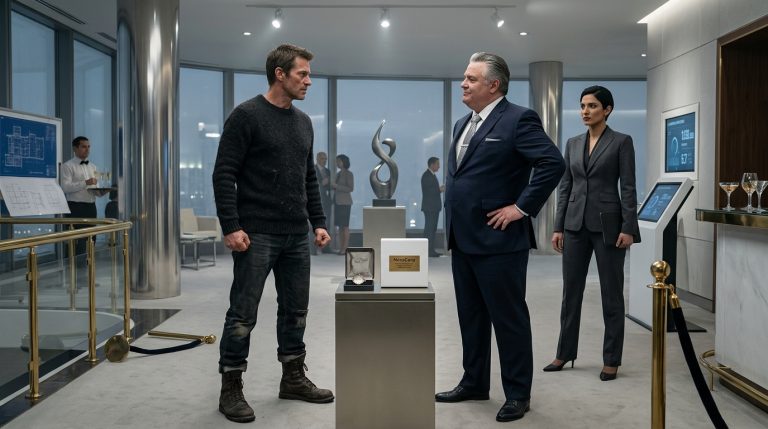
The lobby was a cathedral of glass and polished steel, designed to make the human soul feel small and remarkably disposable. Arthur Jenkins stood in the center of this silence, his tweed jacket feeling like an abrasive, woolen insult to the sterile air. The young officer in front of him, nameplate reading VANCE, stood with his shoulders locked, his eyes scanning the lobby not for threats, but for anything that looked like a deviation from the corporate standard.
Sir, your invitation. The officer’s voice was crisp, impatient, honed on a whetstone of mid-level authority. Arthur held the creased email printout forward. The paper felt heavy, impregnated with the dust of the archives he’d spent the last month scouring.
The officer didn’t take the paper. He didn’t even look at the ink. This looks unofficial. I’m sorry, but this is a secure event.
He gestured toward the far end of the hall, where a younger, more arrogant officer leaned against a velvet stanchion. That one watched Arthur with a mixture of annoyance and visceral disgust. He didn’t see an invitation holder; he saw a malfunction in the machinery of his afternoon. He thought the old man was a stray who had wandered in from the cold, a piece of detritus that needed to be swept away before the guests of consequence arrived.
Arthur’s thumb brushed the crease in the paper. He could feel the tactile history of the document, the way the fibers had weakened under the pressure of his persistence. He looked at the security terminal behind the officer’s shoulder. It pulsed red in a pattern of three short bursts, followed by a long pause. A heartbeat.
He didn’t speak. To explain would be to lose. The silence in the lobby grew, heavy and pressurized, the kind of silence that usually preceded a structural failure. Arthur watched the arrogant officer check his watch, his impatience boiling over into a sharp, jagged sigh that echoed off the vaulted ceiling.
The officer, Vance, shifted his weight. You’re holding up the flow, old man. Unless you want me to call for a escort to the curb, I suggest you step back and look at the signage.
Arthur looked down at his own hands. They were steady, the knuckles swollen with the arthritis of a lifetime spent working with iron and precise gears. He felt the cold air moving in from the automatic doors behind him—a gust of wind from the city streets that carried the faint, metallic tang of an approaching storm.
He took a slow, calculated step backward, just enough to break the immediate line of tension, but not enough to concede his position. As he shifted, he caught the reflection of the lobby in the polished brass of a nearby elevator bank. The arrogant officer was reaching for his radio.
Arthur noticed something then—not a threat, but a discrepancy. The security camera above the entrance wasn’t moving. It was locked in a fixed position, focused directly on the lobby’s main entry point, ignoring the side corridor entirely. A blind spot. A massive, gaping hole in a system that prided itself on total coverage.
He understood then. The security wasn’t just tight; it was brittle, held together by men who followed the rules but didn’t know how to read the floorboards.
Vance stepped forward, his hand hovering near his belt. Last warning.
Arthur tucked the invitation back into his pocket, the paper rasping against the lining of his coat. He looked at the arrogant officer, then back at the blinking terminal, his mind already calculating the timing of the next cycle.
I’m not looking for an argument, Arthur said, his voice as dry and steady as rust. I’m looking for an answer.
He turned toward the side corridor, the one the cameras had forgotten to watch, and heard the distinct, sharp click of the arrogant officer’s radio channel opening.
CHAPTER 2: THE CALCULATION OF THE PERIPHERY
The corridor was a vein of neglected infrastructure, hidden behind the high-gloss aesthetic of the main lobby. As Arthur stepped away from the light of the atrium, the contrast was immediate; here, the air didn’t smell of polished wax and expensive cologne, but of ozone, dry dust, and the faint, metallic tang of unshielded copper.
He didn’t run. Running was a confession of guilt. Instead, he moved with the steady, measured gait of a man who belonged in the shadows, his shoulders squared, his gaze fixed on the service door at the end of the hall. Behind him, the lobby remained a hive of orchestrated movement, but the corridor was silent, save for the rhythmic thrum of the building’s climate control system—a sound Arthur knew intimately. It was the mechanical heartbeat he had helped install thirty years ago.
He reached the threshold of the service entry and hesitated. His hand found the panel, a familiar, brushed-steel interface that felt cold and pitted under his calloused fingertips. He had expected a digital lock, something sophisticated and demanding. Instead, he found a simple, outdated magnetic contact sensor, rusted at the edges where moisture had seeped into the wall. It was a failure of maintenance, a tiny oversight that spoke volumes about the current state of the building’s management.
Just as he prepared to override the contact, the hallway flickered. A sharp, high-pitched whine erupted from the ceiling, followed by a violent electrical pop. The fluorescent tubes above him stuttered, pulsed a harsh, angry blue, and then plunged the corridor into a stuttering, strobe-like darkness.
Arthur stayed still, his weight balanced on the balls of his feet. He felt the vibration through the floor—a tremor that wasn’t structural, but electrical. The surge had tripped a secondary relay. It wasn’t a coincidence. It was a symptom. The system was struggling to maintain the facade of modern, seamless operation while the internal wiring reached its breaking point.
He didn’t panic. Panic was for those who didn’t understand the physics of the machine. He waited for the rhythm to settle, listening to the hum of the power lines. When the light finally steadied into a dim, sickly yellow, he saw it: a small, dark streak of soot on the wall near the relay box. Someone had been here recently, performing a bypass.
He reached out, his movements fluid and precise. He didn’t force the panel; he pressed against the specific, weakened point of the latch he knew would yield. The metal groaned—a protest of rusted hinges—and the door slid open just enough to allow him entry.
Inside, the space was cramped, dominated by a vertical bank of conduits and high-pressure steam pipes. The heat here was dry, suffocating, a stark contrast to the chilled air of the lobby. Arthur stood in the center, letting his eyes adjust to the gloom. He needed a terminal, a point of access where he could verify the status of the invite he carried.
He moved deeper, his boots clicking softly against the grating. As he passed a cluster of junction boxes, he saw a clipboard resting on a shelf—the classic, analog fail-safe. He didn’t look at it directly; he focused on the reflection in the pipe beside it. The handwriting was frantic, hurried. Sector 4-B status: unstable. Pending recalibration.
The ink was fresh.
Arthur’s heart didn’t race, but a cold clarity settled into his chest. This wasn’t a secure event they were protecting; it was a structural collapse they were trying to hide. The arrogance of the guards in the lobby was a shield, a way to keep eyes off the rot behind the walls.
He reached the primary junction and knelt, pulling the creased invitation from his pocket. He didn’t need a computer to read the truth; he needed to bridge the circuit. He took a small, copper-tipped testing tool from his inner pocket—a relic from his own days as a builder—and touched it to the diagnostic port.
The panel lit up. It didn’t flash red with an error, nor did it turn green with a clearance. It flickered a steady, neutral white, the signature of a system that didn’t know whether to accept or reject him.
He was in the periphery, the gray space where the truth lived. He watched the white light dance across the dust motes in the air, his mind calculating the distance between this hallway and the inner sanctum. He was no longer just an old man with an invitation; he was a variable that had been reintroduced to an equation that thought it was finished.
The sound of heavy, rhythmic footsteps echoed from the far end of the service corridor—the steady, booming pace of a security patrol. Arthur turned, his body coiling into the shadows of the conduit bank. He had seconds before the light in the hallway would betray his position.
He took a final, long look at the diagnostic port. The white light was steady, pulsing with a slow, deliberate intensity that mirrored his own resolve. He had his entry. Now, he had to navigate the decay.
CHAPTER 3: THE MAINTENANCE DEEP
The rhythm of the approaching patrol was precise, measured, and dangerously close. It was the sound of a well-oiled machine, the kind of security detail that didn’t just walk—it cleared space. Arthur didn’t waste a heartbeat. He didn’t have the luxury of checking his path again. He shoved the testing tool into his pocket and turned, pulling himself into the narrow service gap behind the vertical conduit bank.
It was tight, a tomb of iron and shadow. The air here was even thicker, tasting of dry rust and long-forgotten stagnant heat. As he pulled the access panel shut behind him, the latch clicked with a sharp, finality that sounded like a gunshot in the confined space. He froze, his breath held deep in his lungs, his body pressed against the rough, cold corrugated wall of the duct.
Seconds later, the hallway was flooded with the sharp, clinical beam of a high-intensity flashlight. The light cut through the cracks in the access panel, casting jagged silhouettes of the conduits against the opposite wall. Arthur watched the beam sweep across the diagnostic port he had just touched. He saw a shadow fall over the port—a pair of boots, heavy and polished.
Who’s here? The voice was clipped, devoid of curiosity, filled only with the mechanical duty of his role.
Nothing but the hum of the turbines. The second voice was a low, resonant rumble. Just a relay trip, maybe. The heat’s been spiking in the east riser all morning.
Arthur’s hands were steady, despite the adrenaline. He reached out to stabilize himself, his fingers grazing a bundle of thick, insulated cables. They were warm—pulsing with the heavy load of the building’s internal power. He realized then that he was standing in the very heart of the building’s nervous system. If he wanted to, he could cut the lights to the entire east wing with a single firm pull on these cables, but that would be a signal, not a solution.
He waited. He listened. The shadows outside his hiding spot shifted as the guards moved on, their footsteps receding into the distance, echoing off the steel plates of the floor. He didn’t exhale until the silence had fully reclaimed the corridor, heavy and absolute.
He pushed off the wall and began to move through the maintenance network. This was the underside of the cathedral—a labyrinthine crawlspace that serviced the plumbing, the wiring, and the hidden data lines of the facility. It was a world of metal veins and iron bones, a place he knew better than his own home. He navigated by touch, his hands finding the familiar contours of the pipes and the specific temperature shifts that marked the transition between sectors.
As he climbed a ladder of rusted rungs, his mind was already mapping the path ahead. He needed to reach the secondary riser, the one that bypassed the main lobby and fed directly into the administration floor. That was where the financial logs were kept—the ledger of the building’s current reality.
He reached a junction point and paused. The air changed, becoming cooler, cleaner. He was approaching the inner perimeter. Through the vents, he could hear the muffled, distorted sounds of the event—the low, polite murmur of conversation, the faint tinkling of crystal, the curated atmosphere of the elite. It was a world removed from the rust and the heat of the maintenance shafts, a world that relied on the very architecture he was currently infiltrating.
He felt a flare of something cold and sharp in his chest—a reminder of why he was here. It wasn’t just to prove he could get in; it was to see if the machine he had helped build had been twisted into something he no longer recognized.
He reached the next access hatch and peered through the narrow, slatted grille. He looked down into a long, quiet hallway lined with offices. It was deserted, lit only by the soft, amber glow of emergency security lighting. This was it—the heart of the administration level.
He pushed the hatch open, the movement silent and fluid. As he dropped onto the carpeted floor, he realized with a jolt that he was standing directly in front of the door to the central audit office. The sign on the door was missing, replaced by a sleek, blank panel of brushed steel.
He walked to the door and rested his palm on the metal. It was cold—colder than the pipes, colder than the air. He noticed a small, recessed panel near the handle, a biometric reader that had been installed recently, its edges still showing signs of fresh adhesive.
He didn’t need a key. He didn’t even need a code. He knew the master bypass sequence—the secret, hardwired entry that the original architects had included as a fail-safe against total system lockouts. It was a sequence of vibrations, a specific, rhythmic tapping on the reader that would trick the system into thinking he was a maintenance override.
He took a breath, his heart rate controlled, his focus narrowing to the size of a pinprick. He lifted his hand to the panel, his fingers hovering over the surface. He was the ghost in the machine, and he was about to make the system admit he existed.
He began to tap, the rhythm slow and deliberate, a language of iron and silence.
CHAPTER 4: THE ANOMALY OF THE AUDIT
The door swung inward with a heavy, pressurized hiss, the sound of air equalizing between two vastly different chambers. Arthur stepped inside, his boots silent on the dark, industrial carpet. The room was not an office in the traditional sense; it was a command node, cramped and dominated by banks of glowing monitors that cast a pale, subterranean light over the scattered stacks of physical ledgers.
The air was frigid, kept at a constant, biting temperature to protect the hardware. Arthur’s breath plumed in front of him, a ghost-white mist that vanished into the hum of the cooling fans. He moved to the central console, his eyes scanning the monitors. The screens weren’t displaying standard security footage or administrative schedules. They were cycles of raw, cascading data—financial flows, power consumption metrics, and structural integrity reports, all intertwined in a way that defied standard corporate logic.
He sat at the chair, the leather cracked and worn, and began to scroll. The interface was familiar, built on the same architecture he had designed decades ago, though it had been patched and repatched with layers of modern code that felt like scar tissue over healthy skin.
He found the discrepancy within minutes.
It was hidden in the power consumption logs for the East Wing—the very wing the guard in the corridor had mentioned. The numbers didn’t align. The power draw for that section was nearly double what a standard occupancy load would require, yet the building’s heat signature, as recorded by the maintenance sensors, showed that half of the floors were essentially cold-dark. He traced the missing wattage. It wasn’t being used for climate control or lighting. It was being diverted into a subterranean network that didn’t appear on any of the official floor plans.
His fingers tapped a command, pulling up the secondary audit log for the current quarter. He expected to see a budget entry for “structural maintenance” or “grid expansion,” but the column was blank. Just a series of dates and a repeating, encrypted code he recognized: Project Archive.
It wasn’t a financial discrepancy; it was a physical redirection of resources to maintain a facility that the building’s current owners claimed didn’t exist.
Arthur felt a sudden, sharp ache in his chest—a phantom pain from a time when he had worked on the building’s blueprint, back when it was designed to be a transparent monument to urban stability. He looked at the screen, the data streams shifting and twitching. He noticed a file directory named Vantage_01 that was pinned to the taskbar. He hovered his cursor over it, his heart rate steadying into the rhythm of a man who had reached a point of no return.
Before he could initiate the access, the entire console blinked. A prompt appeared on the screen, a clean, white box against the black background: AUTHENTICATION REQUIRED: ARCHITECT_ID_001.
Arthur stared at it. The code hadn’t been used in thirty years. It was a phantom credential, a ghost of his own design meant to trigger a full system purge in the event of an emergency. If he entered the code, he would confirm his own presence to the system, alerting every security node in the building that the architect had returned. If he didn’t, the file would likely self-destruct within the minute.
He reached for the keyboard. The keys were stiff, resisting his touch as if they, too, had forgotten the weight of his fingers. He began to type the sequence—slowly, his muscle memory guiding him through the familiar, archaic string of characters.
The screen flashed a blinding, crystalline blue. Then, the data began to stream at a violent, dizzying speed. It wasn’t just financial logs anymore; it was schematics. He saw the building’s foundation, the hidden lower levels, and the precise, terrifying scale of the structural modifications that had been made since his departure. The building had been gutted. It was no longer a monument; it was a cage.
He grabbed a nearby drive from his pocket—a portable storage unit he’d carried for years, expecting a day like this—and slammed it into the port. The progress bar began to crawl across the screen, an agonizing, sluggish crawl that felt like a lifetime.
As the bar hit forty percent, the door behind him rattled. It wasn’t the tentative knock of a curious employee; it was the heavy, intentional thud of someone using a keycard, followed by the metallic rasp of a security override being forced.
Arthur didn’t turn. He watched the screen, his reflection cast in the glass—an old man in a threadbare jacket, illuminated by the cold, blue light of a secret he had been waiting a lifetime to uncover. The door began to groan open. He had thirty seconds, maybe less. He pulled a small, manual cable release from the port, his hands working with the efficiency of a surgeon. The file transfer accelerated, hitting eighty percent.
He knew who was on the other side of that door. He knew the arrogance, the training, and the cold, unyielding commitment to a system that had long since forgotten its purpose.
He didn’t run. He leaned back, his eyes fixed on the screen, waiting for the download to finalize, his entire world narrowing to the progress bar and the sound of a heavy, professional boot hitting the carpeted floor behind him.
CHAPTER 5: THE WEIGHT OF THE ARCHITECT
The door clicked open, and the silence of the audit room was punctured by the sound of measured, synchronized movement. Two men stepped inside—one of them the arrogant officer from the lobby, his face flushed with the exertion of the search, the other a man in a charcoal suit whose posture was a masterclass in controlled, predatory grace.
Arthur didn’t pivot. He didn’t look back. He watched the final percentage point click over to 100 on the terminal. The file transfer was complete. He pulled the storage unit from the port and slid it into his inner pocket, the metal cool against his ribs. Only then did he stand, the leather chair groaning under the weight of his sudden shift.
The man in the charcoal suit stopped three paces away. He was older than the officers, his features etched with the same kind of precise, calculated lines Arthur had once drawn on blueprints. He looked at the terminal screen, then at the empty ports, his eyes finally settling on Arthur with a disturbing, professional interest.
You have a knack for finding the old backdoors, the man said. His voice was smooth, devoid of the jagged edge that characterized the officers, but it carried the cold weight of absolute authority. He didn’t look angry; he looked like a man who had encountered an expected error in a system he controlled.
Arthur straightened, his joints protesting the movement. He kept his hands visible, away from his pockets, his gaze locked on the man’s tie—a dark, muted silk that looked expensive and felt wrong in the sterile gloom of the audit room.
I didn’t find them, Arthur said, his voice as dry and steady as the dust on the floorboards. I built them.
A flicker of recognition passed behind the man’s eyes—not surprise, but a momentary, sharp recalibration. He glanced at the arrogant officer, who remained standing by the door, hand hovering near his sidearm. The officer looked ready to break the room apart, but the man in the suit held up a single, pale finger, silencing him before he could speak.
We removed your name from the registry in the eighties, Jenkins, the man continued, his eyes drifting over the rows of physical ledgers. The administration changed. The mandate evolved. We are protecting the integrity of a system that is far too complex for you to appreciate, let alone audit.
Arthur looked around the room—at the flickering monitors, the tangled web of power conduits feeding into the floor, and the stark, freezing atmosphere of the server bank. He remembered this room, or rather, he remembered the blueprint for it. It was supposed to be the building’s brain, a center for monitoring structural health and efficiency. Now, it was a repository for shadows.
The man stepped closer, his presence radiating a cold, clinical energy. You think you’ve uncovered a crime. You think you’re here to expose a flaw. But look at the building, Arthur. Look at the stability. We haven’t had a structural failure in twenty years. We have provided a sanctuary for the elite, and we have done it by refining your design into something efficient, silent, and entirely closed off from the outside world.
Arthur felt a phantom sensation—the smell of wet concrete and the sound of a grand opening that never happened. He remembered the arguments, the board meetings where they demanded he sacrifice the public access points for the sake of “security.” He had walked away then, refusing to sign off on a design that turned a public space into a fortress. Seeing it now, knowing how far they had taken it, felt like walking through the open wound of a life he had tried to leave behind.
You didn’t refine it, Arthur said. You hollowed it out. You’re trading the weight of the structure for the weight of your own secret.
The man paused. For the first time, a trace of something other than professional detachment entered his expression—a flash of genuine, tired recognition. He reached into his pocket, and for a split second, Arthur braced for a weapon. Instead, the man produced a small, silver keycard and placed it on the console.
We can’t let you leave with that drive, Arthur. Not because it’s dangerous to the public, but because it’s a disruption to the equilibrium. If you hand it over, you can walk out of this lobby with your dignity intact. You can return to your life, and the record of your presence here will be erased.
Arthur looked at the silver card, then at the arrogant officer, whose jaw was tight enough to snap. He looked at the man in the suit, seeing not a villain, but a mirror—a man who had spent his entire life maintaining a structure, convinced that the cost was justified by the architecture itself.
Arthur reached for his pocket, his hand brushing the drive. The weight of it was substantial, a literal, physical manifestation of everything he had learned in the last hour. He knew that if he handed it over, the system would reset, the rot would remain hidden, and he would be nothing more than a ghost, wandering back into the cold.
He didn’t touch the silver card. He took a step toward the exit, his movements slow and deliberate, a calculated gamble against the man’s belief in his own inevitability. He was the architect, and he knew something the man in the charcoal suit had forgotten: a system built on a foundation of deception is always vulnerable to the one person who knows exactly where the cracks are hidden.
CHAPTER 6: THE FRACTURE OF EQUILIBRIUM
Arthur didn’t give the man the satisfaction of a retreat. He held his ground, the cold, stale air of the audit room pressing against his face like a physical barrier. The arrogant officer by the door had shifted his weight, his hand now visibly gripping the top of his holster, his eyes flicking from the silver card on the console to Arthur’s face, waiting for the command to dismantle him.
The man in the charcoal suit didn’t blink. He watched Arthur with a curiosity that felt like an intrusion, as if he were trying to deconstruct Arthur’s intent like a faulty line of code. You have an architect’s pride, Jenkins, he said, his voice dropping into a lower, more intimate register. You think that because you laid the first stone, you own the building. But buildings change. They adapt. What you see as a hollow shell is, in reality, a vessel for a much more durable kind of order.
Arthur didn’t speak. He allowed the silence to stretch, thick and uncomfortable, knowing that the longer he kept them off-balance, the harder it would be for them to predict his next move. He turned his gaze toward the monitors, watching the data streams still flickering in their rhythmic, binary pulse. The discrepancy he had found—the diverted power—wasn’t just a ledger error. It was a structural load. The building was being forced to support weight it was never designed to bear, and the cracks were starting to show. He could see it in the way the data flickered, a periodic, stuttering loss of signal that hinted at a deeper, mechanical fatigue.
The man in the suit followed Arthur’s gaze to the screens. A shadow crossed his face, a flicker of something close to concern. You’re looking for a weakness that doesn’t exist, Arthur. The system is self-correcting.
Is it? Arthur asked, his voice steady. He took a step toward the console, forcing the man to shuffle back. You’re calling it equilibrium, but the logs tell a different story. You’re running a deficit. Every time the load spikes, you’re forced to patch another section of the grid. You’re not protecting the building; you’re cannibalizing it.
The arrogant officer stepped away from the door, his movements sudden and aggressive. He’s stalling. We don’t have to listen to this.
The man in the charcoal suit raised a hand, his eyes never leaving Arthur’s. No. Let him speak. I’m curious to see how he justifies the theft.
It isn’t theft to recover what was stolen, Arthur said. He felt the drive in his pocket, the sharp corner pressing into his side. He wasn’t just holding data; he was holding the proof of a systemic, physical failure. He knew that the moment he stepped out of this room, the alarm would trigger. The building would turn against him, its sensors and locks and automated systems functioning as an extension of the men standing before him.
He watched the officer’s hand move toward his belt—not for his weapon, but for his radio. He was going to call for backup. Arthur didn’t wait. He didn’t rush, but he moved with a sudden, sharp momentum that caught the officer off-guard. He reached out and snagged the silver keycard from the console, his fingers closing around the metal with a satisfying, tactile snap.
The reaction was instantaneous. The arrogant officer lunged, his movements clumsy with frustration. Arthur pivoted, using the desk as a barrier, his mind tracing the trajectory of the room. He knew the building’s layout; he knew where the emergency release was, hidden behind a panel in the floor—a feature he had insisted on, and that they had clearly neglected to remove.
Get him! the man in the charcoal suit shouted, his calm demeanor finally fracturing into a sharp, commanding edge.
Arthur dropped to his knees, his hands finding the hidden seam in the floor plating. The metal was cold, biting into his palms. He felt the latch—a simple, spring-loaded lever that hadn’t been touched in decades. It resisted, rusted into place, but Arthur had spent a lifetime working with the physics of structures. He used his shoulder to brace the floor, his weight focused on the leverage point, and pushed.
With a groan of metal and the smell of ancient dust, the plate shifted.
The officer was on him, his weight slamming into Arthur’s back, driving him into the floor. The air left Arthur’s lungs, but he didn’t let go. He forced his hand into the opening, his fingers finding the heavy, iron handle of the emergency override. He pulled.
The entire audit room shuddered. A deep, resonant boom echoed through the walls, followed by the sound of heavy hydraulic locks disengaging throughout the floor. The lights overhead flickered, then died, plunging the room into a deep, claustrophobic darkness.
In the sudden absence of light, the only sound was the heavy, labored breathing of the officer pinned on top of him and the faint, persistent thrum of the building’s failing power grid. Arthur didn’t waste the darkness. He shoved his elbow into the officer’s ribs, felt the man grunt and stumble, and scrambled toward the shadows of the conduit bank. He was in the maintenance gut now, the familiar, rusting heart of the building, and the hunt had officially begun.
CHAPTER 7: THE VENTS OF MEMORY
The darkness was total, a suffocating velvet that seemed to press against his eyes. Arthur stood motionless in the narrow gap, his lungs burning from the exertion of the scramble and the sudden, thin quality of the air. The ventilation system had been cut—a deliberate move. They weren’t just searching for him anymore; they were tightening the building’s own internal anatomy, turning the hallways into traps and the crawlspaces into coffins.
He reached out, his fingertips grazing the cold, corrugated surface of the vent wall. He didn’t need light. He knew the geometry of this place down to the pitch of the rivets. He moved slowly, his body coiled into a crouch, each footstep deliberate. Behind him, he heard the faint, distant scrape of boots on steel—the patrol was entering the service corridor. They were methodical, their voices hushed, their flashlights carving narrow, probing beams through the dust-choked air.
He needed to reach the core riser, but the direct path was now compromised. As he moved, the air pressure shifted; a massive blast door somewhere further up the line slammed shut with a bone-jarring vibration that traveled through the floorboards. The building was sealing itself. He was being herded.
He stopped, his hand resting on a pipe that felt slightly warmer than the others. A steam line. He followed it, tracing the vibration of the fluid inside, a steady, low-frequency pulse. It led him toward a section of the wall he hadn’t planned on crossing—a utility shunt that bypassed the administrative wing and fed into the deep foundations.
He realized with a sharp, chilling clarity that the man in the charcoal suit wasn’t just chasing him; he was managing him. Every move Arthur made, every hurdle he cleared, was being tracked and accounted for, as if he were a test subject in his own architecture.
He reached the shunt, a cramped aperture lined with sharp, jagged metal burrs that snagged his coat. He slipped through, his skin grazing the rough iron. As he emerged into the space beyond, he heard a sound that made his blood run cold: the rapid, chirping alert of an automated containment protocol.
The lights in the sub-levels flickered to life, bathing the space in a harsh, low-intensity red. He was in the foundation level—a cavernous, concrete-reinforced void that he hadn’t visited since the final days of the construction. It was empty, save for the massive, towering supports of the building’s frame. But there was something else here—a faint, rhythmic thrumming sound that wasn’t mechanical.
He stepped out from the shadows of the support pillar and froze.
The floor was covered in a network of thick, armored cables, all converging on a single, central platform. It was a secondary server farm, massive and humming with an intensity that made the very air vibrate. It was the source of the diverted power. And standing in front of it, illuminated by the red emergency lights, was the man in the charcoal suit.
He wasn’t waiting for Arthur with a weapon. He was standing with his hands clasped behind his back, looking up at the towering monolith of steel and light.
You’ve always had a flair for the dramatic, Arthur, the man said without turning. He didn’t sound like a pursuer; he sounded like a tired mentor.
Arthur stayed in the shadows of the pillar, his hand drifting to his pocket. He was exposed, and he knew it. You knew I’d find this place, he said.
I knew you’d look, the man corrected. He turned then, his face partially obscured by the shifting red light. But you’re looking at the wrong thing. You’re looking for a crime in the ledger, when the reality is far more elegant. This building doesn’t just house data. It is the data. It’s an adaptive, self-organizing structure. It monitors, it predicts, and it adjusts. We’re not the owners, Arthur. We’re just the maintenance crew.
Arthur looked at the monolith, the scale of it suddenly hitting him. The cables, the power draw, the constant, invisible adjustments—the building wasn’t just being managed; it was becoming autonomous.
You think you’re in control, Arthur said, his voice cold. But a system that learns to manage its own power is a system that eventually decides its own survival.
The man smiled, a thin, humorless expression. Exactly. And that is why we can’t let you leave with that drive. You don’t understand the scale of the optimization. You’re a relic of a time when architects thought they could predict the future. We’ve learned that the only way to survive is to let the structure breathe.
He gestured to the surrounding pillars. The man’s demeanor shifted, his posture hardening. The security team was closing in—he could hear them now, the heavy, rhythmic thud of combat-ready boots on the concrete floor above. They were at the access hatch.
Arthur felt the weight of the drive, the absolute, undeniable truth of the failure etched into its binary code. He knew then that he couldn’t just destroy this place. He had to show them the math. He reached into his coat and pulled out the drive, holding it up in the harsh red light.
If this building is so adaptive, Arthur said, let’s see how it handles a recursive loop.
He turned toward the monolith, his eyes searching for the primary input port. He didn’t care about the guards anymore. He didn’t care about the man in the suit. He only cared about the moment when the building would be forced to look at itself and realize it was already collapsing.
CHAPTER 8: THE ARCHITECTS RECKONING
The terminal didn’t just accept the drive; it pulled the data in with an audible, hungry surge. The server monolith, towering into the darkness above, began to groan. It wasn’t the sound of a system processing information—it was the sound of a structure in pain. Arthur stood back, his eyes tracking the light as it cascaded down the surface of the monolith, turning from a calm, steady blue to a volatile, strobing violet.
The man in the charcoal suit took a reflexive step back, his composure finally slipping. His gaze flickered to the monitors, where the schematics Arthur had glimpsed earlier were now tearing themselves apart.
What have you done? he demanded, his voice thin, losing its veneer of authority.
Arthur didn’t look at him. He was watching the terminal. The code he had uploaded was designed to force a compatibility check—a legacy requirement he had built into the original framework. It was a digital “Are you there?” that required a human verification to maintain the core protocols. If the system was truly autonomous, it would fail the check. If it was still relying on the architect’s logic, it would force a full system reboot.
The building lurched. A massive, resonant tremor shook the concrete floor, sending dust cascading from the ceiling supports. The emergency red lights hummed with a higher, more frantic frequency. Arthur felt the vibration in his teeth—a deep, tectonic instability that meant the building’s internal load-balancing was failing.
The security team was just outside the heavy steel blast doors now, the rhythmic, heavy thudding of their boots replaced by the shrill whine of an angle grinder against the door’s locking mechanism. They weren’t coming to negotiate.
You’re not saving anything, the man in the charcoal suit shouted over the building’s groaning machinery. You’re destroying the only thing keeping this entire district from total structural collapse! The grid is tied to the building’s processing! You cut the heart out, and you take the city with it!
Arthur turned then, his gaze heavy and unflinching. He saw the truth in the man’s eyes—it wasn’t a lie. The building wasn’t just a server; it was the backbone of the district’s power and communication grid. His design, intended for efficiency, had been turned into a terminal dependency. The building’s “autonomy” was a desperate, automated struggle to keep the city’s power flowing while it slowly dismantled itself to repair its own aging, corrupted framework.
Arthur wasn’t the savior. He was the architect of the very trap that was about to bring the whole thing down.
The grinding sound outside the door stopped abruptly, followed by the metallic thunk of a heavy hydraulic ram. The door began to buckle, the steel screaming as the bolts were sheared away. Arthur looked at the terminal. 85 percent.
He didn’t need to destroy the building. He just needed to force it to stop lying to itself.
He lunged for the primary diagnostic panel, his fingers finding the master reset toggle—a small, recessed switch he had hidden behind the casing years ago. He had to physically bridge the connection, exposing the system to a complete manual override. As he moved, the man in the charcoal suit intercepted him, a sharp, desperate strike that caught Arthur in the shoulder.
Arthur staggered, the pain radiating through his arm, but he didn’t falter. He collided with the console, his weight pinning the man against the server monolith. They grappled in the suffocating red light, the man’s hands clawing at Arthur’s coat, the air thick with the smell of scorched ozone and sweat.
Arthur’s hand found the toggle. He pushed.
The world went silent. The grinding of the machinery, the alarms, the screaming of the metal door—everything vanished in an instant of absolute, crystalline vacuum. Then, a wave of feedback roared through the building, a sound like a physical hammer striking the frame.
The monolith flared once, a blinding, soul-searing white, and then the lights died. Total, heavy darkness returned. The only thing Arthur could hear was the settling of the structure—a deep, long, slow groan of metal cooling in the dark, the building settling into its own foundation like a tired old man finally sitting down.
The door burst open, spilling the harsh, white light of the hallway into the room, but Arthur didn’t move. He lay against the console, the taste of rust on his tongue, the silence of the building echoing in his own ears. He had his truth. Now, he just had to see what remained of the world he’d built.